Enrow vs SMARTe (2026): Which Data Tool Actually Wins?
Enrow sells verified emails at low bounce rates. SMARTe sells global contact coverage with mobile numbers. They solve different problems — here's which one your outbound motion actually needs, and where a cheaper third option beats both.
TL;DR
- Enrow is a France-built email finder and verifier that sells one thing hard: low bounce rates. It's a waterfall-style enrichment layer, not a prospect database.
- SMARTe is a B2B contact-data platform — emails plus direct dials and mobile numbers — with strong non-US coverage and a Chrome extension for LinkedIn.
- They aren't really the same category. Enrow answers "is this address safe to send to?" SMARTe answers "who do I even contact, and what's their mobile?"
- Pricing transparency is the sharpest split: Enrow publishes per-credit plans; SMARTe runs quote-based annual contracts, so expect a sales call before a number.
- If you want published pricing, a real free tier, and an API you can wire up in an afternoon, a general-purpose finder-verifier like Tomba covers most of the Enrow use case at $49/mo.
What are Enrow and SMARTe, exactly?#
They get compared because both appear in "email finder" lists, but they were built for different jobs.
Enrow is a European email-finding and verification service. You give it a name plus a company (or a domain), and it returns an address it has already validated. Its pitch is accuracy-first: fewer results returned, but a much lower share of them bounce. Under the hood it behaves like a waterfall — multiple sources and validation methods queried in sequence — and it exposes finding, verification, and bulk CSV processing through a dashboard and an API.
SMARTe is a contact and account intelligence platform. It maintains its own B2B database of company and people records, weighted toward global coverage — EMEA and APAC records where a lot of US-first vendors thin out. The headline asset is phone data: direct dials and verified mobile numbers alongside work emails. Sales reps mostly use it through a LinkedIn Chrome extension, pushing contacts into Salesforce, HubSpot, or Outreach.
Put simply: Enrow is a filter. SMARTe is a well. You don't choose a filter over a well — you decide which problem is actually blocking your pipeline this quarter.
How do Enrow and SMARTe compare head-to-head?#
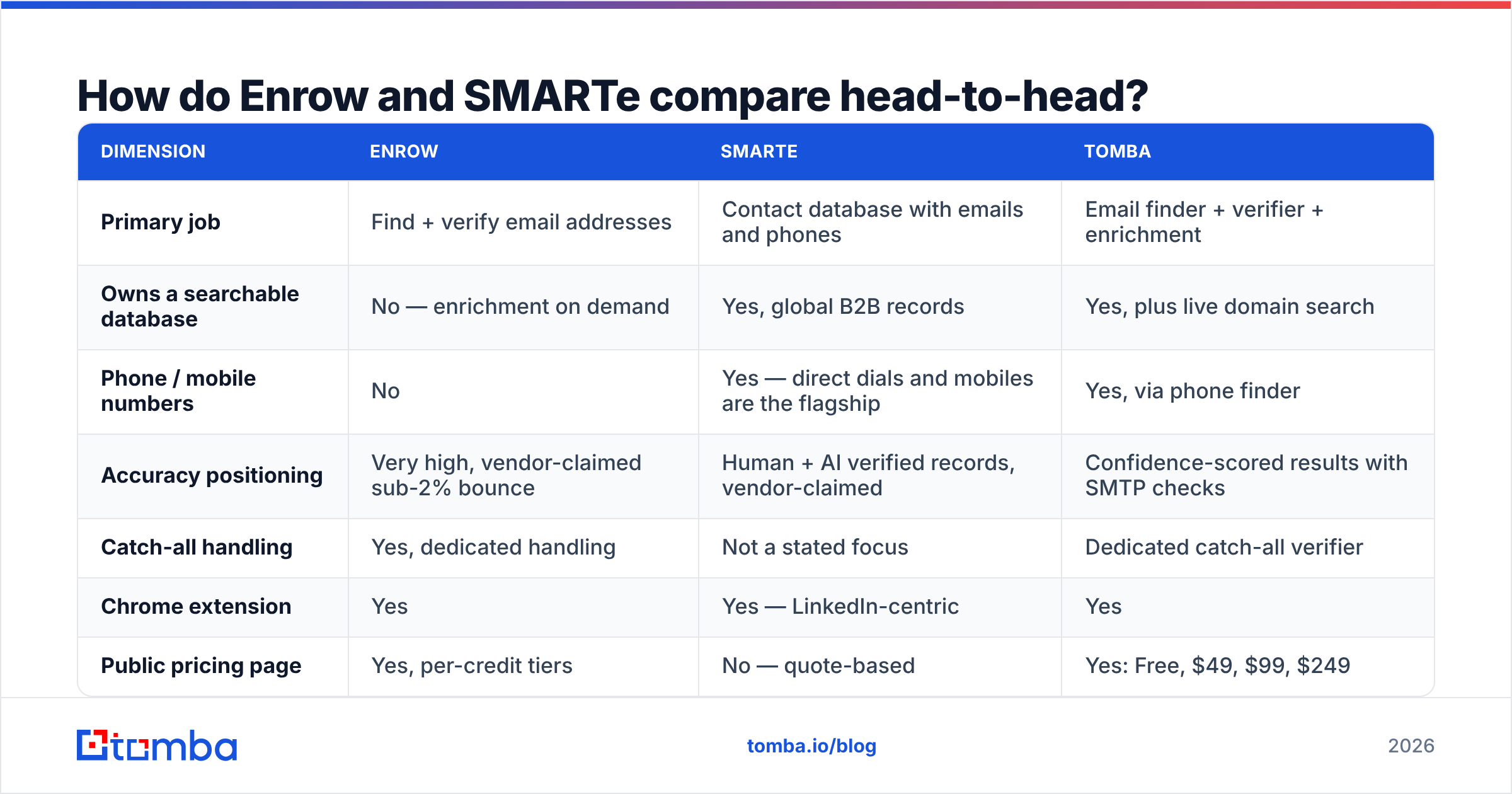
Here's the practical comparison. Note where I've flagged vendor claims versus published facts — accuracy percentages in this category are marketing numbers until you test them on your own list.
| Dimension | Enrow | SMARTe | Tomba |
|---|---|---|---|
| Primary job | Find + verify email addresses | Contact database with emails and phones | Email finder + verifier + enrichment |
| Owns a searchable database | No — enrichment on demand | Yes, global B2B records | Yes, plus live domain search |
| Phone / mobile numbers | No | Yes — direct dials and mobiles are the flagship | Yes, via phone finder |
| Accuracy positioning | Very high, vendor-claimed sub-2% bounce | Human + AI verified records, vendor-claimed | Confidence-scored results with SMTP checks |
| Catch-all handling | Yes, dedicated handling | Not a stated focus | Dedicated catch-all verifier |
| Chrome extension | Yes | Yes — LinkedIn-centric | Yes |
| Public pricing page | Yes, per-credit tiers | No — quote-based | Yes: Free, $49, $99, $249 |
| Free tier | Trial credits | Demo / trial on request | 25 searches/mo, no card |
| API | Yes | Yes, enterprise-oriented | Yes, documented and self-serve |
| Best for | Cleaning and enriching lists you already have | Building lists in EMEA/APAC with phone data | Teams that want finding, verifying and enrichment in one bill |

The row that decides most evaluations isn't accuracy — it's "owns a searchable database." If your reps need to discover contacts, Enrow alone leaves a gap. If your reps already have a list from Sales Navigator, an event export, or your CRM, SMARTe is an expensive way to solve a validation problem.
Which one finds more valid emails?#
Neither vendor will give you a number you can trust without testing, so run the test yourself. The method that actually separates these tools takes about an hour:
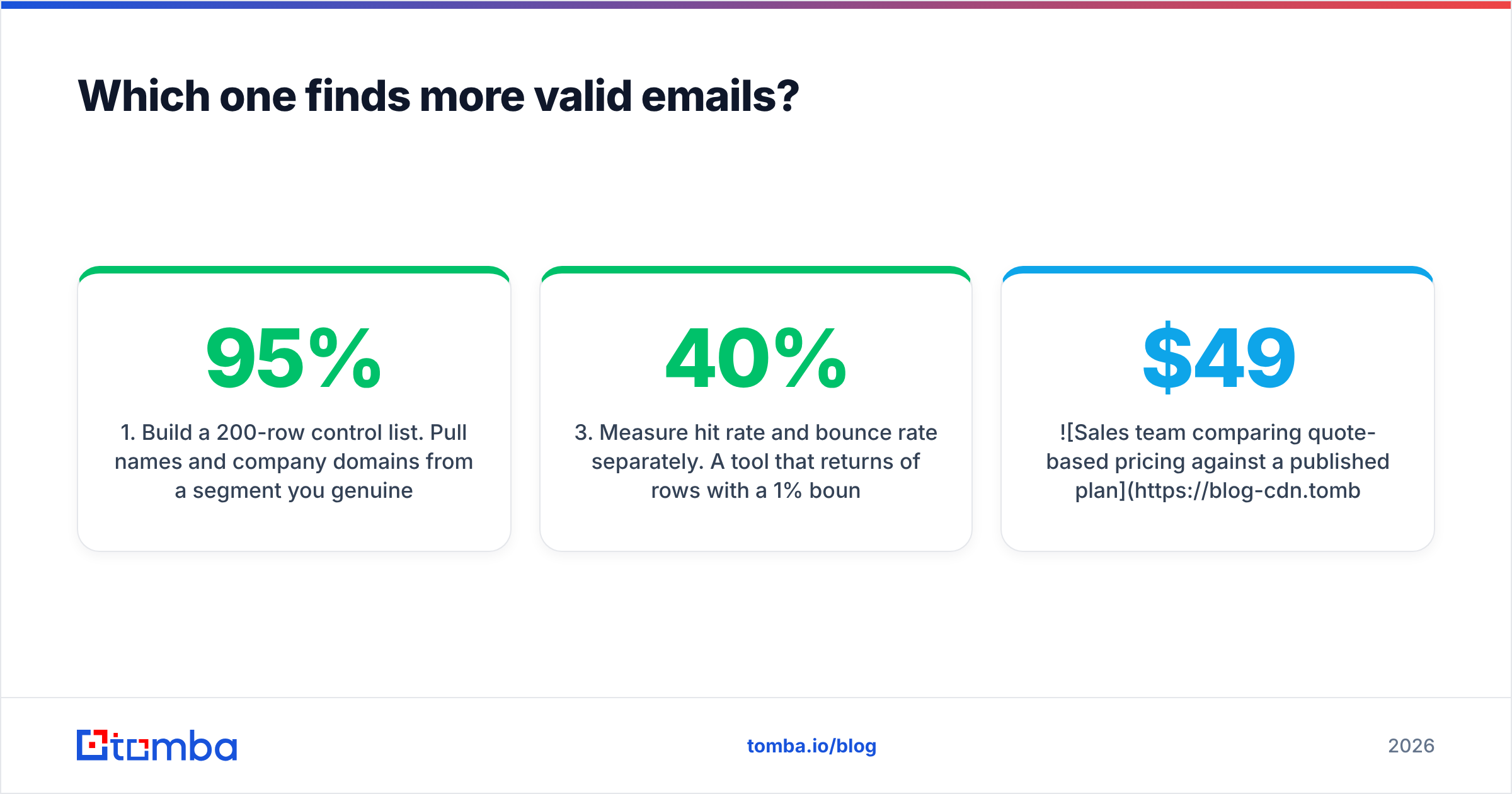
- Build a 200-row control list. Pull names and company domains from a segment you genuinely sell to — not a list of tech unicorns where every tool scores 95%.
- Split by region. 100 rows North America, 100 rows EMEA/APAC. This is where the two tools diverge hardest; SMARTe's international depth is its main structural advantage.
- Measure hit rate and bounce rate separately. A tool that returns 40% of rows with a 1% bounce is often more valuable than one returning 80% with a 9% bounce, because the second number gets your domain throttled.
- Send the survivors through a neutral third verifier. Never grade a finder with its own verifier. Run the output through an independent email verifier so you're not marking your own homework.
- Log the unknowns. Catch-all domains — where the mail server accepts everything — are the honest gray zone. Count them separately or you'll misread both tools.

What you'll typically see: Enrow returns fewer addresses but the returned set is cleaner, because it suppresses low-confidence guesses instead of shipping them. SMARTe returns more contacts overall — including people you'd never have found — but as a database vendor its records carry age, and a record verified nine months ago is not a record verified last week. Neither behavior is wrong. They're different risk postures, and your inbox reputation cares about only one of them.
If bounce rate is what's hurting you right now, read the mechanics of catch-all verification before you buy anything — a meaningful chunk of "unverifiable" addresses aren't the tool's fault.
What does each one actually cost?#
This is the least fun section and the most decisive one.
Enrow publishes credit-based tiers. Entry plans sit in the low tens of dollars per month for a few thousand credits, scaling up from there; credits are consumed by finding and verification, and unused credits generally don't roll over indefinitely. Check the live pricing page before budgeting — European vendors in this space reprice often, and the exact credit-to-dollar ratio has moved more than once.
SMARTe does not publish pricing. Every entry point is "request a demo" or "get a quote," which in practice means an annual contract, a seat count, a credit allocation, and a procurement cycle. Reviews on G2 consistently describe annual commitments rather than monthly self-serve. That's normal for database vendors — it's also a reason small teams bounce off it.
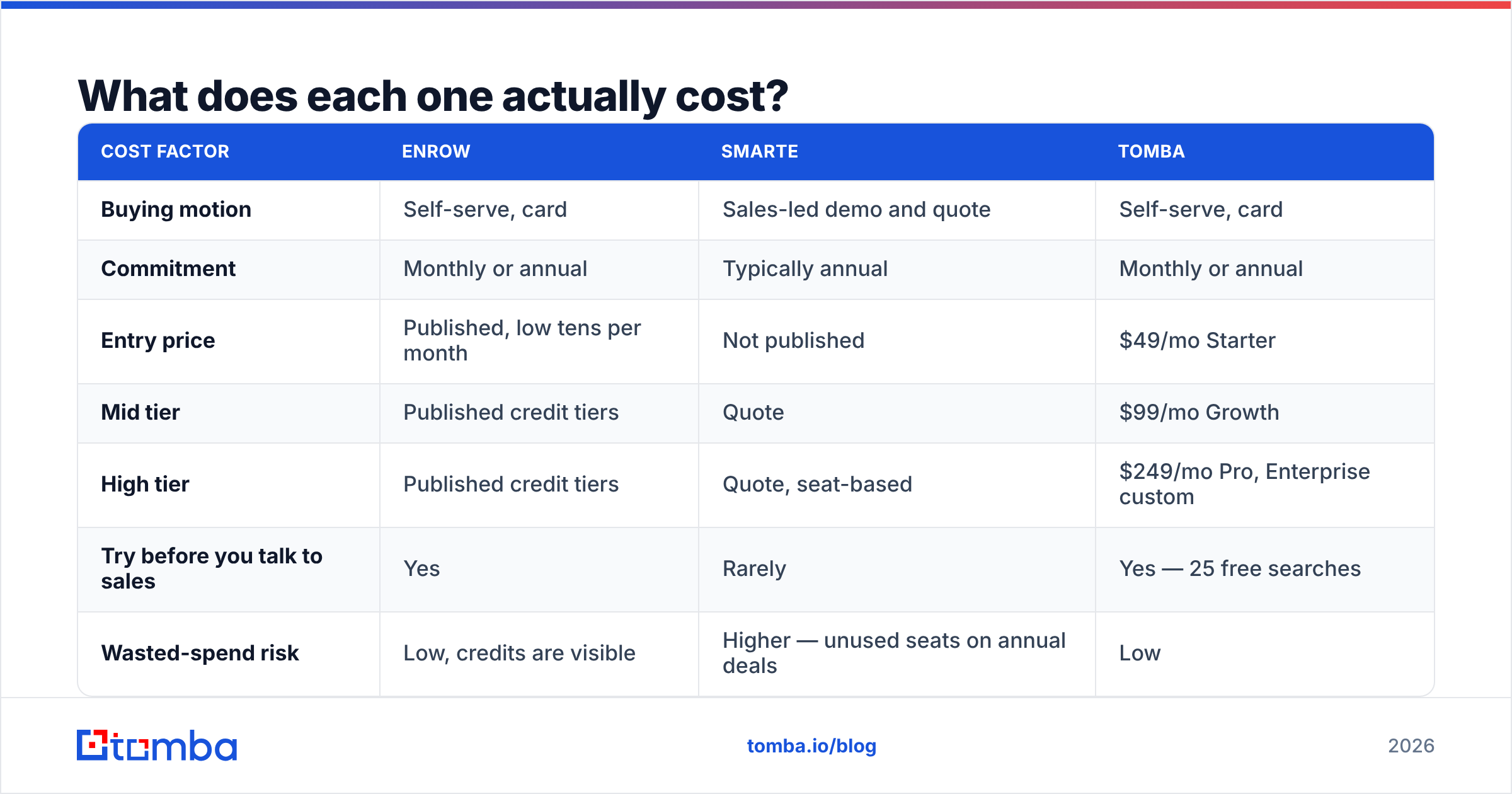
| Cost factor | Enrow | SMARTe | Tomba |
|---|---|---|---|
| Buying motion | Self-serve, card | Sales-led demo and quote | Self-serve, card |
| Commitment | Monthly or annual | Typically annual | Monthly or annual |
| Entry price | Published, low tens per month | Not published | $49/mo Starter |
| Mid tier | Published credit tiers | Quote | $99/mo Growth |
| High tier | Published credit tiers | Quote, seat-based | $249/mo Pro, Enterprise custom |
| Try before you talk to sales | Yes | Rarely | Yes — 25 free searches |
| Wasted-spend risk | Low, credits are visible | Higher — unused seats on annual deals | Low |
Two honest notes. First, quote-based isn't a scam; enterprise data licensing genuinely varies by seat count, region, and export rights. Second, if you're a three-person team running 2,000 emails a month, an annual data contract is the wrong shape of purchase no matter how good the data is. You want published tiers — see Tomba pricing for the comparison baseline used in the table above.
Who should choose Enrow?#
Pick Enrow when your problem is quality, not discovery:
- You already have the names. Sales Navigator exports, webinar registrants, a stale CRM segment — you know who to reach, you just don't trust the addresses.
- Your domain is fragile. You've had a deliverability incident, or you're warming new sending domains and cannot afford a 6% bounce week.
- You're European-first and care about GDPR posture. An EU-based processor simplifies the DPA conversation.
- You want a validation layer behind your own stack. Enrow slots in as an API step between scraper and sequencer.
Skip Enrow if you need phone numbers, firmographic filters, or the ability to say "give me every RevOps manager at 200-1000 person SaaS companies in Germany." That's not what it does.
Who should choose SMARTe?#
Pick SMARTe when your problem is coverage, especially outside North America:
- You sell into EMEA or APAC and your current provider returns blanks past the Atlantic.
- Your motion is phone-led. If SDRs live on dials, mobile-number coverage is worth more than a few points of email accuracy.
- You need CRM-native workflows. Push-to-Salesforce and push-to-Outreach from a LinkedIn profile is where the tool earns its seat cost.
- You have budget and a procurement process. Annual contracts assume you can forecast usage.
Skip SMARTe if you're a startup testing outbound for the first time, or if you already have a database subscription and only need cleaner sending.
What are the real weaknesses of each?#
Every review that says "both are great" is useless. Here are the failure modes worth knowing.
Enrow's limits. Lower hit rate is the direct cost of high precision — you will get fewer results per 1,000 rows than a permissive finder, and on hard segments (SMBs, non-tech industries, tiny domains) that gap widens. It's also a narrow product: no phones, no company filters, no visitor identification. And credit models punish sloppy list hygiene, because you burn credits on rows that were never going to resolve. Dedupe before you upload — a free remove duplicates pass costs nothing and can cut 10-15% off a scraped list.
SMARTe's limits. Opacity is the big one: no public pricing, and no easy way to sample the data before a sales conversation. Database records also decay — B2B contact data goes stale at roughly 2-3% per month as people change jobs, which means "verified" needs a date attached to mean anything. And you're buying a platform: if you only wanted verification, you're paying for a seat, an extension, and CRM connectors you may never open.
The shared blind spot. Neither tool fixes your sending infrastructure. You can buy perfect data and still land in spam with a misconfigured SPF record, no DMARC policy, and a cold domain sending 400 emails on day one. Data quality is necessary and not sufficient.

Is there a better middle option?#
Often, yes — because most teams comparing Enrow vs SMARTe are trying to buy two things at once and don't want two invoices.
A general-purpose finder-verifier covers the overlap. Tomba does domain search (give it a company, get the people and the email pattern), single and bulk email finding, verification including catch-all handling, phone lookup, and enrichment — on published pricing with a free tier that doesn't need a card. The Tomba API is self-serve, which matters if you're building an internal enrichment pipeline rather than clicking through a dashboard. For high-volume list work, the bulk email finder handles CSV in and CSV out.
It's not a like-for-like SMARTe replacement — if verified mobile numbers for APAC directors are your entire business case, buy the specialist. And if you'd rather purchase a prepaid, pay-as-you-go list outright instead of running a subscription, BookYourData is a legitimately good fit for that buying pattern; it's a different model, not a worse one.
| If your bottleneck is… | Buy this |
|---|---|
| Bounces on a list you already own | Enrow, or a standalone verifier |
| Finding contacts in EMEA/APAC with mobiles | SMARTe |
| Finding + verifying + enriching on one bill | Tomba |
| One-off prepaid list, no subscription | A pay-as-you-go list provider |
| Sending reputation, not data | Fix SPF/DKIM/DMARC first — no tool substitutes |
How should you run the evaluation?#
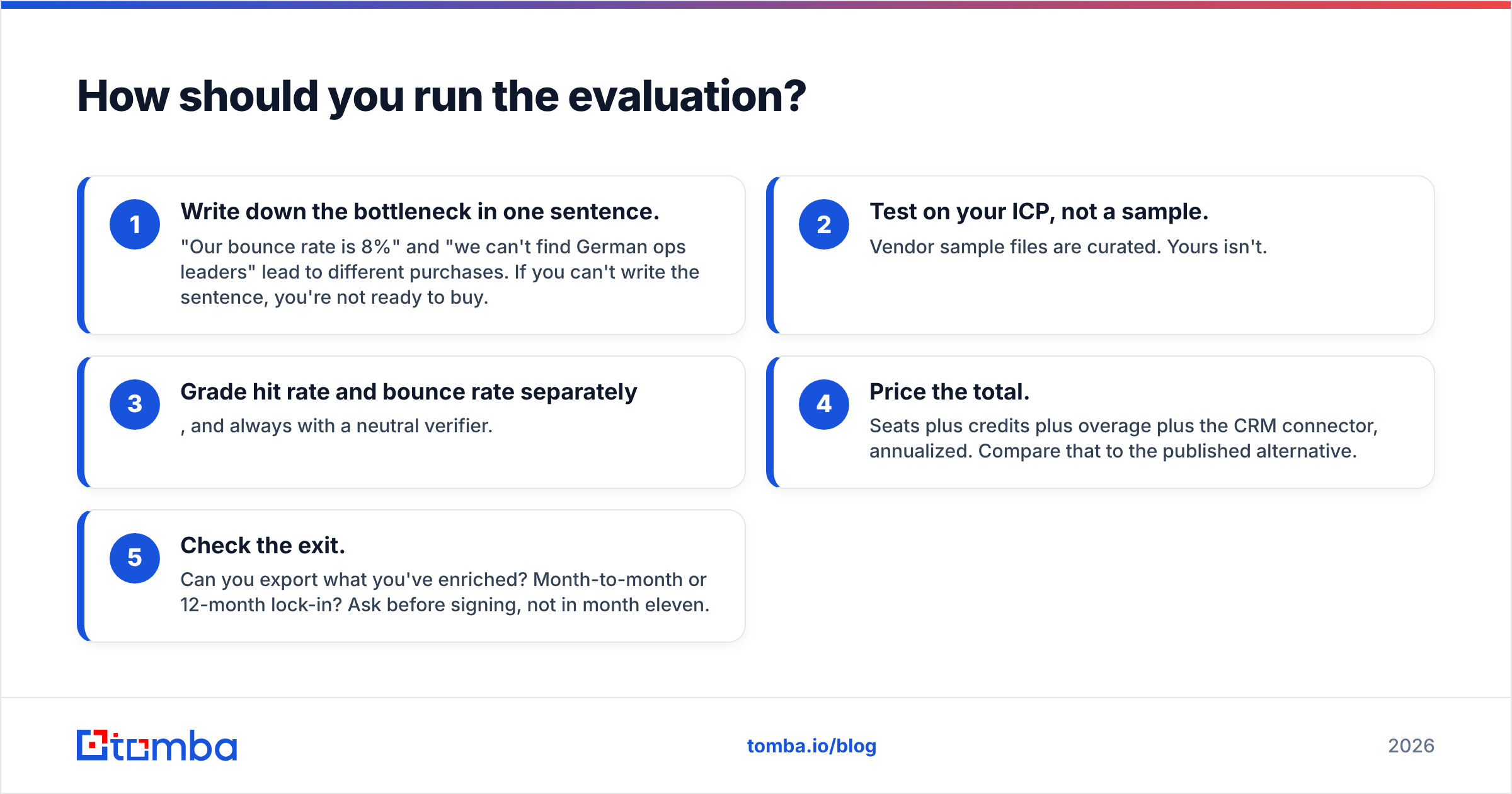
Do it in this order and you'll spend a week instead of a quarter.
- Write down the bottleneck in one sentence. "Our bounce rate is 8%" and "we can't find German ops leaders" lead to different purchases. If you can't write the sentence, you're not ready to buy.
- Test on your ICP, not a sample. Vendor sample files are curated. Yours isn't.
- Grade hit rate and bounce rate separately, and always with a neutral verifier.
- Price the total. Seats plus credits plus overage plus the CRM connector, annualized. Compare that to the published alternative.
- Check the exit. Can you export what you've enriched? Month-to-month or 12-month lock-in? Ask before signing, not in month eleven.
The verdict#
If you need clean sends on a list you already have, Enrow is the tighter, cheaper, faster-to-start choice — and it's transparent about what it costs. If you need to discover contacts outside North America and your reps run a phone-heavy motion, SMARTe's database and mobile coverage justify the sales cycle. They're complements more often than competitors, and plenty of teams end up running a database on one side and a verification layer on the other.
For everyone in the middle — the majority — a single tool that finds, verifies, and enriches without a procurement call is the pragmatic answer. Start with the Tomba Email Finder: 25 free searches a month, no card, and paid plans from $49/mo when you're ready to scale. Run your own 200-row test against whatever you're evaluating, and let the bounce rate pick the winner.
Related guides#
Ready to find emails that actually work?
Join 150,000+ professionals who stopped guessing and started sending. Free credits on signup — no credit card required.
Get the Tomba newsletter
Practical outbound tactics and product updates — once every two weeks.
About the author