Enterprise Account Management: A Practical 2026 Guide
Most enterprise account plans are slide decks nobody reopens. Here is how the top-performing teams actually run enterprise account management in 2026 — selection criteria, plan structure, metrics, and the stack behind it.
TL;DR
- Enterprise account management is not "account management with bigger logos." It is a multi-threaded, multi-year revenue discipline run against a named list of 5–25 accounts per manager, with its own plan, cadence, and P&L.
- Most programs fail for one boring reason: the account plan is a document produced for a review, not an operating system used weekly.
- The three levers that actually move net revenue retention are contact coverage (do you know every buyer and influencer?), executive relationship depth, and a whitespace map tied to real product usage.
- Enterprise account management, key account management, and ABM overlap but answer different questions. Confusing them is why your marketing and sales teams argue about who owns the account.
- Your stack matters less than your data hygiene. A perfect plan built on a contact list that is 40% stale will underperform a mediocre plan built on verified, current contacts.
What is enterprise account management?#
Enterprise account management is the practice of treating a small number of large customers as individual markets — each with its own growth plan, relationship map, risk register, and revenue target — rather than as rows in a pipeline.
Think of it like the difference between running a food truck and running a restaurant with twelve regulars who each pay a retainer. The food truck optimises for throughput: more customers, faster transactions, thinner relationships. The restaurant optimises for depth: you know what each regular orders, which of their colleagues they bring, what would make them leave, and what you could sell them next quarter. Enterprise account management is the restaurant model applied to B2B revenue.
Concretely, an enterprise account manager (sometimes titled strategic account manager, global account director, or client partner) owns:
- Retention of existing contracted revenue — the renewal, and the risk register that protects it.
- Expansion into new business units, geographies, or product lines — the whitespace.
- Relationship breadth and depth — moving from one champion to a mapped buying committee with executive sponsorship on both sides.
- Commercial governance — pricing consistency, contract structure, procurement relationships, and the escalation path when something breaks.
- Internal orchestration — pulling in solutions engineering, support, product, and executives without burning goodwill.
The defining constraint is account count. If a rep carries 60 accounts, they are doing coverage, not enterprise account management. Most high-functioning programs land between 5 and 25 named accounts per manager, depending on average contract value and account complexity.
How is it different from key account management and ABM?#
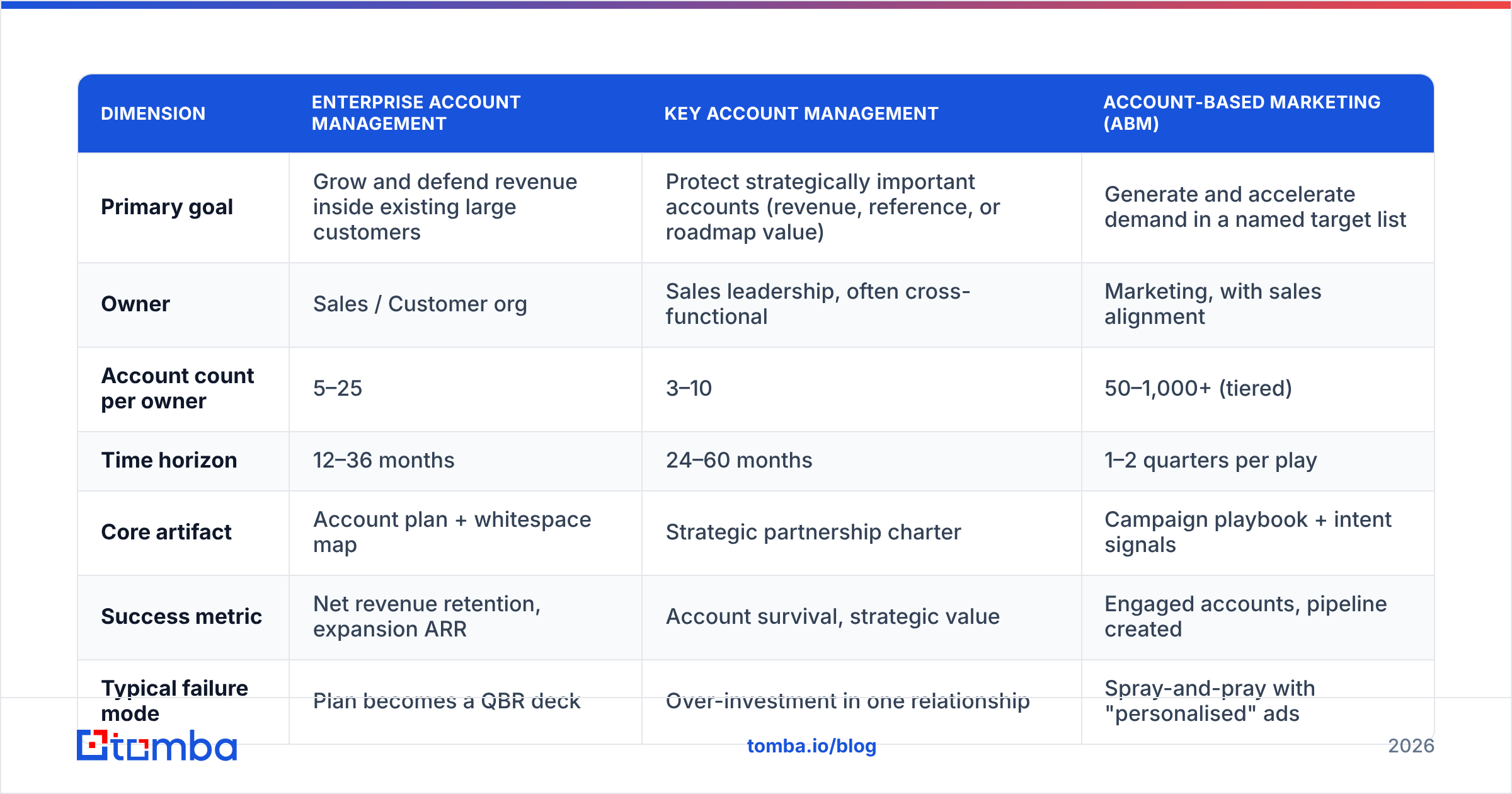
These three terms get used interchangeably in job descriptions and then cause real operational confusion. Here is the practical split.
| Dimension | Enterprise Account Management | Key Account Management | Account-Based Marketing (ABM) |
|---|---|---|---|
| Primary goal | Grow and defend revenue inside existing large customers | Protect strategically important accounts (revenue, reference, or roadmap value) | Generate and accelerate demand in a named target list |
| Owner | Sales / Customer org | Sales leadership, often cross-functional | Marketing, with sales alignment |
| Account count per owner | 5–25 | 3–10 | 50–1,000+ (tiered) |
| Time horizon | 12–36 months | 24–60 months | 1–2 quarters per play |
| Core artifact | Account plan + whitespace map | Strategic partnership charter | Campaign playbook + intent signals |
| Success metric | Net revenue retention, expansion ARR | Account survival, strategic value | Engaged accounts, pipeline created |
| Typical failure mode | Plan becomes a QBR deck | Over-investment in one relationship | Spray-and-pray with "personalised" ads |
The short version: ABM creates the account, enterprise account management compounds it, and key account management is the subset of enterprise accounts important enough that losing one would show up on the board deck.
A well-run company runs all three, but with clear handoffs. The most common breakage is ABM continuing to run generic nurture campaigns into accounts that an enterprise account manager is actively negotiating with — a fast way to look uncoordinated to a buying committee.
Why do most enterprise account plans fail?#
Because they are written for an audience of one: the VP who runs the quarterly review.
You can spot a dead plan in under a minute. The org chart has four boxes and hasn't been touched in eight months. The "risks" section says "budget pressure." The whitespace slide lists every product you sell, with no evidence anyone in the account wants any of them. And the last-modified date is three days before the last review.

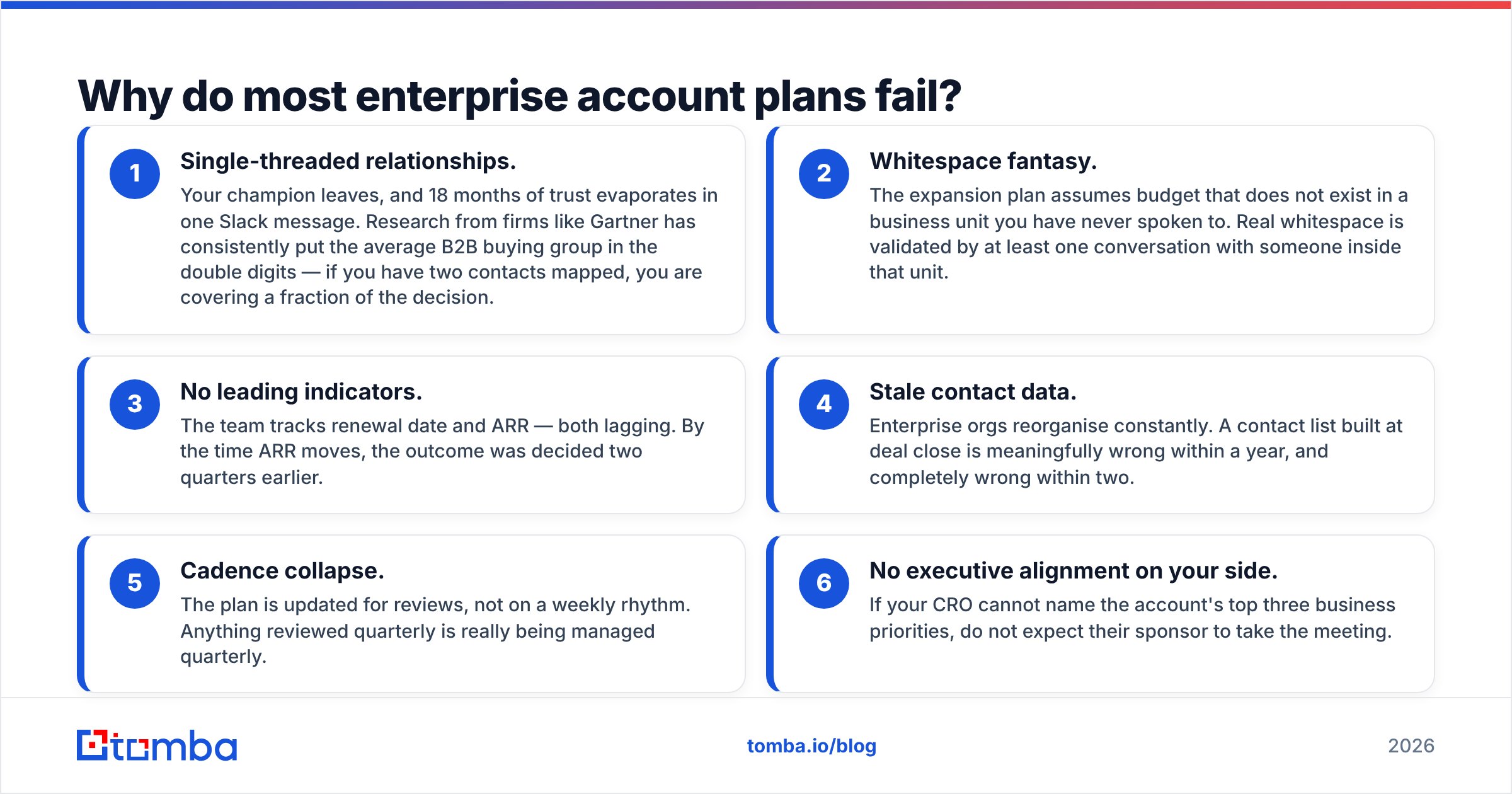
Here are the failure patterns worth naming, because each has a specific fix:
- Single-threaded relationships. Your champion leaves, and 18 months of trust evaporates in one Slack message. Research from firms like Gartner has consistently put the average B2B buying group in the double digits — if you have two contacts mapped, you are covering a fraction of the decision.
- Whitespace fantasy. The expansion plan assumes budget that does not exist in a business unit you have never spoken to. Real whitespace is validated by at least one conversation with someone inside that unit.
- No leading indicators. The team tracks renewal date and ARR — both lagging. By the time ARR moves, the outcome was decided two quarters earlier.
- Stale contact data. Enterprise orgs reorganise constantly. A contact list built at deal close is meaningfully wrong within a year, and completely wrong within two.
- Cadence collapse. The plan is updated for reviews, not on a weekly rhythm. Anything reviewed quarterly is really being managed quarterly.
- No executive alignment on your side. If your CRO cannot name the account's top three business priorities, do not expect their sponsor to take the meeting.
The last one is underrated. Executive sponsorship is a two-way commitment. If you ask a customer's CIO for time and show up with a product roadmap instead of a business conversation, you have spent a favour and bought nothing.
What actually belongs in an enterprise account plan?#
A usable plan is short, current, and answers questions someone will actually ask. Six components cover it:
- Account intelligence — the customer's stated strategy, reported financial pressure, recent leadership changes, M&A activity, and competitive position. Pull this from earnings calls, press releases, and job postings, not from your CRM notes.
- Relationship map — every named contact by role, influence, disposition (champion / neutral / detractor), and last-touch date. Colour-coded, updated monthly, and honest about the gaps.
- Whitespace matrix — business units and geographies down one axis, your products across the other. Each cell marked as sold, in-flight, qualified, or unexplored. Cells only move to "qualified" after a real conversation.
- Value realised to date — the outcomes the customer has actually achieved, in their numbers, not yours. This is the single most useful artifact in a renewal negotiation and the one most teams never build.
- Risk register — champion departure risk, competitive displacement, usage decline, support escalations, contract terms that create leverage against you. Each with an owner and a mitigation.
- Next four plays — the concrete actions for the next 90 days, with dates and owners. Not "deepen executive relationships." Instead: "secure 30 minutes with the VP of Supply Chain via our champion's intro, week of March 9."
If your plan template runs longer than three pages, people will stop reading it, and a plan nobody reads is a plan nobody executes.
How do you choose which accounts get this treatment?#
Enterprise account management is expensive. A dedicated manager, solutions engineering time, executive attention, and custom commercial terms add up quickly. Applying it to the wrong accounts is one of the fastest ways to destroy sales efficiency.
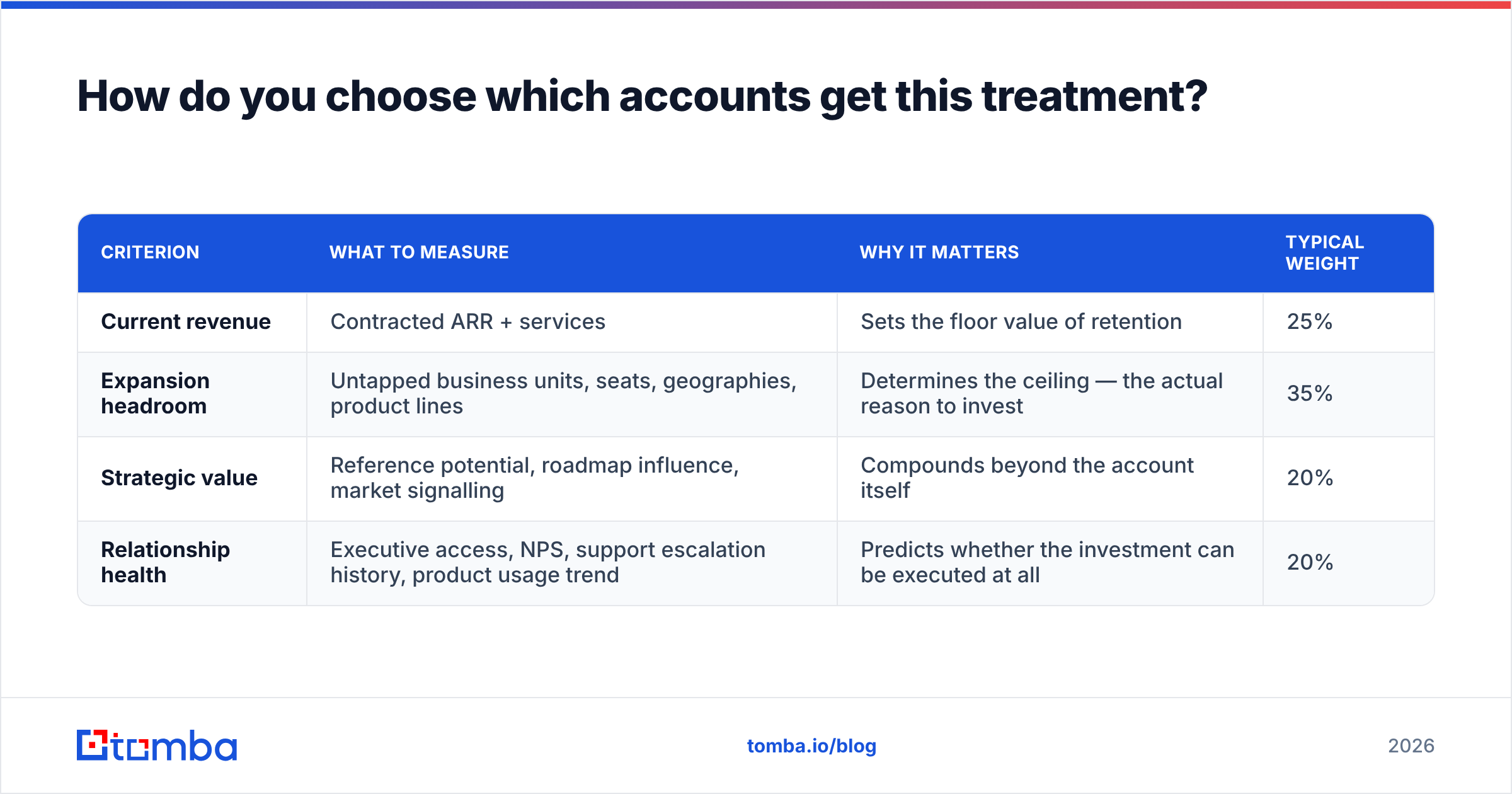
Score candidates on four factors and weight them to your business:
| Criterion | What to measure | Why it matters | Typical weight |
|---|---|---|---|
| Current revenue | Contracted ARR + services | Sets the floor value of retention | 25% |
| Expansion headroom | Untapped business units, seats, geographies, product lines | Determines the ceiling — the actual reason to invest | 35% |
| Strategic value | Reference potential, roadmap influence, market signalling | Compounds beyond the account itself | 20% |
| Relationship health | Executive access, NPS, support escalation history, product usage trend | Predicts whether the investment can be executed at all | 20% |
The trap is loading everything into "current revenue." Your biggest customer might be fully penetrated with a procurement team that grinds price every cycle — worth defending, but not worth a growth-oriented account team. Meanwhile, a mid-sized customer inside a 40,000-person parent company may have ten times the headroom.
Re-score annually. Accounts graduate into and out of the program, and treating the list as permanent is how you end up with managers protecting flat revenue for three years.
What does the stack look like in 2026?#
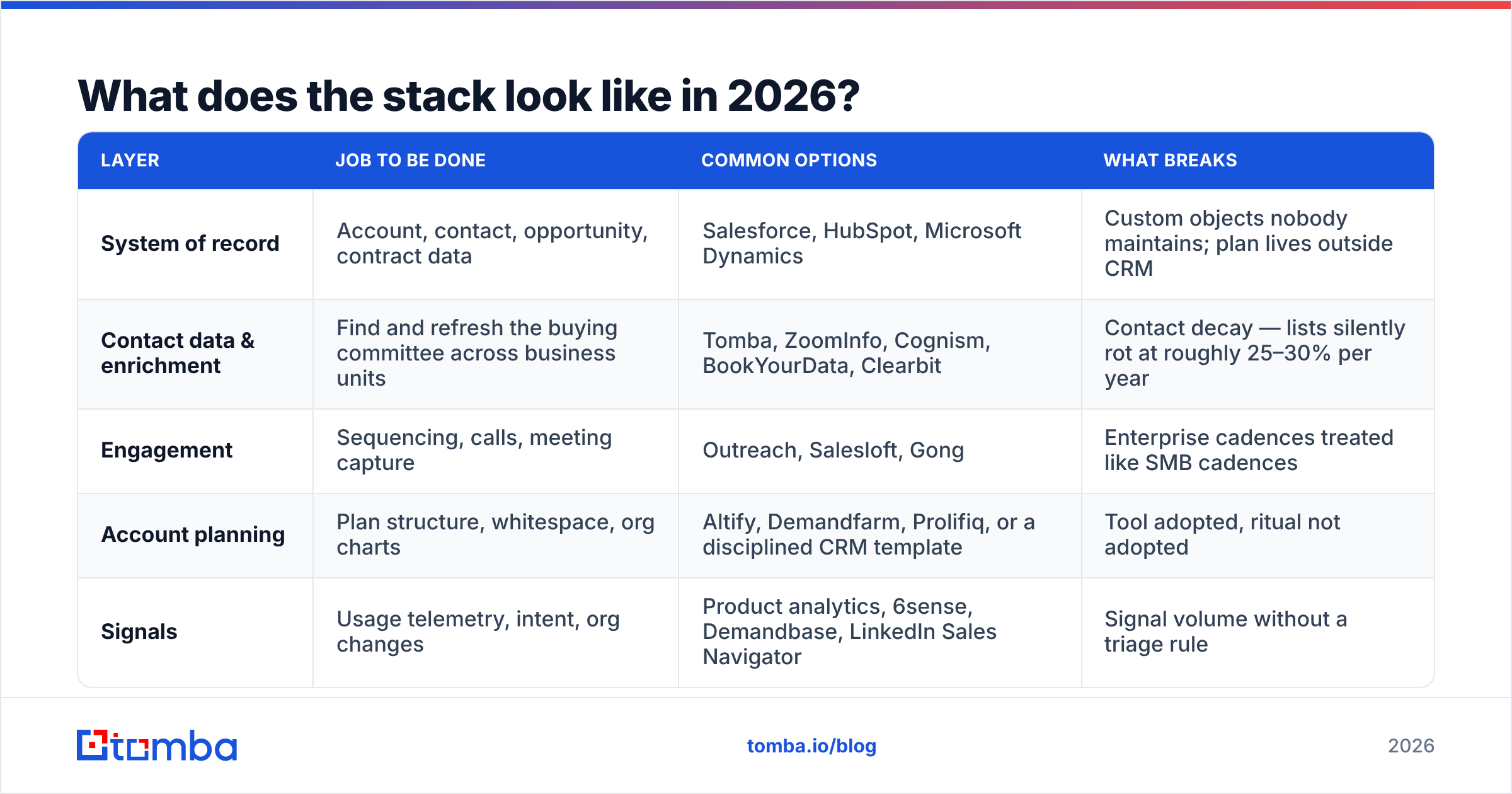
Most enterprise account management stacks have five layers. You do not need best-in-class in all of them; you need the data layer to be right, because everything above it inherits its errors.
| Layer | Job to be done | Common options | What breaks |
|---|---|---|---|
| System of record | Account, contact, opportunity, contract data | Salesforce, HubSpot, Microsoft Dynamics | Custom objects nobody maintains; plan lives outside CRM |
| Contact data & enrichment | Find and refresh the buying committee across business units | Tomba, ZoomInfo, Cognism, BookYourData, Clearbit | Contact decay — lists silently rot at roughly 25–30% per year |
| Engagement | Sequencing, calls, meeting capture | Outreach, Salesloft, Gong | Enterprise cadences treated like SMB cadences |
| Account planning | Plan structure, whitespace, org charts | Altify, Demandfarm, Prolifiq, or a disciplined CRM template | Tool adopted, ritual not adopted |
| Signals | Usage telemetry, intent, org changes | Product analytics, 6sense, Demandbase, LinkedIn Sales Navigator | Signal volume without a triage rule |
A note on the second layer, because it is where most programs quietly bleed. Enterprise accounts reorganise, acquire, spin off, and rebrand. Every one of those events invalidates part of your contact map. Teams that run a scheduled refresh — quarterly re-verification of every mapped contact, plus discovery of new roles in target business units — keep their relationship maps usable. Teams that do not are running plays against people who left last year.
Tools like Tomba's domain search can pull the current published contact structure for a subsidiary domain in one query, and contact enrichment fills in role, seniority, and location so your relationship map reflects the org as it exists now, not as it existed at contract signature. Pair that with an email verifier pass before any executive outreach — a bounce to a customer's CFO is an unforced error that costs more than the credit it saves.
Which metrics actually tell you it is working?#
Split them into leading and lagging, and hold the team accountable to leading indicators weekly.
Leading indicators (weekly or monthly):
- Contact coverage ratio — mapped and verified contacts divided by the estimated buying committee size. Below 60% means you are exposed.
- Multi-threading depth — number of distinct contacts with a meaningful interaction in the last 90 days. One is a risk. Five-plus is a relationship.
- Executive meeting count — VP-level and above meetings held per account per quarter.
- Whitespace conversations — new business units engaged, not new decks sent.
- Product usage trend — direction of active seats or consumption over trailing 90 days.
Lagging indicators (quarterly or annually):
- Net revenue retention on the named account list, reported separately from the wider book.
- Expansion ARR as a percentage of starting ARR.
- Renewal rate and average uplift at renewal.
- Time to first expansion after initial close.
- Reference and advocacy participation — case studies, peer calls, G2 reviews.
One practical rule: never report enterprise account metrics blended with the rest of the book. Blending hides both the wins and the failures, and it is how programs survive three years past the point they should have been restructured. Frameworks published by teams at HubSpot and similar operators are useful references for definitions, but the segmentation discipline matters more than the exact formula.
What does a realistic 90-day rollout look like?#
If you are standing up enterprise account management from scratch, resist the urge to launch with twelve accounts and a new tool.
Days 1–30 — Select and baseline. Score your customer base against the four criteria above. Pick three to five pilot accounts. For each, pull the current contact map out of CRM and measure how much of it is verifiably accurate. Establish baseline NRR, usage, and support history. Expect the data audit to be uncomfortable.
Days 31–60 — Build and validate. Write the three-page plan for each pilot account. Refresh and expand the relationship map with current, verified contacts across every business unit you can identify. Validate at least one whitespace hypothesis per account with a real conversation. Get an executive sponsor named on both sides.
Days 61–90 — Operate the cadence. Weekly 20-minute account stand-ups. Monthly plan updates. One executive-level meeting per account. Track the leading indicators from week one so that by day 90 you have a trend, not a snapshot.
At day 90, decide honestly: did contact coverage, multi-threading, and executive access move? If not, the problem is cadence and data — not the template, and not the tooling. Fix those before you scale the program to twenty accounts.
Where to start#
The cheapest, highest-leverage improvement in most enterprise account management programs is not a new planning tool. It is fixing the contact layer underneath the plan — knowing who is actually in each business unit today, which of your mapped contacts still work there, and how to reach the four people you have never spoken to.
The Tomba Email Finder is built for exactly that job: pull verified professional contacts by domain or by name across every subsidiary and regional entity inside your enterprise accounts, then keep them current with scheduled re-verification. The free tier gives you 25 searches a month to audit one account and see how stale your map really is; paid plans start at $49/mo, with full Tomba pricing laid out if you need bulk or API access for a larger named-account list.
Map the account before you plan it. Everything else follows from that.
Related guides#
Ready to find emails that actually work?
Join 150,000+ professionals who stopped guessing and started sending. Free credits on signup — no credit card required.
Get the Tomba newsletter
Practical outbound tactics and product updates — once every two weeks.
About the author