Enterprise Deals in 2026: How to Win Six-Figure B2B Contracts
Enterprise deals fail on process, not pitch. Here's the 2026 playbook: buying-committee mapping, multi-threading math, procurement gates, and the data stack that keeps 9-month cycles alive.
TL;DR
- An enterprise deal is not a bigger SMB deal. It's a different motion: 6–14 buyers, 4–12 months, a security review, and a procurement gate that has nothing to do with whether your product is good.
- The single biggest predictor of a closed six-figure contract is contact coverage — how many of the actual decision-makers you've reached, not how many meetings your champion took.
- Single-threaded deals lose. When your one contact leaves, the deal doesn't slip, it dies. Multi-threading across 5+ stakeholders is the fix, and it requires contact data you probably don't have yet.
- Budget roughly 30% of the cycle for legal, security, and procurement. Deals that "stall in Q4" usually stalled in InfoSec in Q2.
- Your CRM stage names are lying to you. Replace opinion-based stages ("Interest") with evidence-based gates ("Security questionnaire returned").
What Counts as an Enterprise Deal in 2026?#
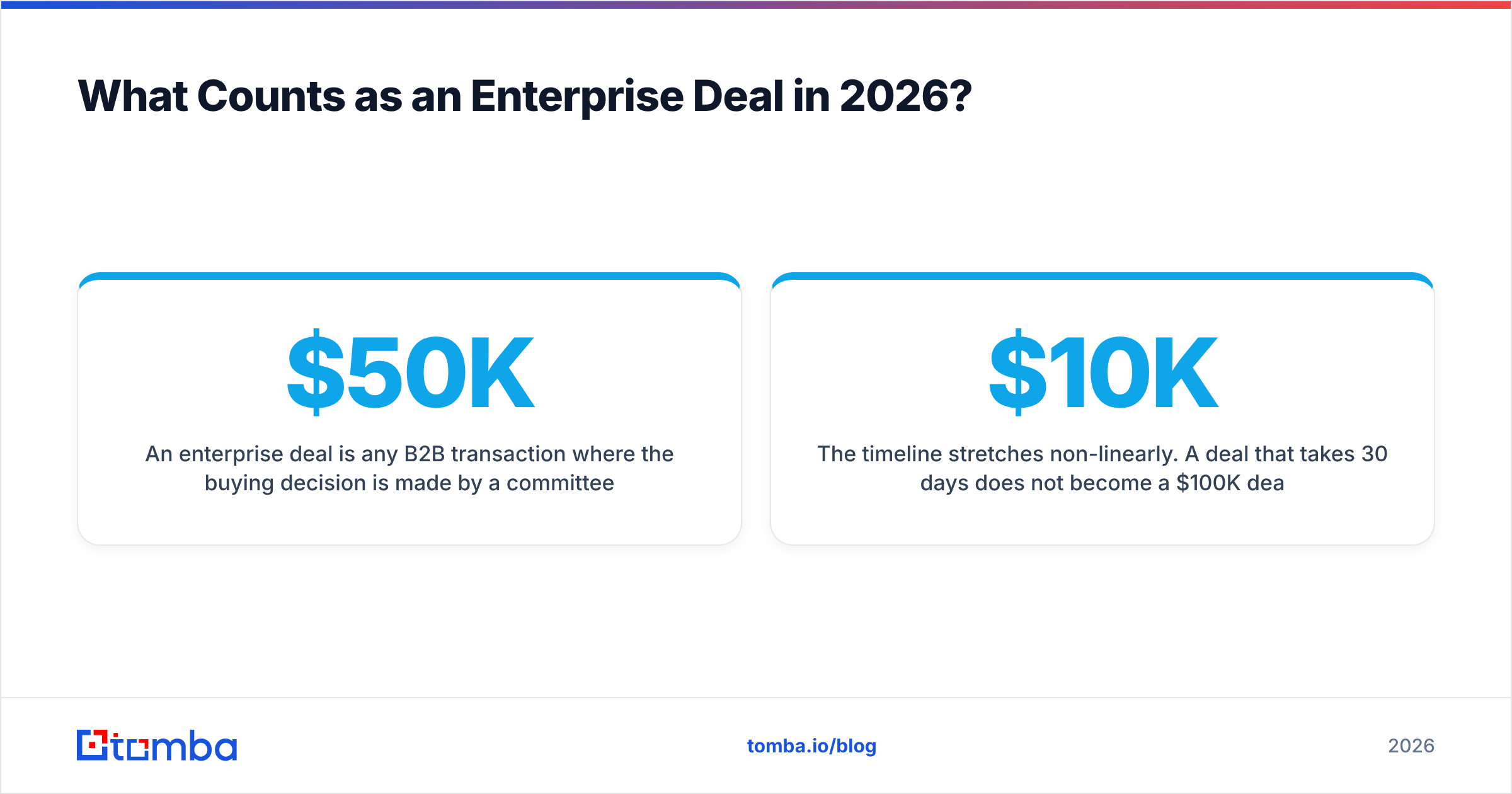
An enterprise deal is any B2B transaction where the buying decision is made by a committee rather than a person. Price is a proxy, not a definition — most teams draw the line somewhere between $50K and $100K ACV, but the real marker is structural: the moment a deal requires sign-off from someone who has never spoken to you, you're in enterprise motion.
Three things change at that threshold, and they change all at once.
The buyer count multiplies. Gartner's widely cited research on B2B buying puts the typical committee for a complex solution at six to ten people, each bringing four or five independently gathered pieces of information to the table. That's up to 50 inputs you don't control.
The timeline stretches non-linearly. A $10K deal that takes 30 days does not become a $100K deal that takes 300 days. It becomes a $100K deal that takes 210 days, of which 60 are pure procedure — legal redlines, SOC 2 review, vendor onboarding portals, insurance certificates.
The failure mode inverts. SMB deals die from "no." Enterprise deals die from "not now," which is the same thing dressed for the office. Roughly half of forecasted enterprise pipeline resolves to no-decision rather than a competitor.
If your sales process was built for a self-serve or mid-market motion and you're now chasing logos with 5,000 employees, none of your instincts transfer. The rep who closed 40 SMB deals last year is often the rep who single-threads the enterprise account into a ditch.
Why Do Most Enterprise Deals Stall Before Signature?#
Because the seller optimized for the champion's enthusiasm and ignored everyone else. Here are the five failure patterns, ranked by how often they show up in a lost-deal review.
- Single-threading. One contact, one relationship, one point of failure. Median tenure in a B2B buying role is well under three years, so on a nine-month cycle there is a real chance your champion changes jobs mid-deal. If they were your only line in, the deal restarts at zero — usually as a no-decision.
- No economic buyer identified. Your champion says "I'll take it to leadership." That sentence has ended more enterprise deals than any competitor. If you cannot name the person who signs, with a title and an email address, you do not have a forecast — you have a hope.
- Procurement discovered late. The seller learns in month six that the account requires a 90-day vendor onboarding, a security questionnaire, and a redline cycle with outside counsel. All of that was knowable in month one by asking one question.
- Value framed as features. Committees don't buy features; they buy a defensible internal argument. Your champion has to present your case in a meeting you're not in. If you haven't given them a one-page business case with numbers, they'll improvise, and improvisation loses to the incumbent.
- Bad contact data. Mundane, unglamorous, and everywhere. Reps can't multi-thread into a committee they can't reach. Bounced outreach to a VP of Security in month four doesn't just waste a touch — it costs you the sender reputation that the next eight touches depend on.

The pattern underneath all five: enterprise deals are lost on coverage and process, not on pitch quality. Nobody loses a $250K contract because their demo was 8% less slick.
Who Is Actually in the Buying Committee?#
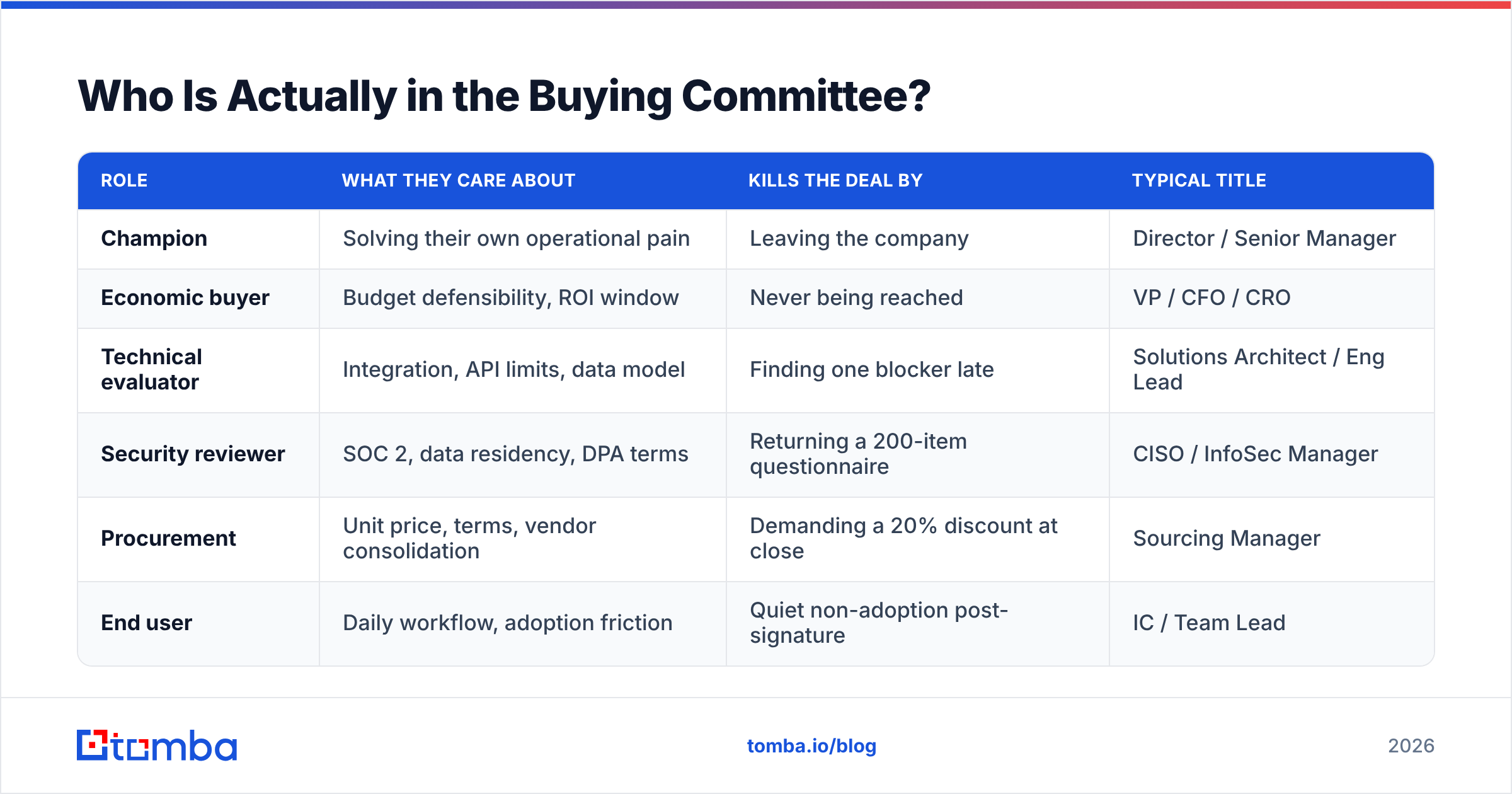
Six roles, and you need contact-level access to at least four of them. Naming the role is not the same as having the person's direct email — that gap is where most "we're multi-threaded" claims fall apart.
| Role | What they care about | Kills the deal by | Typical title |
|---|---|---|---|
| Champion | Solving their own operational pain | Leaving the company | Director / Senior Manager |
| Economic buyer | Budget defensibility, ROI window | Never being reached | VP / CFO / CRO |
| Technical evaluator | Integration, API limits, data model | Finding one blocker late | Solutions Architect / Eng Lead |
| Security reviewer | SOC 2, data residency, DPA terms | Returning a 200-item questionnaire | CISO / InfoSec Manager |
| Procurement | Unit price, terms, vendor consolidation | Demanding a 20% discount at close | Sourcing Manager |
| End user | Daily workflow, adoption friction | Quiet non-adoption post-signature | IC / Team Lead |
Two notes on this table that most playbooks skip.
The end user matters even though they can't sign. They can veto. A pilot with weak usage numbers gives procurement all the ammunition it needs to push renewal into next fiscal year.
Security is a stakeholder, not a step. Treat the CISO's team like a buyer — send them the SOC 2 report and DPA proactively in month two, not reactively in month six. A pre-empted security review turns a four-week block into a two-day formality.
Getting to four of these six people means finding four sets of verified contact details, often across departments that never appear in your CRM. That's a data problem before it's a selling problem. A domain search across the target company surfaces the org's email pattern and the people attached to it, which is how a rep goes from "I know there's a CISO" to "I emailed the CISO on Tuesday."
How Long Should an Enterprise Deal Actually Take?#
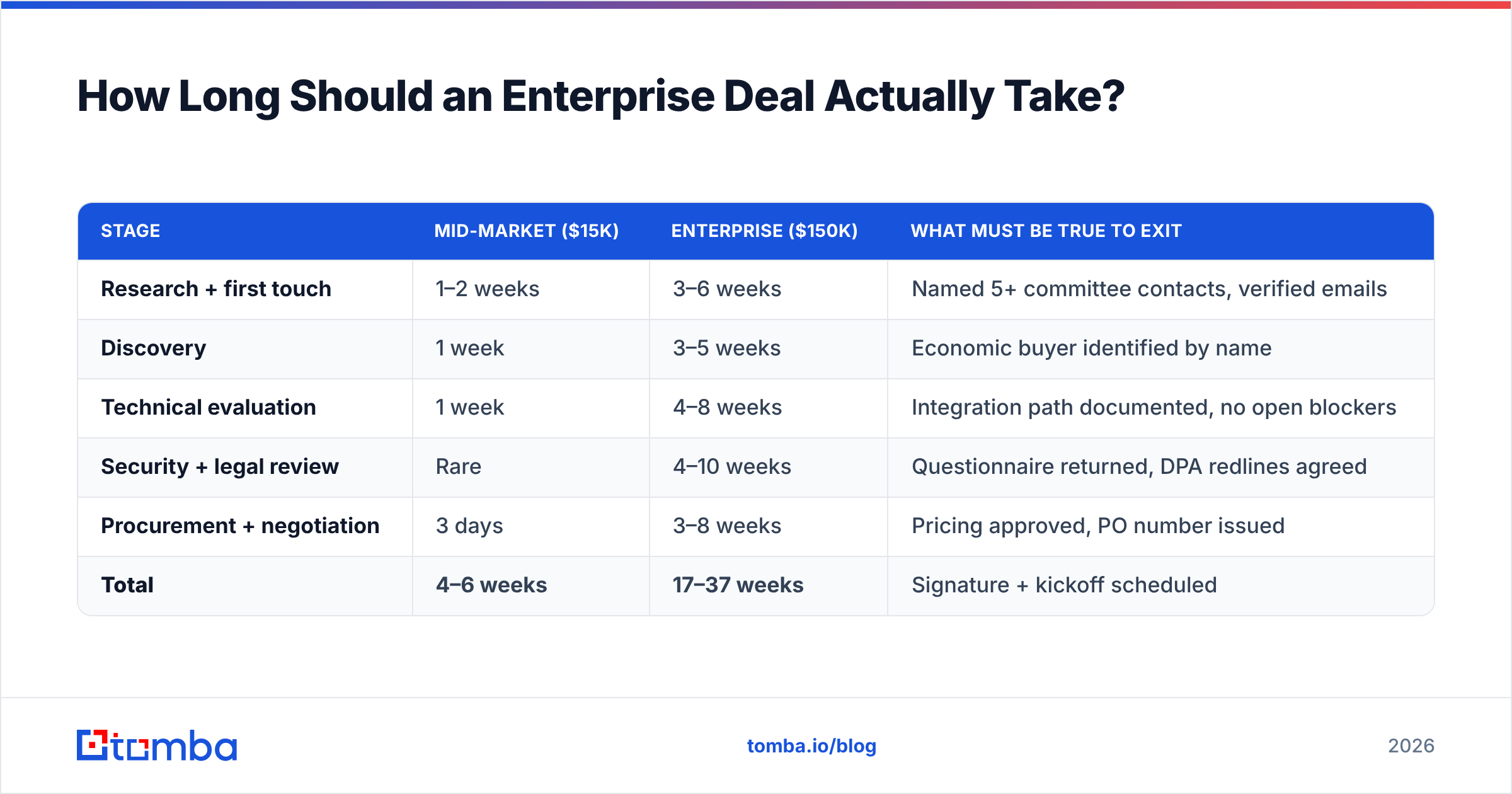
Longer than your CRM's default 30-day stages assume, and the time is distributed unevenly. Here's a realistic shape for a $150K ACV deal in 2026, benchmarked against a typical mid-market cycle.
| Stage | Mid-market ($15K) | Enterprise ($150K) | What must be true to exit |
|---|---|---|---|
| Research + first touch | 1–2 weeks | 3–6 weeks | Named 5+ committee contacts, verified emails |
| Discovery | 1 week | 3–5 weeks | Economic buyer identified by name |
| Technical evaluation | 1 week | 4–8 weeks | Integration path documented, no open blockers |
| Security + legal review | Rare | 4–10 weeks | Questionnaire returned, DPA redlines agreed |
| Procurement + negotiation | 3 days | 3–8 weeks | Pricing approved, PO number issued |
| Total | 4–6 weeks | 17–37 weeks | Signature + kickoff scheduled |
Look at rows four and five. Between eight and eighteen weeks — often 40% of the cycle — sits in functions your rep has no relationship with and cannot accelerate by being charming. The only lever is starting those tracks earlier.
That's the single highest-ROI change most teams can make: move security and procurement from the end of the process to a parallel track that opens at technical evaluation. It doesn't shorten the work. It shortens the calendar.
Which Deal Qualification Framework Fits Enterprise?#
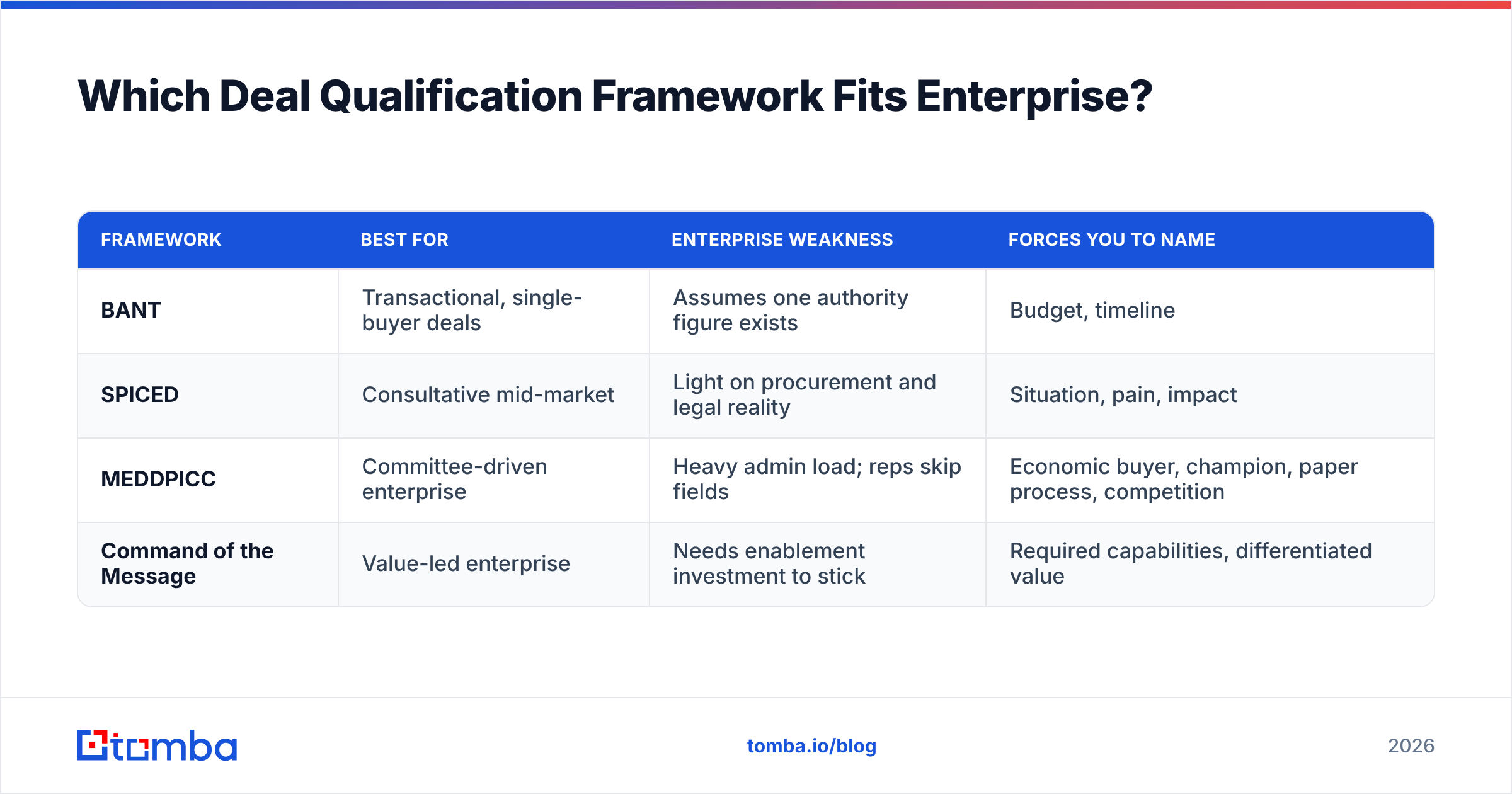
MEDDPICC, mostly — because it's the only common framework that explicitly forces you to name the paper process and the economic buyer. But frameworks are diagnostic tools, not scripts. Here's how the three most-used ones hold up against a committee sale.
| Framework | Best for | Enterprise weakness | Forces you to name |
|---|---|---|---|
| BANT | Transactional, single-buyer deals | Assumes one authority figure exists | Budget, timeline |
| SPICED | Consultative mid-market | Light on procurement and legal reality | Situation, pain, impact |
| MEDDPICC | Committee-driven enterprise | Heavy admin load; reps skip fields | Economic buyer, champion, paper process, competition |
| Command of the Message | Value-led enterprise | Needs enablement investment to stick | Required capabilities, differentiated value |
The practical move is not "adopt MEDDPICC." It's convert every qualification field into a CRM stage gate with evidence attached. "Champion identified" is an opinion. "Champion identified — here's the email thread where they described the internal business case in their own words" is evidence. Only the second one belongs in a forecast.
Rebuild your stages around artifacts:
- Stage 2 exits when you have five verified committee contacts in the CRM, not five business cards.
- Stage 3 exits when the economic buyer has been on a call — recorded, with an attendee list.
- Stage 4 exits when the security questionnaire is returned, not when it's sent.
- Stage 5 exits when a PO number exists or a signed order form is in the queue.
- Nothing exits on optimism. If the artifact is missing, the deal sits.
Teams that make this switch usually see forecast accuracy improve before win rate does — which is fine, because an accurate pipeline is what lets you fix the win rate next quarter.
How Do You Build the Contact Coverage a Committee Sale Requires?#
Systematically, and before the deal starts — not by scrambling for a CISO's email in week 20 when the deal is already slipping.
The workflow that holds up at enterprise scale has four steps.
1. Map the org, not the account. Start from the target domain and pull the people, titles, and email pattern in one pass. Tomba's domain search returns the addresses attached to a company domain along with the pattern (first.last@, finitial.last@), which lets you predict addresses for people you find on LinkedIn but not in any database.
2. Enrich the names you already have. Your champion mentions "Dana in Security" on a call. That's a name and a company, which is enough. Data enrichment turns partial identifiers into a full contact record — email, role, sometimes a direct line via phone finder, which matters because enterprise security reviewers answer phones more reliably than they answer cold email.
3. Verify before you send. This is non-negotiable at enterprise. A hard bounce to a VP inside a target account is worse than no email at all: it signals sloppiness to a buyer whose entire job is evaluating vendor rigor, and it degrades your domain's email deliverability for every other thread in that account. Run the list through an email verifier first, and treat catch-all domains — extremely common in enterprise IT — with a dedicated catch-all verifier rather than guessing.
4. Refresh quarterly. Enterprise cycles outlive job tenures. A contact record captured at month one is meaningfully stale by month seven. Re-run enrichment on your open enterprise pipeline every quarter, or budget for the deals that quietly go dark because three of your five threads changed employers.

On tooling: platforms split roughly into three camps. All-in-one prospecting suites like Apollo bundle sequencing with a large but variable-quality database. Curated B2B list providers — BookYourData is a strong option here — sell verified, filterable contact lists that suit teams building a target account list from scratch. Focused finder-and-verifier tools like Tomba prioritize accuracy per lookup and API access, which suits teams enriching accounts they've already chosen. Enterprise teams frequently run two of the three: a list source for coverage, a verifier for hygiene. Check Tomba pricing against your monthly lookup volume — the Free tier's 25 searches will let you test accuracy on a live account before committing, and Starter at $49/mo covers a single rep's enterprise territory comfortably.
What Should You Do Differently in Procurement and Legal?#
Front-load, document, and give your champion a script. Three specific moves.
Ask the paper-process question in discovery. Verbatim: "Once we agree commercially, what does your approval process look like — who signs, does this go through security review, and how long has that taken for similar vendors?" Asking in week two costs you nothing. Learning the answer in week 24 costs you the quarter.
Build the security packet before you need it. SOC 2 Type II report, DPA template, sub-processor list, pen test summary, data residency statement, SSO/SCIM documentation. Put it in one shareable folder. Send it unprompted when technical evaluation opens. The vendors who lose weeks here are the ones assembling this reactively.
Protect price with structure, not stubbornness. Procurement's job is to extract a discount; they will get one or the deal will feel unfinished to them. Decide in advance what you'll trade: multi-year commitment, case study rights, an earlier payment schedule, a reference call. Trading structure for price preserves your ACV. Just discounting trains the account to expect it at every renewal.
One more thing that costs nothing: ask your champion who else has bought a comparable tool internally in the last 18 months, then ask what went wrong. Procurement teams carry institutional grudges, and knowing that the last vendor missed an implementation deadline tells you exactly which clause will be contested in your MSA.
How Do You Forecast Enterprise Deals Without Lying to Yourself?#
Score coverage, not confidence. A deal's probability should be a function of observable facts, and the most predictive one is how many committee roles you've actually engaged.
A simple, honest model:
- 1 contact engaged — treat as 10% regardless of what the rep says. This is a lead with a calendar invite.
- 2–3 contacts, no economic buyer — 25%. Real interest, no path to signature.
- 4+ contacts including the economic buyer — 50%. Now it's a deal.
- Above plus security review underway — 70%.
- Above plus PO number or verbal from signer — 90%.
Notice that nothing in that ladder depends on how the last call felt. Every rung is a verifiable artifact you can audit in the CRM in ten seconds. Run this against your closed-lost pipeline from last year and you'll typically find that the deals you lost were sitting at rung one or two for months while being forecast at rung four.
Pair it with a cheap weekly hygiene check: any enterprise opportunity with fewer than three engaged contacts gets flagged, and the rep's next action is a mapping exercise, not another follow-up to the same person. That one rule, enforced, does more for enterprise win rate than most sales training budgets.
The Bottom Line#
Enterprise deals reward preparation over persuasion. The teams that win six-figure contracts consistently aren't the ones with the best demo — they're the ones who mapped the committee in week one, opened the security track in month two, and could name every person who touches the signature line before the champion ever mentioned budget.
That entire playbook rests on one unglamorous input: knowing how to reach the six people who decide. If your reps are still guessing at addresses or working from a CRM record last touched in 2024, everything downstream compounds the error.
Start with the map. Tomba's Email Finder gets you verified addresses for the whole buying committee — by name, by domain, or in bulk across your target account list — so your reps spend their week multi-threading instead of hunting for a CISO's email. The free tier gives you 25 searches to test it against a live account before you spend anything.
Related guides#
Ready to find emails that actually work?
Join 150,000+ professionals who stopped guessing and started sending. Free credits on signup — no credit card required.
Get the Tomba newsletter
Practical outbound tactics and product updates — once every two weeks.
About the author