Enterprise GTM in 2026: A Complete Playbook for Revenue Teams
Enterprise GTM fails for boring, predictable reasons: fragmented data, motions that contradict each other, and metrics nobody trusts. Here is the 2026 breakdown of motions, stack, budget, and the 90-day rollout that fixes it.
TL;DR
- Enterprise GTM is not "SMB GTM with bigger logos." It is a multi-threaded, multi-quarter motion where 6–10 stakeholders, procurement, and security review all sit between you and revenue.
- Most enterprise GTM programs stall on data, not strategy. If your account list, contact coverage, and CRM hygiene are weak, no amount of sequencing fixes it.
- Three motions dominate in 2026: ABM/account-based, product-led enterprise (PLG-to-sales), and partner/ecosystem-led. Most teams run two, badly, instead of one well.
- Budget reality: the tooling layer costs far less than the headcount layer, but bad tooling silently taxes every rep hour. Contact data should be a commodity line item, not a five-figure seat.
- Measure pipeline coverage, account penetration depth, and cycle-stage conversion — not activity volume. Activity dashboards are where enterprise GTM programs go to die.
What is enterprise GTM, and how is it different from SMB GTM?#
Enterprise GTM is the coordinated system — segmentation, motion, team design, data, and measurement — a company uses to win accounts large enough that a single deal changes the quarter.
The everyday analogy: SMB selling is a food truck. One person takes the order, cooks it, hands it over, and the whole transaction closes in minutes. Enterprise selling is catering a wedding. You are dealing with the couple, the parents paying, the venue's rules, a dietary-restrictions list, and a coordinator who can veto everything. Same food, completely different operating model.
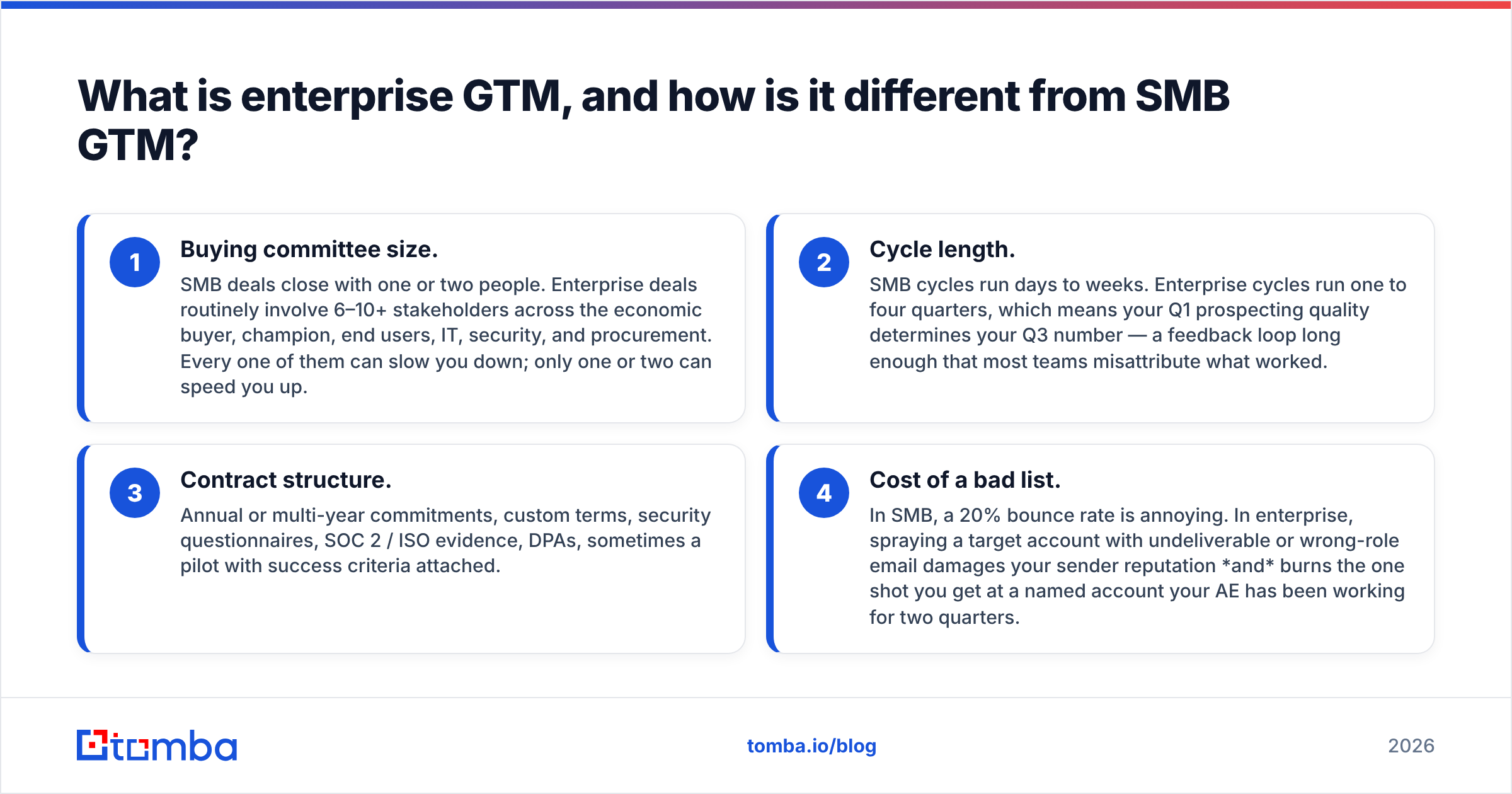
Technically, the differences compound across four dimensions:
- Buying committee size. SMB deals close with one or two people. Enterprise deals routinely involve 6–10+ stakeholders across the economic buyer, champion, end users, IT, security, and procurement. Every one of them can slow you down; only one or two can speed you up.
- Cycle length. SMB cycles run days to weeks. Enterprise cycles run one to four quarters, which means your Q1 prospecting quality determines your Q3 number — a feedback loop long enough that most teams misattribute what worked.
- Contract structure. Annual or multi-year commitments, custom terms, security questionnaires, SOC 2 / ISO evidence, DPAs, sometimes a pilot with success criteria attached.
- Cost of a bad list. In SMB, a 20% bounce rate is annoying. In enterprise, spraying a target account with undeliverable or wrong-role email damages your sender reputation and burns the one shot you get at a named account your AE has been working for two quarters.
That last point is why enterprise GTM conversations that start with "which sequencer should we buy" are already off track. The constraint is almost never the sending tool.

Why do enterprise GTM motions stall in 2026?#
Because the strategy deck and the operational reality never meet. Here are the failure patterns worth naming, in rough order of how often they show up.
Fragmented account data. Marketing has a target list in a spreadsheet, sales has one in the CRM, and RevOps has a third in the data warehouse. None of them agree on what counts as an enterprise account. Every QBR then argues about denominators instead of decisions.
Contact coverage gaps at the exact moment they matter. You have the CEO and one VP. You do not have the security lead, the platform owner, or the finance approver — the three people who actually decide whether your deal closes this quarter or slips. Coverage depth per account is the single most under-measured input in enterprise GTM.
Two motions running at once with no shared definition of a qualified account. ABM says an account is qualified when it hits an intent threshold. PLG says it is qualified when three seats sign up. Sales says it is qualified when someone books a meeting. Three definitions, three dashboards, one very confused pipeline number. Gartner's sales research has been consistent on this point for years: misalignment on qualification criteria is a bigger drag on enterprise conversion than any individual tactic.
Tooling sprawl that nobody audits. The average revenue team accumulates tools the way a garage accumulates cables. Ten platforms, four of which overlap, two of which nobody has logged into since the champion who bought them left.
Measurement that rewards motion, not progress. If the leaderboard shows calls and emails, you will get calls and emails. You will not get multi-threaded accounts.
What are the three enterprise GTM motions, and which should you run?#
Pick one primary motion and one supporting motion. Running all three at full intensity with a team under 50 people is the fastest way to do everything at 60%.
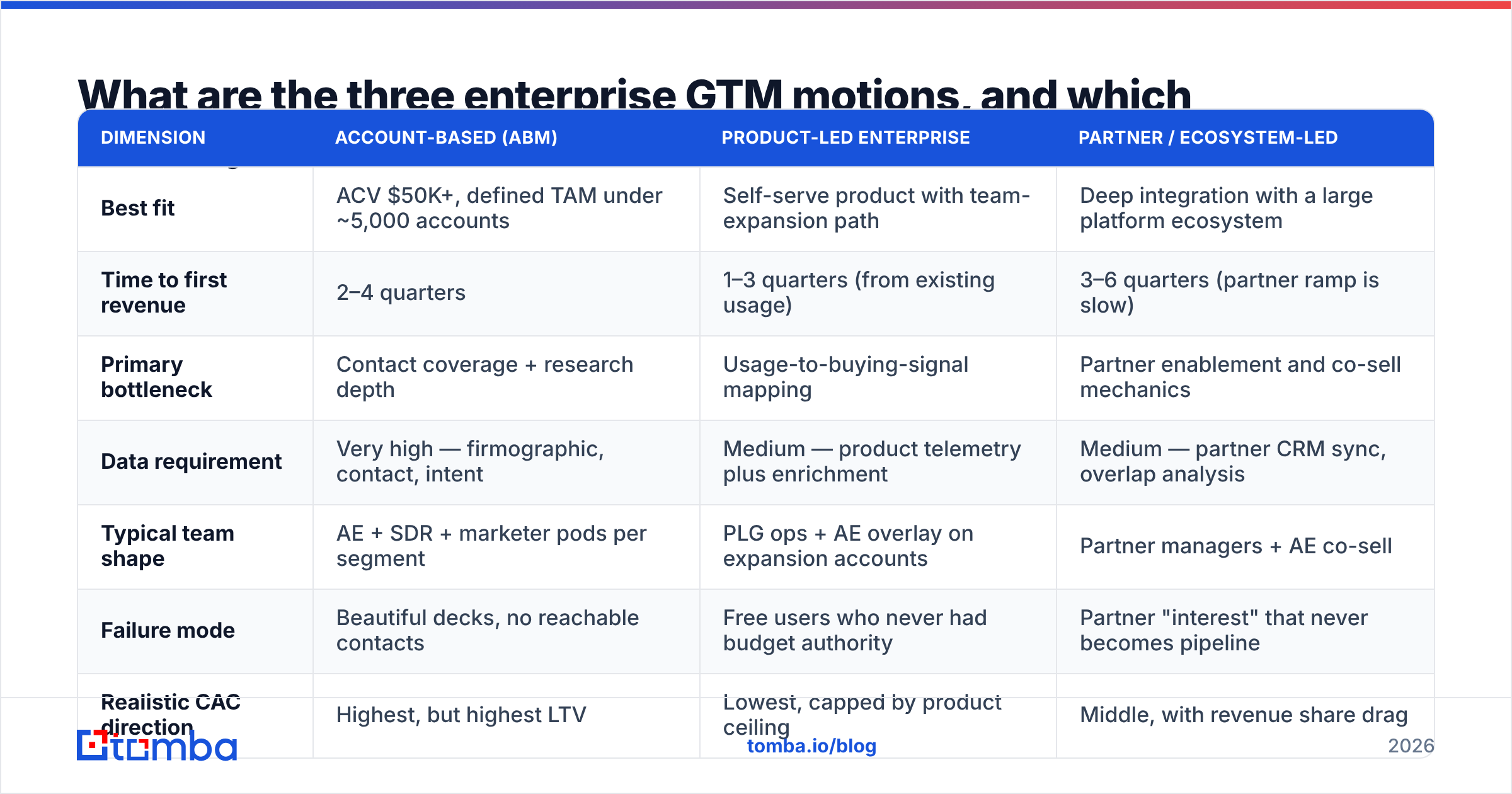
| Dimension | Account-Based (ABM) | Product-Led Enterprise | Partner / Ecosystem-Led |
|---|---|---|---|
| Best fit | ACV $50K+, defined TAM under ~5,000 accounts | Self-serve product with team-expansion path | Deep integration with a large platform ecosystem |
| Time to first revenue | 2–4 quarters | 1–3 quarters (from existing usage) | 3–6 quarters (partner ramp is slow) |
| Primary bottleneck | Contact coverage + research depth | Usage-to-buying-signal mapping | Partner enablement and co-sell mechanics |
| Data requirement | Very high — firmographic, contact, intent | Medium — product telemetry plus enrichment | Medium — partner CRM sync, overlap analysis |
| Typical team shape | AE + SDR + marketer pods per segment | PLG ops + AE overlay on expansion accounts | Partner managers + AE co-sell |
| Failure mode | Beautiful decks, no reachable contacts | Free users who never had budget authority | Partner "interest" that never becomes pipeline |
| Realistic CAC direction | Highest, but highest LTV | Lowest, capped by product ceiling | Middle, with revenue share drag |
A practical rule: if you can name every account you want to win in 2026 on a single spreadsheet, run ABM as primary. If you cannot, your segmentation is not finished and you are not ready to spend on ABM tooling yet.
What does an enterprise GTM stack actually cost?#
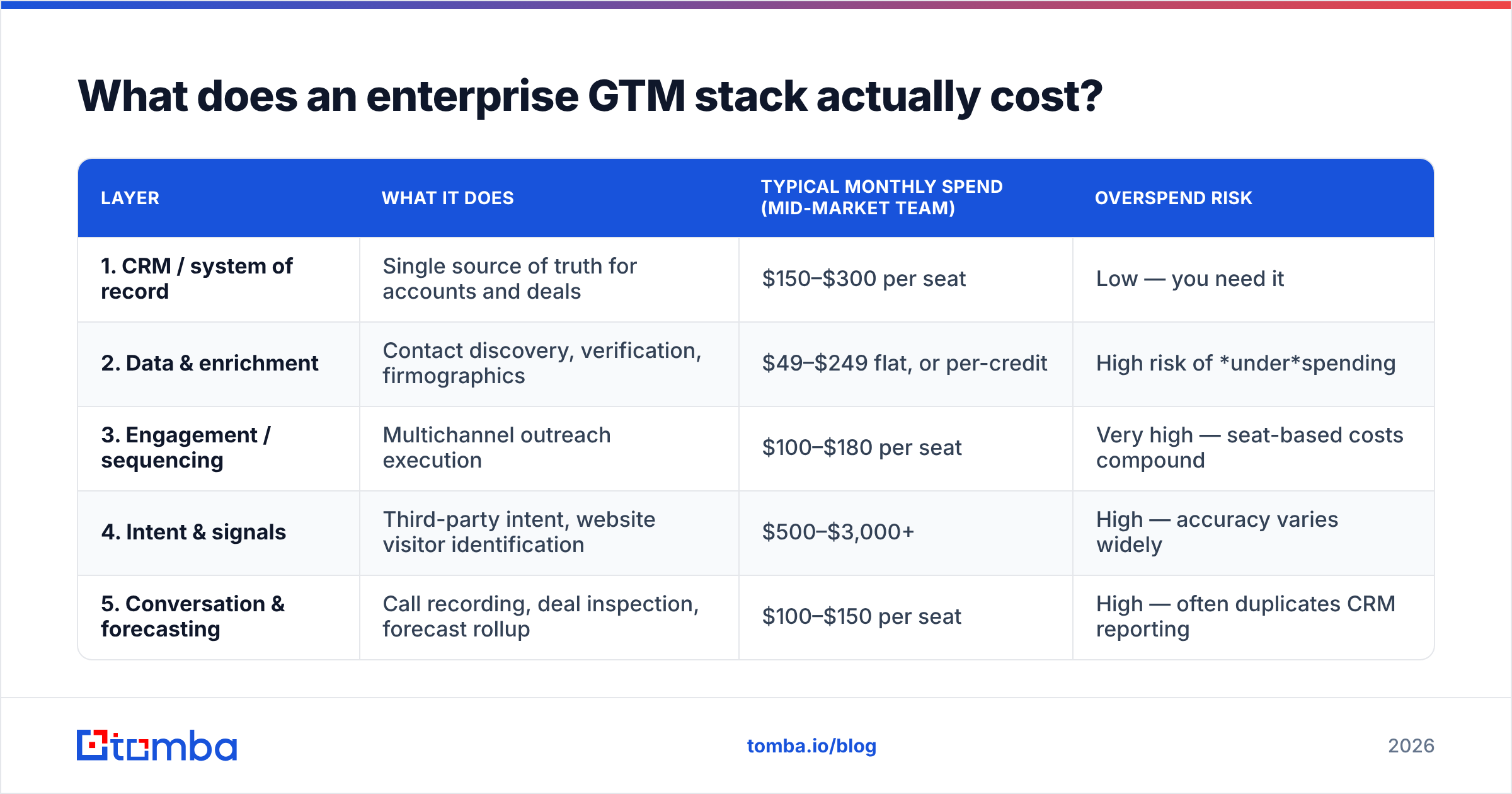
The stack has five layers. Most teams overspend on layers 3 and 5 and underspend on layer 2 — which is backwards, because layer 2 feeds everything above it.
| Layer | What it does | Typical monthly spend (mid-market team) | Overspend risk |
|---|---|---|---|
| 1. CRM / system of record | Single source of truth for accounts and deals | $150–$300 per seat | Low — you need it |
| 2. Data & enrichment | Contact discovery, verification, firmographics | $49–$249 flat, or per-credit | High risk of underspending |
| 3. Engagement / sequencing | Multichannel outreach execution | $100–$180 per seat | Very high — seat-based costs compound |
| 4. Intent & signals | Third-party intent, website visitor identification | $500–$3,000+ | High — accuracy varies widely |
| 5. Conversation & forecasting | Call recording, deal inspection, forecast rollup | $100–$150 per seat | High — often duplicates CRM reporting |
The line that surprises people: layer 2 is the cheapest layer and the one everything else depends on. A sequencer sending to unverified addresses is an expensive way to destroy your domain. An intent platform pointing at accounts you have no contacts for is a very expensive way to feel busy.
For most teams, flat-rate contact data beats per-seat pricing. Tomba's plans run Free (25 searches/month), Starter at $49/mo, Growth at $99/mo, Pro at $249/mo, and custom Enterprise — priced on volume rather than headcount, which matters when you are adding SDRs mid-year. Compare that structure to per-seat data platforms where every new hire adds a four-figure annual line item before they send a single email.
What data layer does enterprise GTM actually require?#
Four things, in this order. Skipping one breaks the ones after it.
- Account resolution. Every account needs one canonical record with one domain. Duplicates ("Acme Inc.", "Acme, Inc.", "acme.com") are why your penetration metrics are wrong. Fix this before you buy anything else.
- Contact coverage per account. Not "do we have a contact" — how many of the buying committee roles do we have? A useful target for enterprise ABM is 5–8 verified contacts per target account spanning at least three functions. Use a domain search pass to map who exists at the company, then fill role gaps deliberately rather than taking whoever appears first.
- Verification before send. Every address goes through an email verifier before it enters a sequence. Enterprise domains are disproportionately catch-all configured, which means a naive "accepts mail" check tells you nothing — a proper catch-all verifier is the difference between a clean list and a list that looks clean.
- Continuous enrichment. Enterprise data decays fast — role changes, reorgs, acquisitions. Quarterly data enrichment refreshes on your named-account list are not optional if your cycle is longer than one quarter, because by close date a meaningful slice of your champions have moved.
On sourcing: there is no single perfect vendor. Waterfall enrichment — trying provider A, falling back to B, then C — is now standard practice at teams that care about coverage. Compliant B2B database vendors like BookYourData are reasonable additions to a waterfall when you need bulk verified lists for a specific geography or industry, and pairing a database source with a real-time finder covers the two failure modes each has on its own: databases go stale, and real-time lookups miss people who keep a low web footprint.
How should you measure enterprise GTM?#
Kill the activity dashboard. Replace it with four numbers that map to how enterprise deals actually move.
- Pipeline coverage by segment. Not global coverage — coverage per segment, per quarter. A blended 3.2x that hides 1.1x in your largest segment is a forecast miss with a countdown timer on it.
- Account penetration depth. Percentage of target accounts with ≥5 verified, multi-function contacts engaged. This is a leading indicator; almost nobody tracks it, and it predicts stage-3 conversion better than meeting count.
- Stage-to-stage conversion, not overall win rate. Overall win rate is a lagging aggregate. Stage conversion tells you where deals die — and in enterprise, they usually die at security review or at the economic-buyer introduction, both of which are fixable with better multi-threading.
- Time-in-stage decay. An enterprise deal that has not moved stages in 45 days is not "in progress," it is a forecast liability. Forrester's B2B research has repeatedly shown that buying-group dynamics, not seller effort, drive most of the variance in cycle length — which means the fix is coverage, not more follow-ups to the same person.
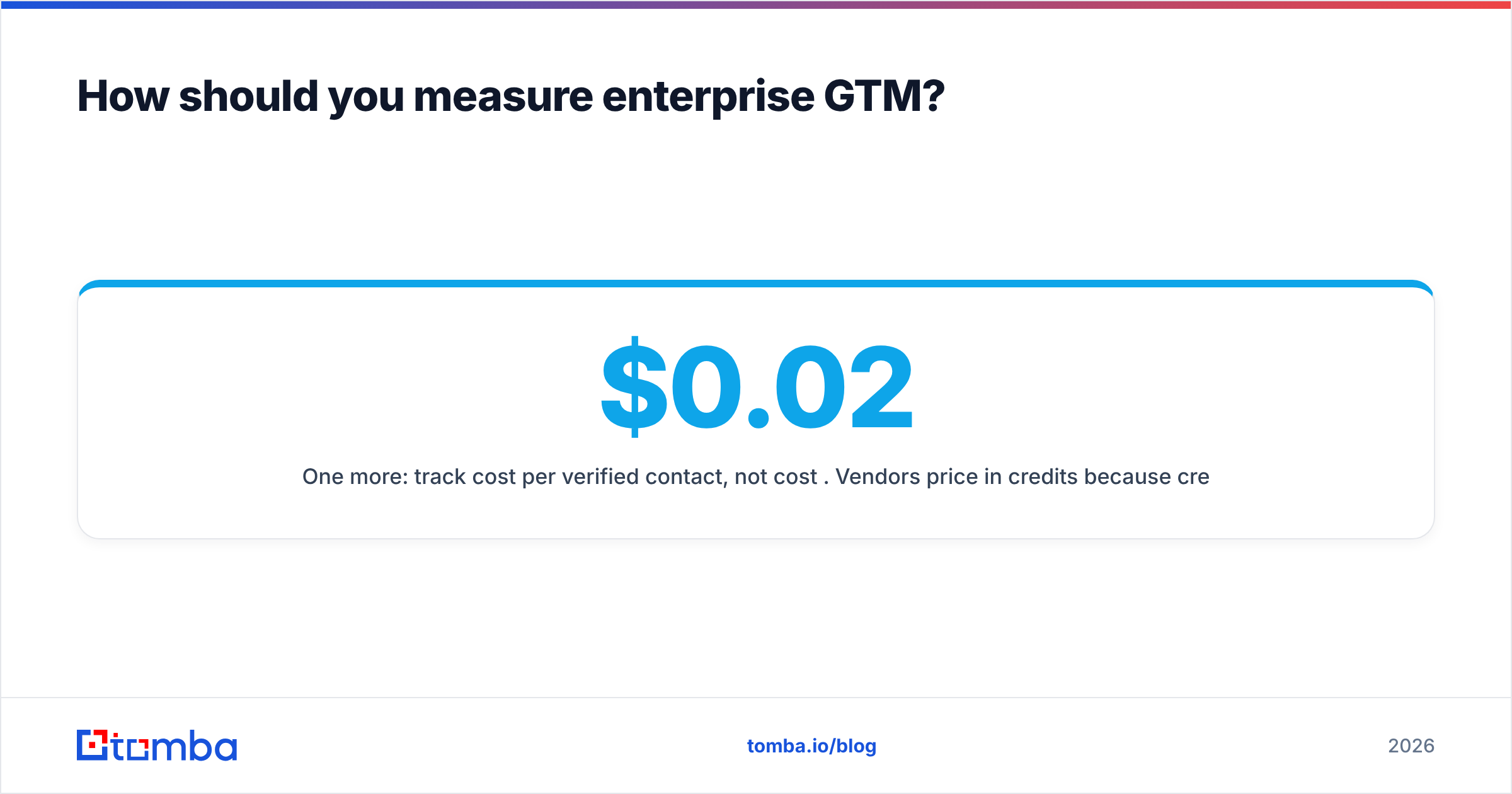
One more: track cost per verified contact, not cost per credit. Vendors price in credits because credits obscure the failure rate. If a provider charges $0.02 per credit but 30% of results bounce, your real cost is $0.029 plus the deliverability damage — and deliverability damage compounds across every campaign that follows.
How do you roll out an enterprise GTM program in 90 days?#
A realistic sequence for a team that already has a CRM and at least a few enterprise logos.
Days 1–15 — Define and clean. Write the enterprise ICP down in one page with hard criteria (employee count, tech stack, geography, trigger events). Deduplicate accounts in the CRM. Agree on one qualification definition across marketing, sales, and RevOps. Nothing else starts until this is signed off.
Days 16–30 — Build the account list. Score and rank your named accounts. Cap the list at what your team can genuinely work — roughly 25–40 accounts per AE for true ABM, not 200. Run a bulk email finder pass across the list to establish baseline contact coverage, then measure the gap by role.
Days 31–50 — Close the coverage gaps. Fill missing buying-committee roles account by account. Verify everything. Add phone coverage for the two or three roles where email response rates are structurally poor — a phone finder pass on economic buyers usually pays for itself within a quarter.
Days 51–70 — Launch the motion. Multi-threaded sequences, differentiated by role rather than by persona label. The security lead and the VP of Ops do not care about the same thing, and sending them the same email tells both of them you did not do the work.
Days 71–90 — Instrument and review. Stand up the four metrics above. Run the first pipeline review against penetration depth rather than activity. Identify which accounts are single-threaded and fix those before adding new accounts.
The temptation at day 60 is to expand the list. Resist it. Enterprise GTM rewards depth over breadth for the first two quarters; breadth is what you earn after the motion converts.
What are the most common enterprise GTM mistakes?#
- Buying intent data before you have contact data. You will learn that Account X is researching your category, then discover you have one contact there and it is a junior analyst who left in March.
- Treating procurement as an obstacle instead of a stage. Procurement has predictable requirements. Prepare the security package, DPA, and reference list in advance and you remove weeks from every cycle.
- Single-threading on the champion. Champions leave, get reorged, or lose budget. Deals with one thread have dramatically worse close rates than deals with four, and this is the cheapest problem on this list to fix.
- Measuring SDRs on meetings booked in an enterprise motion. It produces low-quality meetings with whoever answers. Measure them on qualified accounts penetrated to depth.
- Assuming a bigger tool budget solves a data problem. It does not. It just makes the data problem more expensive to run. Check what your peers actually report on G2 before adding another platform — the gap between category marketing and user reviews is instructive.
Where should you start?#
Start with coverage. Take your top 30 target accounts, and for each one, write down how many verified contacts you have across how many functions. If the average is below five contacts spanning three functions, your enterprise GTM problem is not strategy, positioning, or messaging — it is that you cannot reach the committee that decides.
The Tomba Email Finder is built for exactly that gap: find and verify professional addresses by domain, name, or company, at flat monthly pricing instead of per-seat, so filling coverage gaps across a named-account list does not require a procurement cycle of your own. Start on the free tier with 25 searches to test accuracy against accounts you already know, then scale to Starter at $49/mo when the numbers hold up. Your sequencer, your intent platform, and your forecast all depend on that layer being right first.
Related guides#
Ready to find emails that actually work?
Join 150,000+ professionals who stopped guessing and started sending. Free credits on signup — no credit card required.
Get the Tomba newsletter
Practical outbound tactics and product updates — once every two weeks.
About the author