Enterprise Lead Generation: The 2026 Playbook for Scale
Enterprise lead generation fails on data quality and committee coverage, not effort. Here's the 2026 playbook: channel benchmarks, stack costs, buying-group math, and the metrics that predict pipeline.
TL;DR
- Enterprise lead generation is a buying-group problem, not a lead-volume problem. A single $250K deal needs 6–10 verified contacts across 3+ functions, not 600 unverified MQLs.
- Data decay — not creative — kills most programs. B2B contact data degrades roughly 25–30% per year, so a list you bought in January is materially wrong by summer.
- The channels that still produce enterprise pipeline in 2026: warm outbound to mapped accounts, partner/ecosystem referrals, targeted events, and analyst-adjacent content. Untargeted paid social is the weakest link.
- Budget realistically: a working enterprise stack (data + sequencing + intent + CRM ops) lands between $1,500 and $9,000/month for a 5–10 person GTM team.
- Measure pipeline coverage, buying-group penetration, and meeting-to-opportunity rate. MQL counts are a vanity trap at enterprise deal sizes.
What is enterprise lead generation?#
Enterprise lead generation is the process of identifying, contacting, and qualifying buying groups inside large organizations — typically 1,000+ employees, with deal sizes above $50K and sales cycles running 4 to 18 months.
The word doing the work in that definition is groups. In a mid-market deal you convince a director. In an enterprise deal you convince a director, get budget from a VP, survive a security review, satisfy procurement, and avoid a veto from an adjacent team that wasn't in any of your meetings. Gartner's B2B buying research has consistently put the average buying group at 6–10 stakeholders, each arriving with their own independently gathered information.
That structural fact rewrites everything downstream. Your "lead" is not a person. It's an account with a partially known committee, and your job is to map and cover it.
Think of it like planning a wedding for two families. You can have the best possible relationship with the bride, but if you never talk to the parents paying for the venue, the date never gets set. Enterprise lead gen is stakeholder logistics dressed up as marketing.
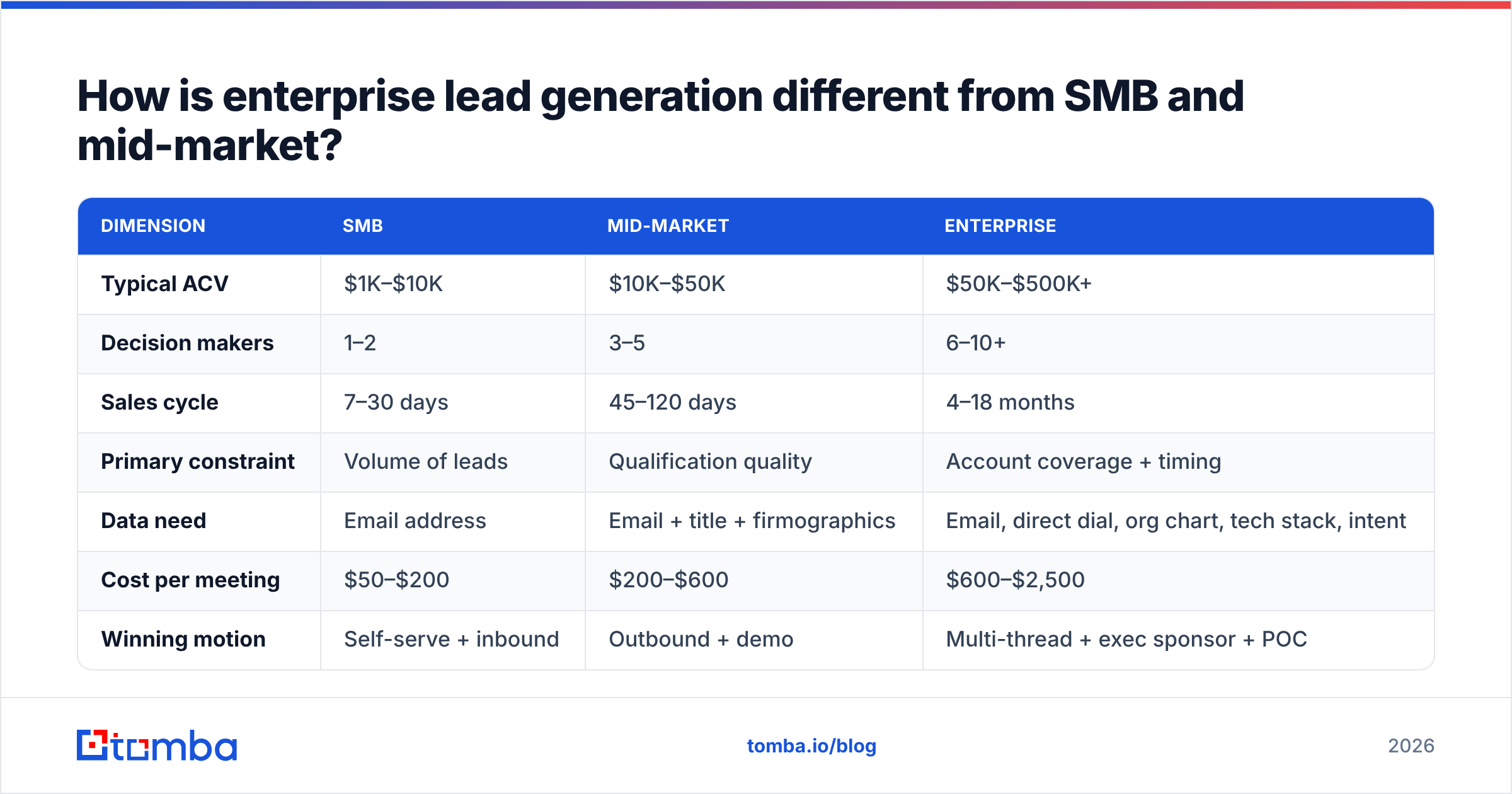
How is enterprise lead generation different from SMB and mid-market?#
The mechanics look similar from the outside — find contacts, send messages, book meetings — but almost every parameter changes.
| Dimension | SMB | Mid-market | Enterprise |
|---|---|---|---|
| Typical ACV | $1K–$10K | $10K–$50K | $50K–$500K+ |
| Decision makers | 1–2 | 3–5 | 6–10+ |
| Sales cycle | 7–30 days | 45–120 days | 4–18 months |
| Primary constraint | Volume of leads | Qualification quality | Account coverage + timing |
| Data need | Email address | Email + title + firmographics | Email, direct dial, org chart, tech stack, intent |
| Cost per meeting | $50–$200 | $200–$600 | $600–$2,500 |
| Winning motion | Self-serve + inbound | Outbound + demo | Multi-thread + exec sponsor + POC |
| Failure mode | Not enough leads | Wrong-fit leads | Single-threaded deals that stall |
The bottom row is the one that costs the most money. Single-threaded enterprise deals — one champion, no exec sponsor, no second function involved — are the largest source of closed-lost/no-decision in most pipelines. And "no decision" outnumbers "lost to competitor" in enterprise categories more often than reps admit in forecast calls.

Why does enterprise lead generation fail more often than it should?#
Five failure modes account for the vast majority of stalled programs. Diagnose yours before you buy another tool.
- Data decay outruns the campaign. Contact records rot at roughly 2–2.5% per month as people change roles, companies restructure, and domains consolidate. A quarterly campaign built on a January export is running on data that is 15–20% wrong by April.
- Single-threading. The rep books a meeting with one enthusiastic manager and treats the account as "in progress" for four months. No second stakeholder, no economic buyer, no procurement path.
- ICP defined by firmographics only. "US, 1,000+ employees, SaaS" is not an ICP — it's a filter. A real enterprise ICP includes a trigger (funding, hiring pattern, tech-stack change, regulatory deadline) that explains why now.
- Volume compensating for precision. Sending 50,000 generic emails to an enterprise list burns domain reputation and gets you blocked at the gateway. Large organizations run aggressive filtering, and one spam-trap-heavy list can quietly kill deliverability for your whole domain.
- Attribution theater. Marketing reports MQLs, sales reports meetings, finance reports revenue, and nobody reconciles the three. When the funnel disagrees with itself, the program gets cut in the next budget cycle.
Fix these in order. Tooling doesn't help until the first three are handled.
What does the enterprise lead generation funnel look like in 2026?#
The modern enterprise funnel is less a funnel than a coverage map. Here's the working sequence most high-performing teams run:
- Account selection. Start from a scored target list of 200–800 accounts, not an open universe. Score on fit (firmographics + tech stack), intent (research signals), and relationship (existing customers, alumni, partner overlap).
- Buying-group mapping. For each account, identify the champion, the economic buyer, the technical evaluator, the security/compliance gate, and the likely blocker. Five roles minimum.
- Contact acquisition and verification. Resolve those roles into real, deliverable contact records. This is where an email finder and an email verifier do the heavy lifting — pattern-matching a name to a domain is cheap; confirming the mailbox actually accepts mail is what protects your sender reputation.
- Multi-channel sequencing. Email plus LinkedIn plus phone, spaced over 3–5 weeks, with different messages per role. The CFO does not care about your API.
- Warm-up and nurture for the 90%. Most mapped accounts aren't in-market this quarter. Route them to a low-frequency nurture track and re-trigger on signal, not on calendar.
- Handoff with context. The AE receives the account map, not a lead record. Every stakeholder, every touch, every objection already logged in the CRM.
Which channels actually produce enterprise pipeline?#
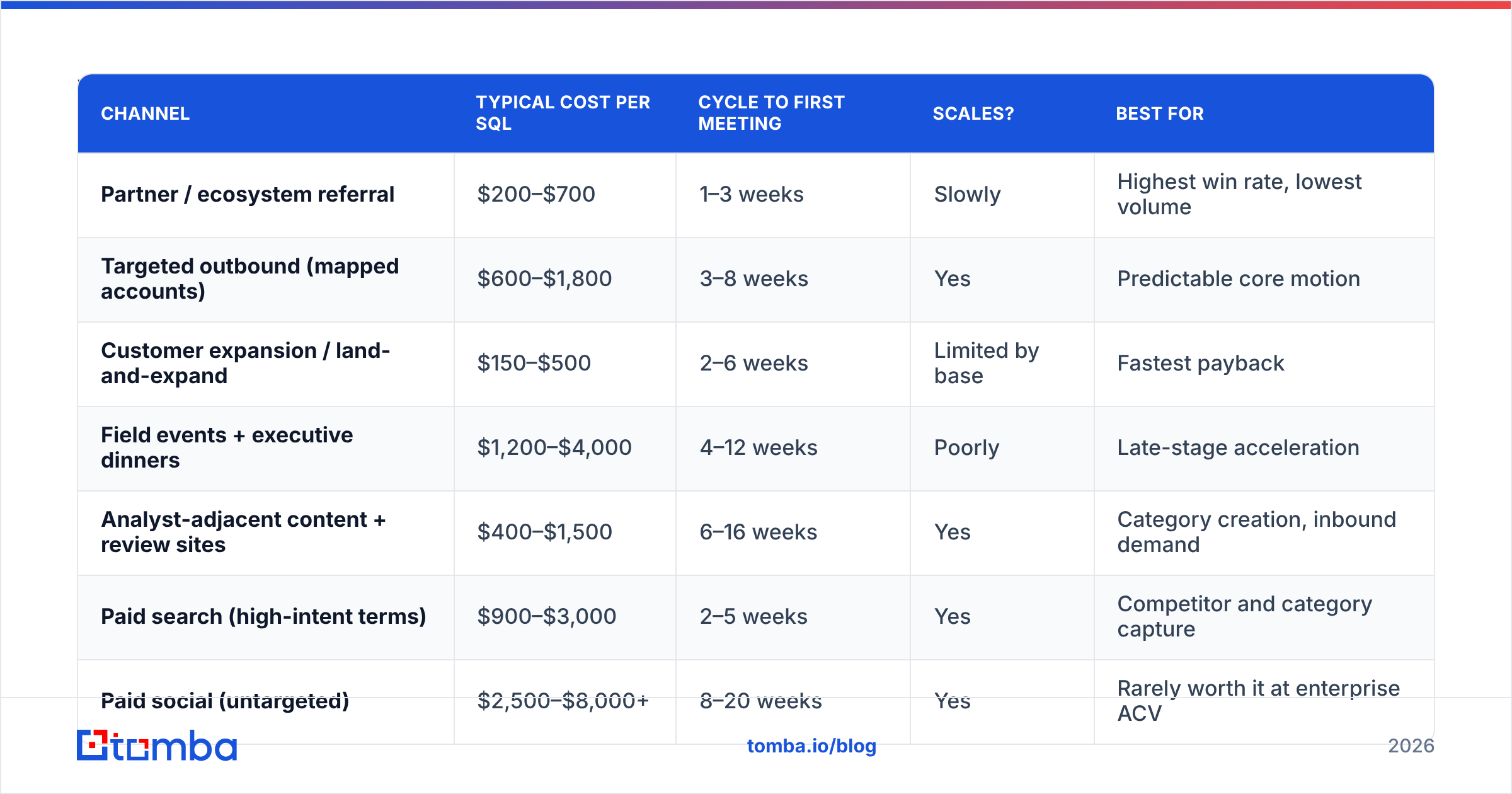
Channel performance varies by category, but the rank order below holds up across most B2B software and services companies at enterprise ACV.
| Channel | Typical cost per SQL | Cycle to first meeting | Scales? | Best for |
|---|---|---|---|---|
| Partner / ecosystem referral | $200–$700 | 1–3 weeks | Slowly | Highest win rate, lowest volume |
| Targeted outbound (mapped accounts) | $600–$1,800 | 3–8 weeks | Yes | Predictable core motion |
| Customer expansion / land-and-expand | $150–$500 | 2–6 weeks | Limited by base | Fastest payback |
| Field events + executive dinners | $1,200–$4,000 | 4–12 weeks | Poorly | Late-stage acceleration |
| Analyst-adjacent content + review sites | $400–$1,500 | 6–16 weeks | Yes | Category creation, inbound demand |
| Paid search (high-intent terms) | $900–$3,000 | 2–5 weeks | Yes | Competitor and category capture |
| Paid social (untargeted) | $2,500–$8,000+ | 8–20 weeks | Yes | Rarely worth it at enterprise ACV |
| Cold calling (direct dials) | $500–$1,600 | 1–4 weeks | Yes | Breaking into non-responsive accounts |
Two notes on reading this table. First, cost per SQL is not the decision metric — win rate is. Partner referrals cost more attention per deal but close at 2–3x the rate of cold outbound, which is why they belong at the top. Second, review-site presence compounds: buyers who arrive from G2 or a peer recommendation are further along and less price-sensitive.
Direct dials still matter more than most content marketers believe. If your team runs phone as a real channel, a phone finder that returns mobile numbers rather than switchboard lines is the difference between 4% and 20% connect rates.
How do you build the data layer for enterprise lead generation?#
The data layer is the part nobody wants to own and everybody blames. Build it in four passes.
Pass 1 — Account resolution. Turn your target list into canonical domains. Enterprise accounts have subsidiaries, regional domains, and acquired brands; "Acme Corp" might be six domains in your CRM. Deduplicate before you spend a cent on contacts.
Pass 2 — Contact discovery. Run domain search against each canonical domain to see the email pattern and the roster of known contacts, then fill role gaps by name. For accounts where LinkedIn is your source of truth, a LinkedIn finder converts profiles into work emails without manual pattern guessing.
Pass 3 — Verification. Verify everything before it enters a sequence. Enterprise domains are disproportionately catch-all configured, which means a naive SMTP check returns "valid" for addresses that don't exist. Use a catch-all verifier so those records get a real confidence score instead of a false green light.
Pass 4 — Enrichment and refresh. Attach firmographics, tech stack, and headcount trend, then re-run data enrichment on a rolling 90-day cycle. Set it as a job, not a project — this is the pass that stops decay from compounding.
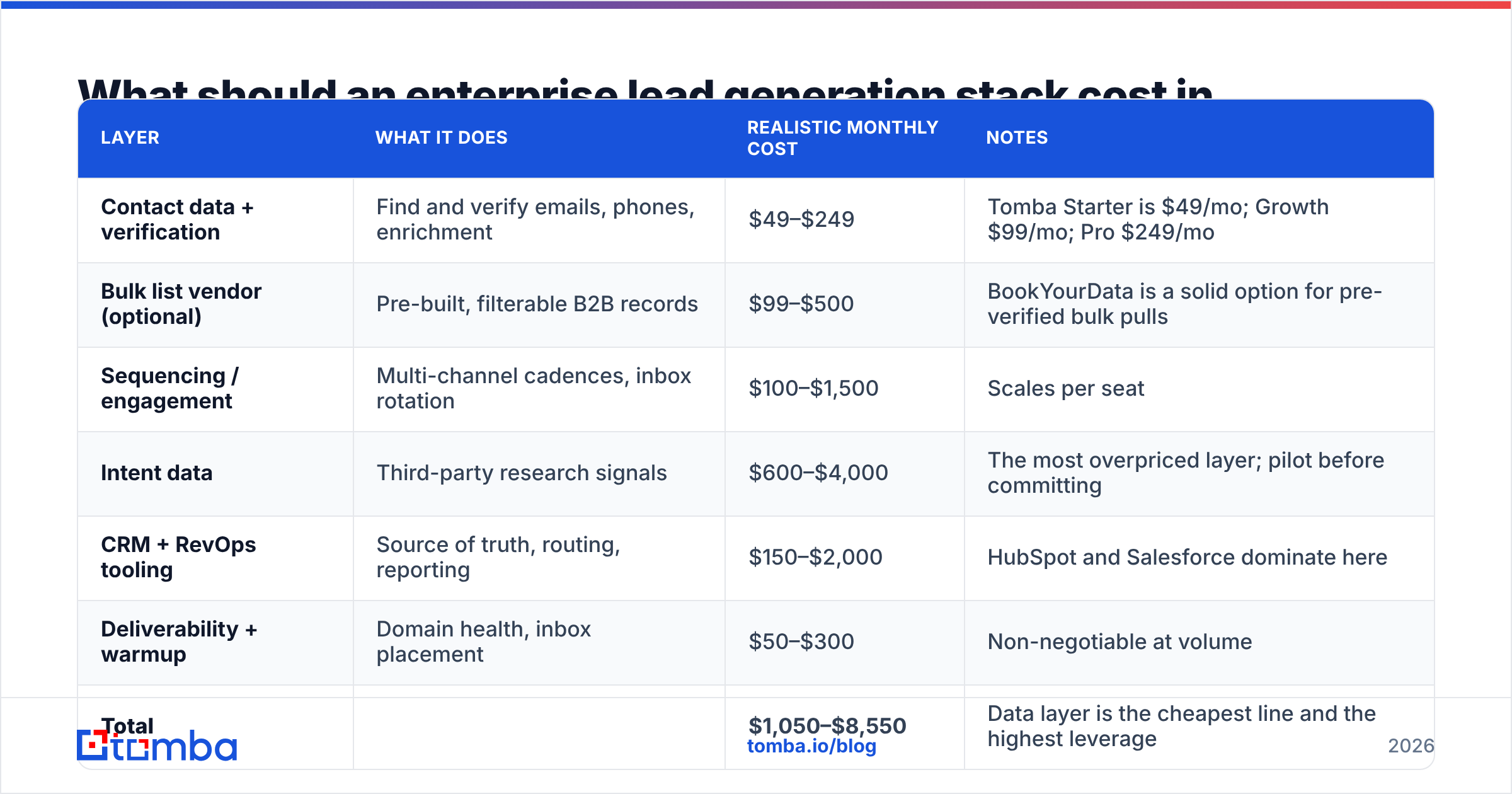
What should an enterprise lead generation stack cost in 2026?#
Here's a realistic monthly budget for a 5–10 person GTM team running an enterprise motion.
| Layer | What it does | Realistic monthly cost | Notes |
|---|---|---|---|
| Contact data + verification | Find and verify emails, phones, enrichment | $49–$249 | Tomba Starter is $49/mo; Growth $99/mo; Pro $249/mo |
| Bulk list vendor (optional) | Pre-built, filterable B2B records | $99–$500 | BookYourData is a solid option for pre-verified bulk pulls |
| Sequencing / engagement | Multi-channel cadences, inbox rotation | $100–$1,500 | Scales per seat |
| Intent data | Third-party research signals | $600–$4,000 | The most overpriced layer; pilot before committing |
| CRM + RevOps tooling | Source of truth, routing, reporting | $150–$2,000 | HubSpot and Salesforce dominate here |
| Deliverability + warmup | Domain health, inbox placement | $50–$300 | Non-negotiable at volume |
| Total | $1,050–$8,550 | Data layer is the cheapest line and the highest leverage |
The counterintuitive line is the first one. Contact data is typically 3–8% of the stack cost but determines whether the other 92% produces anything. Teams routinely spend $4,000/month on intent data while feeding their sequencer a list with a 22% bounce rate. Compare Tomba pricing against what you're paying per usable, verified record — not per raw credit — and the math usually reorders itself.
If you need pre-built volume rather than on-demand lookups, bulk vendors like BookYourData fill that role well; the two approaches complement each other more than they compete. Bulk gets you breadth, on-demand lookup gets you the specific VP of Infrastructure you just identified on the security review call.
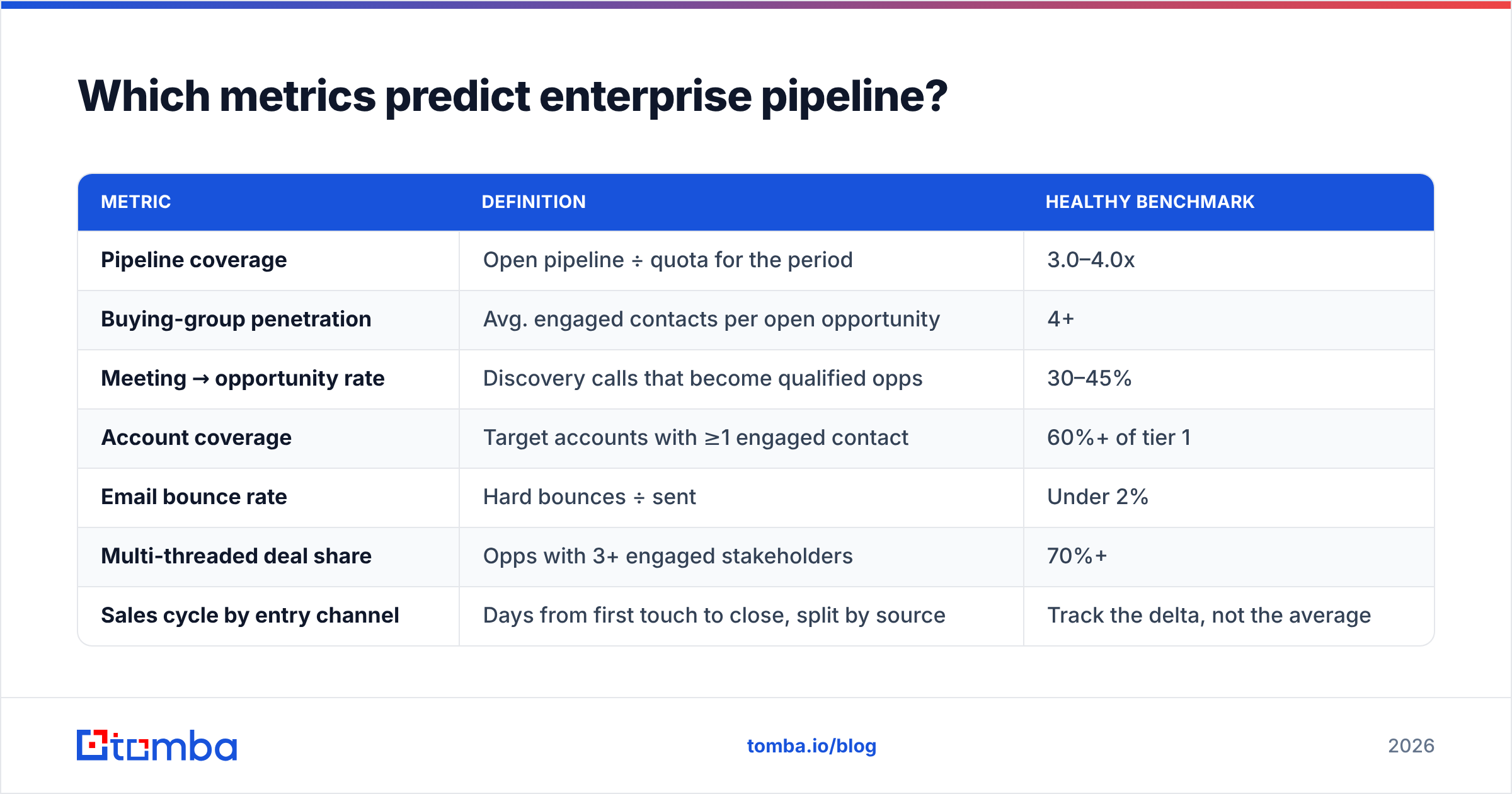
Which metrics predict enterprise pipeline?#
Stop reporting MQLs. At $150K ACV, an MQL count tells you nothing about whether Q3 closes. Track these instead:
| Metric | Definition | Healthy benchmark |
|---|---|---|
| Pipeline coverage | Open pipeline ÷ quota for the period | 3.0–4.0x |
| Buying-group penetration | Avg. engaged contacts per open opportunity | 4+ |
| Meeting → opportunity rate | Discovery calls that become qualified opps | 30–45% |
| Account coverage | Target accounts with ≥1 engaged contact | 60%+ of tier 1 |
| Email bounce rate | Hard bounces ÷ sent | Under 2% |
| Multi-threaded deal share | Opps with 3+ engaged stakeholders | 70%+ |
| Sales cycle by entry channel | Days from first touch to close, split by source | Track the delta, not the average |
Buying-group penetration is the single best leading indicator in the list. When average engaged contacts per opportunity drops below three, forecast accuracy collapses about a quarter later — and by then you're explaining a miss instead of preventing one. Forrester's B2B revenue research has been making this point about group-based buying for years, and every operator who's watched a "committed" deal evaporate because one unmet stakeholder said no already believes it.
How do you run this without a 20-person team?#
Sequence the build. Most teams try to do all of it at once and end up with a half-configured intent platform and no verified contacts.
Weeks 1–2: Fix the list. Deduplicate accounts, define one trigger-based ICP, cut your target list to the 300 accounts you can actually cover. Smaller is faster.
Weeks 3–4: Fix the data. Map five roles per account, resolve contacts, verify everything. Kill anything unverified — do not "test it in the sequence."
Weeks 5–8: Run one channel well. Pick outbound or partner referral. One channel executed properly beats four executed at 40%. Instrument it so you can see meeting → opportunity conversion by segment.
Weeks 9–12: Add the second channel and a refresh job. Only now do you layer intent or events, and only after the bulk verification refresh is running on a schedule.
Ongoing: Review quarterly, refresh monthly. Enterprise ICPs drift as your product moves upmarket. The account list you built a year ago is probably targeting the company you used to be.
The honest summary#
Enterprise lead generation rewards precision over volume, and coverage over creativity. The teams that win are not the ones with the cleverest subject lines — they're the ones whose data is accurate, whose accounts are mapped to five roles instead of one, and whose refresh cycle runs faster than their data decays.
Everything else is optimization on top of a foundation that either exists or doesn't.
If your foundation is the weak link, start there. The Tomba Email Finder resolves names and domains into verified, deliverable work emails, with domain search for full account rosters, catch-all handling for the enterprise domains that break naive verification, and enrichment to keep records current as your committee map grows. The free tier gives you 25 searches a month to test it against accounts you already know — run it on ten contacts you're sure about before you trust it with the ones you aren't.
Related guides#
Ready to find emails that actually work?
Join 150,000+ professionals who stopped guessing and started sending. Free credits on signup — no credit card required.
Get the Tomba newsletter
Practical outbound tactics and product updates — once every two weeks.
About the author