Enterprise Revenue Ops in 2026: The Complete Playbook
Enterprise revenue ops fails on data quality far more often than on strategy. Here is the org model, tech stack, metric set, and 90-day rollout that actually holds up at 500+ employees.
TL;DR
- Enterprise revenue ops is not "sales ops with a bigger budget." It is a single accountable function that owns the data, systems, process, and forecast across marketing, sales, and customer success.
- The failure mode at enterprise scale is almost never strategy. It is a contact and account data layer that decays 25-30% per year and quietly breaks routing, scoring, territories, and attribution.
- The org model that works is a hub-and-spoke: a central RevOps core owning the system of record, with embedded ops partners inside each GTM team.
- Your stack should be four layers — CRM, data/enrichment, engagement, and analytics. Buy the layers that are commoditized; build only the routing and scoring logic that encodes your specific GTM motion.
- Fix the data layer in the first 30 days. Everything downstream (forecast accuracy, SLA compliance, pipeline coverage) is a function of whether your records are complete and current.
What is enterprise revenue ops, exactly?#
Enterprise revenue ops is the function that owns the end-to-end revenue engine — data, systems, process, and reporting — across every customer-facing team, at a company large enough that those teams have stopped talking to each other by default.
The distinction matters. At 40 employees, "revenue ops" is one analyst who fixes Salesforce reports and cleans lists. At 2,000 employees, you have a marketing ops team, a sales ops team, a CS ops team, a deal desk, a systems admin group, and a BI function — all producing numbers that disagree. Enterprise revenue operations exists to collapse that disagreement into one accountable owner.
Gartner has been blunt about the driver: companies that unify their go-to-market operations under a single function outperform those that keep marketing, sales, and service ops in separate reporting lines, largely because the alternative produces duplicated tooling and irreconcilable definitions. You can read their ongoing coverage of RevOps and B2B growth for the analyst framing.
Three things separate enterprise RevOps from its mid-market cousin:
- Scope of the system of record. You are not administering a CRM. You are governing a data model that a dozen downstream systems read from, where one field rename breaks four dashboards and a comp plan.
- Change management is the actual job. Rolling out a new lead-routing rule to 600 reps across nine regions is a communications and enablement project, not a config change.
- Auditability. Enterprise forecasts feed board decks and, in public companies, guidance. Every number needs a traceable lineage back to a source record.
Why do enterprise revenue ops teams stall?#
They stall on data, not on strategy. This is the single most consistent pattern.
Every enterprise RevOps roadmap I have seen opens with something ambitious — unified attribution, AI-assisted forecasting, a propensity model, a full territory redesign. Six months later, the team is still reconciling accounts because the same company exists in the CRM four times with three spellings and two different domains.
Here is the arithmetic that kills projects. B2B contact data decays at roughly 22-30% per year as people change jobs, companies rebrand, and domains consolidate. A 400,000-record CRM built over five years without continuous enrichment is, conservatively, half wrong. Now layer your routing rules on top of the Employee Count field, your scoring model on Industry, and your territory carve on Billing Country — three fields that were populated by a rep in a hurry in 2021.
The visible symptoms are always downstream:
- Reps say leads are "bad" and stop working the queue, so response rate benchmarks look terrible and marketing gets blamed.
- Routing sends enterprise accounts to SMB reps because the firmographic field is blank and the fallback rule catches it.
- Forecast rollups are off because opportunity records inherit the wrong account hierarchy.
- Your ABM platform reports 60% account match rates and nobody can explain the missing 40%.

None of these are strategy problems. They are all one problem wearing four hats.
What should the enterprise revenue ops org chart look like?#
Use a hub-and-spoke model. A centralized core owns the system of record and the definitions; embedded partners sit inside each GTM team and own execution velocity.
- RevOps leader (VP/Sr. Director). Reports to the CRO or COO, not to the VP of Sales. If RevOps reports into sales, the forecast becomes a negotiation instead of a measurement.
- Systems and platform. Owns CRM architecture, the data model, integrations, and technical debt. This is the team that says no to the 47th custom field.
- Data and enrichment. Owns record completeness, dedupe, enrichment vendors, and the account hierarchy. At enterprise scale this is a full-time function, not a quarterly cleanup project.
- Analytics and forecasting. Owns pipeline inspection, forecast methodology, cohort analysis, and the metric dictionary. Every metric gets exactly one definition and one owner.
- Enablement and process. Owns playbook operationalization, SLA design, and the change-management motion when process shifts.
- Embedded ops partners. One per GTM function (demand gen ops, sales ops by segment, CS ops). They report solid-line to RevOps, dotted-line to the function they serve — which keeps definitions consistent while staying responsive.
The ratio that tends to work at enterprise scale is roughly one RevOps headcount per 25-40 quota-carrying or customer-facing reps. Below that you get a ticket queue with a six-week backlog. Above it, you get people inventing work.
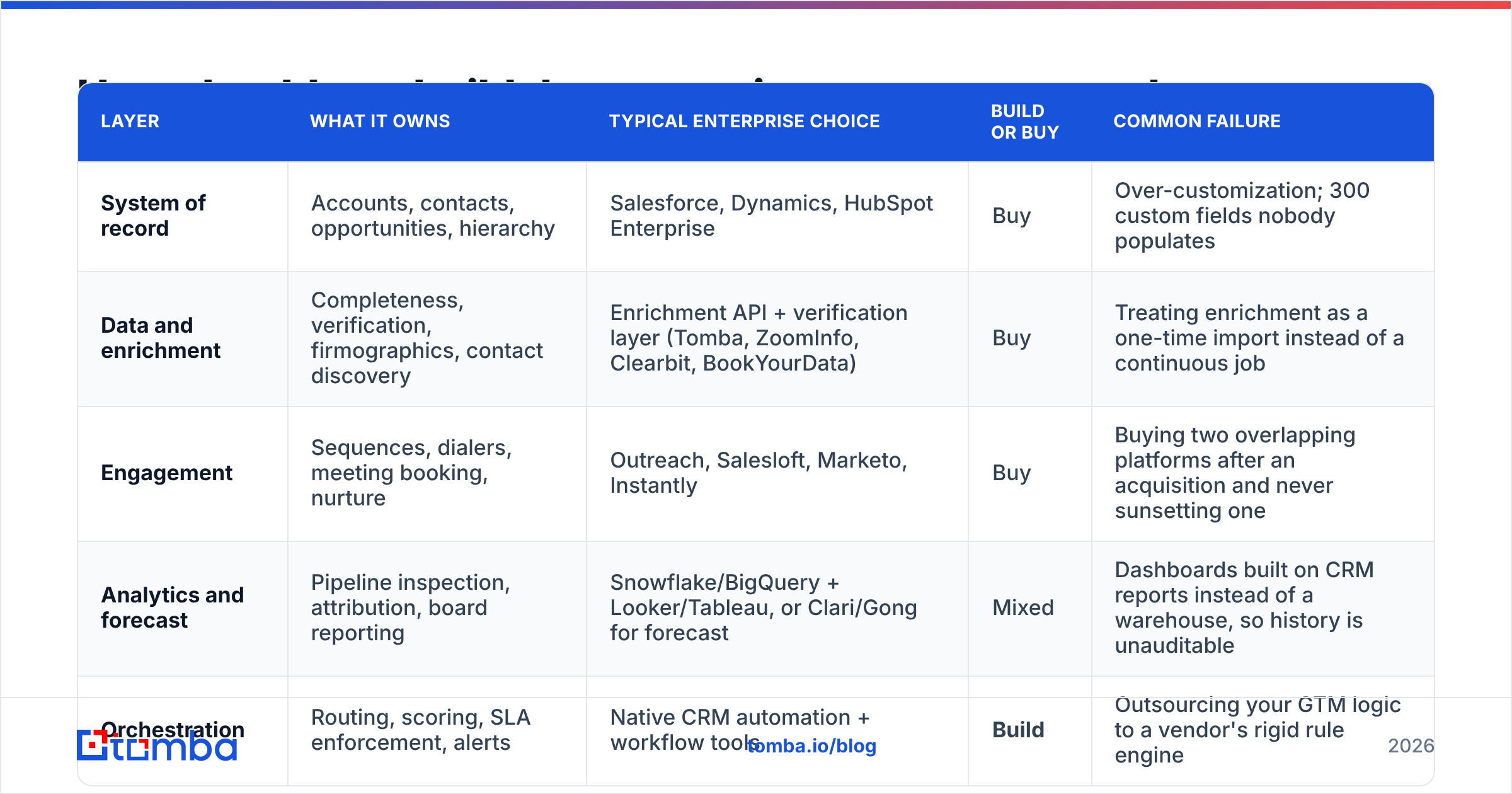
How should you build the enterprise revenue ops tech stack?#
Four layers. Buy what is commoditized, build only the logic that encodes your specific motion.
| Layer | What it owns | Typical enterprise choice | Build or buy | Common failure |
|---|---|---|---|---|
| System of record | Accounts, contacts, opportunities, hierarchy | Salesforce, Dynamics, HubSpot Enterprise | Buy | Over-customization; 300 custom fields nobody populates |
| Data and enrichment | Completeness, verification, firmographics, contact discovery | Enrichment API + verification layer (Tomba, ZoomInfo, Clearbit, BookYourData) | Buy | Treating enrichment as a one-time import instead of a continuous job |
| Engagement | Sequences, dialers, meeting booking, nurture | Outreach, Salesloft, Marketo, Instantly | Buy | Buying two overlapping platforms after an acquisition and never sunsetting one |
| Analytics and forecast | Pipeline inspection, attribution, board reporting | Snowflake/BigQuery + Looker/Tableau, or Clari/Gong for forecast | Mixed | Dashboards built on CRM reports instead of a warehouse, so history is unauditable |
| Orchestration | Routing, scoring, SLA enforcement, alerts | Native CRM automation + workflow tools | Build | Outsourcing your GTM logic to a vendor's rigid rule engine |
Two notes on this table.
First, the orchestration layer is the one place you should build. Routing rules, scoring weights, and SLA thresholds encode how your company actually sells. Vendors sell you a generic version of that, and generic routing is how enterprise accounts land in the SMB queue.
Second, the data layer is where enterprise teams overspend and under-deliver. The default move is a single six-figure data contract that covers 70% of your ICP and leaves you with no answer for the rest. The better architecture is a primary database plus a programmatic fallback: when a record is missing or stale, an API call fills it in real time. That is what a data enrichment endpoint is for, and it is why the Tomba API exists as an infrastructure layer rather than a UI-only product — RevOps teams wire it into the CRM workflow so records self-heal instead of waiting for a quarterly cleanse.

Which metrics should enterprise revenue ops actually own?#
Own the metrics that cross team boundaries. Leave the within-team metrics to the teams.
| Metric | Definition RevOps enforces | Why it belongs to RevOps | Healthy enterprise benchmark |
|---|---|---|---|
| Pipeline coverage | Open pipeline ÷ quota for the period, by segment | Marketing and sales will define this differently on purpose | 3.0-4.0x for the current quarter |
| Speed to lead | Minutes from form fill to first human touch | Spans marketing routing and sales SLA | Under 5 minutes for inbound demo requests |
| Forecast accuracy | Absolute % variance of week-3 commit vs. actual close | The forecast is a RevOps product, not a sales opinion | Within 5% at the segment level |
| Data completeness | % of active accounts with all required fields populated and verified | Nobody else is incentivized to care | 90%+ on routing-critical fields |
| Stage conversion | Rate between each defined stage, with exit criteria enforced | Stage definitions drift without a central owner | Tracked by segment, not blended |
| CAC payback | Fully-loaded GTM spend ÷ new ARR gross margin, in months | Requires finance + marketing + sales data joined | 12-18 months for enterprise SaaS |
The discipline here is the metric dictionary. One definition, one owner, one query. When a VP asks why the number in the board deck differs from their dashboard, you should be able to answer in under five minutes, and the answer should never be "different filters."
How do you fix the data layer first?#
Sequence it as a 30-day sprint before any other roadmap item.
Week 1 — Measure the damage. Pull a sample of 5,000 active accounts. Score each on completeness (are routing-critical fields populated?) and accuracy (does the primary contact's email still resolve?). Run the contacts through an email verifier to get a hard number on bounce risk. You now have a baseline that turns "our data is bad" into "31% of our enterprise-tier accounts have an unreachable primary contact."
Week 2 — Dedupe and set hierarchy. Merge duplicate accounts, establish parent-child relationships for multi-entity customers, and pick one canonical domain per account. This is unglamorous and it unblocks everything else, including ABM matching and territory fairness.
Week 3 — Wire continuous enrichment. Stop treating enrichment as a batch import. Attach an enrichment call to record creation and to a scheduled refresh for accounts touched in the last 12 months. If your CRM is Salesforce, the Salesforce integration pattern is straightforward: enrich on create, re-verify on a cadence, flag records that fail verification for review rather than silently overwriting.
Week 4 — Instrument and alert. Build a data-health dashboard that any GTM leader can open. Set alerts for completeness dropping below threshold on routing-critical fields. Data quality that is not monitored regresses to the mean within two quarters.
Only after this do you attempt scoring models, attribution, or AI forecasting. Every one of those is a function that takes your data as input, and no model survives a bad input layer. HubSpot's own RevOps research and guidance lands in the same place: alignment work fails when the underlying record layer is not trustworthy.
Should you build or buy your enterprise revenue ops capability?#
Buy the platforms, build the logic, and be honest about which consulting spend actually transfers knowledge.
- Buy: CRM, data and verification, engagement platforms, BI tooling. These are commoditized. Your competitive advantage is not a homegrown dialer.
- Build: Routing, scoring, territory logic, the metric dictionary, and the forecast methodology. These encode how you win.
- Contract carefully: Systems integrators are useful for a migration with a hard deadline. They are a bad substitute for permanent headcount, because the institutional knowledge leaves with them. If you use an SI, require documentation and pairing as a deliverable, not an afterthought.
On vendor selection, resist the urge to run a 40-criteria RFP. Score on four things: match rate against a sample of your ICP (not the vendor's demo list), API quality and rate limits, contractual data-refresh commitments, and the total cost at your actual volume including overage. Peer review on G2 is useful for filtering, but nothing replaces running 500 of your own accounts through each candidate's API and comparing the output side by side.
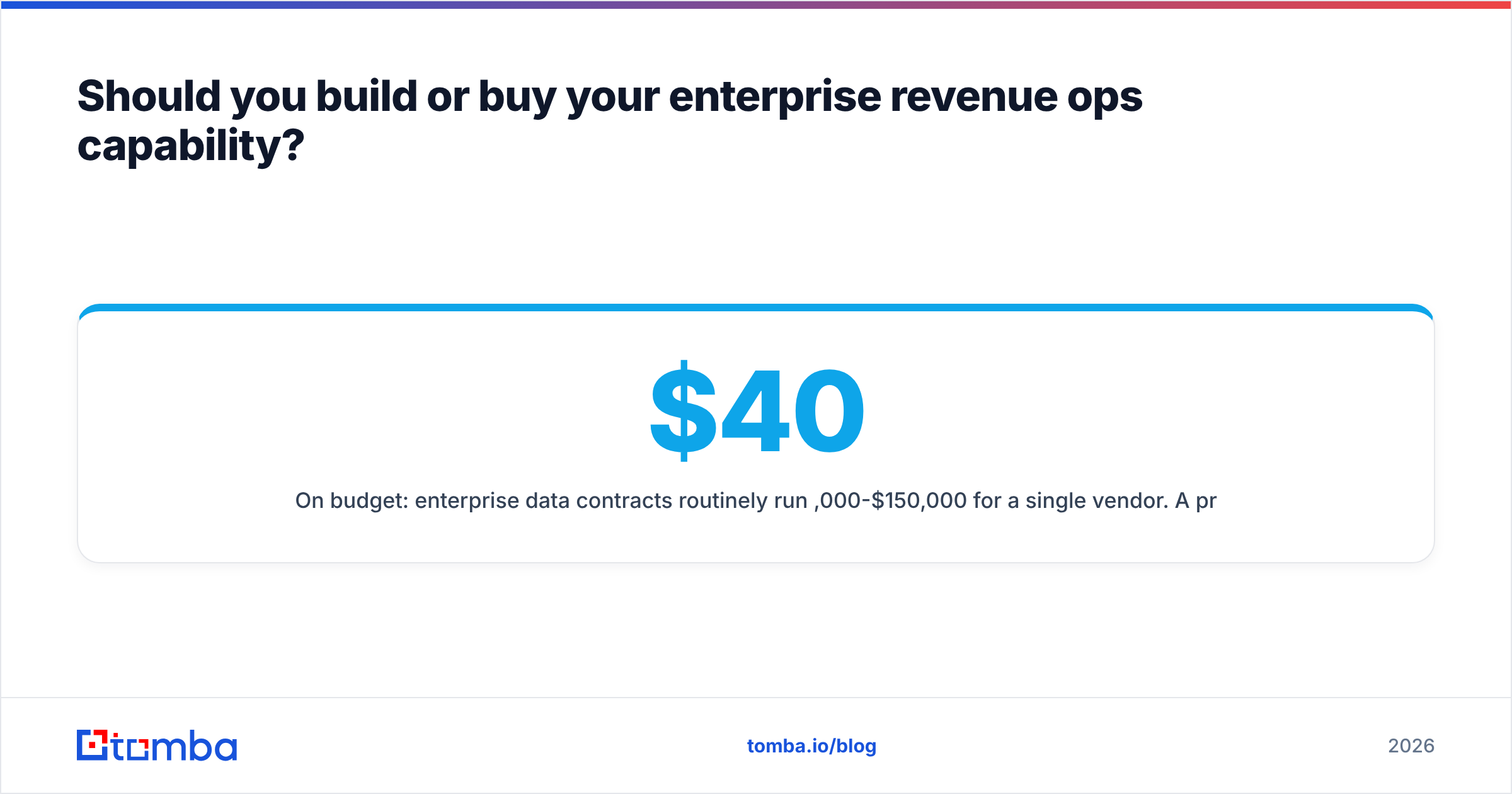
On budget: enterprise data contracts routinely run $40,000-$150,000 per year for a single vendor. A programmatic layer priced per lookup — Tomba pricing starts at $49/mo on Starter, with Growth at $99/mo and Pro at $249/mo — often makes more sense as the fallback tier for the accounts your primary database misses. The point is not that one is better; it is that a two-tier data architecture costs less and covers more than a single monolithic contract.
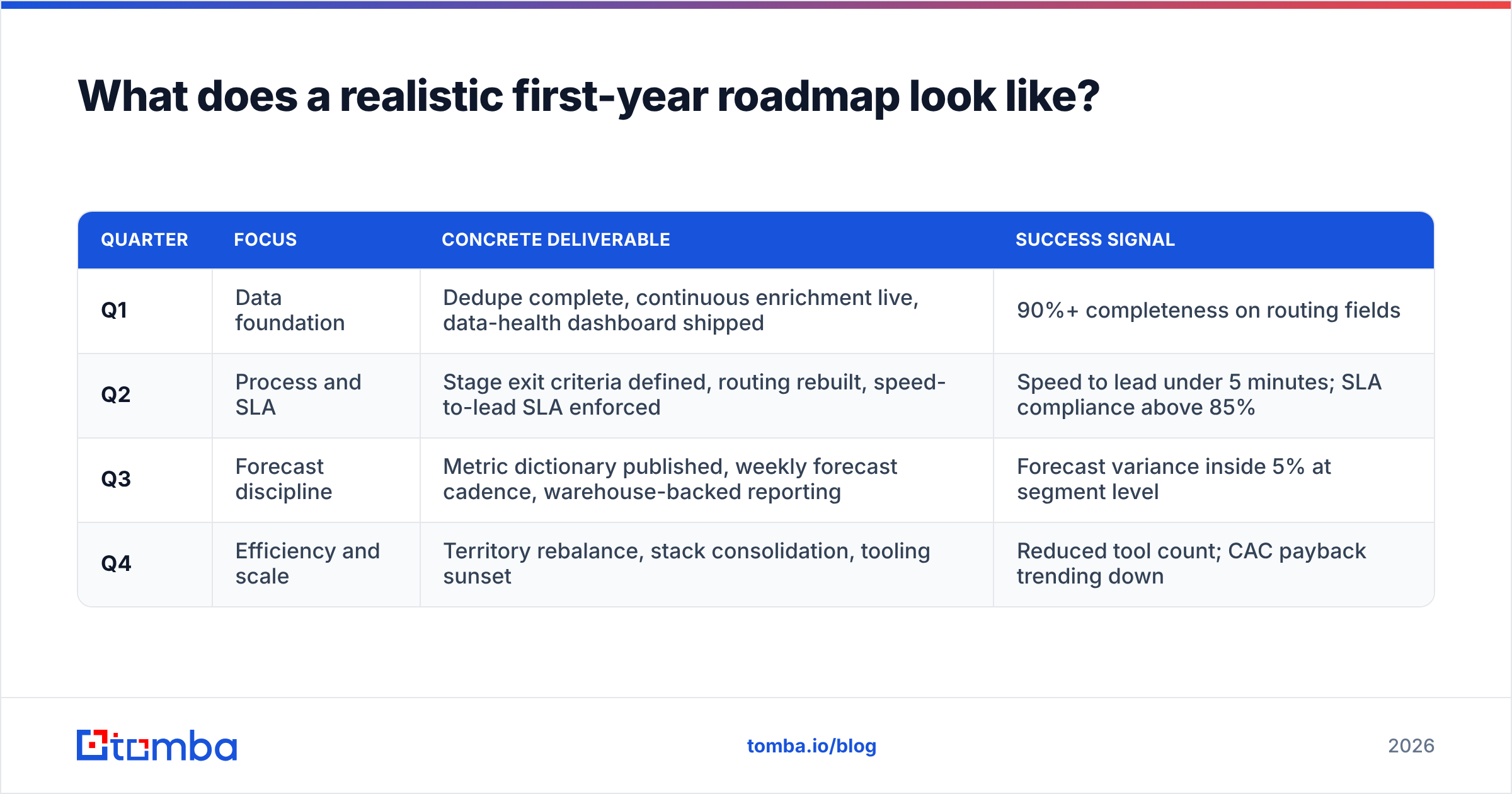
What does a realistic first-year roadmap look like?#
| Quarter | Focus | Concrete deliverable | Success signal |
|---|---|---|---|
| Q1 | Data foundation | Dedupe complete, continuous enrichment live, data-health dashboard shipped | 90%+ completeness on routing fields |
| Q2 | Process and SLA | Stage exit criteria defined, routing rebuilt, speed-to-lead SLA enforced | Speed to lead under 5 minutes; SLA compliance above 85% |
| Q3 | Forecast discipline | Metric dictionary published, weekly forecast cadence, warehouse-backed reporting | Forecast variance inside 5% at segment level |
| Q4 | Efficiency and scale | Territory rebalance, stack consolidation, tooling sunset | Reduced tool count; CAC payback trending down |
Notice what is not on this roadmap: an AI initiative in Q1. AI-assisted forecasting and scoring are genuinely useful, and they are also the single fastest way to launder bad data into confident-sounding predictions. Earn the right to model by fixing the inputs first.
The bottom line#
Enterprise revenue ops succeeds or fails on whether your records are complete, current, and trustworthy. Org design, tooling, and metrics all sit on top of that layer, and none of them compensate for it.
If your first move is auditing what is actually in your CRM, start where the damage is easiest to quantify: contactability. Run your priority accounts through the Tomba Email Finder to find and verify the decision-makers your records are missing, then wire the same lookup into your CRM workflow so new and stale records self-heal instead of decaying quietly for another year. The free tier covers 25 searches a month if you just want to size the problem before you spend anything.
Related guides#
Ready to find emails that actually work?
Join 150,000+ professionals who stopped guessing and started sending. Free credits on signup — no credit card required.
Get the Tomba newsletter
Practical outbound tactics and product updates — once every two weeks.
About the author