Enterprise Sales in 2026: How to Win Six-Figure B2B Deals
Enterprise deals take 6-18 months, involve 11 stakeholders, and die quietly in procurement. Here's the 2026 playbook for running them — from account selection to mutual close plan.
TL;DR
- Enterprise sales means deals above roughly $50K ACV with 6-18 month cycles, 6-11 stakeholders, and a procurement gate that kills more deals than competitors do.
- The single biggest predictor of a closed enterprise deal is not discovery quality — it's how many people inside the account you have a real relationship with. Single-threaded deals close at roughly half the rate of multithreaded ones.
- Your ICP list matters more than your pitch. Twenty accounts researched properly beat 2,000 accounts sprayed.
- Build a mutual action plan by the second call, not the last. Deals without a written close plan slip by a full quarter on average.
- Contact data decay (about 25-30% annually in B2B) quietly wrecks enterprise motions, because your champion changes jobs mid-cycle and nobody notices for six weeks.
What is enterprise sales, exactly?#
Enterprise sales is the practice of selling high-value, high-complexity products to large organizations where no single person can say yes. That last clause is the whole definition. If one person can sign, you're doing mid-market or SMB sales with a bigger number attached.
The practical thresholds most GTM teams use in 2026:
- Deal size — $50K+ annual contract value, often $100K-$1M+.
- Cycle length — 6 to 18 months from first meeting to signed paper, sometimes longer in regulated industries.
- Buying committee — 6 to 11 people touch the decision, per Gartner's long-running B2B buying research.
- Procurement involvement — a formal vendor review, security questionnaire, and legal redline pass.
- Custom scope — pilots, SOWs, implementation plans, and negotiated SLAs rather than a self-serve checkout.
- Executive sponsorship — a VP or C-level owner whose budget the money comes from, and who you often never meet until month four.
Miss any one of those and you're likely running a different motion. A $60K deal that closes in three weeks off a single demo isn't enterprise sales — it's a lucky mid-market deal, and copying its playbook into your enterprise segment will burn a year.

Actually, use the placeholder image below for that section:
How is enterprise sales different from SMB and mid-market?#
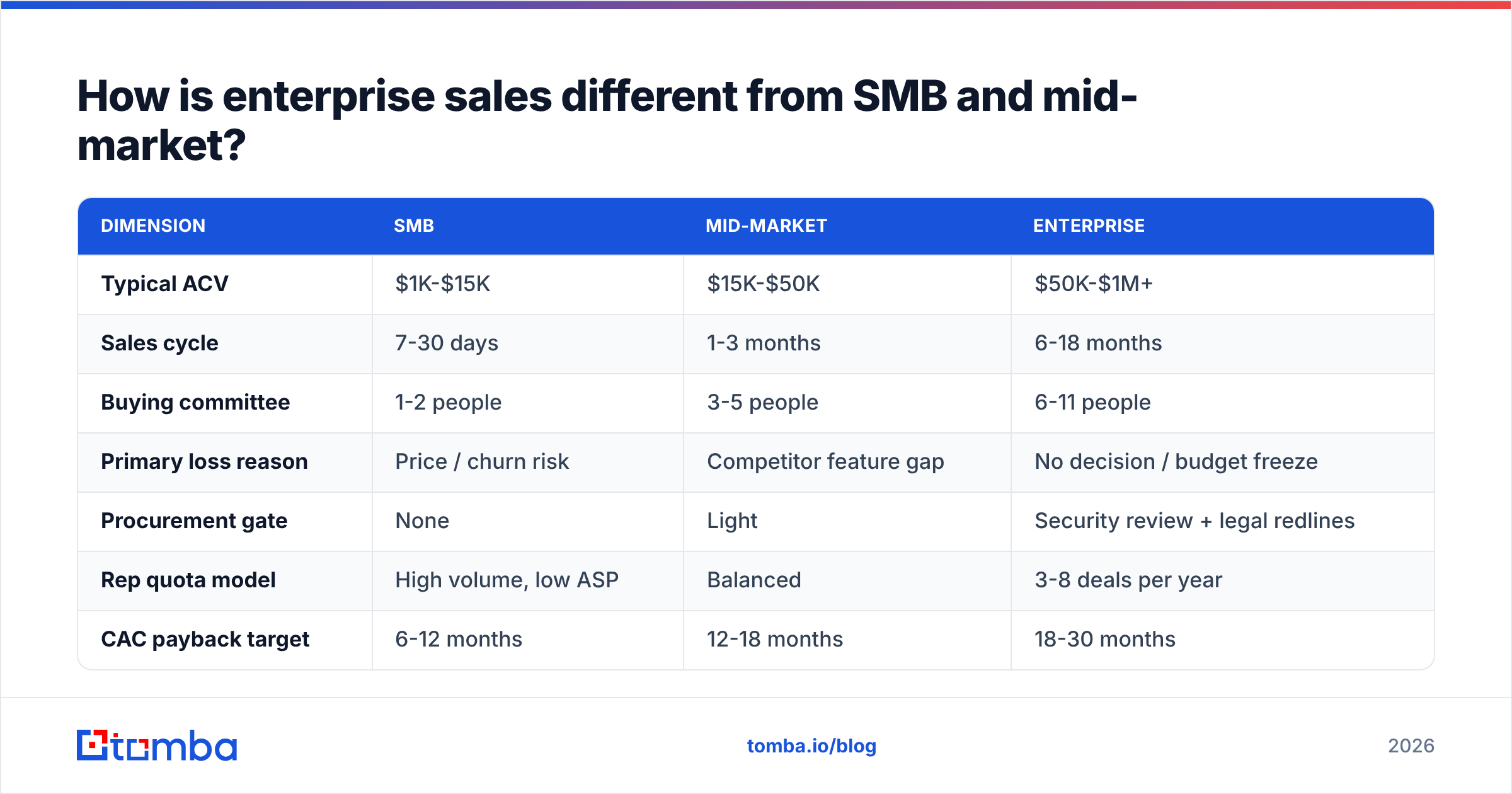
The difference is not "bigger number, same process, more patience." The economics, the risk profile, and the failure modes all change.
| Dimension | SMB | Mid-market | Enterprise |
|---|---|---|---|
| Typical ACV | $1K-$15K | $15K-$50K | $50K-$1M+ |
| Sales cycle | 7-30 days | 1-3 months | 6-18 months |
| Buying committee | 1-2 people | 3-5 people | 6-11 people |
| Primary loss reason | Price / churn risk | Competitor feature gap | No decision / budget freeze |
| Procurement gate | None | Light | Security review + legal redlines |
| Rep quota model | High volume, low ASP | Balanced | 3-8 deals per year |
| CAC payback target | 6-12 months | 12-18 months | 18-30 months |
| Data requirement | Bulk lists | Verified contacts | Org-chart-level mapping |
The row that trips teams up is "primary loss reason." In SMB, you lose to a competitor. In enterprise, your most common competitor is the status quo. Forrester and Gartner have both published repeatedly that "no decision" accounts for a large share of enterprise pipeline losses — often more than any named vendor. That means your pitch isn't competing on feature parity. It's competing against a busy VP deciding this quarter isn't the quarter.
Which changes what you build the deal around: not differentiation, but cost of inaction, quantified in the buyer's own numbers.
How do you pick the right enterprise accounts?#
Account selection is where enterprise sales is won or lost, and it happens before anyone sends an email.
Start from a tight ICP definition — not a firmographic wish list, but the pattern your best five customers share. Look at:
- Trigger events — funding rounds, new exec hires in the buying function, M&A, a public compliance deadline, a competitor's contract renewal window.
- Tech stack fit — if your product needs Salesforce or Snowflake to be valuable, accounts without them are noise no matter how large they are.
- Org shape — does a team exist that owns the problem? If the function doesn't exist, you're selling a category, not a product, and that's a 24-month cycle.
- Existing relationship surface — investors, advisors, former colleagues, current customers who moved. This is the cheapest path into a logo and most teams never audit it.
Then cap the list. A dedicated enterprise AE can meaningfully work about 25-50 named accounts. Give them 400 and you get shallow coverage across all of them, which converts like a spray campaign with a fancier title.
Once the list is set, map the org before you write a single line of outreach. You want names and roles for the economic buyer, the technical evaluator, the end-user champion, and the likely blocker in security or finance. Tools like a domain search let you pull the verified contact surface for a target company in one pass, and a LinkedIn finder converts the org chart you've mapped on LinkedIn into reachable addresses. The point isn't volume — it's that you cannot multithread an account whose contacts you can't reach.
Who is actually on the enterprise buying committee?#
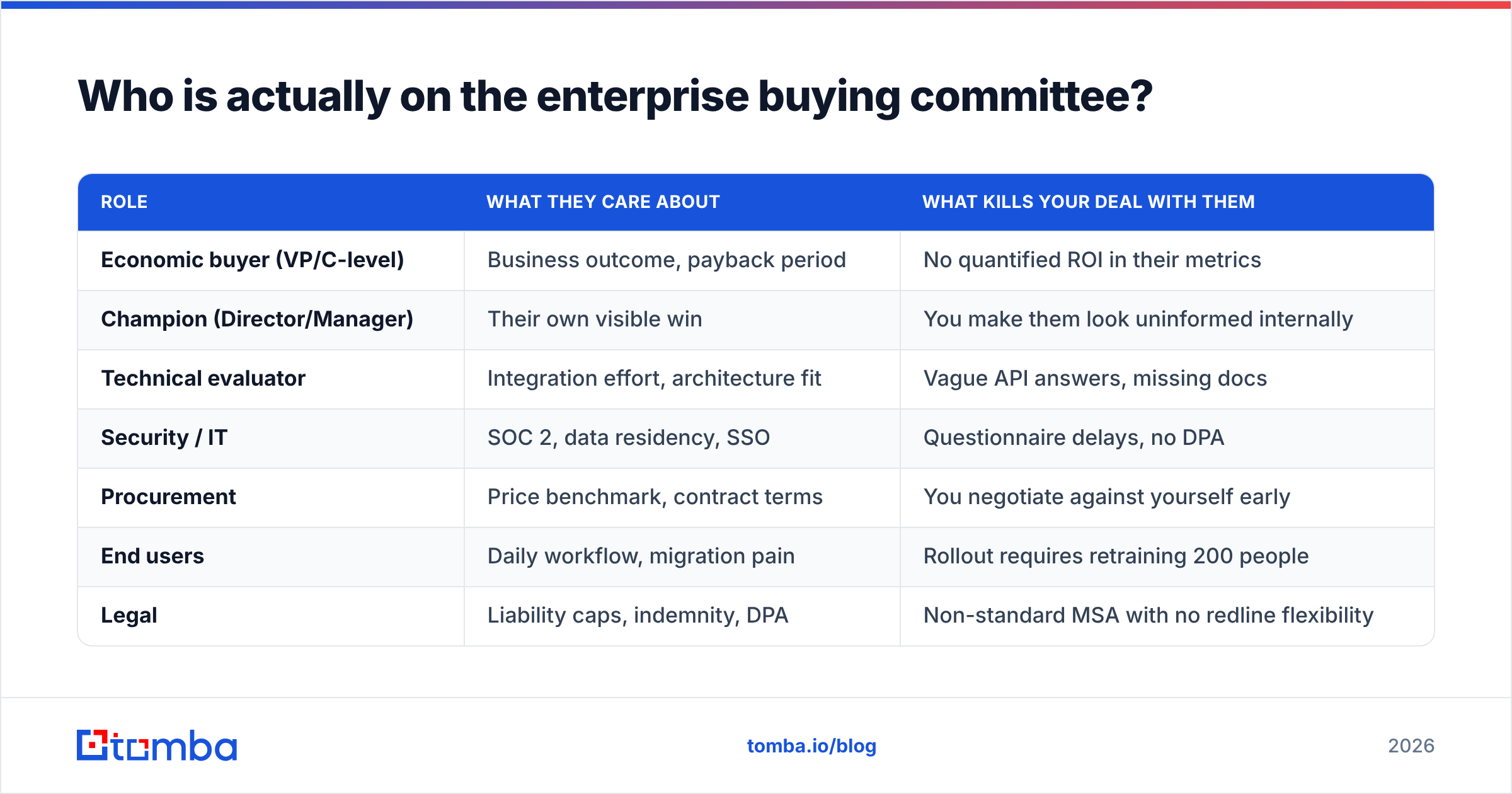
Six to eleven people, and they want different things. Selling one message to all of them is the most common enterprise mistake.
| Role | What they care about | What kills your deal with them |
|---|---|---|
| Economic buyer (VP/C-level) | Business outcome, payback period | No quantified ROI in their metrics |
| Champion (Director/Manager) | Their own visible win | You make them look uninformed internally |
| Technical evaluator | Integration effort, architecture fit | Vague API answers, missing docs |
| Security / IT | SOC 2, data residency, SSO | Questionnaire delays, no DPA |
| Procurement | Price benchmark, contract terms | You negotiate against yourself early |
| End users | Daily workflow, migration pain | Rollout requires retraining 200 people |
| Legal | Liability caps, indemnity, DPA | Non-standard MSA with no redline flexibility |
Your champion is not your decision maker, and treating them as one is why forecasted deals evaporate. The champion's real job is to sell internally when you're not in the room. So your actual deliverable to them isn't a demo — it's an internal business case they can forward without editing.
Practical test: ask your champion, "If I disappeared tomorrow, could you present this to your CFO?" If the answer is anything but a confident yes, you don't have a deal. You have a fan.
What does the enterprise sales process look like end to end?#
Seven stages, and the exit criteria matter more than the stage names.
- Account research and mapping — org chart built, 3+ named contacts identified, trigger event documented. Exit: you can name the economic buyer.
- Multithreaded outreach — 3-5 personas contacted with role-specific angles, not one message blasted sideways. Exit: first meeting booked with someone who owns the problem.
- Discovery — current-state cost quantified in their numbers, decision process mapped, budget cycle known. Exit: written pain statement your champion agrees with.
- Technical validation — pilot or POC with defined success criteria signed off in advance. Exit: evaluator says "this works."
- Business case — ROI model, mutual action plan, executive alignment call. Exit: economic buyer has seen the number.
- Procurement and legal — security review, redlines, pricing negotiation. Exit: paper in signature flow.
- Close and handoff — signature, kickoff scheduled, success criteria transferred to CS. Exit: implementation date on a calendar.
Stage 4 is where most teams get sloppy. A pilot without written success criteria is a free trial that ends in "let's revisit next quarter." Define, in writing, before the pilot starts: what metric, measured how, over what period, and what happens if it's hit. Buyers respect this. It's also the fastest way to disqualify a deal that was never real.
Why do enterprise deals stall, and how do you prevent it?#
Stalls have a small number of repeat causes, and each has a specific counter.
Single-threading. Your champion goes on parental leave, gets promoted, or leaves. If they were your only relationship, the deal restarts at zero — often without you knowing for weeks. Counter: minimum three active relationships per account, and re-verify contact data monthly. B2B contact data decays roughly 25-30% per year, faster in high-churn functions like marketing and sales ops. Running your account contacts through an email verifier on a schedule catches the "champion left in March" problem in days instead of at QBR.
No compelling event. Without a deadline the buyer owns — a contract expiry, an audit, a board commitment, a product launch — enterprise deals default to next quarter forever. Counter: find or co-create the event during discovery. "What happens if this isn't solved by Q3?" If the honest answer is "nothing," you have a nice-to-have.
Procurement ambush. You reach month five, then discover the vendor onboarding process takes nine weeks and requires three documents you don't have. Counter: ask about the procurement process in the second meeting, not the last.
Executive absence. If the economic buyer has never been in a room with you, your deal is a proposal on a pile. Counter: trade access for value — offer a benchmark, a peer intro, or an executive-to-executive session. Champions will make the intro if you make them look good doing it.
Death by consensus. With 11 people involved, the decision reverts to the most risk-averse participant. Counter: identify the likely blocker early and sell to them first, on their terms — usually security, compliance, or migration risk rather than features.
What metrics should you track in an enterprise motion?#
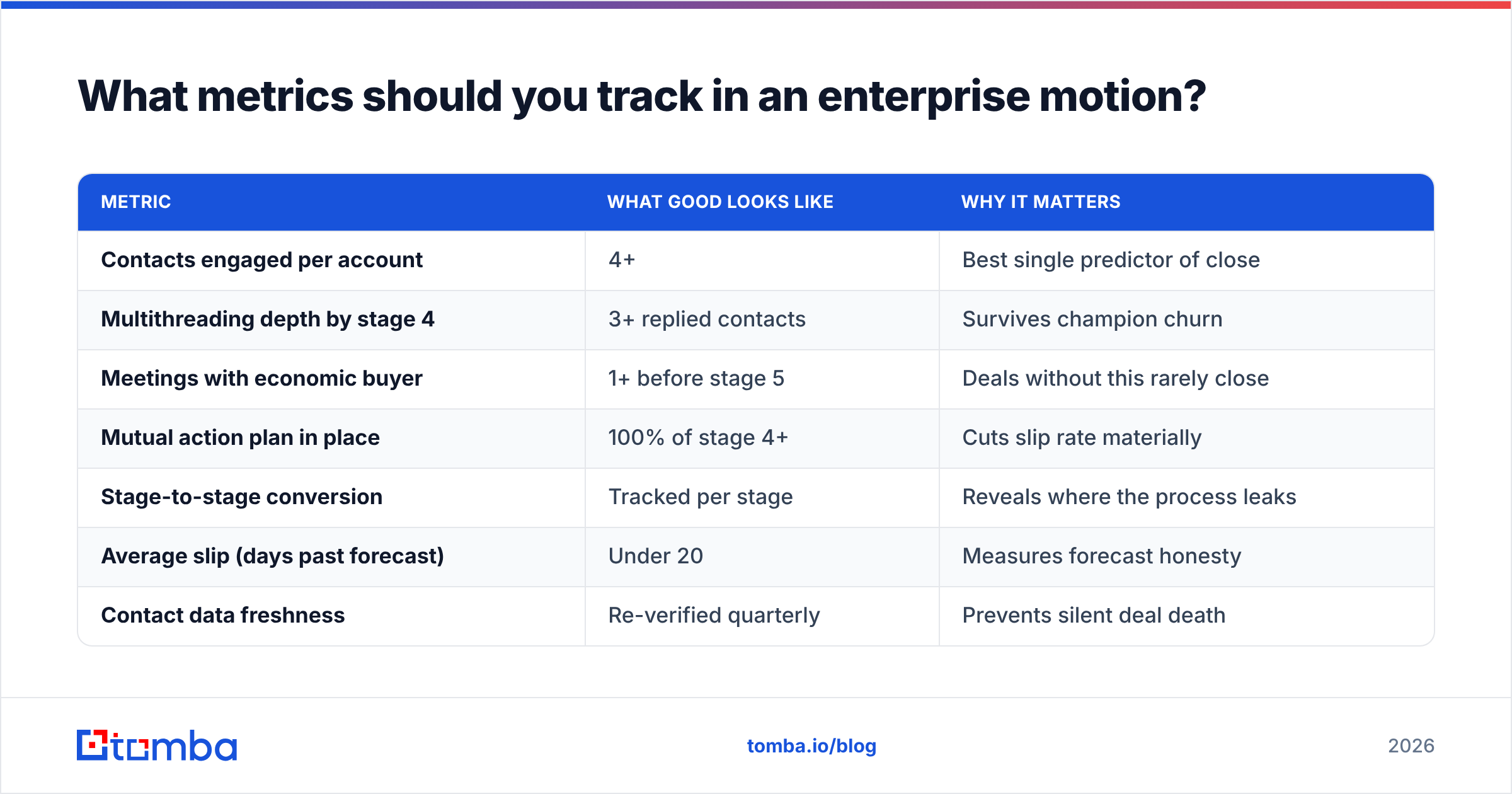
Pipeline coverage and win rate are lagging by six months in this motion. Track leading indicators instead.
| Metric | What good looks like | Why it matters |
|---|---|---|
| Contacts engaged per account | 4+ | Best single predictor of close |
| Multithreading depth by stage 4 | 3+ replied contacts | Survives champion churn |
| Meetings with economic buyer | 1+ before stage 5 | Deals without this rarely close |
| Mutual action plan in place | 100% of stage 4+ | Cuts slip rate materially |
| Stage-to-stage conversion | Tracked per stage | Reveals where the process leaks |
| Average slip (days past forecast) | Under 20 | Measures forecast honesty |
| Contact data freshness | Re-verified quarterly | Prevents silent deal death |
If you track one thing, make it contacts engaged per account. Every enterprise team that measures it finds the same shape: deals with one engaged contact close at roughly half the rate of deals with four or more. It's the cheapest lever you have, and unlike "better discovery," you can actually manage it week to week.
What tools does an enterprise sales team actually need?#
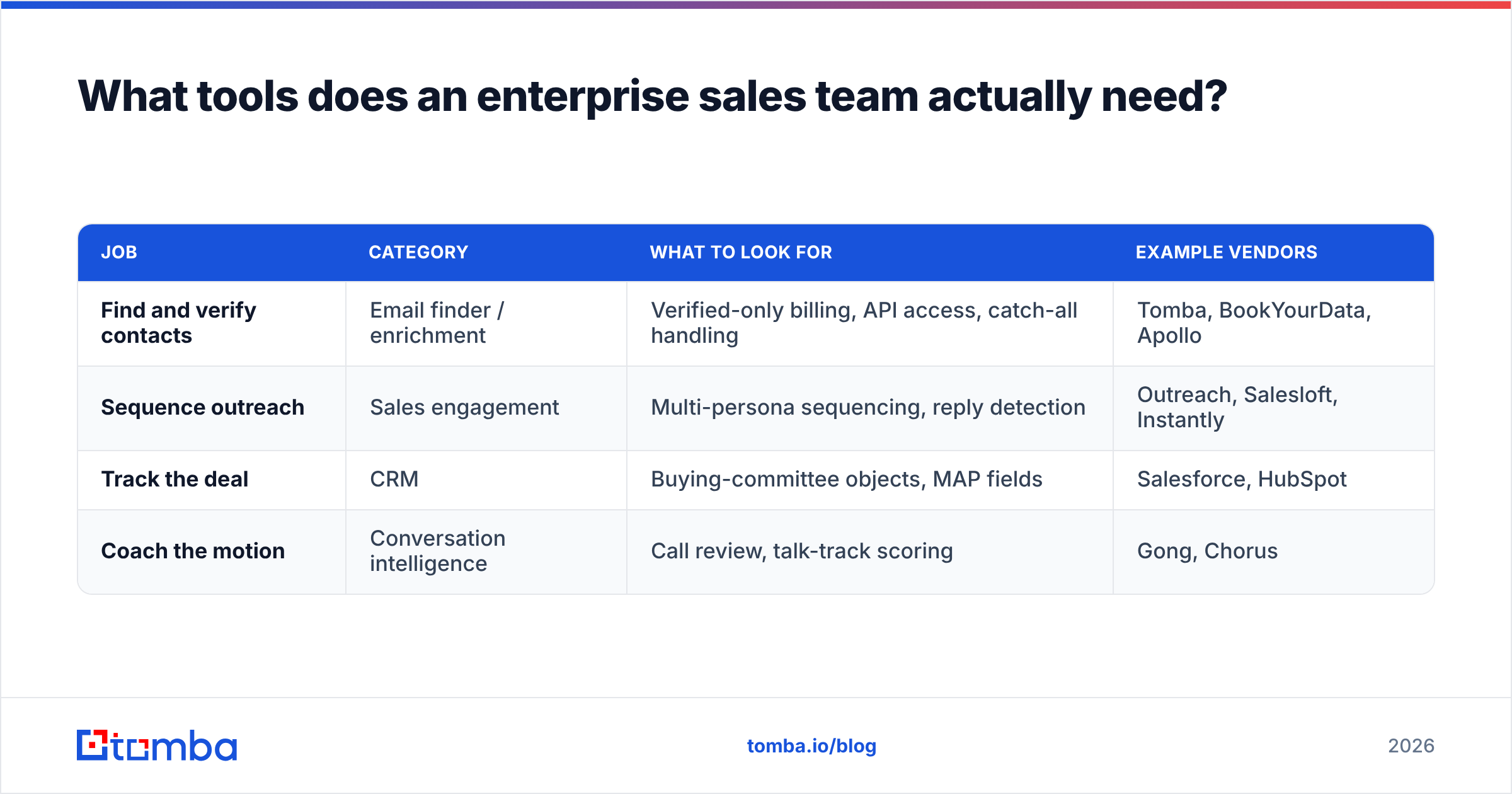
Fewer than vendors would like you to believe. The stack breaks into four jobs.
| Job | Category | What to look for | Example vendors |
|---|---|---|---|
| Find and verify contacts | Email finder / enrichment | Verified-only billing, API access, catch-all handling | Tomba, BookYourData, Apollo |
| Sequence outreach | Sales engagement | Multi-persona sequencing, reply detection | Outreach, Salesloft, Instantly |
| Track the deal | CRM | Buying-committee objects, MAP fields | Salesforce, HubSpot |
| Coach the motion | Conversation intelligence | Call review, talk-track scoring | Gong, Chorus |
The data layer is the one people under-invest in and then blame the sequencer for. If 20% of your enterprise contacts bounce, your sender reputation drops, your deliverability drops, and your carefully sequenced multi-persona campaign never reaches the two people who mattered. Verification isn't a nice-to-have in an account-based motion — it's the precondition.
For teams sourcing contacts directly, Tomba pricing starts with a free tier at 25 searches per month, then $49/mo for Starter, $99/mo for Growth, and $249/mo for Pro, with Enterprise on custom terms. BookYourData is a solid peer option if you prefer buying pre-built lists with a pay-as-you-go structure rather than a monthly search allowance — different shape, same job. Compare on verified-contact cost rather than headline credit counts; a cheap credit that returns a bounce costs more than an expensive one that lands.
For pipelines that already run in a warehouse or an automation layer, hitting the Tomba API directly is usually cleaner than exporting CSVs between tools — you enrich the account list at the moment your ICP filter fires, not two weeks later when the data is already stale.
How do you write outreach that lands in an enterprise account?#
Role-specific, event-anchored, and short. That's it.
The economic buyer gets one paragraph about a business number. The technical evaluator gets integration specifics and a link to docs. The end user gets a workflow comparison. Sending all three the same "quick question" email is how enterprise sequences get 0.4% reply rates.
Anchor on the trigger event you found during research. "Saw you're standing up a RevOps function after the Series C" outperforms any subject-line trick, because it proves you did work before you asked for time. Generic personalization tokens — first name, company name, city — read as automation in 2026 and buyers filter them out.
Cadence matters less than most people think, but sequencing across channels does not. A LinkedIn view, then an email, then a comment on their post, then a call, over three weeks, reaches people that six emails never will. Track response rate per persona rather than per sequence — the aggregate number hides the fact that your CTO messaging is dead while your VP Ops messaging works.
One more thing: enterprise buyers research you before replying. Make sure the person they find on LinkedIn and the person emailing them are recognizably the same, with the same point of view. Consistency does more for reply rates than any template.
Is enterprise sales worth building for your company?#
Not always. Run the math before you hire an enterprise AE.
The honest test: can you name three current customers who would have paid you 5x what they did, and explain what you'd have had to deliver to earn it? If you can't, you don't have an enterprise product yet — you have an SMB product with an aspirational price list, and hiring a $200K-OTE AE to sell it will cost you 12 months and a lot of goodwill.
If you can, the build order matters. Security posture (SOC 2 at minimum) before pipeline. Reference customers before quota. Implementation capacity before the first close, because a botched enterprise onboarding kills the reference you needed for the next three deals. Enterprise revenue is durable and expands — net revenue retention above 120% is normal for good enterprise SaaS versus roughly break-even in SMB — but it compounds slowly and punishes teams that skip the foundations.
Also budget honestly. An enterprise motion needs an AE, an SE or solutions consultant, and marketing air cover. Running it with one rep and a demo deck is how companies conclude "enterprise doesn't work for us" when what didn't work was the staffing model.
Where do you start this week?#
Pick 25 accounts. Map the buying committee for each one — five names minimum, roles labeled. Verify every address before it enters a sequence. Write three role-specific messages instead of one generic one. Put a mutual action plan in front of every deal past discovery.
That's not a transformation program. It's a week of work, and it will tell you more about your enterprise readiness than a quarter of pipeline reviews.
The contact-mapping step is the part that quietly determines everything downstream, because a deal you can't multithread is a deal you're gambling on one person's tenure. Tomba Email Finder finds and verifies professional addresses across a target company by domain, name, or role — so you can build a five-person committee map per account instead of hoping your champion stays. Start on the free tier at 25 searches a month, and scale to Starter at $49/mo when your named-account list outgrows it.
Sources and further reading: Gartner B2B buying research, Forrester B2B revenue insights, G2 sales software category.
Related guides#
// get started
Find, verify and enrich your first contacts today
Start on the free plan with 25 searches a month, then scale when your team is ready.
Free plan · No credit card required · GDPR & CCPA
// about the author