Enterprise Sales Enablement: The Complete 2026 Playbook
Enterprise sales enablement fails on adoption and data quality far more often than on content volume. Here is the 2026 stack, the operating rhythm, the real costs, and the metrics that actually move win rates.
TL;DR
- Enterprise sales enablement is an operating system, not a content library. The differentiator at 200+ seats is governance, routing, and measurement — not how many decks you produced last quarter.
- The most common failure mode is adoption, not creation. Enablement teams ship assets nobody can find, in a CRM nobody trusts, and then report on downloads instead of win rate.
- Platform spend ($45K–$400K+/year for Highspot, Seismic, Showpad, Mindtickle class tools) is usually the second-largest line item. Headcount is the first.
- Bad contact data quietly taxes every other investment. If 20% of your account records have dead emails and wrong titles, your sequencing, routing, and ABM plays all inherit that error rate.
- Measure four things: ramp time, content-influenced win rate, sales cycle length by segment, and quota attainment spread. Everything else is a vanity metric.
What is enterprise sales enablement, and how is it different at mid-market?#
Enterprise sales enablement is the function that makes a large, segmented, multi-region sales organization repeatably competent — through content, training, coaching, tooling, and data — and then proves it with revenue metrics.
Think of it like the difference between cooking dinner and running a restaurant chain. At a 20-rep company, enablement is a person who writes battlecards and runs Friday role-plays. At 400 reps across five regions, three product lines, and two selling motions, that same job becomes supply chain management: someone has to decide who owns the recipe, how it gets localized, how a store manager in Frankfurt knows it changed, and how you find out that half the kitchens ignored it.
Concretely, enterprise scale introduces four problems mid-market teams never face:
- Versioning across segments. The security objection handling that works for a 200-seat SMB deal actively hurts you in a regulated 10,000-seat deal. You now need conditional content, not one battlecard.
- Localization and compliance. Legal review cycles, regional claims restrictions, and translation lag turn a two-day asset update into a six-week program.
- Role sprawl. SDR, AE, SE, CSM, partner sellers, and channel reps all need different slices of the same knowledge. A single "sales portal" serves none of them well.
- Measurement across long cycles. When your average deal takes 9 months, this quarter's enablement change won't show up in bookings until next fiscal year. You need leading indicators or you're flying blind.
Gartner's sales research has repeatedly found that buyers spend a small minority of the buying cycle with any vendor rep — which means the reps who do get time need to be materially better in that window. That is the entire economic argument for the function.
Why do most enterprise sales enablement programs stall?#
Because they optimize for output instead of adoption.
The pattern is predictable. An enablement team gets funded, hires content people, and produces 300 assets in year one. Usage telemetry shows 12 of those assets account for 80% of all opens. Reps keep sending the 2023 deck they saved to their desktop. Leadership asks what enablement did, and the team answers with asset counts because the revenue attribution is too noisy to defend.
Five root causes show up over and over:
- No single source of truth. Assets live in the enablement platform, Google Drive, a Slack channel, and three rep desktops. Every copy is a fork.
- Content isn't contextual. If a rep has to leave the opportunity record to search for something, most won't. Enablement content has to surface inside the CRM at the stage where it's relevant.
- Training is event-driven, not continuous. A two-day SKO is a memory test, not a behavior change. Without spaced reinforcement and manager coaching, retention collapses within weeks.
- Managers are not held accountable. Front-line managers are the actual delivery mechanism for enablement. If their comp and QBRs don't reference coaching, they will deprioritize it every single time.
- The underlying data is wrong. This one is invisible until you audit it, and it's the subject of the section below.
What does the enterprise sales enablement stack look like in 2026?#
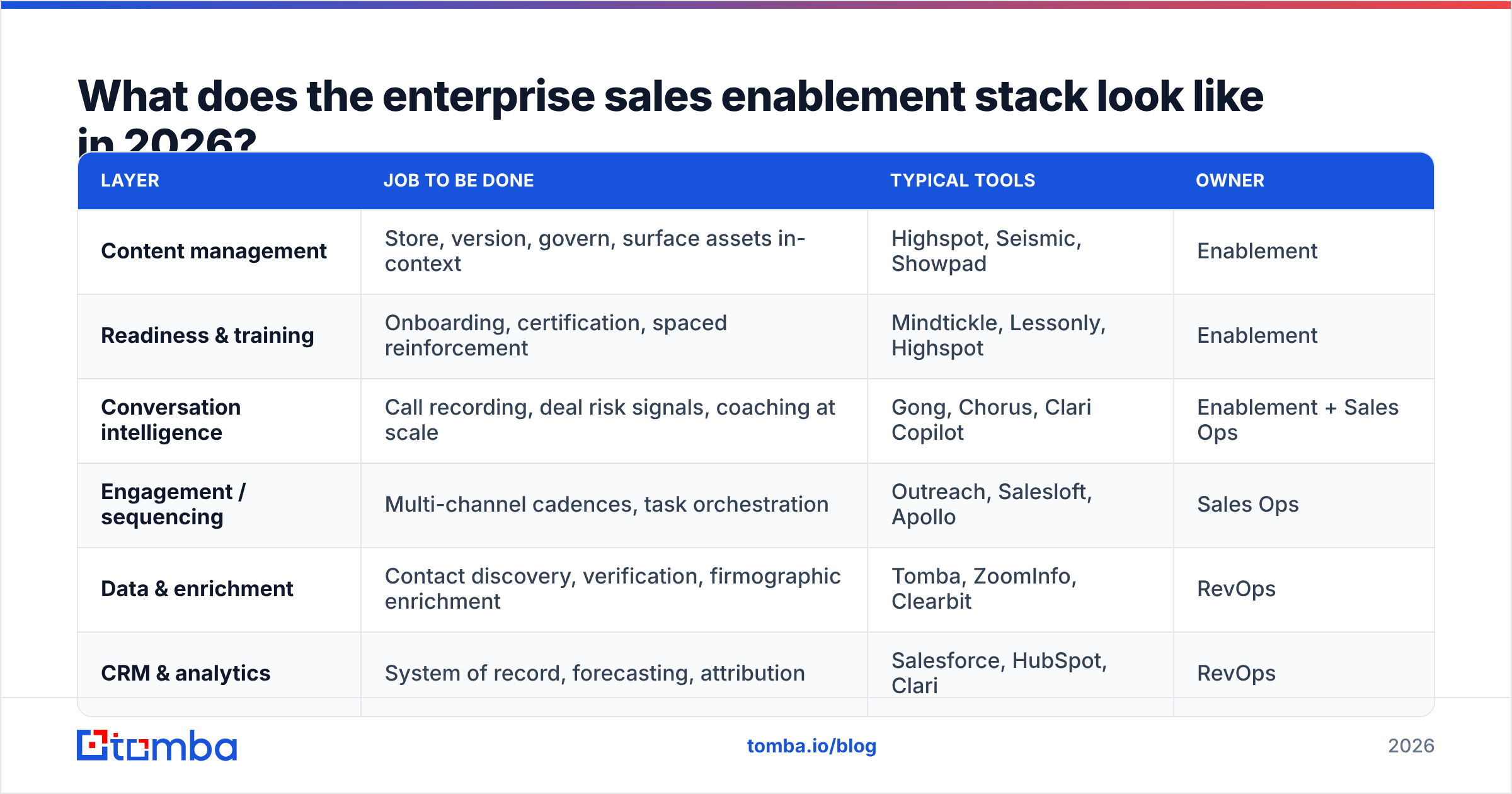
Six layers. Most enterprises own all six, though rarely from one vendor.
| Layer | Job to be done | Typical tools | Owner |
|---|---|---|---|
| Content management | Store, version, govern, surface assets in-context | Highspot, Seismic, Showpad | Enablement |
| Readiness & training | Onboarding, certification, spaced reinforcement | Mindtickle, Lessonly, Highspot | Enablement |
| Conversation intelligence | Call recording, deal risk signals, coaching at scale | Gong, Chorus, Clari Copilot | Enablement + Sales Ops |
| Engagement / sequencing | Multi-channel cadences, task orchestration | Outreach, Salesloft, Apollo | Sales Ops |
| Data & enrichment | Contact discovery, verification, firmographic enrichment | Tomba, ZoomInfo, Clearbit | RevOps |
| CRM & analytics | System of record, forecasting, attribution | Salesforce, HubSpot, Clari | RevOps |
The mistake enterprises make is buying layers 1–3 aggressively and layer 5 as an afterthought. That's backwards. A perfectly governed battlecard delivered to a contact who left the company 14 months ago is worth exactly nothing. G2's sales enablement category lists well over 100 vendors, and the crowding is heaviest in content management — the layer where differentiation is thinnest.
Which enablement platform fits which enterprise?#
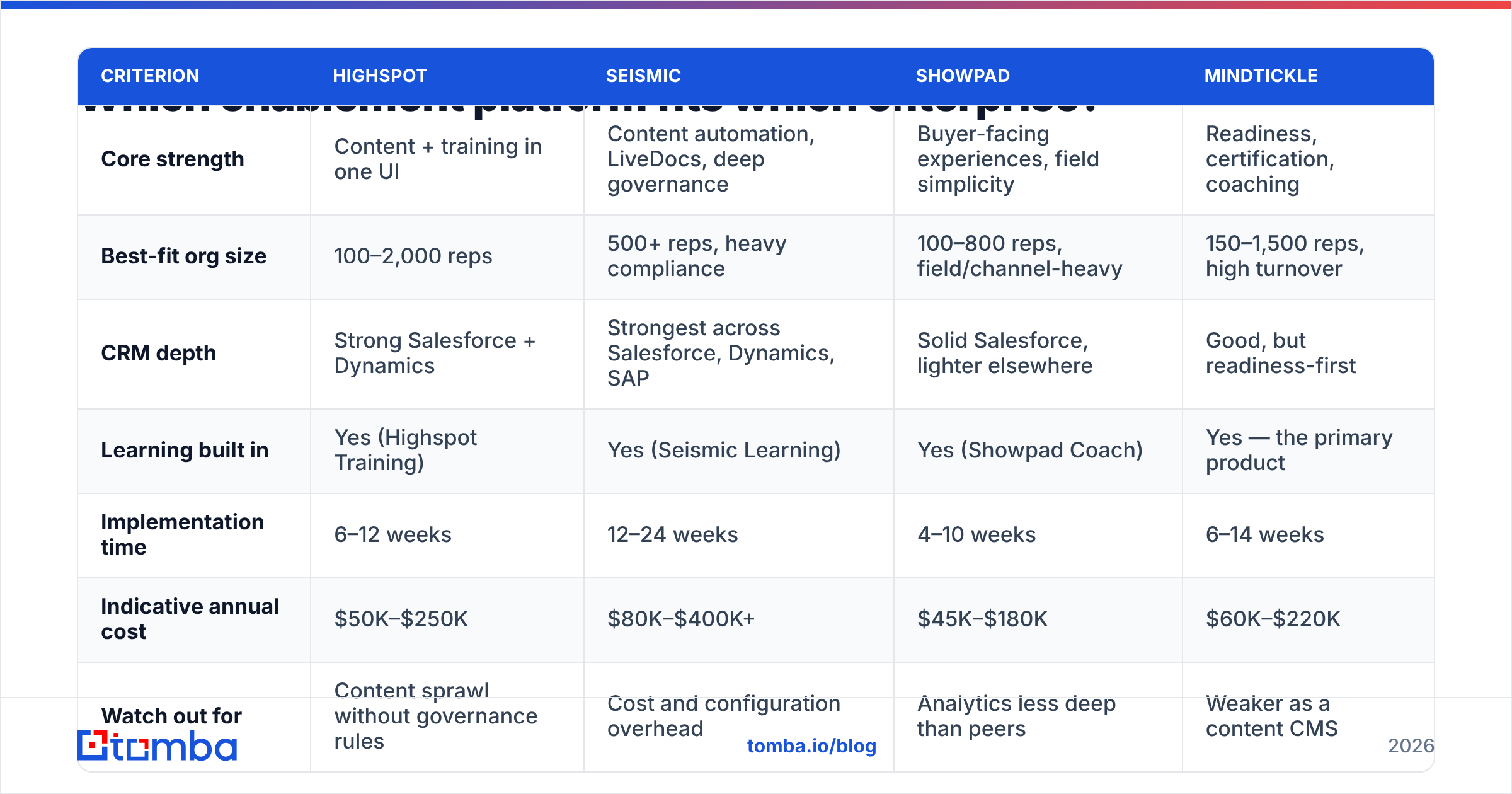
There's no universal winner. The honest split is by primary constraint: content governance, seller readiness, or coaching depth.
| Criterion | Highspot | Seismic | Showpad | Mindtickle |
|---|---|---|---|---|
| Core strength | Content + training in one UI | Content automation, LiveDocs, deep governance | Buyer-facing experiences, field simplicity | Readiness, certification, coaching |
| Best-fit org size | 100–2,000 reps | 500+ reps, heavy compliance | 100–800 reps, field/channel-heavy | 150–1,500 reps, high turnover |
| CRM depth | Strong Salesforce + Dynamics | Strongest across Salesforce, Dynamics, SAP | Solid Salesforce, lighter elsewhere | Good, but readiness-first |
| Learning built in | Yes (Highspot Training) | Yes (Seismic Learning) | Yes (Showpad Coach) | Yes — the primary product |
| Implementation time | 6–12 weeks | 12–24 weeks | 4–10 weeks | 6–14 weeks |
| Indicative annual cost | $50K–$250K | $80K–$400K+ | $45K–$180K | $60K–$220K |
| Watch out for | Content sprawl without governance rules | Cost and configuration overhead | Analytics less deep than peers | Weaker as a content CMS |
Pricing above reflects publicly reported ranges from buyer reviews and is a planning heuristic, not a quote. Every one of these vendors prices per seat with volume tiers, and the delta between list and negotiated is frequently 30–40% on multi-year terms.
Decision shortcut:
- Governance is your bottleneck (regulated industry, legal review on every claim) → Seismic.
- Ramp time is your bottleneck (high turnover, big new-hire classes) → Mindtickle.
- Field adoption is your bottleneck (reps won't log in, channel sellers) → Showpad.
- You want one platform for content and training and can staff governance → Highspot.
- You have fewer than 75 reps → don't buy any of these yet. A well-organized Drive plus your CRM plus conversation intelligence covers 80% of the value at 5% of the cost.
How does data quality break enablement before content does?#
Because everything downstream inherits the error rate.
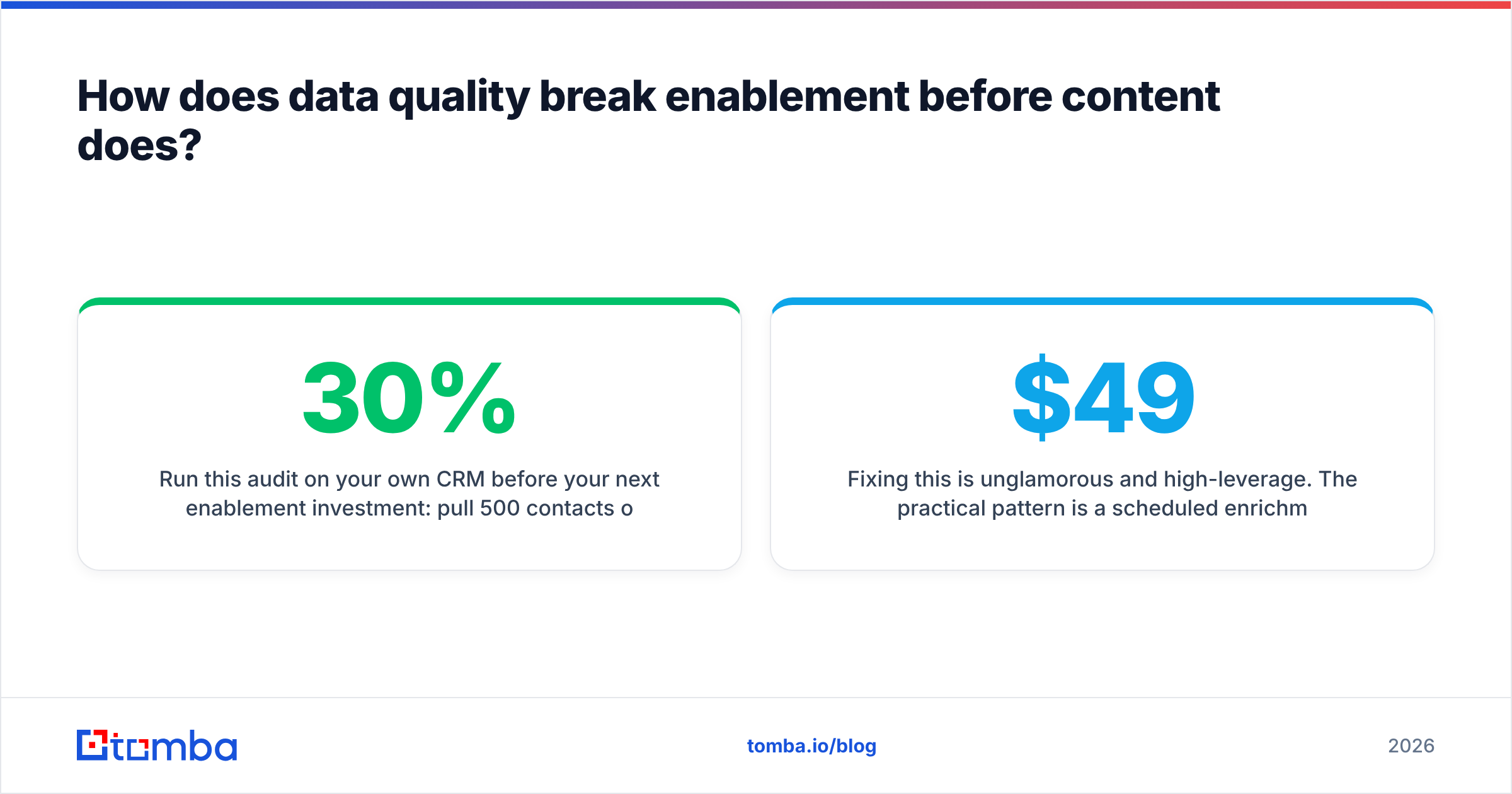
Run this audit on your own CRM before your next enablement investment: pull 500 contacts on open opportunities, verify the email addresses, and check the titles against LinkedIn. In most enterprise instances, 15–30% of records fail on at least one dimension — bounced address, stale title, wrong company after an acquisition, or a duplicate that splits engagement history across two records.
Now trace the damage:
- Sequencing sends to dead addresses, which pushes your bounce rate up and your sender reputation down, which suppresses deliverability for the contacts that are valid.
- Routing assigns accounts to the wrong territory because the firmographics are stale.
- Content personalization fires the wrong persona track — you send the CFO narrative to an IT manager.
- Attribution breaks, because engagement is split across duplicate records, so your enablement ROI analysis undercounts.
Fixing this is unglamorous and high-leverage. The practical pattern is a scheduled enrichment and verification job against the accounts in your active pipeline — not a one-time cleanse. Teams typically wire this through an API into the CRM so records refresh on a cadence. Tomba's data enrichment and email verification API are built for exactly this pattern, and the Salesforce integration means RevOps can run it without a custom middleware project. Pricing starts at a free tier of 25 searches/month, with Starter at $49/mo and Growth at $99/mo — see Tomba pricing for the full breakdown against enterprise volumes.
The rule of thumb: verify before every campaign send, enrich on a quarterly cadence for the full account base, and enrich on-demand at the moment an opportunity is created.
How do you build a 90-day enablement operating rhythm?#
Stop thinking in projects. Build a cadence that runs forever.
- Weekly — call review with front-line managers. Two calls per rep per week, reviewed against a shared scorecard. This is where behavior actually changes. If your managers aren't doing this, no platform will save you.
- Bi-weekly — content triage. Kill or refresh any asset with zero use in 60 days. A shrinking library is a healthy library. Enterprise portals rot because nothing is ever deleted.
- Monthly — win/loss synthesis. Pull five wins and five losses, interview the reps, and turn the delta into one concrete artifact: an objection response, a discovery question set, or a competitive teardown.
- Quarterly — certification. Every rep recertifies on the current pitch, on camera, scored by their manager. Not optional, not self-paced-forever.
- Quarterly — data audit. Sample the CRM, measure the error rate, report it alongside enablement metrics. Treat it as a health metric of the whole GTM system.
- Semi-annually — stack review. Check seat utilization against licenses. Enterprises routinely pay for 400 seats where 240 log in monthly.
HubSpot's sales blog publishes benchmark data worth calibrating against, but your own historical baseline matters more than anyone's industry average.
What metrics prove enterprise sales enablement is working?#
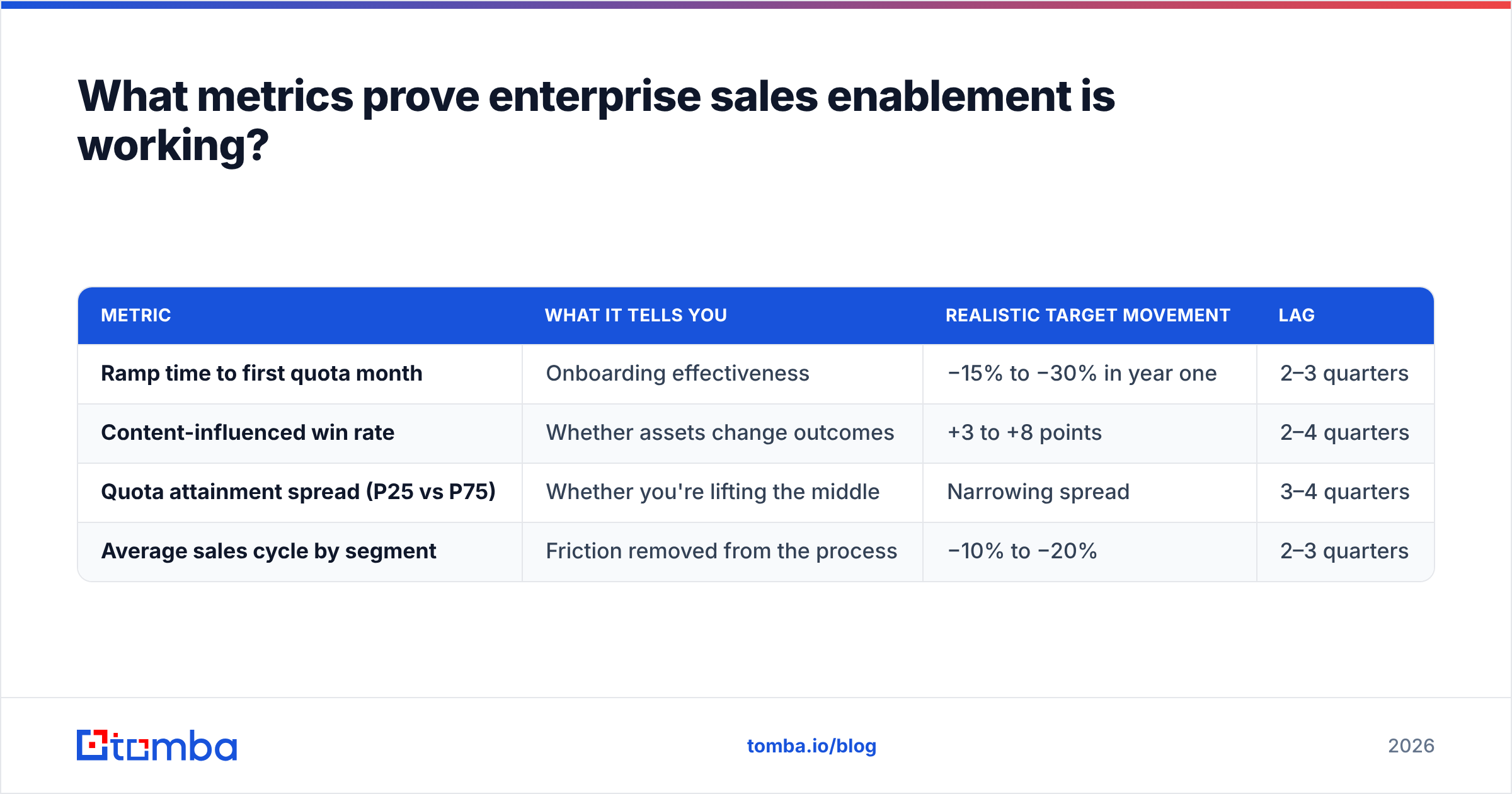
Four, ranked by defensibility.
| Metric | What it tells you | Realistic target movement | Lag |
|---|---|---|---|
| Ramp time to first quota month | Onboarding effectiveness | −15% to −30% in year one | 2–3 quarters |
| Content-influenced win rate | Whether assets change outcomes | +3 to +8 points | 2–4 quarters |
| Quota attainment spread (P25 vs P75) | Whether you're lifting the middle | Narrowing spread | 3–4 quarters |
| Average sales cycle by segment | Friction removed from the process | −10% to −20% | 2–3 quarters |
Note what's absent: asset downloads, portal logins, course completions, and NPS on training sessions. Those are diagnostics for the enablement team's own use. They are not evidence of business impact, and presenting them to a CRO as if they were is the fastest way to get your budget cut in the next planning cycle.
The spread metric deserves special attention. Enablement's real job is raising the floor, not the ceiling. Your top decile will succeed regardless. If your P25 reps improve and your P75 stays flat, that is a win, even though average attainment barely moves.
What does enterprise sales enablement actually cost?#
Budget in three buckets, and expect the total to land between 1.5% and 3% of sales-org fully-loaded cost.
- Headcount: 1 enablement person per 40–60 reps is the common ratio. Below 1:80 the function becomes reactive order-taking.
- Platforms: $45K–$400K+/year for the content/readiness layer, plus conversation intelligence ($90–$150 per seat/month), plus engagement tooling, plus data.
- Content production: Frequently underestimated. Video, localization, and legal review add 30–50% on top of writing cost.
The shock usually arrives at renewal, when per-seat pricing meets a headcount increase and a multi-year uplift clause at the same time. Negotiate the uplift cap in year one; nobody remembers to and everybody regrets it.
One more line item worth defending: data. It's the cheapest layer in the stack and the one every other layer depends on. Cutting a $99/mo enrichment tool to protect a $200K platform renewal is a false economy — you're preserving the delivery mechanism while degrading the addresses it delivers to.
Where should you start if you're rebuilding from scratch?#
In this order: fix the data, then fix manager coaching, then fix content, then buy a platform. Most enterprises do it exactly backwards — platform first — and end up with a beautifully governed library of assets pointed at contacts who no longer work there.
Start with a pipeline audit. Take your open opportunities, verify every contact address, enrich the missing decision-makers, and measure how much of your "coverage" was fictional. That number is usually the most persuasive slide you'll ever put in front of a CRO, and it costs almost nothing to produce.
Get the data layer right first. Use Tomba Email Finder to fill the contact gaps in your enterprise accounts — search by domain, name, or company, verify before you send, and push clean records straight into your CRM through the API. Start free with 25 searches a month, then scale on Starter at $49/mo or Growth at $99/mo when your pipeline audit proves the case.
Related guides#
// get started
Find, verify and enrich your first contacts today
Start on the free plan with 25 searches a month, then scale when your team is ready.
Free plan · No credit card required · GDPR & CCPA
// about the author