Enterprise Sales for Startups: The 2026 Playbook That Closes
Most startups lose enterprise deals on process, not product. Here is the account list, deal structure, security prep, and timeline that actually get six-figure contracts signed in 2026.
TL;DR
- Enterprise sales for startups is not "SMB selling with bigger numbers." It is a different motion: multiple stakeholders, procurement, security review, and a 4–9 month cycle you have to fund in advance.
- The single biggest killer of first enterprise deals is single-threading — one champion, one email thread, zero coverage when that person changes jobs.
- Build a narrow target account list (50–150 accounts, not 5,000), map 5–8 contacts per account, and treat contact data as infrastructure, not a one-off purchase.
- Get SOC 2, a standard MSA, a security questionnaire answer bank, and a DPA ready before your first deal reaches legal. Procurement delays cost more quarters than pricing objections.
- Price the first three logos for reference value and expansion room, not for maximum ACV. Multi-year discounts are cheaper than churn at renewal.
What counts as enterprise sales for a startup?#
Enterprise sales is any deal where the buyer's process — not your product — determines the timeline. Practically, that means a company above roughly 1,000 employees, a contract above $50k ACV, a legal review you cannot skip, and at least four people who can say no.
A useful analogy: selling to SMB is like selling a bicycle to a person. Selling to enterprise is like selling a fleet of buses to a city. The bike buyer decides in an afternoon. The city has a transit committee, a budget cycle, a safety inspector, and a procurement rule that says three vendors must bid. Your bus can be objectively better and still lose because you missed the RFP window.
For a startup, three things change the moment you enter that world:
- Your cash conversion cycle stretches. A 6-month cycle means the pipeline you build in Q1 pays rent in Q3. Model it before you hire the rep.
- Your product roadmap gets hostages. Enterprise buyers ask for SSO, audit logs, role-based permissions, and data residency. These are not features — they are entry tickets.
- Your founder becomes the closer. For the first 10 logos, buyers are buying the company as much as the software. That is normal, and it does not scale, which is why documenting the process from deal one matters.
Why do startups lose enterprise deals they should win?#
Not on price. In post-mortems across early-stage teams, the recurring causes are boring and fixable:
- Single-threading. One champion who loved the demo, then got reorged. The deal dies silently.
- No documented business case. Your champion has to sell internally, and you handed them a feature list instead of a one-page ROI model in their CFO's language.
- Security surprise at month four. The buyer's InfoSec team asks for a SOC 2 report you do not have. Six weeks evaporate.
- No paper process. You did not ask "walk me through what happens after we agree on terms" until after you agreed on terms.
- Discovery that was actually a demo. Gartner's research on the B2B buying journey has been consistent for years: buyers spend the majority of their time in independent research and internal consensus-building, not with your rep. If you do not equip the internal conversation, you are absent from most of the decision.
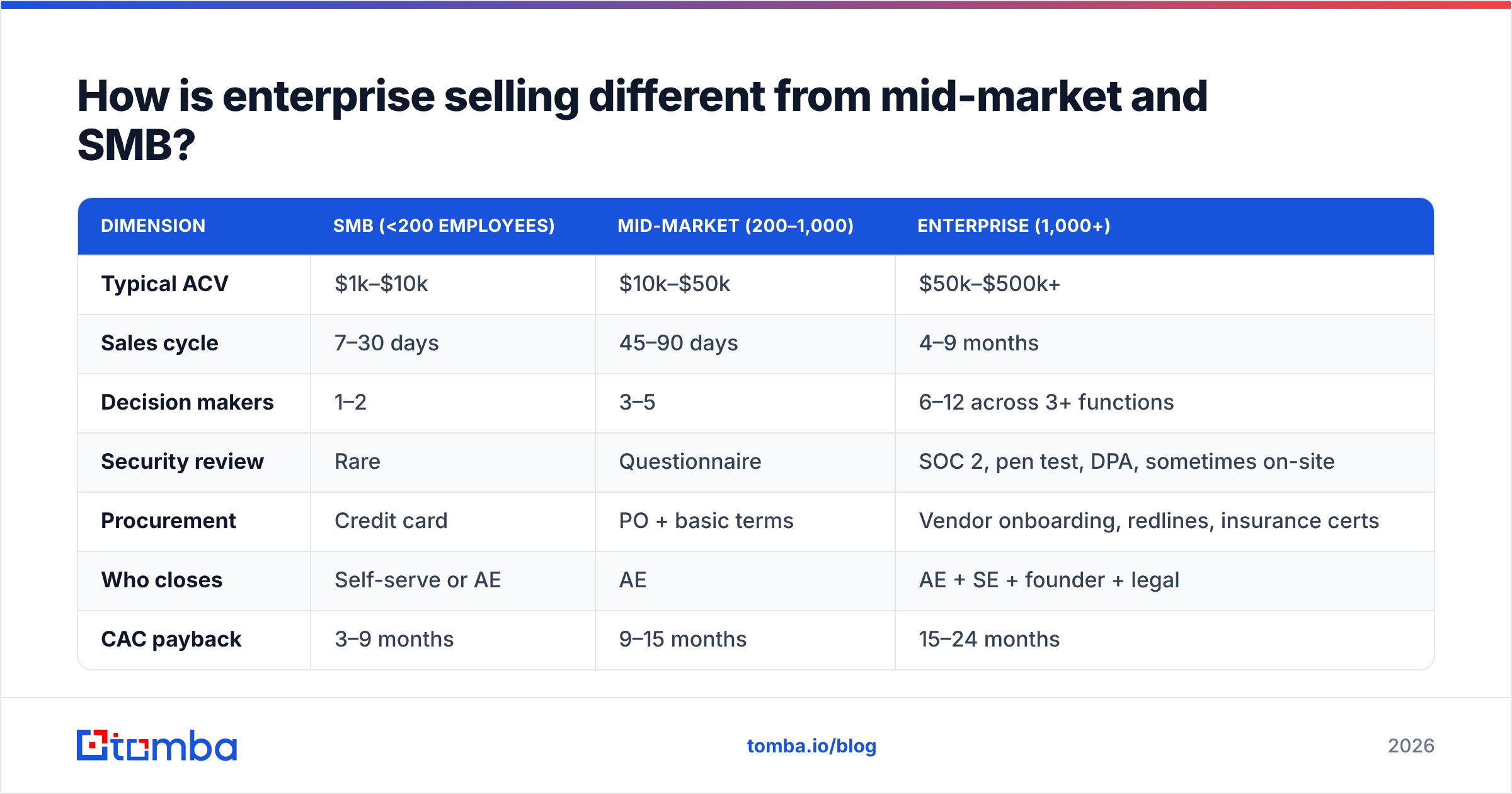
How is enterprise selling different from mid-market and SMB?#
| Dimension | SMB (<200 employees) | Mid-market (200–1,000) | Enterprise (1,000+) |
|---|---|---|---|
| Typical ACV | $1k–$10k | $10k–$50k | $50k–$500k+ |
| Sales cycle | 7–30 days | 45–90 days | 4–9 months |
| Decision makers | 1–2 | 3–5 | 6–12 across 3+ functions |
| Security review | Rare | Questionnaire | SOC 2, pen test, DPA, sometimes on-site |
| Procurement | Credit card | PO + basic terms | Vendor onboarding, redlines, insurance certs |
| Who closes | Self-serve or AE | AE | AE + SE + founder + legal |
| CAC payback | 3–9 months | 9–15 months | 15–24 months |
| Primary risk | Churn | Champion turnover | No decision / budget freeze |
The row that reshapes a startup's org chart is CAC payback. A 15–24 month payback means enterprise motion is a financing decision before it is a sales decision. If your runway is 14 months, do not start an enterprise motion from scratch — land mid-market deals that pay back inside the runway and grow into enterprise from installed accounts.
Who is actually in the enterprise buying committee?#
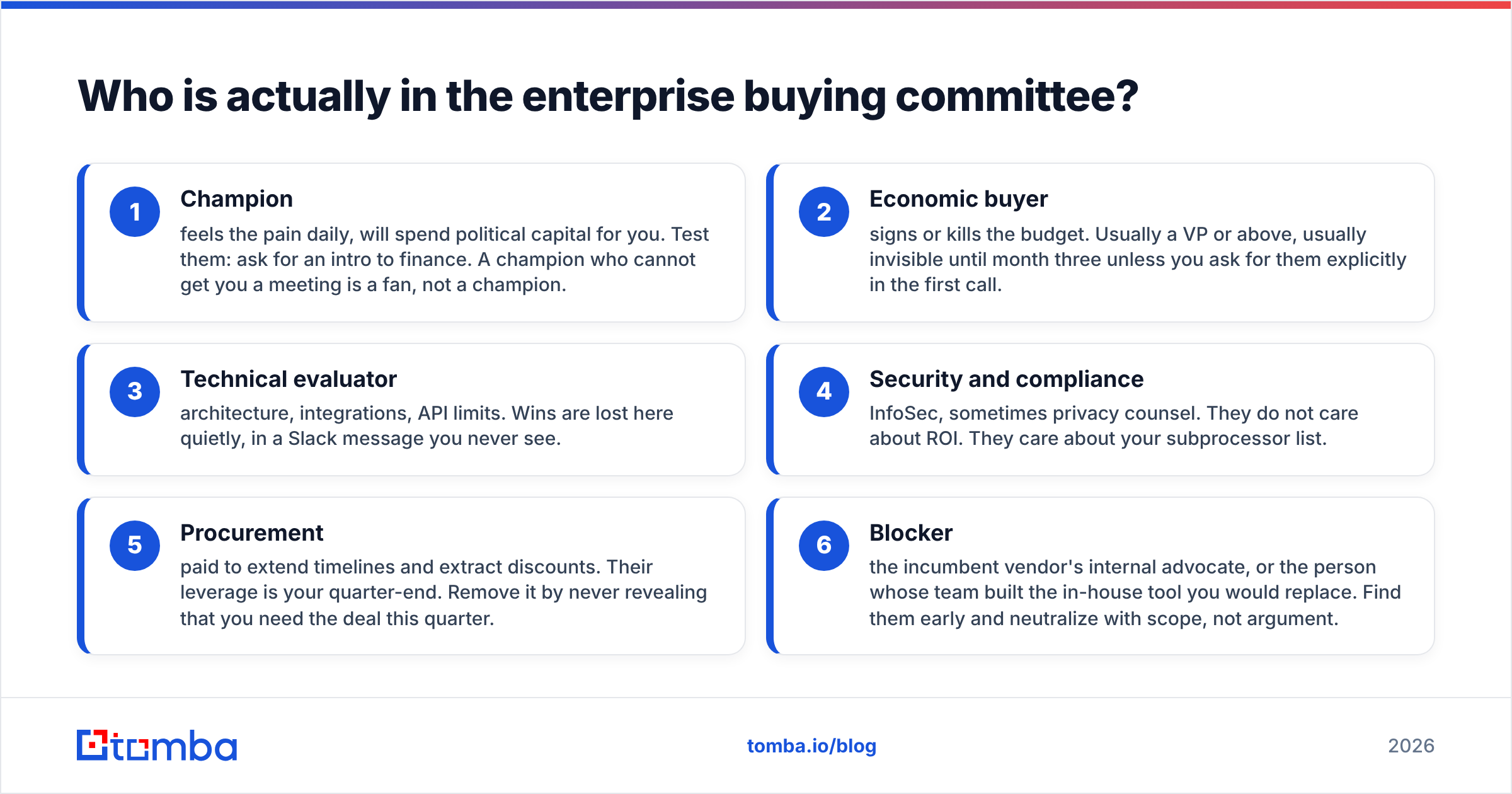
Map every deal against these roles. If you cannot name a human for each one, you have a coverage gap, not a pipeline entry.
- Champion — feels the pain daily, will spend political capital for you. Test them: ask for an intro to finance. A champion who cannot get you a meeting is a fan, not a champion.
- Economic buyer — signs or kills the budget. Usually a VP or above, usually invisible until month three unless you ask for them explicitly in the first call.
- Technical evaluator — architecture, integrations, API limits. Wins are lost here quietly, in a Slack message you never see.
- Security and compliance — InfoSec, sometimes privacy counsel. They do not care about ROI. They care about your subprocessor list.
- Procurement — paid to extend timelines and extract discounts. Their leverage is your quarter-end. Remove it by never revealing that you need the deal this quarter.
- Blocker — the incumbent vendor's internal advocate, or the person whose team built the in-house tool you would replace. Find them early and neutralize with scope, not argument.
Qualification frameworks like MEDDPICC exist mostly to force this map onto paper. Use one. HubSpot's sales methodology overviews are a reasonable free starting point if you do not want to buy training in year one.
How do you build an enterprise target account list without a data team?#
Narrow beats broad. A startup with two reps should work 50–150 named accounts, refreshed quarterly. The list is built in four passes:
Pass 1 — define the firmographic box. Industry, employee range, region, and one technographic or event trigger (uses a specific ERP, hired a Head of Data in the last 90 days, opened an office in the EU). If your box returns 8,000 companies, it is not a box.
Pass 2 — score by evidence of pain. Job postings mentioning the workflow you replace, public case studies with your competitor, regulatory deadlines in their sector. Score 1–3 and cut everything below 2.
Pass 3 — map contacts per account. Six to eight per account, spanning champion, technical, economic, and adjacent teams. This is where most startups stall, because the manual version takes hours per account. A domain search returns the verified addresses and role patterns at a company in one query, and data enrichment fills titles, seniority, and company metadata so your scoring model has something to score. For accounts where email alone will not cut through, a phone finder gives you the second channel enterprise buyers actually answer.
Pass 4 — verify before sending. Enterprise domains are the most likely to be catch-all configured, which means an unverified list quietly torches your sender reputation on exactly the accounts you cannot afford to lose. Run the list through an email verifier and handle catch-all domains separately rather than sending blind.
If you would rather buy a prebuilt list than assemble one, providers like BookYourData offer curated, filterable B2B contact sets that can shortcut pass 1 and 2 — a reasonable complement when you need coverage in a segment you have never sold into. The tradeoff is the same everywhere: prebuilt lists are faster, self-assembled lists are tighter to your ICP. Most teams end up doing both.
What should your first enterprise sales process look like?#
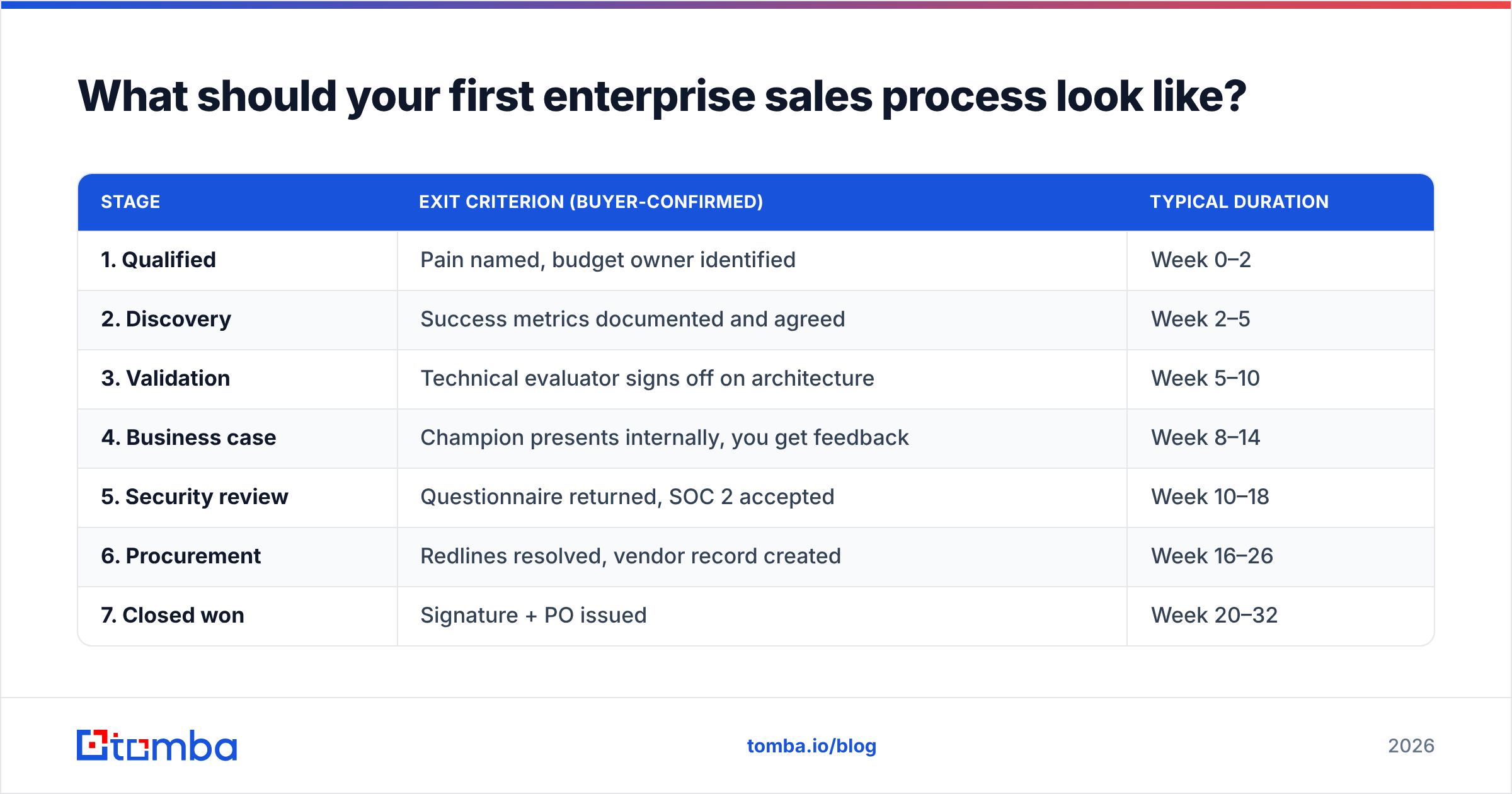
Seven stages, each with an exit criterion the buyer confirms — not one your rep asserts.
| Stage | Exit criterion (buyer-confirmed) | Typical duration |
|---|---|---|
| 1. Qualified | Pain named, budget owner identified | Week 0–2 |
| 2. Discovery | Success metrics documented and agreed | Week 2–5 |
| 3. Validation | Technical evaluator signs off on architecture | Week 5–10 |
| 4. Business case | Champion presents internally, you get feedback | Week 8–14 |
| 5. Security review | Questionnaire returned, SOC 2 accepted | Week 10–18 |
| 6. Procurement | Redlines resolved, vendor record created | Week 16–26 |
| 7. Closed won | Signature + PO issued | Week 20–32 |
Two rules that save quarters. First, stages 5 and 6 run in parallel with 3 and 4, not after them — start security in week 10, not week 22. Second, every stage past 3 requires a mutual action plan: a shared document with dates, owners, and the buyer's own internal milestones. If a buyer will not co-own that document, the deal is not real.
How should a startup price and structure its first enterprise contracts?#
Price the first three enterprise logos for reference value and expansion headroom, not maximum extraction. Concretely:
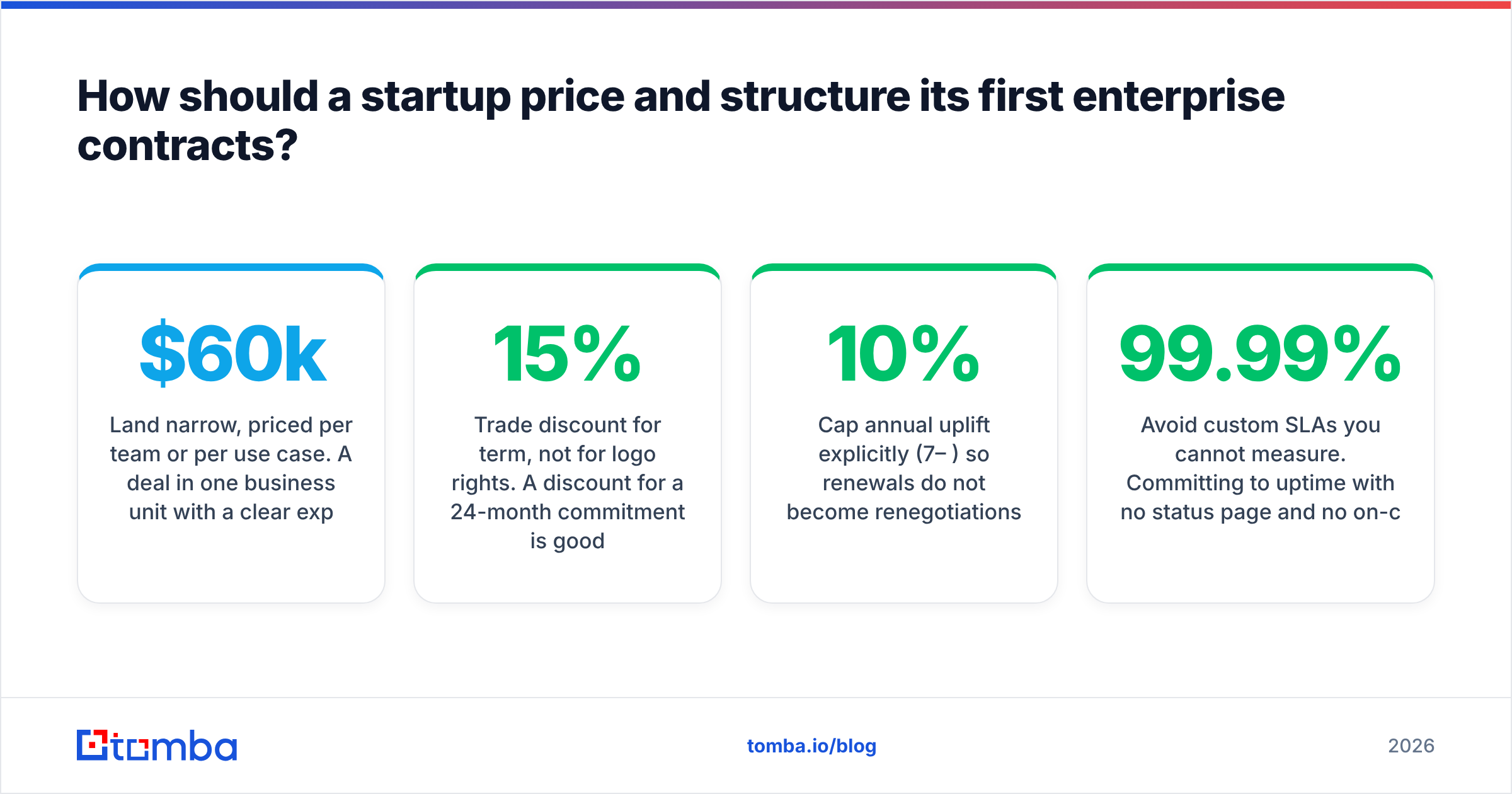
- Land narrow, priced per team or per use case. A $60k deal in one business unit with a clear expansion path beats a $150k enterprise-wide deal you cannot deliver on.
- Trade discount for term, not for logo rights. A 15% discount for a 24-month commitment is good business. A discount "because we're your first customer" sets a permanent anchor.
- Cap annual uplift explicitly (7–10%) so renewals do not become renegotiations.
- Avoid custom SLAs you cannot measure. Committing to 99.99% uptime with no status page and no on-call rotation is how a healthy deal becomes a breach notice.
- Put a mutual termination-for-convenience clause on the table only if you must. Enterprise buyers ask; many accept a 60-day notice window instead.
Also decide early whether you sell on seats, usage, or platform fee. Usage-based pricing lands easier and forecasts worse. If your board wants predictable ARR, a platform fee plus usage overage is the common compromise, and it is what most enterprise-grade vendors — including the pricing structures documented across Salesforce's own sales resources — converge on as accounts scale.
What do you need in place before the first deal hits legal?#
Treat this as a pre-launch checklist, not a fire drill:
- SOC 2 Type II (Type I buys you three to six months of goodwill; Type II is what gets accepted).
- A security questionnaire answer bank — 150 to 300 answered questions in a spreadsheet. This turns a two-week fire drill into a two-hour task.
- A standard MSA and DPA drafted by a lawyer who has done SaaS, plus a fallback position on the three clauses you will always fight: liability cap, indemnity scope, and data deletion timelines.
- A subprocessor list and architecture diagram, current, one page each.
- Insurance certificates — E&O and cyber. Procurement will ask for specific coverage amounts.
- A named internal owner for security responses. Not "the founder when he has time."
A useful benchmark: teams that prepare this in advance report security and procurement adding 3–5 weeks to a deal. Teams that improvise report 10–16 weeks. That gap is the difference between closing four enterprise deals a year and closing two.
What does a realistic first-year enterprise plan look like?#
- Quarter 1: Founder-led. 30 target accounts, 12 discovery calls, 3 opportunities. No AE hire yet.
- Quarter 2: First 1–2 deals in security review. Build the answer bank from real questionnaires. Document objections verbatim.
- Quarter 3: First close. Hire one AE with genuine enterprise experience after you have closed two deals yourself — otherwise you are asking someone to invent your process while carrying quota.
- Quarter 4: Expansion inside the landed logo, plus the first referenceable case study. One strong reference in a regulated industry unlocks more pipeline than 10,000 cold emails.
Compensation: 50/50 base-variable, with accelerators past quota and a clawback window that matches your churn risk. Ramp is six to nine months for enterprise, not three. Budget it.
The through-line across all four quarters is contact data quality. An enterprise account map goes stale fast — buyers change roles constantly, and a mapped committee from six months ago is half wrong. Keep the map refreshed with a bulk email finder run each quarter rather than rebuilding lists from scratch, and check Tomba pricing against how many accounts you actually work: at 50–150 named accounts with 6–8 contacts each, the Starter plan at $49/mo or Growth at $99/mo covers a two-rep team comfortably.
Where should you start this week?#
Pick 50 accounts. Map six people in each. Write one page of business case language in your buyer's numbers. Start the SOC 2 process. Then run the first ten discovery calls yourself and write down every objection word for word.
The data layer under that plan is the easy part to solve. Tomba's Email Finder gets you verified, role-mapped contacts across your target accounts in minutes instead of afternoons — free tier included at 25 searches a month if you want to test the account map before committing budget. Build the list, then go spend your time where it actually compounds: on the buying committee.
Related guides#
Ready to find emails that actually work?
Join 150,000+ professionals who stopped guessing and started sending. Free credits on signup — no credit card required.
Get the Tomba newsletter
Practical outbound tactics and product updates — once every two weeks.
About the author