Enterprise Sales Negotiations: A 2026 Playbook for Closing Big Deals
Enterprise deals are won or lost long before the redline stage. Here is how procurement actually scores you, which concessions cost the least, and the negotiation levers that survive a 9-person buying committee.
TL;DR
- Enterprise sales negotiations are decided in discovery, not in the redline call. If you have not mapped the buying committee and quantified the cost of inaction by then, you are negotiating from a deficit.
- The average enterprise deal now involves 6-11 stakeholders and a dedicated procurement function whose bonus is tied to the discount they extract from you.
- Discounting is the most expensive concession you can make and the easiest to give. Term length, payment timing, logo rights, and case-study participation cost you far less.
- Never concede without a trade. Every give needs a get, stated in the same sentence.
- Multi-threading beats charm. Deals with four or more engaged contacts on the buyer side close at materially higher rates than single-threaded ones — and contact data quality is the bottleneck most teams ignore.
What Are Enterprise Sales Negotiations, Really?#
An enterprise sales negotiation is not one conversation. It is a sequence of parallel negotiations — with the economic buyer over budget, with the technical evaluator over scope, with legal over liability caps, with security over data residency, and with procurement over price — that happen to converge on one signature page.
Think of it like buying a house through a committee where each family member has veto power over a different room. Agreeing with the person who loves the kitchen gets you nowhere if the one inspecting the roof is unhappy.
That structure changes the job. In SMB sales you persuade a person. In enterprise you assemble an internal coalition that can survive a procurement review without you in the room. Gartner's research on B2B buying has repeatedly found that buying groups now range from six to more than ten people, and that most of the buying journey happens without a seller present.
What actually gets negotiated, in rough order of how often it comes up:
- Price and discount — the loudest item, and rarely the most important one to the buyer's actual approval path.
- Contract term and auto-renewal — 12 vs. 24 vs. 36 months, with or without an uplift cap.
- Payment terms — Net 30 vs. Net 60 vs. Net 90, annual prepay vs. quarterly.
- Scope and seat count — what is included, what is an add-on, what triggers a true-up.
- Legal terms — liability cap, indemnification, data processing addendum, termination for convenience.
- Service commitments — SLA uptime, support tier, named CSM, onboarding hours.
Most sellers spend 80% of their energy on line 1 and get ambushed by lines 5 and 6 three weeks before quarter end.
Why Do Most Enterprise Deals Stall at the Procurement Stage?#
Because procurement's job description is not "get the best tool." It is "reduce spend and reduce risk," and those are measured targets.
A procurement lead at a 5,000-person company is typically compensated on savings delivered against list price. When they open your contract, they are not evaluating whether your product is good — your champion already did that. They are running a playbook:
- Anchor low, late. Introduce a budget number far below your quote after you have already invested six weeks.
- Manufacture a competitor. Reference a "very compelling proposal" from an alternative that may or may not be real.
- Split the room. Talk to you and your competitor separately, quoting each to the other.
- Run the clock. Wait until the last week of your quarter, when your discount authority mysteriously expands.
- Nibble. Secure the discount, then ask for onboarding to be thrown in, then the premium support tier.
None of this is hostile. It is the role. Treating it as personal is the most common unforced error in enterprise sales negotiations.
The counter is preparation, not cleverness. Before you get to procurement you should already have: a written business case owned by the champion, a mutual action plan with dates, a named executive sponsor, and at least one thread into finance or the economic buyer that does not run through your champion. If your champion goes on parental leave and your deal dies, you never had a deal.

How Should You Prepare Before the First Negotiation Call?#
Preparation has three components: power mapping, value quantification, and concession planning.
Power mapping means knowing who signs, who influences, who blocks, and who is indifferent. You need names, titles, reporting lines, and — critically — reachable contact details for people your champion has not introduced you to yet. This is where most teams quietly fail. They know the VP of Operations exists; they have no email for her, so they never reach her, so the deal stays single-threaded.
Tools help here. A domain search pulls the verified email patterns for an entire company so you can map an org chart into an outreach list, and a LinkedIn finder turns a profile you found while researching the buying committee into a contactable address. Combine that with data enrichment on the accounts already in your CRM and you can see the shape of the committee before your first pricing conversation instead of after it.
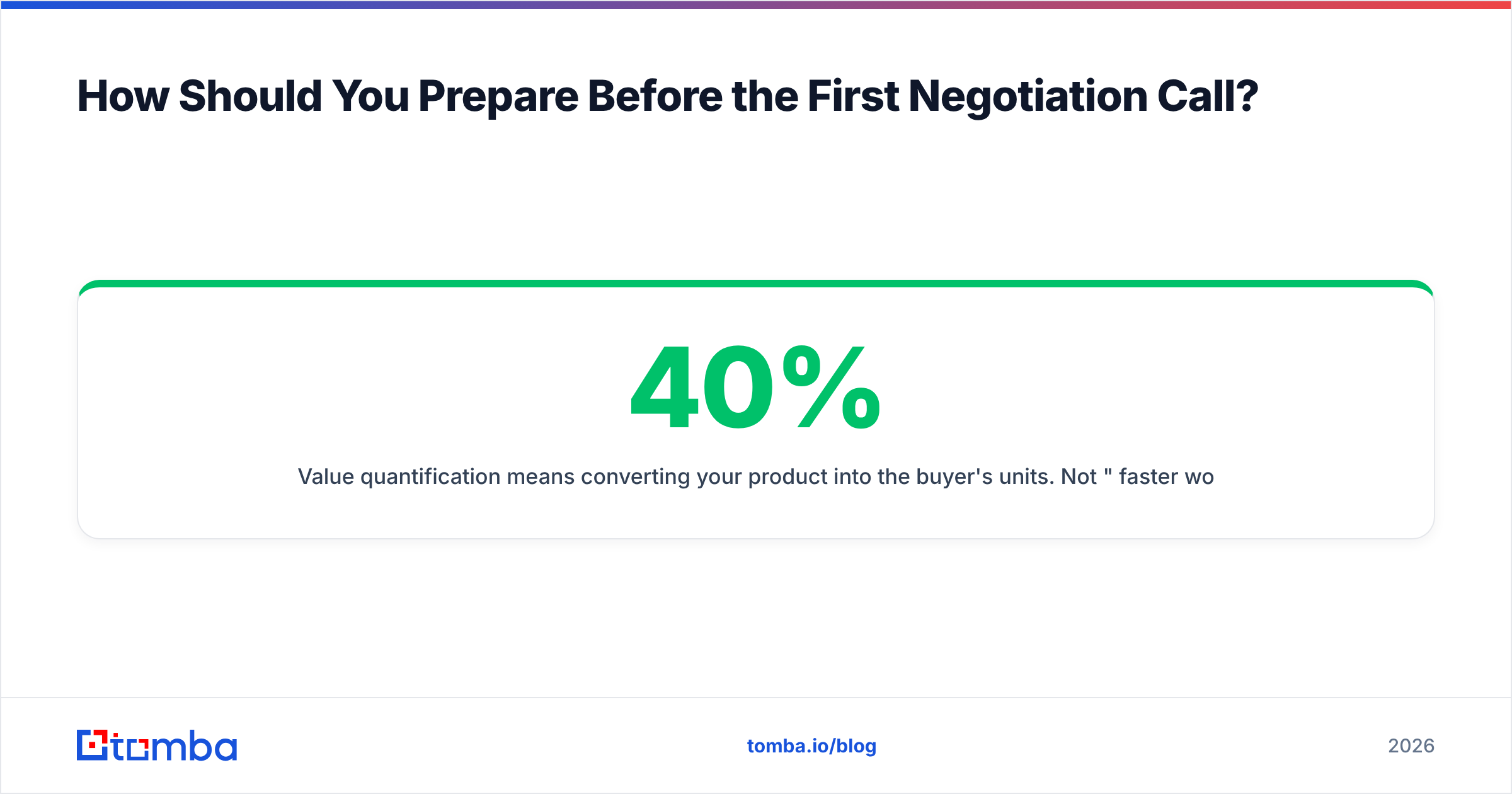
Value quantification means converting your product into the buyer's units. Not "40% faster workflows" but "your 22 SDRs each spend 5.5 hours a week on manual list building; at a fully loaded cost of $78/hour that is $490,000 a year." Procurement cannot negotiate against arithmetic the champion already validated. They can negotiate endlessly against adjectives.
Concession planning means writing down, before the call, every concession you are willing to make, its actual cost to you, and what you will demand in exchange. Do this in a document. Under time pressure at 4pm on the last day of the quarter, you will not invent good trades — you will only execute the ones you already wrote down.
Which Concessions Should You Trade — and What Do They Actually Cost?#
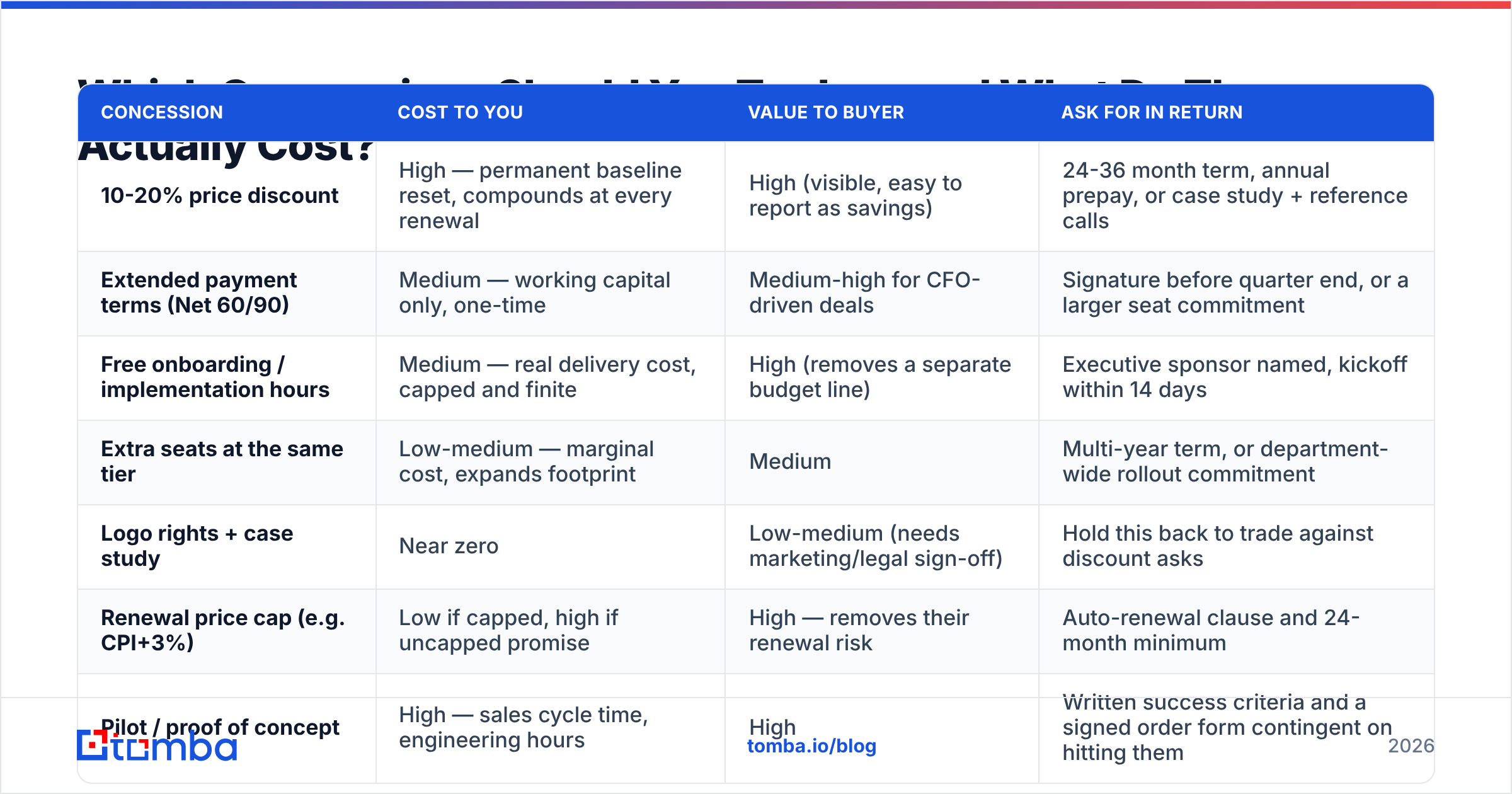
Not all concessions are equal. A 20% discount permanently resets the account's price baseline and follows you through every renewal. Extending payment terms by 30 days costs you working capital once. Sellers routinely swap these in the wrong direction.
| Concession | Cost to you | Value to buyer | Ask for in return |
|---|---|---|---|
| 10-20% price discount | High — permanent baseline reset, compounds at every renewal | High (visible, easy to report as savings) | 24-36 month term, annual prepay, or case study + reference calls |
| Extended payment terms (Net 60/90) | Medium — working capital only, one-time | Medium-high for CFO-driven deals | Signature before quarter end, or a larger seat commitment |
| Free onboarding / implementation hours | Medium — real delivery cost, capped and finite | High (removes a separate budget line) | Executive sponsor named, kickoff within 14 days |
| Extra seats at the same tier | Low-medium — marginal cost, expands footprint | Medium | Multi-year term, or department-wide rollout commitment |
| Logo rights + case study | Near zero | Low-medium (needs marketing/legal sign-off) | Hold this back to trade against discount asks |
| Renewal price cap (e.g. CPI+3%) | Low if capped, high if uncapped promise | High — removes their renewal risk | Auto-renewal clause and 24-month minimum |
| Pilot / proof of concept | High — sales cycle time, engineering hours | High | Written success criteria and a signed order form contingent on hitting them |
The rule underneath the table: never concede unilaterally. Say the give and the get in the same breath. "I can get you to 15% — that works if we move to a 24-month term and you can sign by the 30th." The moment you grant something without an attached condition, you have taught the room that asking works, and they will ask again.
Also worth naming: the "exploding discount" is now widely recognized by professional buyers and often backfires. If you say the 20% expires Friday and then re-offer it three weeks later, you have destroyed your credibility on every future claim. Either the deadline is real and enforced, or you do not use one.
Is Multi-Threading Really Worth the Extra Work?#
Yes, and it is the highest-leverage habit in enterprise sales negotiations.
Single-threaded deals fail in predictable ways: your champion changes jobs, gets reorganized, loses a budget fight you never saw, or simply misrepresents your value to their peers because they only half-understood it. Every one of those is survivable if you have three other relationships in the account.
The mechanics are unglamorous:
- Map before you outreach. Identify 6-10 roles that touch the decision: economic buyer, champion, technical evaluator, security reviewer, procurement, end-user lead, and the champion's boss.
- Get contactable. Find and verify addresses for each. An unverified guess sent into a corporate spam filter costs you a thread and, over time, your sender reputation.
- Enter with value, not a check-in. Each new thread gets a reason to exist — a benchmark, a security doc, an implementation timeline — tailored to that person's role.
- Ask your champion for the intro first. Going around them without warning is the fastest way to lose the one advocate you have. "I'd like to loop in your security lead early so we don't lose two weeks later — can you introduce us, or should I reach out directly?"
- Track engagement per thread, not per account. Four contacts on the CC line is not four threads. A thread is someone who replies.
Forrester and Gartner have both published extensively on the correlation between buying-group consensus and deal velocity; the practical read is that consensus is built by you, in parallel, or it is not built at all.
What Negotiation Tactics Actually Work in 2026?#
Anchor first, with justification. The old advice to never name a number first is largely obsolete in enterprise SaaS, where list pricing is semi-public and buyers arrive pre-informed. Anchor early, high, and with a rationale tied to their quantified value. An anchor without a reason is just a number to argue down.
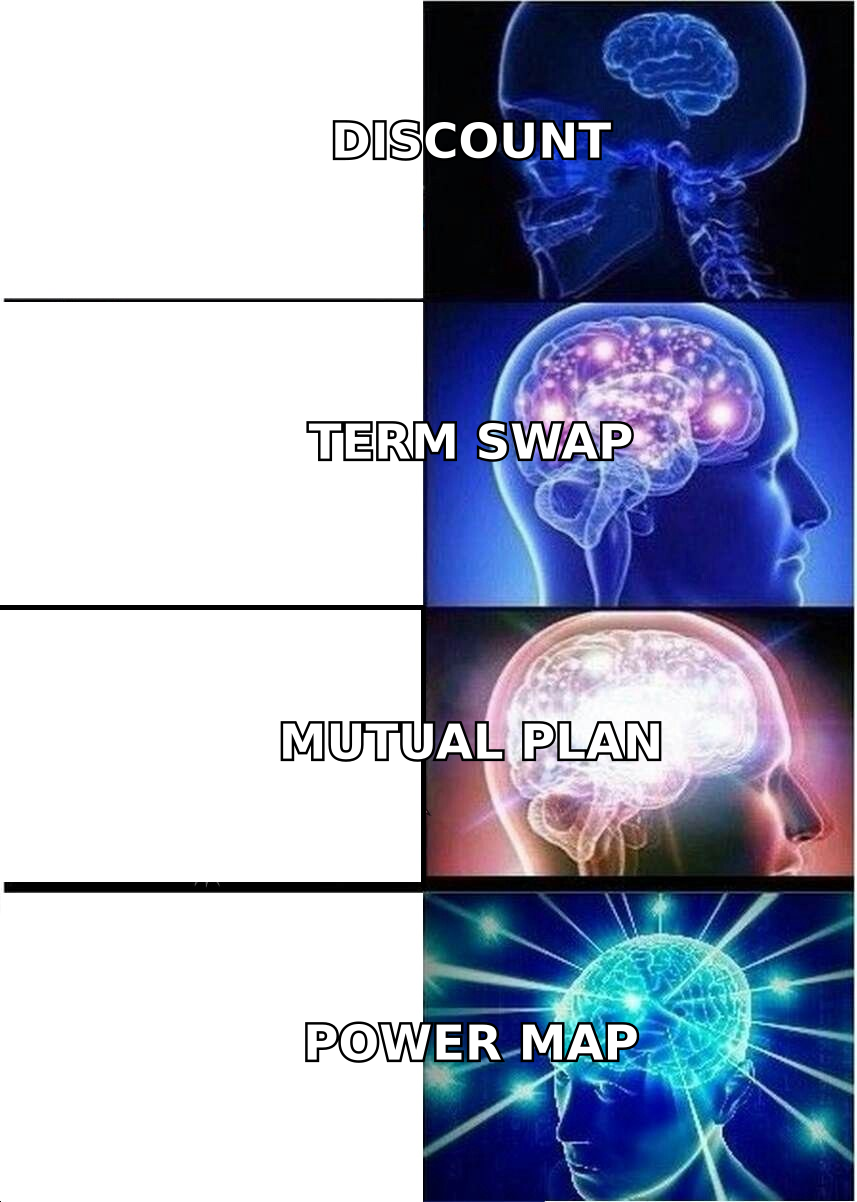
Use a mutual action plan (MAP). A shared document listing every step to go-live, with owners and dates on both sides, converts "let me check internally" into a tracked commitment. It is also the single best early-warning system for a stalling deal — when the buyer stops updating the MAP, the deal is in trouble weeks before the silence starts.
Separate the people from the position. Procurement pushing hard on price is not a signal of low intent. It is often the opposite: they only run the full playbook on deals they expect to close.
Silence is a tool. After stating a price, stop talking. The discomfort you feel is not the buyer's discomfort. Most self-inflicted discounts happen in the ten seconds after a quote when a nervous seller starts negotiating against themselves.
Escalate to peers, not up the chain. When you stall, put your VP in front of their VP as a peer conversation about outcomes — not as an authority play. "My VP would like 20 minutes with your VP to align on the rollout plan" travels much better than "let me get approval."
Know your walk-away. Have a written floor: minimum price, minimum term, non-negotiable legal terms. Deals below the floor that you sign anyway become the reference price for the next three deals in that vertical, and support tickets nobody is paid to answer.
Handle the "we have a cheaper quote" line properly. Ask one question: "Can you share what's included in that scope?" Half the time the comparison is not like-for-like, and the specifics either surface a real gap you can address or reveal the quote is a bargaining device.
How Do You Structure the Final Redline and Close?#
The last 10% of an enterprise deal is administrative, and administrative failure kills more quarters than pricing failure.
Run these in parallel, not in sequence:
- Legal review — send your paper first when you can; the party whose paper is used wins most ambiguity fights. Know in advance which three clauses you will never move on and which five you will trade.
- Security and compliance — get the questionnaire, SOC 2 report, and DPA moving the week the technical evaluation ends, not after pricing is agreed. This is the most common two-week silent killer.
- Procurement onboarding — vendor registration, W-9, insurance certificates, supplier portals. Start it early; some portals take ten business days by themselves.
- Signature logistics — confirm who actually holds signature authority at the dollar amount you are quoting. Many deals discover a $250,000 approval threshold in the final week.
One discipline that pays for itself: after every negotiation call, send a written recap within two hours. State what was agreed, what remains open, and the next date. Ambiguity always resolves in favor of the party with more people in the room, and that is never you.
Enterprise vs. Mid-Market Negotiations: What Changes?#
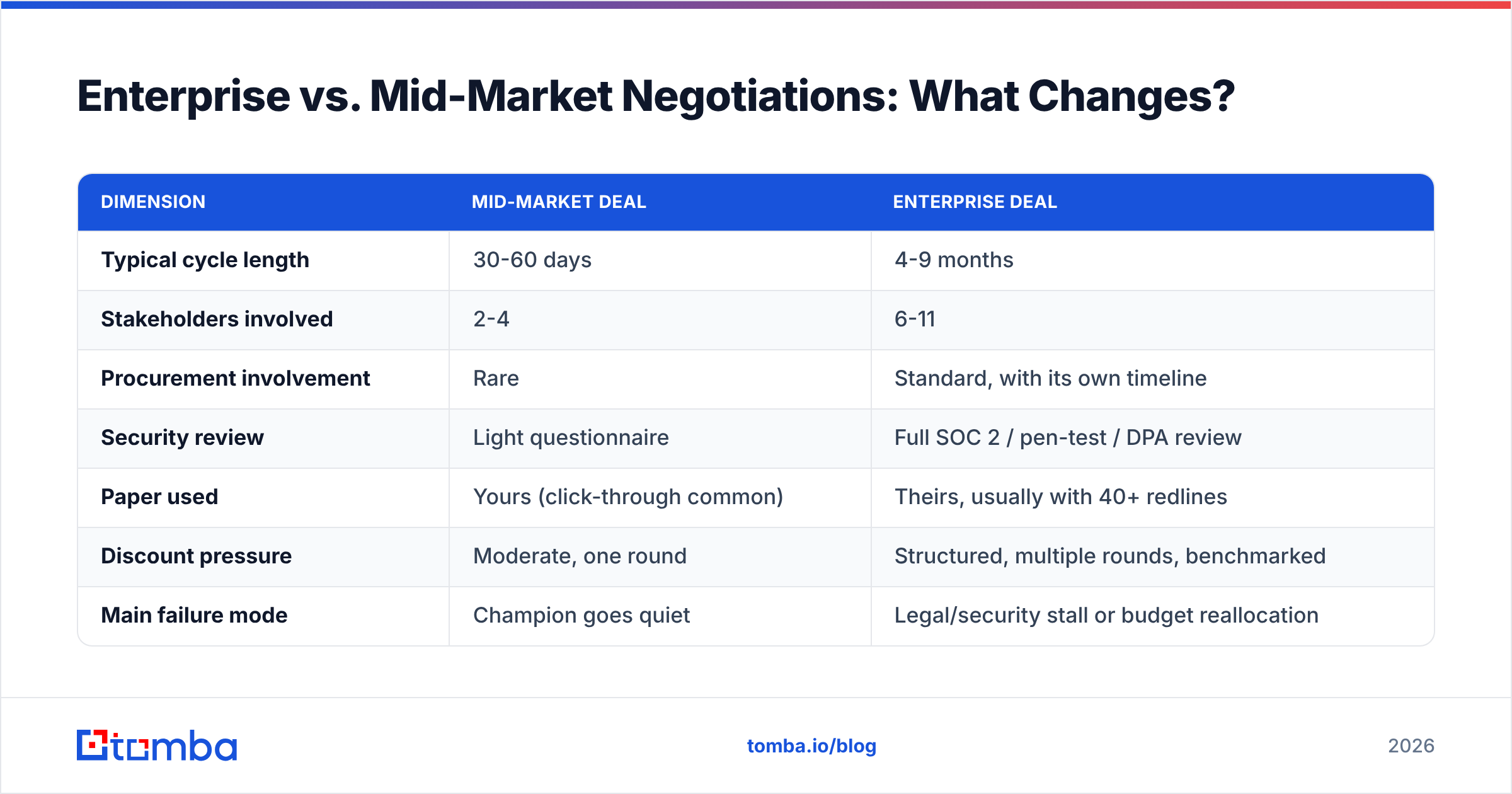
| Dimension | Mid-market deal | Enterprise deal |
|---|---|---|
| Typical cycle length | 30-60 days | 4-9 months |
| Stakeholders involved | 2-4 | 6-11 |
| Procurement involvement | Rare | Standard, with its own timeline |
| Security review | Light questionnaire | Full SOC 2 / pen-test / DPA review |
| Paper used | Yours (click-through common) | Theirs, usually with 40+ redlines |
| Discount pressure | Moderate, one round | Structured, multiple rounds, benchmarked |
| Main failure mode | Champion goes quiet | Legal/security stall or budget reallocation |
| Contact data needed | 2-3 verified emails | 8-12 verified contacts across departments |
The bottom row is the one teams underinvest in. An enterprise motion needs roughly four times the contact coverage of a mid-market motion, and stale or guessed data on a nine-person committee means two or three threads never open at all. Running new committee contacts through an email verifier before outreach keeps your bounce rate low and your threads live — see G2's category listings for how buyers themselves compare tooling in this space, and HubSpot's sales research for baseline benchmark data on cycle length and stakeholder counts.
What Are the Most Common Mistakes?#
- Negotiating with a non-decider. If the person pushing back on price cannot say yes, you are rehearsing, not negotiating. Find out who signs before you discount.
- Discounting to create urgency. Urgency comes from the buyer's own timeline — a compliance deadline, a system sunset, a headcount plan. Manufactured urgency does not survive procurement.
- Treating the quarter-end as your leverage. It is theirs. Every professional buyer knows your fiscal calendar.
- Letting scope creep in silently. "Can you also cover the EMEA team?" is a pricing change, not a favor. Reprice it, cheerfully.
- Going dark on bad news. If your implementation timeline slipped, say so first. Buyers forgive delays; they do not forgive discovering delays themselves.
- Skipping the written recap. See above. Two hours. Every call.
- Single-threading because your champion is friendly. Friendliness is not authority.
Closing: Get the Committee Into Your Pipeline First#
Every tactic in this post assumes one thing — that you can actually reach the people who decide. Power maps, multi-threading, peer escalation, and parallel legal reviews all collapse if half the buying committee is a name in a slide deck with no working email address behind it.
That is the part you can fix this week. Use Tomba Email Finder to turn a mapped org chart into verified, contactable threads: search by domain to surface an entire department, verify before you send so your outreach lands, and enrich what is already in your CRM so you are not rediscovering the same accounts every quarter. The free tier gives you 25 searches a month to test the data against accounts you already know; paid plans start at $49/month, with Growth at $99 and Pro at $249 — full Tomba pricing is public, no demo required.
Map the committee, verify the contacts, then go negotiate.
Related guides#
Ready to find emails that actually work?
Join 150,000+ professionals who stopped guessing and started sending. Free credits on signup — no credit card required.
Get the Tomba newsletter
Practical outbound tactics and product updates — once every two weeks.
About the author