Enterprise Sales Pipeline: How to Build One That Closes in 2026
Most enterprise pipelines are inflated fiction. Here's the stage model, exit criteria, coverage math, and data layer that make a $250K+ deal forecastable instead of hopeful.
TL;DR
- An enterprise sales pipeline is not a bigger SMB pipeline. It has more buyers per deal (6–11 typical), longer cycles (6–18 months), and legal, security, and procurement gates that never appear in a $5K deal.
- Stages must be defined by buyer-verifiable evidence, not seller optimism. If a rep can move a deal forward without anything changing on the customer's side, your stage definitions are broken.
- Coverage of 3x quota is the lazy default. The honest number is
quota ÷ (stage-weighted win rate)calculated per segment, and for most enterprise teams it lands between 3.5x and 5x. - Top-of-funnel quality decides everything downstream. Bad contact data on a 9-month cycle wastes three quarters, not three days.
- Pipeline reviews should kill deals. A review that only adds forecast is a status meeting wearing a costume.
What is an enterprise sales pipeline?#
An enterprise sales pipeline is the sequenced set of stages a high-value, multi-stakeholder deal passes through from first qualified contact to signed contract and, in most modern models, to onboarding handoff.
The everyday analogy: an SMB pipeline is a drive-through. One person orders, pays, and drives off. An enterprise pipeline is a mortgage application. There's an applicant, a co-signer, an underwriter, an appraiser, a compliance check, and a closing agent — and any one of them can stall the whole thing for six weeks. Your pipeline has to model that reality or it will lie to you.
Technically, the pipeline is a state machine over opportunity records in your CRM. Each state has entry conditions, exit criteria, an expected duration, and a historical conversion rate. Revenue forecasting is just probability math applied over that machine. When the math is wrong, it is almost never the math — it's that the states are defined by what the rep feels instead of what the buyer did.
How is an enterprise pipeline different from an SMB pipeline?#
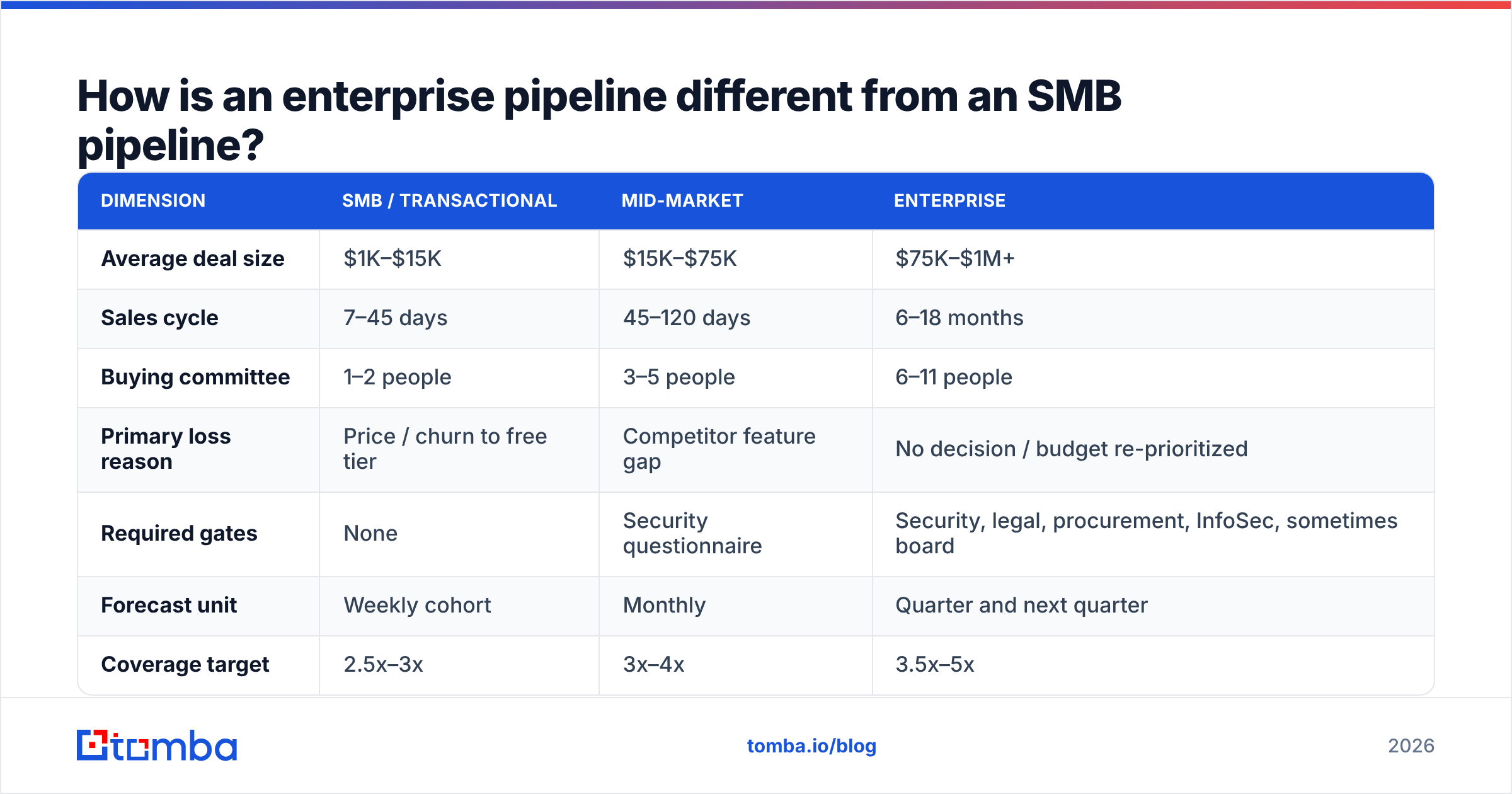
The differences are structural, not cosmetic. Copying a transactional pipeline and adding a "Legal Review" stage is the most common failure mode in mid-market companies moving upmarket.
| Dimension | SMB / transactional | Mid-market | Enterprise |
|---|---|---|---|
| Average deal size | $1K–$15K | $15K–$75K | $75K–$1M+ |
| Sales cycle | 7–45 days | 45–120 days | 6–18 months |
| Buying committee | 1–2 people | 3–5 people | 6–11 people |
| Primary loss reason | Price / churn to free tier | Competitor feature gap | No decision / budget re-prioritized |
| Required gates | None | Security questionnaire | Security, legal, procurement, InfoSec, sometimes board |
| Forecast unit | Weekly cohort | Monthly | Quarter and next quarter |
| Coverage target | 2.5x–3x | 3x–4x | 3.5x–5x |
| Rep motion | Volume, speed | Consultative | Multithreaded, account-planned |
The line that matters most is "primary loss reason." In SMB you lose to a competitor. In enterprise you lose to inertia. Gartner's sales research has consistently found that a large share of qualified enterprise opportunities end in no decision rather than a competitive loss. Your pipeline stages need to detect stalled consensus early, because "no decision" deals sit in Stage 4 looking healthy for two quarters before dying.
What stages should an enterprise sales pipeline have?#
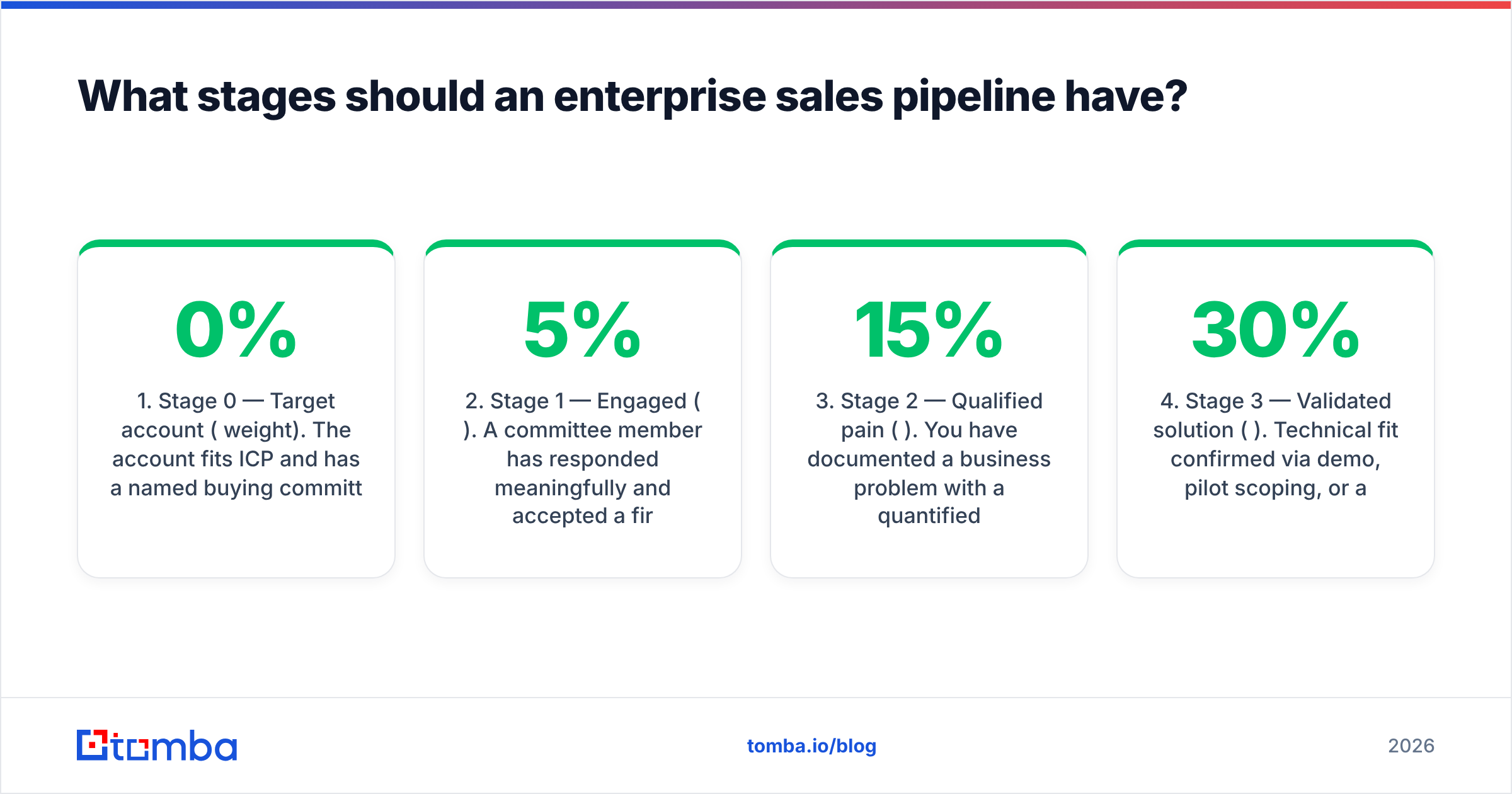
Seven stages is the practical ceiling. More than that and reps stop updating the CRM honestly; fewer and you lose the resolution you need to diagnose where deals die.
- Stage 0 — Target account (0% weight). The account fits ICP and has a named buying committee mapped, but no two-way engagement. This is not pipeline. Keep it out of forecast entirely or it will inflate every number downstream.
- Stage 1 — Engaged (5%). A committee member has responded meaningfully and accepted a first call. Exit criterion: a scheduled discovery meeting with a named title, not a "great chat, following up."
- Stage 2 — Qualified pain (15%). You have documented a business problem with a quantified cost of inaction, plus the identity of the economic buyer. Exit criterion: the customer has articulated the problem in their own words, in writing, in a thread you can quote.
- Stage 3 — Validated solution (30%). Technical fit confirmed via demo, pilot scoping, or architecture review. Exit criterion: a second stakeholder from a different function joins the conversation. Single-threaded deals do not exit Stage 3.
- Stage 4 — Business case (50%). A mutual action plan exists with dates, and the customer has agreed to it. Exit criterion: the buyer supplies their own internal approval timeline — procurement lead time, board meeting date, fiscal cutoff.
- Stage 5 — Procurement and legal (75%). Redlines, security review, vendor onboarding. Exit criterion: MSA in the hands of someone with signature authority.
- Stage 6 — Verbal / closing (90%). Terms agreed, signature pending. Anything sitting here longer than 21 days is not at 90%; re-stage it.
Notice that every exit criterion is something the buyer does. That is the whole trick. Write your stages so that a skeptical CRO reading the record can point to a customer action, not a rep adjective.
How do you set exit criteria that reps can't fudge?#
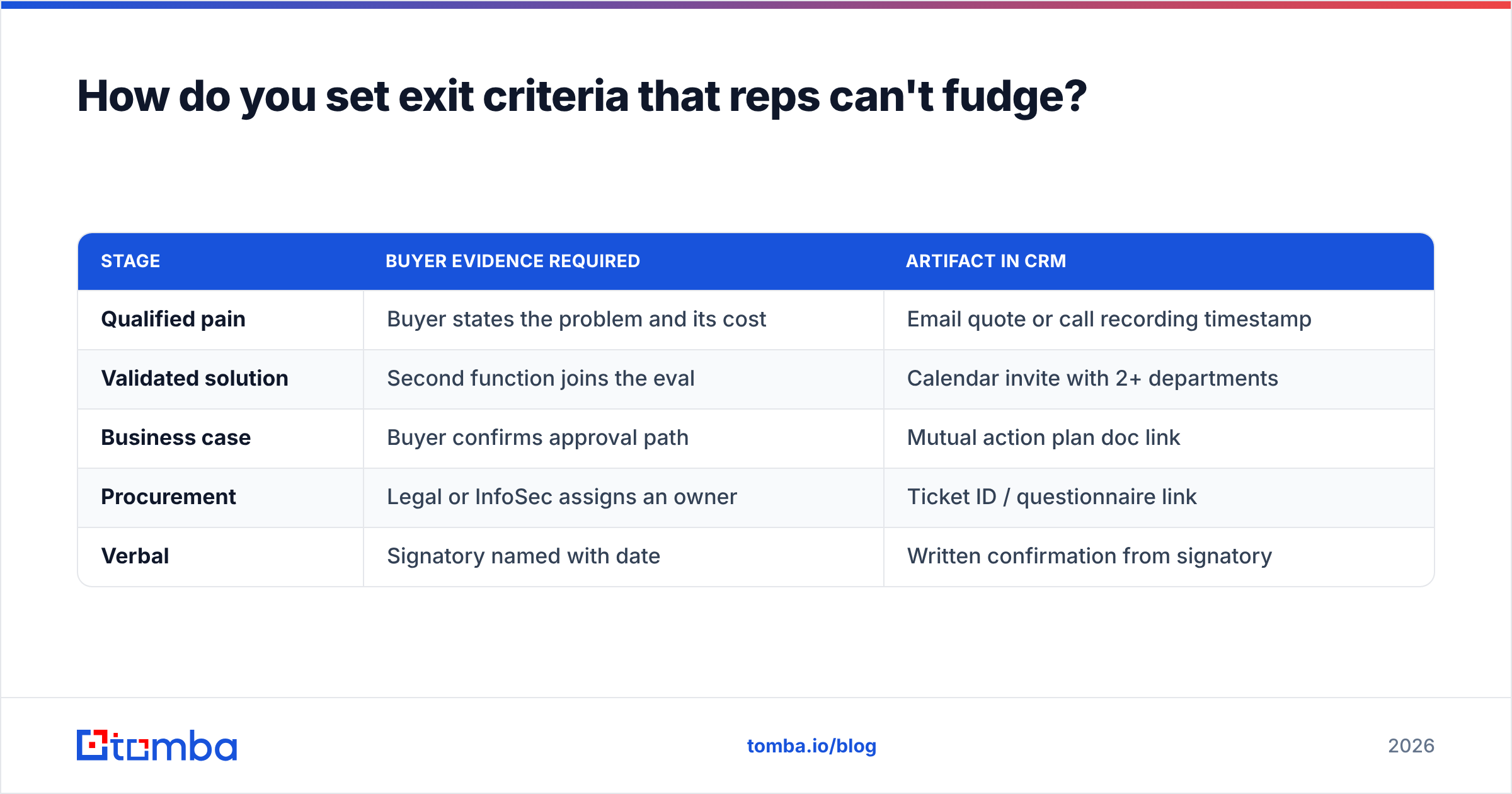
Use a three-column contract: stage, buyer evidence, artifact stored in the CRM. If there's no artifact, the stage doesn't advance. This is the single highest-leverage change most enterprise teams can make in a quarter.
| Stage | Buyer evidence required | Artifact in CRM |
|---|---|---|
| Qualified pain | Buyer states the problem and its cost | Email quote or call recording timestamp |
| Validated solution | Second function joins the eval | Calendar invite with 2+ departments |
| Business case | Buyer confirms approval path | Mutual action plan doc link |
| Procurement | Legal or InfoSec assigns an owner | Ticket ID / questionnaire link |
| Verbal | Signatory named with date | Written confirmation from signatory |
Two rules make this stick. First, stages can move backward — a deal that loses its champion goes back to Stage 2, and that should be normal, not punished. Second, run a monthly audit where a sales ops analyst pulls ten random Stage 4+ deals and checks for artifacts. Teams that audit see forecast accuracy improve within two quarters, because reps stop pre-emptively promoting deals when they know the artifact check is coming.
Which pipeline metrics actually forecast enterprise revenue?#
Most dashboards track pipeline value, which is the least predictive number available. Track these instead.
- Stage-weighted coverage by segment. Not global 3x. Calculate
required pipeline = quota ÷ blended win rateseparately for new logo versus expansion. Expansion win rates often run 3–4x higher, so blending them hides a new-logo shortfall. - Stage aging versus benchmark. For each stage, compute the median days-in-stage for deals that eventually closed-won. Any open deal exceeding 1.5x that median is a risk flag regardless of how confident the rep is.
- Stakeholder count per open opportunity. Deals with four or more engaged contacts close at materially higher rates than single-threaded ones across nearly every enterprise dataset. Track it as a leading indicator, and hold reps to a stakeholder floor per stage.
- Slipped-quarter rate. The percentage of deals forecast for a quarter that push. If this is above 30%, your Stage 4 criteria are too soft, not your reps too optimistic.
- Pipeline creation velocity. New qualified pipeline generated per week, trailing 8 weeks. On a 9-month cycle, this is the only metric that tells you about revenue three quarters out.
- No-decision rate. Track it as a distinct loss reason from competitive loss. They have completely different fixes: no-decision is a business-case problem, competitive loss is a positioning problem.
The HubSpot sales blog publishes useful benchmark ranges on conversion and cycle length, but treat any external benchmark as a sanity check, not a target. Your own closed-won cohort from the last 18 months is a far better baseline than an industry average that blends 40-person startups with Fortune 500 vendors.
How do you fill the top of an enterprise pipeline?#
This is where most enterprise pipeline problems actually originate, and where they are hardest to see, because the cost surfaces two quarters later.
The math is unforgiving. If your cycle is nine months and your Stage 1→Closed-Won conversion is 12%, every bad contact record at the top costs you nine months of capacity. A rep who spends Q1 emailing a decision-maker who left the company in 2023 doesn't find out they wasted the quarter until Q3.
Three inputs determine top-of-funnel quality:
- Account selection. Firmographic fit plus a trigger event — funding, leadership change, tech stack shift, regulatory deadline. Untriggered ICP accounts convert at a fraction of the rate.
- Committee mapping. Before outreach, name the economic buyer, the technical evaluator, the end-user champion, and the likely blocker. If you can only name one, you're building a single-threaded deal on purpose.
- Contact accuracy. Verified work emails and direct phone numbers for every mapped role. This is a data problem, not a hustle problem.
For the third input, running a domain search against a target account surfaces the email pattern and known contacts across departments in one pass, which is faster than hunting each stakeholder individually. Verifying before send matters more here than in SMB: a bounce to a VP at a 40,000-person account can get your sending domain flagged across the entire company, poisoning every future thread with that logo. Run everything through an email verifier first. For account-based plays where you're building the committee map in bulk, a bulk email finder run against a target list is the practical starting point.
What tooling does an enterprise pipeline actually need?#
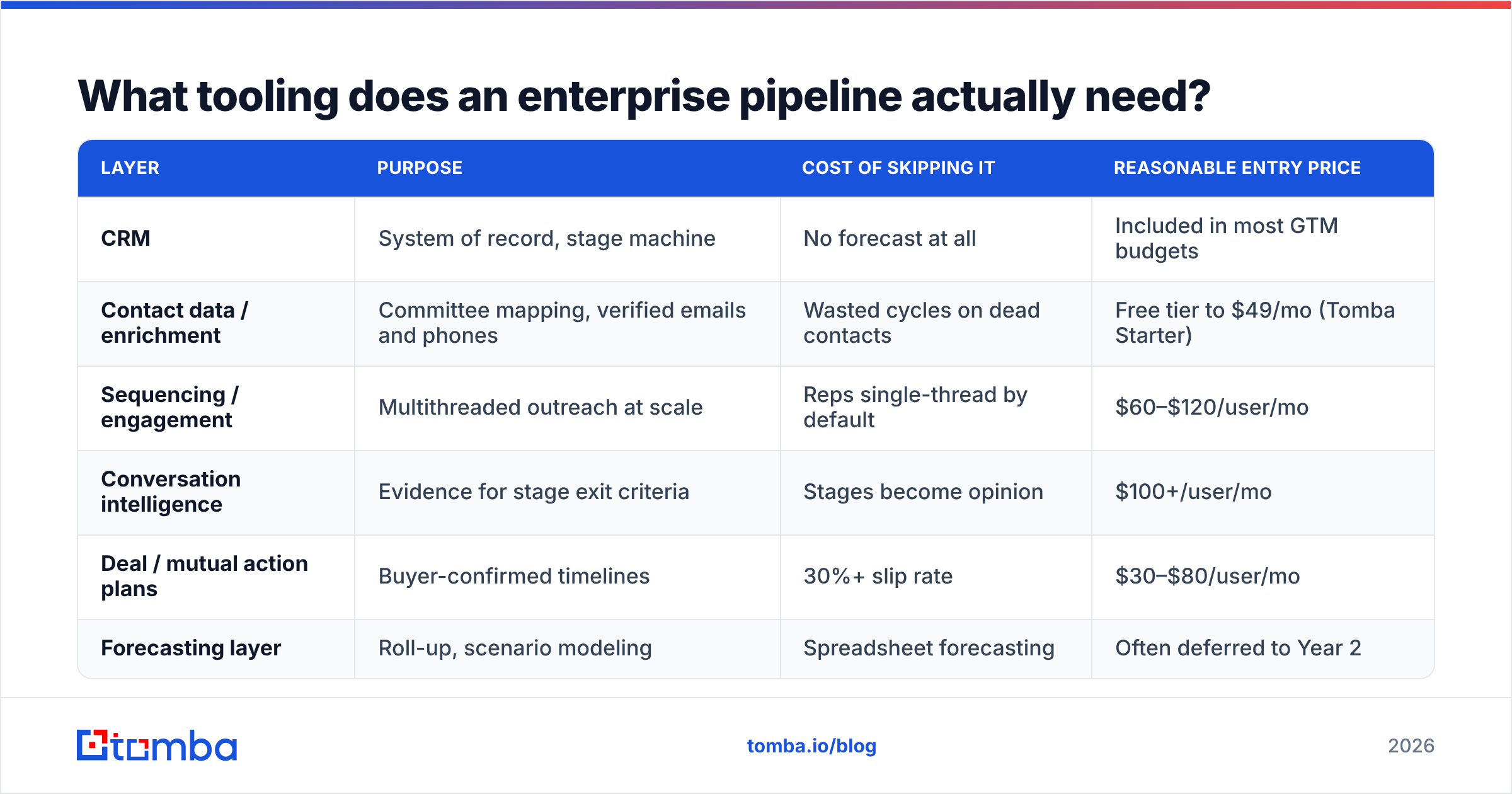
Fewer things than most stacks contain. Here's the honest breakdown of what each layer does and what it costs to skip.
| Layer | Purpose | Cost of skipping it | Reasonable entry price |
|---|---|---|---|
| CRM | System of record, stage machine | No forecast at all | Included in most GTM budgets |
| Contact data / enrichment | Committee mapping, verified emails and phones | Wasted cycles on dead contacts | Free tier to $49/mo (Tomba Starter) |
| Sequencing / engagement | Multithreaded outreach at scale | Reps single-thread by default | $60–$120/user/mo |
| Conversation intelligence | Evidence for stage exit criteria | Stages become opinion | $100+/user/mo |
| Deal / mutual action plans | Buyer-confirmed timelines | 30%+ slip rate | $30–$80/user/mo |
| Forecasting layer | Roll-up, scenario modeling | Spreadsheet forecasting | Often deferred to Year 2 |
You can run a credible enterprise pipeline with just the first three. Conversation intelligence and dedicated forecasting tools are optimizations that pay off after you have 50+ closed-won deals to learn from. Buying a forecasting platform before your stage definitions are clean just gives you faster wrong answers.
On the data layer specifically, Tomba pricing starts with a free tier at 25 searches a month, then $49/mo for Starter, $99/mo for Growth, and $249/mo for Pro — which for a team of three to eight enterprise reps mapping 40–60 accounts a quarter is usually the Growth tier. Peers worth evaluating in the same slot include BookYourData for pre-built B2B lists and the major enrichment platforms if you also need intent signals bundled in. Compare on verified-contact rate per account, not on total database size; a 700-million-record database that can't return a verified CISO email for your 30 target accounts is worth nothing to an enterprise team. You can review methodology on Salesforce's sales resources for how the CRM layer expects data to arrive.
How do you run a pipeline review that isn't theater?#
A good enterprise pipeline review removes deals. If your weekly review only ever adds and advances, you're running a reporting meeting.
Structure it in three passes:
- Hygiene pass (5 minutes). Any deal with a close date in the past, a missing next step, or no activity in 21 days gets flagged automatically before the meeting. Reps fix these in the CRM, not in the room.
- Risk pass (20 minutes). Only deals exceeding stage-age benchmarks or missing a stakeholder floor. For each: what is the buyer's next action, and who confirmed it? If the answer is a seller action, the deal is stalled.
- Strategy pass (20 minutes). Two or three deals worth real coaching — usually the largest, and one that's genuinely at risk. Multithreading plans, champion development, competitive traps.
Ban the phrase "waiting to hear back." It is not a pipeline state. Either the buyer has committed to a dated next step or the deal moves backward a stage. Teams that enforce this see slipped-quarter rates fall by double digits within two quarters, because the deals that were always going to slip get identified in month two instead of month eight.
One more discipline: run a quarterly loss review on no-decision deals specifically. Pull five, call the champion, and ask what happened internally. The answers are consistently more useful than any competitive intel, and they almost always point at a Stage 4 business-case gap rather than a product gap.
Where should you start if your pipeline is a mess right now?#
Do these four things in order, one per month.
- Rewrite stage exit criteria as buyer-verifiable artifacts. Publish them. Audit ten deals.
- Recompute coverage per segment using your own trailing 18-month win rates.
- Add a stakeholder floor per stage and enforce it in the CRM.
- Fix the data layer feeding the top so the next three quarters aren't built on stale contacts.
That fourth step is the one teams keep deferring because it feels like plumbing. It isn't. On a 9-to-18-month cycle, the accuracy of the contact you emailed in February determines whether November has a quarter.
If your bottleneck is finding and verifying the six to eleven people who actually decide inside a target account, start with the Tomba Email Finder. Map the committee, verify every address before it enters a sequence, and let your pipeline stages reflect real buyer engagement instead of hope. The free tier gives you 25 searches to test it against your ten most important target accounts before you commit to anything.
Related guides#
Ready to find emails that actually work?
Join 150,000+ professionals who stopped guessing and started sending. Free credits on signup — no credit card required.
Get the Tomba newsletter
Practical outbound tactics and product updates — once every two weeks.
About the author