Enterprise Sales Pipeline Management: The 2026 Operator Guide
Most enterprise pipelines are 40% fiction. Here is how top revenue teams stage, weight, hygiene-check, and forecast a multi-stakeholder pipeline that actually closes.
TL;DR
- Enterprise pipelines fail on definition, not effort. If "Discovery" means something different to each rep, your forecast is a vote, not a number.
- Exit criteria beat stage names. Every stage needs a buyer-verifiable event — not a rep's feeling — before the deal advances.
- Weighted forecasting on 8-month cycles is misleading unless you segment by deal age. A 40%-probability deal sitting 120 days past its stage average is closer to 5%.
- Pipeline hygiene is a data problem first. Bad contact data inflates coverage, breaks multithreading, and hides single-threaded risk.
- Coverage ratios of 3x are a mid-market myth. Enterprise teams with 6+ stakeholders per deal typically need 4–6x, and the ratio should be calculated per segment.
Enterprise deals do not die from bad selling. They die from a pipeline that reported them as healthy until the week they slipped. When your average cycle runs 6 to 11 months, spans a buying committee of seven, and requires procurement, security review, and a legal redline, the CRM stage becomes the only artifact anyone trusts — and it is usually wrong.
This guide covers how to build stage definitions that survive audit, how to run hygiene at scale, what forecast math actually holds up in enterprise, and where data quality quietly destroys the whole model.
What Is Enterprise Sales Pipeline Management?#
Enterprise sales pipeline management is the practice of defining, measuring, and correcting the flow of large multi-stakeholder deals from first qualified conversation to signed contract — with enough structural discipline that the resulting forecast is defensible to a board.
Think of it like air traffic control rather than a to-do list. A small-business pipeline is a queue: deals come in, deals go out, order matters little. An enterprise pipeline is airspace: every deal has an altitude (stage), a heading (next verifiable event), a fuel level (champion engagement), and a landing slot (budget cycle). Losing track of any one variable does not slow a deal — it grounds it.
The four components that separate enterprise pipeline management from generic pipeline tracking:
- Stage exit criteria tied to buyer behavior — not "sent proposal" but "economic buyer confirmed budget in writing." The test is whether an outsider reading the CRM could verify the claim.
- Multithreading requirements per stage — enterprise deals with a single contact close at roughly a third the rate of deals with four or more engaged stakeholders. Track contact count as a stage gate, not a nice-to-have.
- Time-in-stage decay — a deal's probability is a function of stage and age. Most CRMs only model the first.
- Segment-specific coverage targets — a $40k land motion and a $900k platform deal do not share a coverage ratio, a cycle length, or a slip risk.
- Data provenance — where every contact and account record came from, and when it was last verified. This is the layer most teams skip, and it is the layer that silently corrupts everything above it.
Why Do Enterprise Pipelines Report Healthy and Then Slip?#
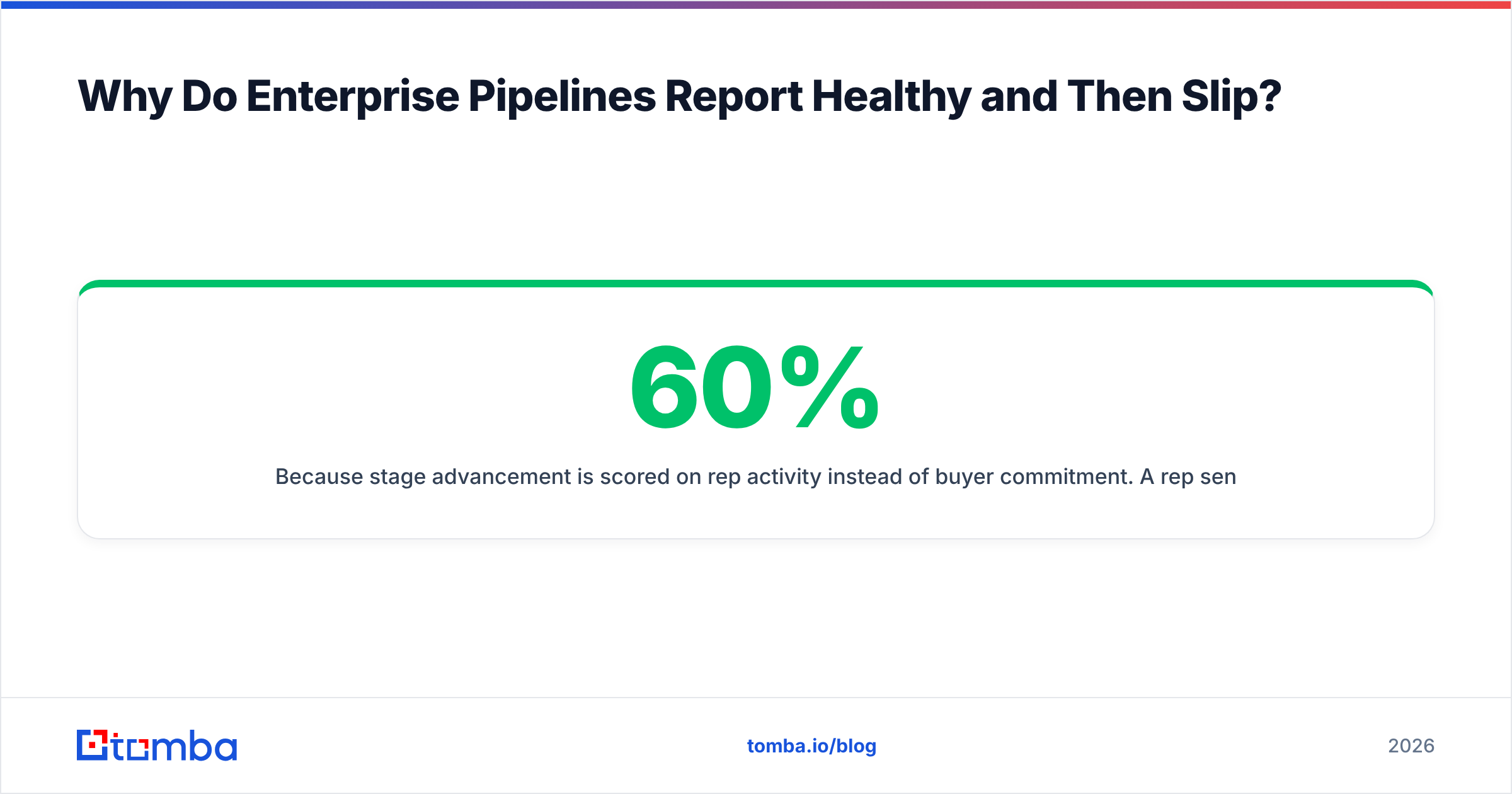
Because stage advancement is scored on rep activity instead of buyer commitment. A rep sends a proposal, moves the deal to "Proposal," and the forecast picks up a 60% weight. Nothing about the buyer changed.
Four failure patterns show up in nearly every enterprise pipeline review:
The single-threaded ghost. One champion, no economic buyer, no technical evaluator. It looks like a real deal because the champion is enthusiastic. Then the champion changes jobs — which happens to roughly one in five B2B contacts annually — and the deal evaporates with zero warning. The fix is a hard stage gate: no deal advances past discovery without at least three mapped stakeholders with verified contact details.
Stage inflation at quarter end. Reps push deals forward to hit activity metrics. Look at the distribution of stage changes by day of quarter — if week 12 has 4x the stage advancements of week 6, you have inflation, not momentum.
The zombie deal. Technically open, last meaningful buyer response 90+ days ago, still carrying weight in the forecast. A simple rule kills this: any deal with no buyer-initiated activity in 2x the median stage duration auto-flags for close-lost review.
Data rot. Your account records were enriched 18 months ago. Titles changed, companies restructured, three of your five stakeholders left. The pipeline shows six contacts on the deal; two are reachable. This is why data enrichment belongs on a quarterly cadence for open enterprise opportunities, not just at lead creation.
How Should You Define Enterprise Pipeline Stages?#
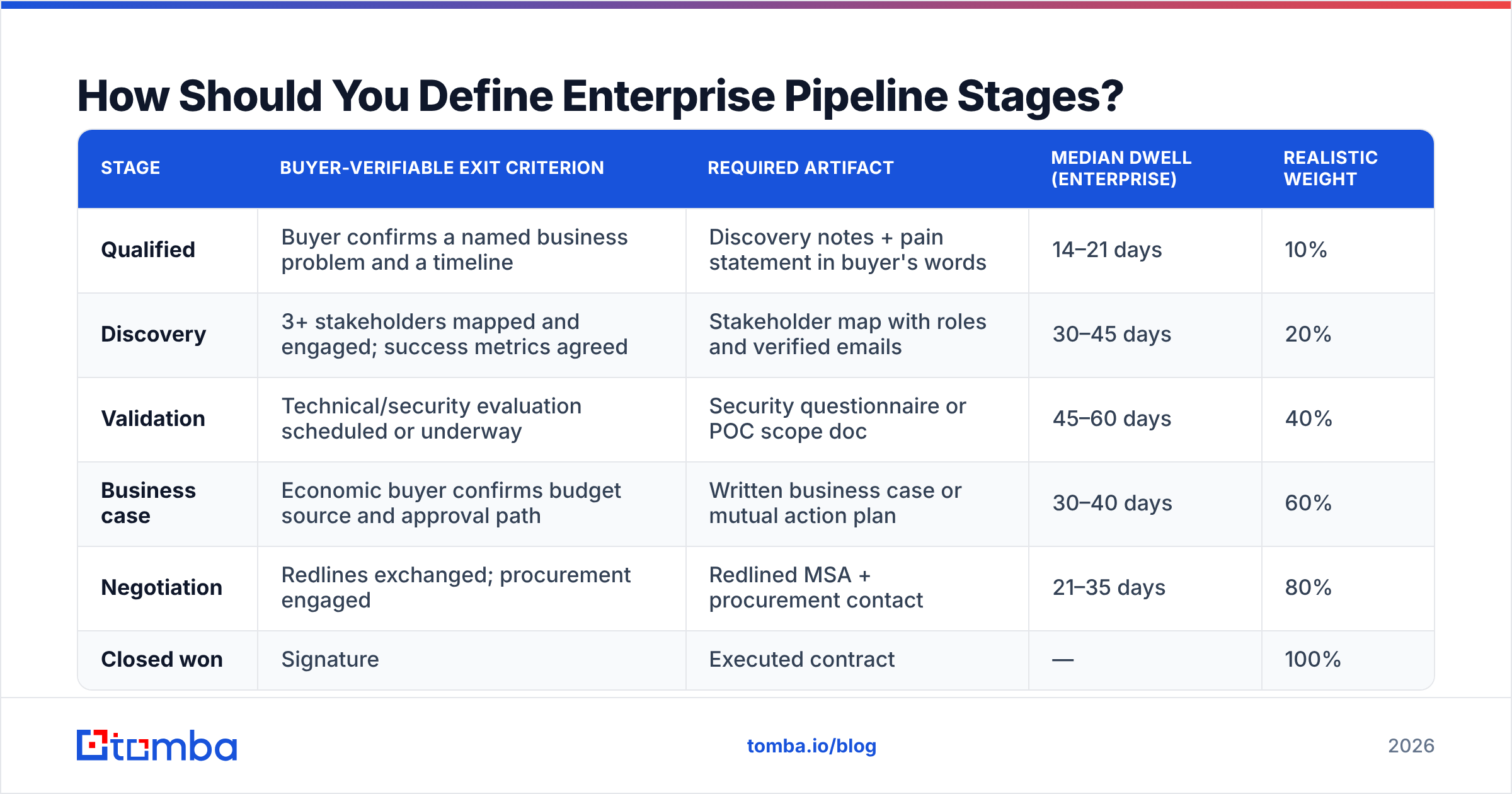
Define each stage by what the buyer has done, add a required artifact, and set a maximum dwell time. Here is a structure that holds up in enterprise deal reviews:
| Stage | Buyer-verifiable exit criterion | Required artifact | Median dwell (enterprise) | Realistic weight |
|---|---|---|---|---|
| Qualified | Buyer confirms a named business problem and a timeline | Discovery notes + pain statement in buyer's words | 14–21 days | 10% |
| Discovery | 3+ stakeholders mapped and engaged; success metrics agreed | Stakeholder map with roles and verified emails | 30–45 days | 20% |
| Validation | Technical/security evaluation scheduled or underway | Security questionnaire or POC scope doc | 45–60 days | 40% |
| Business case | Economic buyer confirms budget source and approval path | Written business case or mutual action plan | 30–40 days | 60% |
| Negotiation | Redlines exchanged; procurement engaged | Redlined MSA + procurement contact | 21–35 days | 80% |
| Closed won | Signature | Executed contract | — | 100% |
Two rules make this table useful rather than decorative.
Rule one: the artifact is mandatory. If there is no stakeholder map attached, the deal is not in Discovery regardless of what the rep believes. This converts pipeline review from a debate into an inspection.
Rule two: dwell time triggers review, not demotion. A deal 50% past median dwell gets a mandatory manager review. It does not automatically move backward — enterprise deals legitimately stall on the buyer's budget calendar — but it stops being invisible.
What Coverage Ratio Does an Enterprise Pipeline Actually Need?#
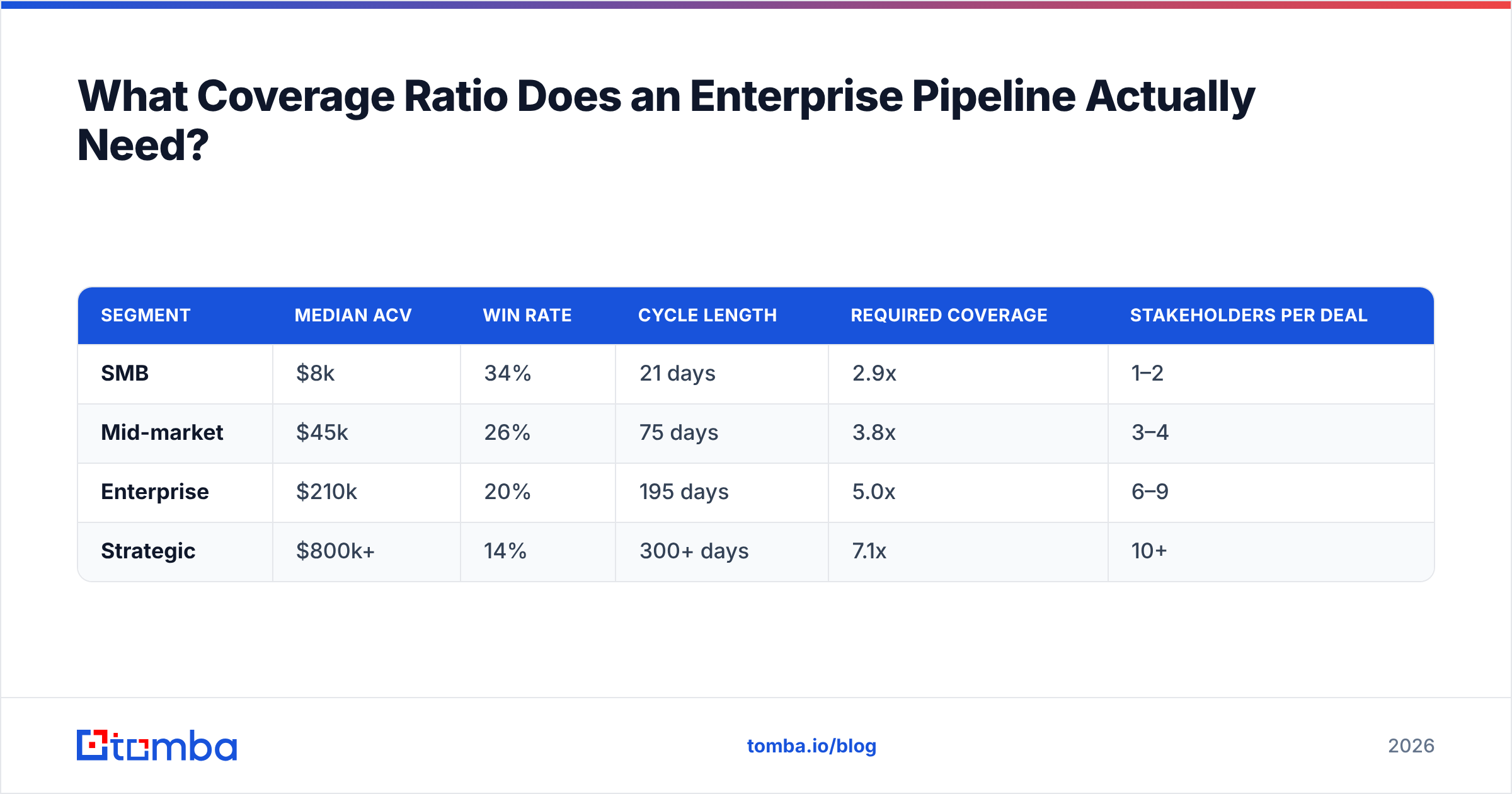
Calculate it from your own historical win rate rather than inheriting the 3x rule of thumb. The formula is simple: required coverage = 1 / (win rate × forecast confidence factor).
If your enterprise segment closes 22% of qualified opportunities and you want to hit quota with margin, you need roughly 4.5x coverage. Teams with 15% win rates and long cycles need 6x or more. Publishing a single company-wide number across segments is how you end up with a mid-market team drowning in pipeline and an enterprise team structurally short.
| Segment | Median ACV | Win rate | Cycle length | Required coverage | Stakeholders per deal |
|---|---|---|---|---|---|
| SMB | $8k | 34% | 21 days | 2.9x | 1–2 |
| Mid-market | $45k | 26% | 75 days | 3.8x | 3–4 |
| Enterprise | $210k | 20% | 195 days | 5.0x | 6–9 |
| Strategic | $800k+ | 14% | 300+ days | 7.1x | 10+ |
Note what happens to stakeholder count as ACV rises. This is the operational reason enterprise pipeline management is a data discipline: 10 stakeholders per deal across 40 open opportunities is 400 contact records you need to keep current, each with a role, an engagement date, and a reachable email address. Manual maintenance does not scale past about 50 open deals.
How Do You Keep Pipeline Data Clean at Enterprise Scale?#
Automate verification on a schedule and treat contact decay as a known rate, not an occasional surprise. B2B contact data degrades at roughly 22–30% per year — HubSpot's research on database decay has pointed at this range for years, and it accelerates during layoff cycles.
A practical hygiene stack for an enterprise pipeline:
- Quarterly re-verification of open-deal contacts. Run every stakeholder email on active opportunities through an email verifier before each quarter's forecast lock. A bounced champion address discovered in week 11 is a slipped quarter.
- Automated stakeholder gap-filling. When a deal advances to Validation with only two contacts, trigger a domain search on the account to surface security, procurement, and finance contacts you have not mapped yet.
- Ownership rules. Every field that gates a stage must have a single owner — rep, SDR, or ops. Fields owned by "everyone" are owned by no one and are blank within a quarter.
- Enrichment at account level, not just contact level. Headcount changes, funding events, and tech-stack shifts are leading indicators of slip or acceleration. Push them into the account record automatically.
- A dead-field audit twice a year. Most enterprise CRM instances carry 40+ custom fields where fewer than 10 influence any decision. Delete the rest; every field you keep is a field reps must maintain.
For teams running this at volume, the practical move is API-driven refresh rather than manual list uploads. A nightly job that pushes open-opportunity contacts through an email verification API and writes results back to the CRM removes hygiene from the rep's job description entirely — which is the only version of this that survives contact with a busy quarter.

Which Pipeline Metrics Actually Predict Enterprise Revenue?#
Four metrics carry most of the signal. Everything else is diagnostic color.
Stage conversion rate by cohort, not aggregate. Aggregate conversion hides the pattern. Cohort deals by the quarter they entered qualification and track how each cohort converts through every stage. A degrading Validation-to-Business-Case rate across three consecutive cohorts is a product or competitive problem, not a rep problem.
Time-in-stage versus median. Track the ratio, not the absolute. A deal at 2.4x median dwell in Negotiation is telling you procurement is stuck or the champion lost internal authority.
Stakeholder engagement breadth. Count distinct contacts who responded (not who were emailed) in the last 30 days. This is the single best leading indicator of enterprise slip that most teams do not instrument.
Slipped-deal recovery rate. Of deals that slip a quarter, what percentage close in the following quarter? If it is under 40%, your "slipped" deals are actually lost deals with better branding, and your forecast should treat them accordingly.
Notice what is missing: activity counts. Calls logged and emails sent correlate with effort, not outcome, at enterprise ACV. Gartner's B2B buying research has consistently found that buyers spend the majority of the purchase cycle in independent research and internal consensus-building — activity you cannot see and cannot manufacture with more outbound touches.
Is Weighted Forecasting Reliable for Long Enterprise Cycles?#
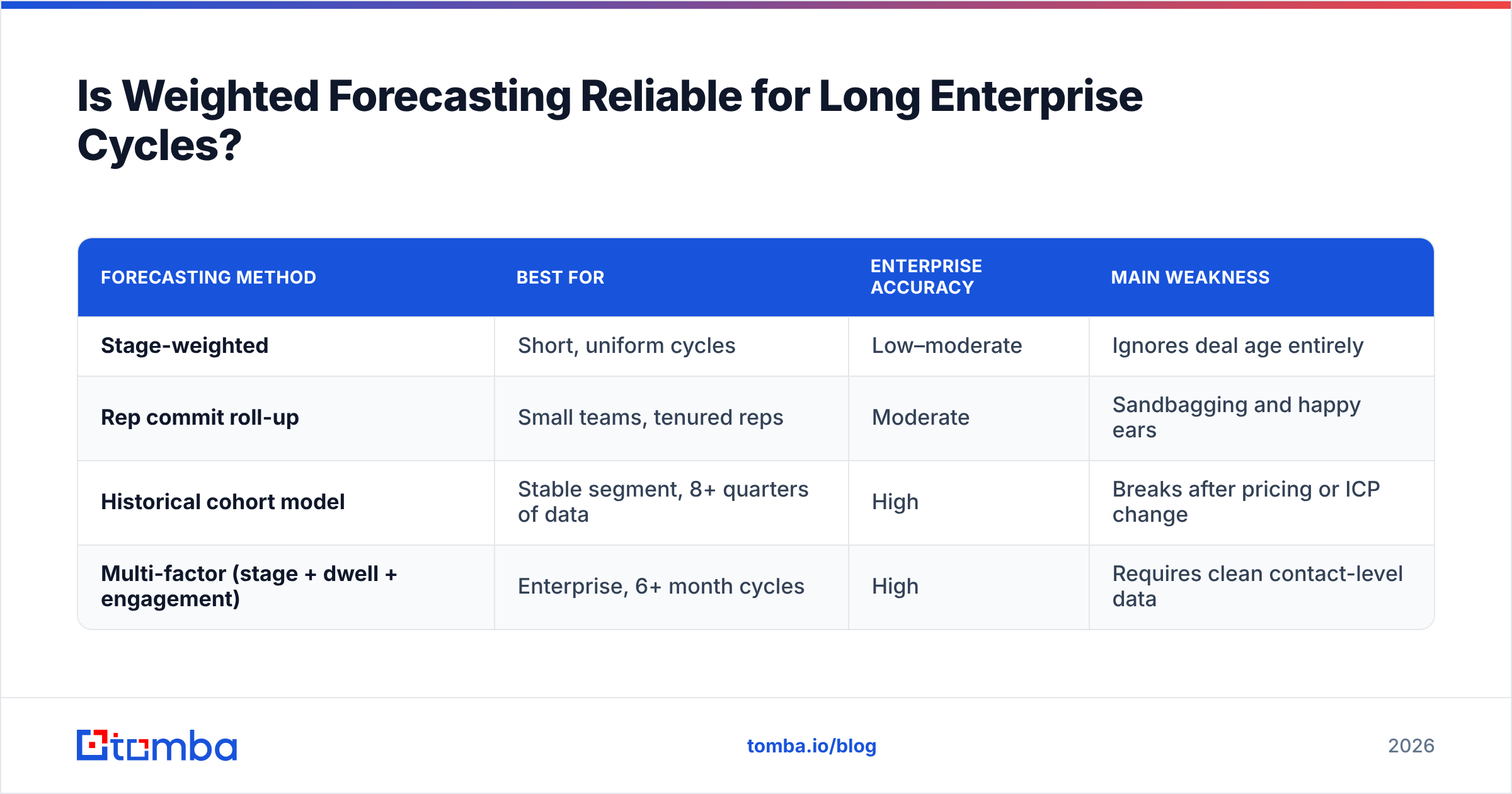
Not on its own. Weighted forecasting assumes probability is a property of stage, which is roughly true in a 30-day cycle and badly false in a 200-day one.
Three adjustments make it usable:
Decay the weight by dwell overage. A 60%-weighted deal at 2x median dwell should be discounted — many revenue teams apply a 40–60% haircut past 1.5x median. The math is crude but it is closer to reality than a flat stage weight.
Run a commit/best-case/pipeline split alongside the weighted number. The weighted forecast is your statistical floor. The commit number is your rep-attested figure. When the gap between them exceeds 20%, something is wrong with either the stage definitions or the rep's judgment, and the review should find out which.
Backtest quarterly. Take last quarter's week-6 weighted forecast and compare it to actuals by stage. If Validation-stage deals closed at 24% against a 40% weight, change the weight. Most companies set stage weights once at CRM implementation and never revisit them.
| Forecasting method | Best for | Enterprise accuracy | Main weakness |
|---|---|---|---|
| Stage-weighted | Short, uniform cycles | Low–moderate | Ignores deal age entirely |
| Rep commit roll-up | Small teams, tenured reps | Moderate | Sandbagging and happy ears |
| Historical cohort model | Stable segment, 8+ quarters of data | High | Breaks after pricing or ICP change |
| Multi-factor (stage + dwell + engagement) | Enterprise, 6+ month cycles | High | Requires clean contact-level data |
The last row is the destination. It is also the one that fails immediately if your stakeholder records are stale — engagement breadth is meaningless when a third of your contact list bounces.
How Do You Run a Pipeline Review That Changes Outcomes?#
Structure the meeting around inspection of artifacts, not narration of deals. A rep describing a deal will always describe it favorably; a stakeholder map either exists or it does not.
A 45-minute enterprise pipeline review that works:
- Ten minutes on hygiene exceptions. Deals missing required artifacts, deals past dwell thresholds, deals with fewer stakeholders than their stage requires. No storytelling — just the list and a decision on each.
- Twenty minutes on the top five deals by weighted value. For each: who is the economic buyer, what is the next buyer-committed date, and what would have to be true for this to close. If the rep cannot name the economic buyer, the deal is downgraded on the spot.
- Ten minutes on the slip list. Deals that moved out of the current quarter since last review. Root cause each one to a category — budget, competitor, priority shift, internal process — and track the category distribution over time.
- Five minutes on what got added. New qualified pipeline, and whether it fits the ICP that actually converts.
What to remove from the meeting: full pipeline walkthroughs, activity dashboards, and any deal under 5% of the total. Those belong in a report, not a room full of expensive people.
If you are building the account and contact layer feeding this process, bulk lead generation and account-level domain search let you map an entire buying committee before the first review rather than discovering the gap in week 10.
What Tooling Stack Supports This?#
You need four capabilities, and they do not have to come from one vendor: CRM as system of record, a data layer that keeps contacts current, a forecasting layer that models dwell and engagement, and a conversation-intelligence layer if your ACV justifies it.
The honest guidance on consolidation: buy the CRM and the forecasting layer together if you can, because forecast logic that lives outside the system of record drifts. Buy the data layer separately and by usage — enterprise contact volumes are spiky, and per-seat data pricing punishes you for having a large team that only occasionally needs lookups.
On the data layer specifically, look for three things: coverage in your target geographies, a verification step that distinguishes valid from catch-all domains, and API access that lets you run scheduled refresh rather than manual exports. Vendors differ sharply here — some sell enormous static databases where accuracy at the record level is unverified, while others verify on request. Peer reviews on G2's sales intelligence category are useful for separating the two, though read for the complaints rather than the scores.
Where Do Most Teams Go Wrong First?#
They fix the forecast model before fixing the definitions. A more sophisticated algorithm applied to stages that mean nothing produces a more confident wrong answer.
The order that works:
- Rewrite stage exit criteria as buyer-verifiable events. Two weeks of work, most of the value.
- Add required artifacts and enforce them for one full quarter. Expect a pipeline drop of 20–35% as fiction gets cleared out — that drop is the point.
- Instrument dwell time and stakeholder count. Now you have inputs for a real model.
- Clean and automate the contact data underneath it, so engagement metrics are trustworthy.
- Only then, rebuild the forecast math.
Teams that run this in reverse spend six months on a forecasting tool implementation and end up with the same accuracy they started with, because the underlying stage data never changed.
Getting the Contact Layer Right#
Every mechanism in this guide — stakeholder gates, engagement breadth, multithreading requirements, quarterly re-verification — depends on knowing who is actually at the account and being able to reach them. That is the layer that quietly determines whether the rest of your pipeline discipline is measuring reality or measuring a CRM.
Tomba's Email Finder maps buying committees by domain and role, verifies deliverability before contacts enter your CRM, and exposes the whole thing through an API so open-opportunity refresh runs on a schedule instead of a rep's memory. The free tier covers 25 searches a month if you want to test it against a handful of your stalled accounts; Tomba pricing starts at $49/mo for Starter and $99/mo for Growth when you are ready to run it across the full pipeline. Start with your ten oldest open enterprise deals — re-verify every stakeholder on them, and you will learn more about your forecast in an afternoon than the last three pipeline reviews told you.
Related guides#
Ready to find emails that actually work?
Join 150,000+ professionals who stopped guessing and started sending. Free credits on signup — no credit card required.
Get the Tomba newsletter
Practical outbound tactics and product updates — once every two weeks.
About the author