The Enterprise Sales Process in 2026: 7 Stages, Explained
Enterprise deals do not stall because your pitch is weak. They stall because the process has no exit criteria, no committee map, and no plan for the 11 people who never showed up to a call. Here is the full 7-stage breakdown.
TL;DR
- An enterprise sales process is a repeatable, stage-gated system for deals with 6–15 stakeholders, 4–18 month cycles, and formal procurement — not a longer version of SMB selling.
- The seven stages that matter: account research, multithreaded outreach, discovery, qualification, business case, procurement/security review, and close-plus-onboarding handoff.
- Every stage needs exit criteria owned by the buyer, not by your rep. "Had a good call" is not an exit criterion. "Champion confirmed the economic buyer and forwarded our ROI model" is.
- Qualification framework matters less than consistency, but MEDDIC/MEDDPICC outperforms BANT in complex deals because it forces you to name the decision process and paper process.
- The single biggest failure mode is single-threading. If one contact goes dark, the deal dies — and contact data decay of roughly 25–30% per year guarantees someone will.
What is an enterprise sales process?#
An enterprise sales process is the documented sequence of stages, exit criteria, and internal handoffs used to sell high-value contracts into large organizations — typically $50K–$1M+ ACV, with a buying committee, legal review, security review, and procurement.
Here is the useful analogy: SMB selling is ordering at a counter. One person decides, pays, and walks out. Enterprise selling is getting a construction permit. There is a committee, a required form set, an inspection, a budget cycle, and any one of six offices can stop you cold — and none of them will call to tell you why.
That structural difference is why enterprise processes look nothing like a five-stage SMB pipeline. You are not managing a conversation. You are managing a consensus-building project inside a company you do not work at.
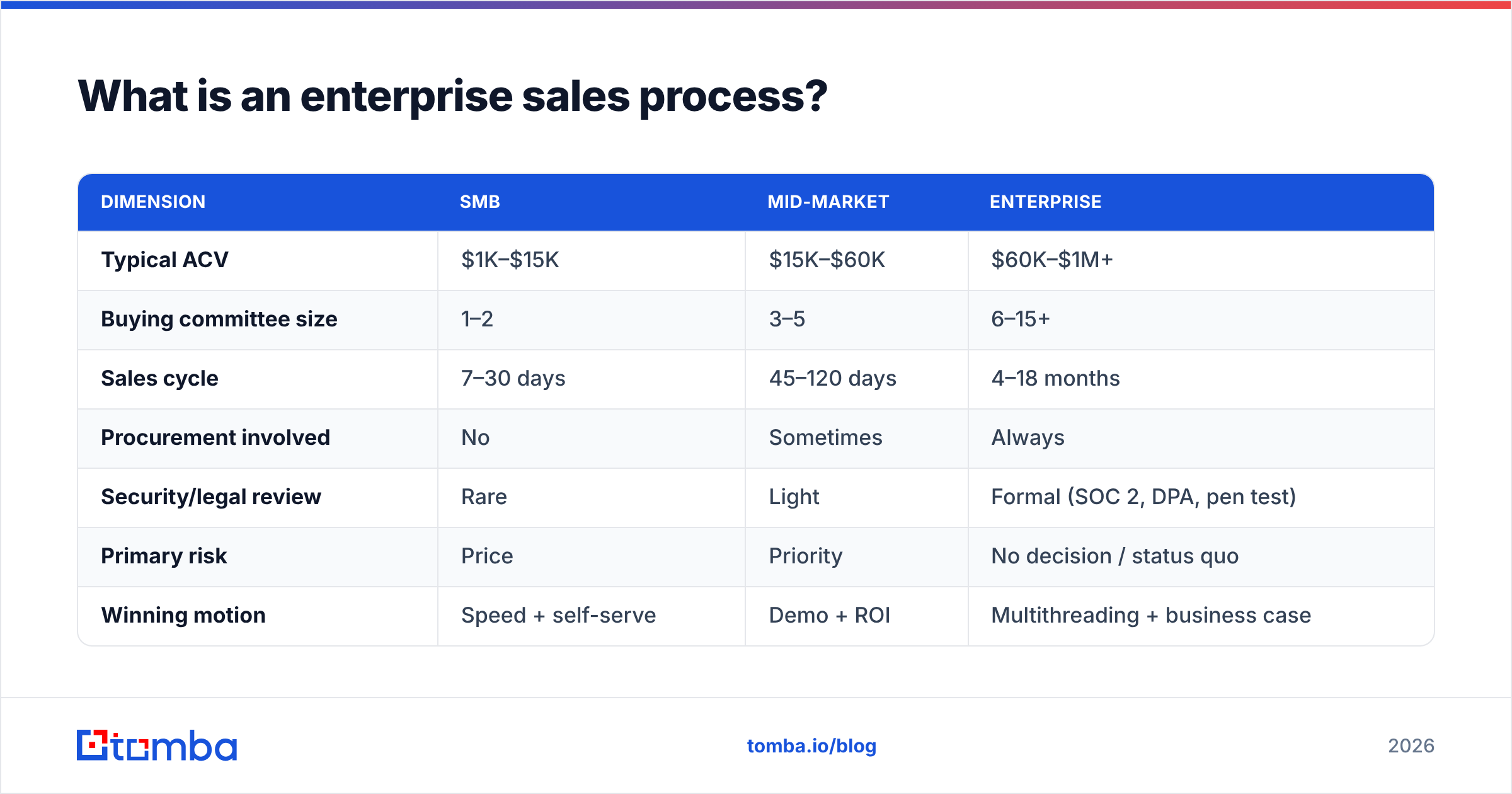
| Dimension | SMB | Mid-market | Enterprise |
|---|---|---|---|
| Typical ACV | $1K–$15K | $15K–$60K | $60K–$1M+ |
| Buying committee size | 1–2 | 3–5 | 6–15+ |
| Sales cycle | 7–30 days | 45–120 days | 4–18 months |
| Procurement involved | No | Sometimes | Always |
| Security/legal review | Rare | Light | Formal (SOC 2, DPA, pen test) |
| Primary risk | Price | Priority | No decision / status quo |
| Winning motion | Speed + self-serve | Demo + ROI | Multithreading + business case |
Note the "primary risk" row. In enterprise, your main competitor is not another vendor — it is the buying committee deciding to do nothing this fiscal year. Research from firms like Gartner has consistently found that buyers spend the majority of their purchase journey away from any vendor, gathering information independently and negotiating internally. Your process has to survive long stretches where nothing visible happens.
What are the 7 stages of the enterprise sales process?#
Stages are only useful if each one has a defined entry trigger and a buyer-verified exit. Here is the sequence that holds up across most B2B categories.
- Account research and territory selection. Before outreach, you build the account map: org structure, tech stack, funding events, hiring signals, and the three named people who own the problem. Exit criterion: you can name the likely economic buyer and at least two potential champions.
- Multithreaded outreach. Three-to-five contacts per account, contacted with different messages tied to their function. Exit criterion: a first meeting booked with someone who has budget influence — not just anyone who replies.
- Discovery. Two or three calls, not one. You are mapping current state, quantified pain, existing workarounds, and the internal politics of change. Exit criterion: the buyer articulates cost of inaction in their own numbers.
- Qualification and mutual action plan. You apply MEDDIC (or your chosen framework) and co-build a dated plan with the champion. Exit criterion: champion agrees in writing to a timeline with named milestones.
- Business case and technical validation. Pilot, POC, security questionnaire, or reference calls. Exit criterion: technical evaluator signs off and the ROI model is forwarded internally without you in the room.
- Procurement, legal, and security. Redlines, DPA, SOC 2 review, vendor onboarding portal, PO issuance. Exit criterion: contract in signature workflow with a named signer.
- Close and handoff. Signature, kickoff scheduled, success criteria transferred to CS with the original discovery notes attached. Exit criterion: onboarding call held within 14 days.
Most teams have some version of these seven. What they lack is discipline about stage 6, which they treat as administrative. It is not. Procurement is where 20–30% of "verbally closed" enterprise deals slip a quarter, because nobody asked in stage 4 how long vendor onboarding takes at that company.
How is enterprise selling different from mid-market selling?#
Three differences do almost all the damage.
Consensus replaces persuasion. In mid-market you convince a buyer. In enterprise you equip a champion to convince eight colleagues in meetings you will never attend. That means your deliverables change: you stop making decks for the person on the call and start making one-page internal justification documents your champion can forward without editing.
Time creates decay. A 9-month cycle means org charts change mid-deal. Your champion gets promoted, reorged, or leaves. Roughly a quarter to a third of B2B contact records go stale annually — job changes, domain migrations after acquisitions, restructured email formats. A deal that depended on one relationship is a deal with a built-in expiration date. This is why running periodic data enrichment against your open opportunities is a pipeline hygiene task, not a marketing task.
Process becomes the product. Large buyers evaluate how you sell as a proxy for how you will support them. Sloppy follow-up, a security questionnaire returned in three weeks, or a rep who cannot answer where their data comes from all read as operational risk. Vendors that publish their data sources and compliance posture up front clear stage 6 measurably faster.
Which qualification framework should you use?#
Use whichever one your team will actually apply to every deal — but understand what each is built for.
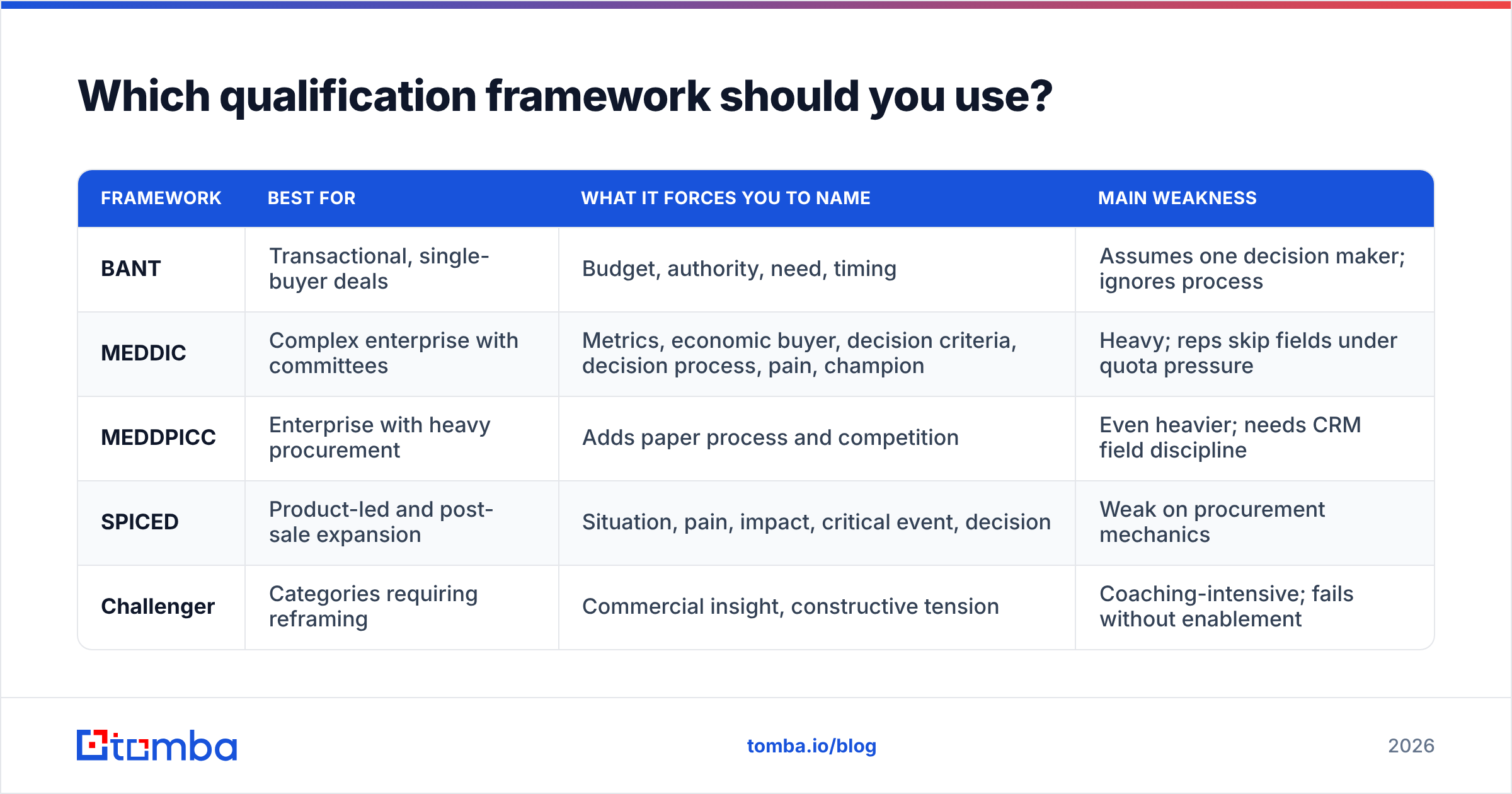
| Framework | Best for | What it forces you to name | Main weakness |
|---|---|---|---|
| BANT | Transactional, single-buyer deals | Budget, authority, need, timing | Assumes one decision maker; ignores process |
| MEDDIC | Complex enterprise with committees | Metrics, economic buyer, decision criteria, decision process, pain, champion | Heavy; reps skip fields under quota pressure |
| MEDDPICC | Enterprise with heavy procurement | Adds paper process and competition | Even heavier; needs CRM field discipline |
| SPICED | Product-led and post-sale expansion | Situation, pain, impact, critical event, decision | Weak on procurement mechanics |
| Challenger | Categories requiring reframing | Commercial insight, constructive tension | Coaching-intensive; fails without enablement |
For most enterprise motions, MEDDPICC's two extra letters are the ones that predict slippage. "Paper process" — how long legal and procurement actually take at this account — is the field that separates a Q3 close from a Q4 close. Ask it in stage 4, not stage 6.
One practical rule: a deal cannot advance past stage 4 without a named economic buyer and documented evidence the champion has spoken to them. Not "my champion says the CFO is on board." Evidence: a forwarded email, a calendar invite, a quote in the mutual action plan.
How do you map and reach the buying committee?#
The buying committee is the part reps consistently underestimate. A $250K platform purchase routinely touches finance, IT security, legal, procurement, the line-of-business owner, the day-to-day user, and an executive sponsor.
Map them by role, not title:
- Economic buyer — controls the budget line. Usually appears late and briefly. Your job is to be in the room once, with numbers.
- Champion — has pain, has credibility, and will spend political capital. Test this: ask them to do something small and see if they do it.
- Technical evaluator — security, IT, or data engineering. Can veto, cannot approve. Give them documentation early.
- Coach — tells you what is happening internally. Not the same person as the champion, and often more valuable.
- Blocker — has an incumbent relationship or an alternative plan. Find them in stage 3 or meet them as a surprise in stage 6.
- End user — will decide renewal even if they cannot decide purchase.
Reaching all six is where prospecting infrastructure earns its keep. You cannot multithread an account if you only have one verified address. Practical workflow: run a domain search to pull the org's addressable contacts and confirm the email pattern, filter by department, then verify before sending so your outreach to seven people at one company does not torch your sender reputation with seven bounces. For executive tiers where email response rates collapse, pair it with B2B phone numbers — a scheduled call with a VP of Engineering often beats the eleventh untouched email.
A useful guardrail: never send to more than three new contacts at the same domain on the same day from the same mailbox. Stagger it. Enterprise spam filters cluster by domain pair, and a coordinated blast looks exactly like what it is.
Where do enterprise deals actually stall?#
Five recurring stalls, ranked by how much pipeline they eat:
1. Single-threading. One contact, one relationship, one point of failure. When they go quiet, you have no independent read on the account. Fix: minimum three active contacts per open opportunity above $50K, enforced as a CRM validation rule.
2. No critical event. Nothing forces a decision by a date. Without a compelling event — contract expiry, audit deadline, headcount plan, product launch — enterprise deals drift indefinitely. Fix: if you cannot name the event in stage 4, downgrade the forecast category regardless of how good the calls feel.
3. Unquantified pain. Buyers cannot get budget for "inefficiency." They can get budget for "$340K in annual rework across 12 FTEs." Fix: leave every discovery call with a number the buyer said out loud.
4. Procurement surprise. Security questionnaire arrives in week 20 with a 200-line spreadsheet and a 3-week SLA. Fix: request the vendor onboarding checklist during stage 4 and pre-fill what you can.
5. Champion attrition. Promotions, layoffs, reorgs. Fix: quarterly re-verification of contacts on all open enterprise opportunities, plus a documented second champion. Tools like HubSpot and Salesforce can flag stale contacts, but they will not find the replacement — that requires an external data source.
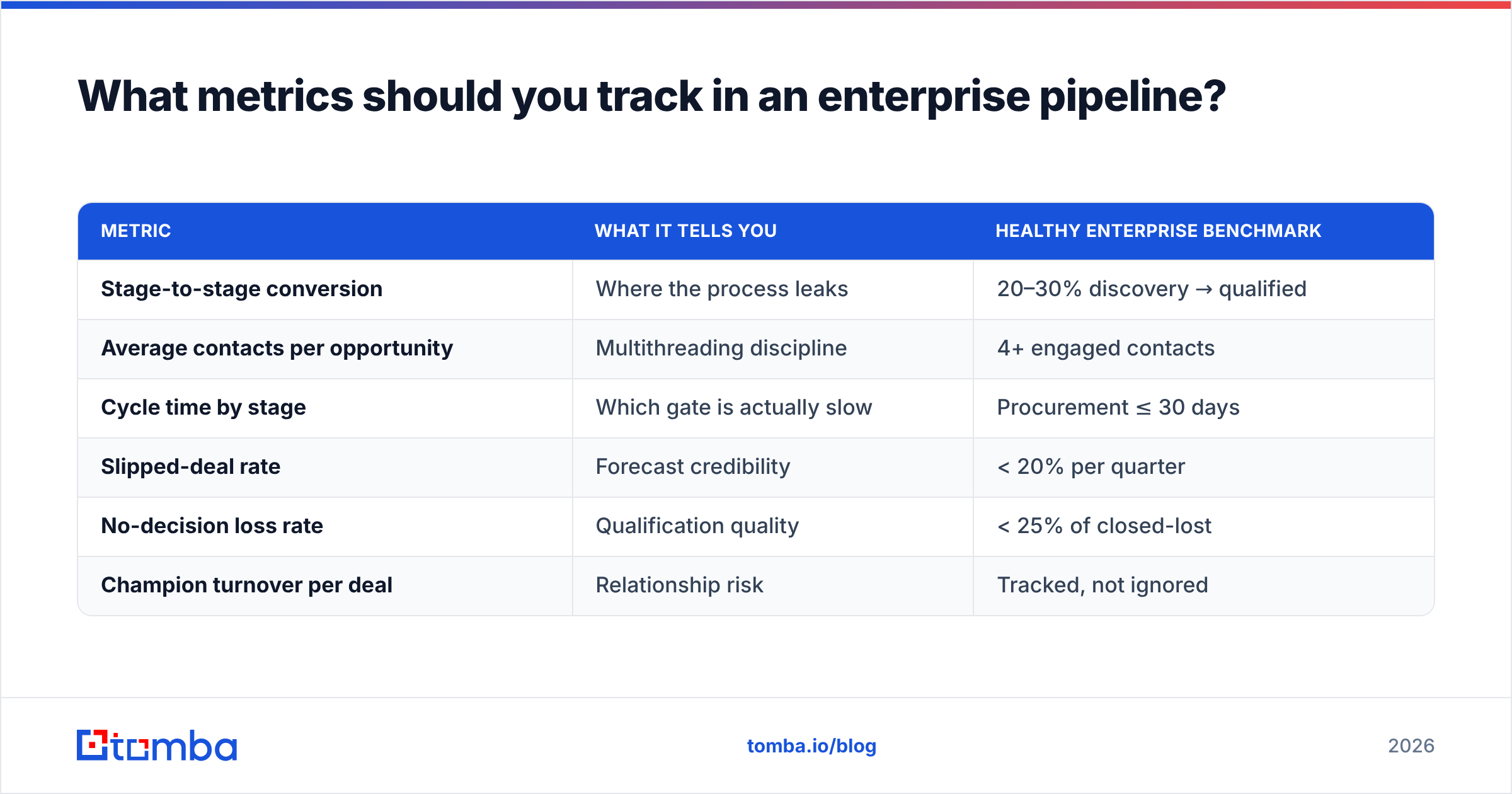
What metrics should you track in an enterprise pipeline?#
Volume metrics lie in long cycles. Track these instead:
| Metric | What it tells you | Healthy enterprise benchmark |
|---|---|---|
| Stage-to-stage conversion | Where the process leaks | 20–30% discovery → qualified |
| Average contacts per opportunity | Multithreading discipline | 4+ engaged contacts |
| Cycle time by stage | Which gate is actually slow | Procurement ≤ 30 days |
| Slipped-deal rate | Forecast credibility | < 20% per quarter |
| No-decision loss rate | Qualification quality | < 25% of closed-lost |
| Champion turnover per deal | Relationship risk | Tracked, not ignored |
The two most diagnostic are no-decision loss rate and contacts per opportunity. If more than a quarter of your losses are "no decision," your stage 4 gate is decorative. If your average opportunity has 1.8 engaged contacts, your win rate is a coin flip dressed up as a forecast. Peer review sites like G2 are useful for benchmarking tooling, but these two numbers come from your own CRM and cost nothing to compute.
How do you build the process without over-engineering it?#
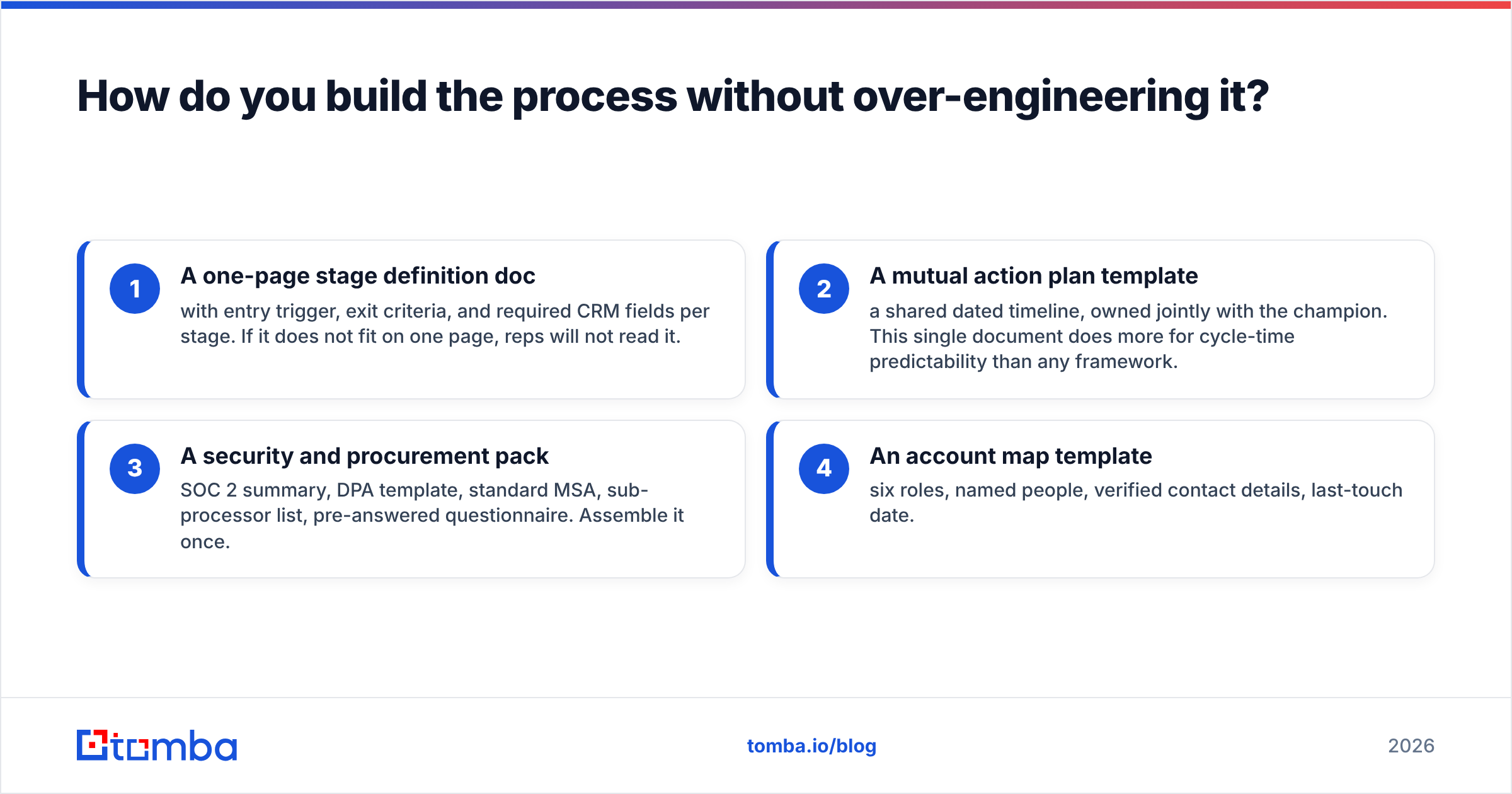
Start with four artifacts, not forty:
- A one-page stage definition doc with entry trigger, exit criteria, and required CRM fields per stage. If it does not fit on one page, reps will not read it.
- A mutual action plan template — a shared dated timeline, owned jointly with the champion. This single document does more for cycle-time predictability than any framework.
- A security and procurement pack — SOC 2 summary, DPA template, standard MSA, sub-processor list, pre-answered questionnaire. Assemble it once.
- An account map template — six roles, named people, verified contact details, last-touch date.
Then enforce exactly one rule for six months: no deal advances a stage without its exit criterion documented. Not "mostly." Not "the rep says so." Documented. Teams that do only this typically see forecast accuracy improve before anything else changes, because the pipeline stops containing deals that were never real.
Add sophistication later. Deal reviews, win/loss interviews, and value-engineering resources all help — but they compound on top of clean stage discipline, and they cannot substitute for it.
Where does contact data fit into all of this?#
At stages 1, 2, and 5 — and again every quarter thereafter.
Stage 1 needs org coverage: who works there, in what function, reachable how. Stage 2 needs deliverability: verified addresses so multithreaded sequences do not bounce and burn the domain. Stage 5 needs refresh: by month six, some of what you collected in month one is wrong.
That is the unglamorous foundation under every enterprise process diagram. You can run flawless MEDDIC on an account you cannot reach, and it will not matter. Before you invest in another framework rollout, audit whether your reps can actually name and contact six people at every open opportunity. Most cannot.
If that audit comes back ugly, start there. Use Tomba Email Finder to build verified, multithreaded contact maps for your target accounts — domain-level coverage, verification built in, and a free tier with 25 searches a month so you can test it against a live account list before committing. Paid plans start at $49/mo, with Growth at $99/mo for teams running higher volume; full Tomba pricing is public. Map the committee first. Then run your process.
Related guides#
Ready to find emails that actually work?
Join 150,000+ professionals who stopped guessing and started sending. Free credits on signup — no credit card required.
Get the Tomba newsletter
Practical outbound tactics and product updates — once every two weeks.
About the author