Enterprise Sales Rep in 2026: Role, Skills, Pay, and Stack
What an enterprise sales rep actually does in 2026 — the 9-month cycle, 12-person buying committee, real OTE bands, and the prospecting stack that keeps a $1M+ quota alive.
TL;DR
- An enterprise sales rep sells complex, high-ACV deals ($100K+) into large organizations, running 6–12 month cycles across buying committees of 8–14 people.
- The job is 20% pitching and 80% orchestration: multithreading, business-case building, security/procurement navigation, and internal resource coordination.
- Typical 2026 US OTE lands between $240K and $400K at a 50/50 split, with quotas of $800K–$1.5M and ramp periods of 4–6 months.
- The highest-leverage skill is not closing — it's account research and contact accuracy. Reps who multithread into 6+ stakeholders close at roughly double the rate of single-threaded reps.
- Your stack matters less than your data hygiene. Bad contact data quietly kills more enterprise pipeline than bad discovery does.
What Is an Enterprise Sales Rep?#
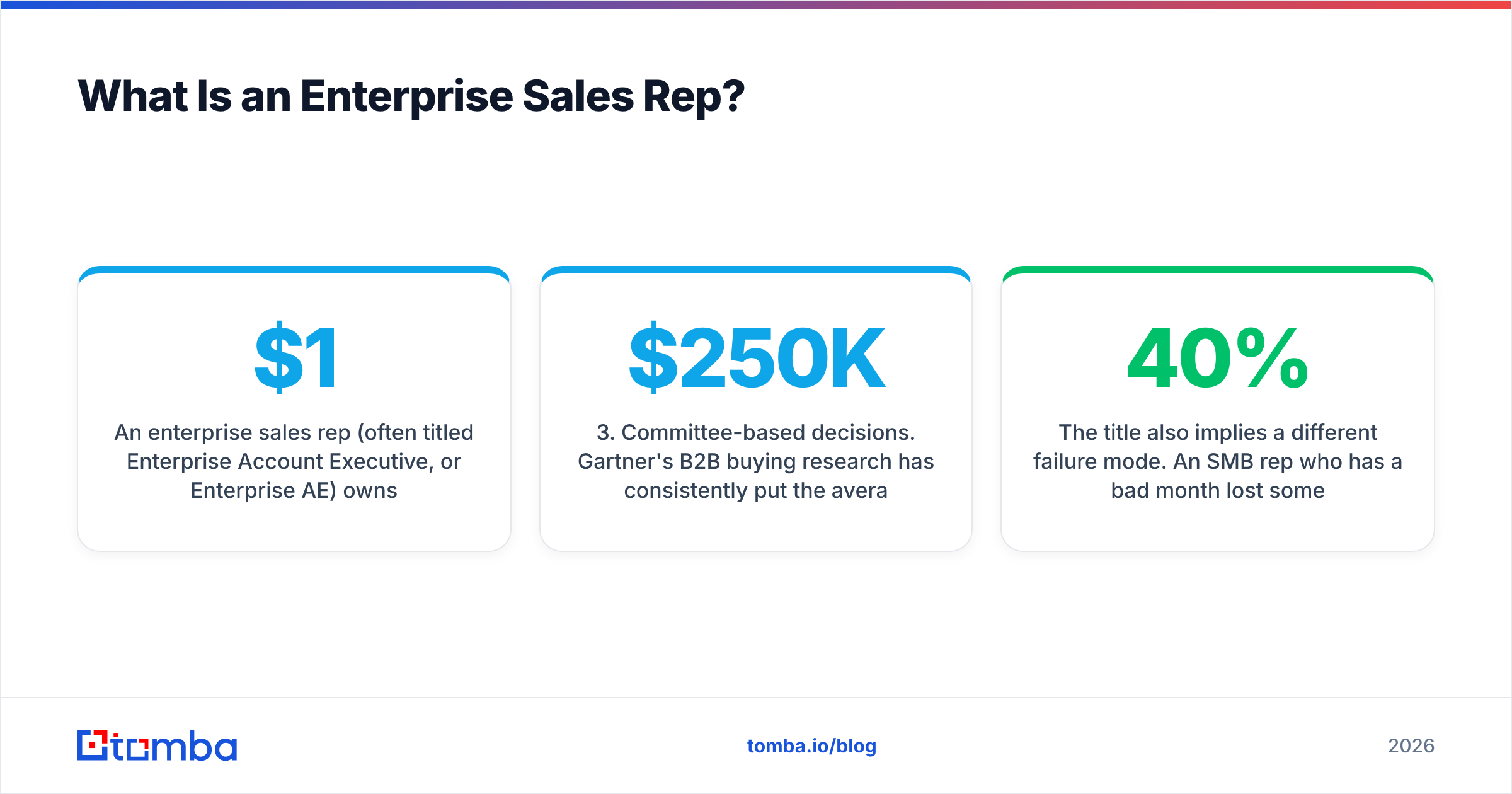
An enterprise sales rep (often titled Enterprise Account Executive, or Enterprise AE) owns revenue for a small, named set of large accounts — usually companies above 1,000 employees or above $1B in revenue, depending on how your company draws segment lines.
Think of the difference like this: an SMB rep is a restaurant server working twenty tables a night, optimizing for turnover. An enterprise rep is a private chef planning one wedding banquet for nine months — fewer plates, far more people to please, and every single one of them can cancel the event.
Concretely, the role means:
- A tiny book of accounts. 20–50 named accounts, sometimes as few as 8 in strategic/named-account roles. You are not working a lead list; you are working a map.
- Long, non-linear cycles. 6–12 months is normal. Deals stall on budget freezes, reorgs, security review, and legal redlines — none of which are your fault and all of which are your problem.
- Committee-based decisions. Gartner's B2B buying research has consistently put the average buying group at 6–10 people for complex solutions, and it skews higher in enterprise software — 11 to 14 stakeholders is common at $250K+ ACV.
- Consultative, business-case selling. You are not selling a feature. You are selling a financial argument that a CFO will interrogate.
- Cross-functional orchestration. Solutions engineers, security teams, legal, professional services, executive sponsors, and partner channels all touch your deal. Coordinating them is the actual job.
The title also implies a different failure mode. An SMB rep who has a bad month lost some deals. An enterprise rep who has a bad quarter may have lost one deal — and that one deal was 40% of the annual number.
How Is Enterprise Sales Different From SMB and Mid-Market?#
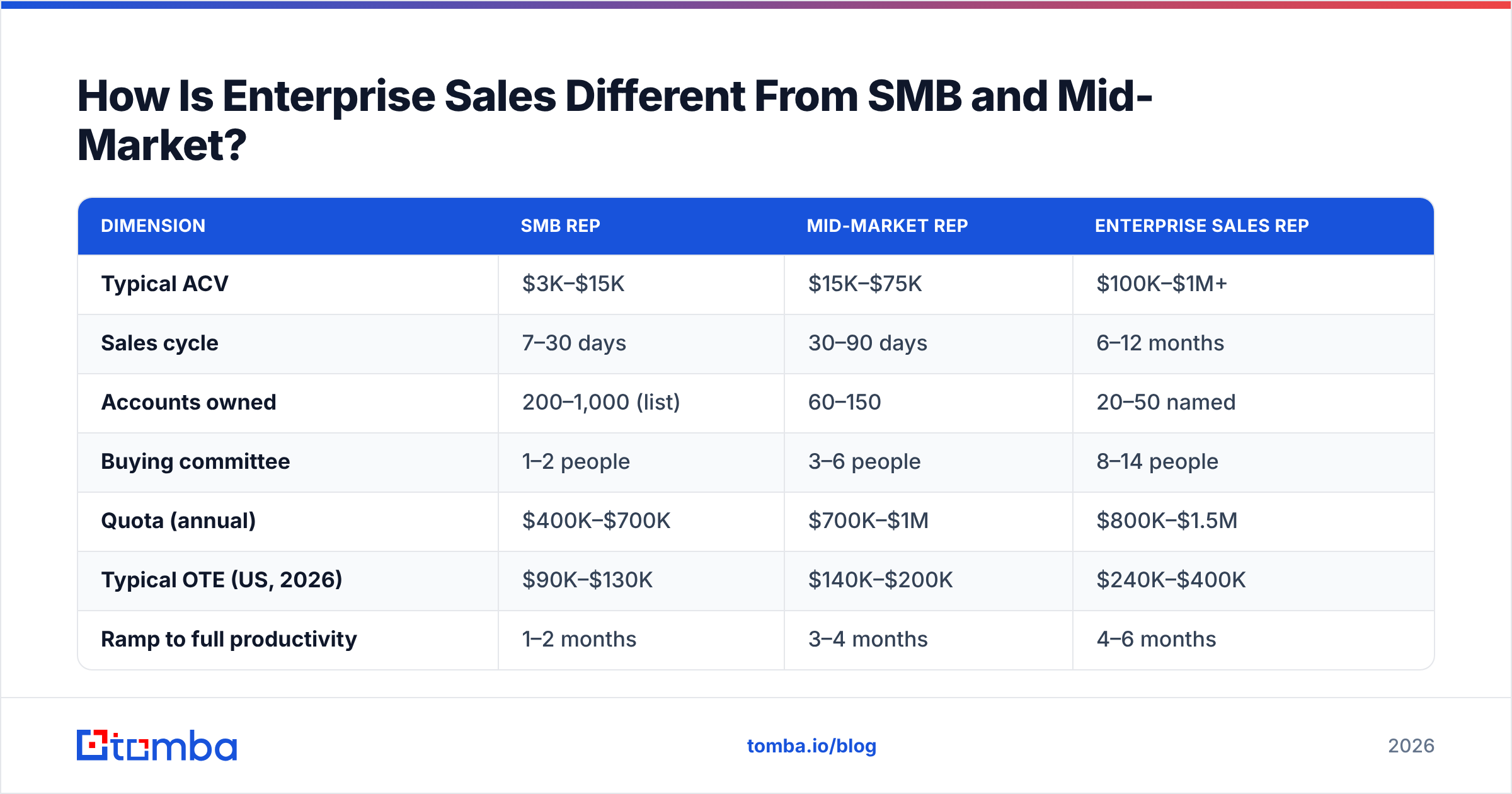
The segments are not the same job with bigger numbers. They're structurally different roles with different daily rhythms, different skill ceilings, and different reasons reps wash out.
| Dimension | SMB Rep | Mid-Market Rep | Enterprise Sales Rep |
|---|---|---|---|
| Typical ACV | $3K–$15K | $15K–$75K | $100K–$1M+ |
| Sales cycle | 7–30 days | 30–90 days | 6–12 months |
| Accounts owned | 200–1,000 (list) | 60–150 | 20–50 named |
| Buying committee | 1–2 people | 3–6 people | 8–14 people |
| Quota (annual) | $400K–$700K | $700K–$1M | $800K–$1.5M |
| Typical OTE (US, 2026) | $90K–$130K | $140K–$200K | $240K–$400K |
| Ramp to full productivity | 1–2 months | 3–4 months | 4–6 months |
| Primary skill | Speed + volume | Discovery + urgency | Orchestration + business case |
| Main failure mode | Not enough activity | Single-threaded deals | Slipped quarters, no exec sponsor |
The row that matters most is "buying committee." Everything else follows from it. When 12 people must agree, no amount of rapport with one champion saves you. Your champion goes on parental leave, changes teams, or gets overruled by a VP you never met — and the deal evaporates.
That's why enterprise reps spend a disproportionate share of their week on research and contact-building rather than on calls. You cannot multithread into people you cannot identify or reach.
What Does an Enterprise Sales Rep Actually Do All Week?#
Here's a realistic breakdown for a rep carrying a $1.2M quota with 30 named accounts. The percentages come from how experienced enterprise AEs describe their calendars, not from an idealized process doc.
- Account research and mapping (15–20%). Org charts, funding events, 10-K language, leadership changes, tech-stack signals, and open roles. This is where you decide who matters before you decide what to say.
- Outbound and multithreading (20–25%). Not cold-dialing a list — targeted, personalized outreach to 8–15 named people inside a single account, sequenced over weeks. This is where an accurate email finder and a reliable phone finder do more for your number than any new sequence template.
- Discovery and demo calls (20%). Usually 4–8 meaningful calls a week, each with a different stakeholder lens: economic buyer, technical evaluator, end user, security, procurement.
- Deal orchestration (20%). Prepping your SE, chasing security questionnaires, aligning legal, scheduling exec-to-exec calls, building mutual action plans.
- Business-case and proposal work (10–15%). Building the ROI model, the pilot success criteria, the pricing scenarios, and the one-page summary your champion forwards internally.
- Forecasting and CRM hygiene (5–10%). Weekly pipeline reviews, MEDDPICC/MEDDIC fields, next-step accuracy. Painful, but it's how you keep leadership out of your deals.
Notice what isn't on this list: waiting for marketing leads. Most enterprise reps source 50–70% of their own pipeline. Inbound leads at the enterprise level are usually late-stage signals or the wrong persona.
What Skills Separate a Great Enterprise Rep From an Average One?#
Four skills consistently show up in reps who beat quota three years running, and none of them are "closing technique."
1. Account mapping over lead chasing. Great reps build a stakeholder map before they send the first email: who owns the budget, who owns the pain, who blocks, who influences. They know the difference between a champion (fights for you when you're not in the room) and a coach (gives you information but won't spend capital).
2. Business-case fluency. You need to speak in payback period, cost avoidance, headcount deflection, and risk reduction — in the buyer's own numbers, not your marketing deck's. A rep who can build a defensible model with the CFO's assumptions wins deals against better products.
3. Multithreading discipline. The single strongest predictor of an enterprise deal closing is stakeholder count. Deals with six or more engaged contacts routinely close at roughly twice the rate of single-threaded deals. Reps who treat "my champion loves us" as safety are the reps whose Q4 collapses.
4. Patience with process, impatience with vagueness. Enterprise cycles are long, and that's fine. What kills reps is tolerating vague next steps. "They're excited, we'll reconnect next month" is not a stage. A dated mutual action plan is.
There's a fifth, unglamorous skill: data hygiene. Bounced emails and wrong-number dials don't just waste time — they damage your sender reputation and can get your outbound domain flagged before your best account ever sees a message.
How Much Does an Enterprise Sales Rep Make in 2026?#
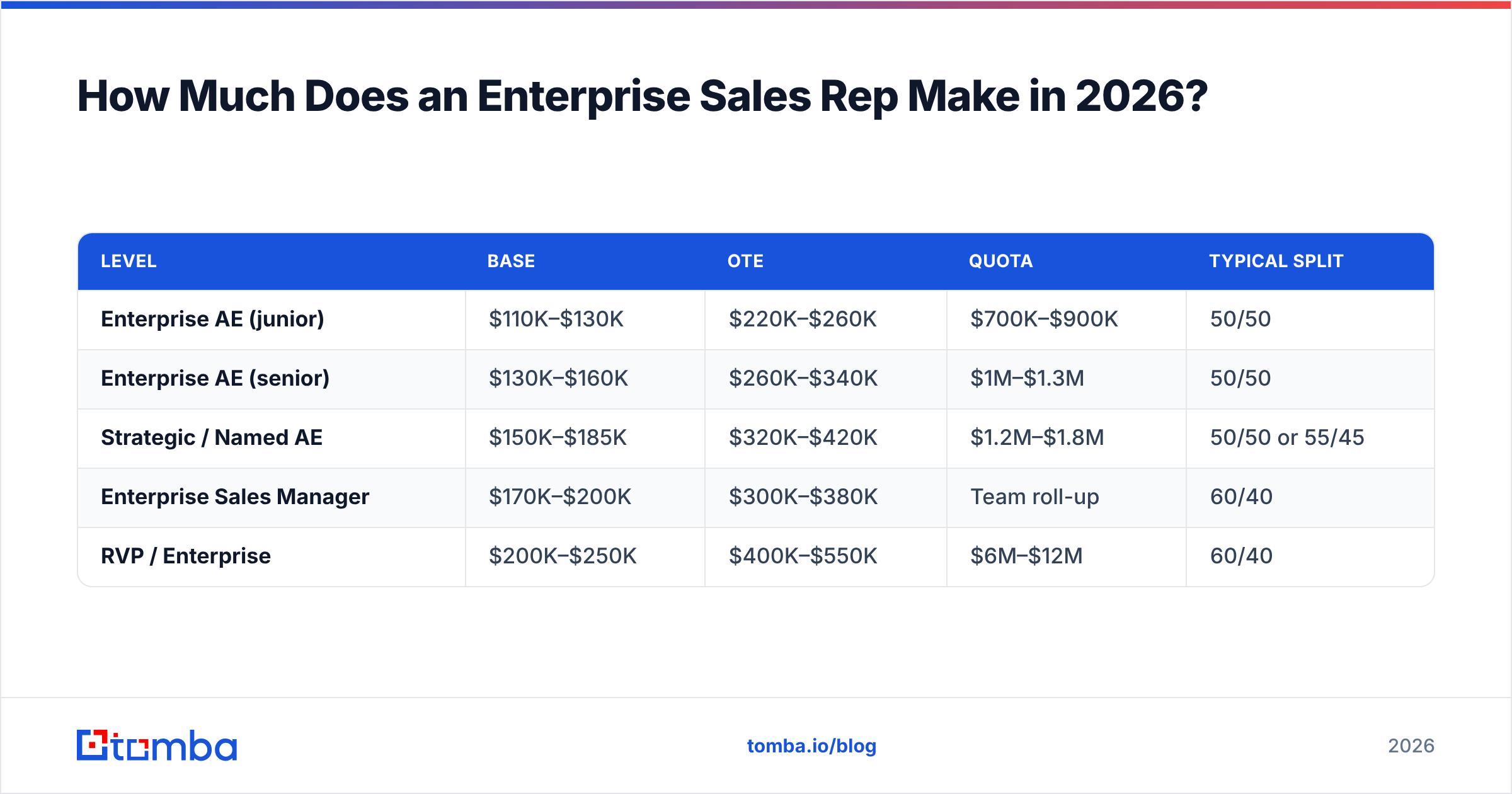
Compensation varies wildly by market, product, and whether the company is pre-IPO or public. These are realistic US ranges based on published comp data from sources like G2 buyer research, public job postings, and standard SaaS comp structures.
| Level | Base | OTE | Quota | Typical Split |
|---|---|---|---|---|
| Enterprise AE (junior) | $110K–$130K | $220K–$260K | $700K–$900K | 50/50 |
| Enterprise AE (senior) | $130K–$160K | $260K–$340K | $1M–$1.3M | 50/50 |
| Strategic / Named AE | $150K–$185K | $320K–$420K | $1.2M–$1.8M | 50/50 or 55/45 |
| Enterprise Sales Manager | $170K–$200K | $300K–$380K | Team roll-up | 60/40 |
| RVP / Enterprise | $200K–$250K | $400K–$550K | $6M–$12M | 60/40 |
A few realities the ranges hide:
- Accelerators matter more than base. Reps who hit 120%+ of quota often earn 1.5–2x on the overage. The gap between a 95% rep and a 125% rep is far larger than 30%.
- Ramp is unpaid risk. Most enterprise roles guarantee commission for 3–6 months. If cycles run 9 months, your first real commission check may arrive in month 10.
- Equity is real but illiquid. Pre-IPO equity is a lottery ticket with a 4-year vest, not compensation you can spend.
- Territory quality beats company brand. A great rep in a picked-over territory loses to an average rep with 30 untouched Fortune 1000 accounts, every time.
What Does the Enterprise Sales Stack Look Like?#
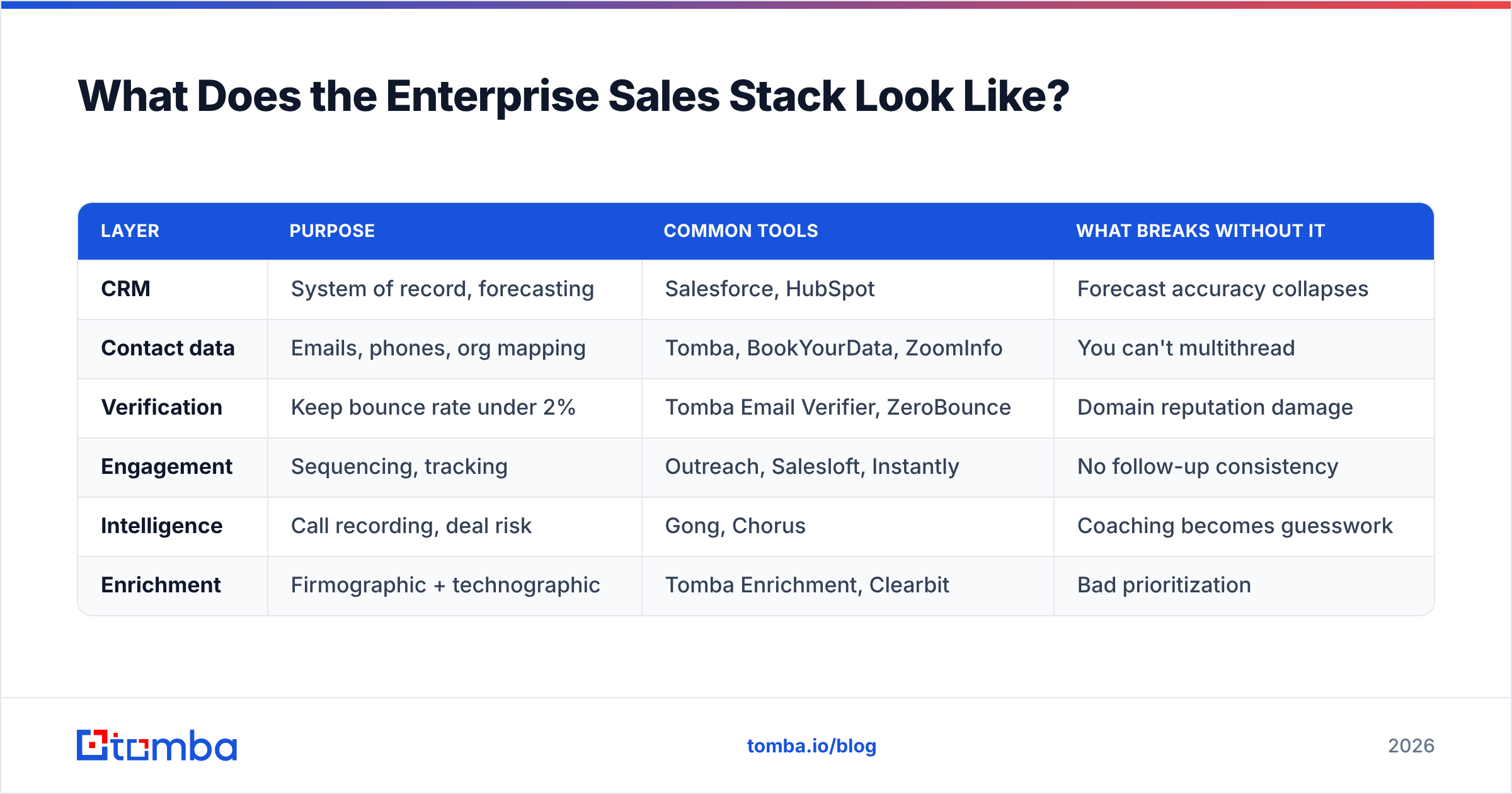
Enterprise reps run a heavier stack than SMB reps because the work is research-first. Here's how the layers stack up and where the money actually goes.
| Layer | Purpose | Common Tools | What Breaks Without It |
|---|---|---|---|
| CRM | System of record, forecasting | Salesforce, HubSpot | Forecast accuracy collapses |
| Contact data | Emails, phones, org mapping | Tomba, BookYourData, ZoomInfo | You can't multithread |
| Verification | Keep bounce rate under 2% | Tomba Email Verifier, ZeroBounce | Domain reputation damage |
| Engagement | Sequencing, tracking | Outreach, Salesloft, Instantly | No follow-up consistency |
| Intelligence | Call recording, deal risk | Gong, Chorus | Coaching becomes guesswork |
| Enrichment | Firmographic + technographic | Tomba Enrichment, Clearbit | Bad prioritization |
Two practical notes on the data layer, since that's where most enterprise stacks quietly leak money.
First, coverage and accuracy are different problems. A provider with 300M contacts is useless if 30% of the emails for your ICP bounce. Enterprise reps typically need depth in a narrow set of accounts — 40 verified contacts inside 30 companies beats 4,000 unverified contacts across 4,000 companies. That's why domain search tends to be more valuable to enterprise reps than broad list-building: you start from the account, not from a filter.
Second, verify before you send, always. Catch-all domains are extremely common at large enterprises, which means standard verification returns "unknown" on exactly the accounts you care about most. A dedicated catch-all verifier is the difference between a usable enterprise list and a list that torches your domain.
How Do You Break Into Enterprise Sales?#
There are three realistic paths, and one of them is much slower than people admit.
Path 1: SDR → Mid-Market AE → Enterprise AE. The standard route. Expect 4–6 years total. The mid-market step is non-negotiable at most companies because it's where you learn to run multi-stakeholder discovery without a $500K deal on the line.
Path 2: Lateral from a technical or industry role. Solutions engineers, consultants, and industry practitioners often skip straight to enterprise AE because they bring credibility the buying committee respects. If you spent six years in healthcare ops, selling into hospital systems is a shorter jump than most SDRs will ever make.
Path 3: Internal promotion into a named-account team. The fastest path if you're already at a company with an enterprise motion. Volunteer for the big-deal support work — SE coordination, security questionnaires, RFP responses — and you'll be first in line when a territory opens.
Whichever path you take, the hiring bar in 2026 is specific. Interviewers want to hear:
- A deal story with a named committee. Who were the 8 people, what did each care about, how did you convert a blocker.
- A number with context. "112% of a $1.1M quota, 4 deals, average ACV $310K" beats "exceeded quota."
- A pipeline-generation story. How you sourced your own pipeline, not how marketing fed you.
- A loss post-mortem. Reps who can articulate why they lost a big deal are more trusted than reps who only tell wins.
For a deeper primer on how deal stages and forecasting fit together, the Salesforce resource library and HubSpot's sales blog both publish free, vendor-neutral frameworks worth reading before an interview.
What Are the Most Common Enterprise Sales Rep Mistakes?#
- Single-threading. The most expensive mistake in the profession. If your deal has one contact, it's not a deal — it's a conversation.
- Confusing activity with progress. Twelve meetings with the same friendly manager isn't advancement. One meeting with the person who signs is.
- Skipping the economic buyer until late. If you first meet the budget owner during pricing negotiation, you're negotiating from zero credibility.
- Sending unverified outreach at scale. Enterprise domains have aggressive filtering. A 12% bounce rate on a Fortune 500 domain can get your sending domain blocked at the gateway — killing outreach to every contact at that account, permanently.
- Forecasting with hope. "Verbal yes" is not a stage. If there's no signed mutual action plan and no procurement date, it's not this quarter.
- Neglecting the loss column. Reps who never run loss reviews repeat the same structural mistake for years.
How Should an Enterprise Rep Build a Target Account List?#
Work top-down, not bottom-up. The sequence that consistently works:
- Define the account criteria before the contact criteria. Industry, size, tech stack, funding stage, trigger events. Twenty accounts that fit perfectly beat 500 that mostly fit.
- Map the org for each account. Identify 8–15 relevant roles per company: economic buyer, technical evaluator, end-user champion, security, procurement, and the exec sponsor two levels above your champion.
- Find and verify contact details for every mapped role. This is where most reps stop early and pay for it later. Use bulk email finder workflows to resolve entire org maps at once instead of one contact at a time.
- Layer in trigger monitoring. New leadership hires, funding, product launches, and regulatory deadlines are your reasons to reach out with something other than "just checking in."
- Sequence by role, not by account. A CISO and a VP of Engineering at the same company need completely different first messages sent weeks apart, not the same template on the same day.
- Refresh quarterly. Enterprise contact data decays fast — roughly 25–30% of B2B contact records go stale annually through job changes alone.
Is the Enterprise Sales Rep Role Getting Harder?#
Yes, in two specific ways — and easier in one.
Harder: buying committees have grown, and budget scrutiny is tighter than it was in the 2021 growth era. Deals that once needed a VP signature now need CFO review. Security and procurement reviews have also lengthened, particularly for anything touching customer data or AI features.
Harder: inbox competition. Enterprise inboxes are saturated, and both Google and Microsoft tightened bulk-sender enforcement. Generic outreach at volume no longer works; it just gets you filtered. Good email deliverability practice is now a prerequisite, not an optimization.
Easier: research that used to take an hour per account now takes minutes. Org mapping, contact resolution, and enrichment are largely automated, which means the reps who win are the ones who spend the recovered time on business-case quality rather than on more outreach volume.
The net effect: the role rewards depth more than it used to. Fewer, better-researched, better-threaded accounts beat brute-force coverage — and that's a good thing for anyone who prefers craft to grind.
Start With the Contact Layer#
Every enterprise sales problem that looks like a pipeline problem is usually a data problem one layer down. You can't multithread into 12 stakeholders you can't reach, and you can't run a business case with an economic buyer whose email bounces.
The Tomba Email Finder is built for exactly this motion: start from a target account's domain, surface the people in the roles you mapped, and get verified addresses you can safely send to — including on the catch-all domains that most tools give up on. The free tier includes 25 searches a month, Starter is $49/mo, and Growth is $99/mo; full Tomba pricing is public if you want to check the credit math against your account count before committing.
Map the account. Verify the people. Then go build the business case.
Related guides#
Ready to find emails that actually work?
Join 150,000+ professionals who stopped guessing and started sending. Free credits on signup — no credit card required.
Get the Tomba newsletter
Practical outbound tactics and product updates — once every two weeks.
About the author