Enterprise Sales Skills: The 9 That Actually Close Deals
Enterprise deals die in procurement, not in the demo. Here are the nine enterprise sales skills that separate reps who close $250K contracts from reps who collect polite no-decisions.
TL;DR
- Enterprise sales skills are not "better closing." They are multi-threading, business-case math, procurement navigation, and internal orchestration — the work that happens between the demo and the signature.
- The number one competitor in an enterprise deal is not another vendor. It's status quo. Roughly 40-60% of qualified enterprise pipeline ends in no-decision, not a loss to a rival.
- Gartner puts the average B2B buying group at 6-10 stakeholders. If you're single-threaded, you're one reorg away from a dead deal.
- The skills that compound: discovery that surfaces cost of inaction, champion enablement (they sell when you're not in the room), and mutual action plans that make timelines a shared artifact.
- Skills sit on top of data. You cannot multi-thread into seven personas you can't reach — accurate contact data is the floor, not the ceiling.
What Are Enterprise Sales Skills, Exactly?#
Enterprise sales skills are the competencies required to move a high-value, multi-stakeholder, long-cycle deal through an organization that is structurally biased toward doing nothing.
That definition matters because it rules things out. Objection handling scripts, rapport-building tricks, and "always be closing" energy are SMB skills. They work when one person can sign, the cycle is 14 days, and the risk of a bad decision is a $99 monthly charge.
Enterprise is a different physics. A $250,000 contract touches security review, legal redlines, procurement benchmarking, IT integration sign-off, and a finance team that wants your business case defended in a spreadsheet they built. The rep is less a closer and more a project manager who happens to carry quota.
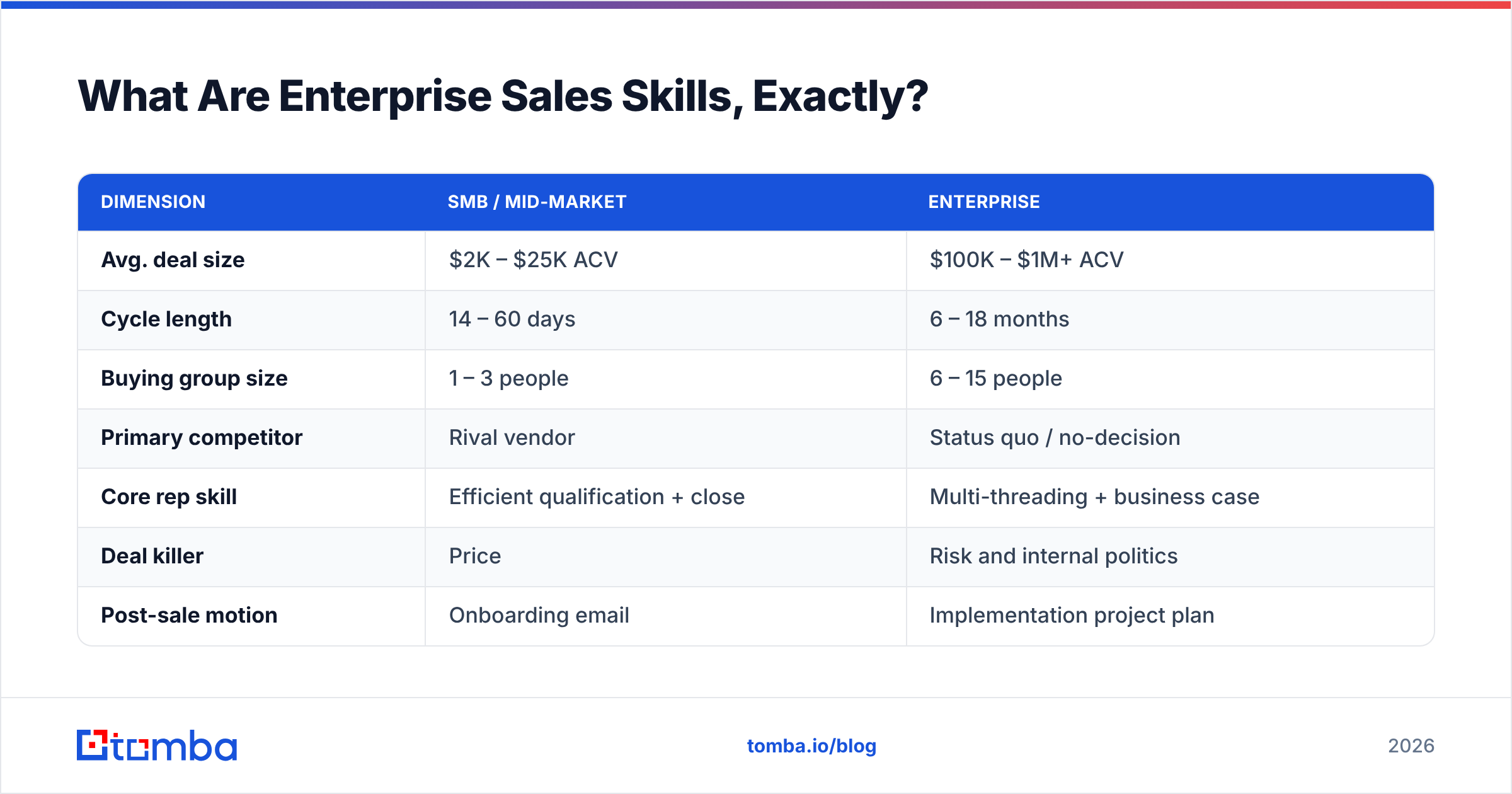
Here's the practical split:
| Dimension | SMB / Mid-Market | Enterprise |
|---|---|---|
| Avg. deal size | $2K – $25K ACV | $100K – $1M+ ACV |
| Cycle length | 14 – 60 days | 6 – 18 months |
| Buying group size | 1 – 3 people | 6 – 15 people |
| Primary competitor | Rival vendor | Status quo / no-decision |
| Core rep skill | Efficient qualification + close | Multi-threading + business case |
| Deal killer | Price | Risk and internal politics |
| Post-sale motion | Onboarding email | Implementation project plan |
If you were promoted from mid-market into enterprise and your win rate cratered, this table is the reason. You kept optimizing for speed in a game that rewards coverage.
Which Enterprise Sales Skills Actually Move Deals?#
Nine, ranked by how often their absence explains a lost deal.
- Multi-threading. Building relationships across at least five roles in the account — economic buyer, champion, technical evaluator, end user, and one skeptic. Single-threaded deals lose to reorgs, PTO, and job changes. Roughly one in five B2B contacts changes roles annually; a single-threaded deal has a built-in expiry date.
- Business-case construction. Translating your product into the buyer's own financial language: current cost, projected cost, payback period, and the number your champion will defend in a room you're not invited to.
- Champion enablement. A champion is not someone who likes you. A champion is someone with internal credibility who will spend political capital on your behalf. Your job is to arm them — a one-page internal memo, an ROI model with their logo, an FAQ for the objections their CFO will raise.
- Discovery that quantifies inaction. Bad discovery finds pain. Good discovery finds pain, attaches a dollar figure to it, and identifies who owns that number.
- Procurement navigation. Knowing when procurement enters, what their scorecard weights, how to avoid a reverse auction, and why "we're in legal" is a status, not a stage.
- Mutual action plans. A shared, dated document listing every step from evaluation to go-live, with named owners on both sides. It converts your close date from a guess into a commitment.
- Executive presence. Speaking to a CFO for eleven minutes without using a product noun. Their agenda is risk, margin, and headcount — not your feature roadmap.
- Internal orchestration. Deploying your own solutions engineer, security team, exec sponsor, and legal counsel at the right moment. Enterprise reps who run their internal team well close faster than reps who hoard the deal.
- Deal-cycle patience with forecast honesty. Knowing the difference between a deal that is slow and a deal that is dead, and telling your VP the truth about which is which.
Why Do Most Enterprise Deals Die of No-Decision?#
Because doing nothing is free and doing something has a name attached to it.
Every enterprise purchase creates personal risk for whoever championed it. If your platform underdelivers, someone's performance review takes the hit. Status quo has no such downside. That asymmetry — not your pricing — is what you're actually selling against.
Three failure patterns account for most no-decisions:
The unquantified problem. The buyer agrees the problem is real but has never sized it. "Our data is messy" doesn't get budget. "We waste 340 SDR hours per quarter on bad contact data, which is $61,000 in fully loaded cost" gets budget. Your discovery has to produce the second sentence, and the buyer has to say it out loud before you do.
The orphaned business case. You built the ROI model. Nobody inside the account owns it. When your champion presents to the steering committee, they're reading your slides in your language, and the CFO's first question kills it. Co-build the model with the champion instead. Let them change the assumptions. A number they argued about is a number they'll defend.
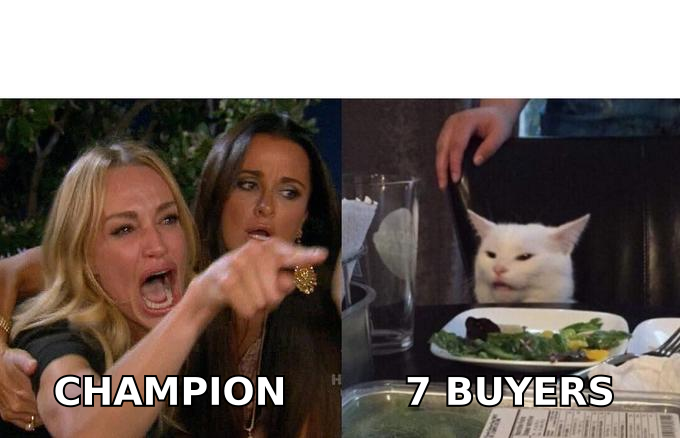
The invisible blocker. There's a director in security or IT who was never in a call, who has a competing internal project, and who quietly rates you a 3 out of 5 on the evaluation matrix. You never met them because you were single-threaded into your champion. This is why multi-threading is skill number one.
A useful diagnostic: at any point in the cycle, can you name every person who will be in the room when the decision is made, and what each of them personally gains or risks? If not, you don't have a deal — you have a conversation.
How Do You Actually Multi-Thread an Account?#
Systematically, not opportunistically. Waiting for your champion to "loop in" other stakeholders is how deals stall for two quarters.
The mechanics:
- Map before you meet. Build an org chart of the target function before your second call. Identify the VP, their direct reports, the technical evaluator, and the finance partner assigned to that department.
- Ask for the map, don't guess at it. "Walk me through who else touches this decision and what each of them cares about" is a discovery question, not an imposition. Champions answer it readily; if yours won't, that's diagnostic information.
- Earn each intro with value, not a favor. Don't ask your champion to broker a meeting. Give them a reason to want the meeting to happen — a benchmark report their CISO would want, a security questionnaire pre-filled, a peer reference from a comparable company.
- Go around when you have to. If your champion is gatekeeping, direct outreach to a VP with a genuinely relevant insight is acceptable enterprise practice. Tell your champion you're doing it. Surprises break trust; transparency rarely does.
- Instrument the coverage. Track contacts-per-opportunity in your CRM as a leading indicator. Deals with five or more engaged contacts close at materially higher rates than deals with one or two — run the query on your own closed-won data and you'll see the split.
The operational blocker is almost always contact data. You've mapped seven stakeholders and you have direct email for two. That's where a domain search across the target company closes the gap, and an email verifier keeps you from burning sender reputation on guesses. Multi-threading is a data problem dressed up as a skill problem.
What Does a Strong Enterprise Business Case Look Like?#
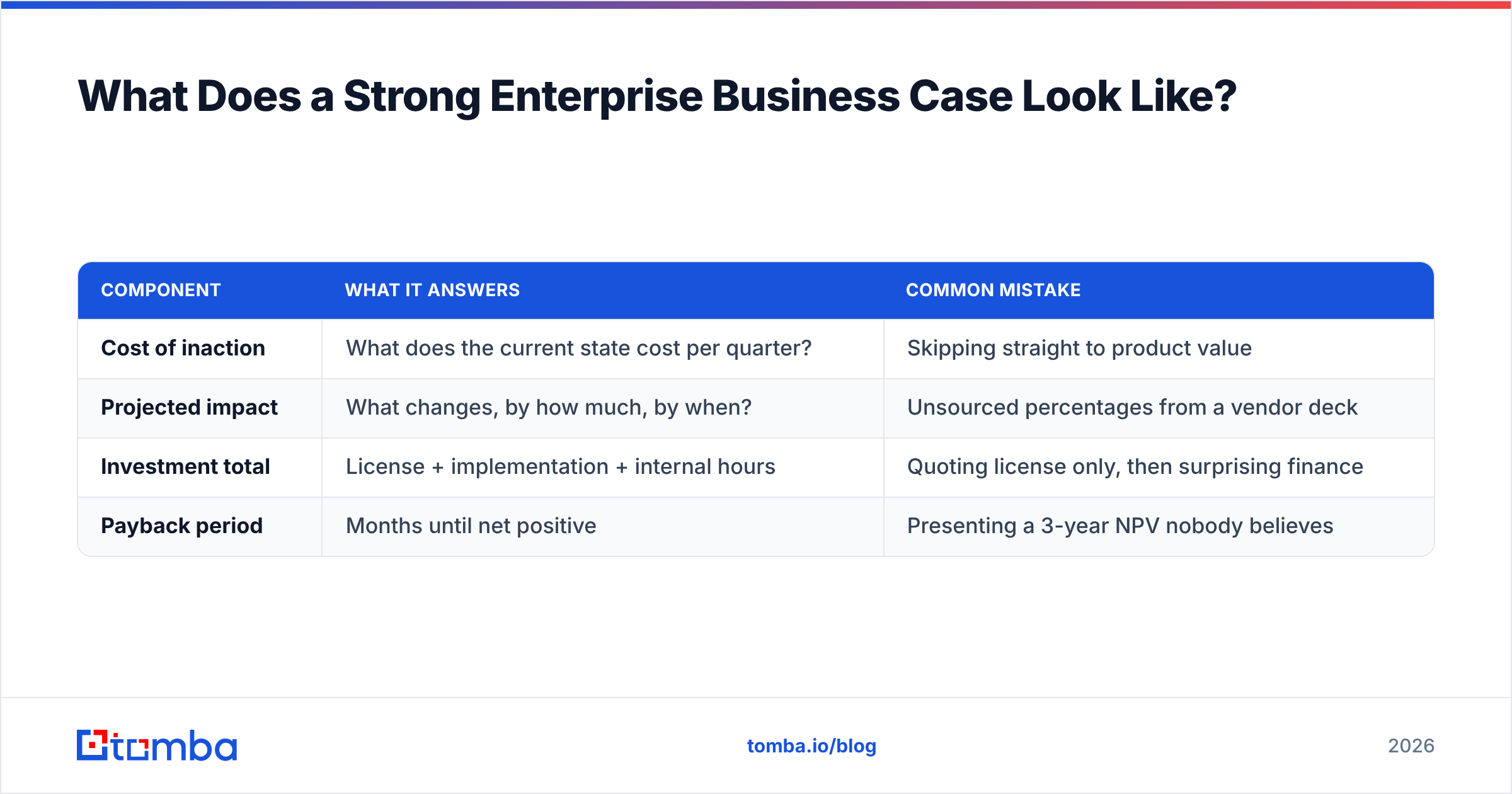
Four components. If any one is missing, the case gets deferred.
| Component | What it answers | Common mistake |
|---|---|---|
| Cost of inaction | What does the current state cost per quarter? | Skipping straight to product value |
| Projected impact | What changes, by how much, by when? | Unsourced percentages from a vendor deck |
| Investment total | License + implementation + internal hours | Quoting license only, then surprising finance |
| Payback period | Months until net positive | Presenting a 3-year NPV nobody believes |
Two rules for building it.
Use their numbers. Every input should be a figure the buyer gave you or can verify in their own systems. The moment your model relies on "industry average uplift of 32%," you've moved from business case to marketing claim, and a CFO can smell the difference instantly.
Be conservative on purpose. Model the low end. If your realistic projection is a 25% efficiency gain, present 12% and note the upside. A business case that overdelivers creates an internal advocate for your renewal. One that underdelivers creates a churn risk and a bad reference.
Include the cost of your own implementation. Enterprise finance teams have been burned by vendors who quoted $180K in license and then required 400 hours of internal engineering. Naming that cost yourself buys more credibility than any case study.
How Do You Handle Procurement Without Losing Margin?#
Assume procurement is measured on savings, then remove the levers they'd normally pull.
Procurement typically enters at 60-80% of the cycle, after the business has already chosen you. Their mandate is to reduce price and de-risk terms. They will benchmark you against alternatives whether or not those alternatives were seriously evaluated.
What works:
- Get to procurement early, voluntarily. Introduce yourself before you're handed off. A vendor who arrives at the table already knowing the process is easier to approve than one who is a variable.
- Ask for the scorecard. Many enterprise procurement teams score vendors on weighted criteria — price, security posture, support SLA, references, financial stability. Ask which criteria carry the most weight and address them directly rather than guessing.
- Trade concessions, never gift them. Discount in exchange for multi-year commitment, an upfront payment, a case study, or a reference call. A unilateral discount teaches the account that your price is fictional.
- Fill the security questionnaire before they ask. SOC 2 documentation, DPA, subprocessor list, penetration test summary. Reps who pre-load this shave weeks off the cycle.
- Know your walk-away number and say it once. Enterprise procurement respects a firm floor delivered without defensiveness far more than a floor that moves three times.
Peer-review data on vendor selection is worth reading before your first procurement call — sites like G2 publish the criteria buyers actually weight, and Gartner's B2B buying research documents how buying groups make and unmake decisions.
How Do You Build These Skills If You're Coming From SMB?#
Deliberate practice, not more calls. Volume builds SMB skills; enterprise skills need reps against specific, isolated competencies.
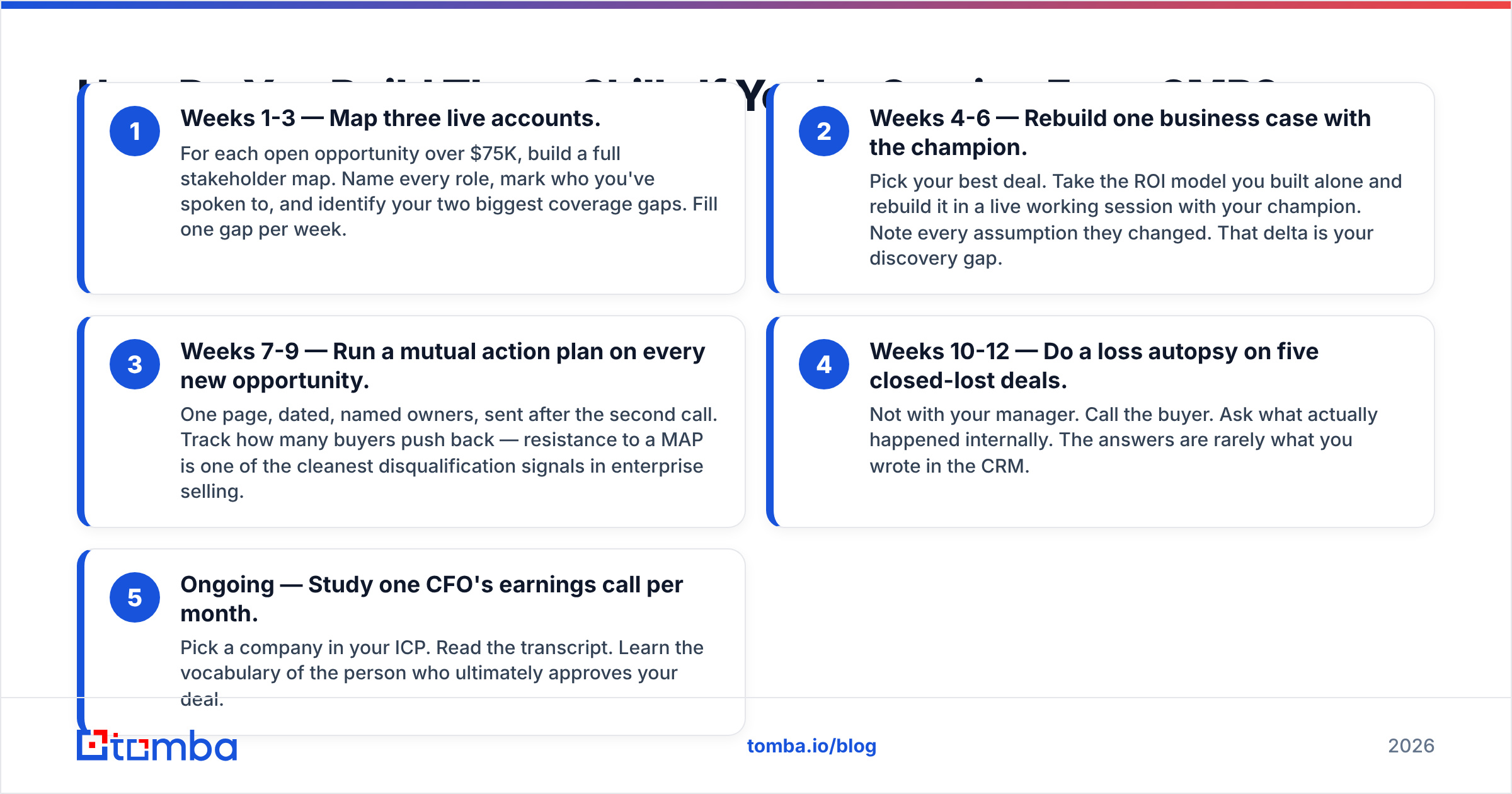
A 90-day self-development plan that actually works:
- Weeks 1-3 — Map three live accounts. For each open opportunity over $75K, build a full stakeholder map. Name every role, mark who you've spoken to, and identify your two biggest coverage gaps. Fill one gap per week.
- Weeks 4-6 — Rebuild one business case with the champion. Pick your best deal. Take the ROI model you built alone and rebuild it in a live working session with your champion. Note every assumption they changed. That delta is your discovery gap.
- Weeks 7-9 — Run a mutual action plan on every new opportunity. One page, dated, named owners, sent after the second call. Track how many buyers push back — resistance to a MAP is one of the cleanest disqualification signals in enterprise selling.
- Weeks 10-12 — Do a loss autopsy on five closed-lost deals. Not with your manager. Call the buyer. Ask what actually happened internally. The answers are rarely what you wrote in the CRM.
- Ongoing — Study one CFO's earnings call per month. Pick a company in your ICP. Read the transcript. Learn the vocabulary of the person who ultimately approves your deal.
Two things to stop doing: chasing more meetings when your existing deals are single-threaded, and treating a demo request as buying intent. Enterprise buyers request demos to complete an evaluation checklist. The demo tells you nothing about whether budget exists.
What Tooling Actually Supports Enterprise Selling?#
Less than vendors claim, and the useful categories are narrower than the market suggests.
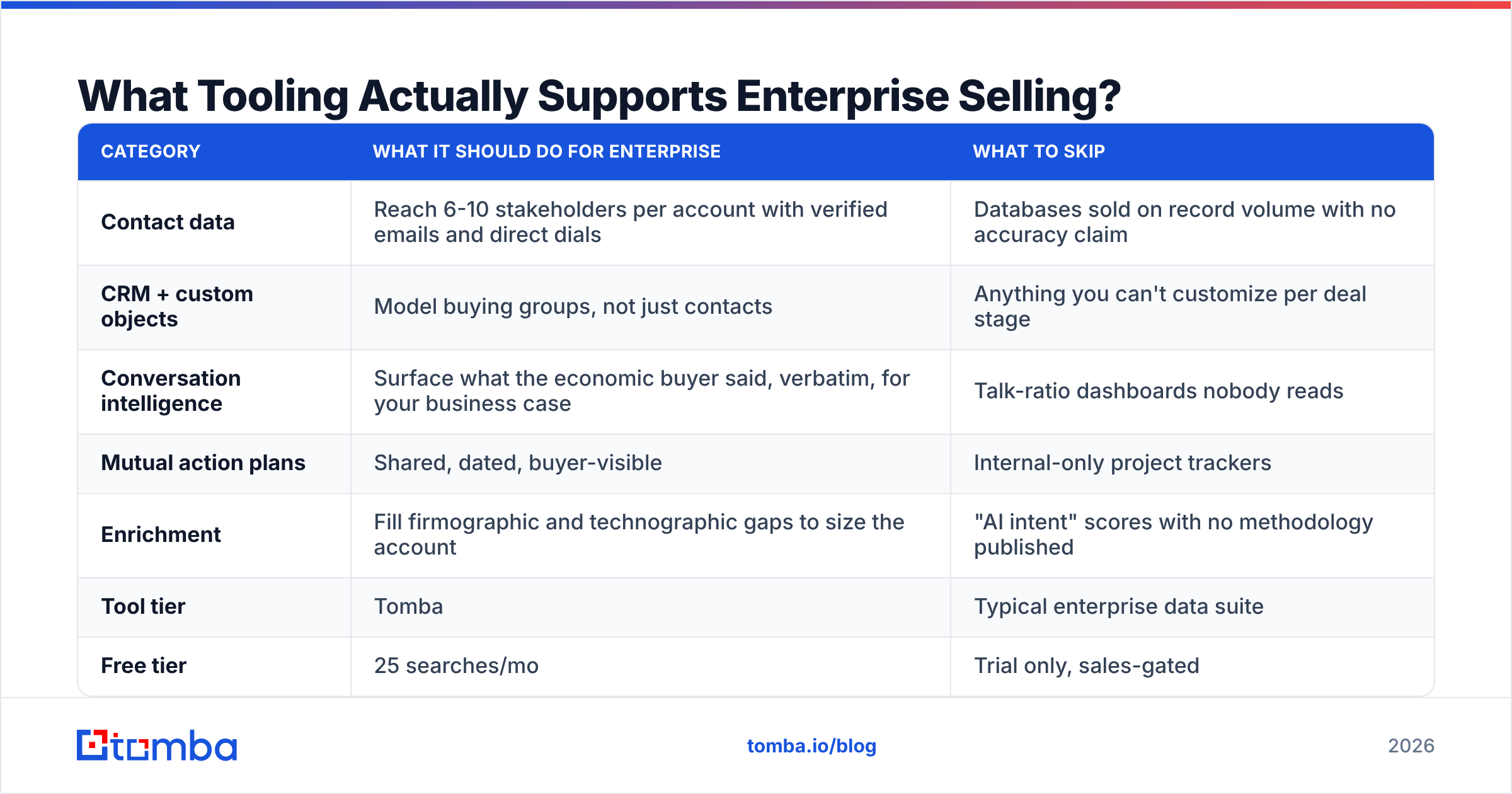
| Category | What it should do for enterprise | What to skip |
|---|---|---|
| Contact data | Reach 6-10 stakeholders per account with verified emails and direct dials | Databases sold on record volume with no accuracy claim |
| CRM + custom objects | Model buying groups, not just contacts | Anything you can't customize per deal stage |
| Conversation intelligence | Surface what the economic buyer said, verbatim, for your business case | Talk-ratio dashboards nobody reads |
| Mutual action plans | Shared, dated, buyer-visible | Internal-only project trackers |
| Enrichment | Fill firmographic and technographic gaps to size the account | "AI intent" scores with no methodology published |
On contact data specifically: enterprise multi-threading fails quietly when your data doesn't resolve. You identify a VP of Revenue Operations as your economic buyer, you have their name and LinkedIn, and you have no way to reach them. That's not a skill deficit.
Pricing across the category varies widely. For reference:
| Tool tier | Tomba | Typical enterprise data suite |
|---|---|---|
| Free tier | 25 searches/mo | Trial only, sales-gated |
| Entry paid | $49/mo | $500 – $1,000/mo minimum |
| Mid tier | $99/mo (Growth) | $1,500 – $3,000/mo |
| Upper tier | $249/mo (Pro) | $25K – $75K annual contract |
| Enterprise | Custom | Custom, annual only |
| Contract minimum | Monthly | Annual, often multi-year |
The point isn't that cheaper wins. It's that a rep covering 30 named accounts does not need a $40K annual data platform to reach 200 stakeholders — and paying for one out of an already-thin enablement budget is a bad trade. Compare Tomba pricing against whatever your team is currently renewing and check whether the delta is buying you accuracy or just a logo on the vendor list. If you need direct dials for exec outreach, a phone finder covers the second channel most enterprise reps neglect.
Peer platforms like BookYourData take a pay-as-you-go approach to verified B2B contacts and are a legitimate option when your buying pattern is bursty rather than continuous — worth evaluating alongside subscription tools rather than instead of them.
What Metrics Tell You If Your Enterprise Skills Are Improving?#
Skip activity metrics. They measure effort, not competence.
Track these instead:
- Contacts engaged per opportunity. The single best leading indicator of enterprise win rate. Target five or more with a two-way interaction, not just an email open.
- Percentage of deals with a documented mutual action plan. Should approach 100% for opportunities past discovery.
- Economic-buyer meeting rate. What share of your open pipeline has had at least one direct conversation with the person who controls the budget? Under 50% means your forecast is fiction.
- No-decision rate as a share of losses. If most of your losses go to status quo rather than competitors, your business case is weak, not your product.
- Forecast accuracy at the 60-day mark. Enterprise reps who can call a quarter 60 days out have genuine deal-cycle judgment. Most can't.
- Average response rate on exec-level outreach. Low rates usually indicate a relevance problem or a data problem — check the data first, it's cheaper to fix.
Review these monthly against your closed-won cohort. Patterns emerge fast, and they're usually uncomfortable.
Where Do Enterprise Sales Skills Break Down First?#
At the handoff between "the business wants this" and "the organization approves this."
Most reps are competent at the first half — discovery, demo, champion relationship. The second half is where deals rot: security review takes seven weeks, legal wants indemnification changes your counsel won't accept, the champion gets promoted into a different org, procurement reopens pricing after verbal agreement.
The skill there is anticipation. Before you forecast a deal, write down every remaining approval gate, who owns it, how long it historically takes at a company that size, and what could reset it. Reps who do this stop sandbagging and stop happy-earing at the same time.
And when a deal does die, extract the lesson properly. Not "they went with a competitor" but "we were single-threaded into a director whose budget got reallocated in Q3 planning, and we had no relationship in finance to see it coming." That's a skill gap you can close next quarter.
Build the Coverage Your Enterprise Deals Require#
Every skill on this list assumes you can actually reach the people who decide. Mapping seven stakeholders is worthless if you can only email two of them.
Tomba Email Finder resolves verified professional emails by name and domain, so a stakeholder map turns into an outreach plan the same afternoon you build it. Start on the free tier — 25 searches per month, no card — and run it against your three largest open opportunities. If the coverage gap closes, the $49/mo Starter plan handles a full named-account territory. The skills are on you; the data doesn't have to be.
Related guides#
Ready to find emails that actually work?
Join 150,000+ professionals who stopped guessing and started sending. Free credits on signup — no credit card required.
Get the Tomba newsletter
Practical outbound tactics and product updates — once every two weeks.
About the author