Enterprise Sales Stages: The Complete 2026 Deal Cycle Guide
Enterprise deals do not fail at the demo. They fail in the gaps between stages nobody defined. Here is the 8-stage enterprise sales cycle, with exit criteria, realistic timelines, and the data work each stage demands.
Most teams draw their enterprise sales stages once and never test them again. This guide rebuilds the model from the buyer's side. Eight stages, one exit test each, and honest timelines for a 6–18 month deal.
TL;DR
- Enterprise sales stages are not a pipeline picture. Each stage is a deal with your forecast: the buyer must do something provable to exit it.
- The eight-stage model below covers the 6–18 month cycles typical of $50K+ ACV deals (Territory Planning → Qualification → Discovery → Solution Validation → Business Case → Negotiation → Procurement & Legal → Onboarding Handoff).
- Most deals die between Discovery and Business Case, not in Negotiation. The champion could not turn your product into a number their CFO cared about.
- The average buying group is now 6–10 people. One contact per opportunity means your stage data is fiction.
- Stage hygiene fixes forecasts faster than any new tool. Write exit criteria first. Automate the data work under them second.
What Are Enterprise Sales Stages, Really?#
Enterprise sales stages are the checkpoints a large deal passes through. They run from "we found an account" to "the customer is live and paying." That is the boring definition. The useful one: a stage is a claim about buyer behavior that you can prove or disprove.
Think of stages like an airport security line. Nobody clears you because you walked toward the gate with confidence. You clear because you showed a boarding pass and an ID. Sales stages work the same way. The rep's activity is the walk. The buyer's action is the boarding pass. Most pipelines rot because managers accept the walk.
SMB and enterprise stage design differ in one way: how many people are in the room. Gartner's B2B research puts the typical enterprise buying group at six to ten stakeholders. Each one brings four or five facts they gathered alone. So a single stage — say, Discovery — is not one conversation. It is five or six, and some happen without you.
A workable set of enterprise sales stages needs three things per stage:
- A buyer-side exit test. Something the customer did or confirmed, in writing.
- A named owner. The stakeholder inside the account who moved you forward.
- A time budget. So you can spot rot before the quarter ends.
Miss any of the three and the stage is just decoration.

What Are the 8 Enterprise Sales Stages?#
Here is the model. Rename the stages to match your CRM. Keep the exit tests strict.
1. Territory and Account Planning#
Before any opportunity exists, you pick the accounts worth a year of your life. Reps who skip this step build a pipeline of whoever answered.
Exit criterion: a tiered account list, a mapped org chart for each Tier 1 account, and verified contacts for three roles — economic buyer, champion candidate, and technical evaluator.
Data quality either saves or wrecks the next twelve months right here. Building the map by hand? A domain search across the target company gets you the names. A pass through an email verifier tells you which ones still work. That beats paying for a seat-based database you open twice a quarter.
2. Qualification#
You have contact. Now decide whether this is a deal or a hobby.
Exit criterion: a confirmed path to budget authority (not the budget itself), a compelling event with a date, and a problem the prospect named in their own words.
Frameworks help here — MEDDICC, BANT, whatever your team already speaks. The framework matters less than where the answers came from. The buyer, or your rep's optimism?
3. Discovery#
The longest stage, and the most abused. Enterprise discovery is never one call. It is a run of role-by-role conversations: the operator who feels the pain, the manager who owns the budget line, the IT reviewer who will object, and the finance analyst who models the return.
Exit criterion: a documented current-state process, a cost of inaction in dollars, and at least three stakeholders interviewed with notes in the CRM.
Cannot state the cost of doing nothing in dollars? Then discovery is not finished, however good the calls felt.
4. Solution Validation#
Demos, technical deep dives, security review, sometimes a proof of concept.
Exit criterion: written sign-off from the technical evaluator that requirements are met, plus a finished security questionnaire or vendor assessment.
The trap is a POC with no success criteria agreed up front. An open-ended pilot is free consulting. It ends when your champion changes jobs.
5. Business Case and Mutual Action Plan#
Exit criterion: a shared plan you and the champion own together. It lists every remaining step, owner, and date through go-live. It also carries an ROI number the champion has already presented internally.
This is the highest-leverage stage in enterprise selling. Most teams treat it as paperwork. A mutual action plan turns your champion from a fan into a project manager.
6. Negotiation#
Pricing, terms, discount structure, multi-year commitments.
Exit criterion: verbal agreement on commercial terms from the economic buyer. Log every concession and what you got back for it.
7. Procurement, Legal, and Security#
This stage shocks everyone who came from SMB sales. Vendor onboarding portals, MSA redlines, SOC 2 evidence, data processing agreements, insurance certificates.
Exit criterion: a signed contract. Not "in legal." Signed.
8. Onboarding Handoff#
The deal is not won until the customer gets value. In enterprise, the handoff earns its own stage. A botched one kills the renewal fourteen months later.
Exit criterion: kickoff scheduled, success metrics written down, and the CS or implementation owner introduced to the buying group.
How Long Should Each Stage Take?#
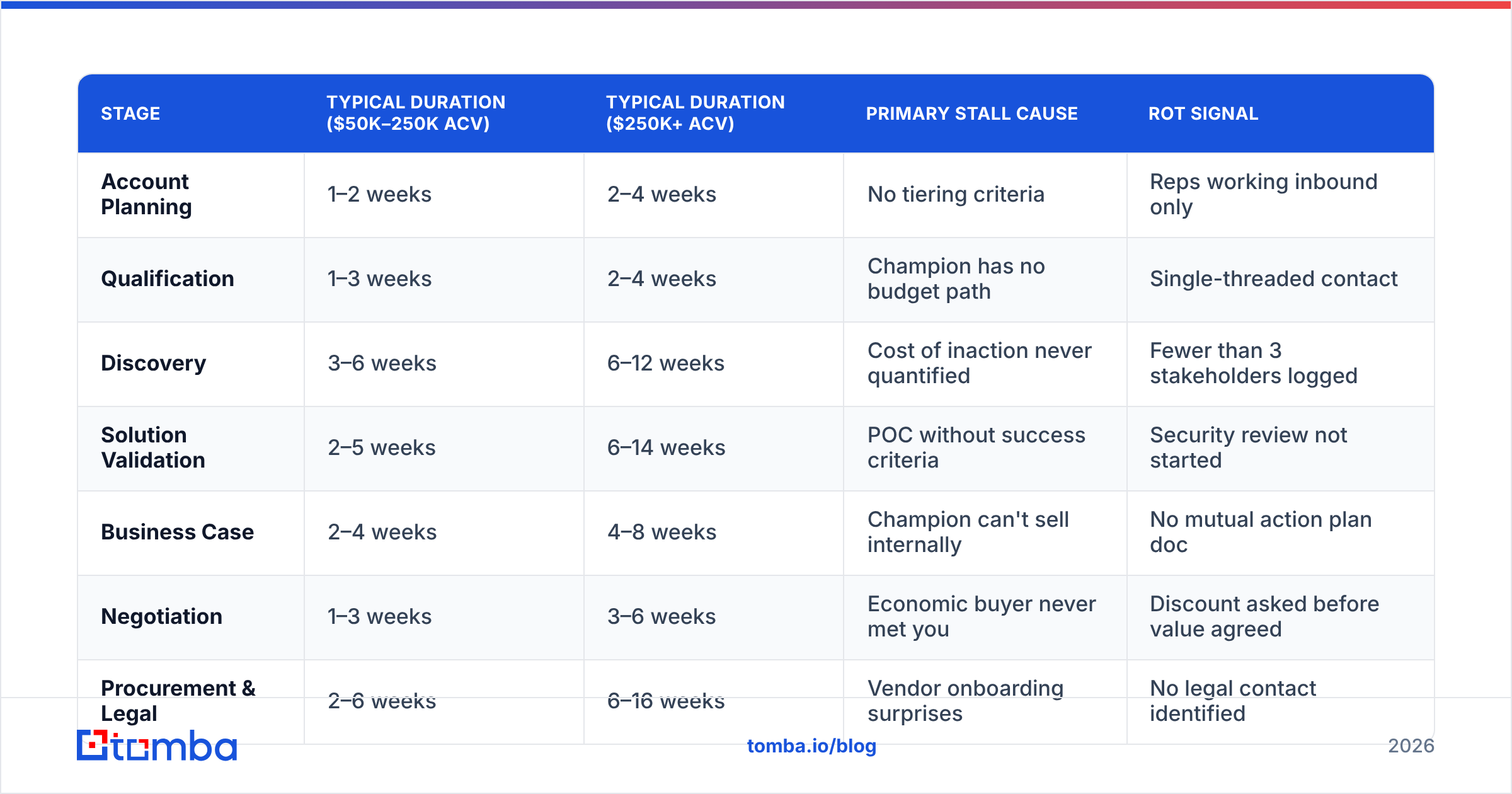
Time in stage is your earliest warning system across all eight enterprise sales stages. A deal that sits in Discovery for 90 days is not slow. It is a deal where nobody with budget has shown up.
| Stage | Typical duration ($50K–250K ACV) | Typical duration ($250K+ ACV) | Primary stall cause | Rot signal |
|---|---|---|---|---|
| Account Planning | 1–2 weeks | 2–4 weeks | No tiering criteria | Reps working inbound only |
| Qualification | 1–3 weeks | 2–4 weeks | Champion has no budget path | Single-threaded contact |
| Discovery | 3–6 weeks | 6–12 weeks | Cost of inaction never quantified | Fewer than 3 stakeholders logged |
| Solution Validation | 2–5 weeks | 6–14 weeks | POC without success criteria | Security review not started |
| Business Case | 2–4 weeks | 4–8 weeks | Champion can't sell internally | No mutual action plan doc |
| Negotiation | 1–3 weeks | 3–6 weeks | Economic buyer never met you | Discount asked before value agreed |
| Procurement & Legal | 2–6 weeks | 6–16 weeks | Vendor onboarding surprises | No legal contact identified |
| Onboarding Handoff | 1–2 weeks | 2–6 weeks | CS not involved pre-signature | Kickoff unscheduled 14 days post-close |
Watch two numbers across that table. First, time in stage against your own median — yours, not an industry benchmark. Second, stakeholder count, which should only go up. A deal that reaches Negotiation with two contacts logged will reopen in Procurement.
Why Do Most Enterprise Deals Actually Die?#
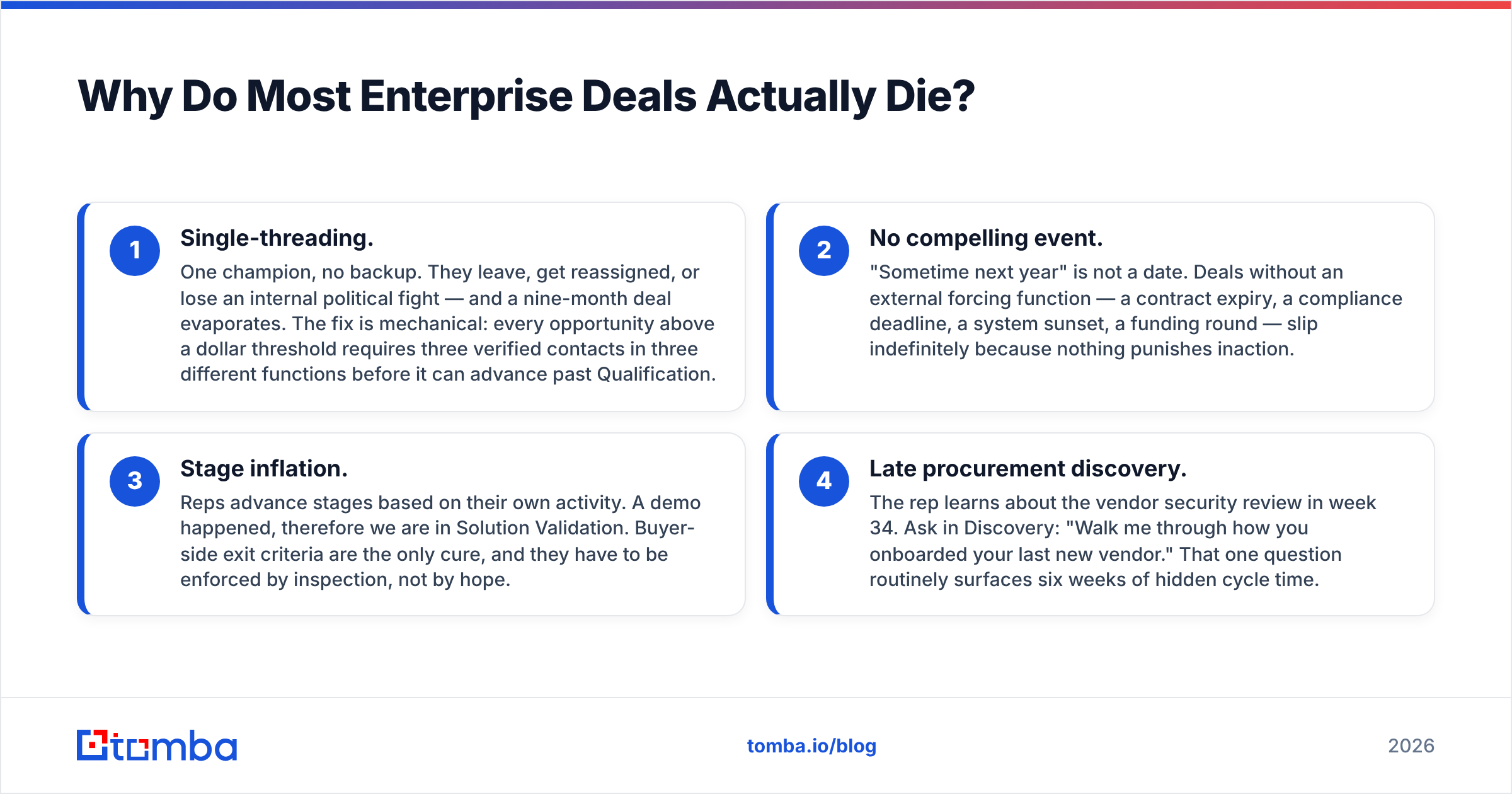
Not in negotiation. In the gap between Discovery and Business Case.
Your champion understood the product. They could not rebuild your argument in a room you were not in, in words their CFO respects. That looks like a sales failure. It is really a content and enablement failure.
Four patterns show up again and again in deal post-mortems, ranked by how often:
- Single-threading. One champion, no backup. They leave, get reassigned, or lose a political fight. A nine-month deal evaporates. The fix is mechanical. Above a set deal size, require three verified contacts in three functions before the deal leaves Qualification.
- No compelling event. "Sometime next year" is not a date. Deals without an outside forcing function slip forever. Look for a contract expiry, a compliance deadline, a system sunset, or a funding round.
- Stage inflation. Reps advance stages based on their own activity. A demo happened, so we must be in Solution Validation. Buyer-side exit tests are the only cure, and managers have to inspect them.
- Late procurement discovery. The rep hears about the security review in week 34. Ask this in Discovery: "Walk me through how you onboarded your last new vendor." That one question often surfaces six hidden weeks.
All four share a root cause. Each is a missing piece of buyer information. The rep never asked for it, or never wrote it down. So the fix is part process, part data plumbing.
How Does Data Quality Change Each Stage?#
Every one of the enterprise sales stages runs on contact data. Stale data quietly stretches all of them.
Look at what "multi-thread the account" really takes. You need the org structure, current titles, working email addresses, and ideally direct dials for people who joined last quarter. B2B contact data decays fast. Industry estimates commonly cite 25–30% a year, and layoff cycles speed that up. On an 11-month deal, a real share of the contacts you mapped in Account Planning are wrong by the time you reach Negotiation.
Stage by stage, here is the data work:
- Account Planning: map the org chart and verify at least three roles. Tomba's domain search or a LinkedIn finder build the first map. Broad B2B databases such as BookYourData fit better when you need whole-vertical list coverage instead of account-by-account depth.
- Qualification: check that the economic buyer still holds that title. Titles change more often than CRM records do.
- Discovery: add every new name from a call to the account map within 24 hours. Verify it before you send anything. A bounced first email to a VP is an expensive hello.
- Procurement: find the legal and security contacts before you need them. Re-verifying here catches the reorg that happened during your POC.
- Handoff: enrich the full buying group so CS inherits a complete map, not three names.
Batch work matters. Re-verifying 400 contacts across 40 accounts once a quarter is a bulk verify job, not a rep task. Push it into an automated step and reps stop treating data hygiene as optional.
Running this at scale? The Tomba API re-verifies contacts on a schedule and writes results back to the CRM. Then a stage advance can be gated on one rule: every logged contact verified in the last 60 days.
Enterprise vs Mid-Market vs SMB: What Actually Changes?#
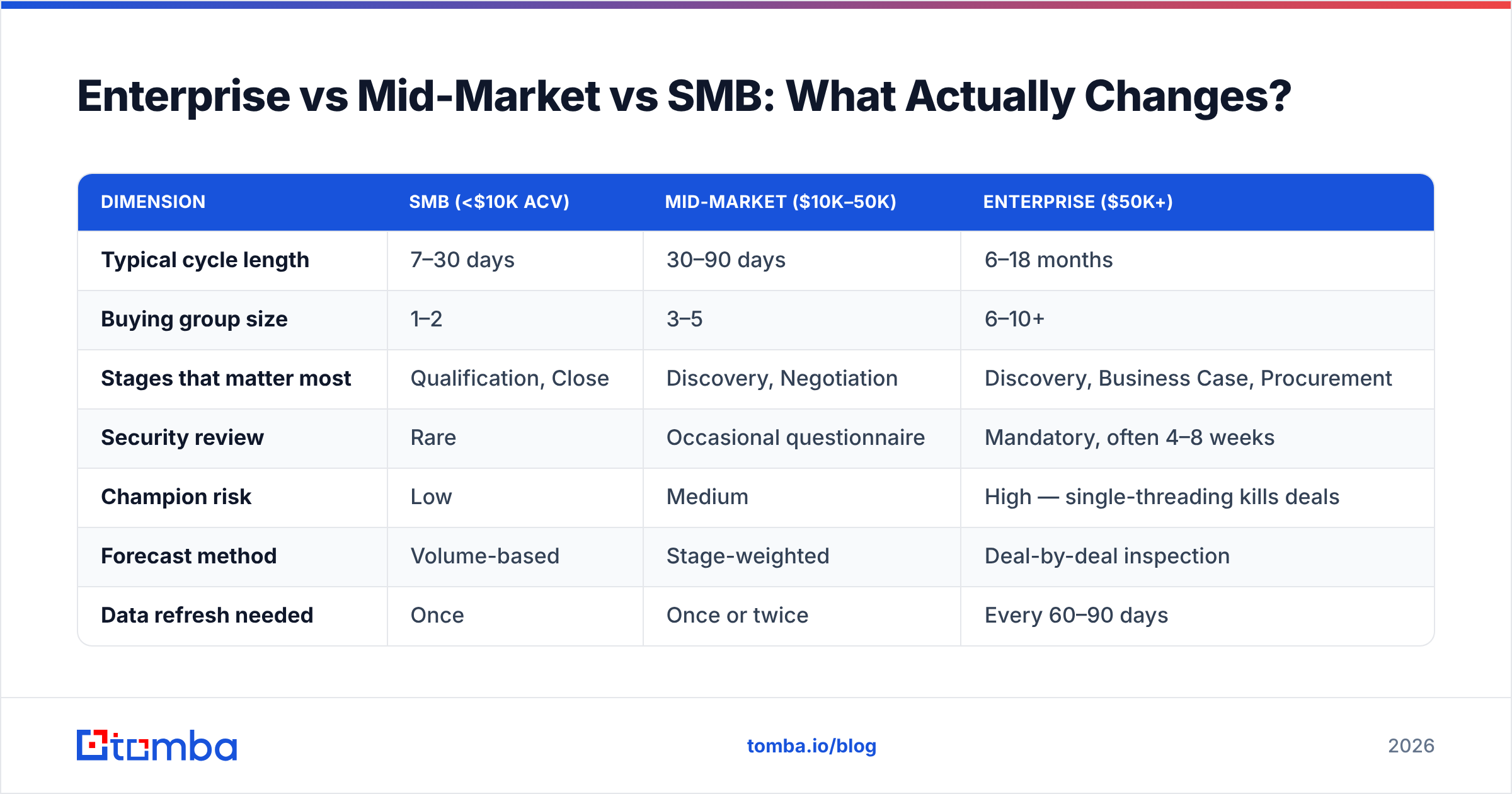
The stage names look alike. The mechanics do not.
| Dimension | SMB (<$10K ACV) | Mid-Market ($10K–50K) | Enterprise ($50K+) |
|---|---|---|---|
| Typical cycle length | 7–30 days | 30–90 days | 6–18 months |
| Buying group size | 1–2 | 3–5 | 6–10+ |
| Stages that matter most | Qualification, Close | Discovery, Negotiation | Discovery, Business Case, Procurement |
| Security review | Rare | Occasional questionnaire | Mandatory, often 4–8 weeks |
| Champion risk | Low | Medium | High — single-threading kills deals |
| Forecast method | Volume-based | Stage-weighted | Deal-by-deal inspection |
| Data refresh needed | Once | Once or twice | Every 60–90 days |
| Post-close handoff | Self-serve | Light onboarding | Formal implementation project |
The last row matters most. In SMB, you find an email and use it that week. In enterprise, the contact record has to survive a year of churn. Teams that treat the account map as a living document forecast well. Teams that treat it as a one-time export guess.
How Do You Actually Enforce Stage Discipline?#
Three mechanisms, in order of impact.
Tie required fields to stage advancement. Your CRM should refuse to move a deal into Business Case without a mutual action plan link and an ROI figure. Not a warning. A hard block. Reps route around soft guidance every time.
Inspect exit criteria weekly, not rep confidence. The manager question is never "how do you feel about this one." It is "show me where the technical evaluator confirmed requirements in writing." Salesforce and HubSpot both document required fields and validation rules for this. The HubSpot deal stage documentation is a fine starting point if you are rebuilding your schema.
Run stage-exit retros on losses. For every lost deal, find the stage where it was really lost. It is usually two stages before Closed Lost. Patterns show up within a quarter, and they rarely match what the rep typed in the loss reason field.
One caution on stage counts. Eight enterprise sales stages suit six-figure deals with formal procurement. If your average cycle is 60 days, eight stages is theater — collapse to five. The right number is the smallest one where each stage has its own distinct exit test. If two neighbors share a test, they are one stage.
Want outside benchmarks on cycle length and win rates? Cross-check against Gartner's B2B buying group research. It is still the most-cited source on how many people sit behind a modern enterprise purchase.
What Should You Instrument First?#
Rebuilding your enterprise sales stages this quarter? Do it in this order:
- Write a buyer-side exit test for every stage. One sentence each. If you cannot write one, the stage is not real.
- Add a stakeholder-count field and require it to rise from stage to stage.
- Measure time in stage. Set a rot threshold at 1.5× your own median.
- Schedule contact re-verification every 60 days on open enterprise deals.
- Run loss retros against stage exits, not against rep-written loss reasons.
The first three cost a CRM admin one afternoon. The fourth is where most teams stall. Manual re-verification never survives a busy quarter, which is the whole case for automating it.
Get the Contact Layer Right First#
Every one of these enterprise sales stages rests on one assumption. You know who is in the room and how to reach them. That assumption breaks quietly, and it breaks worst in month nine of a twelve-month cycle.
Tomba's Email Finder covers the part reps never do by hand. It maps a buying group by domain, verifies every address before outreach, and re-checks the account list on a schedule. Your Procurement-stage emails stop bouncing off a reorg.
The free tier gives you 25 searches a month, enough to test the workflow on one target account. Paid plans start at $49/mo. Full pricing details cover the Growth ($99/mo) and Pro ($249/mo) tiers for teams running hundreds of accounts. Map one Tier 1 account end to end, then decide whether it belongs in your stage-gate rules.
Related guides#
Ready to find emails that actually work?
Join 150,000+ professionals who stopped guessing and started sending. Free credits on signup — no credit card required.
Get the Tomba newsletter
Practical outbound tactics and product updates — once every two weeks.
About the author