Enterprise Sales Strategy: The Complete 2026 Playbook
Enterprise deals fail on process, not pitch. Here's the account planning, multithreading, and committee-mapping system that turns 9-month cycles into predictable six-figure wins.
TL;DR
- Enterprise sales strategy is not "SMB sales but slower" — it is a different motion built around a buying committee of 6–11 people, a 6–12 month cycle, and a procurement gate that has nothing to do with your pitch.
- The single highest-leverage change most teams can make: multithread early. Deals with one contact die when that contact changes jobs, and roughly one in five B2B contacts changes role each year.
- Account planning beats activity volume. Forty deeply researched accounts with 8 mapped contacts each will outperform 5,000 cold sends at enterprise ACVs.
- Build your pipeline math backwards from ACV and win rate, not forwards from "how many emails can we send."
- Data quality is the hidden constraint — a mapped committee is worthless if half the addresses bounce and torch your sending domain.
What Is an Enterprise Sales Strategy?#
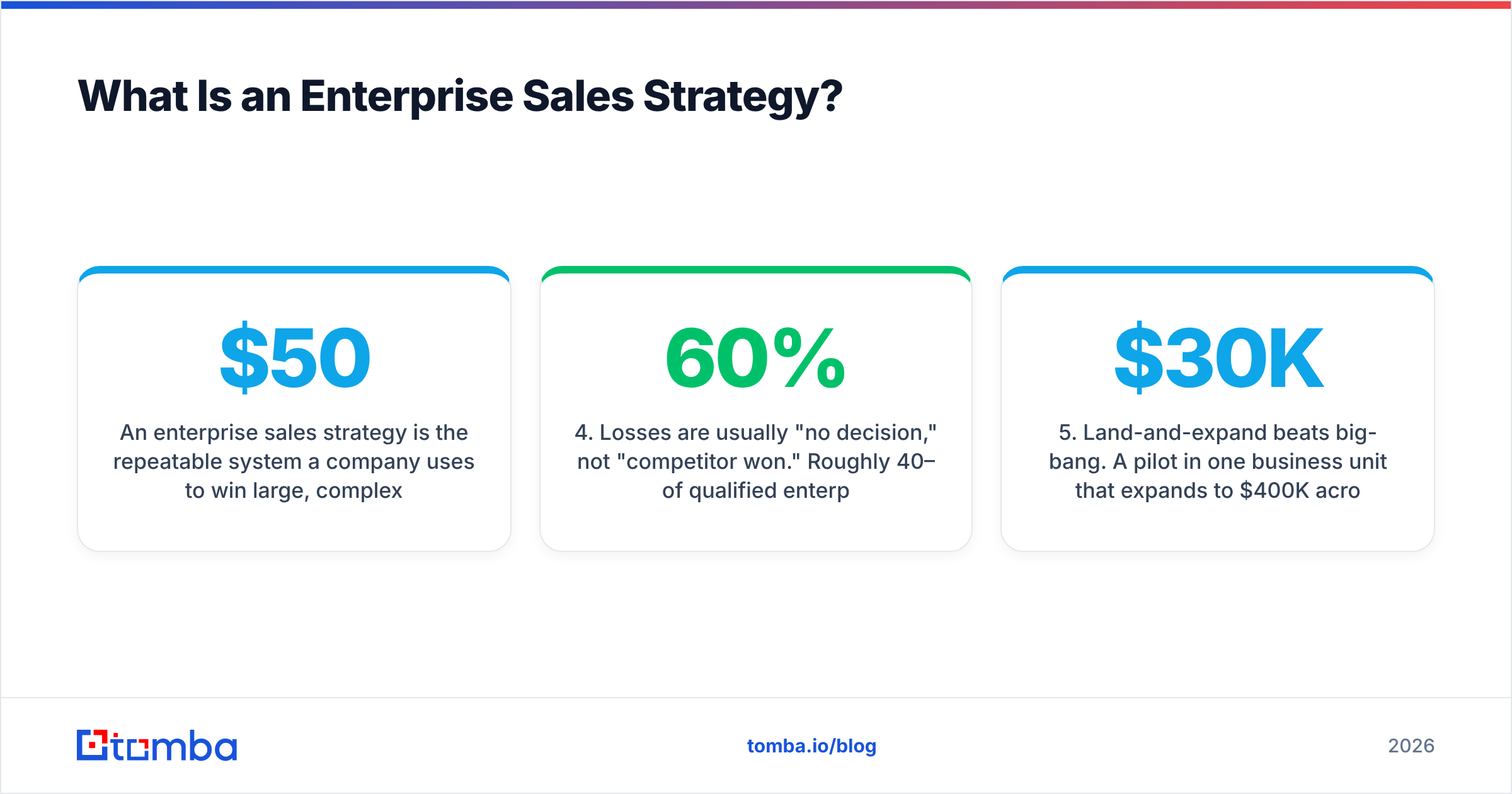
An enterprise sales strategy is the repeatable system a company uses to win large, complex, multi-stakeholder deals — typically $50,000+ in annual contract value, sold to organizations with 1,000+ employees, across a cycle measured in quarters rather than days.
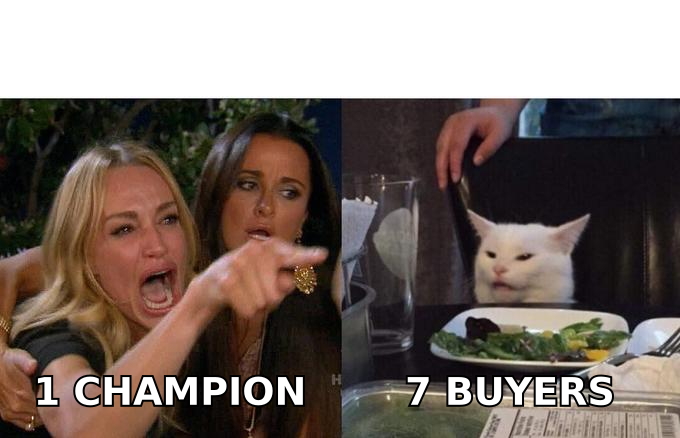
The defining feature is not deal size. It is consensus risk. In an SMB deal, one person can say yes. In an enterprise deal, one person can say yes and six others can quietly kill it. Gartner's research on B2B buying consistently finds that the typical enterprise purchase involves six to ten decision makers, each arriving with their own independently gathered information.
Think of it like getting a mortgage approved versus buying coffee. The coffee transaction needs your wallet. The mortgage needs an underwriter, an appraiser, a title company, a lawyer, and your spouse — and any one of them can stall the whole thing for reasons unrelated to whether you want the house.
That structural difference reshapes everything downstream:
- Discovery is multi-session, not single-call. You are not qualifying one person's pain; you are assembling a map of seven people's competing priorities.
- Your champion is a project manager, not a buyer. Their job is selling internally. Your job is arming them with the deck, the ROI model, and the security answers they need for meetings you will never attend.
- Procurement and security reviews are separate sales. SOC 2 documentation, DPAs, and vendor risk questionnaires can add 30–60 days if you start them at contract stage instead of at proposal stage.
- Losses are usually "no decision," not "competitor won." Roughly 40–60% of qualified enterprise pipeline dies to inertia. Your real competitor is the status quo.
- Land-and-expand beats big-bang. A $30K pilot in one business unit that expands to $400K across five is a lower-risk path than a $400K first swing.
Why Do Most Enterprise Sales Strategies Fail?#
They fail because teams import an SMB playbook — high volume, single-threaded, fast — into a market that punishes all three.
Here are the failure patterns worth naming, because each has a specific fix:
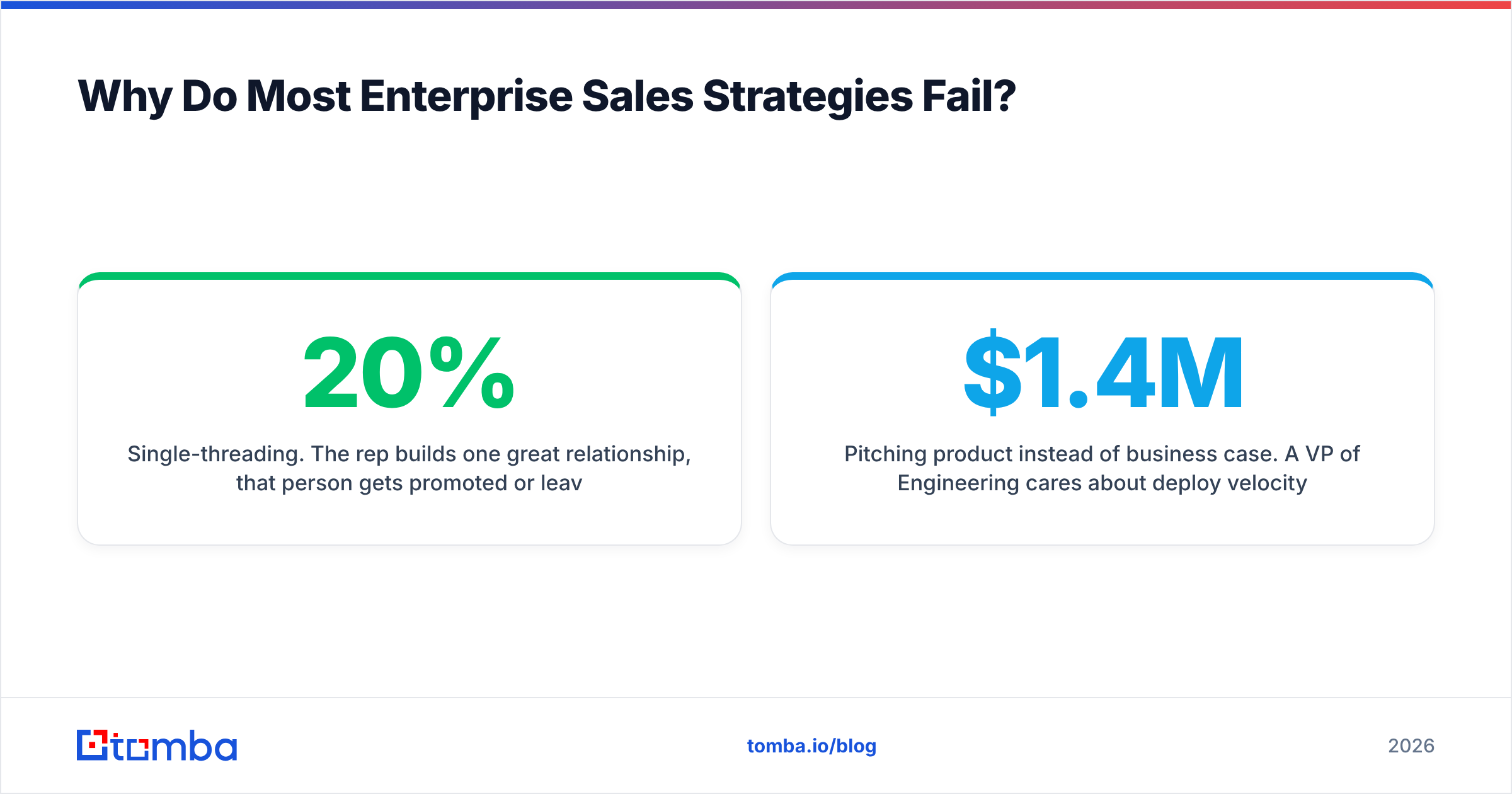
Single-threading. The rep builds one great relationship, that person gets promoted or leaves, and the deal evaporates. LinkedIn's own workforce data has shown B2B job change rates hovering near 20% annually. If your $250K deal rests on one email address, you are running a coin flip on a nine-month investment.
Pitching product instead of business case. A VP of Engineering cares about deploy velocity. Their CFO cares about the $1.4M line item. If your champion carries your feature deck into a budget meeting, you lose — not because the product is wrong, but because the language is.
Treating procurement as paperwork. Procurement's incentive is to reduce spend and risk, not to buy your thing. Engage them at proposal stage, ask what their process requires, and pre-load the security documentation. Reps who do this routinely close 3–4 weeks faster.
No mutual action plan. Without a shared, dated close plan, timelines drift by default. A one-page MAP — signed steps, owners, dates — is the cheapest forecast accuracy improvement available.
Bad contact data underneath everything. You cannot multithread into a committee you cannot reach. This is where most "strategy" conversations quietly break: the plan assumes you can get the CFO, the Head of Security, and the Director of Ops on email. Half the time, the data says you can and it is wrong.
How Does Enterprise Sales Compare to Mid-Market and SMB?#
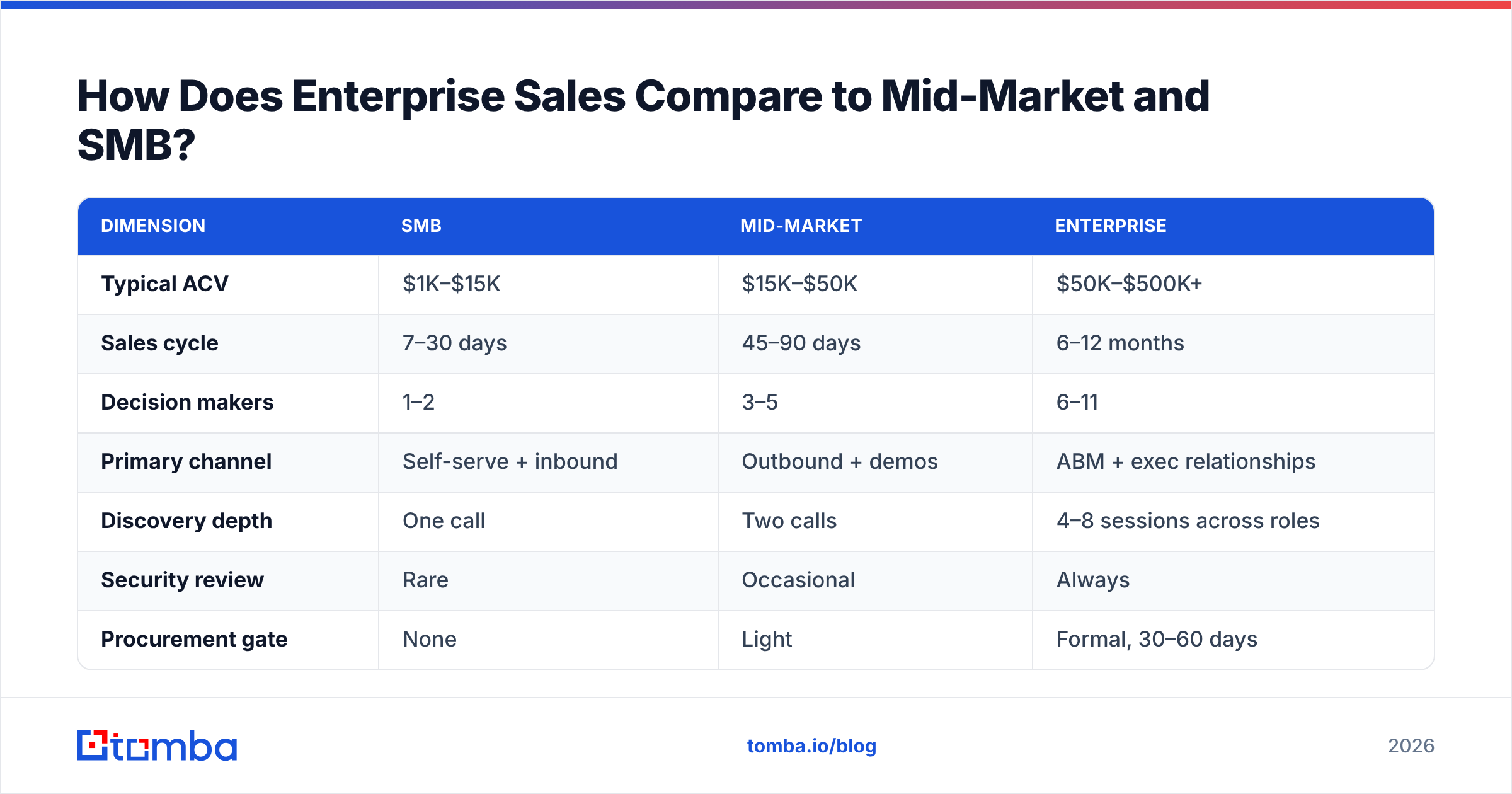
The table below is the version I would put on a whiteboard for a team transitioning upmarket. The numbers are directional industry benchmarks, not guarantees — your ACV and cycle length will vary by category.
| Dimension | SMB | Mid-Market | Enterprise |
|---|---|---|---|
| Typical ACV | $1K–$15K | $15K–$50K | $50K–$500K+ |
| Sales cycle | 7–30 days | 45–90 days | 6–12 months |
| Decision makers | 1–2 | 3–5 | 6–11 |
| Primary channel | Self-serve + inbound | Outbound + demos | ABM + exec relationships |
| Discovery depth | One call | Two calls | 4–8 sessions across roles |
| Security review | Rare | Occasional | Always |
| Procurement gate | None | Light | Formal, 30–60 days |
| Win rate on qualified pipe | 20–30% | 15–25% | 10–20% |
| Contacts needed per account | 1–2 | 3–6 | 8–15 |
| CAC payback target | 6–12 months | 12–18 months | 18–24 months |
The row that changes your daily behavior is the second-to-last one. Eight to fifteen contacts per account, at 40 target accounts, is 320–600 verified contacts — a completely different data problem than "scrape 10,000 emails and blast." You need depth per domain, which is why domain search tends to matter more than list-buying at this tier.
How Do You Map an Enterprise Buying Committee?#
Start from the org, not from your CRM. The committee has predictable roles, and each needs a different message.
- Economic buyer — controls budget, usually VP+ or C-level. Cares about payback period, risk, and what happens if they do nothing. Rarely your first contact; almost always your last approval.
- Champion — feels the pain daily, has political capital, and will fight for you internally. Test them: a real champion will get you a meeting with someone senior. A "coach" who never does that is just a friendly source.
- Technical evaluator — security, IT, or platform engineering. Their veto is absolute and often silent. Pre-empt with SOC 2, SSO, data residency, and API documentation before they ask.
- End users — the people who live in your product. They rarely approve, but their loud objection in a pilot review kills deals.
- Procurement / legal — optimizing for terms, not outcomes. Engage early, ask for their checklist, never surprise them.
- Blocker — the person whose current tool, headcount, or internal project competes with yours. Identify them by asking your champion, "Who would be least happy if this went through?"
Practical sequencing that works: enter through the champion, use them to map the committee, then reach the economic buyer with the champion rather than around them. Going over a champion's head without warning is the fastest way to convert an advocate into a blocker.
To build the map itself, you need names and reachable addresses for roles you have never met. Enrichment from a LinkedIn profile or a company domain is the standard path — the LinkedIn finder approach works well when you have identified the human but not the inbox, and data enrichment fills in title, seniority, and company firmographics so you can prioritize which six of the eleven people actually matter.
What Does an Account Plan Actually Contain?#
Most "account plans" are slide decks nobody opens. A working one fits on a page and gets updated weekly. Here is the minimum viable structure:
- Account thesis — one paragraph on why this company should buy now. Trigger events beat generic fit: new exec hire, funding round, regulatory deadline, competitor migration, hiring surge in the relevant function.
- Committee map — names, titles, role in the deal (economic buyer / champion / evaluator / blocker), relationship strength (cold / warm / advocate), and last touch date.
- Business case — their numbers, not yours. Cost of the current process, quantified. If you cannot express value in a formula the CFO would recognize, you do not have a business case.
- Mutual action plan — dated steps from today to signature, with named owners on both sides.
- Risk register — what could kill this, and the mitigation. "Security review not started" is a risk. "Champion is new in role" is a risk.
- Expansion path — which adjacent team or region is deal two, and who introduces you.
Run a 20-minute account review on your top 10 deals every week against this template. Deals with no committee movement in 14 days are stalling regardless of what the champion says on calls.
How Do You Build the Prospecting Engine Behind It?#
Enterprise prospecting is a research operation with an outreach layer bolted on — not the other way around. The workflow that holds up:
Step 1 — Define the ICP tightly enough to hurt. "Companies with 1,000+ employees" is not an ICP. "US-based fintechs, 1,000–5,000 employees, running Snowflake, with a VP of Data hired in the last 12 months" is. Tight enough and 40 accounts is plenty.
Step 2 — Build the account list before the contact list. Sequence matters. Pick accounts on thesis strength, then find people inside them.
Step 3 — Map 8–15 contacts per account. Cover the full committee shape from the section above, not just the four people whose titles match your persona doc.
Step 4 — Verify before you send. At enterprise volumes your list is small, so there is no excuse for bounces. Run every address through an email verifier and handle catch-all domains explicitly — large enterprises run catch-all configurations far more often than SMBs, which is exactly where naive verification tools return false positives.
Step 5 — Sequence by role, not by list. The CFO gets a cost-of-inaction message. The technical evaluator gets architecture and security. The end user gets the workflow pain. Same account, four different narratives, referencing each other.
Step 6 — Measure account penetration, not send volume. The metric that predicts enterprise outcomes is "number of accounts with 3+ engaged contacts," not open rate.
Which Metrics Actually Predict Enterprise Revenue?#
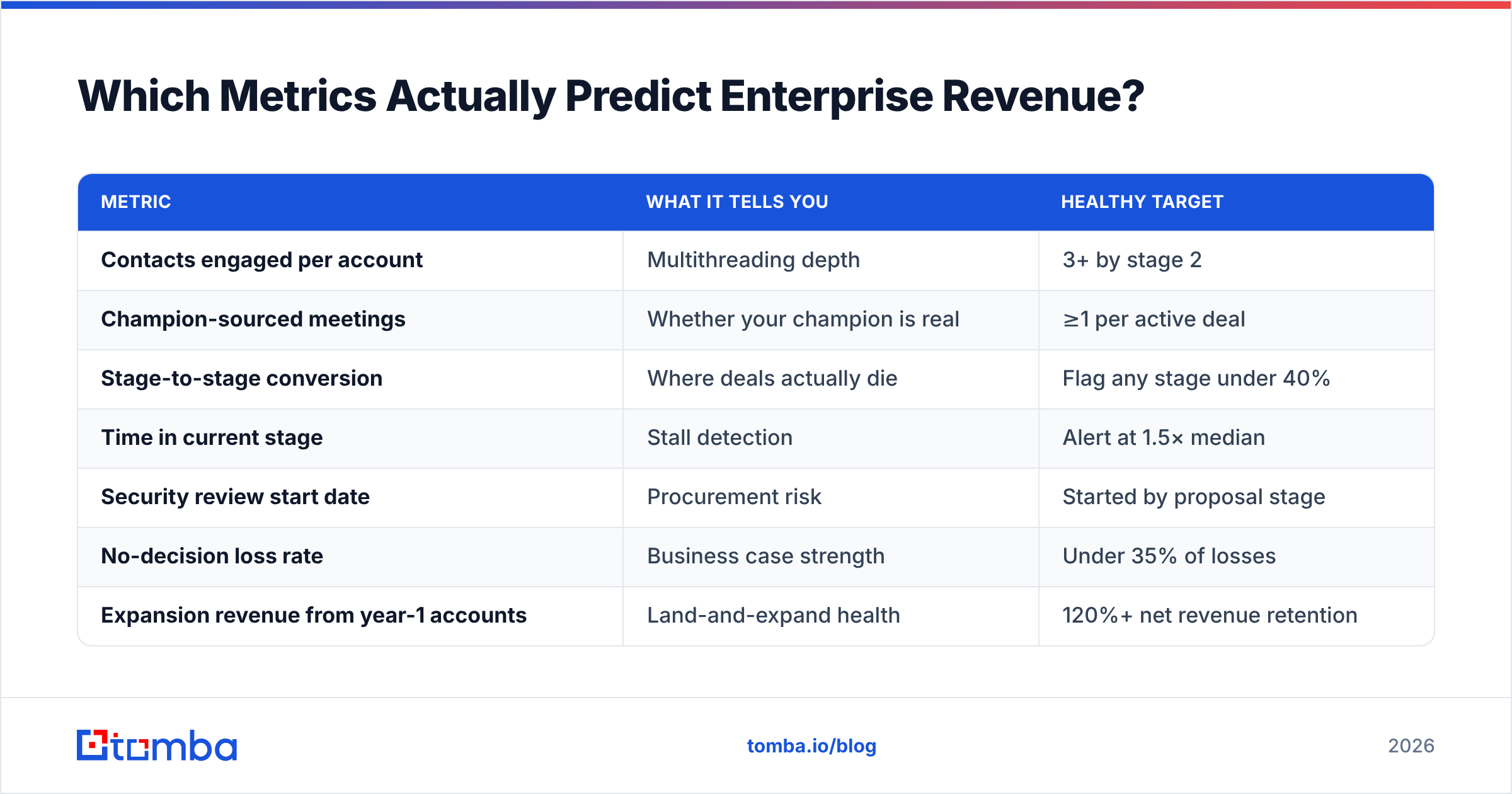
Activity metrics lie at this tier. A rep can send 400 emails a week and build zero pipeline; another can send 40 and land three committee meetings. Track these instead:
| Metric | What it tells you | Healthy target |
|---|---|---|
| Contacts engaged per account | Multithreading depth | 3+ by stage 2 |
| Champion-sourced meetings | Whether your champion is real | ≥1 per active deal |
| Stage-to-stage conversion | Where deals actually die | Flag any stage under 40% |
| Time in current stage | Stall detection | Alert at 1.5× median |
| Security review start date | Procurement risk | Started by proposal stage |
| No-decision loss rate | Business case strength | Under 35% of losses |
| Expansion revenue from year-1 accounts | Land-and-expand health | 120%+ net revenue retention |
The single most diagnostic number on that list is no-decision loss rate. If more than a third of your losses are "they did nothing," the problem is not your competitor or your pricing. It is that you never built a strong enough case for change, and the CFO chose the free option: inertia.
For a broader view of how these roll into forecasting, G2's B2B software buyer research and Gartner's B2B buying journey work are both worth reading directly — they document the committee dynamics far more rigorously than most vendor content, including Tomba's.
How Do You Handle Procurement and Security Without Losing Two Months?#
Treat it as a parallel workstream that starts at proposal, not a sequential gate that starts at verbal yes.
Ask your champion three questions at proposal stage:
- "What does your security review process look like, and who owns it?"
- "Is there a preferred vendor list or an existing MSA we could paper under?"
- "What is the approval threshold — does this spend level need CFO or board sign-off?"
Then pre-package everything: SOC 2 Type II report, penetration test summary, DPA template, sub-processor list, SSO/SCIM documentation, and an uptime SLA. Reps who send this bundle unprompted routinely compress reviews from six weeks to three.
One more tactic worth the effort: ask for the redlines before the verbal commit. Legal review running in parallel with final approval, rather than after it, is often the difference between closing in-quarter and slipping.
How Do You Scale This Without Losing Deal Quality?#
The tension in enterprise sales is that the motion is inherently manual and your board wants it to be repeatable. Three things make it scale:
Specialize the roles. An enterprise AE who also builds their own lists is an expensive researcher. Pair AEs with a research-focused SDR or a RevOps analyst who owns account and contact mapping. Enterprise SDR-to-AE ratios of 1:1 or 1:2 are normal precisely because the research load is heavy.
Automate the data layer, not the relationship layer. Committee mapping, enrichment, verification, and CRM hygiene should be automated. Discovery, business case building, and exec relationships should never be. Pushing verified contacts into your CRM through a HubSpot integration or via the Tomba API removes the copy-paste tax without touching the parts that require judgment.
Codify what winners do. Record the discovery questions, the ROI model, the security bundle, and the MAP template. Enterprise reps often ramp for 6–9 months; every codified asset shortens that.
One honest caveat: not every company should sell enterprise. If your ACV is $8K, your product has no security story, and your team is four people, the enterprise motion will burn 12 months of runway before producing a single close. Mid-market first is not a failure — it is usually the correct sequencing.
Getting the Data Layer Right#
Every strategy in this post assumes one thing: you can actually reach the eight to fifteen people inside each target account. That assumption is where most enterprise plans fail quietly — the plan is fine, the list is stale, and the emails bounce into a damaged sending domain.
Tomba's Email Finder is built for exactly this shape of work: find verified professional addresses by domain, name, or company, so you can map an entire buying committee from a single target domain rather than assembling it from scraped exports. The free tier gives you 25 searches a month to test accuracy against accounts you already know, and paid plans start at $49/mo with bulk and API access as your account list grows — full Tomba pricing is public if you want to model the cost per mapped account before committing.
Map the committee. Verify the addresses. Then go sell.
Related guides#
Ready to find emails that actually work?
Join 150,000+ professionals who stopped guessing and started sending. Free credits on signup — no credit card required.
Get the Tomba newsletter
Practical outbound tactics and product updates — once every two weeks.
About the author