Enterprise Sales vs B2B Sales: Key Differences in 2026
Enterprise sales is a subset of B2B sales — but the deal size, buying committee, cycle length, and pipeline math are so different that running one playbook for both quietly kills your win rate.
Enterprise sales vs B2B sales is not a contest between two categories. One sits inside the other. But deal size, buying committee, and cycle length differ so much that a single playbook cannot cover both.
TL;DR
Enterprise sales vs B2B sales is a nesting question, not a rivalry. Enterprise sales is a subset of B2B sales. All enterprise sales is B2B. Most B2B sales is not enterprise.
The dividing lines are deal size (about $50K+ ACV), buying committee size (6–11 people), and cycle length (6–18 months). Headcount alone tells you little.
Mid-market B2B rewards volume and speed. Enterprise rewards account depth, multithreading, and patience. Running the volume playbook on enterprise accounts is the most common revenue leak.
Your data strategy has to flip too. Velocity motions need thousands of verified contacts. Enterprise needs 12 accurate contacts per account, mapped to the org chart.
Most teams should run both, as two segments with their own quotas, comp plans, and coverage ratios. Blending them produces forecasts nobody believes.
What is B2B sales, and where does enterprise sales sit inside it?#
B2B sales is the whole category: one business sells to another. That covers a $29/month project tool sold self-serve. It covers a $12,000 payroll platform closed in three calls. It also covers a $2.4M ERP replacement that takes two years and a board sign-off.
Enterprise sales is the top slice of that range. The deal is large. The buyer's organization is complex. So the sale becomes a change management project rather than a transaction.
Think of it like real estate. A studio apartment and a 40-floor office tower are both property sales. Same legal category, very different jobs. One is a weekend of showings. The other is eighteen months of due diligence, financing committees, zoning reviews, and anchor-tenant talks. Nobody would use the studio playbook on the tower. Sales teams do the equivalent every week.
The mistake is not the definition. It is assuming the same process, comp plan, and prospecting data work at both ends of the range.
Enterprise sales vs B2B sales: what actually differs?#
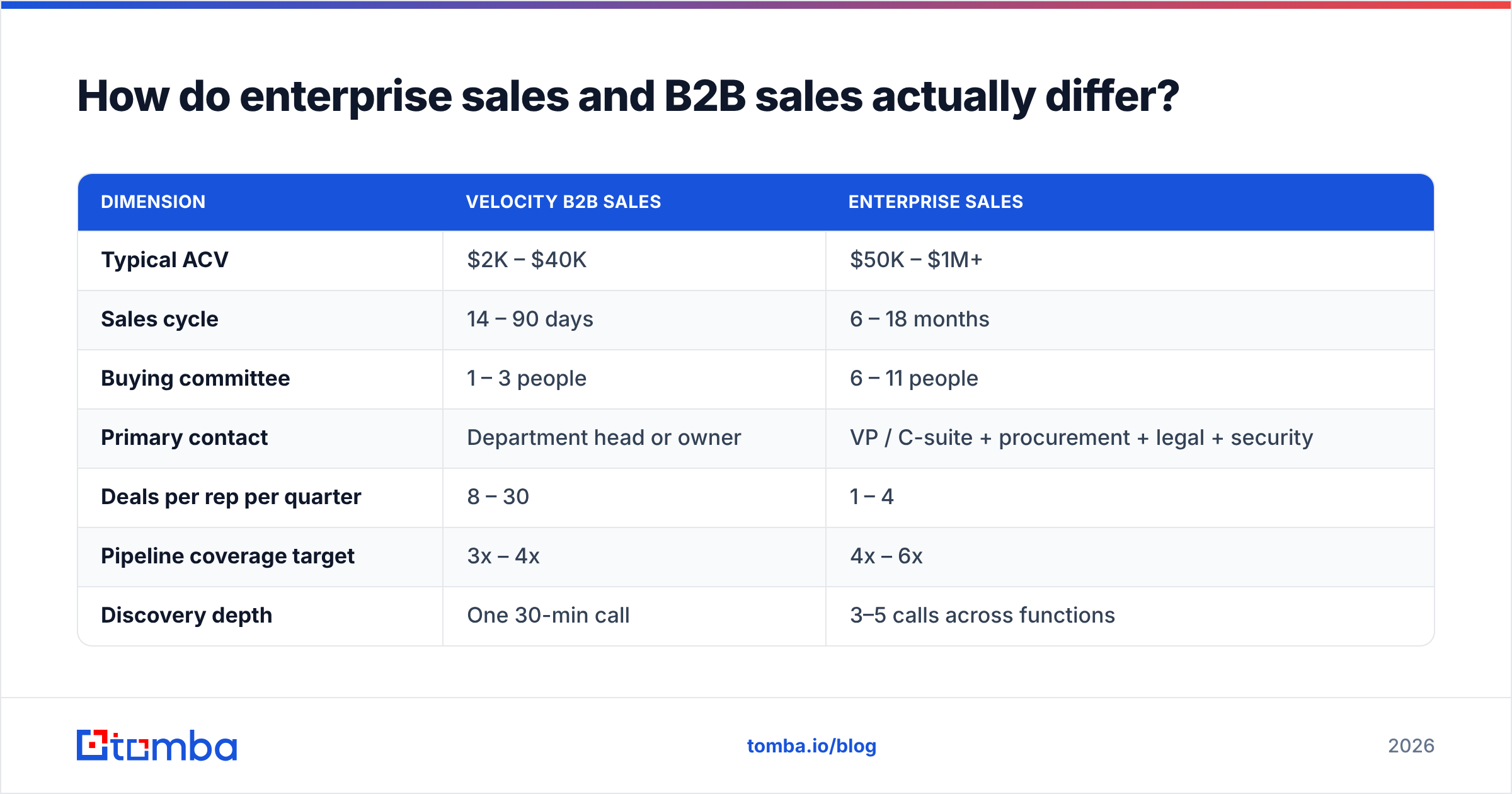
Here is the honest side-by-side. B2B sales in this table means the SMB and mid-market velocity motion most teams run, since that is the real point of comparison.
| Dimension | Velocity B2B sales | Enterprise sales |
|---|---|---|
| Typical ACV | $2K – $40K | $50K – $1M+ |
| Sales cycle | 14 – 90 days | 6 – 18 months |
| Buying committee | 1 – 3 people | 6 – 11 people |
| Primary contact | Department head or owner | VP / C-suite + procurement + legal + security |
| Deals per rep per quarter | 8 – 30 | 1 – 4 |
| Pipeline coverage target | 3x – 4x | 4x – 6x |
| Discovery depth | One 30-min call | 3–5 calls across functions |
| Security / legal review | Rare | Always (SOC 2, DPA, pen test, MSA redlines) |
| Procurement involvement | Credit card or simple PO | Formal RFP, vendor onboarding, 30–90 day paperwork |
| Champion required | Helpful | Mandatory — no champion, no deal |
| Rep profile | Fast, high activity, script-fluent | Consultative, patient, comfortable with ambiguity |
| Comp structure | Higher volume, lower per-deal | Lower volume, large accelerators, longer ramp |
| Ramp to full productivity | 1 – 3 months | 6 – 12 months |
| CAC payback | 6 – 14 months | 18 – 30 months |
| Churn risk driver | Single-user disengagement | Executive sponsor turnover |
Two rows deserve extra attention.
Deals per rep per quarter. A velocity AE closes 20 deals a quarter. She can lose eight and still hit her number. An enterprise AE works three deals and cannot lose two. That gap drives every other difference. It is why enterprise reps run five discovery calls instead of one, and why they multithread so hard.
Ramp time. Enterprise reps ramp in 6–12 months. Hiring one in October to save Q4 is a fantasy. Velocity teams can hire when they feel the pain. Enterprise teams hire two to three quarters ahead of plan.
Why does the buying committee change everything?#
Gartner's research on the B2B buying journey has been steady for years. A complex B2B purchase now involves six to ten decision makers. Each one shows up with information they gathered alone. Enterprise deals sit at the top of that range. They also add roles that smaller deals never touch: security review, data privacy, vendor risk, and sometimes a works council in the EU.
Here is what that means in practice. Most reps underestimate the first three points.
Every stakeholder can say no. Only one can say yes. Procurement cannot buy your product, but it can kill the deal over payment terms. Security cannot sign the contract, but a failed questionnaire ends the review. You need a yes from the economic buyer and a not-no from everyone else.
Consensus is the real product you sell. Your champion has to sell you internally when you are not in the room. Arm them with a one-page business case, a build-vs-buy comparison, and a reference call with a peer. If they have to invent those artifacts alone, they will not.
Single-threaded deals die on people changes. A VP-level buyer stays under two years on average. On an 11-month cycle, your only contact may leave mid-deal. Three engaged contacts per account is insurance, not paranoia.
The last two points are about blind spots and timing.
The blockers are usually invisible. The person who kills your deal is often someone you never met. It may be a director whose team owns the incumbent tool. It may be an architect who wants fewer vendors. Map the org chart before you need it.
Their calendar sets the timeline, not yours. Budget cycles, fiscal year ends, board meetings, and audit windows decide when a deal can close. Ask about them in discovery, not in the last two weeks of the quarter.
The prospecting job changes with it. A mid-market deal needs one good contact. An enterprise account needs eight to twelve accurate contacts across four functions. You need them before the deal starts, not after your champion goes quiet.
What does the pipeline math look like for each model?#
The numbers are where enterprise sales vs B2B sales stops being a definition debate.
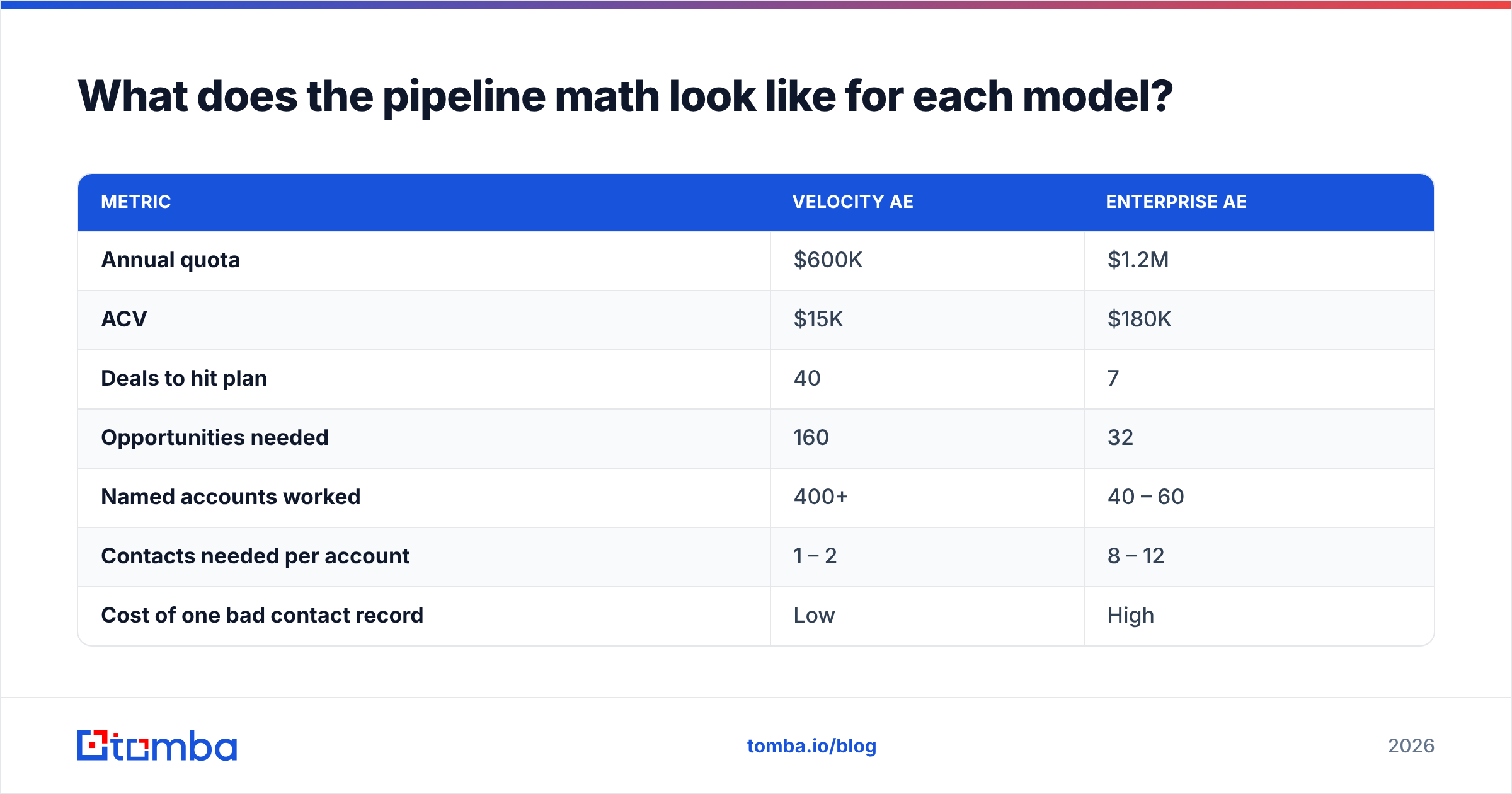
Velocity B2B, one AE: $600K quota, $15K ACV, 25% win rate. That is 40 closed deals a year and 160 qualified opportunities. At a 15% meeting-to-opportunity rate, the team needs roughly 1,070 booked meetings. This motion runs on contact volume. You need thousands of verified addresses per quarter, and a 15% bad-data rate costs you real pipeline.
Enterprise, one AE: $1.2M quota, $180K ACV, 22% win rate. That is about 7 closed deals a year and 32 opportunities. Each one comes from a named list of 40 to 60 accounts the rep works all year. Volume does not matter here. Per-contact accuracy and a complete org chart do.
The same 15% bad-data rate can cost an enterprise team a whole account. A bounced email to the CFO on a 45-account territory is not a rounding error. It burns 2% of the year's addressable list. That is where an email verifier step stops being nice to have and becomes a control on territory quality.
| Metric | Velocity AE | Enterprise AE |
|---|---|---|
| Annual quota | $600K | $1.2M |
| ACV | $15K | $180K |
| Deals to hit plan | 40 | 7 |
| Opportunities needed | 160 | 32 |
| Named accounts worked | 400+ | 40 – 60 |
| Contacts needed per account | 1 – 2 | 8 – 12 |
| Cost of one bad contact record | Low | High |
Is enterprise sales better than mid-market B2B sales?#
No. Framing it as a ladder is how good companies wreck their unit economics.
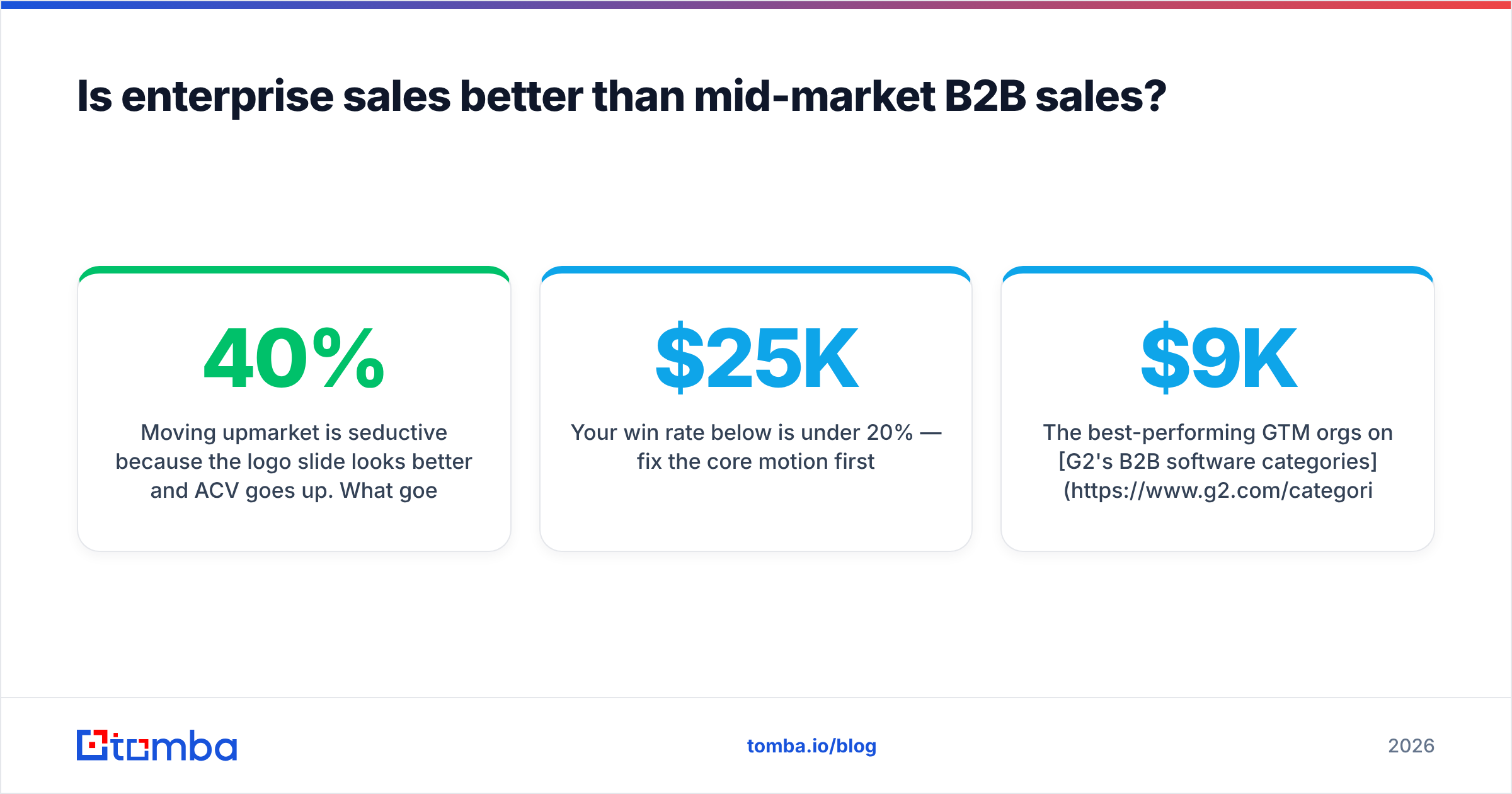
Moving upmarket is tempting. The logo slide looks better and ACV goes up. So do the sales cycle, CAC, implementation cost, support load, contract liability, and the roadmap you sell before it exists. Plenty of companies have grown revenue 40% while gross margin fell apart. They chased enterprise before their product, security posture, and services team could carry it.
Signals you are ready for enterprise:
- Enterprise deals already close by accident. That is pull, not push.
- SOC 2 Type II (or equivalent) is done, not planned.
- You can staff implementation without pulling engineers off the roadmap.
- Someone other than the founder owns security questionnaires and MSA redlines.
- Your product handles SSO, audit logs, role-based permissions, and data residency.
Signals you should stay mid-market and get better at it:
- Your win rate below $25K is under 20%. Fix the core motion first.
- Every enterprise deal you closed needed a custom build.
- Your average implementation runs 3x over estimate.
The best GTM teams on G2's B2B software categories run both motions in parallel, with hard segmentation rules. They do not blend a $9K deal and a $400K deal into one forecast.
How does prospecting data change between the two motions?#
This is the operational gap most teams miss. They buy one data tool and point it at both segments.
Velocity B2B needs breadth. Large volumes of verified addresses, refreshed often, pushed into sequences with no manual steps. The workflow is list, verify, enrich, sequence, run weekly. Bulk email finding and CSV enrichment matter more than depth. Deliverability is the constraint. One bad list can hurt sender reputation for weeks, so verification is not optional at this volume. Purchased lists and live lookups both fit here, depending on how fresh the data has to be.
Enterprise needs depth. For 50 named accounts you need the full map: economic buyer, champion, technical evaluator, security contact, and procurement lead. Add two lateral contacts who may become champions later. That is a domain search pattern. Pull every contact you can find at the company, filter by department and seniority, then verify each one before you reach out.
Enterprise also needs phone numbers. Executives at large companies ignore cold email at rates that make email-only prospecting hopeless. Multichannel sequences pair an email with a call and a LinkedIn touch. Direct dials from a phone finder are what make multithreading real instead of theoretical.
One rule sums up enterprise sales vs B2B sales here. In velocity motions, optimize for cost per verified contact. In enterprise motions, optimize for coverage per account: the share of target accounts where every role is mapped and reachable. Those two metrics pull toward different tools.
What does an enterprise sales process look like, step by step?#
Stage names differ by company. The sequence holds.
Account selection. Fifty accounts you researched beat 500 you filtered. Score on fit signals: tech stack, headcount growth, funding, regulatory posture, and contracts up for renewal.
Org mapping. Build the contact map before outreach. Who owns the budget, who owns the problem, who owns the risk. Enrich each one with verified contact data.
Multithreaded entry. Reach three or four people in parallel with role-specific messaging. The CFO angle and the VP Engineering angle are not the same email with a new first name.
Discovery across functions. Run separate calls for business outcome, technical fit, and risk. Each one surfaces different objections and different blockers.
The second half is where velocity playbooks run out of road.
Champion enablement. Co-build the business case. Give your champion the deck they will present internally, with their own finance team's numbers in it.
Validation. Run a pilot, POC, or reference calls. Define success criteria in writing before the pilot starts. Undefined pilots never end.
Procurement and legal. Start the security review alongside the business case, not after it. This step often adds 45 days and slips the quarter.
Close and handoff. A signature with a bad implementation plan is a churn event on a delay.
HubSpot's sales enablement resources cover the tactics of each stage well. The strategic point is simpler. Steps 2, 5, and 7 barely exist in velocity B2B sales. That is why velocity reps promoted into enterprise roles struggle without retraining.
Which one should your team run in 2026?#
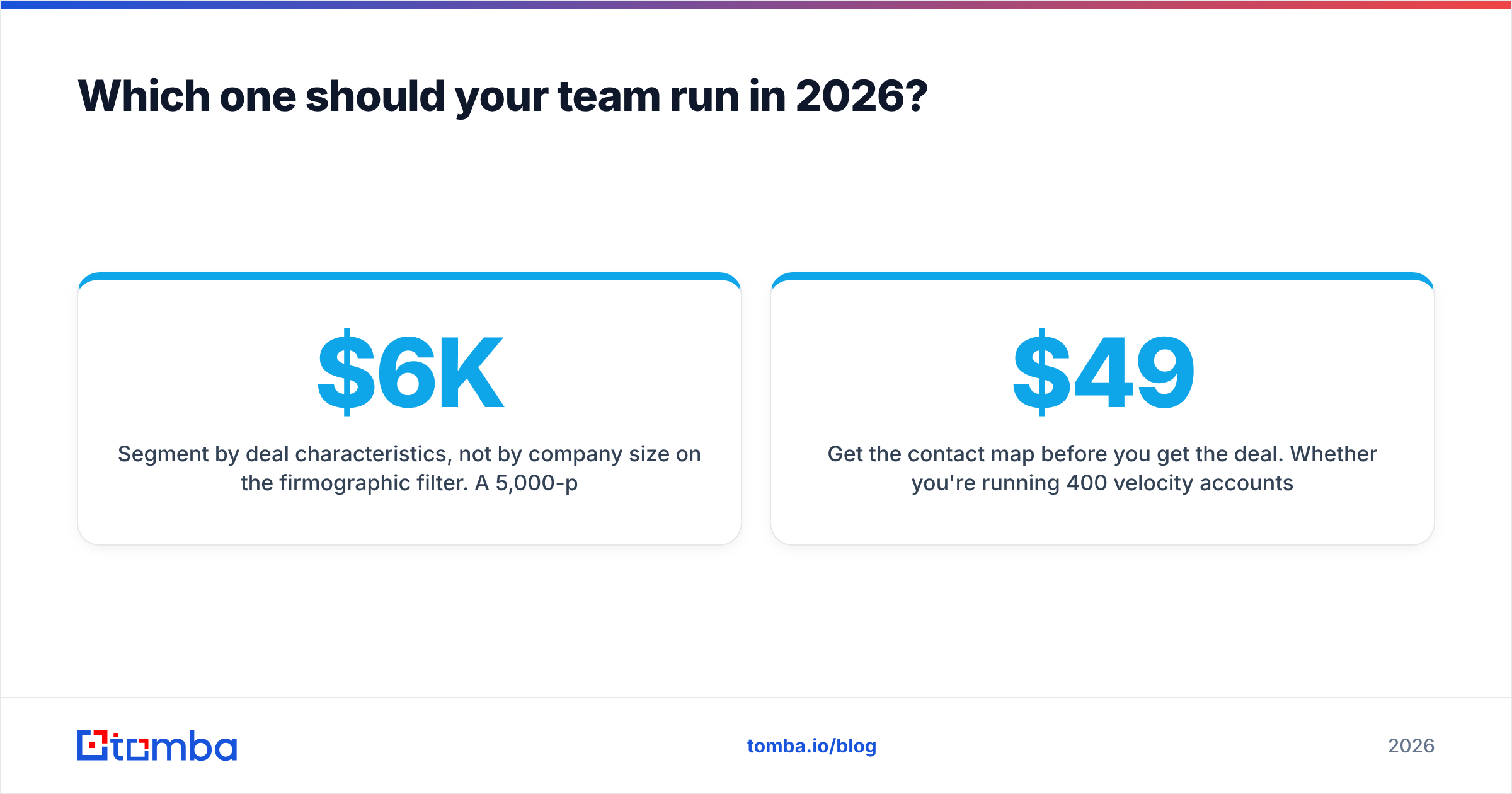
Segment by deal shape, not by company size in a filter. A 5,000-person company buying a $6K departmental tool is a velocity deal. A 300-person fintech buying a $200K platform with a full security review is an enterprise deal. Route on complexity, not headcount.
Then keep the segments apart. Give each its own quotas, comp plans, coverage ratios, data budgets, and forecast rollup. When both live in one pipeline, enterprise deals distort the average cycle length. Velocity deals hide enterprise slippage until it is too late to react.
Take one thing from this enterprise sales vs B2B sales comparison. Enterprise is not harder B2B sales. It is a different sport on the same field. Staff it, comp it, and equip it that way.
Get the contact map before you get the deal. Whether you run 400 velocity accounts or 50 enterprise ones, both motions break at the same point: outdated, unverified contact data.
Tomba Email Finder returns verified professional emails by name, company, or domain, each with a confidence score attached. You can map a whole buying committee before your first touch instead of guessing formats. Start free with 25 searches a month, or check Tomba pricing — Starter is $49/mo and Growth is $99/mo — and stop losing accounts to bounced email.
Related guides#
Ready to find emails that actually work?
Join 150,000+ professionals who stopped guessing and started sending. Free credits on signup — no credit card required.
Get the Tomba newsletter
Practical outbound tactics and product updates — once every two weeks.
About the author