Enterprise Selling in 2026: A Practical Guide to Closing
Enterprise deals are not big SMB deals. They involve 6-12 stakeholders, procurement gates, and 9-month cycles. Here is the operating system that actually moves six-figure contracts across the line.
TL;DR
- Enterprise selling is not "SMB selling with a bigger number." You sell to a committee of 6-12 people. Most of the deal happens in rooms you never enter.
- Cycles run 6-12 months. Expect 3-5 gates: business case, security, procurement, legal, and finance. Plan around gates, not around "closing."
- Multithreading is the top lever. Single-contact deals stall at roughly twice the rate of deals with four or more mapped stakeholders.
- Name the economic buyer, the metric they own, and the paper process. MEDDICC forces that. BANT does not.
- Contact data in large accounts decays 25-30% a year because of reorgs. Re-verify committee contacts every quarter.
What is enterprise selling?#
Enterprise selling means closing high-value deals inside large companies. Think 1,000+ employees, a real procurement team, and contracts from $50,000 to seven figures a year.
Deal size is not the defining trait. Split authority is. In an SMB deal, one person says yes and pays by card. In enterprise selling, nobody says yes alone. About eleven people can say no.
Security can block you over a SOC 2 gap. Legal can block you over data-residency wording. Procurement can stall a quarter over one clause. Finance can push the deal into next year's budget.
Here is an analogy. Painting your bedroom is a decision. Getting a building permit is a process. It has named reviewers, a set order, and a queue. The skill is not charm. It is knowing the order and clearing each reviewer early.
That reframe changes how you prospect, how you forecast, how you write follow-ups, and what data you keep on file.
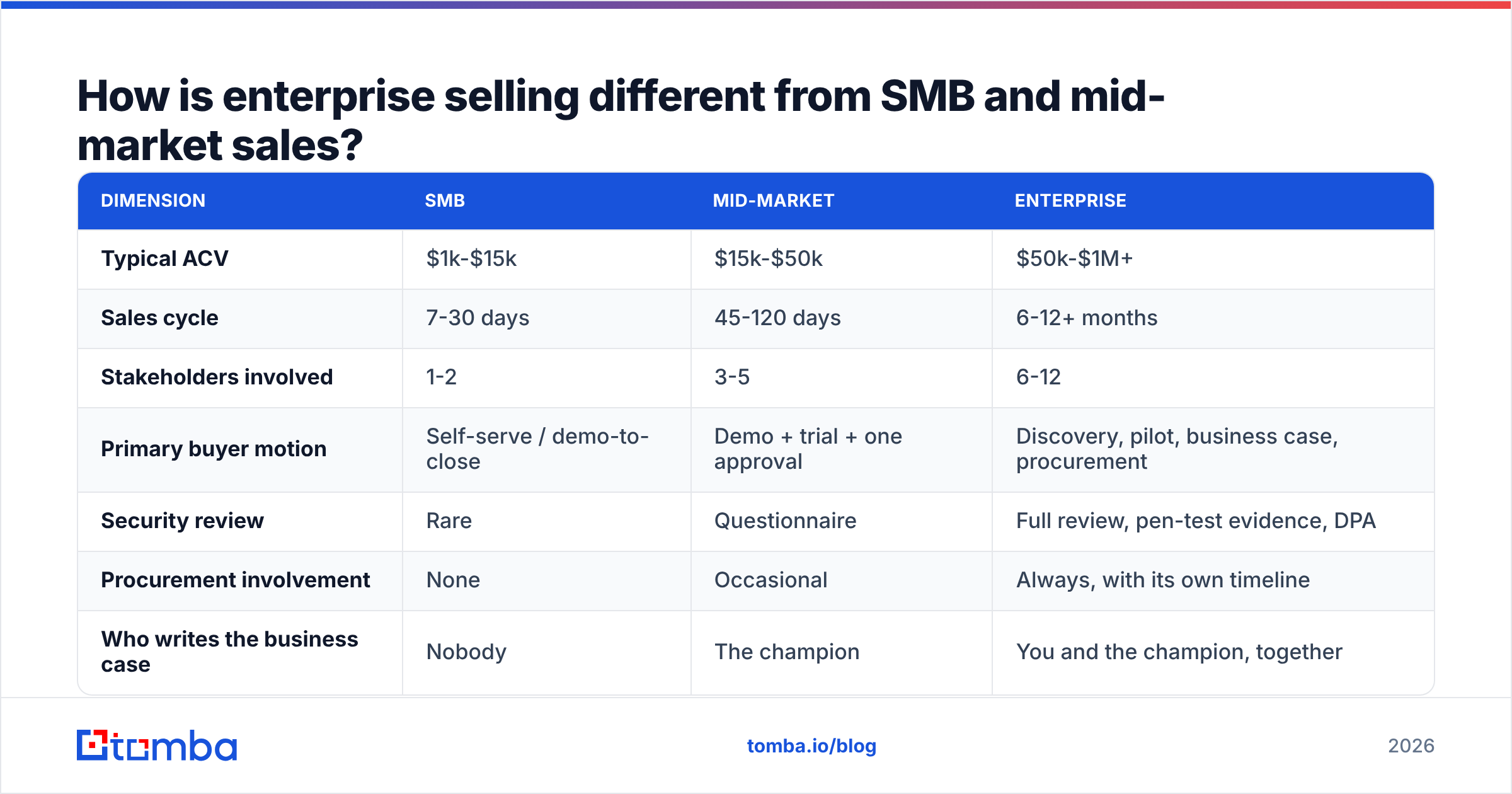
How is enterprise selling different from SMB and mid-market sales?#
The gaps are structural, not cosmetic. Use this table before you try to move upmarket.
| Dimension | SMB | Mid-market | Enterprise |
|---|---|---|---|
| Typical ACV | $1k-$15k | $15k-$50k | $50k-$1M+ |
| Sales cycle | 7-30 days | 45-120 days | 6-12+ months |
| Stakeholders involved | 1-2 | 3-5 | 6-12 |
| Primary buyer motion | Self-serve / demo-to-close | Demo + trial + one approval | Discovery, pilot, business case, procurement |
| Security review | Rare | Questionnaire | Full review, pen-test evidence, DPA |
| Procurement involvement | None | Occasional | Always, with its own timeline |
| Who writes the business case | Nobody | The champion | You and the champion, together |
| Win-rate lever | Speed and volume | Product fit | Committee coverage and risk removal |
| Cost of bad contact data | Low (retry tomorrow) | Medium | High (a wrong contact costs weeks) |
| Forecast method | Rep gut feel | Stage-weighted | Gate-based with paper process mapped |
The last row surprises most teams. In SMB, a stale email is a small annoyance. You find another address in ten minutes.
In enterprise selling, the cost is far higher. Email a VP who left four months ago, and your champion's boss never sees the business case. The quarter closes. The budget moves elsewhere. Long cycles let small errors compound.

Who is actually in the enterprise buying committee?#
Map these six roles by name on every deal above $50k. If a slot is blank in your CRM, the deal is not qualified. It does not matter how good the last call felt.
- Economic buyer — owns the budget line and can approve unplanned spend. Usually a VP or C-level. Meet this person before the proposal, not after. No access means no real champion.
- Champion — has a personal stake and sells for you when you are not on the call. Test them. Ask for an intro to the economic buyer. A real champion delivers it within a week.
- Technical evaluator — IT, security, or platform engineering. Their job is to find reasons to say no. Send docs early. A security questionnaire returned in three days beats any demo.
- End users — they live in your product daily. They rarely hold a veto. They do create the adoption proof that drives renewal. Get at least three into the pilot.
- Procurement — they optimize for price, terms, and fewer vendors. They are not judging your product. Ask your champion for the procurement calendar in month one.
- Blocker — someone tied to the current tool or an internal build. Find them early. Give them a role in the review instead of routing around them.
Gartner's research on the B2B buying journey shows where buying groups spend their time. Most of it goes to internal meetings and private research, not to sellers. That is the core problem enterprise selling has to solve. You are arming people to sell for you in rooms you will never enter.
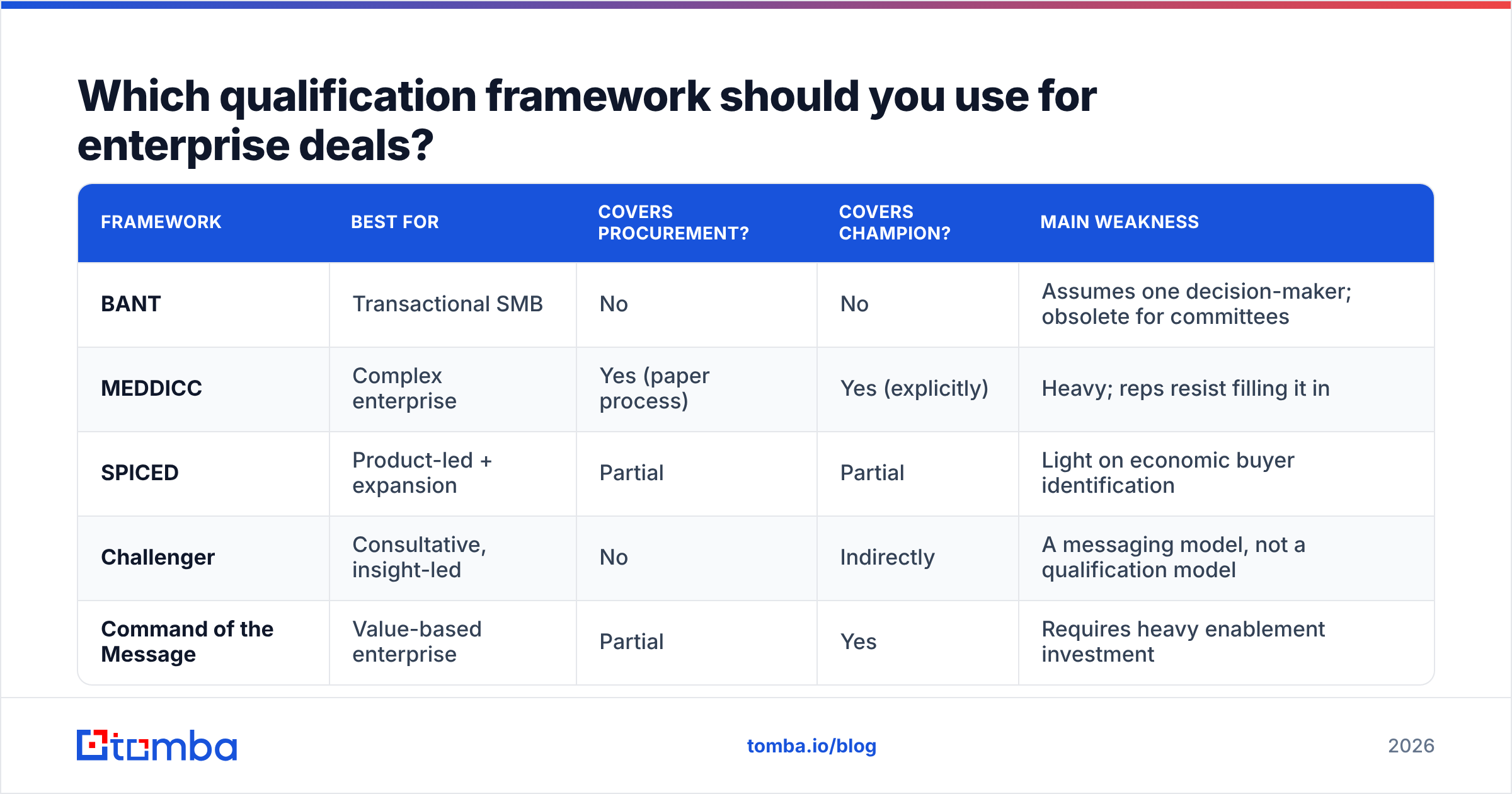
Which qualification framework should you use for enterprise deals?#
Pick one and enforce it in the CRM. The discipline matters more than the choice. Still, some frameworks fit committee deals much better.
| Framework | Best for | Covers procurement? | Covers champion? | Main weakness |
|---|---|---|---|---|
| BANT | Transactional SMB | No | No | Assumes one decision-maker; obsolete for committees |
| MEDDICC | Complex enterprise | Yes (paper process) | Yes (explicitly) | Heavy; reps resist filling it in |
| SPICED | Product-led + expansion | Partial | Partial | Light on economic buyer identification |
| Challenger | Consultative, insight-led | No | Indirectly | A messaging model, not a qualification model |
| Command of the Message | Value-based enterprise | Partial | Yes | Requires heavy enablement investment |
MEDDICC wins for most enterprise selling motions. It has explicit fields for the economic buyer, the decision criteria, and the paper process. Those three fields are usually the empty ones on deals that slip.
Try this review. Take your last ten lost or pushed deals. Check how many had a named economic buyer when the proposal went out. The number is usually under half.
One rule keeps the forecast honest. No deal enters commit without the economic buyer's name, the metric they are measured on, and the date procurement opens its queue.
What does the enterprise sales cycle look like stage by stage?#
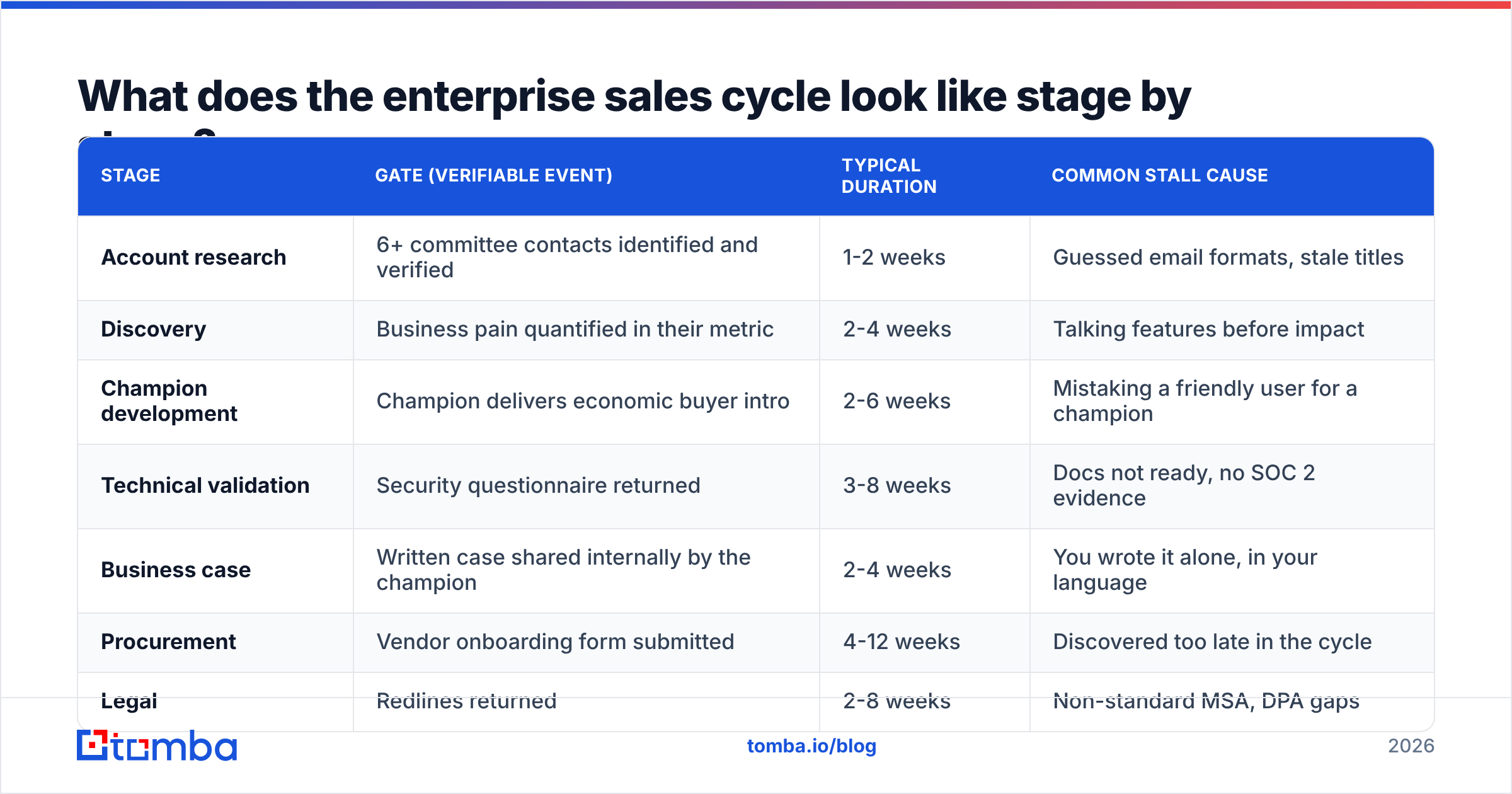
Model your pipeline on gates, not on feelings. A gate is an event you can verify. It either happened or it did not.
| Stage | Gate (verifiable event) | Typical duration | Common stall cause |
|---|---|---|---|
| Account research | 6+ committee contacts identified and verified | 1-2 weeks | Guessed email formats, stale titles |
| Discovery | Business pain quantified in their metric | 2-4 weeks | Talking features before impact |
| Champion development | Champion delivers economic buyer intro | 2-6 weeks | Mistaking a friendly user for a champion |
| Technical validation | Security questionnaire returned | 3-8 weeks | Docs not ready, no SOC 2 evidence |
| Business case | Written case shared internally by the champion | 2-4 weeks | You wrote it alone, in your language |
| Procurement | Vendor onboarding form submitted | 4-12 weeks | Discovered too late in the cycle |
| Legal | Redlines returned | 2-8 weeks | Non-standard MSA, DPA gaps |
| Signature | Countersigned contract | 1-2 weeks | Signature authority unclear |
Procurement and legal can eat more calendar time than discovery, validation, and the business case combined. Most reps treat a verbal yes as the finish line. It is closer to the two-thirds mark.
Why does contact data break enterprise deals?#
Because org charts move faster than your CRM does.
Large companies reshuffle all the time. A VP of Operations becomes a VP of Transformation. A director shifts business units. An acquisition renames the email domain. Benchmarks put annual B2B data decay at 25-30%. It runs higher at senior levels, which is the exact tier you need.
The failure mode is quiet. You get no error. You send the business case to first.last@company.com. The mailbox forwards to someone who left. You mark the deal cold. It was not cold. It never arrived.
Three habits fix most of this in enterprise selling:
- Verify before every committee expansion. Your champion names three new stakeholders. Do not guess the pattern. Confirm each address with an email verifier first. One bounce on a VP mailbox hurts your sender reputation across the whole domain.
- Re-enrich open deals every quarter. Any deal open past 90 days needs a fresh pass of contact enrichment. Titles, departments, and reporting lines change mid-cycle more often than reps expect.
- Keep a phone path to the economic buyer. When email fails in silence, a direct dial is the fastest recovery. Add a phone finder to account research before you need it.
New logo with only a domain? Run a domain search across the target department. You get the naming convention plus names and titles to check against LinkedIn. That beats asking a champion for six intros in one email.

How do you build an enterprise account plan that survives contact with reality?#
A good plan fits on one page. It answers five questions. Anything longer goes stale.
- What is the compelling event? A regulatory deadline, a renewal with the incumbent, a funding round, a new exec with a mandate. Without one, the deal has no reason to close this quarter.
- What metric does the economic buyer own? Not "efficiency." A number with a unit and a target: cost per ticket, pipeline coverage, days to onboard. Your business case must move it.
- Who are the six roles, by name? Every blank is a risk. Give each blank an owner and a date.
- What is the paper process? Queue length, legal review time, security requirements, signing limits. Ask directly. Champions know, and nobody asks them.
- What is the pilot success criterion? Written, agreed, measurable, and time-boxed before the pilot starts. An open-ended pilot is how deals die politely.
Update the plan after every committee meeting. HubSpot's sales blog has usable templates. Skip the fifteen-page frameworks. A plan that takes an hour to maintain gets dropped by week three.
How do you handle procurement, security, and legal without losing a quarter?#
Front-load them. The fastest teams start procurement in month one, in parallel with the sales conversation.
Four moves:
- Ask about vendor onboarding during discovery, not at proposal. "What does your procurement process look like for a purchase this size?" is a normal question. It saves four to six weeks.
- Keep a security packet ready to send in 24 hours: SOC 2 report, pen-test summary, DPA template, sub-processor list, architecture diagram, and CAIQ answers.
- Agree your MSA fallback terms in-house first. Then redlines do not trigger a new approval chain on your side. Your own legal queue is often the hidden bottleneck.
- Get the signing limit in writing. Deals stall when a $120k contract crosses a $100k board-approval line nobody mentioned.
Selling into regulated industries? Check whether the buyer needs a third-party vendor risk assessment. That alone can add 30-60 days.
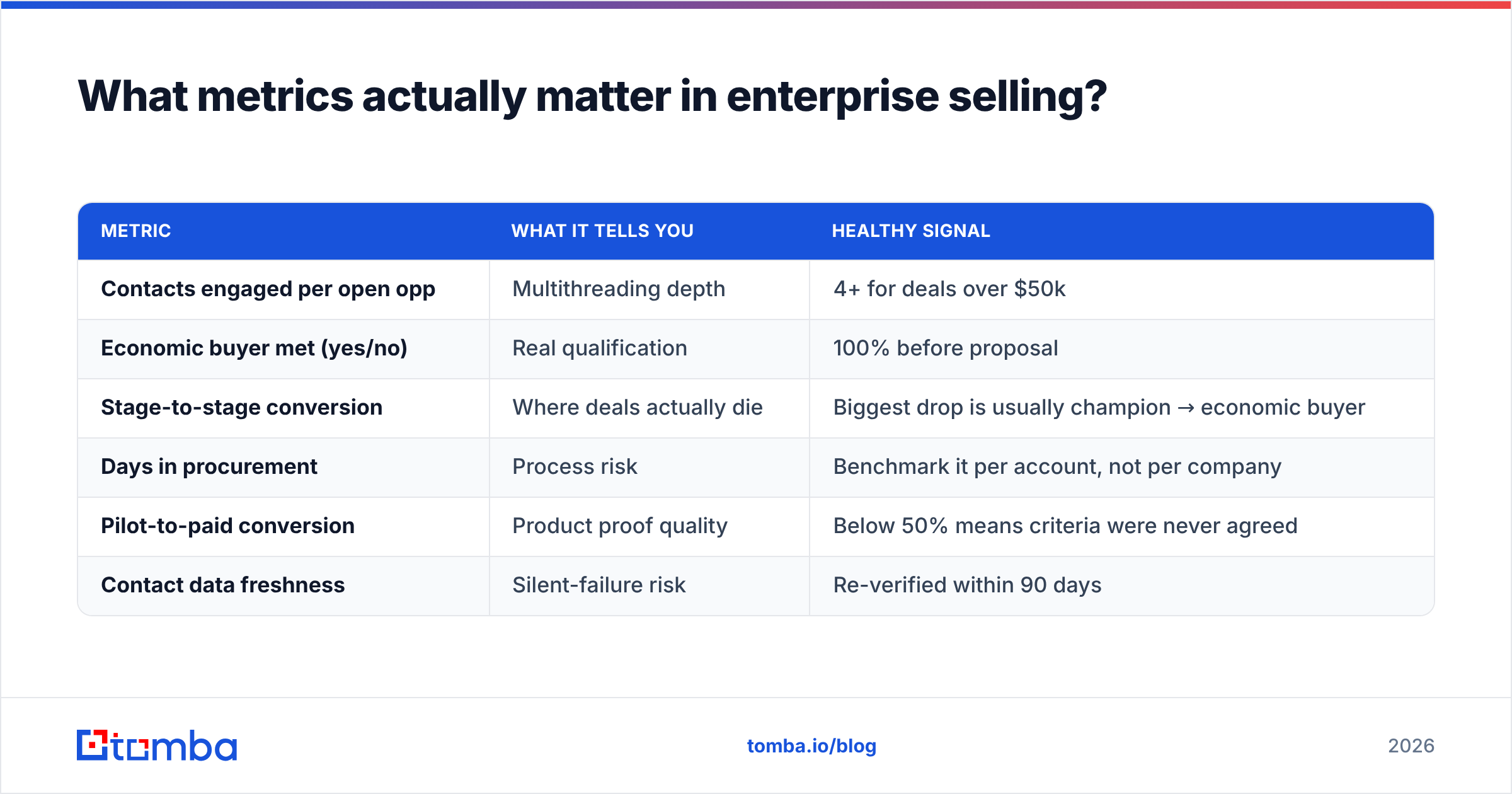
What metrics actually matter in enterprise selling?#
Volume metrics mislead at this deal size. Track coverage and progression instead.
| Metric | What it tells you | Healthy signal |
|---|---|---|
| Contacts engaged per open opp | Multithreading depth | 4+ for deals over $50k |
| Economic buyer met (yes/no) | Real qualification | 100% before proposal |
| Stage-to-stage conversion | Where deals actually die | Biggest drop is usually champion → economic buyer |
| Days in procurement | Process risk | Benchmark it per account, not per company |
| Pilot-to-paid conversion | Product proof quality | Below 50% means criteria were never agreed |
| Contact data freshness | Silent-failure risk | Re-verified within 90 days |
The best diagnostic is simple. Sort your closed-won and closed-lost deals by how many contacts you engaged. Single-threaded deals lose far more often. That one chart changes behavior faster than any training.
What are the most common enterprise selling mistakes?#
- Treating a friendly user as a champion. Enthusiasm is not internal capital. Test it with an ask.
- Discounting to speed things up. Procurement reads an unasked-for discount as proof your list price was fake. It invites another round.
- Sending the business case yourself. It has to come from inside. Write it in your champion's words, then hand over the pen.
- Ignoring the incumbent's renewal date. If that contract auto-renews in six weeks, that is your real deadline.
- Prospecting enterprise like SMB. A generic blast to 400 contacts at one account gets your domain flagged. Ten researched, verified contacts win instead.
- Letting data rot mid-cycle. Nine months is long enough for a third of the committee to move.
Building account lists at scale? Run research through a bulk email finder and verify before import. The CRM stays clean without manual work, and your forecast rests on contacts that still exist.
Where should you start?#
Pick your ten largest open deals. Fill in the six committee roles by name. Count the blanks. That number is your enterprise selling maturity score. Closing those gaps lifts win rates faster than any new method.
Then fix the data underneath. Current contact records for every committee member turn a good plan into one you can actually run. They are also the first thing to go stale in a nine-month cycle.
Start with the Tomba Email Finder to build and re-verify your committee maps by name and domain. The free tier covers 25 searches a month, so you can test it on one account first. Paid plans start at $49/mo on Starter. Growth is $99/mo for teams running several enterprise pursuits at once. Full Tomba pricing is public if you want to size it against your account load.
Related guides#
Ready to find emails that actually work?
Join 150,000+ professionals who stopped guessing and started sending. Free credits on signup — no credit card required.
Get the Tomba newsletter
Practical outbound tactics and product updates — once every two weeks.
About the author