Enterprise Software Marketing Strategy: A 2026 Playbook
Enterprise deals take 9-18 months, involve 11 stakeholders, and die quietly in procurement. Here is how to build an enterprise software marketing strategy that survives all three — with budget math, channel mix, and the data layer underneath.
TL;DR
- Enterprise software marketing is not SMB marketing with bigger logos. The unit of purchase is a committee of 6-11 people, not a buyer, and your strategy has to produce consensus, not clicks.
- Budget splits that work at $50K+ ACV: roughly 40% demand creation, 25% account-based programs, 20% product/content marketing, 15% events and field.
- Pipeline math beats channel opinions. If you need $12M in bookings at a 22% win rate and $120K ACV, you need ~455 qualified opportunities — work backwards from that, not from a channel wishlist.
- Your ABM list is only as good as your contact data. Bad emails silently cap every downstream metric, and no amount of creative fixes a 30% bounce rate.
- Measure influenced pipeline by account, not MQLs by person. Enterprise attribution is a committee problem, and person-level scoring hides it.
What is an enterprise software marketing strategy?#
An enterprise software marketing strategy is the plan for generating and progressing revenue from organizations large enough that no single person can sign the contract. That constraint drives everything else.
Think of it like selling a house to a family instead of a studio apartment to one person. The person who loves the kitchen is not the person who approves the mortgage, and the teenager who hates the neighborhood can kill the deal without ever talking to you. Enterprise software works the same way: your champion wants the product, security wants a SOC 2 report, finance wants a three-year TCO model, and legal wants a redlined MSA.
Gartner's B2B buying research has consistently found that a typical enterprise purchase involves 6-10 decision makers, each arriving with four or five independently gathered pieces of information — most of which they collected without ever contacting you. Your strategy either equips that committee to reach agreement, or it doesn't.
Technically, an enterprise strategy differs from mid-market motion on five axes:
- Deal cycle length. 6-18 months versus 14-45 days. Every program needs a payback horizon longer than a quarter, and your board reporting has to reflect that.
- Buying committee size. 6-11 stakeholders with conflicting success criteria. Content must be produced per-role, not per-persona-in-general.
- Procurement gauntlet. Security review, vendor risk assessment, legal redlines, and sometimes a formal RFP. Marketing owns the artifacts that clear these gates.
- Account concentration. 20-50 target accounts can represent most of your number. Broad-reach spend is often wasted; depth beats breadth.
- Post-sale expansion. In enterprise, 30-50% of ARR growth comes from existing accounts. Marketing keeps running after the close.
If your current plan reads like "publish more blog posts and run LinkedIn ads," it is a mid-market plan wearing an enterprise badge.
How do you size the pipeline before you pick channels?#
Start with arithmetic, not tactics. Every credible enterprise software marketing strategy begins with a pipeline model that a CFO would sign off on.
Work backwards from bookings:
- Bookings target: $12,000,000
- Average contract value: $120,000 → 100 closed-won deals needed
- Win rate from qualified opportunity: 22% → 455 qualified opportunities
- Opportunity creation from qualified account engagement: 18% → ~2,530 engaged accounts
- Marketing-sourced share: 40% → ~1,010 accounts marketing must engage
Now you have a real number to allocate against. If your total addressable list is 3,000 accounts, you need to meaningfully engage a third of it — that is an ABM problem, not a paid-search problem. If your list is 40,000 accounts, you have room for scaled demand generation.
The mistake most teams make is picking channels first and then reverse-engineering a forecast to justify them. Do it the other way around and half your budget arguments disappear.
What does the budget split actually look like?#
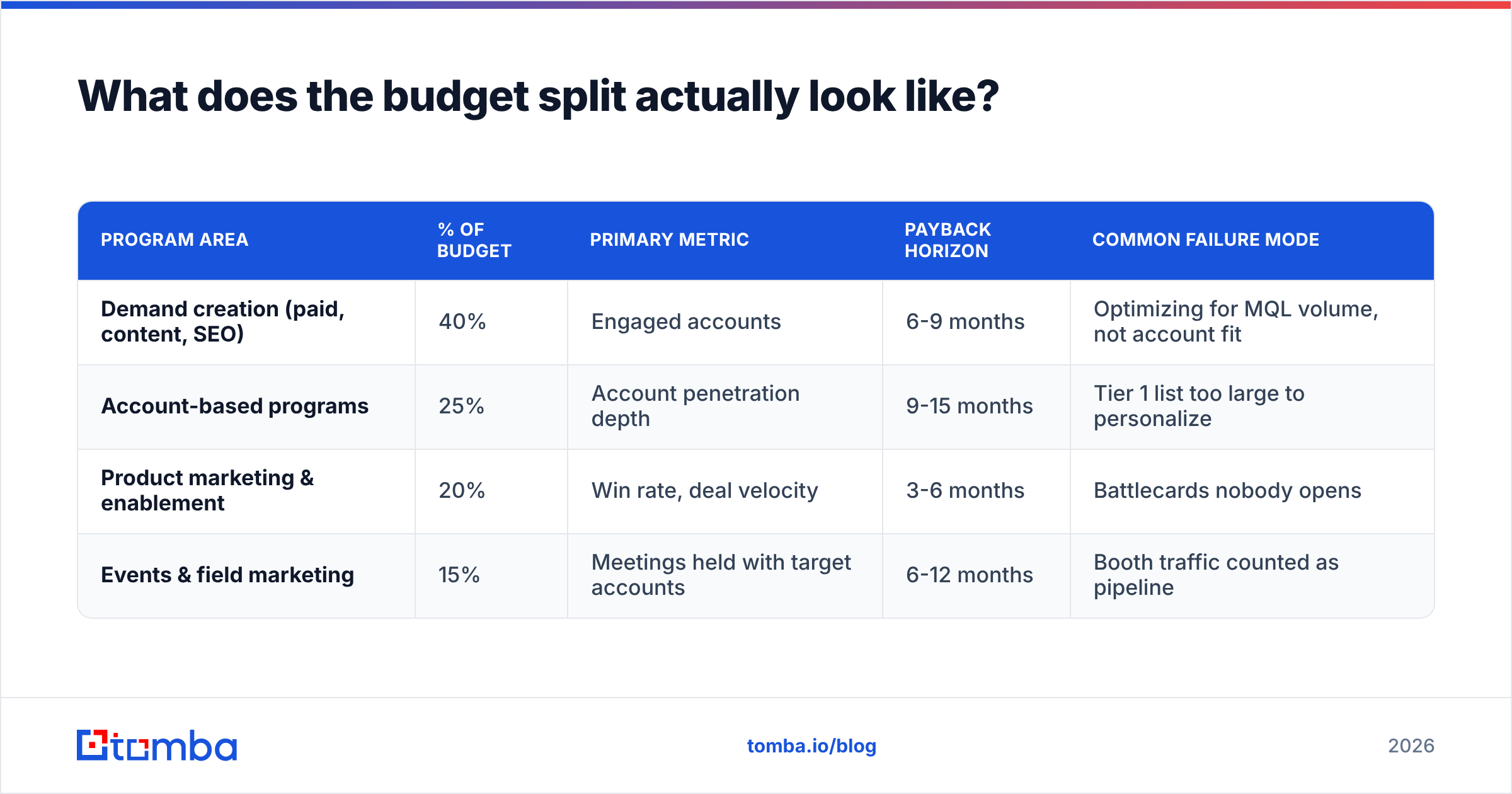
Here is a defensible starting allocation for a Series B-D enterprise software company doing $10M-$40M ARR. Adjust based on ACV and category maturity, but do not drift far without a reason.
| Program area | % of budget | Primary metric | Payback horizon | Common failure mode |
|---|---|---|---|---|
| Demand creation (paid, content, SEO) | 40% | Engaged accounts | 6-9 months | Optimizing for MQL volume, not account fit |
| Account-based programs | 25% | Account penetration depth | 9-15 months | Tier 1 list too large to personalize |
| Product marketing & enablement | 20% | Win rate, deal velocity | 3-6 months | Battlecards nobody opens |
| Events & field marketing | 15% | Meetings held with target accounts | 6-12 months | Booth traffic counted as pipeline |
Two notes on this table. First, product marketing gets 20% because in enterprise it directly moves win rate — the highest-leverage number in the model above. A 22% to 26% win rate improvement is worth more than a 15% traffic increase, and it costs less. Second, events survive at 15% because face time still closes seven-figure deals, but only when the meetings are booked before the event, not hoped for during it.
Is account-based marketing worth it at your stage?#
Yes — if your target list is small enough to personalize and your ACV is high enough to justify the cost per account. No, if you are still hunting for product-market fit across three segments.
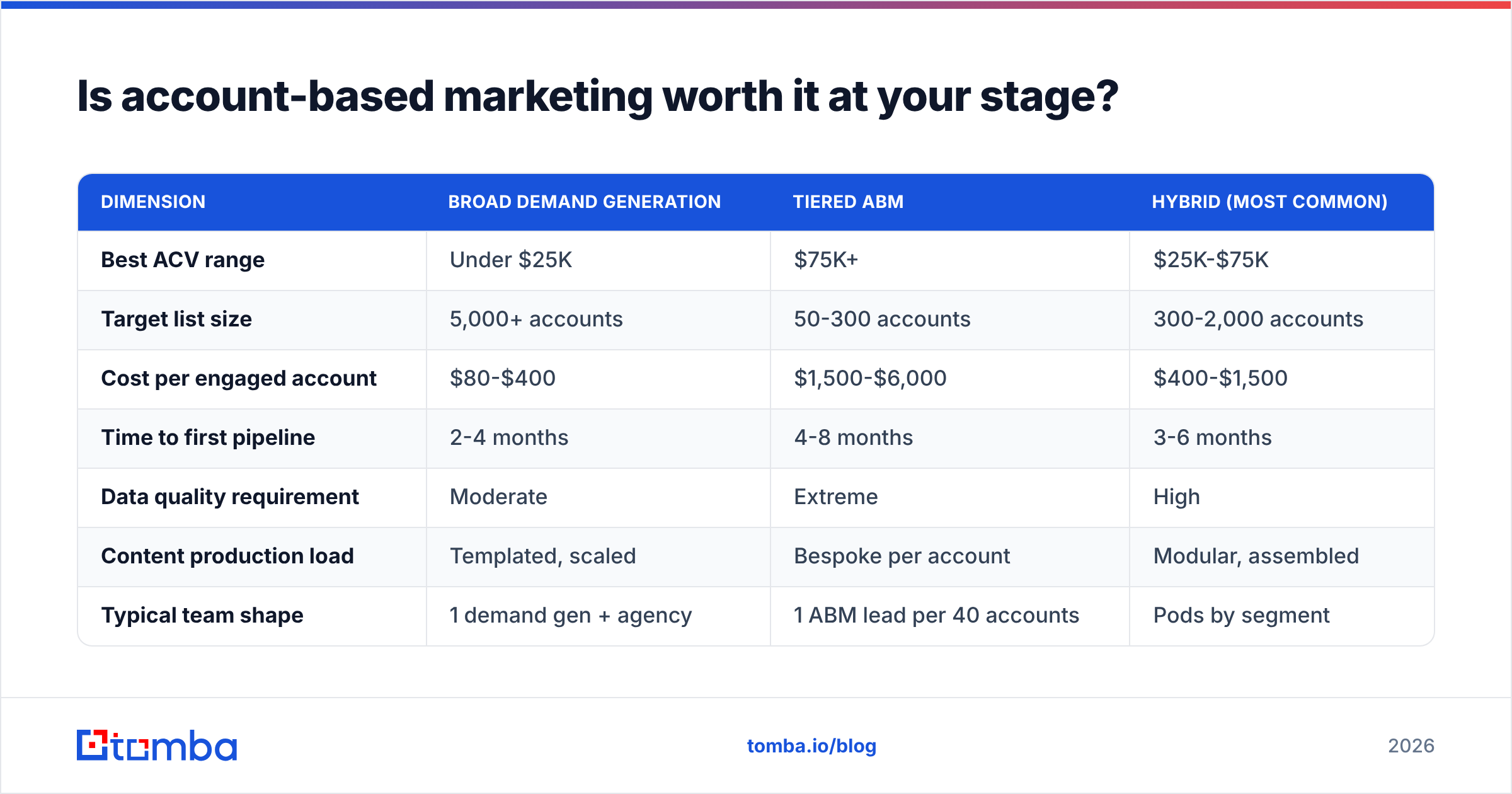
The honest comparison:
| Dimension | Broad demand generation | Tiered ABM | Hybrid (most common) |
|---|---|---|---|
| Best ACV range | Under $25K | $75K+ | $25K-$75K |
| Target list size | 5,000+ accounts | 50-300 accounts | 300-2,000 accounts |
| Cost per engaged account | $80-$400 | $1,500-$6,000 | $400-$1,500 |
| Time to first pipeline | 2-4 months | 4-8 months | 3-6 months |
| Data quality requirement | Moderate | Extreme | High |
| Content production load | Templated, scaled | Bespoke per account | Modular, assembled |
| Typical team shape | 1 demand gen + agency | 1 ABM lead per 40 accounts | Pods by segment |
Most enterprise software companies land in the hybrid column and mislabel it as ABM. That is fine, as long as the tiering is honest:
- Tier 1 (10-30 accounts): custom microsites, executive dinners, named-account research briefs. Budget $5K-$15K per account per year.
- Tier 2 (100-300 accounts): industry-specific content, targeted display, curated events. Budget $500-$2,000 per account.
- Tier 3 (1,000+ accounts): programmatic, intent-triggered nurture, webinars. Budget under $200 per account.
The tiering fails when Tier 1 grows past what your team can genuinely personalize. Thirty accounts with real research beats 200 accounts with a merge field.
Why does contact data quality decide the outcome?#
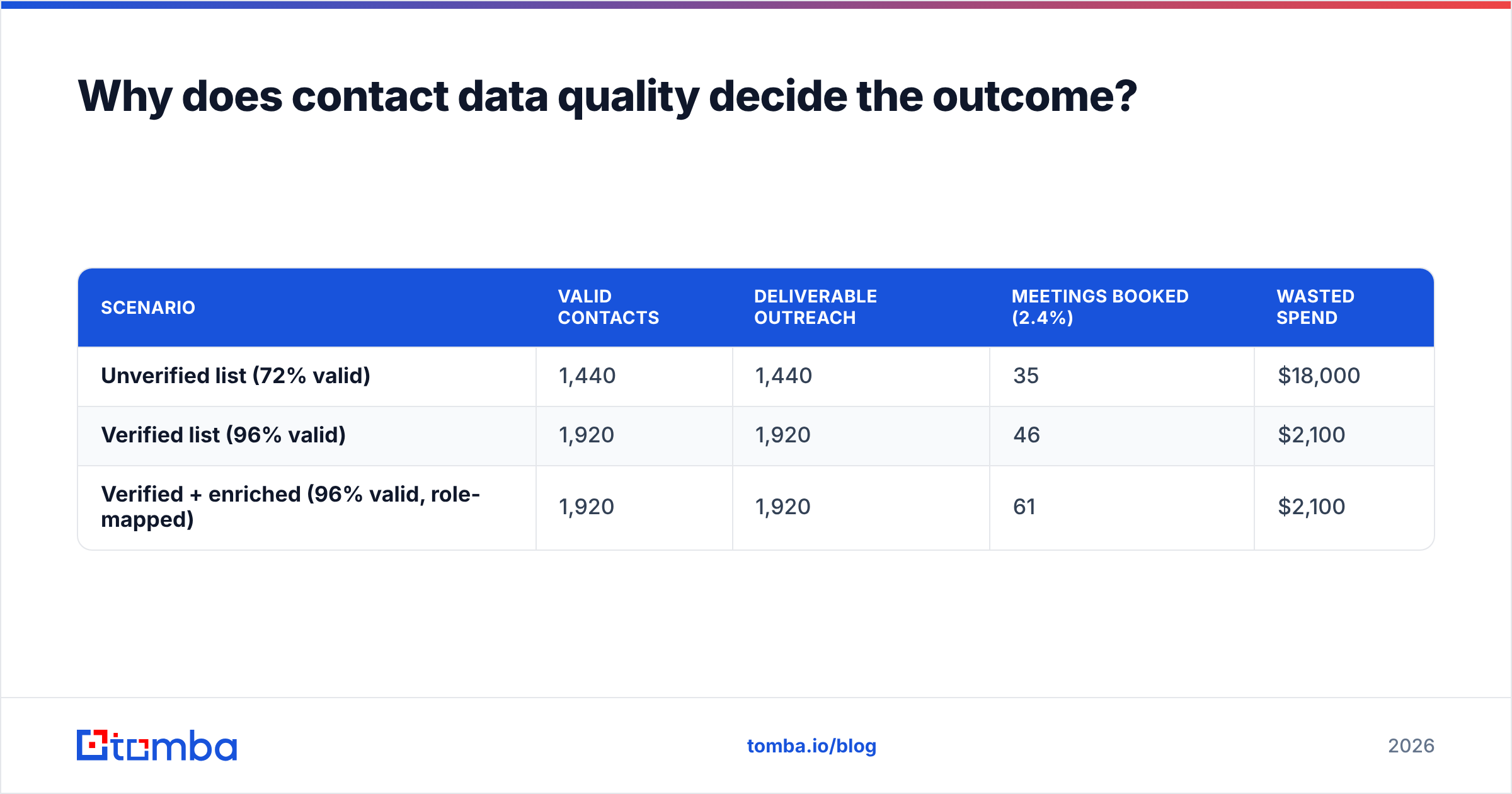
Because every enterprise program is a multiplication, and data quality is one of the terms. If 28% of your contact records are wrong, you did not lose 28% of one campaign — you lost 28% of every campaign that touches those records, plus the sender reputation damage that follows.
Run the numbers on a Tier 2 program of 250 accounts, 8 contacts each:
| Scenario | Valid contacts | Deliverable outreach | Meetings booked (2.4%) | Wasted spend |
|---|---|---|---|---|
| Unverified list (72% valid) | 1,440 | 1,440 | 35 | $18,000 |
| Verified list (96% valid) | 1,920 | 1,920 | 46 | $2,100 |
| Verified + enriched (96% valid, role-mapped) | 1,920 | 1,920 | 61 | $2,100 |
The third row is where the compounding happens. Enrichment does not just confirm that an email works — it tells you whether you are talking to the VP of Platform Engineering or a contractor with a similar title, which changes the message and the conversion rate.
Practically, this means three habits:
- Verify before every send, not once at import. B2B contact data decays 22-30% annually. A list verified in January is measurably worse by June. Run it through an email verifier as a pre-flight step, not an annual cleanup.
- Map the whole committee, not the champion. When you identify a target account, find the security lead, the finance approver, and the end-user manager too. A domain search across the account gives you the org shape in one pass instead of eight LinkedIn sessions.
- Enrich for routing, not vanity fields. Firmographic and technographic data enrichment should feed lead routing, territory assignment, and content selection. If an enriched field never changes a decision, stop collecting it.

What content does a buying committee actually need?#
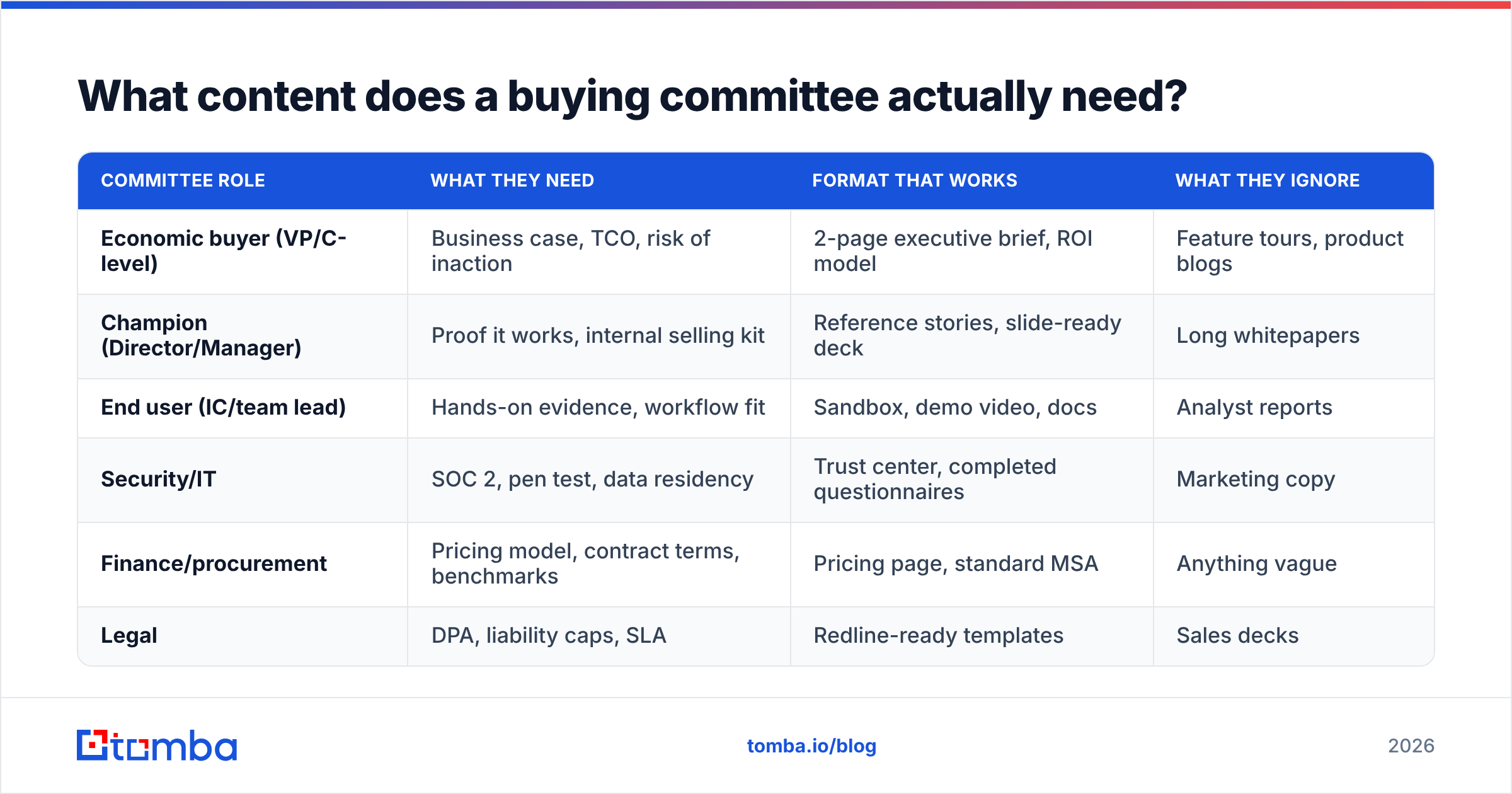
Different documents for different chairs at the table. The most common content failure in enterprise software marketing is producing one excellent piece for the champion and nothing for the six people who can veto them.
| Committee role | What they need | Format that works | What they ignore |
|---|---|---|---|
| Economic buyer (VP/C-level) | Business case, TCO, risk of inaction | 2-page executive brief, ROI model | Feature tours, product blogs |
| Champion (Director/Manager) | Proof it works, internal selling kit | Reference stories, slide-ready deck | Long whitepapers |
| End user (IC/team lead) | Hands-on evidence, workflow fit | Sandbox, demo video, docs | Analyst reports |
| Security/IT | SOC 2, pen test, data residency | Trust center, completed questionnaires | Marketing copy |
| Finance/procurement | Pricing model, contract terms, benchmarks | Pricing page, standard MSA | Anything vague |
| Legal | DPA, liability caps, SLA | Redline-ready templates | Sales decks |
The item that most often goes missing is the internal selling kit for the champion. Your champion has to sell this internally on a Tuesday afternoon to people who have never heard of you. Give them a five-slide deck, three bullet points on cost avoidance, and a one-line answer to "why not just build it?" Peer review sites like G2 are useful here too — champions cite third-party validation because their own advocacy is discounted internally.
How do you measure enterprise marketing without lying to yourself?#
Switch the unit of measurement from person to account, and from sourced to influenced.
MQL counts are actively misleading in enterprise. If eleven people from one target account download a whitepaper, that is one buying signal, not eleven leads. Person-level scoring will happily route eleven records to eleven SDRs and call it a good week.
Use these instead:
- Account engagement score — weighted signal across all known contacts at an account, decayed over time. Rising scores predict opportunity creation far better than individual lead scores.
- Committee coverage — what percentage of the expected buying roles do you have verified contacts for? An open opportunity with two known contacts is materially riskier than one with seven.
- Influenced pipeline by account — total opportunity value where any marketing touch occurred within the account, not just the person on the opp record.
- Stage velocity — days in each stage, segmented by whether marketing content was consumed. This is where product marketing proves its 20% budget line.
- Win rate by committee coverage tier — the correlation is usually strong enough to reset how the whole team prioritizes.
Report these monthly to the exec team and quarterly to the board. The HubSpot marketing blog has good primers on attribution modeling if you need to bring finance along on the methodology.
What breaks first when you scale this?#
Three predictable failure points, in the order they usually appear.
The list outgrows the data. You expand from 200 target accounts to 1,200, and nobody re-checks whether the new 1,000 have accurate contacts. Bounce rates climb, your sending domain reputation drops, and suddenly the emails that used to land in Tier 1 inboxes stop landing anywhere. Build verification into the pipeline itself — the Tomba API exists precisely so this becomes a workflow step instead of a quarterly panic.
Personalization becomes a merge field. Tier 1 treatment gets applied to Tier 2 volume, and the "personalized" microsite is a template with a logo swap. Buyers notice immediately. Shrink Tier 1 rather than dilute it.
Sales and marketing disagree about what "qualified" means. In enterprise this is expensive, because a rejected account can sit untouched for six months. Write the definition down, include committee coverage as a criterion, and review rejections weekly for the first quarter.
What should you do in the first 90 days?#
If you are building or rebuilding the strategy from scratch:
- Days 1-15: Build the pipeline model. Get finance to agree on ACV, win rate, and cycle length assumptions. Do not skip this.
- Days 16-35: Define and score the target account list. Tier it honestly. Verify contact data across every Tier 1 and Tier 2 account before a single campaign launches.
- Days 36-60: Audit content against the committee table above. You will find gaps in the security, finance, and champion-enablement rows. Fill those before producing anything new.
- Days 61-90: Launch one Tier 1 program and one Tier 3 program simultaneously. The contrast teaches you more about your market in a quarter than a year of mid-tier hedging.
Review Forrester's B2B research if you need external benchmarks to calibrate against, but do not let benchmarking replace your own pipeline math. Your ACV and cycle length are the only numbers that matter for your plan.
Where does the data layer fit?#
Underneath all of it. Committee mapping, ABM tiering, routing, verification, and expansion targeting all depend on knowing who works at your target accounts and how to reach them accurately.
That is the job the Tomba Email Finder does well: give it a target company domain and the names or roles you need, and it returns verified professional email addresses with confidence scores, so your Tier 1 list is a real list instead of a spreadsheet of guesses. Pair it with bulk verification before each send, and the multiplication problem from earlier stops eating your budget.
You can test the accuracy on your own account list with the free tier at 25 searches per month, and Tomba pricing starts at $49/mo for Starter, $99/mo for Growth, and $249/mo for Pro when you need volume across a few hundred target accounts. Run your existing Tier 1 list through it and compare the bounce rate against your last quarter — that single test usually settles the argument about whether data quality is worth a line item.
Related guides#
Ready to find emails that actually work?
Join 150,000+ professionals who stopped guessing and started sending. Free credits on signup — no credit card required.
Get the Tomba newsletter
Practical outbound tactics and product updates — once every two weeks.
About the author