Enterprise Software Sales: The 2026 Playbook That Closes
Enterprise software deals die in procurement, not in the demo. Here is the stage-by-stage anatomy of a 2026 enterprise sales cycle — buying committees, security review, pilot traps, and the metrics that actually predict close.
TL;DR
- Enterprise software sales means selling a multi-year, multi-seat contract to an organization where 6–11 people must agree and no single person can say yes alone.
- The average enterprise cycle runs 6–18 months. Most of that time is not selling — it is security review, legal redlines, procurement, and internal budget defense you never see.
- Deals are lost in the middle, not the demo. The single highest-leverage artifact is a mutual action plan co-owned with your champion.
- Pipeline math is brutal: at a 20% win rate and $180K ACV, a $3M quota needs roughly $15M of qualified pipeline. That starts with accurate contact data, not more activity.
- Track multi-threading depth, stage-to-stage conversion, and time-in-stage. Ignore raw activity counts — they predict nothing at this deal size.
What is enterprise software sales?#
Enterprise software sales is the practice of selling high-value software contracts — typically $50K to $5M+ in annual contract value — to large organizations through a consultative, multi-stakeholder, multi-month process.
Here is the everyday analogy. Selling SMB software is like selling someone a laptop: one person, one card, one afternoon. Enterprise software sales is like getting a city to approve a new bridge. The engineer wants it, the budget office questions it, the safety inspector must sign off, the mayor takes the political risk, and the whole thing goes to a public vote. Your job is not to convince one person the bridge is good. It is to help the engineer win the vote when you are not in the room.
Technically: you are selling into a buying committee with formal procurement, security and legal gates, and a documented business case that must survive scrutiny from people who have never met you.
Three structural things separate enterprise from everything else:
- No single decision-maker. Gartner's research on the B2B buying journey puts the typical buying group at six to ten stakeholders, each arriving with four or five independently researched pieces of information. Consensus, not persuasion, is the bottleneck.
- Compliance is a real gate. SOC 2, ISO 27001, penetration test results, data residency, subprocessor lists, DPAs. A 40-page security questionnaire can add six weeks on its own.
- Budget is annual and contested. Your deal is not competing against a rival vendor half the time. It is competing against a warehouse robotics project and a headcount request.
Why do enterprise deals take 6 to 18 months?#
Because the actual selling is maybe 20% of the calendar. The rest is organizational process you can influence but not control.
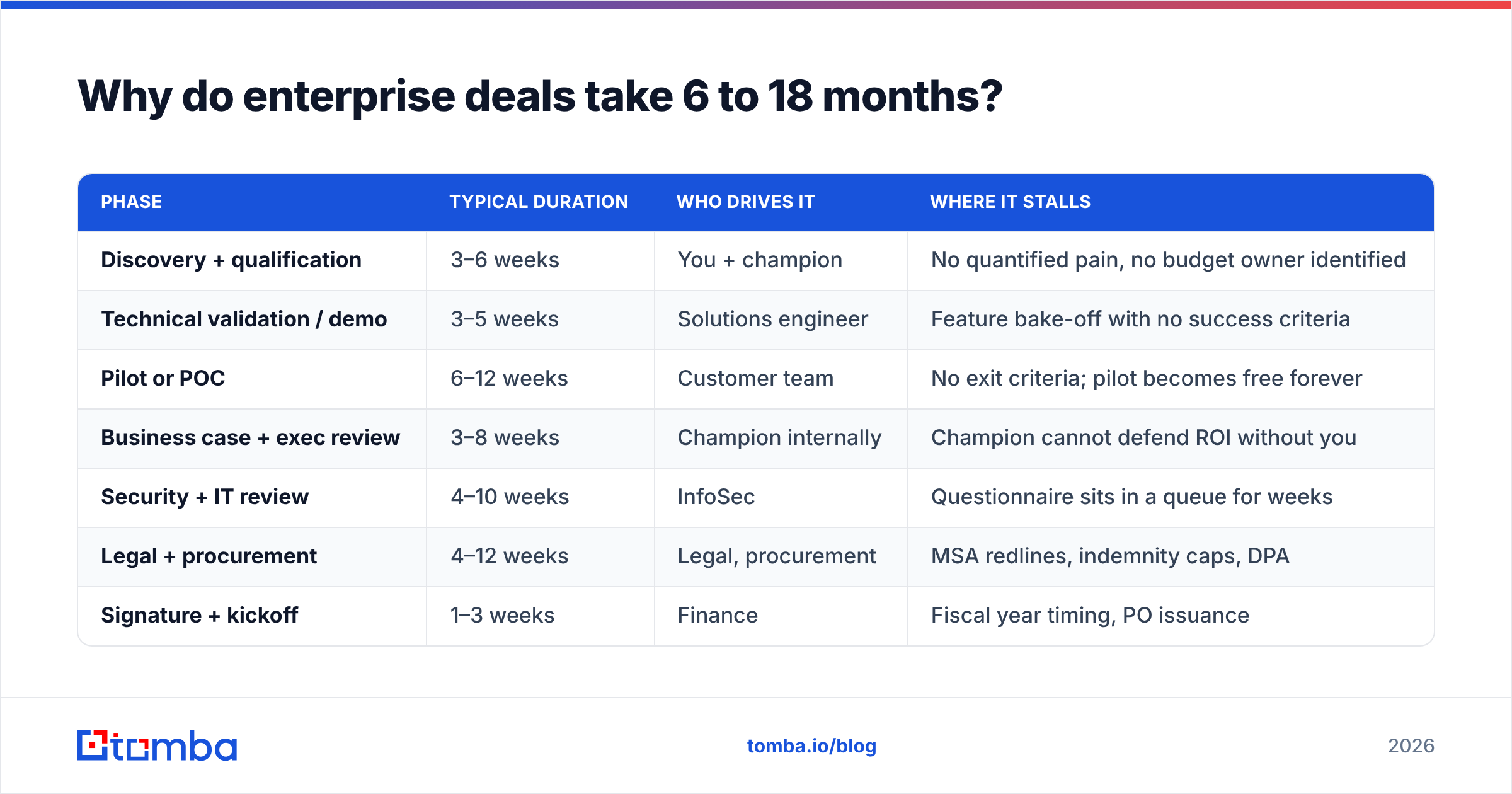
A realistic breakdown of where a 9-month cycle goes:
| Phase | Typical duration | Who drives it | Where it stalls |
|---|---|---|---|
| Discovery + qualification | 3–6 weeks | You + champion | No quantified pain, no budget owner identified |
| Technical validation / demo | 3–5 weeks | Solutions engineer | Feature bake-off with no success criteria |
| Pilot or POC | 6–12 weeks | Customer team | No exit criteria; pilot becomes free forever |
| Business case + exec review | 3–8 weeks | Champion internally | Champion cannot defend ROI without you |
| Security + IT review | 4–10 weeks | InfoSec | Questionnaire sits in a queue for weeks |
| Legal + procurement | 4–12 weeks | Legal, procurement | MSA redlines, indemnity caps, DPA |
| Signature + kickoff | 1–3 weeks | Finance | Fiscal year timing, PO issuance |
The lesson is not "be patient." It is that every one of those rows has an owner who is not your champion, and each one can be started earlier than you think. Sending the security questionnaire to InfoSec in week 4 instead of week 24 is worth more than any objection-handling script.
Who actually decides in an enterprise deal?#
Nobody, individually. That is the point. Map the committee by role, not by title:
- Champion — feels the pain daily, has internal credibility, will spend political capital. Test this: ask them to set up a meeting with someone senior. If they cannot or will not, they are a coach, not a champion.
- Economic buyer — controls the budget line. Usually a VP or C-level who will spend 25 minutes on your deal total. Your job is to make those 25 minutes decisive.
- Technical evaluator — IT architect, security lead, or platform owner. They cannot approve the purchase but they can absolutely kill it.
- End users — the people whose workflow changes. If they hate the tool during a pilot, adoption risk becomes the objection you never overcome.
- Procurement — paid to reduce your price and extend your terms. Engage them early on process, late on price.
- Legal / compliance — DPAs, data residency, liability caps. Non-negotiable and non-emotional.
Rule of thumb: if you have fewer than three real relationships inside an account by the pilot stage, you are single-threaded and your forecast is fiction. Champions get promoted, laid off, and reorganized. Roughly one in five enterprise deals loses its champion mid-cycle. Multi-threading is not a nice-to-have — it is deal insurance.
How does enterprise compare to mid-market and SMB sales?#
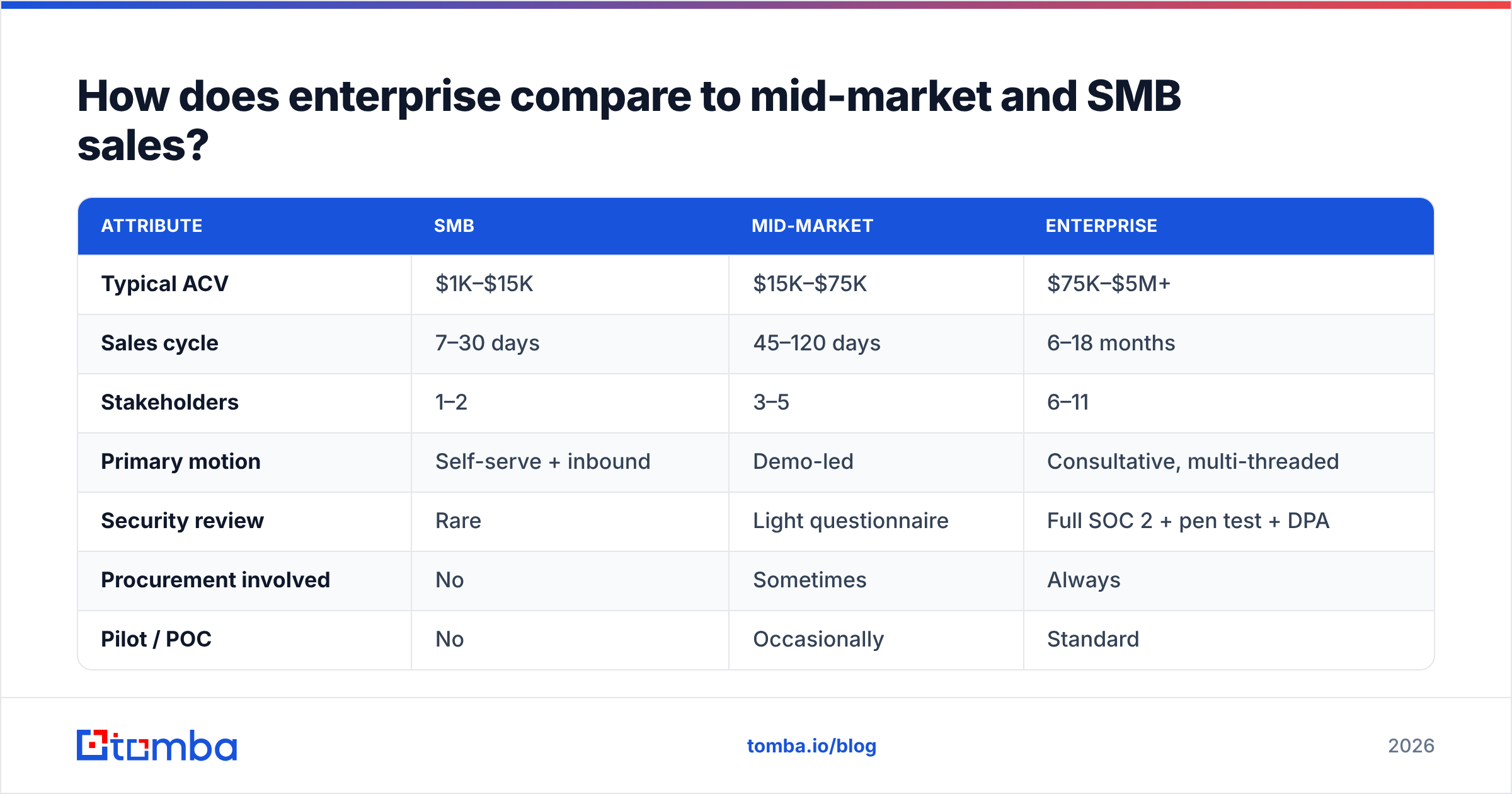
The motions are not the same job with a bigger number attached. They are different jobs.
| Attribute | SMB | Mid-market | Enterprise |
|---|---|---|---|
| Typical ACV | $1K–$15K | $15K–$75K | $75K–$5M+ |
| Sales cycle | 7–30 days | 45–120 days | 6–18 months |
| Stakeholders | 1–2 | 3–5 | 6–11 |
| Primary motion | Self-serve + inbound | Demo-led | Consultative, multi-threaded |
| Security review | Rare | Light questionnaire | Full SOC 2 + pen test + DPA |
| Procurement involved | No | Sometimes | Always |
| Pilot / POC | No | Occasionally | Standard |
| Rep quota | $400K–$700K | $700K–$1.2M | $1M–$3M |
| Deals needed per year | 80–200 | 20–40 | 4–12 |
| Cost of a lost deal | Low | Moderate | Severe — quarters of work |
Notice the last two rows. An enterprise rep closing eight deals a year cannot afford a bad quarter of prospecting. That is why data quality matters far more here than in high-volume outbound: you get fewer swings, so every swing must be at a real target with a real contact.
How do you build enterprise pipeline that does not evaporate?#
Start with account selection, not activity. In enterprise, targeting is 60% of outcome.
Step 1 — Build a real ICP, not a firmographic sketch. Go back through your last 20 closed-won deals and find what they share beyond industry and headcount: a specific tech stack, a compliance trigger, a funding event, a new VP hire in the buying department. Those triggers are the difference between a cold sequence and a timely one.
Step 2 — Build the account map before the first touch. For each target account, name the six committee roles above with actual humans. This is where most teams quietly fail: they have a company list, not a people list. Use domain search to pull the verified contact structure of an account so you can see who exists in the org, then layer titles and reporting lines from LinkedIn.
Step 3 — Verify before you send. Enterprise domains are the worst offenders for catch-all configurations, which is exactly why so many "delivered" emails vanish. Run addresses through an email verifier before a sequence touches your primary domain. A 12% bounce rate on a 200-account enterprise list is not a deliverability inconvenience — it is your sender reputation and your only shot at those accounts.
Step 4 — Enrich for context, not for volume. Phone, LinkedIn, tenure, and prior employer matter more than another email address. Contact enrichment that tells you the new CISO came from a company that already runs your category is a warm opener; a raw email is not.
Step 5 — Sequence to the committee, not the persona. The CFO gets a cost-of-inaction message. The technical evaluator gets an architecture note. The end-user manager gets a workflow story. Same account, three different first lines, sent within the same two-week window so your name reaches the room from three directions.
What actually moves an enterprise deal forward?#
Four artifacts, in order of leverage.
The mutual action plan. A shared, dated, two-column document listing every remaining step to go-live, who owns each one, and the target date. It is the single best predictor of close in enterprise sales because building it forces the buyer to reveal their real process — including the approval step they forgot to mention. If a buyer refuses to build one with you, they are not buying this quarter.
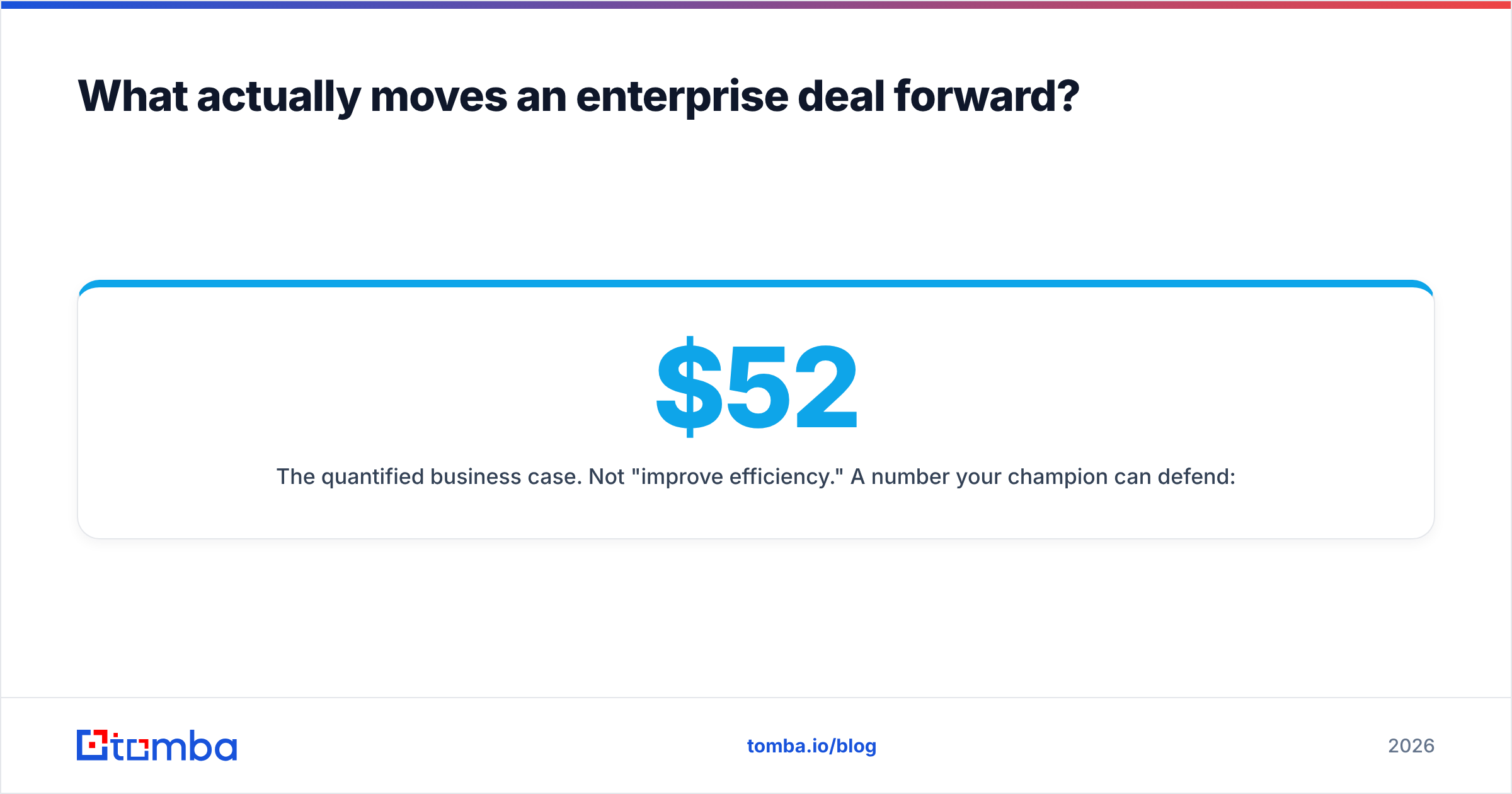
The quantified business case. Not "improve efficiency." A number your champion can defend: "3,200 hours of manual research per year at a $52 loaded rate is $166K; the platform costs $84K." Build it with the customer's numbers, in their spreadsheet, so they own it.
Pilot exit criteria signed up front. Before the POC starts, agree in writing: what will be measured, by whom, over how long, and what happens if it succeeds. Pilots without exit criteria do not end — they become a permanent free tier that your champion has no reason to convert.
Early compliance packet. Ship your SOC 2 report, pen test summary, subprocessor list, and standard DPA to the security contact the week technical validation starts. You cannot make InfoSec faster, but you can make them start sooner.
Which metrics predict enterprise revenue?#
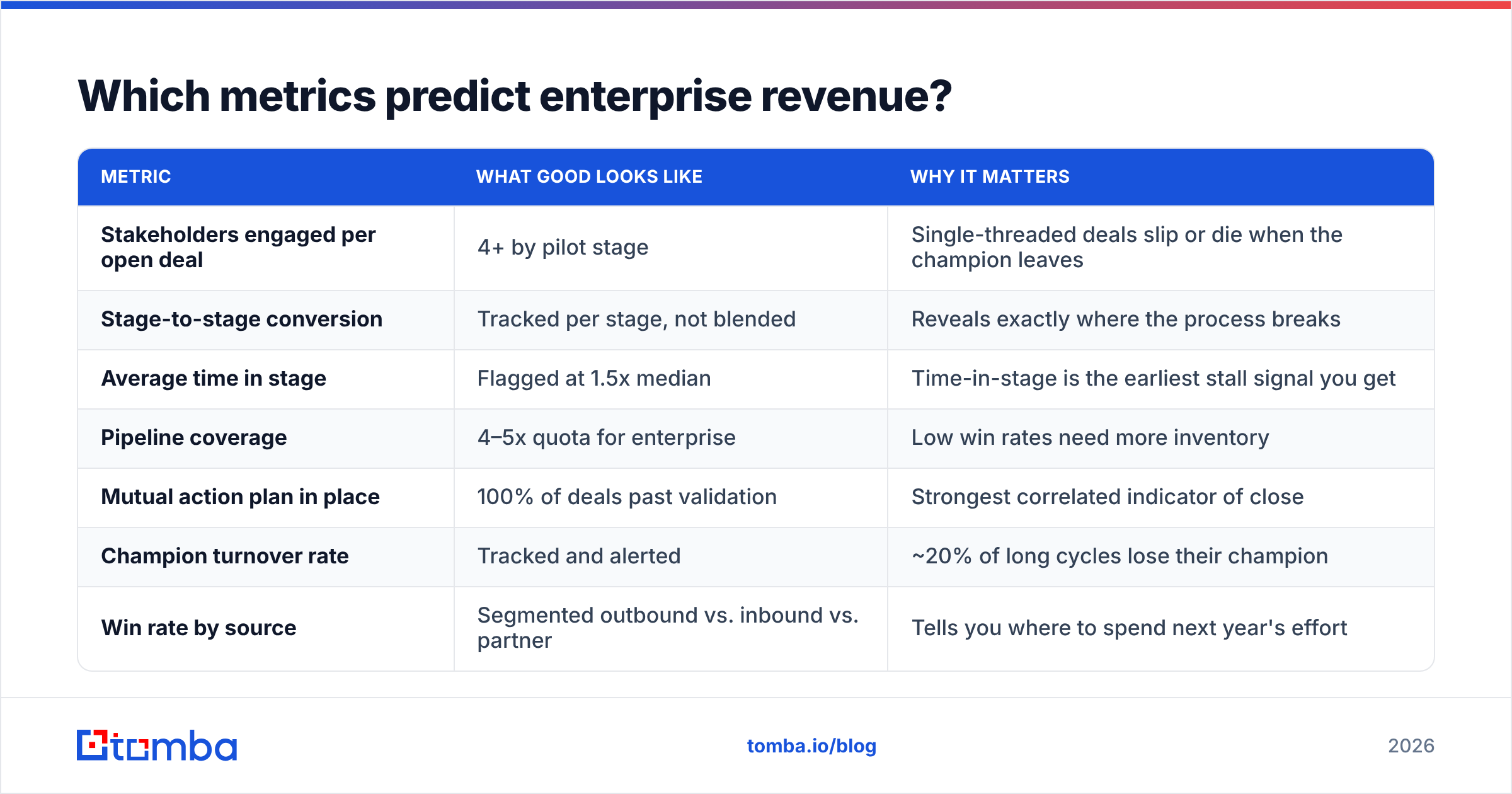
Activity metrics lie at this deal size. Twelve calls a day is meaningless if all twelve are to a single-threaded account with no budget.
| Metric | What good looks like | Why it matters |
|---|---|---|
| Stakeholders engaged per open deal | 4+ by pilot stage | Single-threaded deals slip or die when the champion leaves |
| Stage-to-stage conversion | Tracked per stage, not blended | Reveals exactly where the process breaks |
| Average time in stage | Flagged at 1.5x median | Time-in-stage is the earliest stall signal you get |
| Pipeline coverage | 4–5x quota for enterprise | Low win rates need more inventory |
| Mutual action plan in place | 100% of deals past validation | Strongest correlated indicator of close |
| Champion turnover rate | Tracked and alerted | ~20% of long cycles lose their champion |
| Win rate by source | Segmented outbound vs. inbound vs. partner | Tells you where to spend next year's effort |
If your CRM cannot answer "how many distinct contacts have we engaged in this account in the last 30 days," that is the first reporting gap to fix. Everything else in the CRM is secondary to multi-threading visibility.
What are the most expensive mistakes in enterprise software sales?#
Selling to the champion instead of arming them. Your champion presents your deal internally without you. If they cannot explain the ROI in two sentences, you have not equipped them — you have entertained them.
Discounting to accelerate. A 20% discount for a quarter-end signature teaches procurement that waiting is profitable, and it prices your next three renewals. Trade concessions instead: multi-year term, case study rights, expanded scope, faster payment terms.
Treating procurement as an obstacle. Procurement wants a defensible process, not a bloodbath. Ask for their process and timeline in week one and they will often tell you exactly what will hold the deal up in month six.
Confusing interest with intent. A well-attended demo is not a buying signal. Budget confirmed, a named executive sponsor, a documented compliance path, and a date-bound plan are buying signals. HubSpot's ongoing sales research has made the same point for years: buyers self-educate long before they engage, so engagement volume is a lagging indicator, not a leading one.
Skipping the data foundation. Reps burning ten hours a week hunting contact details are not doing enterprise selling, they are doing manual research. Push that to tooling — bulk lead generation and an API-driven workflow — and give the hours back to account planning. Compare vendor options on a neutral source like G2's sales intelligence category rather than vendor claims.
What does a modern enterprise sales stack look like in 2026?#
Consolidation is the trend. Most teams run four layers: CRM as the system of record, a contact data layer, an engagement layer, and a revenue intelligence layer. What changed recently is that the data layer became the constraint — AI-assisted sequencing made outreach cheap, which means the only remaining differentiator is whether you reach the right person at all.
Practically: a fifty-rep enterprise org should be spending less on sequence volume and more on making sure the 400 accounts that matter are mapped completely and accurately. That is a data spend, not a tooling spend.
For teams building that layer, Tomba pricing starts free at 25 searches per month, with Starter at $49/mo, Growth at $99/mo, and Pro at $249/mo — which makes it realistic to test contact coverage against your actual target account list before committing to an annual data contract. Run twenty of your named accounts through it, count how many committee members you can actually reach, and let that number decide.
Where should you start?#
Pick your top twenty target accounts. For each, name the champion, the economic buyer, the technical evaluator, and the procurement contact. If you cannot fill in three of the four, you do not have an account plan — you have a wish.
Fill those gaps with the Tomba Email Finder: search by domain or by name and company, verify each address before it enters a sequence, and build the full committee map instead of a single point of contact who might leave in month five. Free tier gets you 25 searches to test coverage on your own accounts — enough to know within an afternoon whether your enterprise pipeline problem is a messaging problem or a data problem.
Related guides#
Ready to find emails that actually work?
Join 150,000+ professionals who stopped guessing and started sending. Free credits on signup — no credit card required.
Get the Tomba newsletter
Practical outbound tactics and product updates — once every two weeks.
About the author