Ethical Data Collection in B2B: The 2026 Compliance Guide
Buying B2B contact data without asking where it came from is now a legal and revenue risk. Here is how ethical data collection actually works in 2026 — the laws, the sourcing methods, and the vendor questions that expose a bad list.
TL;DR
- Ethical data collection means you can answer three questions about every contact record: where it came from, what legal basis you hold it under, and how fast you can delete it. If any answer is "the vendor won't say," you own the risk.
- GDPR does not ban B2B prospecting. It requires a lawful basis, a source disclosure, and a working opt-out. Most fines in this space come from missing records, not from cold email itself.
- Scraped-and-resold lists, "500M contacts for $99" datasets, and browser extensions that silently harvest your own inbox are the three sourcing models most likely to burn you.
- A defensible stack looks like this: public professional data plus pattern-based discovery, real-time verification instead of stale stockpiles, and per-record source attribution you can export.
- Run the 10-question vendor audit at the end of this post before you renew any data contract in 2026.
What is ethical data collection?#
Ethical data collection is the practice of gathering contact and company data in ways a reasonable person — and a regulator — would accept if you explained the whole process out loud. That is the working test. If describing your sourcing to a prospect on a discovery call would embarrass you, it is not ethical, whatever the terms of service say.
Think of it like sourcing ingredients for a restaurant. You can buy the cheapest bulk meat with no paperwork and it will still cook. But when an inspector asks for the supply chain, "I bought it from a guy" is not an answer, and one bad batch closes the kitchen. Data works the same way. The record performs fine right up until someone asks where it came from.
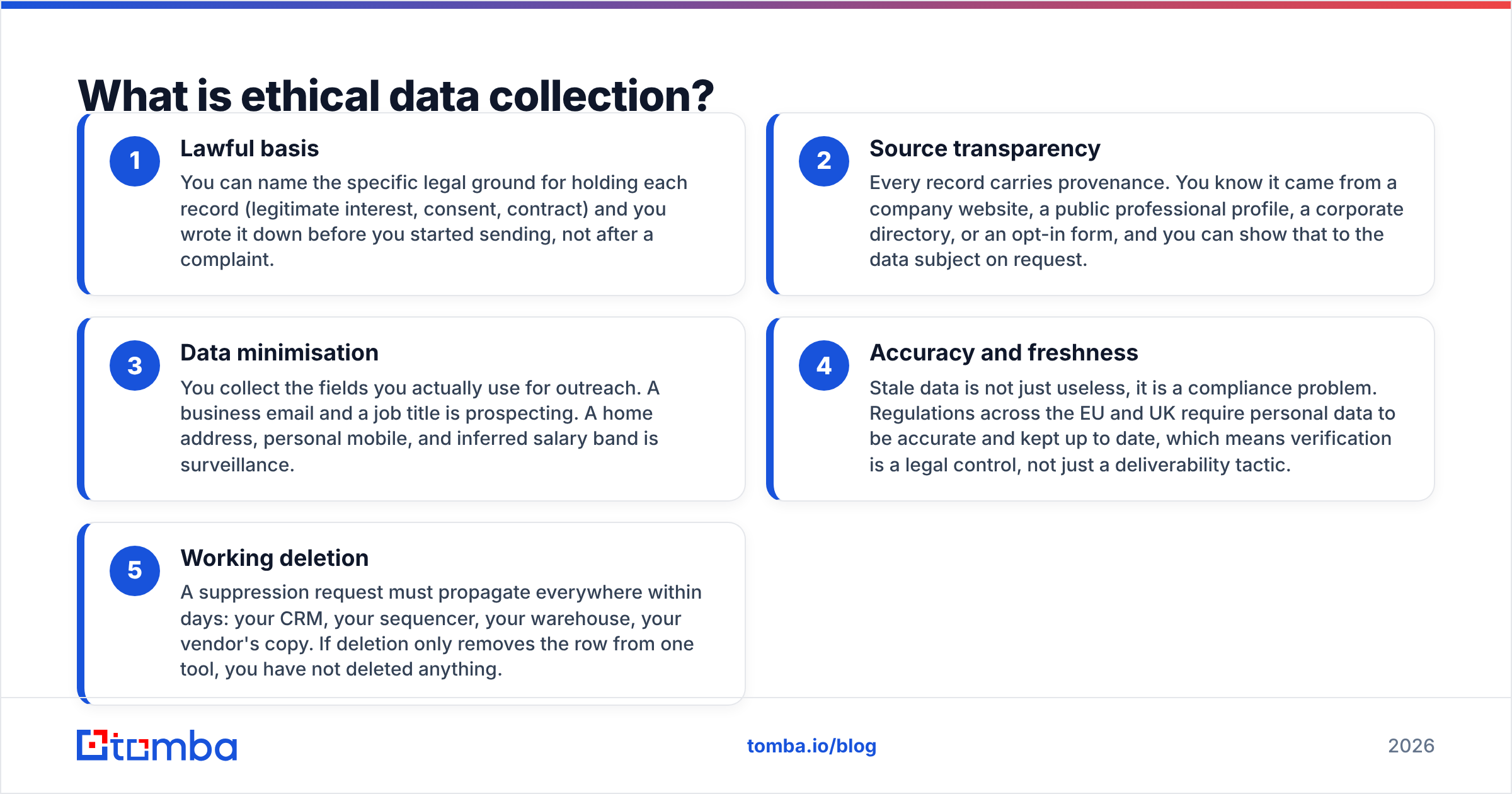
In practical terms, ethical data collection in B2B rests on five pillars:
- Lawful basis — You can name the specific legal ground for holding each record (legitimate interest, consent, contract) and you wrote it down before you started sending, not after a complaint.
- Source transparency — Every record carries provenance. You know it came from a company website, a public professional profile, a corporate directory, or an opt-in form, and you can show that to the data subject on request.
- Data minimisation — You collect the fields you actually use for outreach. A business email and a job title is prospecting. A home address, personal mobile, and inferred salary band is surveillance.
- Accuracy and freshness — Stale data is not just useless, it is a compliance problem. Regulations across the EU and UK require personal data to be accurate and kept up to date, which means verification is a legal control, not just a deliverability tactic.
- Working deletion — A suppression request must propagate everywhere within days: your CRM, your sequencer, your warehouse, your vendor's copy. If deletion only removes the row from one tool, you have not deleted anything.
Miss any one of these and the other four stop protecting you. Provenance without deletion is a paper trail of a violation.
Which laws actually govern B2B contact data in 2026?#
Short answer: it depends entirely on where your recipient sits, not where your company sits. That is the part most outbound teams get wrong. A US startup emailing a prospect in Munich is inside the GDPR's territorial scope.
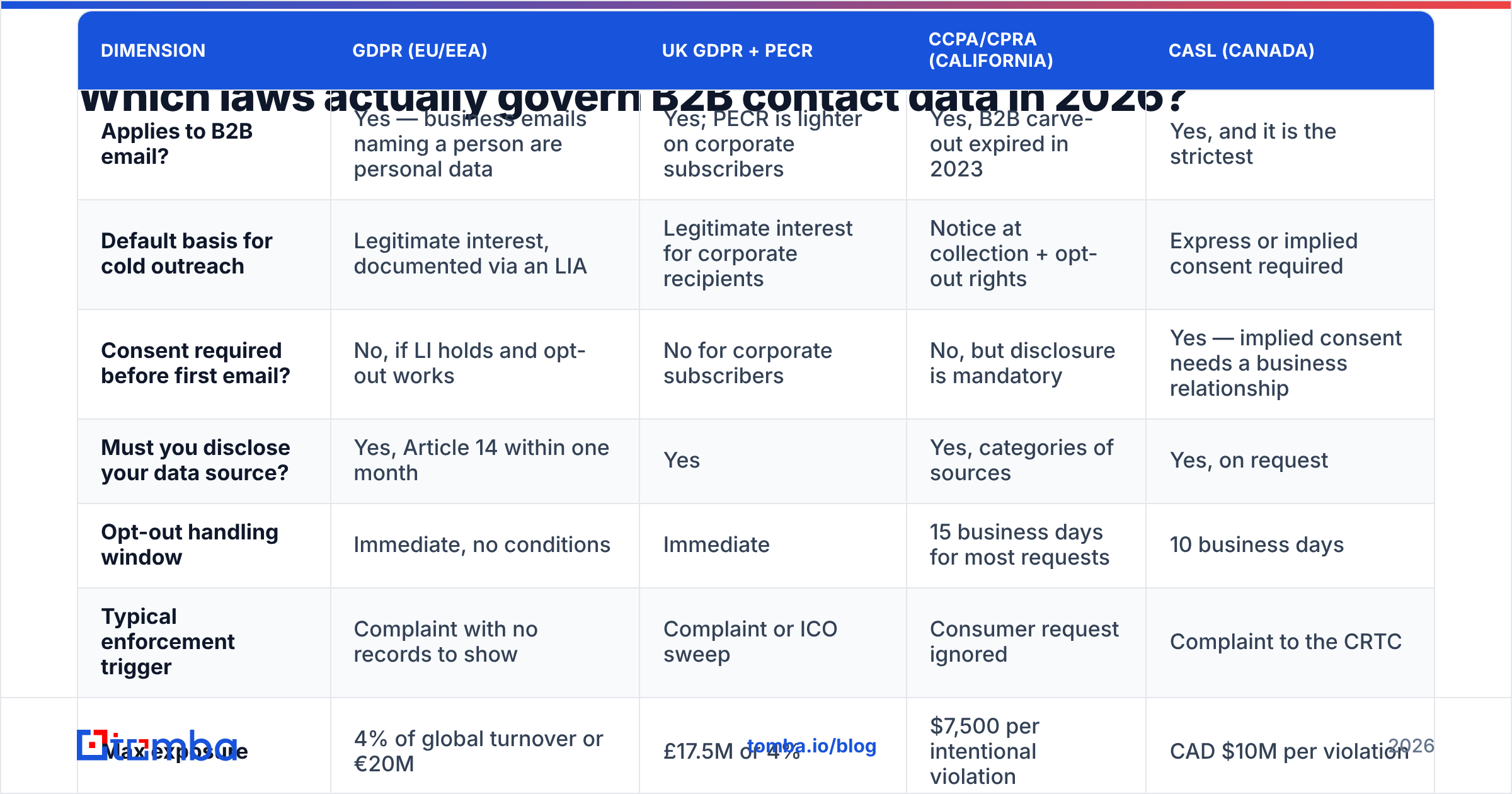
Here is how the four regimes that cover most B2B outreach compare.
| Dimension | GDPR (EU/EEA) | UK GDPR + PECR | CCPA/CPRA (California) | CASL (Canada) |
|---|---|---|---|---|
| Applies to B2B email? | Yes — business emails naming a person are personal data | Yes; PECR is lighter on corporate subscribers | Yes, B2B carve-out expired in 2023 | Yes, and it is the strictest |
| Default basis for cold outreach | Legitimate interest, documented via an LIA | Legitimate interest for corporate recipients | Notice at collection + opt-out rights | Express or implied consent required |
| Consent required before first email? | No, if LI holds and opt-out works | No for corporate subscribers | No, but disclosure is mandatory | Yes — implied consent needs a business relationship |
| Must you disclose your data source? | Yes, Article 14 within one month | Yes | Yes, categories of sources | Yes, on request |
| Opt-out handling window | Immediate, no conditions | Immediate | 15 business days for most requests | 10 business days |
| Typical enforcement trigger | Complaint with no records to show | Complaint or ICO sweep | Consumer request ignored | Complaint to the CRTC |
| Max exposure | 4% of global turnover or €20M | £17.5M or 4% | $7,500 per intentional violation | CAD $10M per violation |
Two takeaways. First, cold email is legal in most of these jurisdictions — the GDPR text itself explicitly recognises direct marketing as a possible legitimate interest in Recital 47. Second, what actually gets teams fined is the paperwork gap: no legitimate interest assessment, no source record, no functioning suppression list. The UK's Information Commissioner's Office publishes enforcement actions that follow this pattern almost every quarter.
Canada is the exception worth memorising. CASL flips the default to consent, and "we found your email on your company website" only counts if the address was published without a statement refusing unsolicited mail and your message relates to their role. Build a separate sending policy for Canadian domains or exclude them.

Where does B2B contact data actually come from?#
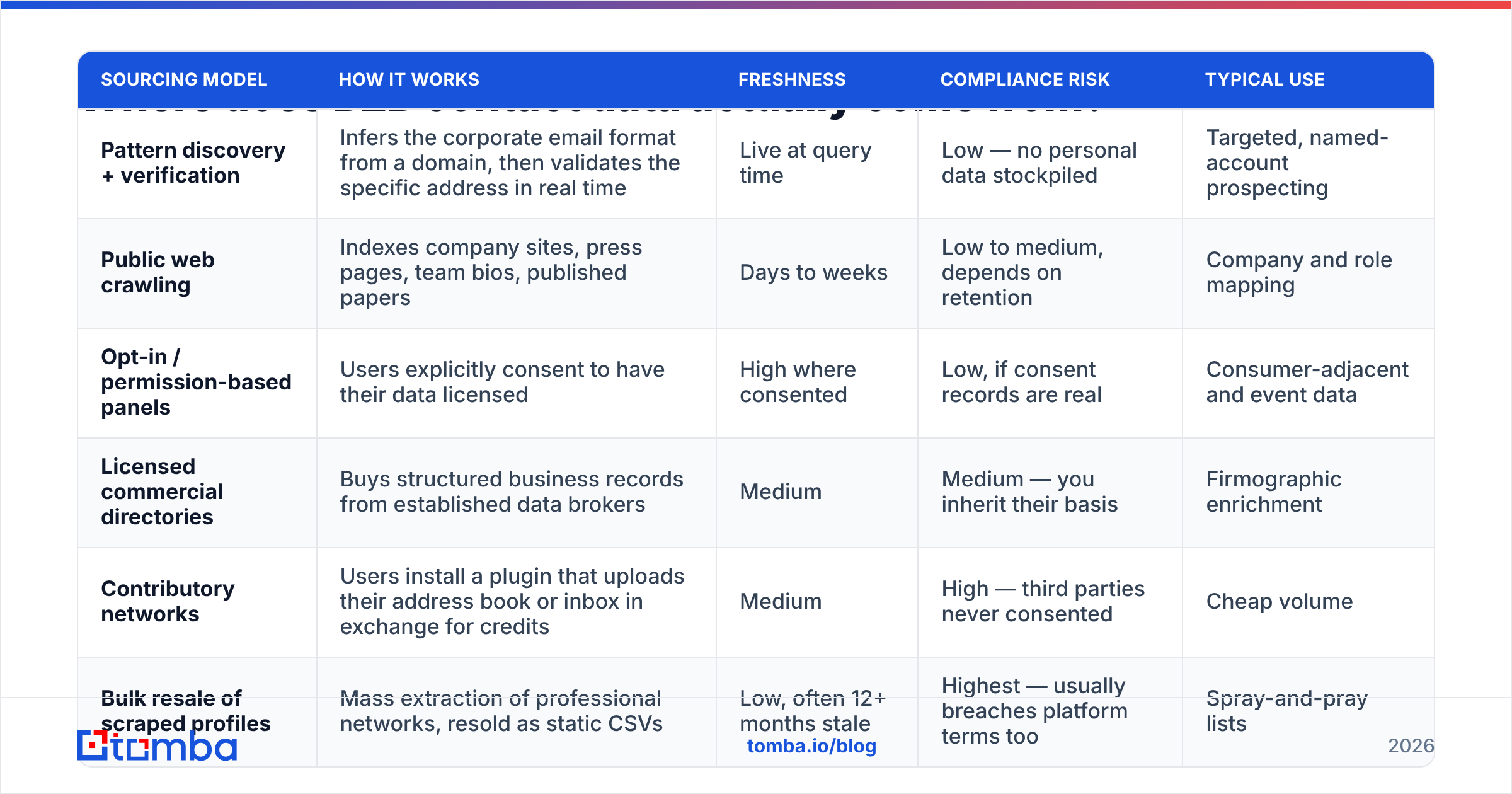
Every vendor says "public sources and proprietary data." That phrase means nothing. There are really six sourcing models in this market, and they carry wildly different risk profiles.
| Sourcing model | How it works | Freshness | Compliance risk | Typical use |
|---|---|---|---|---|
| Pattern discovery + verification | Infers the corporate email format from a domain, then validates the specific address in real time | Live at query time | Low — no personal data stockpiled | Targeted, named-account prospecting |
| Public web crawling | Indexes company sites, press pages, team bios, published papers | Days to weeks | Low to medium, depends on retention | Company and role mapping |
| Opt-in / permission-based panels | Users explicitly consent to have their data licensed | High where consented | Low, if consent records are real | Consumer-adjacent and event data |
| Licensed commercial directories | Buys structured business records from established data brokers | Medium | Medium — you inherit their basis | Firmographic enrichment |
| Contributory networks | Users install a plugin that uploads their address book or inbox in exchange for credits | Medium | High — third parties never consented | Cheap volume |
| Bulk resale of scraped profiles | Mass extraction of professional networks, resold as static CSVs | Low, often 12+ months stale | Highest — usually breaches platform terms too | Spray-and-pray lists |
The last two rows deserve the scrutiny. Contributory networks are the model where a rep installs an extension, grants inbox access, and thereby "contributes" every contact they have ever emailed — including people who never heard of that vendor. Legally, the contact never consented and cannot be notified, which fails Article 14 on day one. Commercially, it means your own customer list may already be sitting inside a competitor's database.
Bulk scraped resale has a second problem beyond legality: decay. B2B contact data goes stale at roughly 25 to 30 percent per year through job changes alone, so a two-year-old static file is closer to half-fiction. That is why the sourcing question and the accuracy question are the same question. A provider that publishes where its data comes from is making a checkable claim; a provider that says "proprietary" is asking you to absorb their risk.
Not every list vendor is a problem, either. Established providers like BookYourData built their business on verified, documented B2B records with clear opt-out handling, and they are a reasonable fit when you need pre-built lists rather than on-demand lookups. The distinction that matters is not "list vendor vs API" — it is whether provenance and suppression are auditable.
How do you audit a data vendor before you sign?#
Send these ten questions to your account rep in writing. Written answers matter more than the answers themselves, because a written answer is a contractual representation and an evasive one is a signal.
- What are the named categories of sources for the records I will receive? "Public and licensed" is a non-answer. You want: company websites, corporate directories, public professional profiles, licensed partner X.
- Do you operate a contributory or extension-based collection model? If yes, can I opt my own contacts out of contribution?
- Can you provide per-record source attribution on export? Some can, at the field level. Most cannot. Know which you are buying.
- Who is the controller and who is the processor in our arrangement? Get the DPA and read the Annexes, not the marketing page.
- How do you handle an Article 14 notification obligation? If the answer is "that's on you," price that work in — it is real.
- What is your suppression propagation SLA? Ask for the number in business days and get it in the contract.
- How often is each record re-verified, and what does your verification actually test? SMTP-level checks, catch-all handling, and role-account flagging are different capabilities.
- Do you sell or license data about EU or UK data subjects, and under what basis? Look for a documented legitimate interest assessment, not a shrug.
- What happens to my search history and uploaded lists? Some tools train shared models on your inputs. Read the retention clause.
- Can I get a sample of 50 records with sources attached, before signing? Real vendors say yes.
If a vendor cannot survive ten questions, they will not survive a regulator's twelve.
What does compliant enrichment look like day to day?#
The compliant workflow is not slower than the sloppy one. It is just ordered differently: you find fewer records, you check them harder, and you keep the receipts.
Start from an account list, not a contact dump. Pick the 300 companies that match your ICP. That constraint is what makes legitimate interest defensible — you are contacting people whose job function is directly relevant to what you sell, which is exactly the balancing test regulators apply.
Resolve contacts on demand, not in bulk. Query a domain search for the roles you need at each account instead of downloading a hundred thousand rows you will never touch. Data you never held is data you never have to protect, disclose, or delete. This is data minimisation doing real work rather than sitting in a policy document.
Verify before send, every time. Run every address through an email verifier at the moment of use, not at the moment of purchase. This kills two birds: bounce rates stay under the 2% threshold that keeps your sender reputation intact, and your "accuracy" obligation gets satisfied continuously rather than annually. If a domain is catch-all, treat it as unconfirmed and route it to a lower-volume, higher-personalisation track.
Attach provenance at the row level. Add two columns to your CRM: source_type and sourced_at. It costs one mapping in your data enrichment sync and turns an unanswerable subject access request into a two-minute lookup.
Include the source line in the email. One sentence — "I found you through your team page at Acme" — does three things at once. It satisfies transparency, it lifts reply rates because it proves you did not blast a list, and it makes your own team think twice before sourcing something they would not want to write down.
Wire suppression to the top of the stack. An unsubscribe must write back to the source of truth that feeds every sequence, not just to the sequencer that received it. Test this quarterly with a seed address. Most teams that think they handle suppression correctly discover a second copy of the contact somewhere.
Is legitimate interest enough for cold outreach?#
Usually, in the EU and UK, for B2B, if you actually do the assessment. The legitimate interest assessment is three short paragraphs: the purpose test (why are you processing), the necessity test (is there a less intrusive route to the same outcome), and the balancing test (would this person reasonably expect a work email about this topic).
A VP of Engineering at a 400-person SaaS company receiving one relevant, well-targeted email about developer tooling passes that test comfortably. The same person receiving the eighth automated follow-up about a product unrelated to their role does not — and the failure is in the targeting, not the sourcing. This is the uncomfortable part of the ethics conversation: volume and relevance are compliance variables. A team sending 200 sharply targeted emails a day is on far firmer ground than one sending 5,000 generic ones from the same list.
California is the different animal. The CPRA removed the B2B exemption, so your California contacts have full access, deletion, and opt-out rights. The state's Attorney General guidance on CCPA is readable in fifteen minutes and worth the time. Practically: publish a notice at collection, honour deletion requests within 45 days, and do not sell data you sourced for your own outreach.
What are the red flags in a data vendor's pitch?#
- Contact counts that outrun the addressable market. There are not 700 million verifiable business email addresses with current job titles. Enormous numbers usually mean permutations presented as verified records.
- No published data-sources page. Providers confident in their pipeline document it.
- Verification bundled invisibly into the finder. If you cannot see the confidence score and the check type behind each result, you cannot triage.
- Free unlimited plans with no rate limits. Someone is paying, and the currency is usually your contact graph.
- Refusal to sign a DPA or a DPA with no sub-processor list.
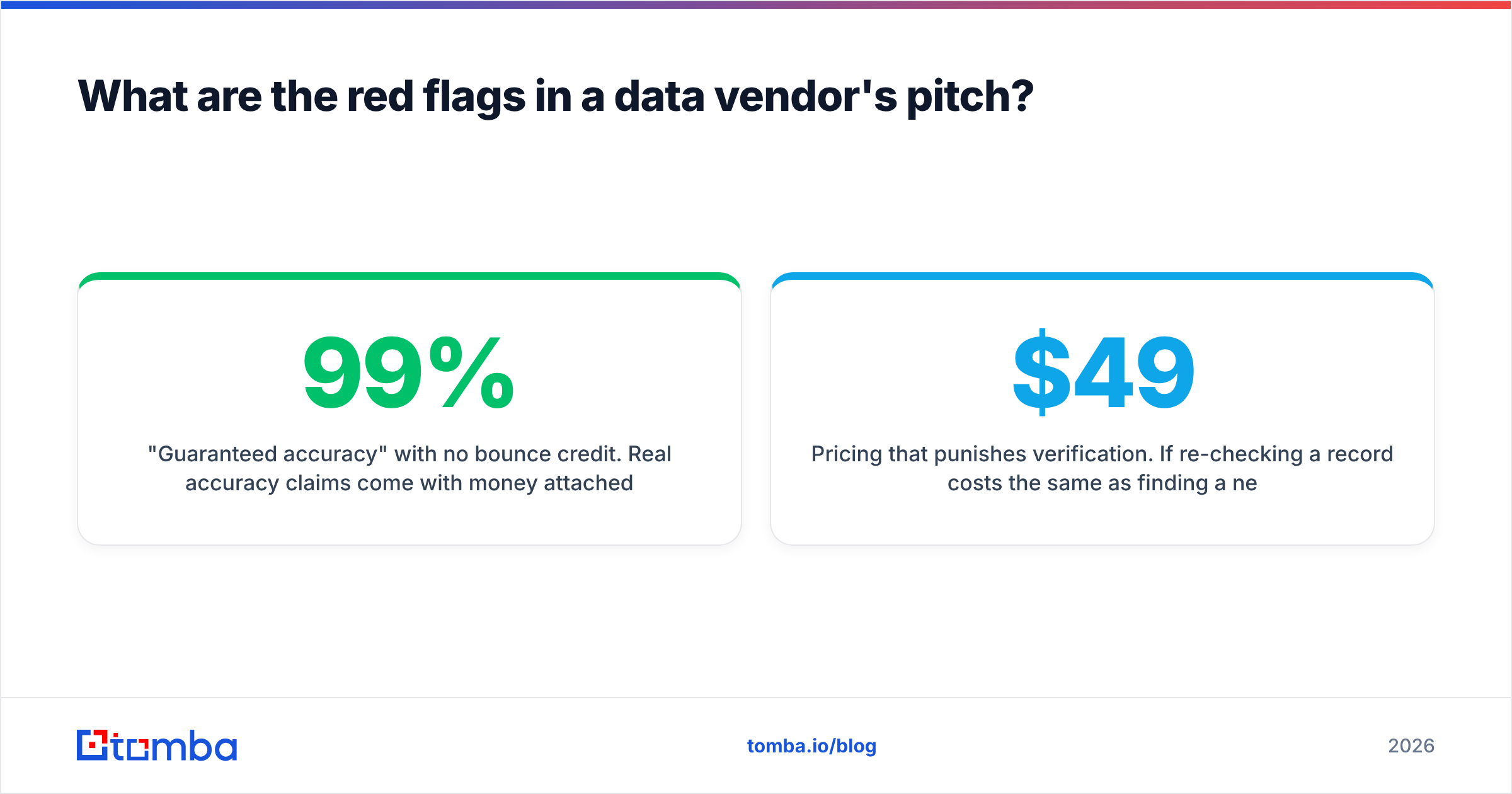
- "Guaranteed 99% accuracy" with no bounce credit. Real accuracy claims come with money attached. Check independent reviews on G2 rather than the vendor's own case studies.
- Pricing that punishes verification. If re-checking a record costs the same as finding a new one, the pricing model is quietly encouraging you to send to stale data. Compare that against transparent per-credit Tomba pricing — Free at 25 searches a month, Starter at $49/mo, Growth at $99/mo, Pro at $249/mo — where verification and discovery sit in the same predictable budget.
Where should you start this quarter?#
Pick one: audit your current vendor with the ten questions, or run a provenance check on the last 1,000 contacts you imported. Both take an afternoon. Both will tell you more about your actual risk than any policy document you could write.
Then fix the pipeline so the next thousand records arrive clean. If you want discovery that resolves addresses from public professional sources with documented provenance and real-time verification instead of a warehouse of aging CSVs, start with the Tomba Email Finder — the free tier gives you 25 searches a month, enough to test both the match rate and the paper trail before you commit a budget to anyone.
Related guides#
Ready to find emails that actually work?
Join 150,000+ professionals who stopped guessing and started sending. Free credits on signup — no credit card required.
Get the Tomba newsletter
Practical outbound tactics and product updates — once every two weeks.
About the author