EvaluAgent Pricing, Reviews, Pros and Cons: 2026 Buyer Guide
EvaluAgent quotes are per-agent and rarely published in full. Here is what teams actually pay in 2026, what reviewers praise, where the hidden costs sit, and when a cheaper QA stack wins.
This guide sets out EvaluAgent pricing, reviews, pros and cons in plain language. You get the real per-agent costs, the add-ons that inflate a quote, what users praise, and the cases where a cheaper QA tool wins.
TL;DR
- EvaluAgent is a quality assurance and coaching platform for contact centers. It sells per agent, per month. Most real quotes arrive after a demo, not off a public price list.
- Reported 2026 pricing sits near $20–$35 per agent/month for core QA. It rises to $40–$65 per agent/month once AI auto-scoring and coaching are switched on. Expect an annual term and a seat minimum.
- Reviewers praise the scorecard builder, the coaching and gamification layer, and fast support. The repeat complaints are rigid reporting, setup effort, and integration limits on smaller CCaaS platforms.
- The costs that surprise buyers are not the licence. Watch implementation fees, seat minimums, per-integration charges, and QA seats you pay for but do not staff.
- If your problem is reaching the right people, QA software is the wrong line item. Fix your contact data first.
What is EvaluAgent, and who actually buys it?#
EvaluAgent is a quality assurance and performance platform for contact centers. You pipe in conversations from your telephony, CCaaS, helpdesk, or CRM system. You score them against scorecards you build. The results then feed coaching sessions, agent dashboards, and league tables. The EvaluAgent product competes with Scorebuddy, MaestroQA, Playvox, and Zendesk QA (formerly Klaus).
The typical buyer is a QA manager or head of customer operations. The team runs 50–500 seats and has outgrown spreadsheets. The trigger is nearly always the same: a compliance miss, an audit, or a CSAT drop nobody could explain. QA was sampling two percent of calls by hand.
That buyer profile matters for pricing. Per-agent pricing punishes two groups. Very small teams cannot hit the seat minimum. Very large teams find that a cheap per-agent rate times 400 agents is a six-figure line item.
How much does EvaluAgent cost in 2026?#
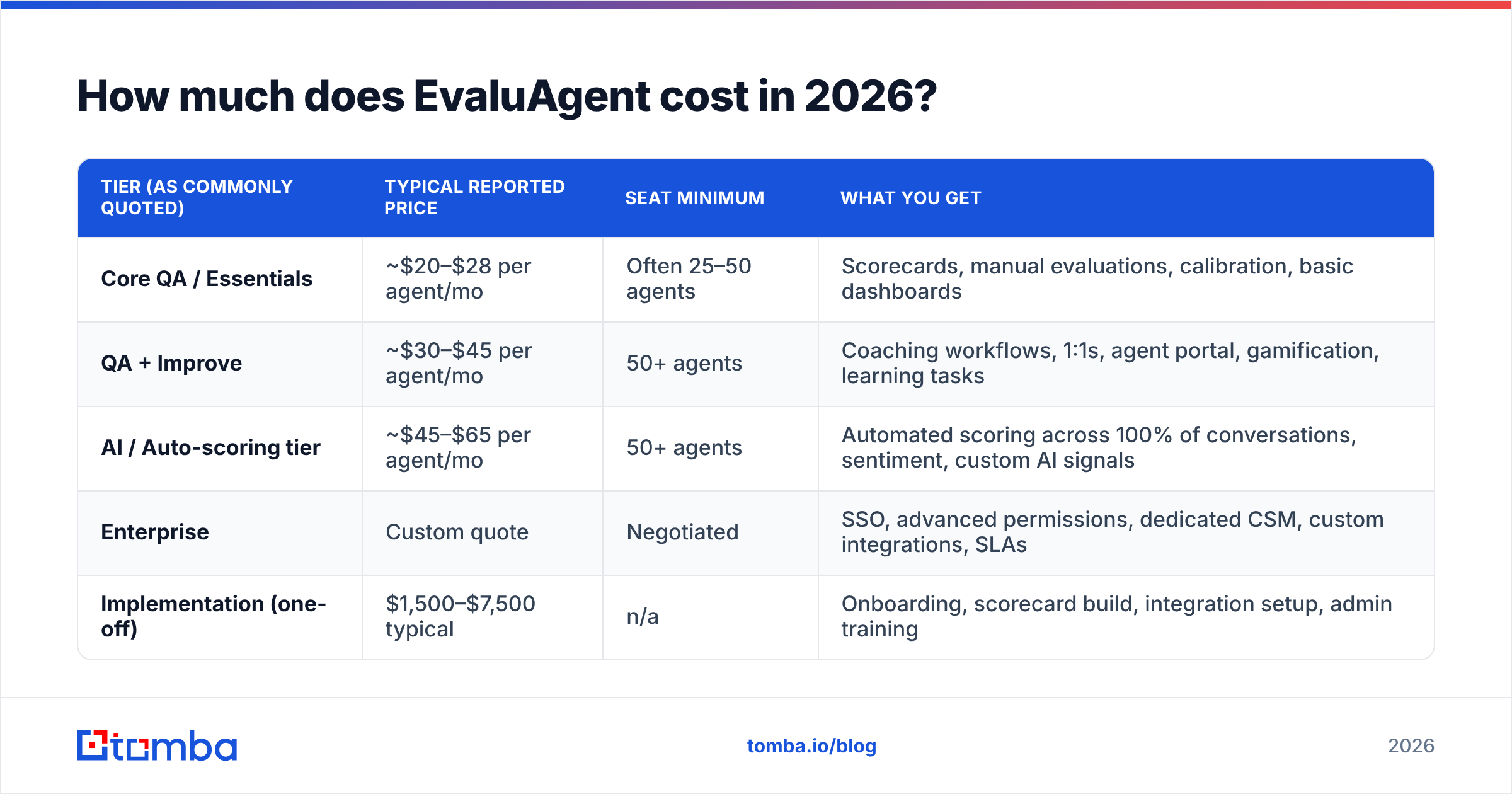
EvaluAgent does not publish a full self-serve price list. That is normal in this category, and it is why the question gets searched so often. The ranges below come from buyers and review sites, not official rate cards. Treat them as negotiation anchors. Confirm your number in writing.
| Tier (as commonly quoted) | Typical reported price | Seat minimum | What you get |
|---|---|---|---|
| Core QA / Essentials | ~$20–$28 per agent/mo | 25–50 agents | Scorecards, manual reviews, calibration |
| QA + Improve | ~$30–$45 per agent/mo | 50+ agents | Coaching, 1:1s, agent portal, gamification |
| AI / Auto-scoring tier | ~$45–$65 per agent/mo | 50+ agents | Auto-scoring of all calls, sentiment |
| Enterprise | Custom quote | Negotiated | SSO, permissions, dedicated CSM, SLAs |
| Implementation (one-off) | $1,500–$7,500 typical | n/a | Onboarding, scorecard build, training |
Two structural things drive that spread more than the tier label does:
- Contracted term. Annual prepay usually costs 15–25% less than monthly. Multi-year saves more, but you lose flexibility in year two.
- AI coverage. Auto-scoring every conversation is the headline feature. It is also the biggest price multiplier. Some contracts price it by conversation volume instead of per agent. That changes the math for high-volume, short-call teams.

What drives your final EvaluAgent quote?#
The quote you get depends on six inputs. Know all six before the first call. You will negotiate from a stronger position.
- Agent headcount, not QA headcount. You pay for every agent whose conversations get scored. You do not pay only for the evaluators. Budget on your full roster.
- Conversation volume and channel mix. Voice costs more to process than chat or email. A blended center pays differently than a chat-only desk.
- AI auto-scoring scope. Scoring every call rather than a smart sample is often the gap between a $25 and a $55 rate.
- Integrations required. Connectors to mainstream CCaaS platforms are usually included. Anything bespoke is scoped and priced on its own. That includes in-house dialers, legacy phone systems, and unusual CRM setups.
- Contract term and prepay. Annual and multi-year deals unlock the real discounts. Month-to-month is available but rarely competitive.
- Timing. Quarter-end and year-end quotes are measurably softer. That is true of every SaaS vendor in this bracket, and EvaluAgent is no exception.
What do EvaluAgent reviews actually say?#
Most searches for EvaluAgent pricing, reviews, pros and cons end up on G2 and Capterra. EvaluAgent sits in the 4.5-and-up range there, level with its main rivals. Average ratings are not a useful tie-breaker in this category. Every serious QA tool clusters between 4.4 and 4.8. The signal is in what the reviews repeat.
What reviewers repeatedly praise:
- Scorecard flexibility. Weighted sections, auto-fail criteria, and conditional questions handle real compliance frameworks without workarounds.
- The agent-facing side. Agents see their own scores, dispute evaluations, and complete assigned learning. That openness reduces the "QA is a black box run against me" dynamic that kills adoption elsewhere.
- Coaching workflows. The link between a low score, a coaching session, and a follow-up task is one of the tighter loops in the category.
- Support responsiveness. Named CSMs and fast ticket turnaround come up often enough to be credible.
What reviewers repeatedly criticize:
- Reporting rigidity. Standard dashboards are good. Truly custom cross-object reporting usually means exporting to a BI tool.
- Setup effort. Building a scorecard library that matches your quality framework takes weeks, not an afternoon. Several reviewers say the platform was fine and their own readiness was not.
- Integration edges. Mainstream stacks connect cleanly. Niche or homegrown telephony is where the friction shows up.
- Admin learning curve. Power comes with configuration depth. Casual admins struggle. Dedicated ones do fine.
One caveat is worth stating plainly. Review-site scores skew toward customers who survived onboarding. Teams that churned in month three rarely leave a review.
So ask the vendor for two references at your seat count and in your industry. Then ask those references about month one to month three specifically.
How does EvaluAgent compare to other contact center QA tools?#
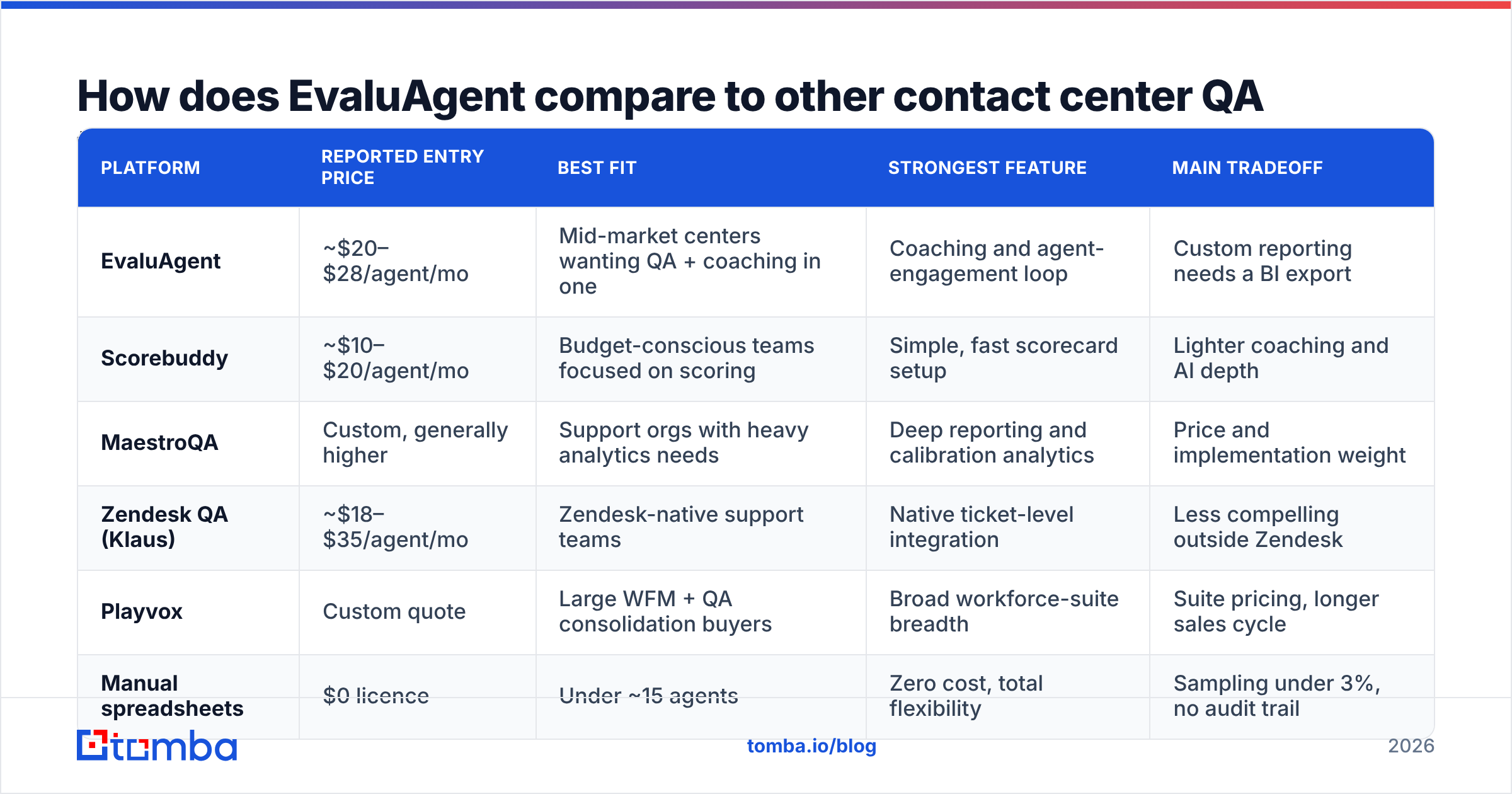
| Platform | Reported entry price | Best fit | Strongest feature | Main tradeoff |
|---|---|---|---|---|
| EvaluAgent | ~$20–$28/agent/mo | Mid-market QA + coaching | Coaching loop | Custom reports need BI |
| Scorebuddy | ~$10–$20/agent/mo | Budget scoring teams | Fast scorecard setup | Lighter coaching and AI |
| MaestroQA | Custom, generally higher | Analytics-heavy support orgs | Deep reporting | Price and setup weight |
| Zendesk QA (Klaus) | ~$18–$35/agent/mo | Zendesk-native teams | Ticket-level integration | Weaker outside Zendesk |
| Playvox | Custom quote | WFM + QA consolidation | Suite breadth | Longer sales cycle |
| Manual spreadsheets | $0 licence | Under ~15 agents | Zero cost | No audit trail |
Read that table as a positioning map, not a leaderboard. Scorebuddy wins on price when you only need scoring. Zendesk QA wins if your world is entirely Zendesk. MaestroQA wins on analytics depth. EvaluAgent argues that scoring without coaching does not change behavior, and it charges for the coaching layer.
What are the real pros of EvaluAgent?#
It closes the loop. Most QA tools stop at the score. EvaluAgent assumes a score is worthless unless it leads to a coaching conversation and a change next month. If your QA program produces reports nobody acts on, that is the feature you are buying.
Agents can see and challenge their scores. Disputes are handled in the platform, with evidence attached. That defuses the biggest source of QA resentment, and it shows up in adoption more than in feature lists.
Compliance frameworks map cleanly. Auto-fail criteria, weighted sections, and calibration sessions suit regulated work. In finance, healthcare, and utilities, a missed disclosure is a real liability rather than a coaching note.
AI auto-scoring changes the sample size argument. Moving from 2% manual sampling to near-total coverage is the genuine step change. It is why the AI tier costs a premium. Calibrate your auto-score thresholds against human scores before you attach anything consequential to them.
What are the cons and hidden costs?#
You pay for agents, not evaluations. Seasonal centers get hit hardest. If your roster swings from 120 to 300 agents in Q4, negotiate flex seats up front. Otherwise you pay peak pricing for twelve months.
Implementation is a real project. Budget internal time, not just the vendor fee. First value takes four to eight weeks. Most of that is your team deciding what "good" means on a call.
Custom reporting hits a ceiling. If leadership expects bespoke cross-functional dashboards, plan a BI export path from day one. Do not discover the limit in month four.
AI scoring needs calibration, not faith. Auto-scores that disagree with your human evaluators will quietly destroy trust. Run a parallel period where humans and AI score the same calls, then close the gap before you cut over.
Renewal uplift. Multi-year deals often include annual increases. Ask for the uplift cap in writing during the first negotiation, while you still have leverage.
EvaluAgent pricing, reviews, pros and cons: is it worth it?#
It is worth it if three things are true. You have more than roughly 40 agents. You already know what quality means in your business. And someone owns QA as their actual job. Those conditions turn a per-agent licence into fewer escalations, fewer compliance misses, and faster ramp for new hires.
It is a poor fit under 25 agents. Seat minimums push the effective per-agent cost above Scorebuddy or a well-built spreadsheet. It is also a poor fit if nobody owns QA. Software does not create a quality program. It scales one that already exists.
A third case is more common than either. Some teams buy QA software when the real bottleneck sits at the top of the funnel.
If your reps burn half their dials on wrong numbers and bounced emails, a better scorecard just documents a pipeline problem it cannot fix. Score quality is downstream of contact quality. Cleaning your data with a proper email verifier and a phone validator costs less per seat and lands faster than any QA rollout.
How do you negotiate a better EvaluAgent price?#
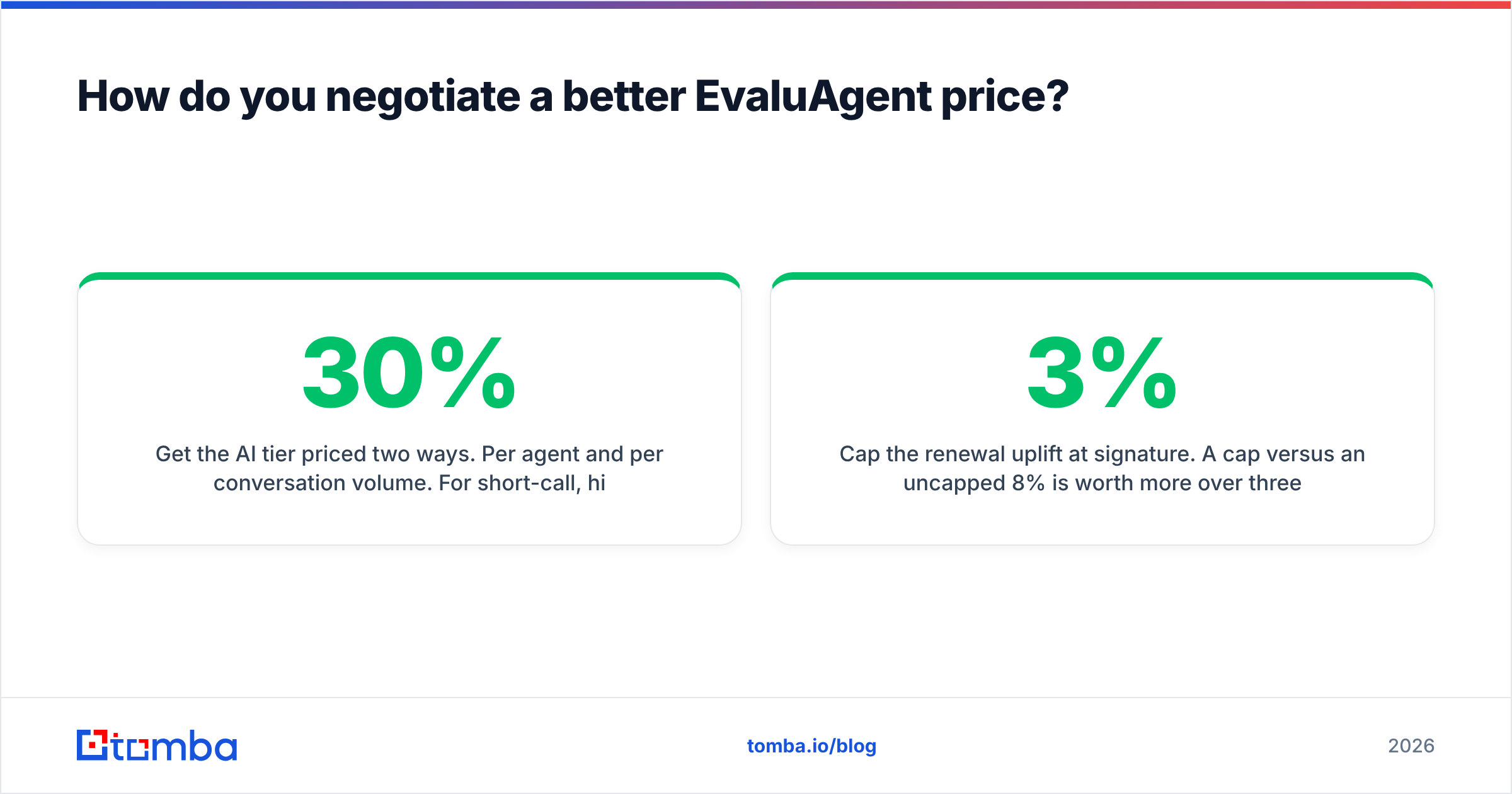
- Get the AI tier priced two ways. Per agent and per conversation volume. For short-call, high-volume teams the gap can be 30% or more.
- Ask for the seat minimum in writing. Negotiate a flex band for seasonal swings before you sign.
- Bundle implementation into year one. Vendors discount services more readily than licences.
- Cap the renewal uplift at signature. A 3% cap beats an uncapped 8% over three years, and it is worth more than today's discount.
- Time the close. End of quarter, and especially end of fiscal year, moves numbers that mid-quarter talks will not.
- Bring a real alternative. A quote from Scorebuddy or Zendesk QA is the only leverage that reliably works here.
Where should your budget go instead, if the funnel is the problem?#
If reviewing calls is not your constraint, spend the money upstream. Finding people worth calling may be the real gap. Verified contact data compounds: every clean record lifts connect rate, cuts bounce, and makes each QA score reflect selling skill rather than list rot.
That is the honest boundary between these two categories. EvaluAgent makes the conversations you already have better. It does not create more of them. Weigh EvaluAgent pricing, reviews, pros and cons against that boundary before you sign.
If your bottleneck is reach rather than quality, start with Tomba Email Finder. You get verified work emails by name or domain. The free tier covers 25 searches a month, so you can test match rate against your own list. Paid plans start at $49/mo — see Tomba pricing, or pull numbers alongside emails with the phone finder. Fix the data first, then buy the scorecard.
Related guides#
Ready to find emails that actually work?
Join 150,000+ professionals who stopped guessing and started sending. Free credits on signup — no credit card required.
Get the Tomba newsletter
Practical outbound tactics and product updates — once every two weeks.
About the author