9 Best Evawarm Alternatives for Cold Email Warmup in 2026
Evawarm covers inbox warmup, but most teams need verification, data, and sending too. Here are 9 alternatives compared on price, pooling risk, and what they actually fix.
TL;DR
- Evawarm is a narrow tool: it fixes engagement signals, not bad data. If your bounce rate is above 3%, warmup is the wrong thing to buy first.
- The strongest Evawarm alternatives split into three buckets: pure warmup pools (Warmy, Mailreach, Folderly), sending platforms with warmup bundled (Instantly, Smartlead, Saleshandy), and data-quality tools that remove the cause of the problem (Tomba, ZeroBounce).
- Bundled warmup inside a sending platform is almost always cheaper than a standalone subscription — Instantly and Smartlead include it at no extra per-inbox charge.
- Google and Microsoft have both tightened bulk-sender rules since 2024, and artificial warmup pools are a diminishing-returns tactic. Real replies beat synthetic ones.
- The cheapest deliverability win is still list hygiene: verify before you send, and warmup has far less work to do.
What is Evawarm and what does it actually do?#
Evawarm is an email warmup service. You connect a mailbox over SMTP/IMAP or an OAuth link, and it starts a scripted conversation loop: your inbox sends messages to other inboxes in the network, those inboxes open, reply, mark as important, and drag anything from spam back into the primary tab. Over two to four weeks, mailbox providers see a sending address with high engagement and low complaint rates, and they route more of your real mail to the inbox.
The everyday analogy: warmup is like building credit history. You make small, predictable transactions and pay them off so a lender trusts you with a bigger line later. Technically, you are feeding positive engagement signals into Gmail and Outlook's reputation models before you start sending volume to strangers.
What Evawarm does not do is equally important:
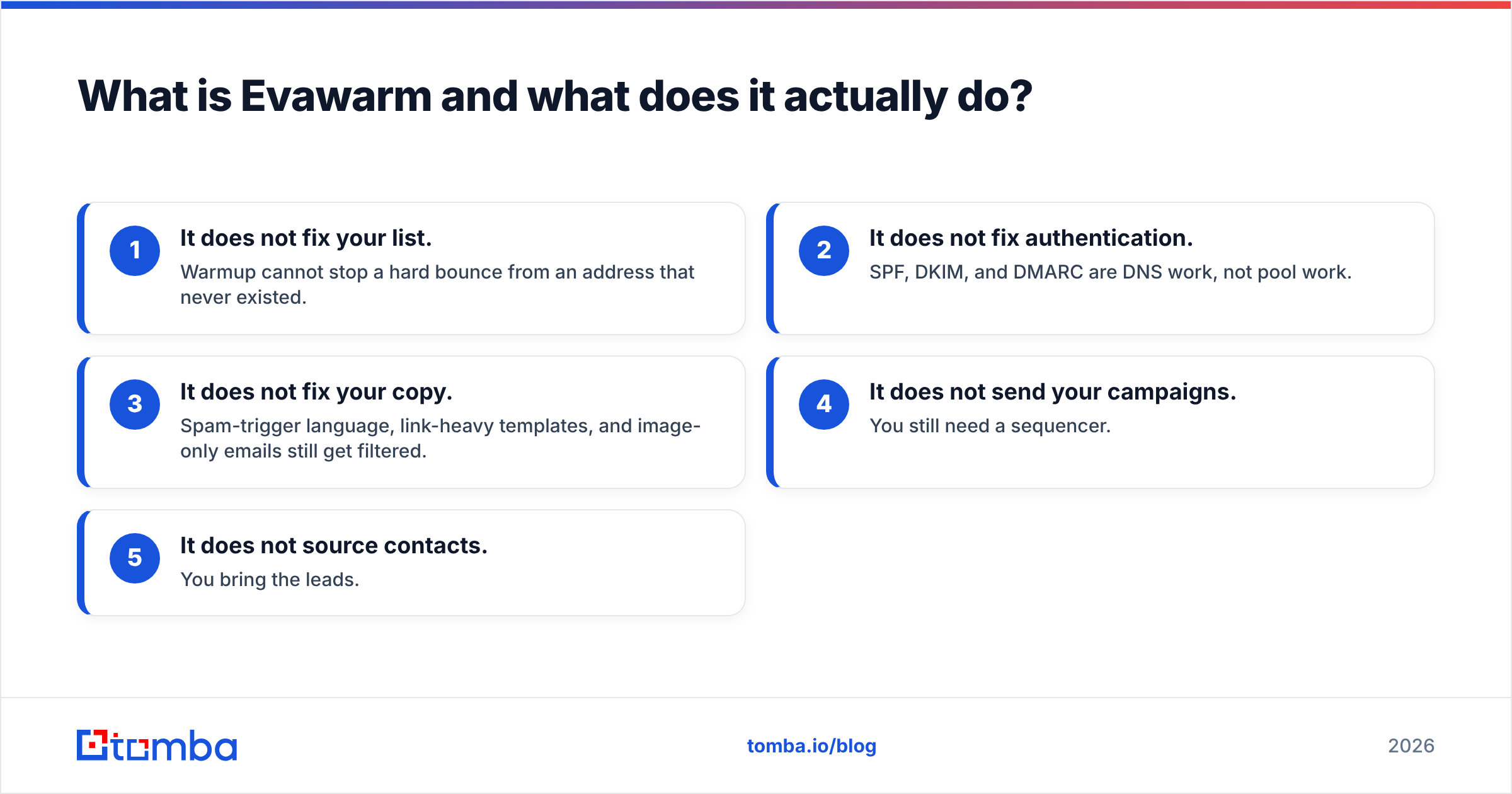
- It does not fix your list. Warmup cannot stop a hard bounce from an address that never existed.
- It does not fix authentication. SPF, DKIM, and DMARC are DNS work, not pool work.
- It does not fix your copy. Spam-trigger language, link-heavy templates, and image-only emails still get filtered.
- It does not send your campaigns. You still need a sequencer.
- It does not source contacts. You bring the leads.
That gap is why most teams searching for Evawarm alternatives are not really looking for a different warmup pool. They're looking for the tool that fixes whichever part of the chain is actually broken.

Why look for Evawarm alternatives in 2026?#
Four reasons come up repeatedly when teams switch.
Pooling risk. Warmup networks are shared environments. If the pool contains burned domains, spam-trap-adjacent mailboxes, or accounts already flagged by Google, your inbox is exchanging engagement with bad neighbors. Larger, better-curated networks (Mailreach, Warmy) filter more aggressively than small ones. This is the single biggest quality differentiator between warmup vendors, and it's the hardest to audit from the outside.
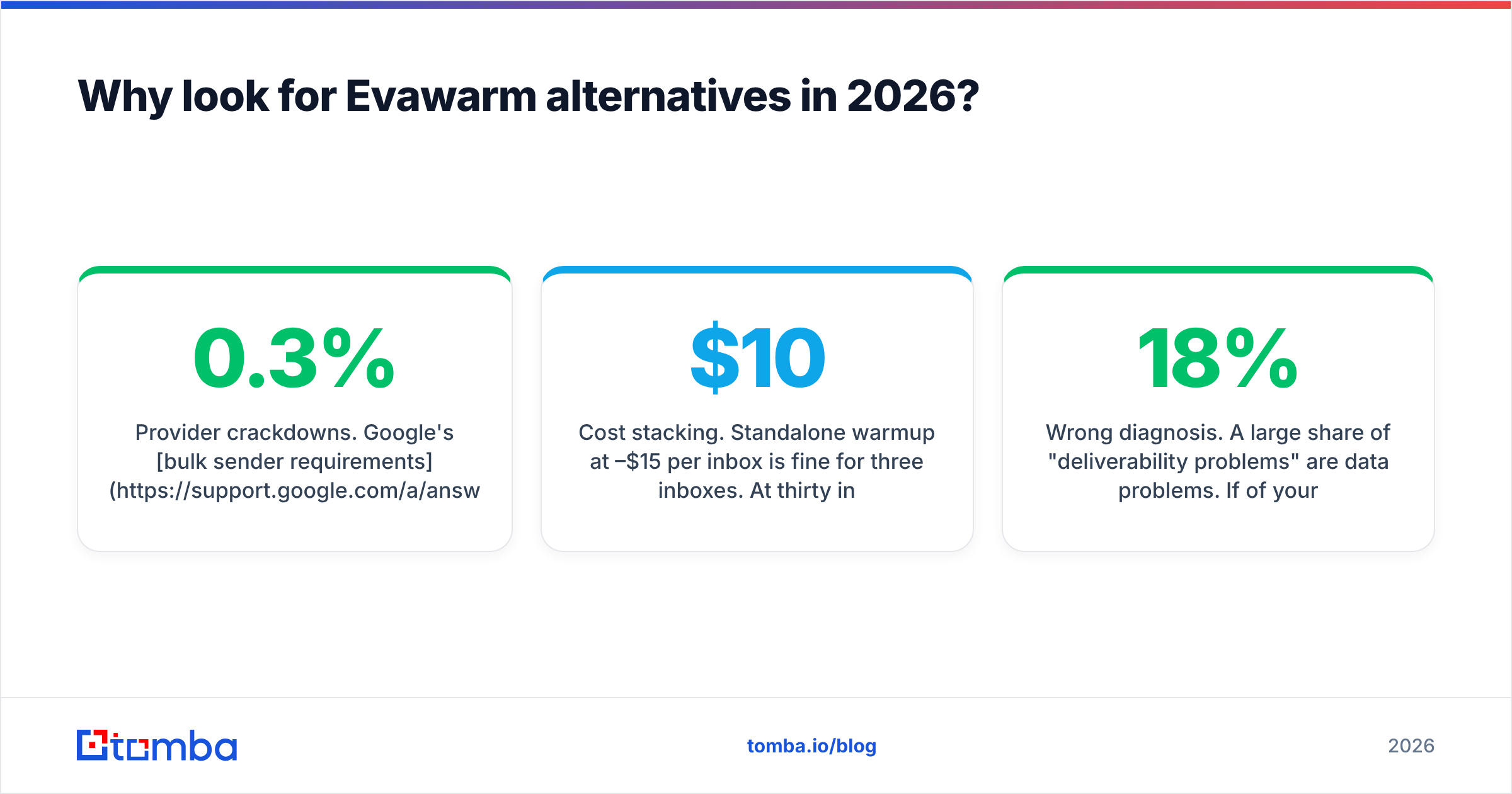
Provider crackdowns. Google's bulk sender requirements and Microsoft's equivalent rules now enforce authenticated sending, one-click unsubscribe on bulk mail, and a spam-complaint rate under 0.3%. Synthetic engagement is a weaker lever than it was in 2021 because the models increasingly weight complaint rate and real reply behavior above open counts.
Cost stacking. Standalone warmup at $10–$15 per inbox per month is fine for three inboxes. At thirty inboxes, you're paying $300–$450/mo for something Instantly and Smartlead include in their base plan.
Wrong diagnosis. A large share of "deliverability problems" are data problems. If 18% of your list bounces, no warmup schedule saves you — mailbox providers read a high bounce rate as a list you did not earn. Fixing that with an email verifier is faster and cheaper than three weeks of warmup.
What should you compare warmup tools on?#
Before the table, here's the evaluation frame. Score every candidate on these six dimensions:
- Pool quality and size — How many real mailboxes, and how are bad actors removed? Ask the vendor directly; a refusal to answer is an answer.
- Provider coverage — Gmail/Workspace, Outlook/Microsoft 365, and custom SMTP at minimum. Some tools handle Google well and Microsoft badly.
- Reporting depth — Do you get per-provider inbox placement, spam-folder rate, and a reputation trend line, or just a green "warming" badge?
- Pricing model — Per inbox, per domain, or flat? Per-inbox pricing punishes the multi-inbox setups that cold outreach requires.
- Bundled vs standalone — Does your sending platform already include this? Paying twice is the most common overspend in this category.
- Root-cause tooling — Does the vendor also help with list hygiene, DNS records, and content scoring, or only engagement simulation?
How do the top Evawarm alternatives compare?#
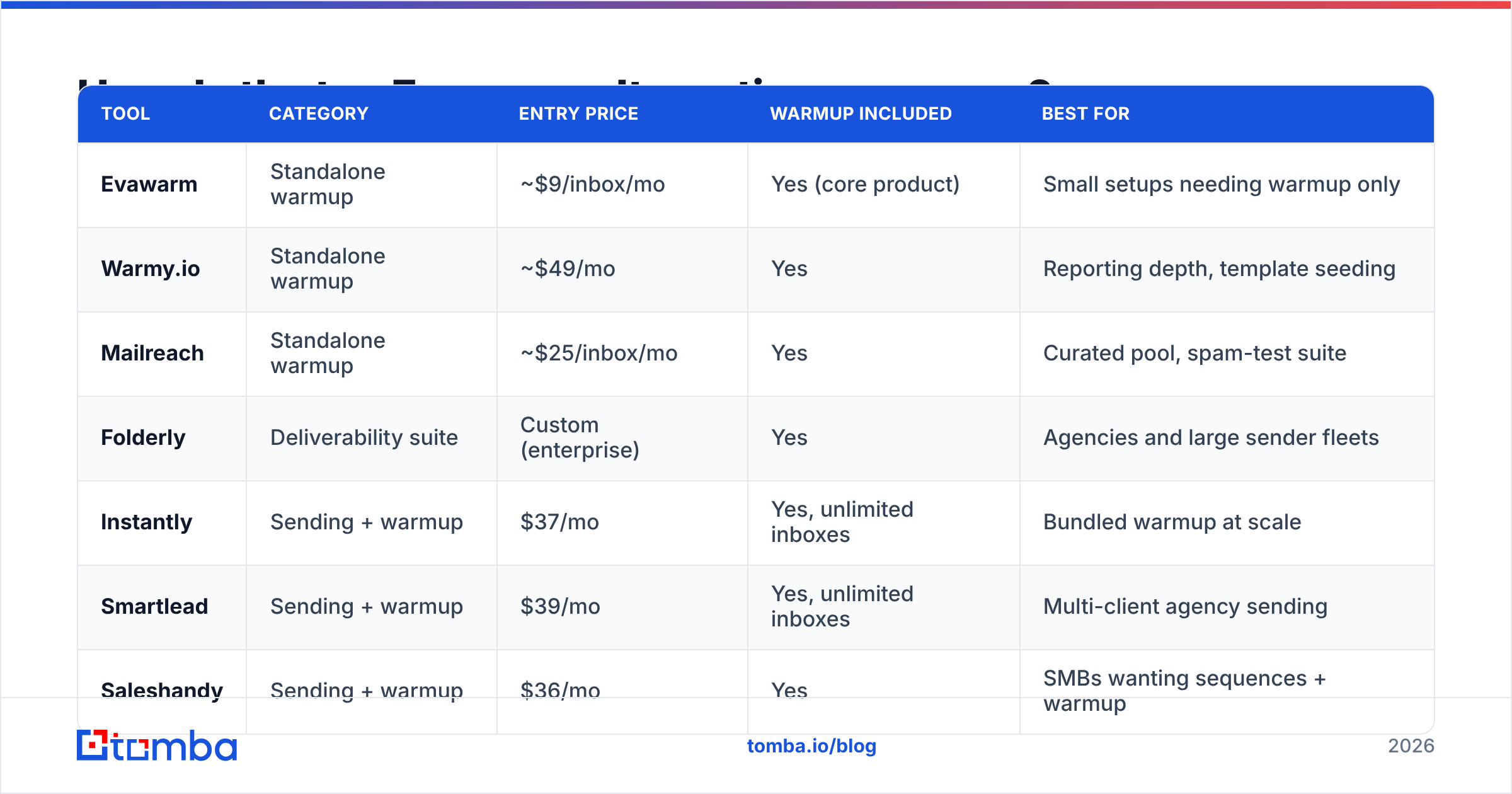
| Tool | Category | Entry price | Warmup included | Best for |
|---|---|---|---|---|
| Evawarm | Standalone warmup | ~$9/inbox/mo | Yes (core product) | Small setups needing warmup only |
| Warmy.io | Standalone warmup | ~$49/mo | Yes | Reporting depth, template seeding |
| Mailreach | Standalone warmup | ~$25/inbox/mo | Yes | Curated pool, spam-test suite |
| Folderly | Deliverability suite | Custom (enterprise) | Yes | Agencies and large sender fleets |
| Instantly | Sending + warmup | $37/mo | Yes, unlimited inboxes | Bundled warmup at scale |
| Smartlead | Sending + warmup | $39/mo | Yes, unlimited inboxes | Multi-client agency sending |
| Saleshandy | Sending + warmup | $36/mo | Yes | SMBs wanting sequences + warmup |
| ZeroBounce | Verification + warmup | $18 (credit pack) | Add-on | Teams that need verification first |
| Tomba | Data + verification | Free tier, $49/mo Starter | No (by design) | Fixing bounce rate at the source |
| BookYourData | B2B contact data | Pay-as-you-go | No | Buying pre-verified contact lists |
Prices are entry-level list prices as published by each vendor and move often — confirm on the vendor's own pricing page before you commit.
Which Evawarm alternative fits which situation?#
Warmy.io — best reporting#
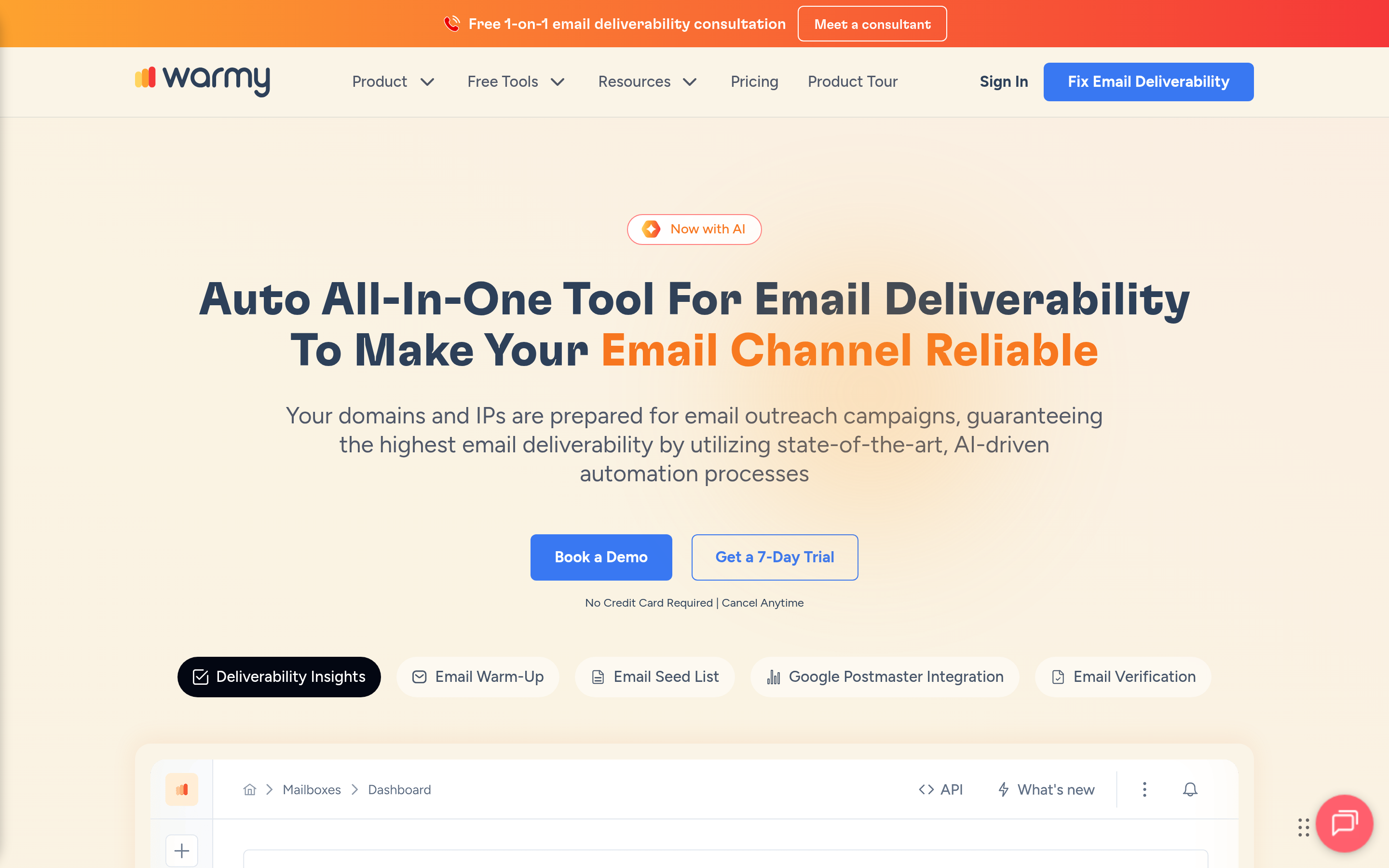
Warmy leans hardest into visibility. You get per-provider placement breakdowns, template-level spam scoring, and a "Free Email Deliverability Test" that seeds your message into a set of monitored inboxes. If your current complaint is "I don't know where my mail is landing," this is the closest answer. Flat monthly pricing rather than strict per-inbox billing helps at mid-size fleets.
Trade-off: the interface has a learning curve, and the cheapest plan caps warmup volume lower than most cold-email teams want.
Mailreach — best curated pool#
Mailreach has one of the more selective networks in this category and pairs warmup with a standalone spam-test tool that scores content, DNS, and blocklist status independently of the warmup loop. Per-inbox pricing is the honest constraint: at scale it becomes the most expensive line item in a warmup-only stack.
Folderly — best for agencies with real budget#
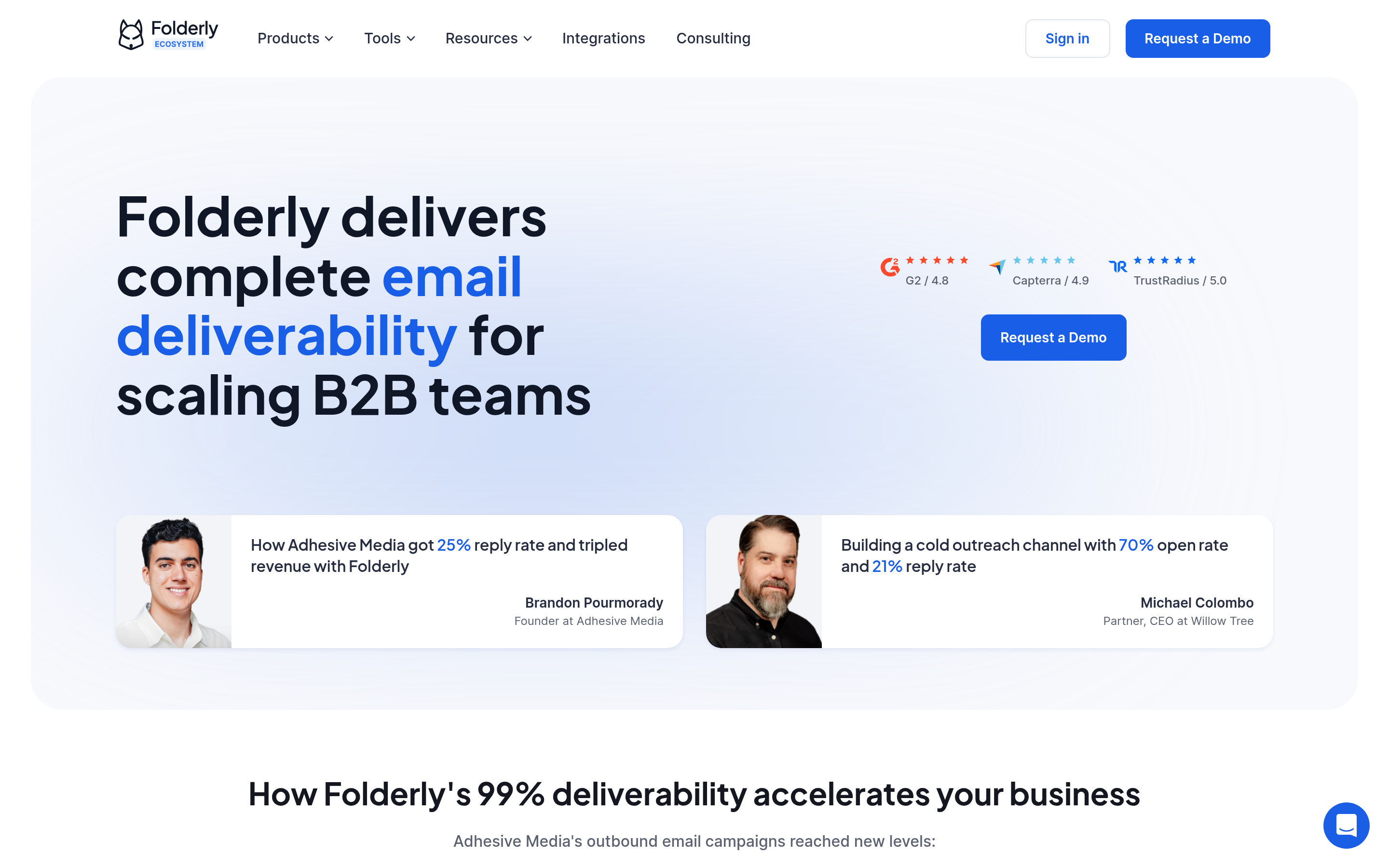
Folderly is a full deliverability program, not a warmup toggle: DNS auditing, content analysis, placement monitoring, dedicated strategist. Pricing is enterprise-custom and typically several hundred dollars per month per domain. Right for a 50-inbox agency with revenue tied to placement; overkill for a founder with three inboxes.
Instantly and Smartlead — best value if you also need to send#
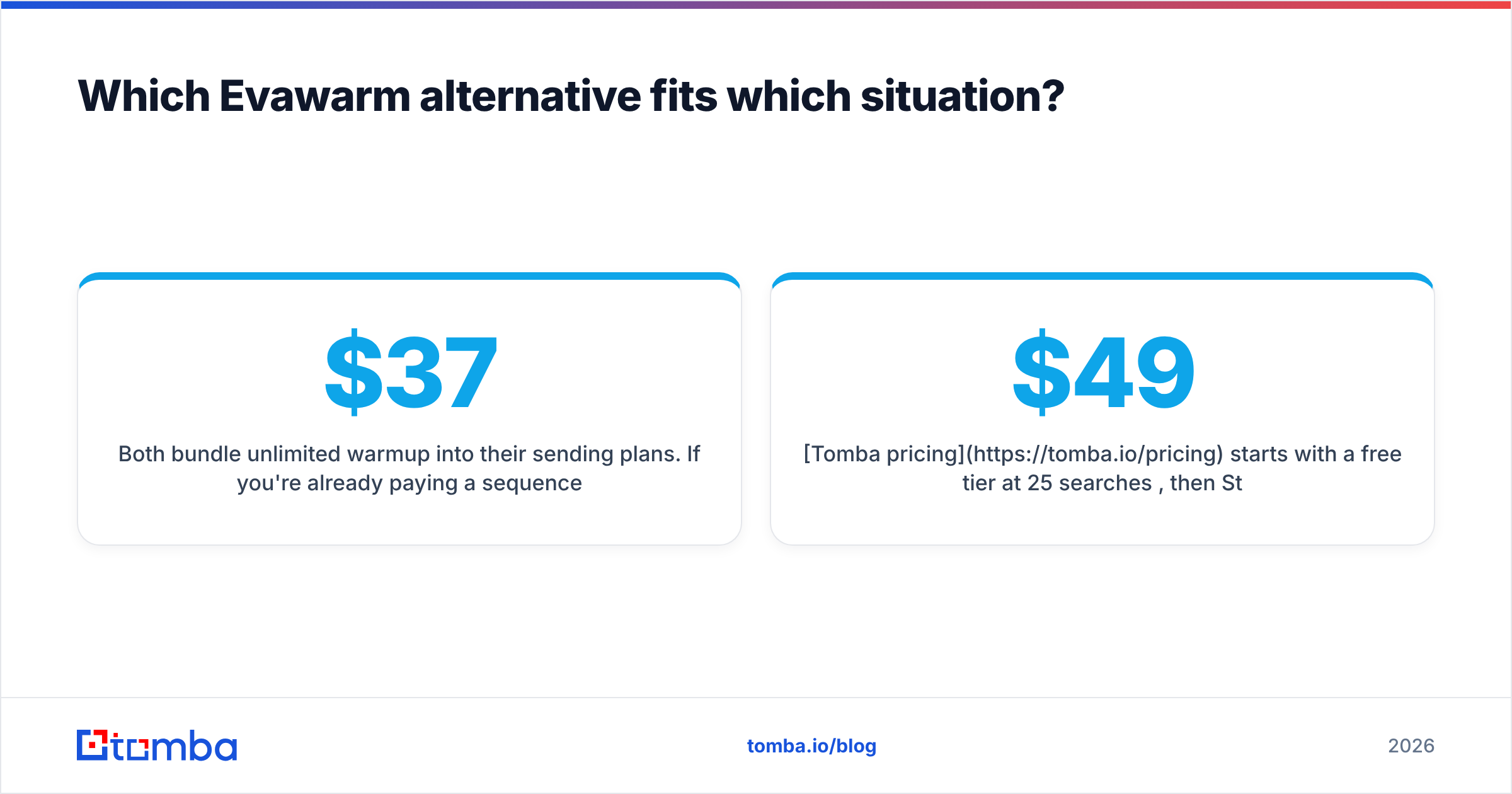
Both bundle unlimited warmup into their sending plans. If you're already paying a sequencer, a separate warmup subscription is usually redundant spend. Instantly starts around $37/mo, Smartlead around $39/mo, and both include unlimited connected mailboxes for warmup on paid tiers. Teams comparing them often look at an Instantly alternative or a Saleshandy alternative when they need stronger data rather than stronger sending.
Trade-off: you're now locked into their sequencer. Bundled warmup is only free if you wanted the platform anyway.
ZeroBounce — verification with a warmup add-on#
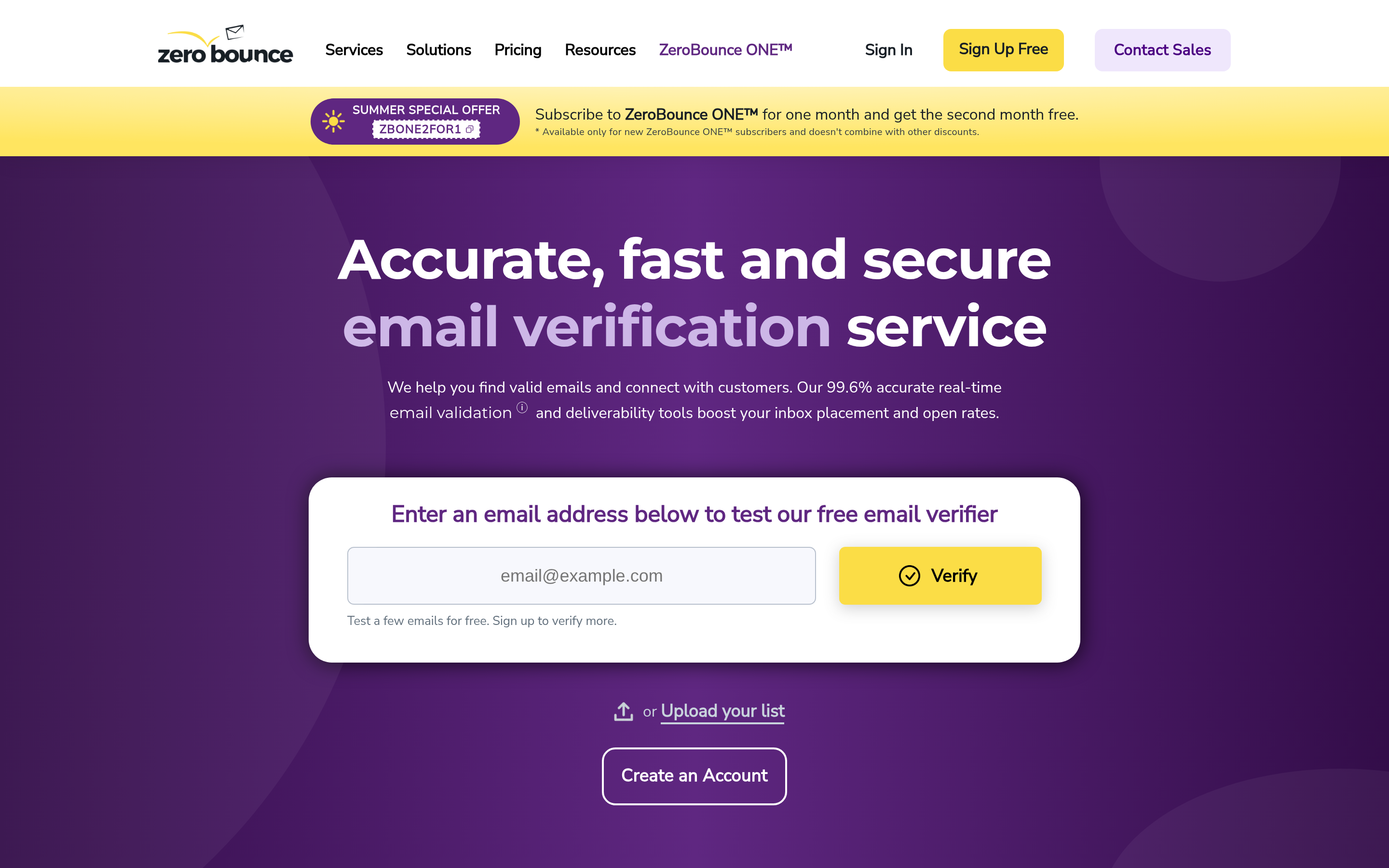
ZeroBounce is primarily a verification service that added warmup later. The verification is solid; the warmup is a secondary feature rather than a differentiator. Useful if you want one vendor for both, and worth weighing against a dedicated ZeroBounce alternative if verification volume is your main cost.
BookYourData — pre-verified contact data#
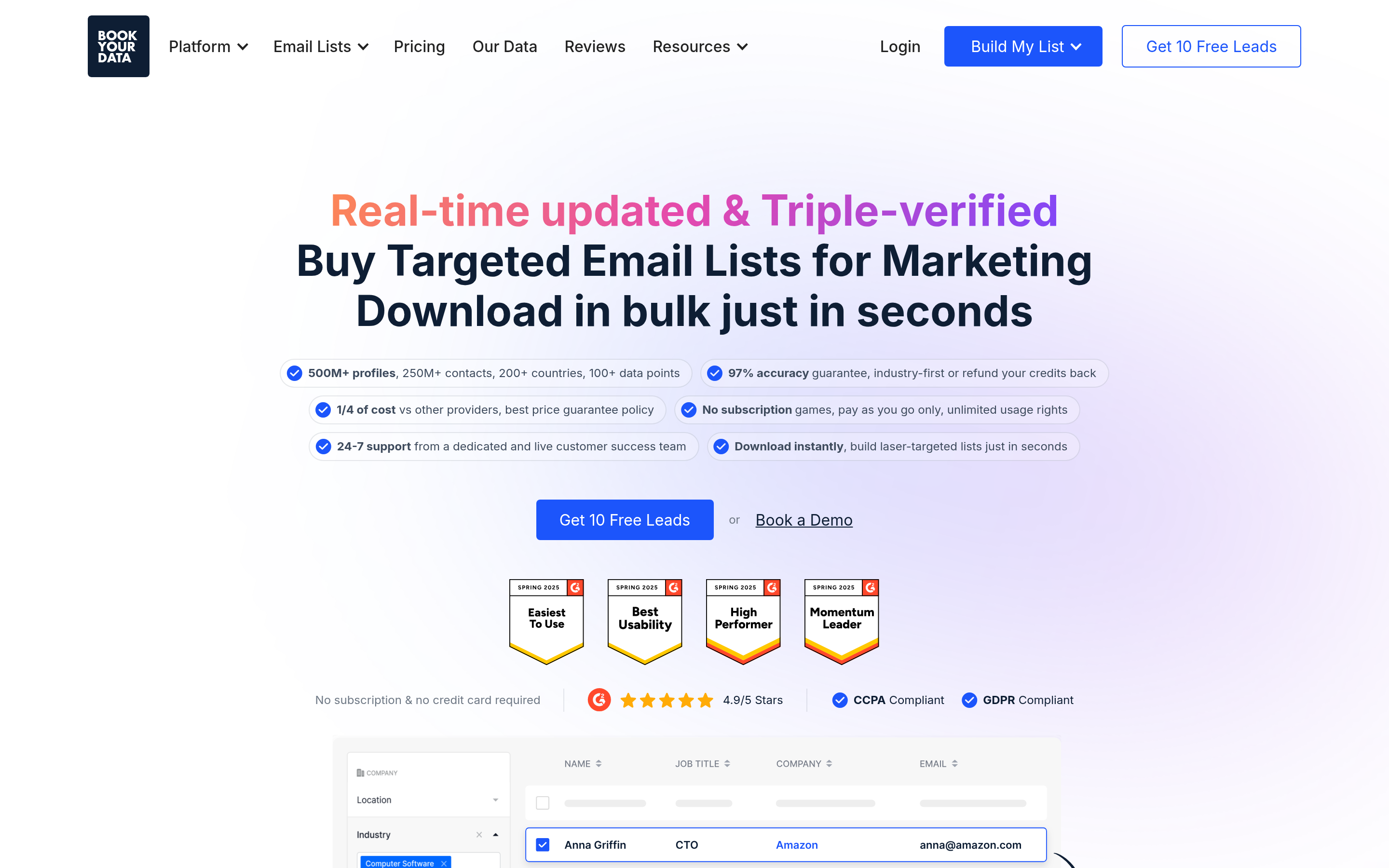
If your problem is that you're building lists from scraped, stale sources, BookYourData sells pay-as-you-go B2B contact data with a verification guarantee attached. It's a different lever than warmup entirely: better inputs mean fewer bounces, which means less reputation damage to repair. A reasonable complement to any warmup tool rather than a replacement for one.
Tomba — fix the cause, not the symptom#
Tomba isn't a warmup tool and doesn't pretend to be. It sits one step earlier in the chain: finding correct addresses and confirming they're deliverable before a single message goes out. If your bounce rate is high, this is the intervention with the largest effect per dollar.
The relevant pieces:
- Email finder — resolve a name plus company domain into a verified work address.
- Domain search — pull every discoverable address on a company domain with role and confidence scoring.
- Email verifier — SMTP-level checks, syntax, disposable detection, and a catch-all verifier for the domains that accept everything.
- Bulk email finder — run a whole list at once instead of one row at a time.
Tomba pricing starts with a free tier at 25 searches/mo, then Starter at $49/mo, Growth at $99/mo, and Pro at $249/mo. Enterprise is custom.

Does warmup still work in 2026?#
Partly — and less than it used to.
Warmup still helps in two specific situations. First, a brand-new domain or mailbox with zero sending history: providers have no prior on you, and a few weeks of clean, engaged sending establishes one. Second, recovery after a bad campaign: if you torched a domain with a high bounce or complaint run, sustained positive engagement is one input into digging out.
Warmup does not help when the underlying problem is elsewhere. Run this check before subscribing to anything:
- Bounce rate above 3%? That's a data problem. Verify the list.
- SPF, DKIM, or DMARC failing? That's DNS. Use an SPF checker and fix records first — warmup on an unauthenticated domain is wasted money.
- Domain or IP on a blocklist? Check with a blacklist checker and file delisting requests.
- Complaint rate above 0.3%? That's targeting and copy. You're emailing people who don't want to hear from you.
- Sending 500 cold emails/day from one inbox? That's volume. No warmup schedule survives that.
Industry review sites like G2 and Capterra are useful for seeing which vendors have recent, verified reviews rather than a burst of reviews from a launch push — sort by most recent, not by rating.
The uncomfortable truth vendors don't lead with: mailbox providers know what warmup networks look like. Reciprocal reply patterns between accounts with no other relationship are detectable. Pool-based warmup is a supporting tactic, not a strategy. Real engagement from real prospects — driven by relevance and a clean list — is the durable version of the same signal.
What does a sane deliverability stack look like?#
Layer it in this order, and stop as soon as your placement is fine:
- Authentication — SPF, DKIM, DMARC configured and passing. Free, mandatory, non-negotiable. Read the email deliverability fundamentals if any of those acronyms are unfamiliar.
- Data quality — verified addresses, catch-all domains handled explicitly, duplicates removed. This is where bounce rate is won or lost.
- Infrastructure — separate sending domain from your primary domain, sensible per-inbox daily caps (30–50 cold sends is a common ceiling), multiple inboxes instead of one hammered mailbox.
- Warmup — now it makes sense, on top of a foundation that's already clean.
- Content and targeting — plain-text-ish formatting, minimal links, a real reason you're emailing this person.
- Monitoring — sender reputation tracking and placement tests, checked weekly, not after things break.
Teams that skip straight to step 4 are the ones who write the "warmup didn't work" reviews. Steps 1 and 2 do more work than step 4 ever will, and step 2 is the one most often neglected because it's unglamorous.
Which one should you pick?#
Short answers by situation:
- Already using Instantly, Smartlead, or Saleshandy? Use their bundled warmup. Cancel the standalone subscription.
- Need warmup only, want the best reporting? Warmy.
- Need warmup only, want the most curated pool? Mailreach.
- Agency with placement in the contract? Folderly.
- Bounce rate above 3%? Nothing on this list helps until you verify. Start there.
- Building lists from scratch? Fix sourcing first — accurate contacts, then warmup.
Fix the input before you fix the signal#
Warmup tools treat a symptom. Bad contact data is the cause, and it's the thing that keeps costing you — in bounced sends, in burned domains, in reps working lists that were never real.
Start with Tomba's Email Finder to build lists from verified, current work addresses instead of guessed patterns. The free tier covers 25 searches a month, enough to check whether your current data source is as accurate as you assumed. Run a hundred of your existing contacts through it, compare the results to what you're sending today, and you'll know in ten minutes whether your deliverability problem was ever a warmup problem at all.
Related guides#
Ready to find emails that actually work?
Join 150,000+ professionals who stopped guessing and started sending. Free credits on signup — no credit card required.
Get the Tomba newsletter
Practical outbound tactics and product updates — once every two weeks.
About the author