Everready Alternatives: 9 Better B2B Email Data Tools
Everready promises B2B contact data, but quote-only pricing and thin public docs push most teams to shop around. Here are 9 alternatives compared on accuracy, verification, pricing and free tiers.
TL;DR
- Everready sits in the crowded B2B contact-data category, and the most common complaints that push buyers to look at Everready alternatives are quote-only pricing, limited public documentation, and no self-serve free tier to test accuracy before committing.
- If your bottleneck is finding and verifying work emails at scale, a focused email-finder like Tomba (free tier, $49/mo Starter, full API) usually beats a general contact database on cost per usable contact.
- If your bottleneck is volume of net-new accounts, a database-first tool (Apollo, BookYourData, RocketReach) makes more sense — you are buying coverage, not precision.
- Never migrate on a demo. Run the same 200-row test list through 2–3 finalists, verify the output, and score them on valid-and-deliverable rate, not on raw match rate.
- Budget for verification separately. A 92% match rate with no SMTP validation still bounces you out of the inbox.
What is Everready and who is it for?#
Everready is positioned as a B2B contact and lead-data provider — the category that includes email lookup, company data, and list building for outbound teams. Buyers typically evaluate it alongside tools like Apollo, Cognism, RocketReach, and dedicated email finders.
Two honest caveats before we go further. First, Everready does not publish a transparent self-serve pricing table the way most of its competitors now do, so any cost comparison you read (including this one) is a moving target — confirm numbers with the vendor before you sign. Second, because there is no widely available free tier, you cannot cheaply validate its data quality against your own ICP, which is exactly why "Everready alternatives" is a query people type in the first place.
That is not a knock on the product. It is a purchasing problem. B2B data is the one software category where the only meaningful evaluation is a head-to-head test on your own accounts — vendor-published accuracy percentages are marketing, not evidence.

Why do teams look for Everready alternatives?#
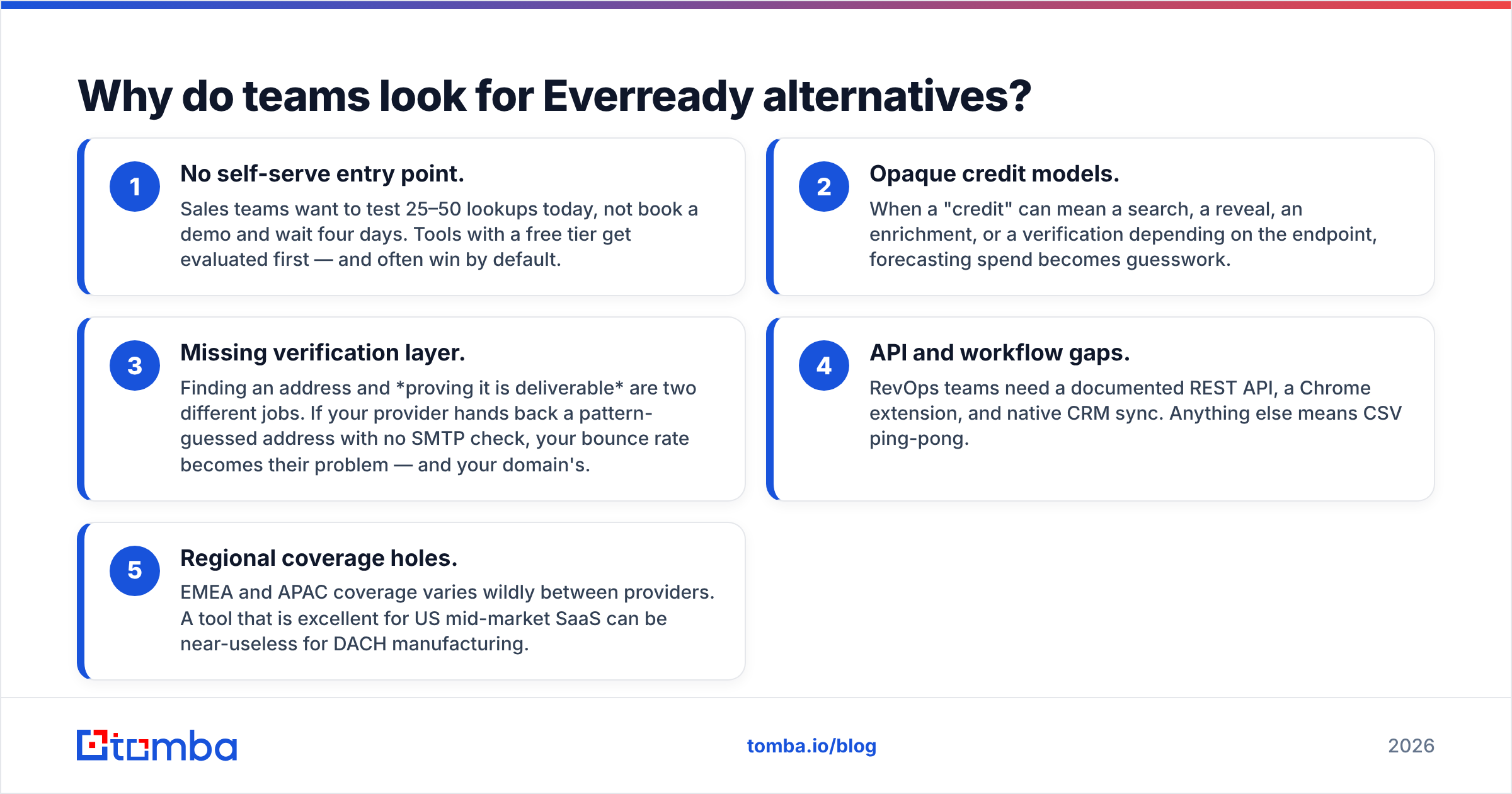
Across switching conversations, the same five reasons come up:
- No self-serve entry point. Sales teams want to test 25–50 lookups today, not book a demo and wait four days. Tools with a free tier get evaluated first — and often win by default.
- Opaque credit models. When a "credit" can mean a search, a reveal, an enrichment, or a verification depending on the endpoint, forecasting spend becomes guesswork.
- Missing verification layer. Finding an address and proving it is deliverable are two different jobs. If your provider hands back a pattern-guessed address with no SMTP check, your bounce rate becomes their problem — and your domain's.
- API and workflow gaps. RevOps teams need a documented REST API, a Chrome extension, and native CRM sync. Anything else means CSV ping-pong.
- Regional coverage holes. EMEA and APAC coverage varies wildly between providers. A tool that is excellent for US mid-market SaaS can be near-useless for DACH manufacturing.
If one or two of those describe your situation, you do not necessarily need a full platform swap — you may just need to add a dedicated email verifier in front of your existing source.
What should you compare before switching?#
Score every finalist on these six axes. Weight them by your actual workflow, not by the feature grid on the vendor's homepage.
- Valid-and-deliverable rate — the percentage of returned contacts that survive independent verification. This is the only accuracy number that matters. Match rate alone rewards guessing.
- Confidence scoring and sources — does the tool tell you why it believes an address is right? Providers that expose data sources let you make risk decisions per contact.
- Catch-all handling — roughly one in five B2B domains is catch-all. A tool that marks every catch-all as "valid" is lying to you; a tool that marks them all "unknown" is throwing away pipeline. You want a real catch-all verifier.
- Pricing model clarity — flat monthly credits, rollover rules, overage cost, and what happens on a failed lookup (charged or not).
- API and integration depth — REST API, bulk endpoints, rate limits, plus native connections to your CRM and sequencer.
- Compliance posture — GDPR/CCPA handling, suppression lists, and opt-out processing documented in writing.
Which Everready alternatives are worth testing in 2026?#
Here is the shortlist, grouped by what each tool is actually best at. Prices are list prices at the time of writing and change often — verify on each vendor's page.
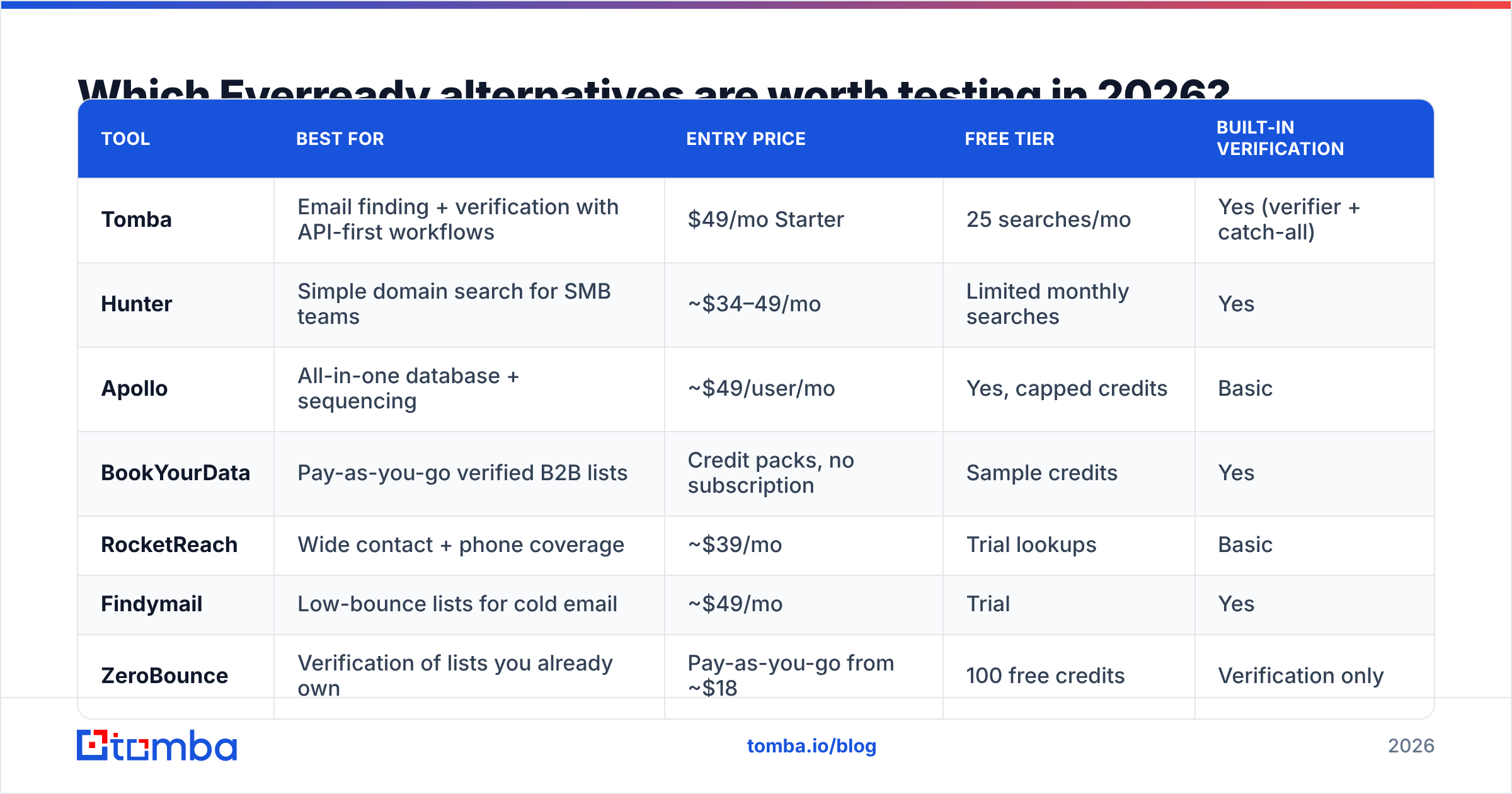
| Tool | Best for | Entry price | Free tier | Built-in verification |
|---|---|---|---|---|
| Tomba | Email finding + verification with API-first workflows | $49/mo Starter | 25 searches/mo | Yes (verifier + catch-all) |
| Hunter | Simple domain search for SMB teams | ~$34–49/mo | Limited monthly searches | Yes |
| Apollo | All-in-one database + sequencing | ~$49/user/mo | Yes, capped credits | Basic |
| BookYourData | Pay-as-you-go verified B2B lists | Credit packs, no subscription | Sample credits | Yes |
| RocketReach | Wide contact + phone coverage | ~$39/mo | Trial lookups | Basic |
| Findymail | Low-bounce lists for cold email | ~$49/mo | Trial | Yes |
| ZeroBounce | Verification of lists you already own | Pay-as-you-go from ~$18 | 100 free credits | Verification only |
| Clearbit (Breeze) | Enrichment inside HubSpot | Bundled/quote | No | No |
| Everready | Managed B2B data sourcing | Quote-based | Not published | Not published |

Tomba — best if you want finding and verification in one API#
Tomba is an email-finder-first platform: email finder, domain search, catch-all verification, phone finder, and enrichment sit on the same credit pool. The practical advantage over a database-first tool is that you are not paying a per-seat platform fee to do one job well.
The free tier gives you 25 searches per month, which is enough to run a real accuracy test before spending anything. Paid Tomba pricing runs $49/mo (Starter), $99/mo (Growth), $249/mo (Pro), and custom Enterprise. Developer-side, there is a documented REST API, a CLI, an MCP server, Chrome extension, and Sheets/Excel add-ins — which matters if your enrichment lives in a workflow rather than in a UI.
Where it is not the best pick: if you want a built-in dialer, sequencer, and intent data in one login, you want a platform, not a finder.
Hunter — the simplest domain search#
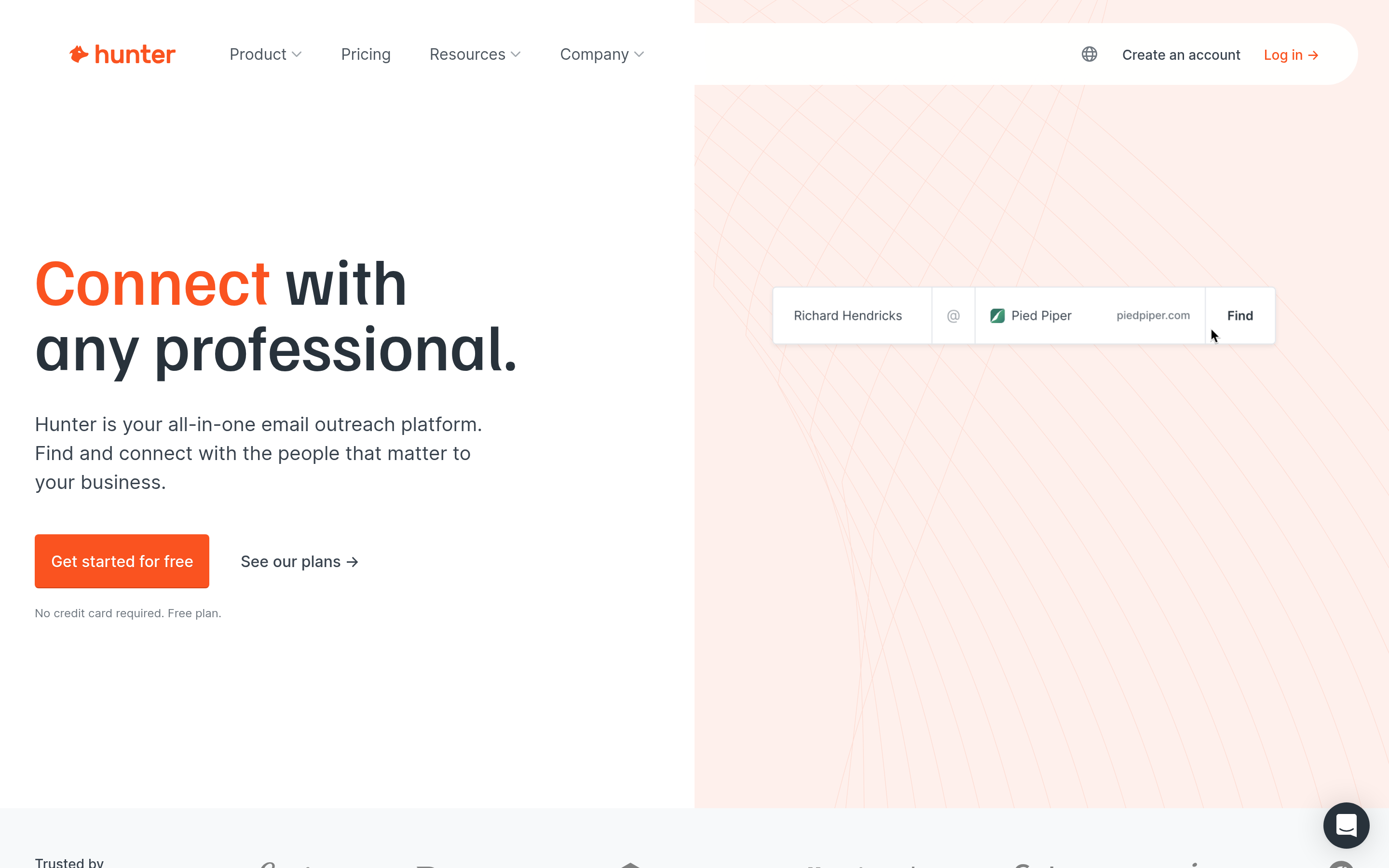
Hunter remains the easiest tool to hand to a non-technical marketer. Type a domain, get the pattern and the known addresses. Coverage is strongest on well-indexed western SaaS and agency domains, thinner on enterprise subsidiaries. See hunter.io for current plans.
Apollo — coverage plus sequencing in one seat#
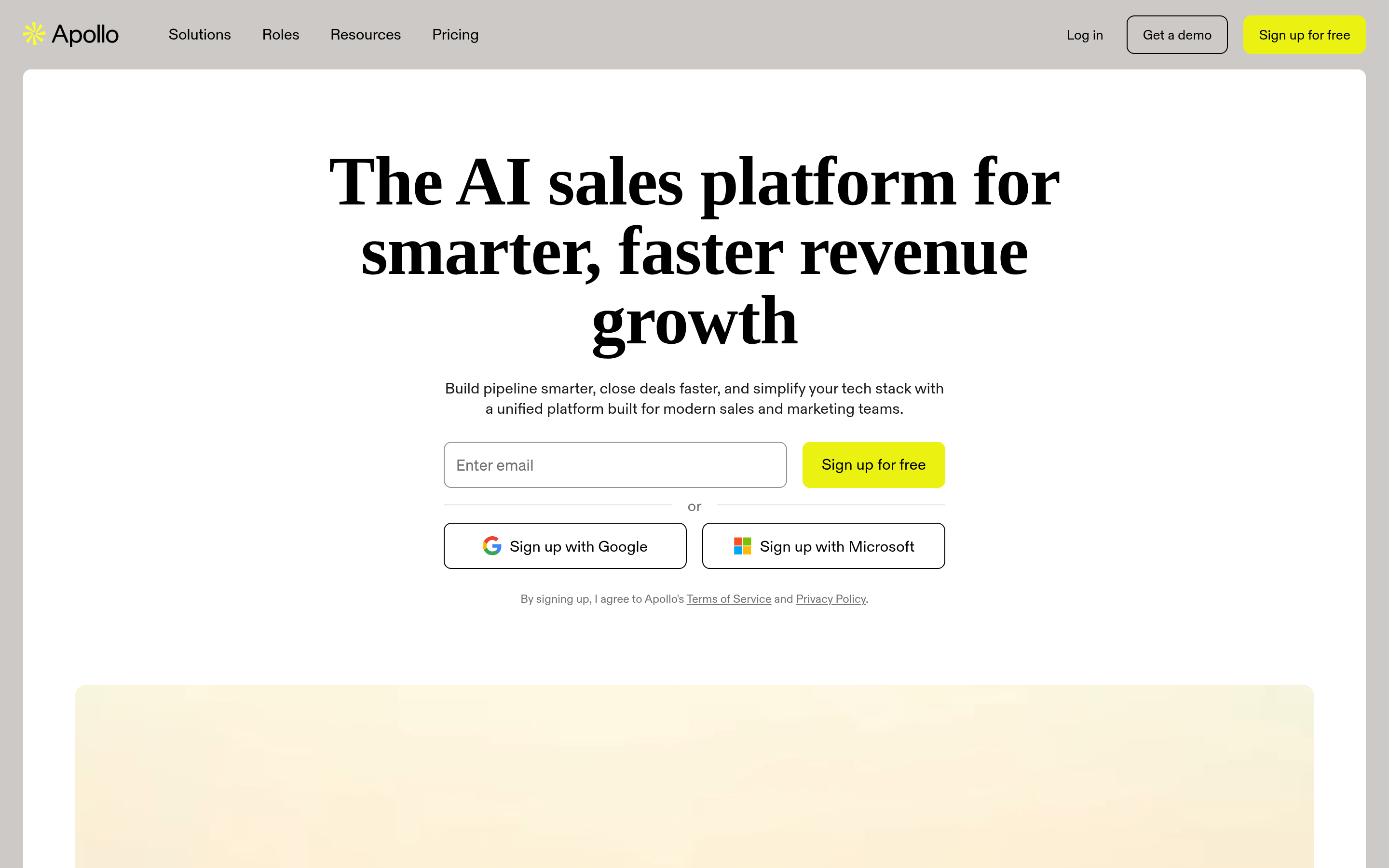
Apollo's pitch is the database (hundreds of millions of contacts) plus native sequences. It is a genuinely good deal per seat if your reps live inside it. The trade-off is data freshness variance and the per-user pricing model, which gets expensive on a 12-rep team. If you like the workflow but not the bill, look at a dedicated Apollo alternative for the data layer and keep your sequencer separate. Details at apollo.io.
BookYourData — strong pay-as-you-go option#
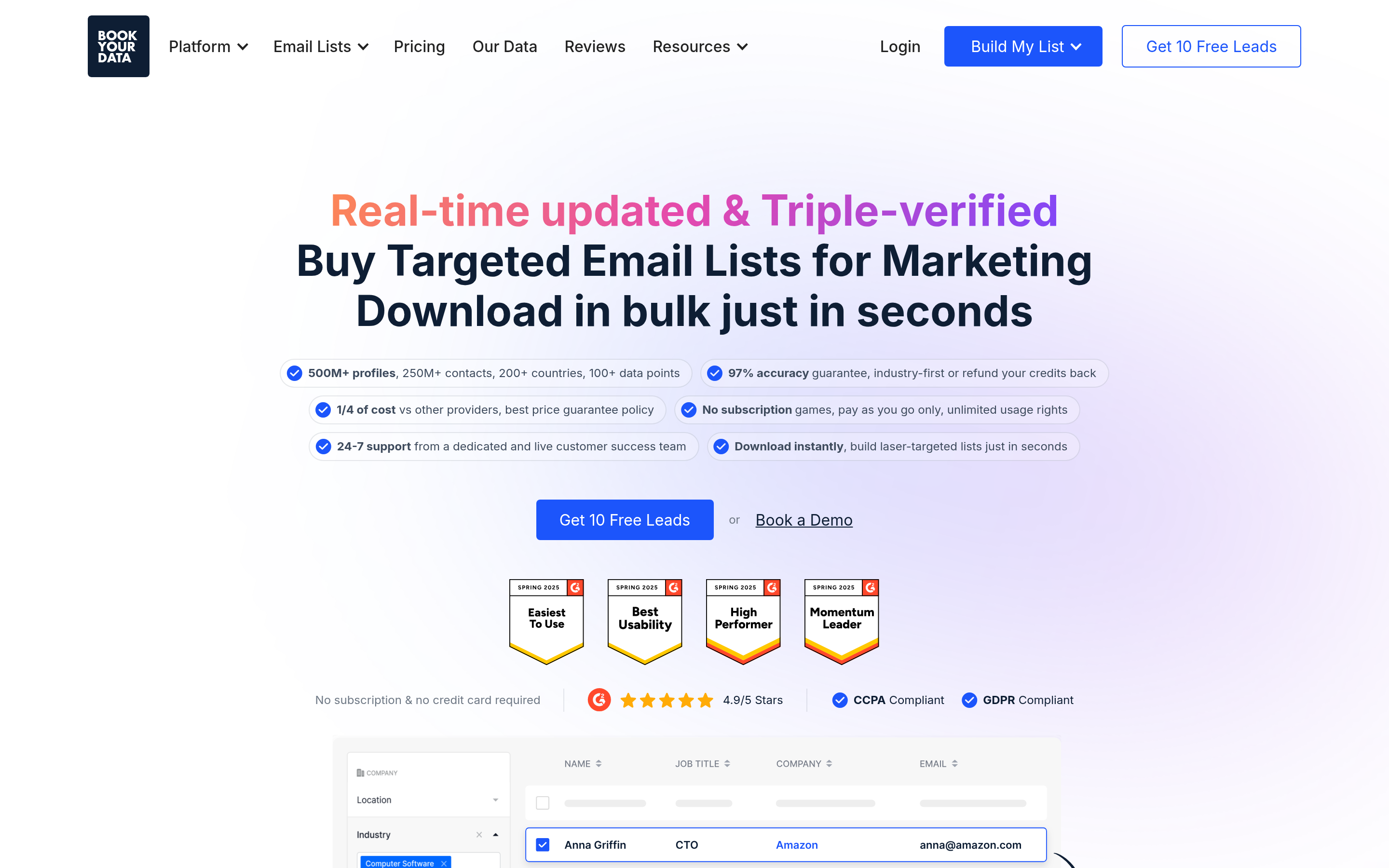
BookYourData takes a different and often underrated approach: buy verified contacts in credit packs with no subscription, filter by industry, title, geography, and download. For teams running quarterly campaigns rather than always-on outbound, not paying a monthly platform fee is a real advantage, and the accuracy guarantee is one of the more concrete commitments in the category. It is a solid choice when you want a clean list now and do not need an ongoing API.
RocketReach — when you need phones too#
RocketReach's coverage of personal and mobile numbers is its differentiator. If half your motion is calling, that is worth paying for. If you only need email, you are subsidising data you will not use — compare against a focused phone finder plus an email tool before assuming the bundle is cheaper.
Findymail and ZeroBounce — the bounce-rate specialists#
Findymail markets around low bounce rates for cold-email operators. ZeroBounce is not a finder at all — it verifies lists you already have, which makes it complementary rather than competitive. If your current data source is fine and your only pain is bouncing, you may need a verifier, not a migration.
How accurate are these tools really?#
Accuracy claims in this category are close to meaningless because every vendor measures a different thing. Vendor A reports "match rate" (did we return anything?). Vendor B reports "accuracy" (of the ones we returned, how many were right?). Vendor C reports "deliverability" after their own verification pass. Those three numbers can differ by 30 points on the same dataset.

Run your own benchmark instead. It takes about an hour:
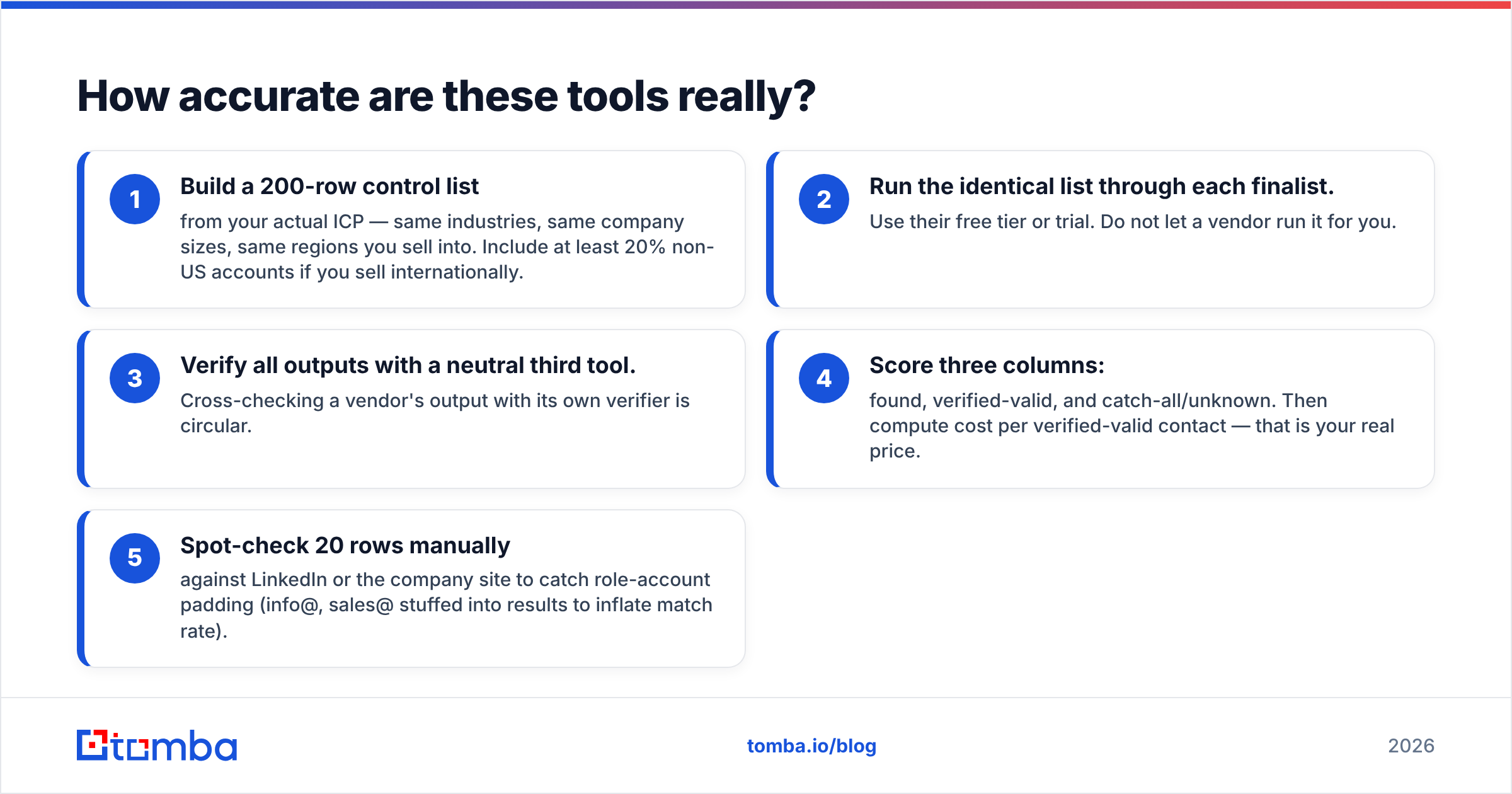
- Build a 200-row control list from your actual ICP — same industries, same company sizes, same regions you sell into. Include at least 20% non-US accounts if you sell internationally.
- Run the identical list through each finalist. Use their free tier or trial. Do not let a vendor run it for you.
- Verify all outputs with a neutral third tool. Cross-checking a vendor's output with its own verifier is circular.
- Score three columns: found, verified-valid, and catch-all/unknown. Then compute cost per verified-valid contact — that is your real price.
- Spot-check 20 rows manually against LinkedIn or the company site to catch role-account padding (info@, sales@ stuffed into results to inflate match rate).
Most teams find the ranking flips once they divide by verified contacts rather than returned rows.

What does switching actually cost you?#
Migration risk is mostly operational, not technical. Plan for these:
- Credit forfeiture. Annual contracts rarely refund unused credits. Time the switch to your renewal, or run both in parallel for one month.
- Field mapping. Your CRM's enrichment fields were shaped by the old provider's schema. Map before you import or you will silently overwrite good data with worse data.
- Suppression lists. Export do-not-contact records first. Losing these is a compliance incident, not an inconvenience.
- Sequence pauses. Do not swap the data source mid-campaign. Finish the current cadence, then cut over.
For a bulk cutover, load the old list into a bulk email finder run and compare re-verification results against your existing records before trusting either source.
Which Everready alternative should you pick?#
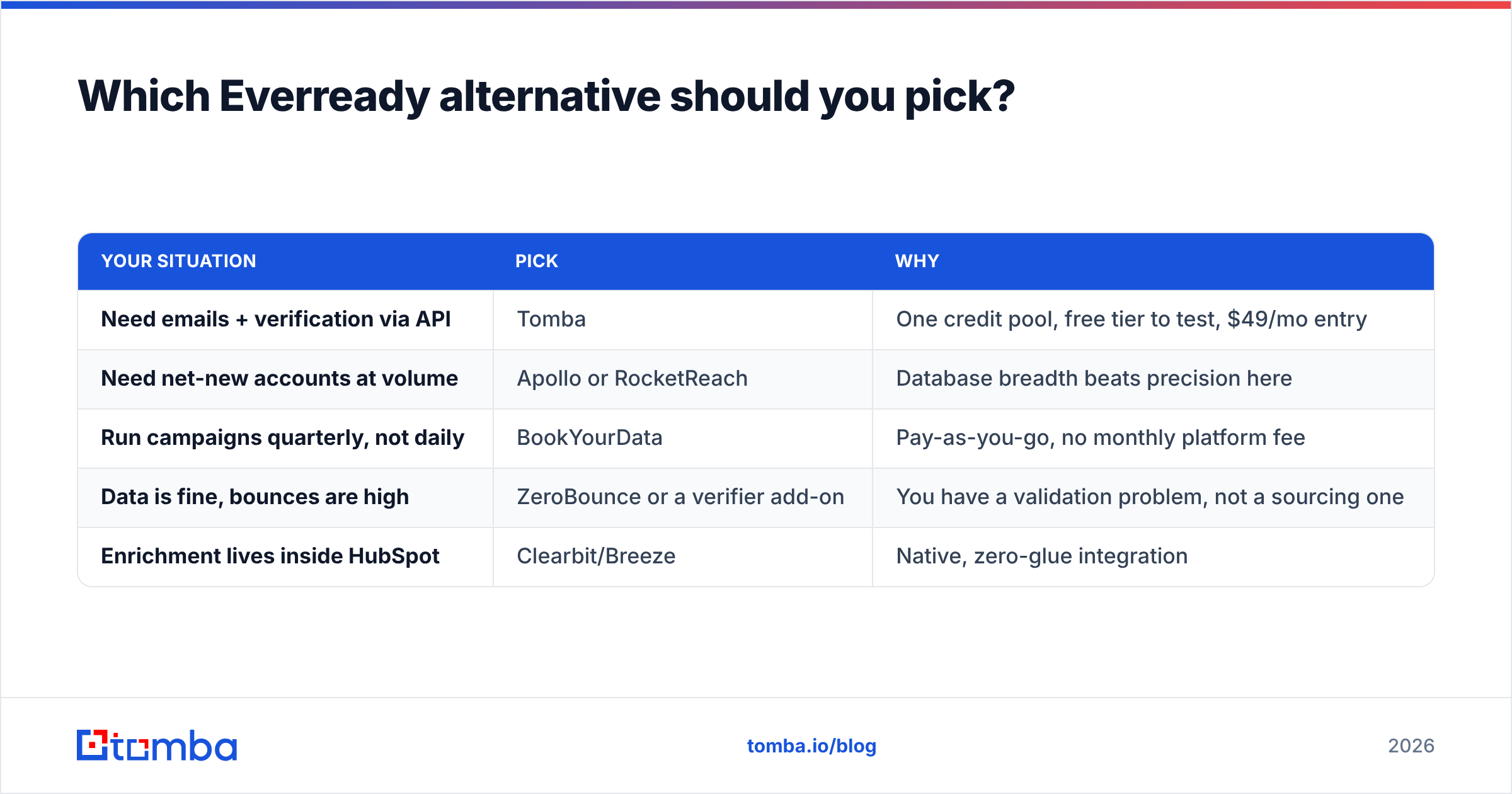
Match the tool to the bottleneck, not to the feature list:
| Your situation | Pick | Why |
|---|---|---|
| Need emails + verification via API | Tomba | One credit pool, free tier to test, $49/mo entry |
| Need net-new accounts at volume | Apollo or RocketReach | Database breadth beats precision here |
| Run campaigns quarterly, not daily | BookYourData | Pay-as-you-go, no monthly platform fee |
| Data is fine, bounces are high | ZeroBounce or a verifier add-on | You have a validation problem, not a sourcing one |
| Enrichment lives inside HubSpot | Clearbit/Breeze | Native, zero-glue integration |
Before you commit, sanity-check the category landscape on an independent review site like G2's lead intelligence category — filter reviews by company size close to yours, since data quality feedback from a 5,000-person enterprise tells you nothing about mid-market coverage.
Start with the cheapest honest test#
The best move when evaluating Everready alternatives is the one that costs nothing: take 25 accounts from your pipeline, look up the decision-maker emails, verify them, and see how many survive. If a vendor will not let you do that without a sales call, that is data too.
Tomba's Tomba Email Finder gives you 25 free searches a month with no card, verification and catch-all checks in the same account, and a documented API when you are ready to move the workflow out of the browser. Run your control list through it alongside whatever else is on your shortlist — then let the verified-valid column pick the winner.
Related guides#
Ready to find emails that actually work?
Join 150,000+ professionals who stopped guessing and started sending. Free credits on signup — no credit card required.
Get the Tomba newsletter
Practical outbound tactics and product updates — once every two weeks.
About the author