Everready Pricing, Reviews, Pros and Cons: A 2026 Buyer Guide
Everready keeps most of its price list behind a sales call, which turns budgeting into guesswork. Here's how the pricing model works, what buyers praise and complain about, and how the real cost per verified contact stacks up against flat-rate tools.
TL;DR
- Everready does not publish a complete public price list. Expect a discovery call, a seat-plus-credit quote, and an annual commitment before you see real numbers — budget accordingly.
- The pros are real: a broad contact pool, decent enterprise support, and CRM-friendly exports. The cons are equally real: opaque pricing, credits that usually expire, and verification you often pay for twice.
- The number that matters is not the sticker price. It is cost per verified, deliverable contact — which is where quote-based vendors lose to flat-rate tools.
- Lean teams (1–20 reps) almost always overpay on quote-based platforms. A published $49–$99/mo plan with transparent credits does the same job for a fraction of the spend.
- Before you sign anything, run the same 100 target contacts through two vendors and compare bounce rates. That test costs nothing and settles the argument.
What is Everready, and who is it actually for?#
Everready sits in the B2B contact-data and outbound tooling category — the same shelf as Apollo, RocketReach, Lusha, BookYourData, and Tomba. The pitch is familiar: give sales teams a searchable pool of business contacts, layer on filters, and push the results into a CRM or sequencer so reps stop copy-pasting from LinkedIn.
The buyer profile skews toward mid-market and enterprise sales orgs. That matters for pricing, because vendors who sell to enterprise typically build their commercial model around three levers:
- Seats — you pay per user, whether that user pulls 10 contacts a month or 10,000.
- Credits — a metered allowance for lookups, exports, or enrichment calls, usually reset monthly and usually non-rolling.
- Contract length — annual is the default; monthly, if offered at all, carries a premium of 20–40%.
If you are a two-person agency, that model is structurally wrong for you. You will pay for seats you barely use and credits you cannot bank. If you are a 60-rep enterprise team with procurement and a security review, the model is normal and the negotiation is where you win.
The honest framing: Everready is not a scam and it is not a bargain. It is a vendor whose pricing is designed to be discussed, not published — and that design has predictable consequences for your budget.
How does Everready pricing actually work?#
Everready does not maintain a fully public, self-serve price page in the way that flat-rate tools do. That is the single most important fact in this review. Anything you read online quoting an exact monthly figure — including this post — should be treated as a directional estimate reported by buyers, not a quote. Always confirm directly with the vendor.
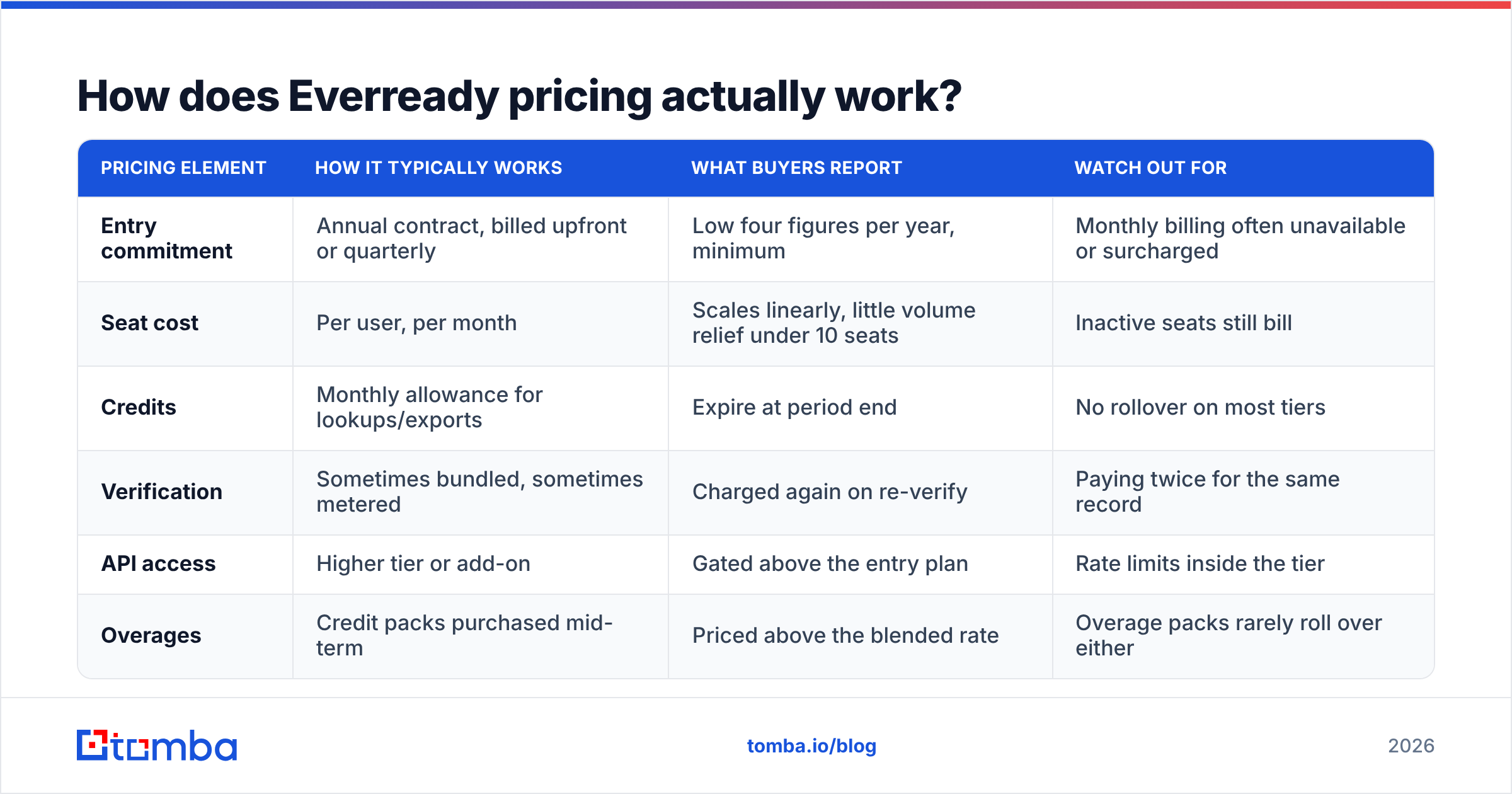
Here is the structure buyers consistently describe, with the bands they report:
| Pricing element | How it typically works | What buyers report | Watch out for |
|---|---|---|---|
| Entry commitment | Annual contract, billed upfront or quarterly | Low four figures per year, minimum | Monthly billing often unavailable or surcharged |
| Seat cost | Per user, per month | Scales linearly, little volume relief under 10 seats | Inactive seats still bill |
| Credits | Monthly allowance for lookups/exports | Expire at period end | No rollover on most tiers |
| Verification | Sometimes bundled, sometimes metered | Charged again on re-verify | Paying twice for the same record |
| API access | Higher tier or add-on | Gated above the entry plan | Rate limits inside the tier |
| Overages | Credit packs purchased mid-term | Priced above the blended rate | Overage packs rarely roll over either |
Compare that with the published, self-serve model most small teams need. Tomba pricing is a fixed ladder — a free tier with 25 searches a month, Starter at $49/mo, Growth at $99/mo, Pro at $249/mo, and a custom enterprise tier. You can model your annual spend in a spreadsheet in 90 seconds without booking a call. BookYourData takes a different but equally transparent route with pay-as-you-go credits and no forced subscription, which suits buyers who spike hard in one quarter and go quiet the next.
Neither approach is universally better. But there is a real difference between "I know exactly what this costs" and "I will find out after two calls and an NDA."
Wait — that placeholder renders as an image below:

What do reviews say — the honest pros and cons?#
Pull the review sites and the pattern is consistent. Everready gets solid marks on breadth and support, and takes hits on pricing transparency and data freshness in narrower segments. You can sanity-check the current state of the category on G2's lead intelligence listings and Capterra's lead generation software directory, both of which surface unfiltered buyer complaints alongside the marketing.
Pros reviewers repeat
- Coverage at the top of the market. Large, well-known companies are well represented. If your ICP is Fortune 5000, you will find people.
- Support and onboarding. Enterprise-grade vendors staff CSMs. That is worth real money when you are rolling out to 40 reps.
- CRM hygiene. Field mapping into Salesforce and HubSpot tends to be clean, which reduces the "two contacts, three records" mess.
- Filtering depth. Multi-attribute search (title, seniority, headcount, tech signals) beats scraping by a wide margin.
Cons reviewers repeat
- You cannot price it yourself. Every budget conversation requires the vendor's participation. Procurement teams hate this; solo founders hate it more.
- Credits expire. Unused allowance evaporates monthly. If your outbound is seasonal, you are burning money in the quiet months.
- Long-tail data thins out. Sub-50-employee companies, non-US regions, and niche verticals are where accuracy claims meet reality.
- Re-verification is not free. Data decays roughly 2–3% per month in normal B2B conditions. If re-checking a record costs another credit, your effective price per usable contact climbs quietly.
- Annual lock-in. You discover the data gaps in month two and pay through month twelve.
Note that none of these are unique to Everready. They are the standard trade-offs of the quote-based enterprise data model. The question is whether you are the buyer that model was built for.
What are the hidden costs in Everready pricing?#
The sticker price is the smallest number in the deal. Here is where the rest hides:
- The bounce tax. A 12% bounce rate on 5,000 sends is 600 dead addresses, plus the sender reputation damage that suppresses the other 4,400. Most teams never price this in. Run exports through a dedicated email verifier before sending and you convert an invisible cost into a visible, tiny one.
- Double-paying for verification. If your data vendor charges a credit to find a contact and another to confirm it is still live, your real per-contact cost is roughly double the quoted rate.
- Idle seats. Every plan has a rep who logs in twice a quarter. At per-seat pricing, that rep costs the same as your top performer.
- Overage packs. Mid-term credit purchases almost always price above the blended contract rate. Vendors know demand is inelastic once you are three months into a campaign.
- Migration and ops time. Deduplicating a messy export, normalizing job titles, and fixing CRM field mismatches is a real engineering cost. Tools with a proper bulk email finder workflow and a clean API cut that time; tools with CSV-only exports do not.
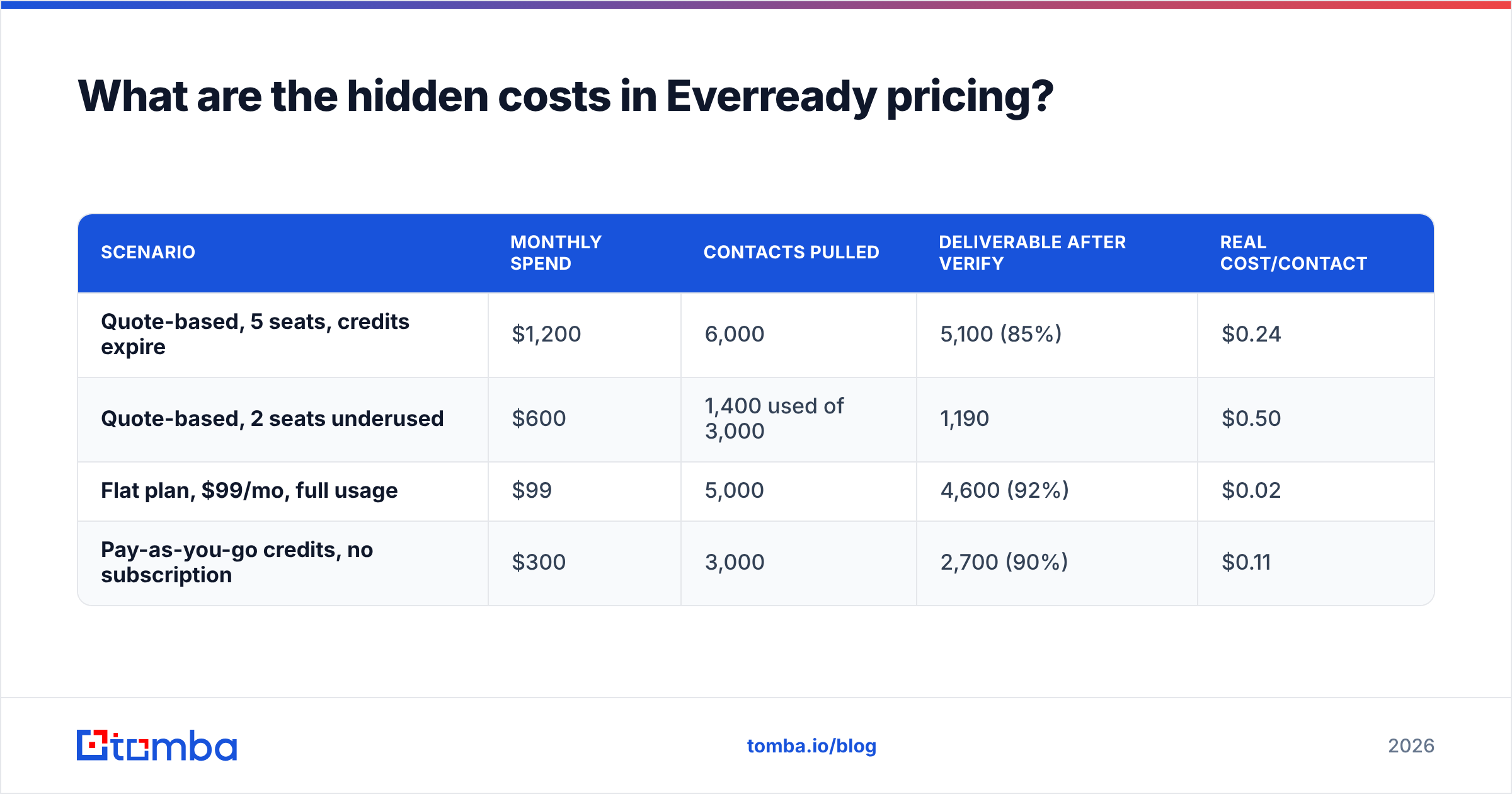
A simple way to expose all five: compute cost per verified, deliverable contact, not cost per credit.
| Scenario | Monthly spend | Contacts pulled | Deliverable after verify | Real cost/contact |
|---|---|---|---|---|
| Quote-based, 5 seats, credits expire | $1,200 | 6,000 | 5,100 (85%) | $0.24 |
| Quote-based, 2 seats underused | $600 | 1,400 used of 3,000 | 1,190 | $0.50 |
| Flat plan, $99/mo, full usage | $99 | 5,000 | 4,600 (92%) | $0.02 |
| Pay-as-you-go credits, no subscription | $300 | 3,000 | 2,700 (90%) | $0.11 |
The middle row is the one that kills budgets. Underuse on a per-seat contract does not save you money — it doubles your effective rate.
How does Everready compare to other B2B data tools on price?#
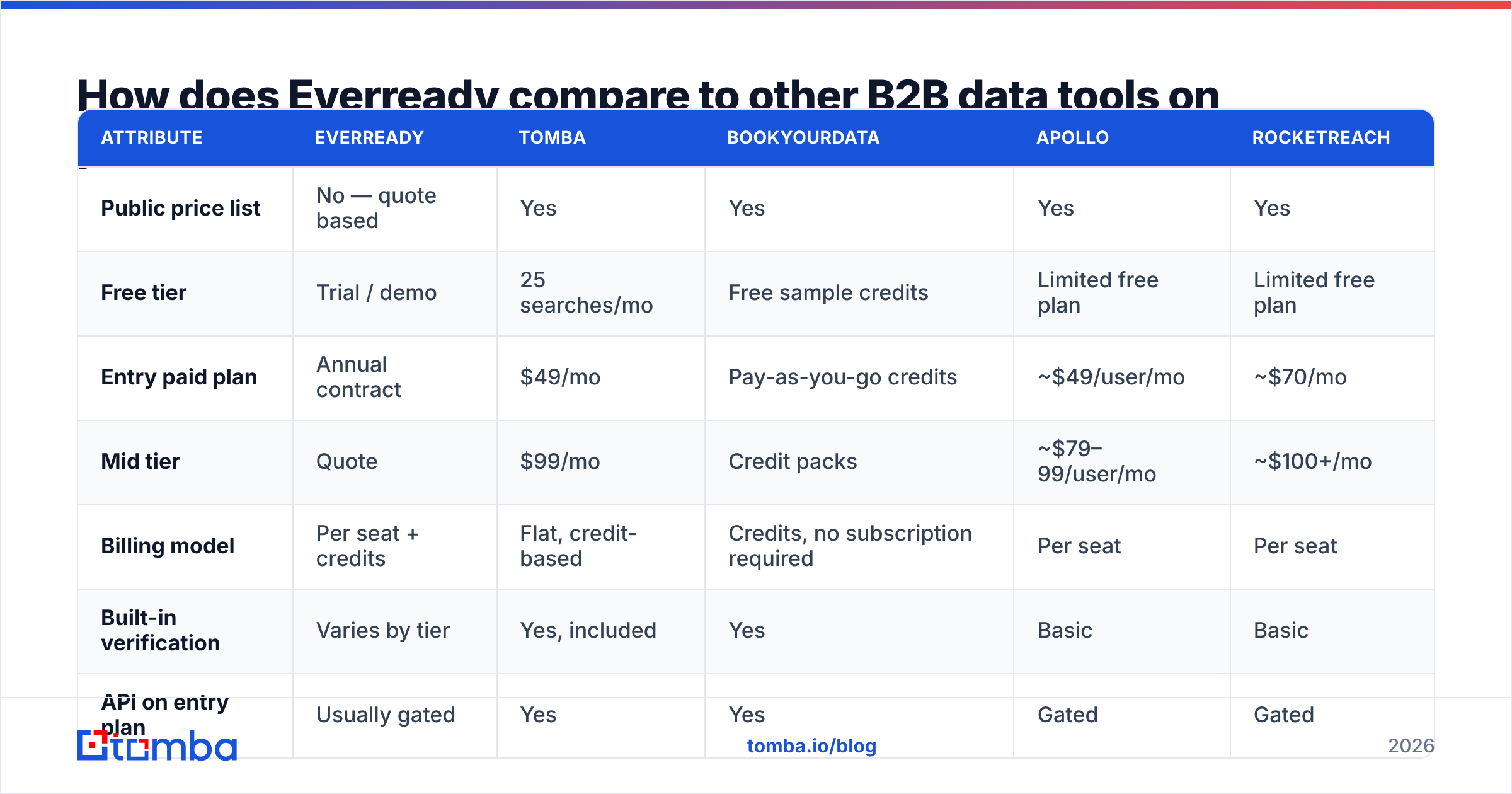
Here is the head-to-head on the attributes that actually change your invoice.

| Attribute | Everready | Tomba | BookYourData | Apollo | RocketReach |
|---|---|---|---|---|---|
| Public price list | No — quote based | Yes | Yes | Yes | Yes |
| Free tier | Trial / demo | 25 searches/mo | Free sample credits | Limited free plan | Limited free plan |
| Entry paid plan | Annual contract | $49/mo | Pay-as-you-go credits | ~$49/user/mo | ~$70/mo |
| Mid tier | Quote | $99/mo | Credit packs | ~$79–99/user/mo | ~$100+/mo |
| Billing model | Per seat + credits | Flat, credit-based | Credits, no subscription required | Per seat | Per seat |
| Built-in verification | Varies by tier | Yes, included | Yes | Basic | Basic |
| API on entry plan | Usually gated | Yes | Yes | Gated | Gated |
| Contract length | Annual typical | Monthly or annual | None required | Monthly or annual | Monthly or annual |
| Best fit | 25+ rep enterprise teams | Lean teams, devs, agencies | Burst-buying, list purchases | Full outbound stack in one seat | Recruiters, individual researchers |
Two takeaways. First, if you need a full sequencer, dialer, and data in one login, the per-seat platforms genuinely earn their price — that bundle has value. Second, if you already run Instantly, Smartlead, or your own sending stack and you only need clean contact data, per-seat pricing is dead weight. You are renting a suite to use one drawer.
Is the data accurate enough to justify the price?#
Accuracy is where pricing arguments get settled, because a cheap bad record is more expensive than an expensive good one.

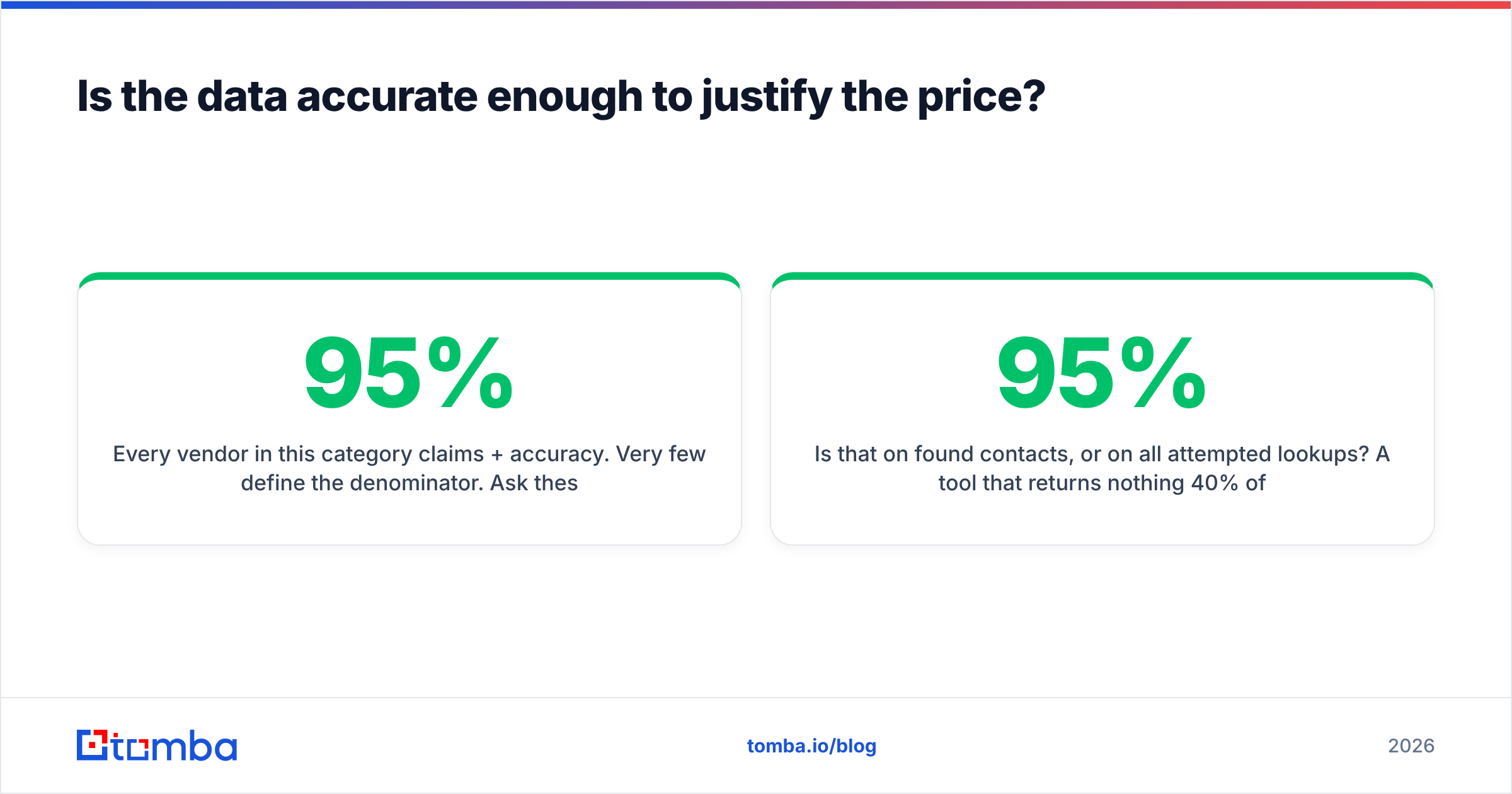
Every vendor in this category claims 95%+ accuracy. Very few define the denominator. Ask these four questions on the sales call and write down the answers:
- Is that 95% on found contacts, or on all attempted lookups? A tool that returns nothing 40% of the time can honestly claim high accuracy on what it does return.
- How is a catch-all domain scored? Catch-alls accept everything at SMTP and tell you nothing. Vendors that count them as "valid" are inflating the number. A dedicated catch-all verifier is the honest way to handle them.
- How old is the record? Ask for last-verified timestamps, not just a confidence score.
- What is the refund policy on bounces? A vendor that credits you back for hard bounces is telling you it believes its own numbers.
Then run the test that no marketing page can spin: take 100 contacts inside your exact ICP, pull them from two vendors, and send an identical verified-only campaign. Compare hard bounce rate and reply rate. Whichever tool wins gets your budget. This takes an afternoon and routinely overturns a six-figure procurement assumption.

When should you pick Everready — and when shouldn't you?#
Pick it if:
- You have 25+ reps and per-seat economics genuinely apply.
- You need SOC 2 paperwork, SSO, a named CSM, and procurement-friendly invoicing.
- Your ICP is enterprise, US-heavy, and well covered by mainstream data providers.
- You have leverage to negotiate — Q4 quotes on annual contracts are routinely 20–30% below the first number.
Skip it if:
- You are under 10 reps. The per-seat math will not work for you, and no amount of negotiation fixes a structural mismatch.
- Your outbound is bursty. Expiring credits punish seasonal demand hard.
- You need contacts in the long tail — sub-50-headcount companies, EMEA/APAC mid-market, niche verticals.
- You already own your sequencing stack and only need data plus verification.
- You want to build against an API without upgrading two tiers to get access to it.
For that last group, a developer-first approach is usually cheaper by an order of magnitude. A documented email finder API available on entry plans means you can enrich inside your own workflow instead of paying for a UI your reps will not open.
What is the leanest replacement if the quote comes back too high?#
Start with the job to be done. Most teams asking about Everready pricing need three things: find the right person's email, confirm it is live, and get it into the CRM without manual work. Everything else on an enterprise contract is optional.
That stack looks like this:
- Find — domain-level or name-level lookup across your target account list.
- Verify — SMTP-level checks plus catch-all handling before a single send.
- Enrich — job title, company size, and social profiles appended automatically.
- Sync — push to HubSpot, Salesforce, or a sheet on a schedule, not by hand.
You can assemble that for $49–$99/mo on published pricing, with no call, no annual lock, and no seat tax. If you later scale past it, the enterprise vendors will still be there — and you will negotiate from a much stronger position because you will have real bounce-rate data from your own ICP instead of a slide deck. For broader context on how the category is structured, Wikipedia's lead generation overview is a reasonable neutral primer.
The bottom line on Everready pricing#
Everready is a legitimate option for enterprise teams that need coverage, support, and compliance paperwork, and that have the seat count to make per-seat pricing rational. It is a poor fit for lean teams, bursty campaigns, and API-first builders — not because the product is bad, but because the commercial model was not designed for them.
Judge it on cost per verified contact, insist on a real trial with your own ICP list, and never sign before you have run the 100-contact bounce test.
If you want to skip the sales call entirely, start with the Tomba Email Finder. The free tier gives you 25 searches a month to run that bounce test today, verification is built in rather than metered separately, and paid plans start at a published $49/mo with API access included — so you can price your outbound program in a spreadsheet instead of a procurement cycle.
Related guides#
Ready to find emails that actually work?
Join 150,000+ professionals who stopped guessing and started sending. Free credits on signup — no credit card required.
Get the Tomba newsletter
Practical outbound tactics and product updates — once every two weeks.
About the author