Everstage Alternatives: 9 Sales Commission Tools for 2026
Everstage is solid ICM software, but it is not the right fit for every comp team. Here are nine Everstage alternatives compared on pricing, implementation time, plan complexity, and who each one actually serves best.
TL;DR
- Everstage is a strong mid-market incentive compensation management (ICM) platform, but it is quote-only, sales-led, and priced per payee — which pushes small teams and very complex enterprises elsewhere.
- If you want self-serve and cheap, look at QuotaPath or Visdum. If you want enterprise plan complexity, look at Xactly, Varicent, or Performio. If you want the closest like-for-like swap, look at CaptivateIQ or Salesforce Spiff.
- Commission software does not fix bad data. Roughly every ICM implementation that blows past schedule does so because CRM records — owners, territories, contacts, account mapping — are dirty, not because the calc engine is weak.
- Expect 4–12 weeks of implementation for any real ICM tool, and budget for a comp analyst's time, not just license fees.
- Before you migrate, run one full quarter in parallel. Every team that skips this step regrets it on the first payout run.
What is Everstage and who is it actually for?#
Everstage is commission automation software. You load quotas, plan rules, and closed-won data from your CRM; it calculates payouts, publishes rep-facing dashboards, and gives finance an audit trail instead of a 40-tab spreadsheet.
Its sweet spot is the 50–500 payee company that has outgrown Excel but does not need a Fortune 500 comp engine. Reps get a live earnings view, managers get quota attainment reporting, and comp admins get a no-code plan designer that does not require a consultant for every rule change.
What it is not: cheap, self-serve, or instant. Pricing is quote-only, sold per payee per month, with an annual commitment and an implementation fee. That's standard for the category — but it's also the number one reason buyers start hunting for Everstage alternatives.
Why do teams look for Everstage alternatives?#
Five reasons come up repeatedly in buyer reviews on G2 and in RevOps communities:
- Price floor. Per-payee pricing with an annual minimum prices out teams under ~25 reps. A 12-person sales team rarely justifies a five-figure ICM contract.
- Plan complexity ceiling. Multi-entity, multi-currency, cross-quarter clawbacks, and tiered team overlays are where enterprise buyers report friction. Xactly and Varicent exist for exactly this.
- Implementation drag. Any ICM rollout requires clean historical data. Teams with messy CRM hygiene discover this in week three and blame the tool.
- Ecosystem lock-in. Heavy Salesforce shops often prefer Salesforce Spiff because it's native to the platform they already administer.
- Wanting spreadsheets back — sort of. Some finance leads want a calculation layer they can audit line by line, not a black box. That's a real preference, and a few tools serve it better than others.
How do the top Everstage alternatives compare?#
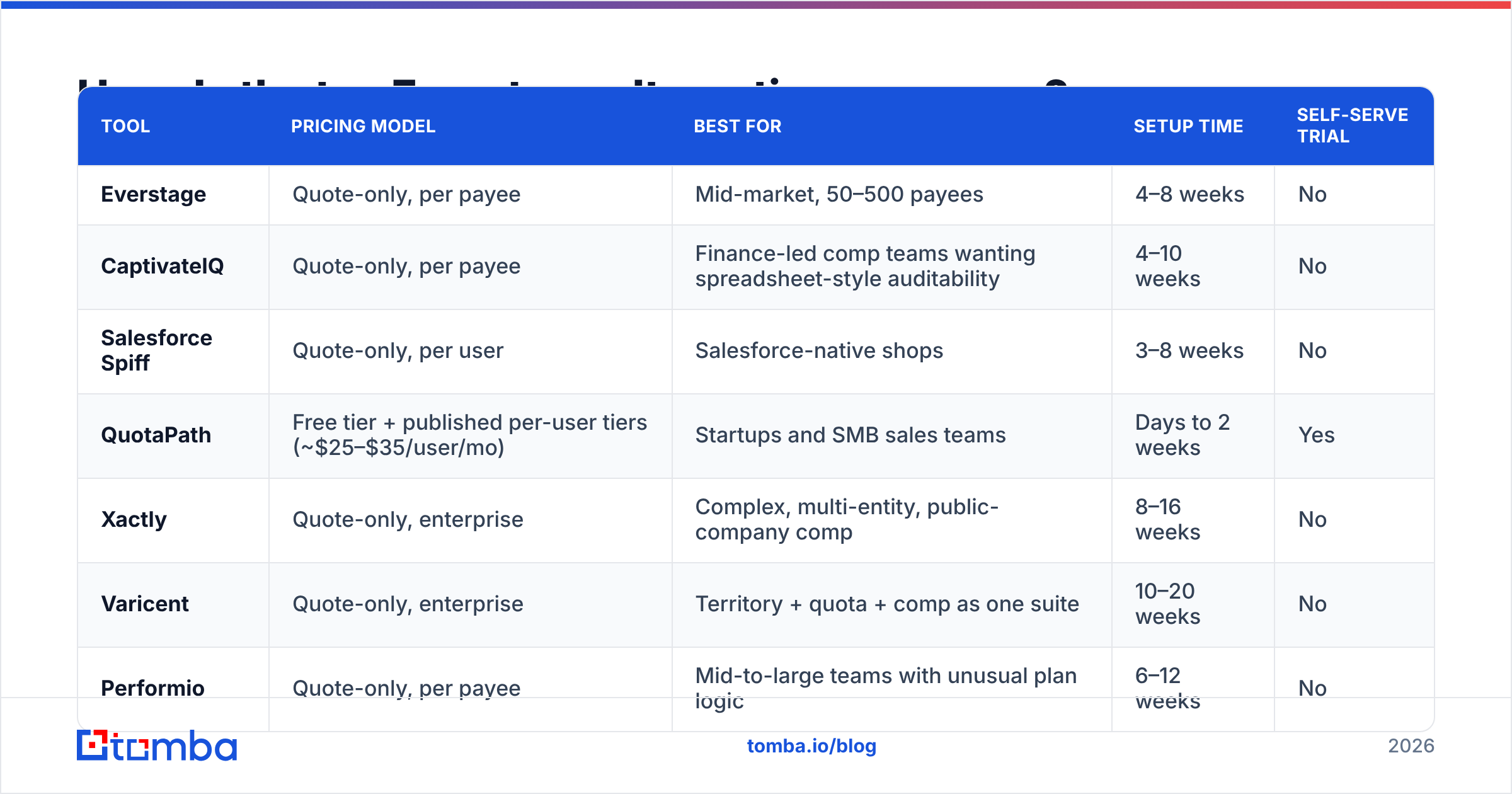
Pricing in this category is mostly quote-only. The figures below are the published list prices where vendors publish them, and buyer-reported ranges where they don't — treat the latter as directional, not contractual, and always get your own quote.
| Tool | Pricing model | Best for | Setup time | Self-serve trial |
|---|---|---|---|---|
| Everstage | Quote-only, per payee | Mid-market, 50–500 payees | 4–8 weeks | No |
| CaptivateIQ | Quote-only, per payee | Finance-led comp teams wanting spreadsheet-style auditability | 4–10 weeks | No |
| Salesforce Spiff | Quote-only, per user | Salesforce-native shops | 3–8 weeks | No |
| QuotaPath | Free tier + published per-user tiers (~$25–$35/user/mo) | Startups and SMB sales teams | Days to 2 weeks | Yes |
| Xactly | Quote-only, enterprise | Complex, multi-entity, public-company comp | 8–16 weeks | No |
| Varicent | Quote-only, enterprise | Territory + quota + comp as one suite | 10–20 weeks | No |
| Performio | Quote-only, per payee | Mid-to-large teams with unusual plan logic | 6–12 weeks | No |
| Visdum | Published per-payee, SaaS-focused, low entry | SaaS teams under 100 reps | 2–4 weeks | Yes |
| Core Commissions | Published tiers starting a few hundred $/mo | Small teams wanting managed calc service | 2–6 weeks | Limited |
Two things stand out. First, the only tools you can actually try before a sales call are QuotaPath, Visdum, and (partially) Core Commissions — that alone narrows the list for a lot of buyers. Second, setup time correlates almost perfectly with plan complexity, not with vendor quality. A 16-week Xactly rollout isn't slow software; it's a comp plan with 40 rules and six entities.
Which Everstage alternative fits which team?#
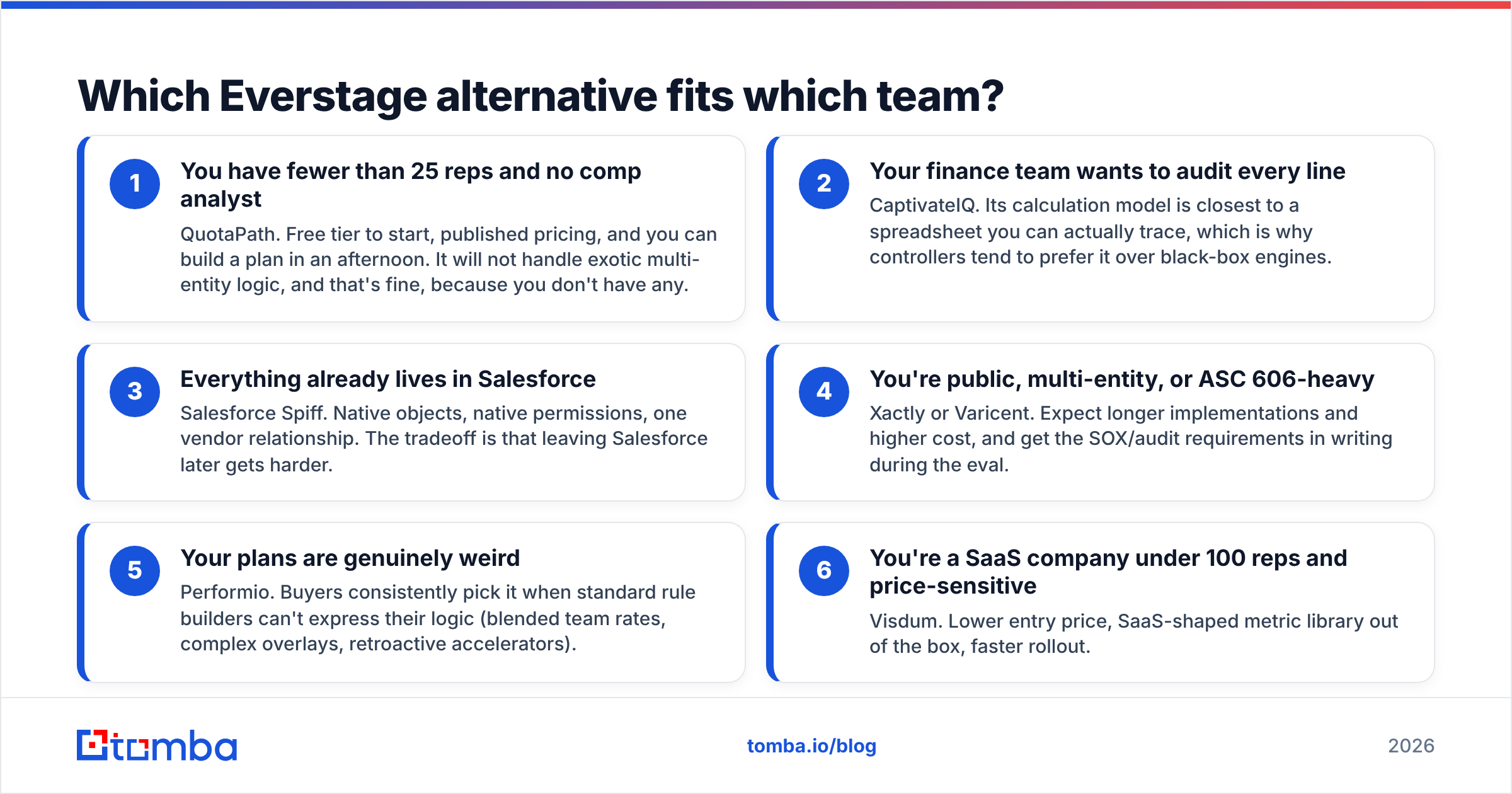
Match the tool to your constraint, not to the feature grid:
- You have fewer than 25 reps and no comp analyst — QuotaPath. Free tier to start, published pricing, and you can build a plan in an afternoon. It will not handle exotic multi-entity logic, and that's fine, because you don't have any.
- Your finance team wants to audit every line — CaptivateIQ. Its calculation model is closest to a spreadsheet you can actually trace, which is why controllers tend to prefer it over black-box engines.
- Everything already lives in Salesforce — Salesforce Spiff. Native objects, native permissions, one vendor relationship. The tradeoff is that leaving Salesforce later gets harder.
- You're public, multi-entity, or ASC 606-heavy — Xactly or Varicent. Expect longer implementations and higher cost, and get the SOX/audit requirements in writing during the eval.
- Your plans are genuinely weird — Performio. Buyers consistently pick it when standard rule builders can't express their logic (blended team rates, complex overlays, retroactive accelerators).
- You're a SaaS company under 100 reps and price-sensitive — Visdum. Lower entry price, SaaS-shaped metric library out of the box, faster rollout.
If none of those describe you, honestly, staying on Everstage is a defensible answer. Switching ICM vendors is one of the highest-friction migrations in the RevOps stack.
What does commission software actually cost in 2026?#
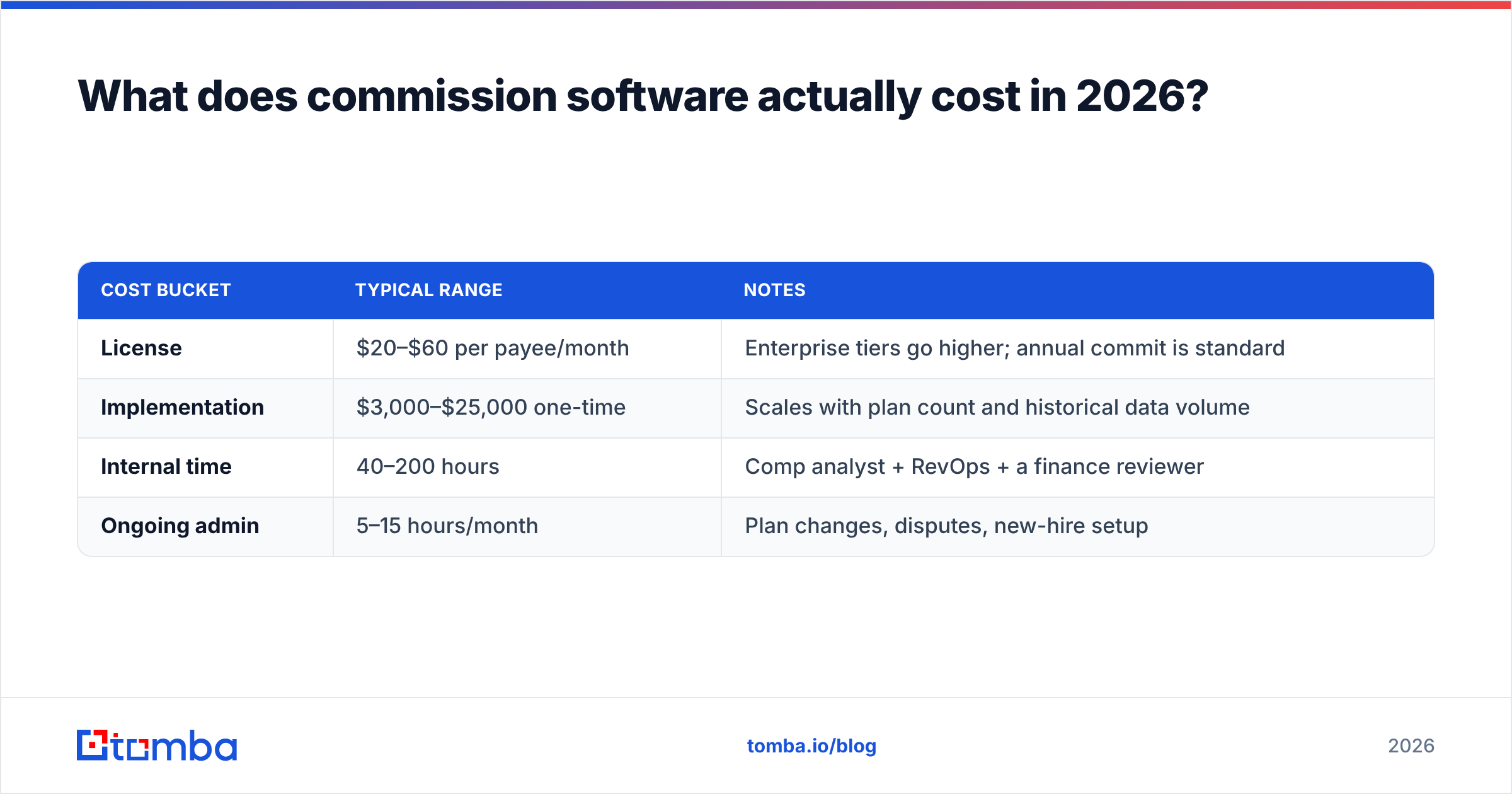
Budget in three buckets, not one:
| Cost bucket | Typical range | Notes |
|---|---|---|
| License | $20–$60 per payee/month | Enterprise tiers go higher; annual commit is standard |
| Implementation | $3,000–$25,000 one-time | Scales with plan count and historical data volume |
| Internal time | 40–200 hours | Comp analyst + RevOps + a finance reviewer |
| Ongoing admin | 5–15 hours/month | Plan changes, disputes, new-hire setup |
The internal-time line is the one buyers systematically under-forecast. A tool that costs $18k/year but takes 150 hours of your RevOps lead's time is not cheaper than a $30k tool that takes 40. Price the whole thing.
How do you migrate without breaking payroll?#
Run this sequence. Skipping steps is where migrations go wrong.
- Freeze the current quarter. Never migrate mid-period. Pick a clean quarter boundary.
- Export three quarters of historical payouts as your regression test set. If the new tool can't reproduce them to the cent, you have a rule mismatch — find it before go-live.
- Clean the CRM first, not after. Owner fields, split credit, territory assignment, account hierarchy, and duplicate contacts all feed the calc engine. Garbage in, disputed payouts out.
- Rebuild plans from the plan document, not from the old tool's config. Old configs carry old workarounds.
- Run one full quarter in parallel. Old tool and new tool, same inputs, compare outputs weekly.
- Publish rep dashboards last. Reps checking a dashboard that's still wrong destroys trust in the new system permanently.
Step 3 is where most of the pain lives, and it has nothing to do with which vendor you picked.
Why does data quality decide whether your ICM rollout works?#
Commission engines are deterministic. Feed them the right deal records, the right owner, the right account, and they will be correct forever. Feed them a CRM where 20% of accounts have a stale owner, three duplicate records, and a contact list full of bounced addresses, and every payout run generates disputes.
Think of ICM software as a very precise scale. The scale is not the problem — what you put on it is.
That means the pre-work for an Everstage alternative migration looks a lot like general CRM hygiene work:
- Deduplicate accounts and contacts before you map credit rules to them.
- Fix owner and territory fields, because split-credit rules read from them directly.
- Refresh contact data on open pipeline so the deals feeding your quota attainment are real, not zombie opportunities with a champion who left 14 months ago.
- Standardize company records — domain, legal entity, region — so multi-entity plans route to the right books.
This is where a data enrichment layer earns its keep. Enriching account and contact records with current job titles, verified emails, and correct company domains before a comp migration removes a whole category of downstream dispute. If your CRM is Salesforce, a Salesforce integration that keeps contact records fresh on a schedule is worth more to your comp accuracy than another rule in the calc engine.
How do these tools handle rep-facing transparency?#
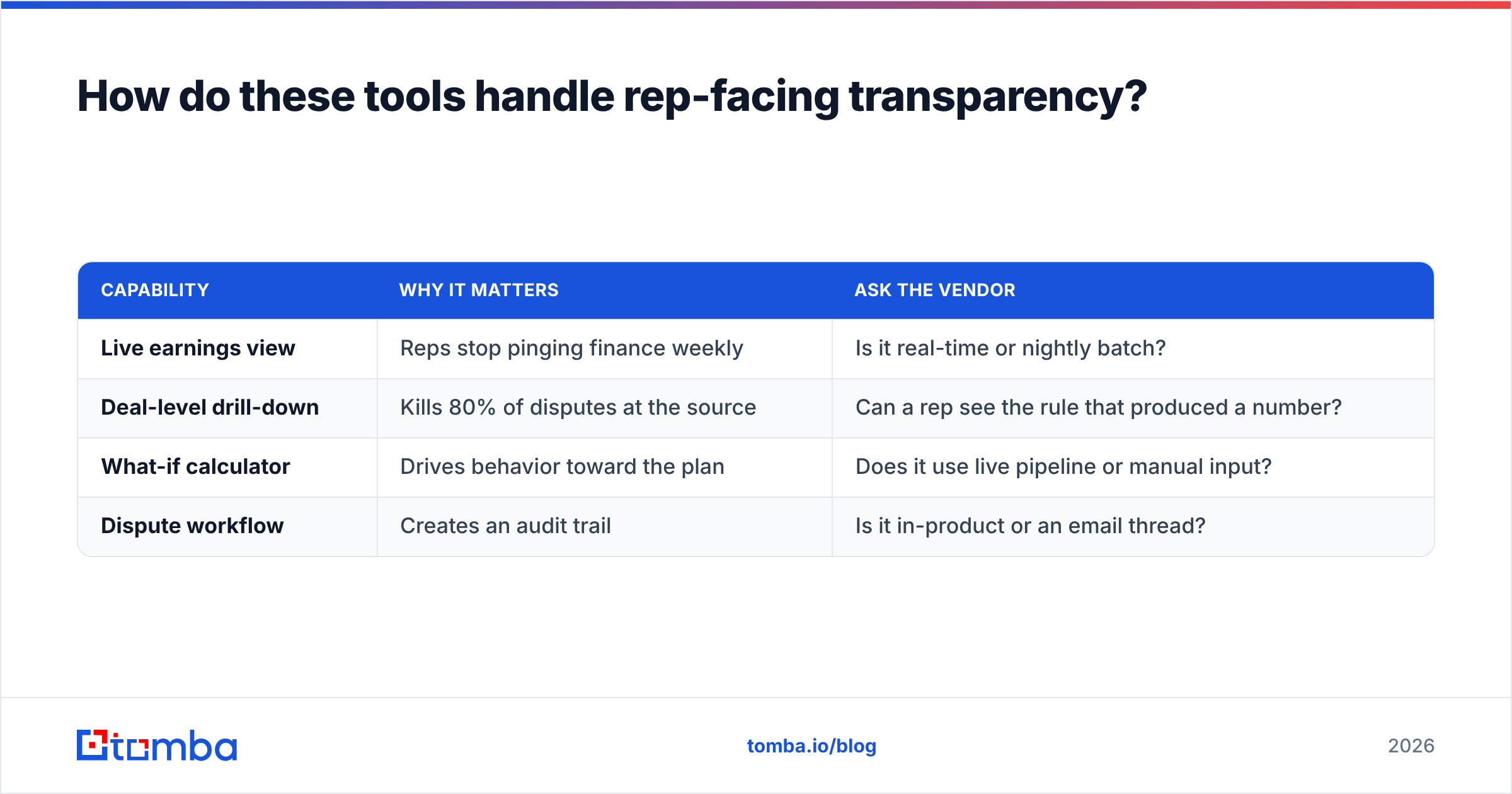
Transparency is the feature reps actually judge you on. Everstage is genuinely good here — its rep dashboards and "what-if" calculators are among the reasons it wins mid-market deals. When you evaluate alternatives, test these four things with a real rep, not a demo persona:
| Capability | Why it matters | Ask the vendor |
|---|---|---|
| Live earnings view | Reps stop pinging finance weekly | Is it real-time or nightly batch? |
| Deal-level drill-down | Kills 80% of disputes at the source | Can a rep see the rule that produced a number? |
| What-if calculator | Drives behavior toward the plan | Does it use live pipeline or manual input? |
| Dispute workflow | Creates an audit trail | Is it in-product or an email thread? |
QuotaPath and CaptivateIQ score well on the first two. Enterprise tools tend to be strongest on the audit trail and weakest on rep experience — a real tradeoff, not a bug.
Do you need ICM software at all?#
If you have fewer than about 10 payees, one plan, and no accelerators, a well-built spreadsheet plus a monthly review is genuinely fine. The tipping point is usually one of:
- More than ~15 payees
- More than 2 plan types
- Any split credit, clawback, or team-based component
- A finance close that gets delayed by commission calculations
- Reps disputing payouts more than once a quarter
Hit two of those and the software pays for itself in reclaimed analyst hours. Hit none and you're buying process, not value.
For teams still building the pipeline that will eventually justify comp software, the constraint is upstream: getting enough qualified contacts into the funnel in the first place. That's a revenue operations sequencing question — pipeline generation first, comp automation second.
What should you do next?#
Shortlist three tools maximum: one self-serve (QuotaPath or Visdum), one like-for-like (CaptivateIQ or Spiff), and one enterprise option only if your plan complexity genuinely requires it. Give each the same three historical quarters and make them reproduce your actual payouts. The one that gets closest with the least configuration wins.
Then fix the data underneath it. A commission engine calculating on stale contacts and duplicated accounts produces confident, precise, wrong numbers.
If your pipeline data is the weak link — missing contacts, bounced addresses, accounts with no verified decision-maker — start there. Tomba's Email Finder pulls verified professional emails by domain, name, or company so the accounts feeding your quota attainment are real people you can actually reach. It's free to test with 25 searches a month, and paid plans start at $49/mo — a rounding error next to any ICM contract, and the difference between a comp migration that lands and one that generates disputes for two quarters.
Related guides#
Ready to find emails that actually work?
Join 150,000+ professionals who stopped guessing and started sending. Free credits on signup — no credit card required.
Get the Tomba newsletter
Practical outbound tactics and product updates — once every two weeks.
About the author