EVS7 Pricing Reviews Pros and Cons: 2026 Cost Breakdown
A neutral look at EVS7's dialer lineup: what each product actually costs per seat, where the add-ons hide, what reviewers praise and complain about, and when a cheaper stack beats it.
This guide covers EVS7 pricing reviews pros and cons in one place: per-seat costs, the add-ons that hide in the quote, what users praise, and where the tool falls short.
TL;DR
- EVS7 sells three dialers: Cricket, Dolphin Power Dialer, and Parrot Predictive Dialer. Seat prices run from the $30s to the $150s per month.
- The seat price is not the real cost. Minutes, caller-ID numbers, CRM work, and onboarding push it higher.
- Reviewers praise the US-based support and the fast setup. They fault the dated UI, call-quality dips, and thin integrations.
- It fits phone-first teams in insurance, staffing, real estate, and collections. It is a weak fit if you want email, calls, and LinkedIn in one tool.
- Fix your list before you buy seats. A dialer calls whatever numbers you feed it, and bad ones cost the same as good ones.
What is EVS7 and who actually uses it?#
EVS7 is Electronic Voice Services, a Texas-based dialer vendor. It has sold outbound calling software since the 1990s. That history shapes how you should read the product. EVS7 is not a venture-funded sales-engagement platform trying to own your whole outbound stack. It sells calling infrastructure — dialers — to teams that live on the phone.
The lineup breaks into three tiers of aggressiveness:
- Cricket — a lightweight click-to-call and voice-broadcast tool. One call at a time, browser-based, minimal setup. Aimed at solo reps, small agencies, and anyone replacing a cell phone plus a spreadsheet.
- Dolphin Power Dialer — the flagship. Sequential power dialing through a list, with built-in contact management, call recording, local presence, voicemail drop, and scripting. This is what most EVS7 buyers end up on.
- Parrot Predictive Dialer — multi-line predictive dialing that calls several numbers per agent and connects only answered calls. Built for high-volume call floors where agent idle time is the primary cost.
- Add-on layers — SMS, email drip, and CRM connectors sit alongside the dialers rather than being bundled into a single subscription.
The typical EVS7 customer is a 3–50 seat outbound team in insurance, staffing, mortgage, home services, debt collection, or B2B appointment setting. If your reps make 100+ dials a day and your CRM is a mid-market tool rather than Salesforce Enterprise, you are squarely in the target profile. You can confirm current product scope on the official EVS7 site.
How much does EVS7 cost in 2026?#
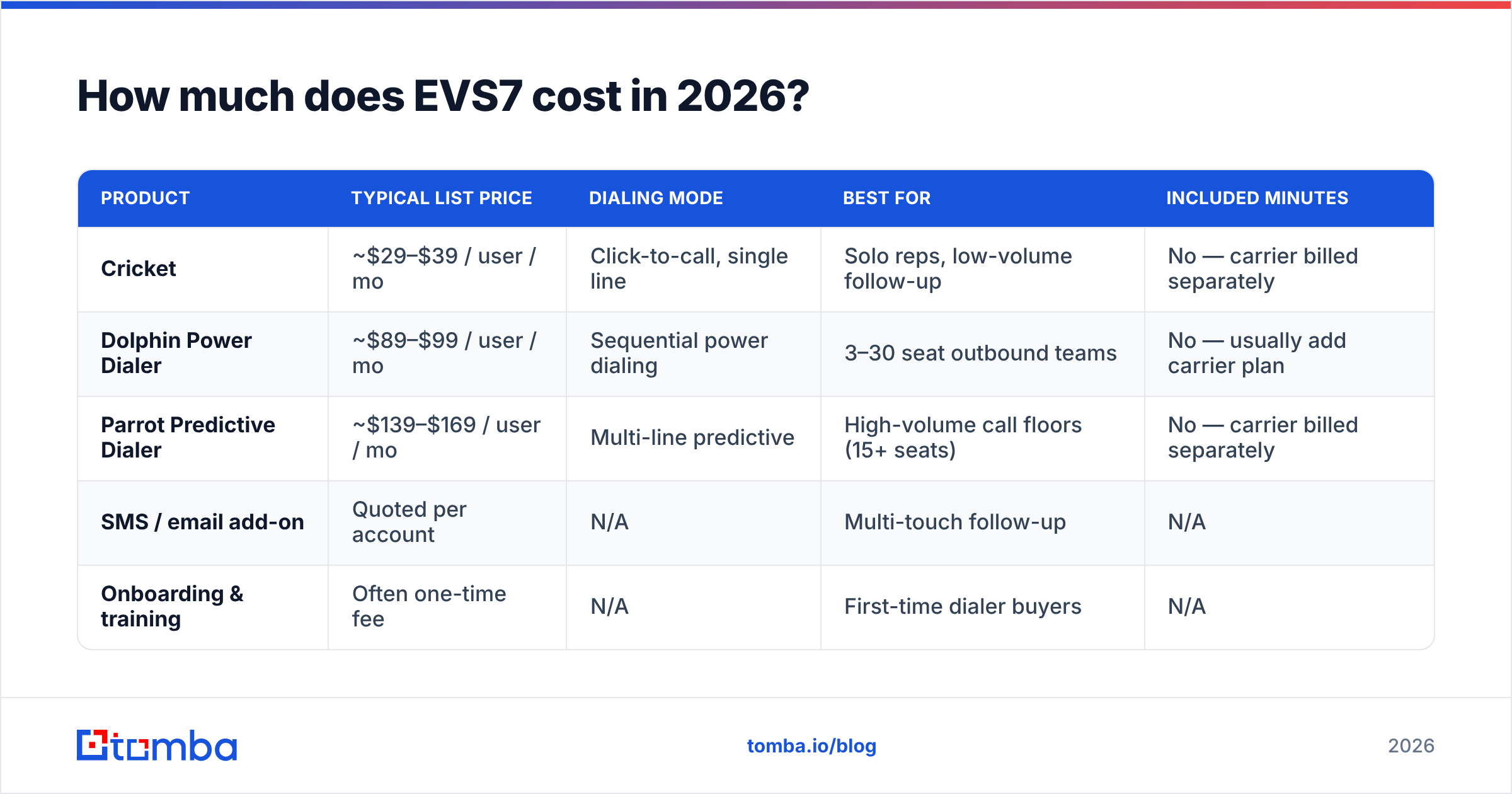
EVS7 publishes per-seat monthly pricing. The exact number depends on product, seat count, and contract length. Treat the table below as a planning baseline and verify it against a live quote. Dialer vendors move pricing more often than SaaS tools do, and volume discounts kick in fast above ten seats.
| Product | Typical list price | Dialing mode | Best for | Included minutes |
|---|---|---|---|---|
| Cricket | ~$29–$39 / user / mo | Click-to-call, single line | Solo reps, low-volume follow-up | No — carrier billed separately |
| Dolphin Power Dialer | ~$89–$99 / user / mo | Sequential power dialing | 3–30 seat outbound teams | No — usually add carrier plan |
| Parrot Predictive Dialer | ~$139–$169 / user / mo | Multi-line predictive | High-volume call floors (15+ seats) | No — carrier billed separately |
| SMS / email add-on | Quoted per account | N/A | Multi-touch follow-up | N/A |
| Onboarding & training | Often one-time fee | N/A | First-time dialer buyers | N/A |
Two structural things to notice.
First, minutes are almost always separate. Most EVS7 configurations let you bring your own SIP trunk or buy minutes through the vendor. That flexibility helps if you already have a carrier relationship. It confuses things if you are budgeting for the first time. A busy power-dialer seat can burn 2,000–4,000 outbound minutes a month. At $0.01–$0.02 per minute, that is another $20–$80 per seat before anyone answers.
Second, predictive dialing changes your compliance exposure, not just your price. Multi-line dialing triggers abandonment-rate rules and consent requirements that single-line click-to-call does not. The FCC's telemarketing and robocall rules are the baseline; state-level rules stack on top. Budget for compliance review, not just software.
What do EVS7 reviews actually say?#
Pull the aggregate sentiment from public review sites like G2 and Capterra and a consistent shape emerges. EVS7 scores well on support and value, and less well on modernity.
What reviewers repeatedly praise:
- Support that answers. This is the single most common positive. Reviewers describe named account contacts, real phone support, and short resolution times — a meaningful contrast with self-serve platforms where support is a chat widget.
- Fast to stand up. Teams report going from signup to live dialing in days, not weeks. There's no six-figure implementation partner in the middle.
- Dial volume lift is real. The most cited hard number is roughly a 2–3x increase in daily connects when moving from manual dialing to Dolphin, which tracks with what power dialers do generally.
- Price predictability at the seat level. No per-minute surprises baked into the platform fee itself.
What reviewers repeatedly criticize:
- The interface looks its age. Functional, dense, not delightful. Reps coming from a modern CRM notice immediately.
- Call quality varies by carrier setup. Complaints about dropped calls and audio lag usually trace back to network or SIP configuration rather than the software, but the buyer experiences it as a product problem.
- Integration depth. Native CRM connections exist but are thinner than what Outreach, Salesloft, or Apollo ship. Teams often end up using Zapier or the API as glue.
- Reporting is basic. You get call outcomes and agent activity. You do not get conversation intelligence, talk-track scoring, or the analytics layer that revenue teams increasingly expect.
The honest summary: EVS7 reviews describe a tool that does its narrow job well and does not pretend to be a platform.
What are the real pros and cons of EVS7?#
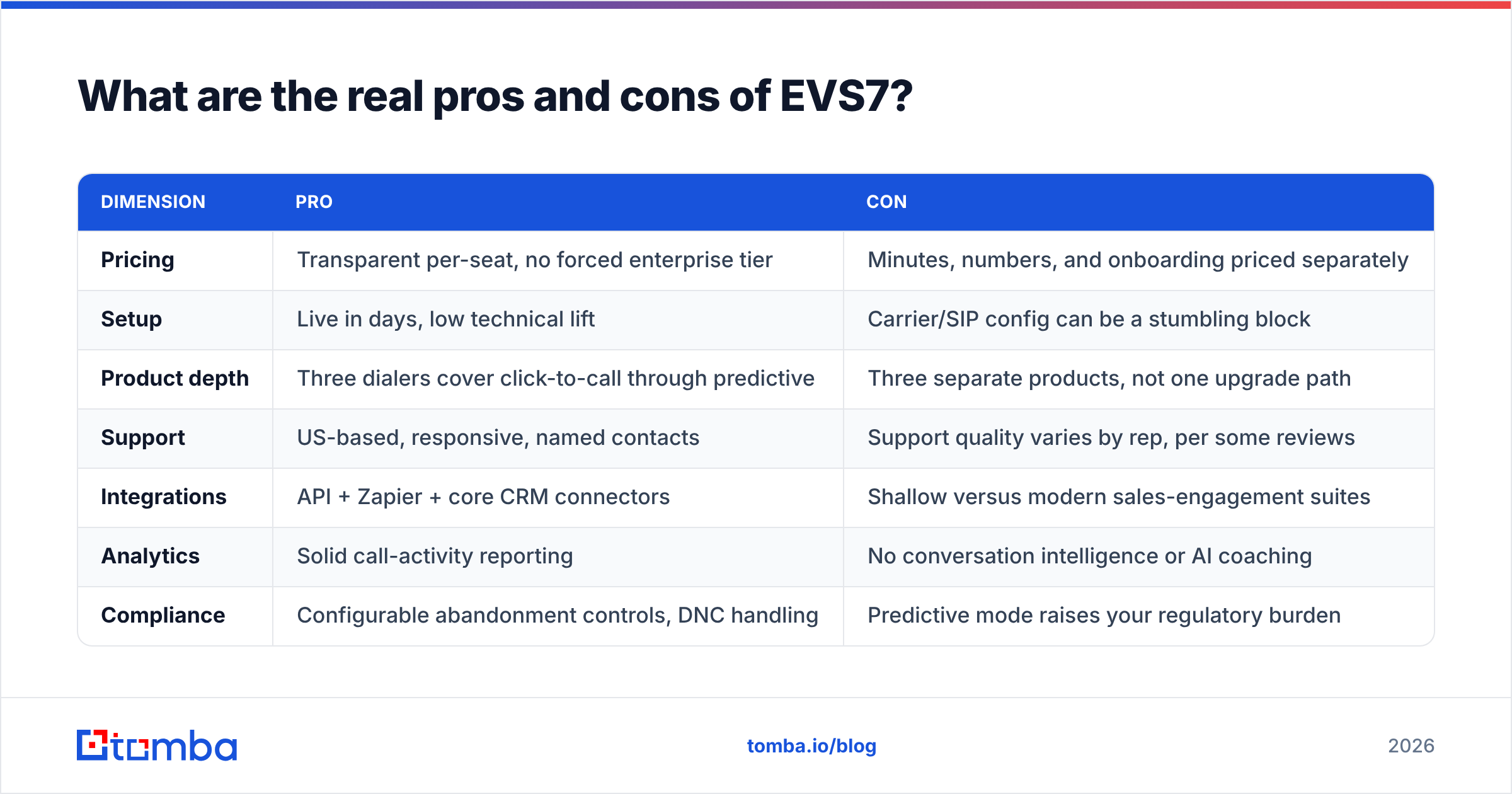
| Dimension | Pro | Con |
|---|---|---|
| Pricing | Transparent per-seat, no forced enterprise tier | Minutes, numbers, and onboarding priced separately |
| Setup | Live in days, low technical lift | Carrier/SIP config can be a stumbling block |
| Product depth | Three dialers cover click-to-call through predictive | Three separate products, not one upgrade path |
| Support | US-based, responsive, named contacts | Support quality varies by rep, per some reviews |
| Integrations | API + Zapier + core CRM connectors | Shallow versus modern sales-engagement suites |
| Analytics | Solid call-activity reporting | No conversation intelligence or AI coaching |
| Compliance | Configurable abandonment controls, DNC handling | Predictive mode raises your regulatory burden |
| Contract | Month-to-month available on some plans | Best pricing usually requires annual commitment |
Where do the hidden costs show up?#
Model the fully loaded cost, not the sticker. For a ten-seat Dolphin deployment, a realistic monthly build-up looks like this:
- Seats: 10 × ~$95 = ~$950
- Minutes: 10 × ~2,500 min × $0.012 = ~$300
- DIDs / local presence numbers: 20–50 numbers × $1–$2 = ~$40–$100
- Number rotation and reputation monitoring: $0–$150 depending on vendor
- CRM integration maintenance: a few engineering hours a quarter
- Onboarding: one-time, often $300–$1,000
That's roughly $1,300–$1,600/month all-in for ten seats — versus a $950 headline. The gap is about 40%. That's not unique to EVS7; it's how the dialer category prices. But it means a "cheaper" competitor with bundled minutes can end up costing the same or more.
The cost nobody budgets for is wrong numbers. Say 25% of your list has a disconnected, wrong-department, or gatekeeper-only number. You then pay full price for a quarter of your dial volume to go nowhere, and you age your caller IDs into spam-likely territory while you do it. Running a phone validator pass over the list before it hits the dialer is a rounding error against the minute spend it saves.
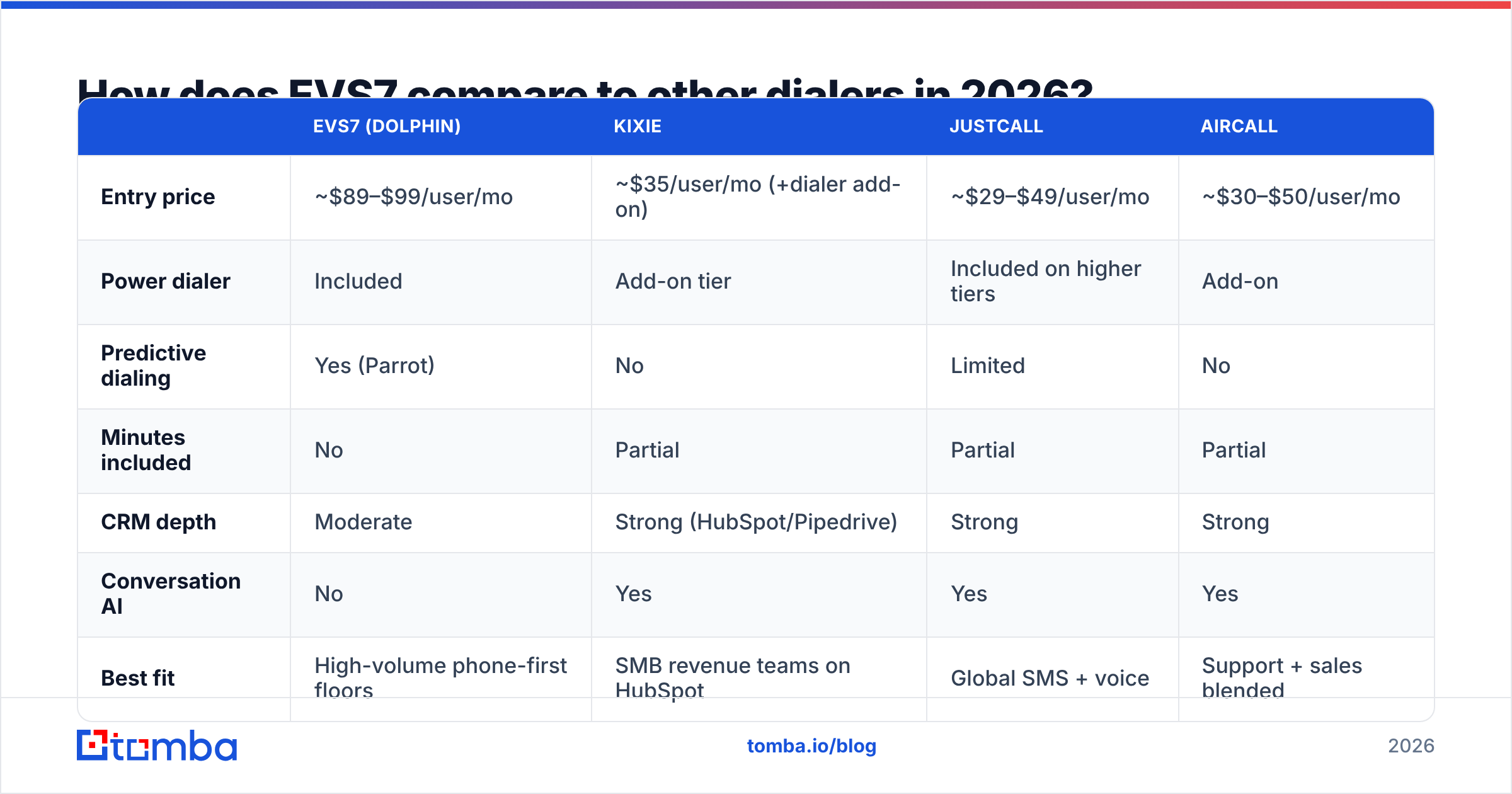
How does EVS7 compare to other dialers in 2026?#
| EVS7 (Dolphin) | Kixie | JustCall | Aircall | |
|---|---|---|---|---|
| Entry price | ~$89–$99/user/mo | ~$35/user/mo (+dialer add-on) | ~$29–$49/user/mo | ~$30–$50/user/mo |
| Power dialer | Included | Add-on tier | Included on higher tiers | Add-on |
| Predictive dialing | Yes (Parrot) | No | Limited | No |
| Minutes included | No | Partial | Partial | Partial |
| CRM depth | Moderate | Strong (HubSpot/Pipedrive) | Strong | Strong |
| Conversation AI | No | Yes | Yes | Yes |
| Best fit | High-volume phone-first floors | SMB revenue teams on HubSpot | Global SMS + voice | Support + sales blended |
Read that table as a positioning map, not a scoreboard. EVS7 wins on dialing throughput per dollar at high volume and on predictive capability, which most of the modern SMB voice tools simply don't offer. It loses on ecosystem — if your team wants voice, email, SMS, LinkedIn, and AI coaching in one pane of glass, EVS7 is not that product and doesn't claim to be.

Is EVS7 worth it for your team?#
Answer three questions honestly.
1. Is phone your primary channel, or a supporting one? If more than half of your first touches are dials, a dedicated dialer earns its seat cost quickly. If the phone is your third channel behind email and LinkedIn, you'll get more out of a sequencer with a decent built-in dialer than out of a best-in-class standalone one.
2. Do you have 15+ agents dialing simultaneously? Predictive dialing only pays off at scale, because the entire value is compressing agent idle time. Below roughly ten concurrent agents, the math on Parrot rarely beats a power dialer plus a better list.
3. Can you tolerate a dated UI in exchange for support that picks up? Some teams genuinely can. Others will churn on aesthetics alone within a quarter. Know which you are before you sign an annual deal.
If you answered yes, yes, and yes, EVS7 is a defensible buy and probably a cheaper one than a full sales-engagement platform. If you answered no to the first question, the money is better spent elsewhere in your stack.
What should you fix before buying any dialer?#
Your list. Every time.
A dialer is a multiplier. Multiply a clean, verified, well-segmented list and you get more conversations. Multiply a scraped list with stale mobile numbers and generic info@ addresses and you get more voicemails, more spam flags, and a caller ID that's cooked in six weeks.
Practical sequencing that works:
- Build the account list first, contacts second. Use domain search to map who actually works at a target company before you decide who to call.
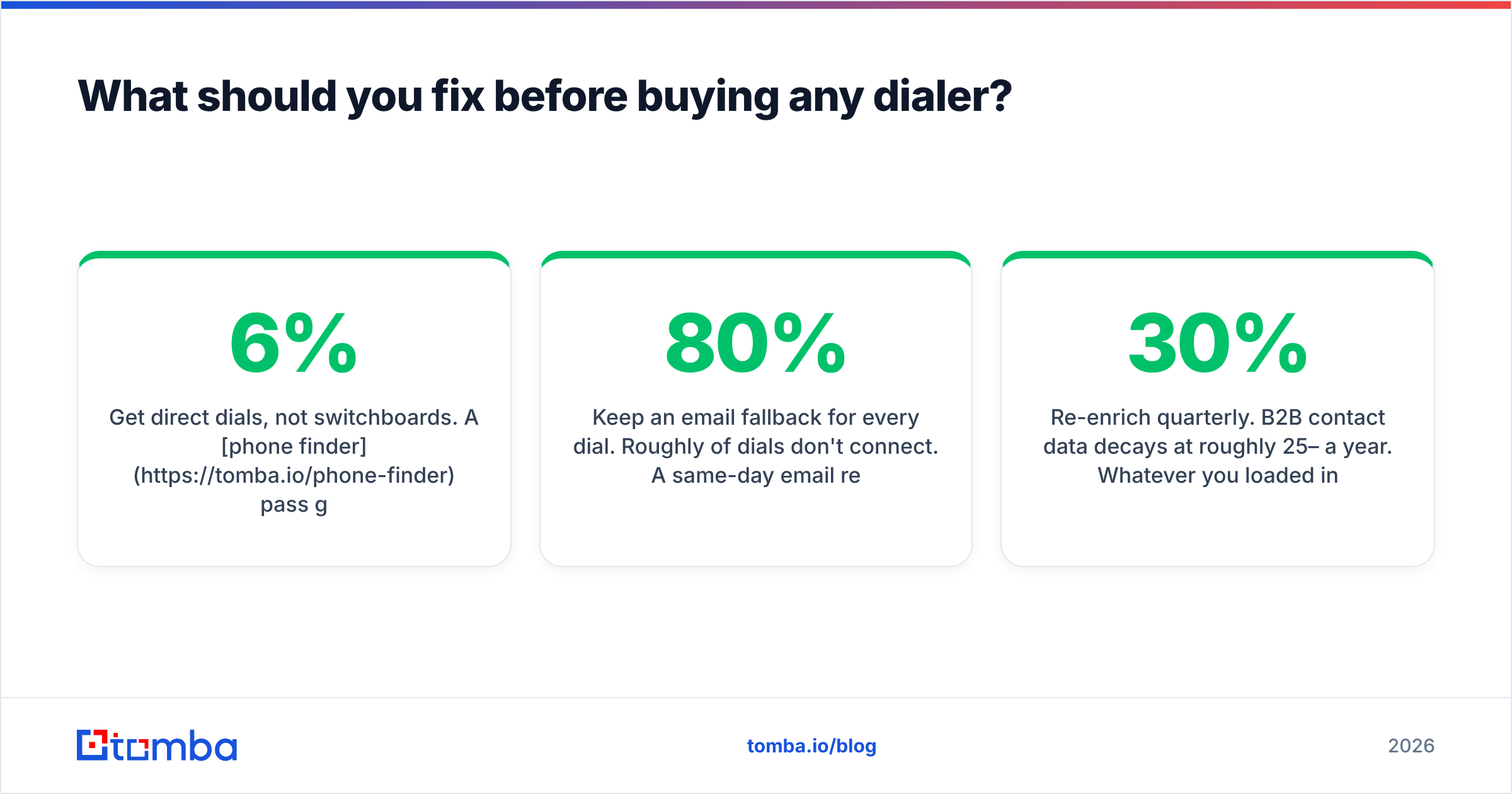
- Get direct dials, not switchboards. A phone finder pass gives you mobile and direct numbers, which is the difference between a 6% and a 20% connect rate.
- Verify before you dial, and before you email. Run numbers through validation and addresses through an email verifier so your bounce rate and your abandonment rate both stay clean.
- Keep an email fallback for every dial. Roughly 80% of dials don't connect. A same-day email referencing the call attempt is the cheapest multi-touch you'll ever run.
- Re-enrich quarterly. B2B contact data decays at roughly 25–30% a year. Whatever you loaded in January is meaningfully wrong by July.
Do that work and a mid-priced power dialer will outperform an expensive predictive one running on garbage. Skip it and no amount of dialing software saves the quarter.
EVS7 pricing reviews pros and cons: the final verdict#
Weigh the EVS7 pricing reviews pros and cons together and the call is simple. EVS7 is fairly priced for what it is: a specialist dialer vendor with unusually good support and no ambition to be your CRM. Expect $89–$99 per seat for Dolphin, another 30–40% on top for minutes, numbers, and setup, and a real jump to Parrot only if you're running a genuine call floor. The pros — throughput, support, speed to deploy, predictive option — are real. So are the cons: dated UI, thin integrations, no conversation AI. None of those will change soon.
If your outbound motion is phone-first and high-volume, shortlist it. If it's multi-channel, look at a sequencer with an embedded dialer instead.
Either way, the dialer is the cheap part. The data is what decides your connect rate. Start with Tomba Email Finder to build verified, direct-contact lists before you commit a dollar to seats — the free tier gives you 25 searches a month to test list quality against your own ICP, and paid plans start at $49/mo. Full Tomba pricing is public, so you can model total cost of a dialer-plus-data stack in one sitting.
Related guides#
Ready to find emails that actually work?
Join 150,000+ professionals who stopped guessing and started sending. Free credits on signup — no credit card required.
Get the Tomba newsletter
Practical outbound tactics and product updates — once every two weeks.
About the author