Exact Data vs Apolloio (2026): Which B2B Data Wins?
Exact Data sells list files. Apollo.io sells a prospecting platform. They price, bounce, and scale completely differently — here's the honest breakdown, plus who each one actually fits in 2026.
Exact Data vs Apolloio comes down to one question: do you want to own a file, or rent a database? Here is the short answer, then the detail.
TL;DR
- Exact Data is a list broker: you buy a one-time file of records (postal, email, phone) filtered by demographics or firmographics, priced per record. Apollo.io is a subscription prospecting platform: a living contact database plus sequences, dialer, and CRM sync.
- They are not really substitutes. Exact Data suits direct mail, consumer campaigns, and one-off event lists. Apollo suits repeatable B2B outbound where you need fresh data every week.
- Bounce risk is the real cost. Static purchased files decay roughly 2-2.5% per month as people change jobs. Apollo's data is refreshed continuously, but its email accuracy still varies widely by seniority and region.
- Neither replaces verification. Whichever you pick, run the list through an email verifier before it touches your sending domain.
- Budget reality: an Exact Data file of 25,000 B2B records typically runs into four figures once, while Apollo's paid seats start around $49/user/mo and scale with credits and seats.
Most "Exact Data vs Apolloio" searches come from someone who got a quote from a list broker, then saw an Apollo free plan and wondered why the price gap is so wide. The answer is that you're comparing a product to a subscription. This post breaks down what each one delivers, where each one fails, and how to decide without burning your sending reputation.
What is Exact Data and who is it for?#
Exact Data is a US-based list brokerage and compiled-database company. You specify a target — say, "IT directors at manufacturing companies with 200+ employees in the Midwest" — and they return a count and a price. You pay per record, download a CSV, and the file is yours.
Three things define the model:
- One-time purchase, permanent file. No seat licensing, no monthly credits. You own the download.
- Multichannel records. Postal addresses are the historical core. Email and phone are add-ons, priced separately and usually with lower match rates than the postal fields.
- Consumer + business coverage. Exact Data sells consumer demographic lists (homeowners, new movers, age/income segments) alongside B2B files. That's a genuinely different inventory from Apollo, which is B2B-only.
The tradeoff is freshness. A compiled file is a snapshot. The day it lands in your inbox, it starts decaying. Industry estimates put B2B contact decay at 22% to 30% per year. So a file you bought in January is much worse by summer.

What is Apollo.io and how does the model differ?#
Apollo.io is a go-to-market platform. Underneath sits a contact and company database (Apollo advertises 200M+ contacts). It is built from public sources, user contributions, and a contributory network. On top sit sequences, an email sender, a dialer, a LinkedIn extension, and two-way CRM sync.
You don't buy records — you rent access. Plans are per user per month. Export credits cap how many records you can pull into your CRM. If you stop paying, you keep whatever you exported but lose the search, the enrichment, and the sequencing.
The practical difference: Apollo is built for a rep who prospects every day. Exact Data is built for a marketer who runs a campaign and then goes quiet for a quarter.
Exact Data vs Apolloio: how do they compare head to head?#
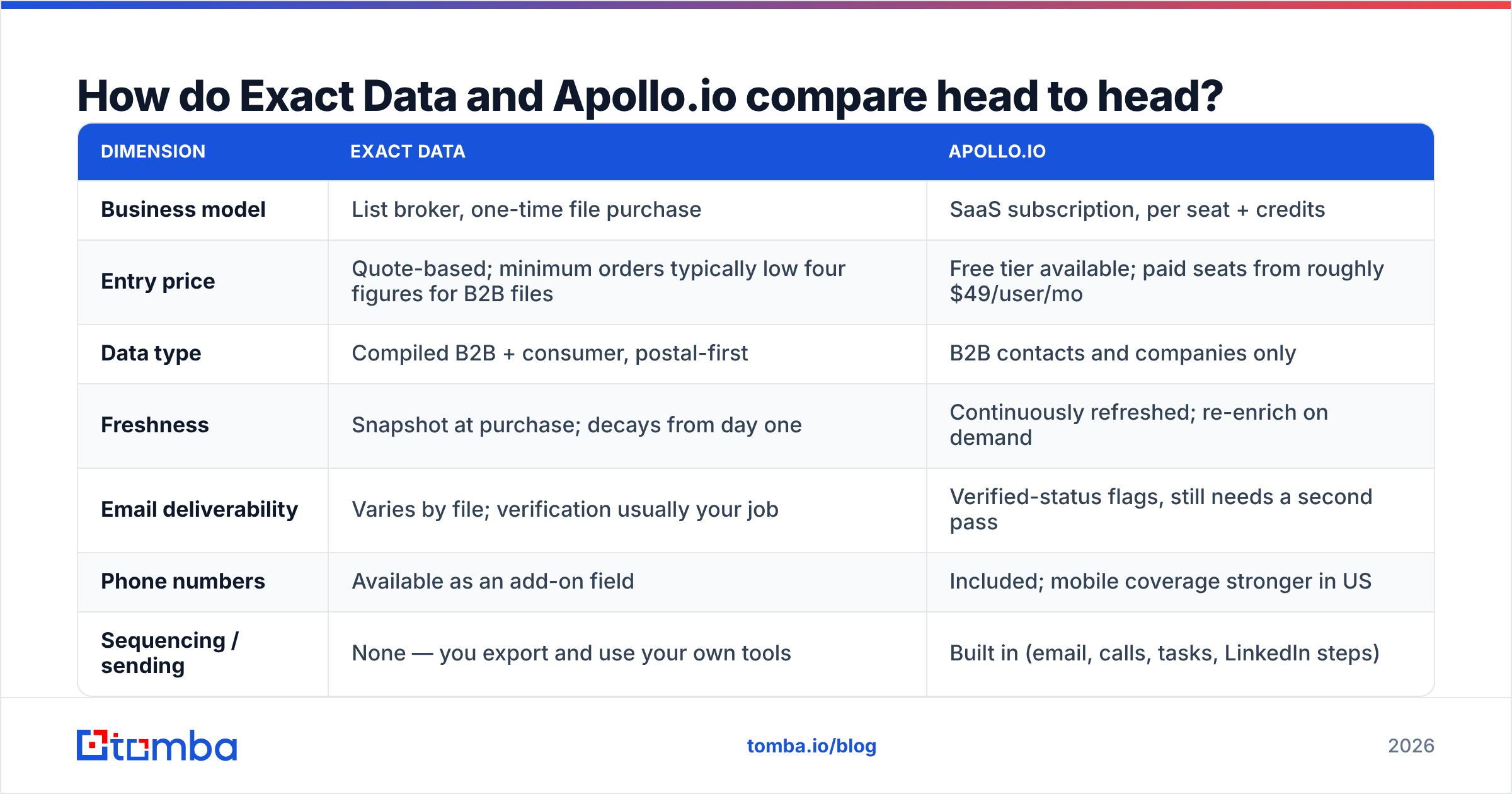
| Dimension | Exact Data | Apollo.io |
|---|---|---|
| Business model | List broker, one-time file purchase | SaaS subscription, per seat + credits |
| Entry price | Quote-based; minimum orders typically low four figures for B2B files | Free tier available; paid seats from roughly $49/user/mo |
| Data type | Compiled B2B + consumer, postal-first | B2B contacts and companies only |
| Freshness | Snapshot at purchase; decays from day one | Continuously refreshed; re-enrich on demand |
| Email deliverability | Varies by file; verification usually your job | Verified-status flags, still needs a second pass |
| Phone numbers | Available as an add-on field | Included; mobile coverage stronger in US |
| Sequencing / sending | None — you export and use your own tools | Built in (email, calls, tasks, LinkedIn steps) |
| CRM sync | Manual CSV import | Native HubSpot, Salesforce, Pipedrive sync |
| API access | Limited | Full REST API on higher tiers |
| Best for | Direct mail, consumer targeting, one-off events | Repeatable SDR outbound, inbound enrichment |
Read that table twice before you decide. If four of the rows you care about sit in the "sequencing / CRM / API" band, Exact Data is the wrong shape of product no matter how good its counts look. If your campaign is a physical mailer to 40,000 homeowners, Apollo simply doesn't have that inventory.
Which one has better data accuracy?#
Neither vendor's published accuracy claim survives contact with a real list. Here's how to think about it honestly.
Exact Data's strength is postal. Compiled postal files, refreshed against NCOA (National Change of Address), are genuinely reliable. That's a mature, regulated data ecosystem. Email appended to those records is a different story. Appended email is often matched by guesswork, and match confidence is rarely shown at the record level. Expect a large chunk of unknowns.
Apollo's strength is breadth and recency. Because contributions flow in constantly, job changes surface faster. But Apollo's "verified" label is a status flag, not a guarantee. Its coverage also skews toward US tech, SaaS, and mid-market. Try to build a list of plant managers in Germany or procurement heads in Japan and hit rates drop sharply. Independent reviews on G2 repeat this pattern: great for US SaaS, thinner outside it.
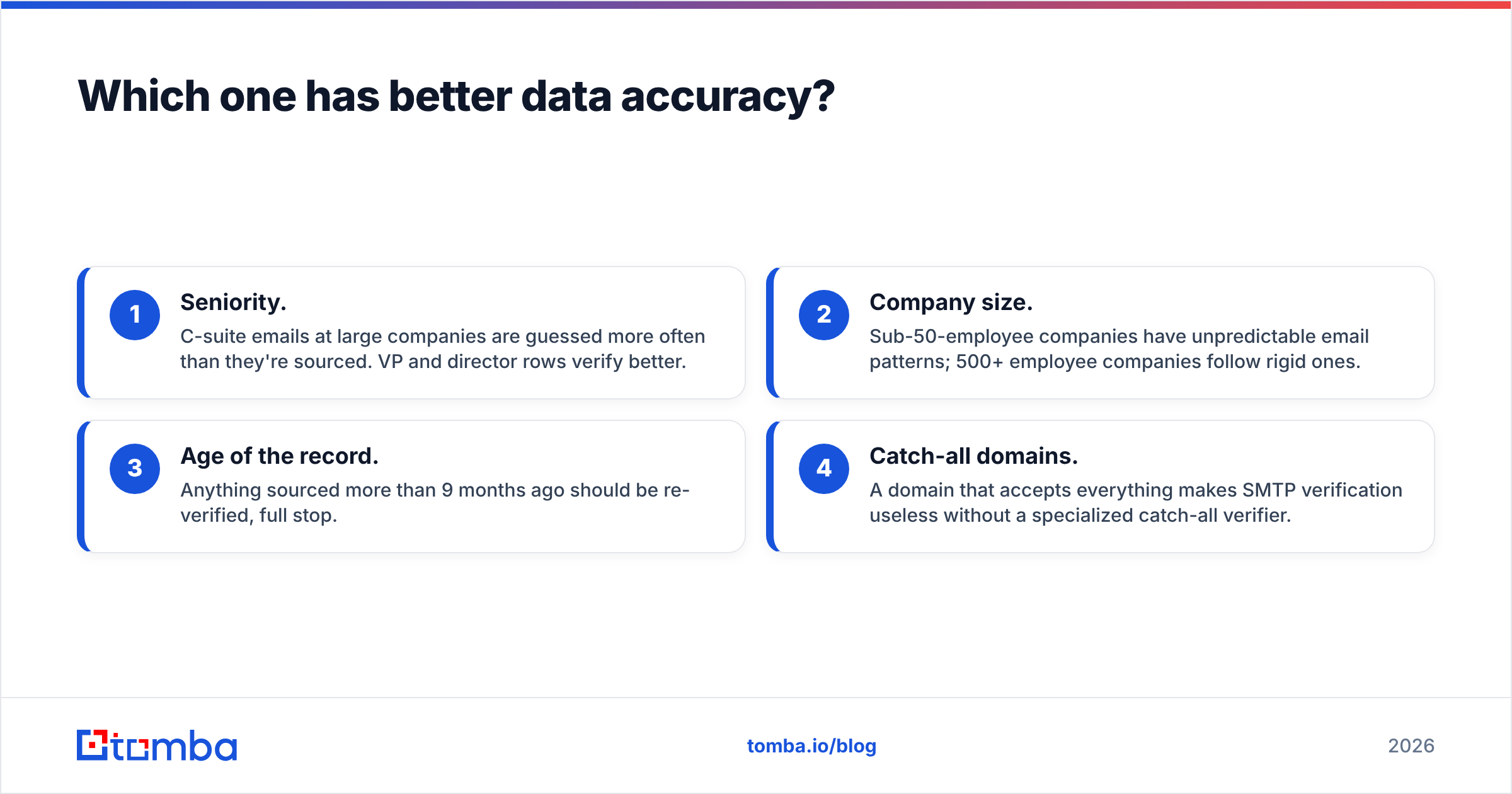
What actually determines your bounce rate is not the vendor. It's these four things:
- Seniority. C-suite emails at large companies are guessed more often than they're sourced. VP and director rows verify better.
- Company size. Sub-50-employee companies have unpredictable email patterns; 500+ employee companies follow rigid ones.
- Age of the record. Anything sourced more than 9 months ago should be re-verified, full stop.
- Catch-all domains. A domain that accepts everything makes SMTP verification useless without a specialized catch-all verifier.
The teams with sub-2% bounce rates aren't the ones who found a magic vendor. They re-verify every list before every send, whatever the source.
What does each one actually cost?#
Exact Data quotes per record with volume minimums, and the price moves with how many fields you want. A basic name-and-postal record is cheap. Add email, add phone, add a firmographic filter, and per-record cost climbs. Because it's a one-time buy, the math is simple: cost per usable record = total price ÷ records that don't bounce. If a $2,000 file of 20,000 records has a 20% bounce rate, you paid $0.125 per usable record.
Apollo's math is different. Seats plus credit caps mean cost scales with team size, not list size. Two reps on a mid tier can pull far more contacts over a year than a single list purchase. But you pay every month, and if you churn, the flow of fresh data stops.
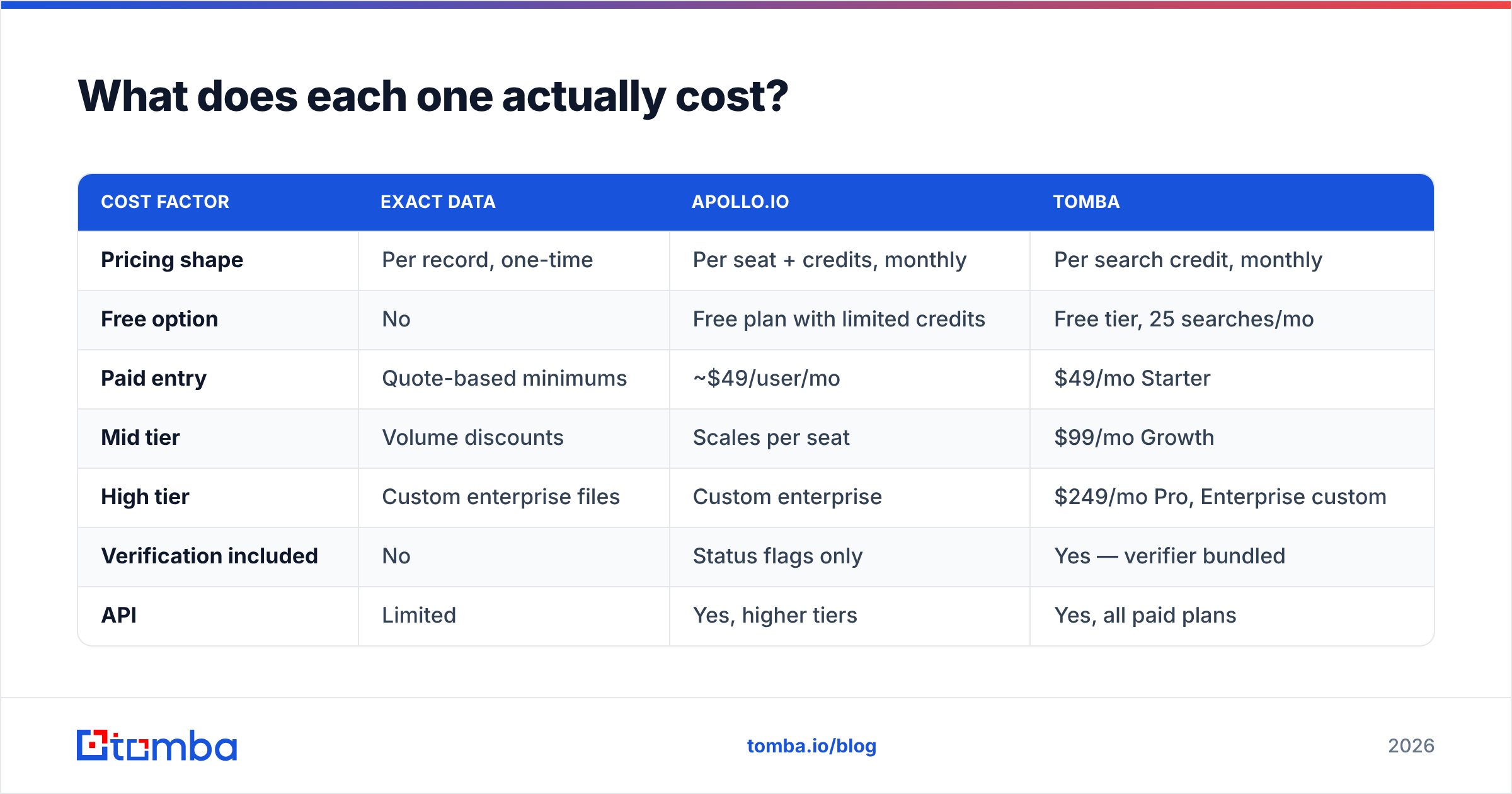
| Cost factor | Exact Data | Apollo.io | Tomba |
|---|---|---|---|
| Pricing shape | Per record, one-time | Per seat + credits, monthly | Per search credit, monthly |
| Free option | No | Free plan with limited credits | Free tier, 25 searches/mo |
| Paid entry | Quote-based minimums | ~$49/user/mo | $49/mo Starter |
| Mid tier | Volume discounts | Scales per seat | $99/mo Growth |
| High tier | Custom enterprise files | Custom enterprise | $249/mo Pro, Enterprise custom |
| Verification included | No | Status flags only | Yes — verifier bundled |
| API | Limited | Yes, higher tiers | Yes, all paid plans |
That third column matters for a specific buyer: the one who doesn't want a full GTM suite or a bulk file, but does want accurate emails on demand. Full Tomba pricing is public, so you can do the per-credit math before you talk to anyone.
When should you choose Exact Data over Apollo?#
Pick Exact Data when:
- You're running direct mail. Postal is its home turf and Apollo doesn't compete there.
- Your target is consumers, not businesses. Homeowners, new movers, income segments — Apollo has none of this.
- You need a one-time file for a specific event. Trade show follow-up, a regional launch, a single-quarter campaign.
- You have no ongoing outbound motion. Paying monthly for a platform nobody logs into is pure waste.
- You want to own the data outright. No seat license, no export cap, no vendor lock.
Pick Apollo when:
- You have reps prospecting daily. The sequencing and dialer save more hours than the data itself.
- Your ICP is US B2B tech or mid-market services. That's where coverage is densest.
- You need CRM hygiene. Continuous re-enrichment beats a static file for keeping records current.
- You want one bill instead of five tools. Data + sequencer + dialer in one line item is real operational value.

What are the alternatives worth checking?#
Neither of these two is the whole market, and both leave gaps.
BookYourData sits in an interesting middle. It sells prepaid, filterable B2B lists with a stated accuracy guarantee and refund policy — more transactional than a subscription, more verified than a raw compiled file. If you like Exact Data's one-time-purchase model but want B2B-focused, verification-backed records, it's the natural comparison to run alongside.
ZoomInfo competes with Apollo at the enterprise end with deeper firmographics and intent data, at a much higher price. Clay and similar orchestration tools stitch multiple data vendors into one waterfall, which is increasingly how sophisticated teams operate. No single provider covers every region and seniority band.
Tomba occupies a narrower lane on purpose. Rather than selling a list or a full GTM suite, it does discovery and verification: domain search to map every public address at a company, email finder for named prospects, and bulk verification to clean whatever list you already bought. That makes it complementary to both tools here — the layer that protects your sending domain from whatever the list vendor got wrong.
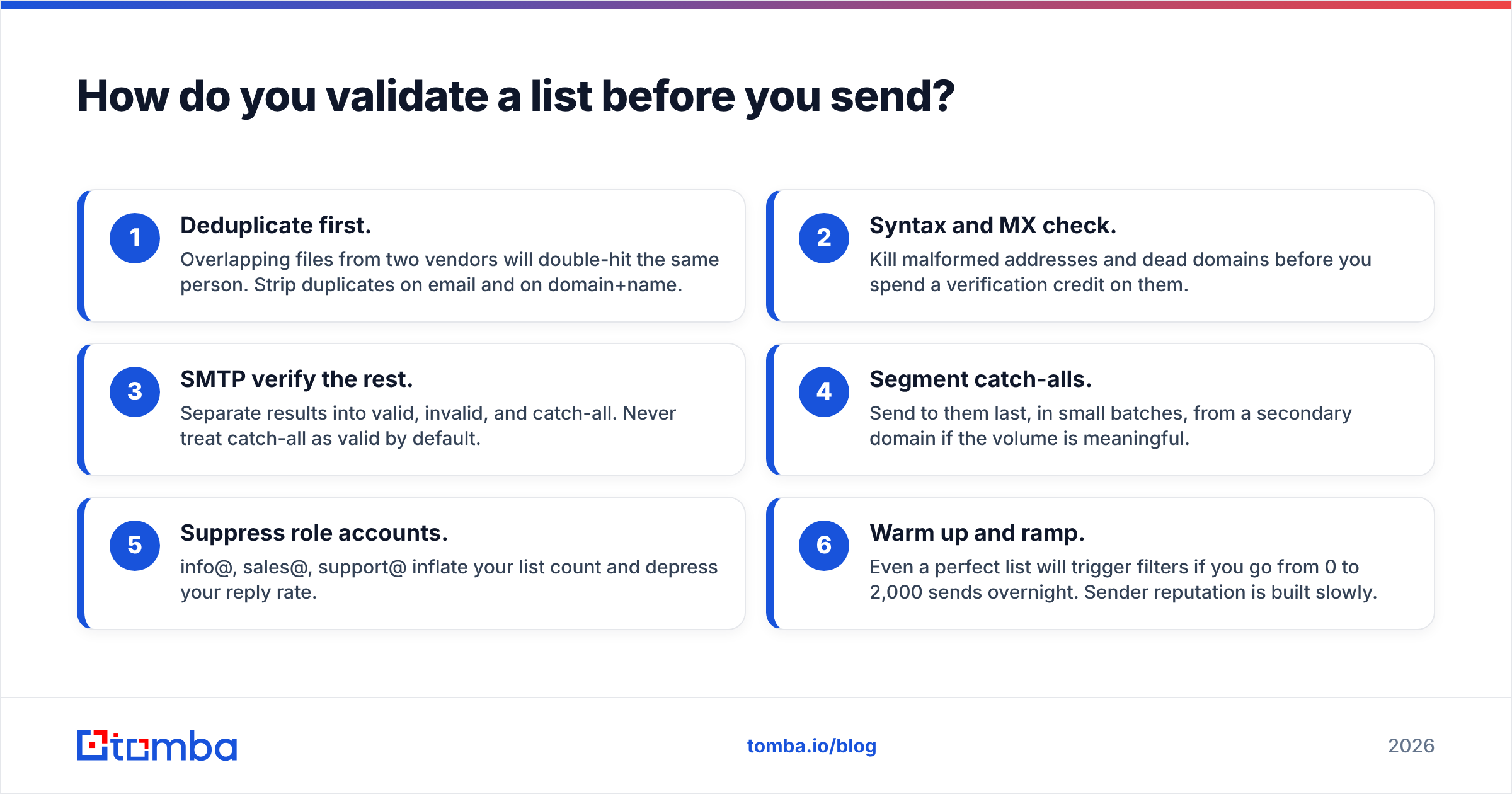
How do you validate a list before you send?#
Whichever vendor you pick, run this sequence. It takes an afternoon and saves your domain.
- Deduplicate first. Overlapping files from two vendors will double-hit the same person. Strip duplicates on email and on domain+name.
- Syntax and MX check. Kill malformed addresses and dead domains before you spend a verification credit on them.
- SMTP verify the rest. Split results into valid, invalid, and catch-all. Never treat catch-all as valid by default.
- Segment catch-alls. Send to them last, in small batches, from a secondary domain if the volume is meaningful.
- Suppress role accounts. info@, sales@, support@ inflate your list count and depress your reply rate.
- Warm up and ramp. Even a perfect list will trigger filters if you go from 0 to 2,000 sends overnight. Sender reputation is built slowly.
Skipping step 3 is the single most common reason a purchased list "doesn't work." The data wasn't always bad. It was untested, and the first send burned the domain before anyone measured anything.
Which should you actually buy in 2026?#
Here is how the Exact Data vs Apolloio call breaks down.
If you run continuous B2B outbound with a team: Apollo.io, because the platform value compounds and static files can't keep up with job changes.
If you run direct mail or consumer campaigns: Exact Data, because Apollo doesn't have the inventory. You'd be paying a subscription for a database you'd query twice a year.
If you want one-time B2B files with a verification guarantee: compare BookYourData before defaulting to a general compiled broker. The accuracy commitment changes the risk math.
If your problem is precision, not volume: you probably don't need either. You need accurate addresses for a defined target account list, and a way to prove they're real before you send.
That last case is where Tomba fits. Point the Tomba Email Finder at a company domain and a prospect name, get the address with a confidence score, and verify it in the same workflow. The free tier gives you 25 searches a month, so you can test hit rates against your own ICP before spending anything. That beats any vendor's marketing page. Run 50 of your known-good contacts through it, check the match rate, then decide.
Related guides#
Ready to find emails that actually work?
Join 150,000+ professionals who stopped guessing and started sending. Free credits on signup — no credit card required.
Get the Tomba newsletter
Practical outbound tactics and product updates — once every two weeks.
About the author