ExactVerify vs Exellius: Which Email Tool Wins in 2026?
One tool cleans lists. The other builds them. Here is an honest, test-first breakdown of ExactVerify vs Exellius — accuracy, pricing, coverage, and when neither is the right answer.
TL;DR#
- They are not the same category. ExactVerify is built around email verification — cleaning a list you already have. Exellius leans toward sourcing and enrichment — building the list in the first place. Comparing them head-to-head only makes sense if you are trying to decide what your bottleneck actually is.
- Verification is a commodity; discovery is not. Any competent verifier will catch hard bounces on standard mailboxes. The real differentiator is catch-all handling, and that is where vendors diverge hardest.
- Neither publishes an accuracy number you should take at face value. Every vendor in this space quotes 95–99%. Run your own 500-contact test before you commit budget.
- Pricing models differ more than price. Credit-based verification and seat-plus-credit prospecting platforms produce very different bills at the same headline rate.
- If you need both jobs done, a combined finder-plus-verifier (Tomba's free tier starts at 25 searches/mo, Starter at $49/mo) usually beats stitching two single-purpose vendors together.
What are ExactVerify and Exellius?#
ExactVerify positions itself as an email verification service: you upload a list, it runs syntax checks, DNS and MX record lookups, disposable-domain detection, role-account flagging, and SMTP-level mailbox probing, then hands back a scored list of valid, invalid, risky, and unknown addresses. That is the classic verifier workflow, and it is the same job ZeroBounce alternative shoppers are usually trying to solve.
Exellius sits closer to the lead-generation end of the market — finding contact data, enriching records with firmographic detail, and pushing them into outbound workflows. Where a verifier asks "is this address deliverable?", a discovery tool asks "who at this company should I email, and what is their address?"
Here is the honest disclaimer up front: both vendors are smaller and less independently documented than the Apollo/ZoomInfo tier. Public reviews are thin, feature pages change without changelogs, and pricing is frequently gated behind a demo. Everything below that touches specific plan mechanics should be re-checked on the vendor's own site before you sign anything. Where we could not verify a claim, we say so rather than inventing a number.
How do ExactVerify and Exellius actually differ?#
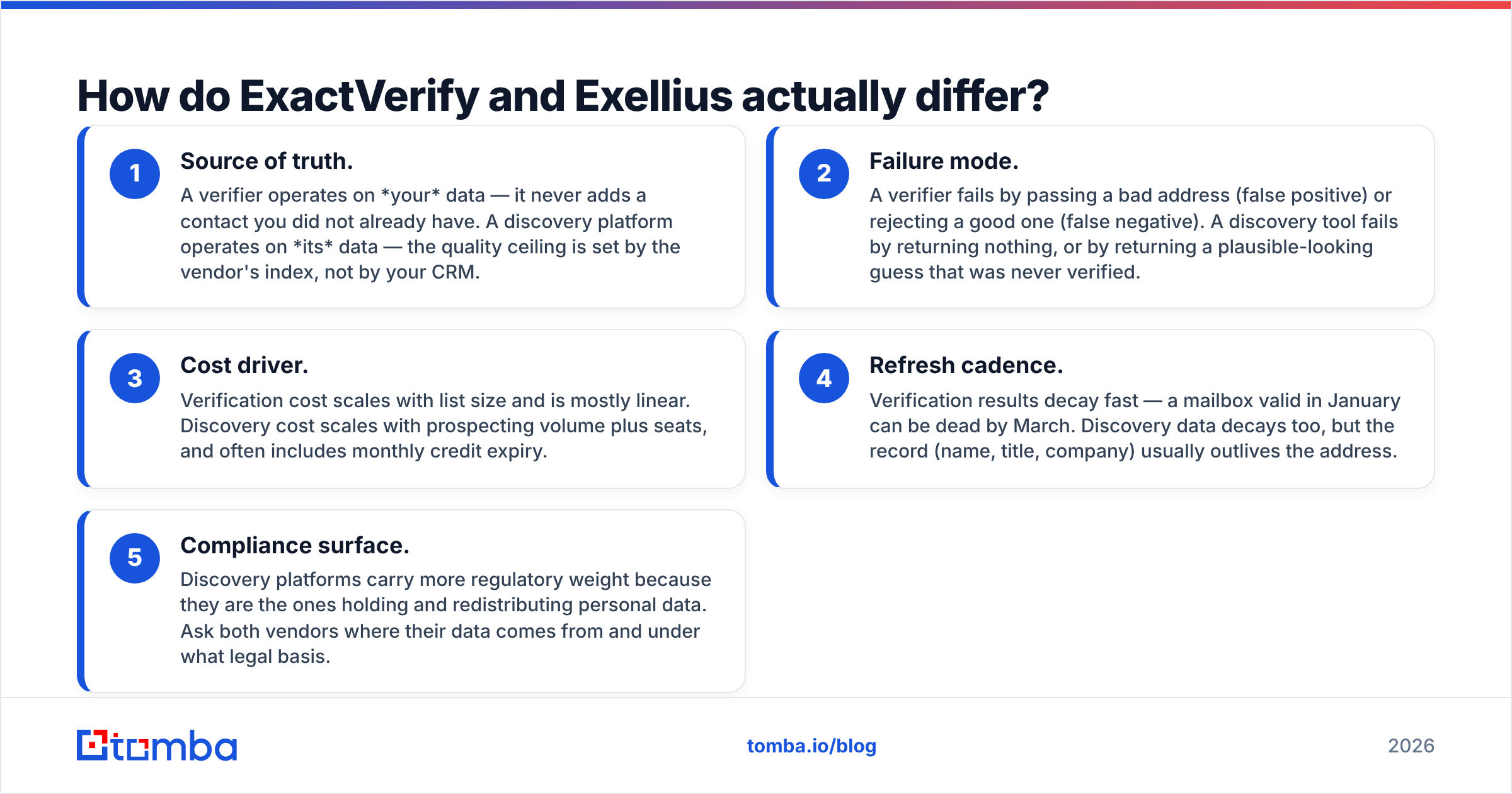
The cleanest way to think about this is by the job each tool is hired to do:
- Source of truth. A verifier operates on your data — it never adds a contact you did not already have. A discovery platform operates on its data — the quality ceiling is set by the vendor's index, not by your CRM.
- Failure mode. A verifier fails by passing a bad address (false positive) or rejecting a good one (false negative). A discovery tool fails by returning nothing, or by returning a plausible-looking guess that was never verified.
- Cost driver. Verification cost scales with list size and is mostly linear. Discovery cost scales with prospecting volume plus seats, and often includes monthly credit expiry.
- Refresh cadence. Verification results decay fast — a mailbox valid in January can be dead by March. Discovery data decays too, but the record (name, title, company) usually outlives the address.
- Compliance surface. Discovery platforms carry more regulatory weight because they are the ones holding and redistributing personal data. Ask both vendors where their data comes from and under what legal basis.
If your list already exists and it is bouncing, you have a verification problem. If your reps are spending an hour a day hunting for addresses on LinkedIn, you have a discovery problem. Buying the wrong one is the most common and most expensive mistake in this category.

How accurate is each one, really?#
Every vendor in this space advertises somewhere between 95% and 99% accuracy. Those numbers are not lies exactly, but they are measured on the vendor's terms — usually on clean, well-known corporate domains where every tool performs well.
What separates good tools from marketing tools is what happens at the edges:
- Catch-all domains. A catch-all server accepts mail for any address at the domain, so an SMTP probe cannot tell you whether the specific mailbox exists. Weak verifiers dump these into "unknown" and let you decide. Better ones apply pattern intelligence, historical engagement signals, and secondary sourcing to give you a real confidence score. This is the single biggest quality gap in verification, and it is worth testing explicitly with a catch-all verifier.
- Greylisting and rate limits. Many mail servers intentionally defer unknown senders. A verifier that treats a temporary 4xx response as a hard failure will silently throw away good contacts.
- Role and shared mailboxes.
info@,sales@,support@are technically valid and commercially useless for most outbound. Does the tool flag them separately, or count them toward its accuracy score? - Freshness of the discovery index. For Exellius-style tools, the question is not "is this address syntactically valid" but "was this person still in this role last quarter?"
The mechanics behind all of this are just SMTP conversation handling — there is no secret sauce, only how carefully a vendor handles the ambiguous responses.

The only test that matters: take 500 contacts you already know the outcome for — addresses that bounced, addresses that replied, addresses that went to a shared inbox — and run them through each tool. Compare the verdicts against reality. Any vendor that will not give you enough free credits to run that test is telling you something.
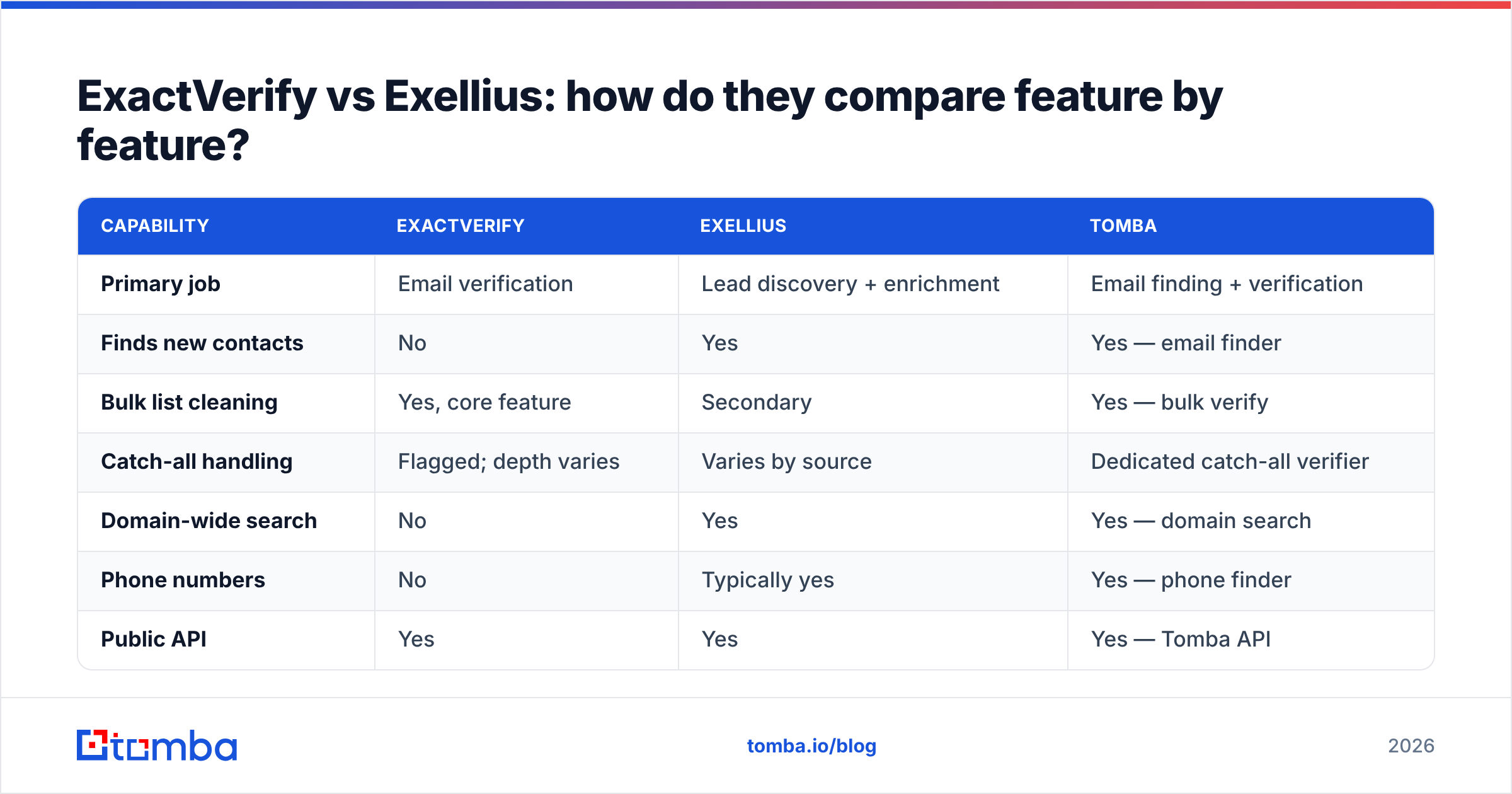
ExactVerify vs Exellius: how do they compare feature by feature?#
| Capability | ExactVerify | Exellius | Tomba |
|---|---|---|---|
| Primary job | Email verification | Lead discovery + enrichment | Email finding + verification |
| Finds new contacts | No | Yes | Yes — email finder |
| Bulk list cleaning | Yes, core feature | Secondary | Yes — bulk verify |
| Catch-all handling | Flagged; depth varies | Varies by source | Dedicated catch-all verifier |
| Domain-wide search | No | Yes | Yes — domain search |
| Phone numbers | No | Typically yes | Yes — phone finder |
| Public API | Yes | Yes | Yes — Tomba API |
| Chrome extension | Limited | Yes | Yes |
| Spreadsheet add-ons | Varies | Varies | Google Sheets + Excel |
| Free tier | Trial credits | Demo-gated in most cases | 25 searches/mo, no card |
| Published entry price | Credit packs | Quote-based | $49/mo Starter |
Two caveats on that table. First, "varies" is not a dodge — it is an accurate description of vendors that ship features quietly and document them inconsistently. Second, capability presence is not capability quality. Both tools list an API; that tells you nothing about rate limits, webhook reliability, or whether the SDK has been touched in the last year. Ask for the docs URL before you evaluate.

What does each one cost in practice?#
Headline price is the least useful number in this category. Three mechanics move your actual bill far more:
Credit expiry. Monthly credits that do not roll over turn a $99 plan into a $99 tax on months when your pipeline is quiet. Annual credit pools are strictly better if your prospecting is lumpy.
What consumes a credit. Some verifiers charge for "unknown" results. Some finders charge for a search that returns nothing. Read the fine print — a tool with a 20% no-result rate that still bills those attempts is 25% more expensive than its sticker price suggests.
Seats. Discovery platforms usually price per seat plus credits. Verification tools rarely do. A five-rep team can face a 5x multiplier on one side of this comparison and none on the other.
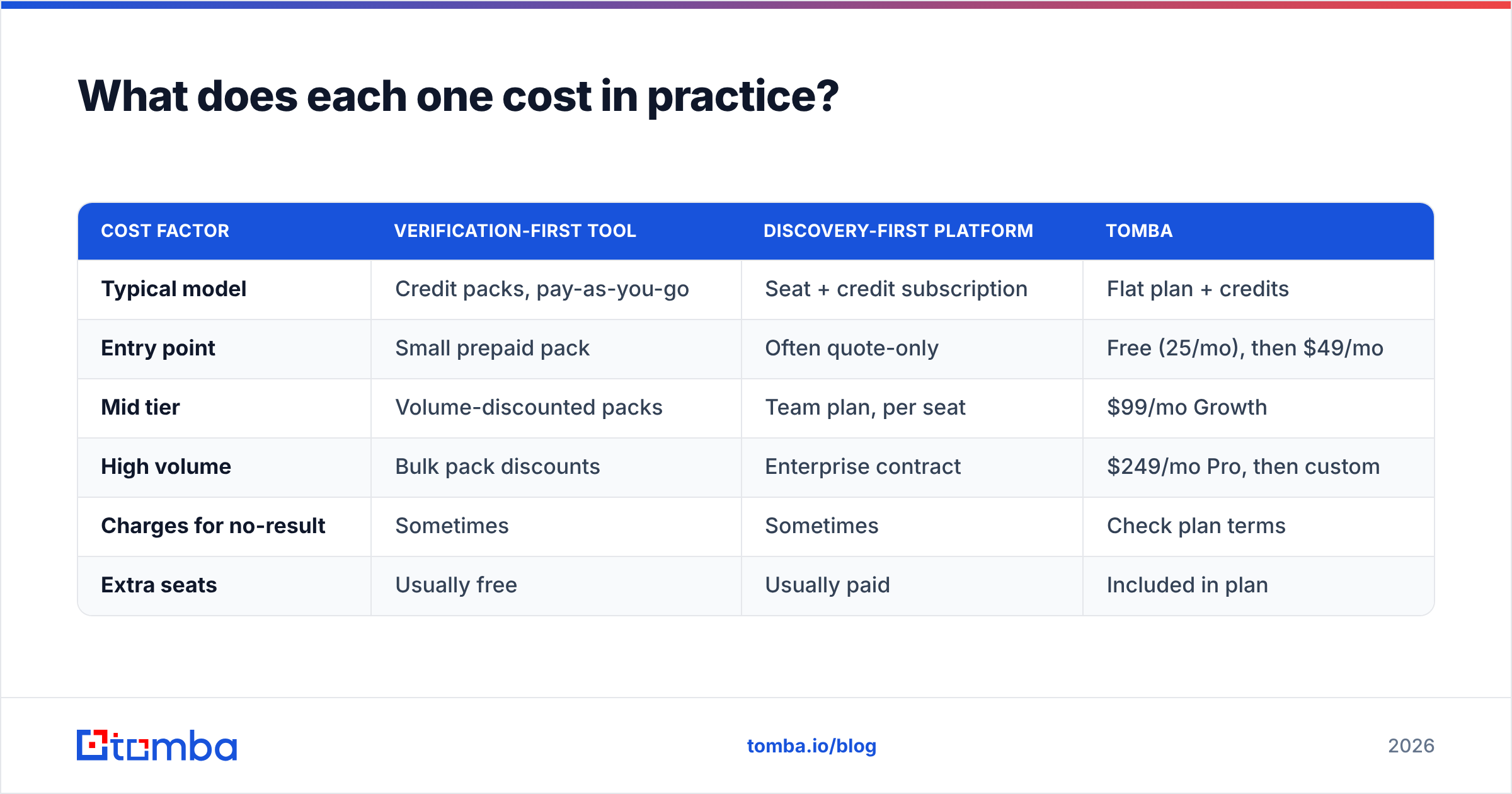
| Cost factor | Verification-first tool | Discovery-first platform | Tomba |
|---|---|---|---|
| Typical model | Credit packs, pay-as-you-go | Seat + credit subscription | Flat plan + credits |
| Entry point | Small prepaid pack | Often quote-only | Free (25/mo), then $49/mo |
| Mid tier | Volume-discounted packs | Team plan, per seat | $99/mo Growth |
| High volume | Bulk pack discounts | Enterprise contract | $249/mo Pro, then custom |
| Charges for no-result | Sometimes | Sometimes | Check plan terms |
| Extra seats | Usually free | Usually paid | Included in plan |
Full Tomba pricing is public and does not require a call. For ExactVerify and Exellius, expect to request a quote for anything above entry volume — which is itself a data point about how they sell.
Which one should you pick for your workflow?#
Pick a verification-first tool (ExactVerify's lane) if:
- You inherited a list — from an event, a webinar, a legacy CRM, or an acquisition — and you need to know what is still alive before you send.
- Your bounce rate crossed 3% and your deliverability is degrading. Cleaning is triage, and it is urgent.
- You already have a reliable source of new contacts and just need hygiene at the end of the pipeline.
- Your compliance team is nervous about buying contact data but fine with validating data you collected yourself.
Pick a discovery-first platform (Exellius's lane) if:
- Your reps are manually hunting addresses. Every hour spent on that is an hour not spent talking to prospects — a pattern the HubSpot sales research has documented repeatedly.
- You are entering a new market segment and have no existing list to clean.
- You need firmographic filters — headcount, tech stack, funding stage — to build target accounts, not just find addresses.
- You want phone numbers alongside email for multichannel sequences.
Consider neither if: your problem is actually deliverability infrastructure. No verifier fixes a missing SPF record, a cold domain, or a spammy template. Clean data is necessary, not sufficient.
Is there a reason not to buy both?#
There is, and it is not just cost. Running a separate finder and a separate verifier means:
- Two data models to reconcile. The finder's confidence score and the verifier's status field do not map cleanly onto each other. Someone on your team ends up maintaining a mapping spreadsheet.
- Two failure points in your automation. Every Zapier hop between vendors is a place where records silently drop.
- Double-charging for the same contact. You pay a credit to find the address, then pay another to verify it — even though the finder already ran a verification pass internally and threw the result away.
- Two vendor relationships, two renewals, two security reviews.
The integrated approach — find and verify in one call, with one confidence score — removes all four. That is the argument for a consolidated tool, and it is stronger for small teams than for enterprises with dedicated data ops staff who genuinely want best-of-breed in each slot.
If you do go integrated, check the data sources page of whoever you pick. A vendor that will not explain where its data comes from is a vendor you cannot defend to your legal team.
What should you test before you commit?#
Run this checklist against both tools during trial. It takes about two hours and it will save you a year of regret.
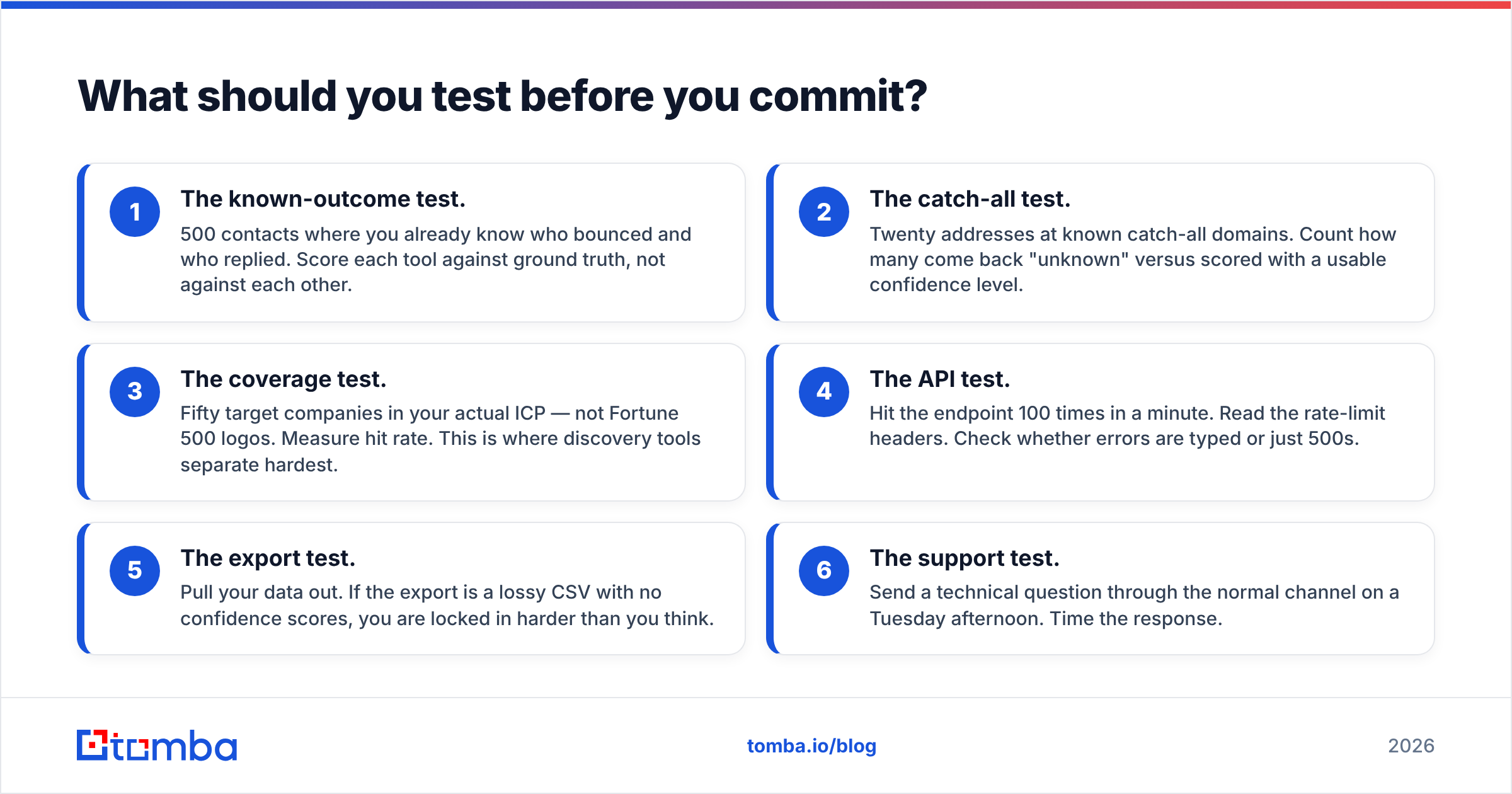
- The known-outcome test. 500 contacts where you already know who bounced and who replied. Score each tool against ground truth, not against each other.
- The catch-all test. Twenty addresses at known catch-all domains. Count how many come back "unknown" versus scored with a usable confidence level.
- The coverage test. Fifty target companies in your actual ICP — not Fortune 500 logos. Measure hit rate. This is where discovery tools separate hardest.
- The API test. Hit the endpoint 100 times in a minute. Read the rate-limit headers. Check whether errors are typed or just 500s.
- The export test. Pull your data out. If the export is a lossy CSV with no confidence scores, you are locked in harder than you think.
- The support test. Send a technical question through the normal channel on a Tuesday afternoon. Time the response.
Independent reviews on G2's email verification category are useful for spotting recurring support and billing complaints, though volume is thin for smaller vendors — read the one-star reviews first, since those are where the real operational friction shows up.
Final verdict: ExactVerify vs Exellius#
There is no single winner, because they are answering different questions. ExactVerify's lane — verification — is the right buy when your list exists and is decaying. Exellius's lane — discovery and enrichment — is the right buy when your list does not exist yet. Buying the wrong lane will not just underdeliver; it will convince you the whole category is overpriced.
What most teams discover after a quarter is that they needed both jobs done, and that running two vendors to do them costs more in credits, integration time, and reconciliation than a single tool that does both competently.
Start there. Tomba's Email Finder finds professional addresses by domain, name, or company and verifies them in the same call, with catch-all handling, bulk processing, a documented API, and spreadsheet add-ons in every plan. The free tier gives you 25 searches a month with no card, which is enough to run the known-outcome test above before you spend anything. If it wins on your data, Starter is $49/mo — and you get to cancel one vendor instead of onboarding two.
Related guides#
Ready to find emails that actually work?
Join 150,000+ professionals who stopped guessing and started sending. Free credits on signup — no credit card required.
Get the Tomba newsletter
Practical outbound tactics and product updates — once every two weeks.
About the author