ExactVerify vs SignalHire in 2026: Which Tool Should You Pick?
ExactVerify verifies emails you already have. SignalHire finds contacts you don't. Here's an honest breakdown of accuracy, pricing, credit models, and which one actually belongs in your 2026 outbound stack.
ExactVerify vs SignalHire is a fair fight only once you know what you need. One tool checks emails you already have. The other finds emails you don't. Here is the honest breakdown.
TL;DR
- ExactVerify vs SignalHire is not a true head-to-head. ExactVerify is an email verification service. SignalHire is a contact discovery tool built on a LinkedIn browser extension. They solve different halves of one job.
- Pick ExactVerify if you already own a list. A scraper export, a CRM dump, a partner file. You need bounce rates under 2% before you hit send.
- Pick SignalHire if sourcing is the bottleneck. You live on LinkedIn. You want phone numbers next to emails. You build lists one profile at a time.
- Neither tool covers the full find → verify → enrich loop alone. Running both means two subscriptions, two credit systems, and two accuracy standards.
- Want one bill instead? A single platform with a shared credit pool (Tomba's email finder plus email verifier start at $49/mo) removes the seam between the two steps.
ExactVerify vs SignalHire: what does each tool do?#
Think of a restaurant kitchen. SignalHire is the buyer at the market, picking out ingredients. ExactVerify is the line cook, checking whether those ingredients have gone off. Both jobs matter. But they are different jobs. Hiring a market buyer will not fix spoiled food.
ExactVerify is a bulk email verification platform. You upload a CSV or call the API. It returns a status for each address: valid, invalid, catch-all, role-based, disposable, or unknown. It runs syntax checks, MX-record lookups, SMTP handshakes, and disposable-domain matching. It will not find you a single new contact.
SignalHire is a contact-finding platform with roots in recruiting. Its core asset is a Chrome extension. The extension sits on LinkedIn profiles and reveals emails and direct-dial phone numbers. It also ships a searchable contact database, light ATS-style pipeline features, and bulk enrichment. Verification exists inside SignalHire, but it is a supporting feature.
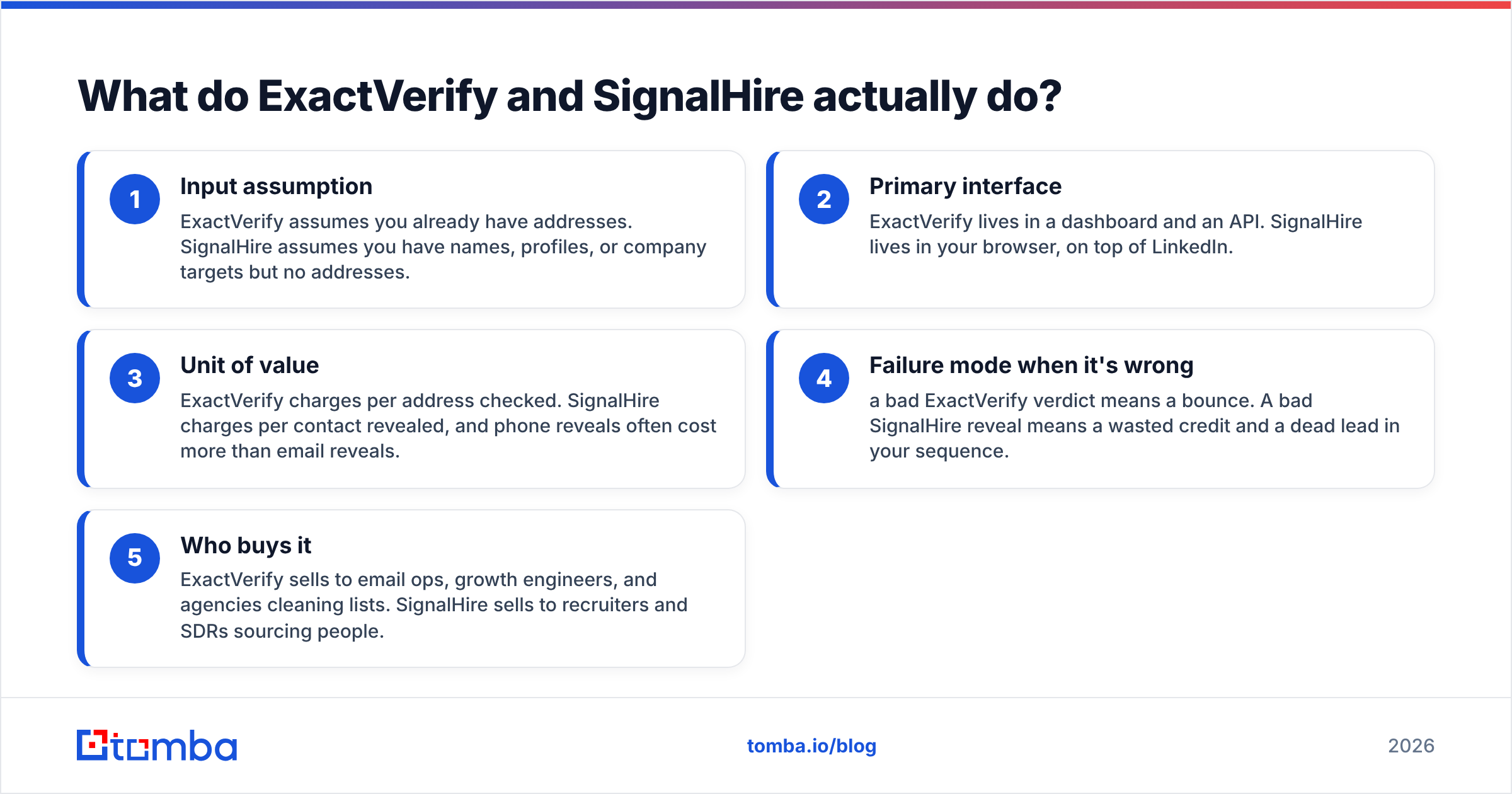
That split drives every other difference in the ExactVerify vs SignalHire matchup:
- What you start with — ExactVerify assumes you already have addresses. SignalHire assumes you have names or company targets, but no addresses.
- Where you work — ExactVerify lives in a dashboard and an API. SignalHire lives in your browser, on top of LinkedIn.
- What you pay for — ExactVerify charges per address checked. SignalHire charges per contact revealed. Phone reveals often cost more than email reveals.
- What goes wrong — A bad ExactVerify verdict means a bounce. A bad SignalHire reveal means a wasted credit and a dead lead in your sequence.
- Who buys it — ExactVerify sells to email ops, growth engineers, and agencies cleaning lists. SignalHire sells to recruiters and SDRs sourcing people.
ExactVerify vs SignalHire: feature by feature#
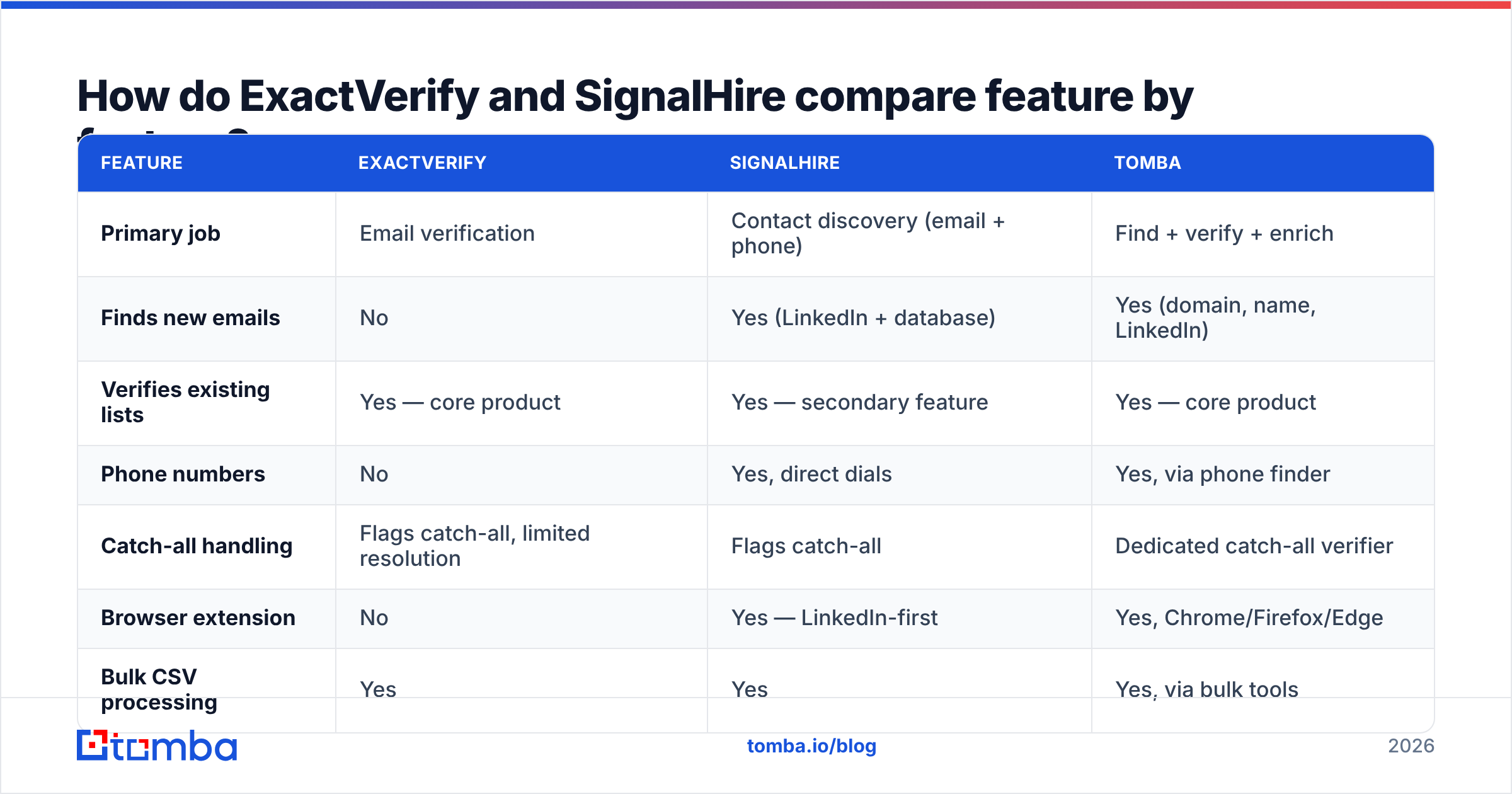
Here is the practical comparison. Treat pricing as directional. Both vendors adjust tiers, so confirm current numbers on their own pages before you buy.
| Feature | ExactVerify | SignalHire | Tomba |
|---|---|---|---|
| Primary job | Email verification | Contact discovery (email + phone) | Find + verify + enrich |
| Finds new emails | No | Yes (LinkedIn + database) | Yes (domain, name, LinkedIn) |
| Verifies existing lists | Yes — core product | Yes — secondary feature | Yes — core product |
| Phone numbers | No | Yes, direct dials | Yes, via phone finder |
| Catch-all handling | Flags catch-all, limited resolution | Flags catch-all | Dedicated catch-all verifier |
| Browser extension | No | Yes — LinkedIn-first | Yes, Chrome/Firefox/Edge |
| Bulk CSV processing | Yes | Yes | Yes, via bulk tools |
| Public API | Yes | Yes | Yes, REST + CLI + MCP |
| Free tier | Trial credits | Limited free credits monthly | 25 searches/mo, no card |
| Entry paid price | Pay-as-you-go credits, low entry | ~$49/mo entry tier | $49/mo Starter |
| Best fit | Cleaning owned lists | LinkedIn-heavy sourcing | Consolidating both steps |
The row that matters most is free tier. Verification tools are easy to over-buy. Before you commit to a monthly plan, run 100 known-good and 100 known-bad addresses through the free credits. Then score the results yourself. Vendor accuracy figures are marketing. Your own list is evidence.
Which one is more accurate?#
Wrong question. This is where most comparison posts go sideways. Accuracy means two different things here.
For ExactVerify, accuracy means one thing: when it says "valid," does the message land? It fails in two ways. It can clear an address that bounces. Or it can return an over-cautious "unknown" on catch-all domains, which quietly shrinks your usable list.
For SignalHire, accuracy means something else: is the revealed address the right person's current work email? It fails in two ways too. The record can be stale, because the contact left the company eight months ago. Or the address can be a pattern guess dressed up as a fact.

A few things are worth knowing before you read anyone's accuracy claim.
- Catch-all domains level the field. Roughly a fifth of B2B domains accept every address at the SMTP layer. No verifier can prove validity through a handshake alone.
- A hard "valid" on a catch-all domain is a guess. An "unknown" is honest but unhelpful. The useful middle ground is a scored confidence verdict, backed by pattern history and secondary signals. That is why we built a separate catch-all finder instead of folding it into the standard verifier.
- Fresh data beats a big database. SignalHire's database is large. But B2B contact data decays fast. Analysts peg annual decay at a quarter to a third of records, driven mostly by job changes. A smaller, recently re-checked dataset wins for cold outbound.
- Test on your own ICP. A tool that shines on US SaaS mid-market can be weak on European manufacturing or APAC logistics. Reviews on G2 help with support and billing signals. They say little about accuracy in your segment.
The honest verdict on ExactVerify vs SignalHire: for pure list hygiene, a dedicated verifier beats verification bolted onto a sourcing tool. For finding a contact who is not in your CRM yet, a verifier gives you nothing at all. These are not competing scores. They are different exams.
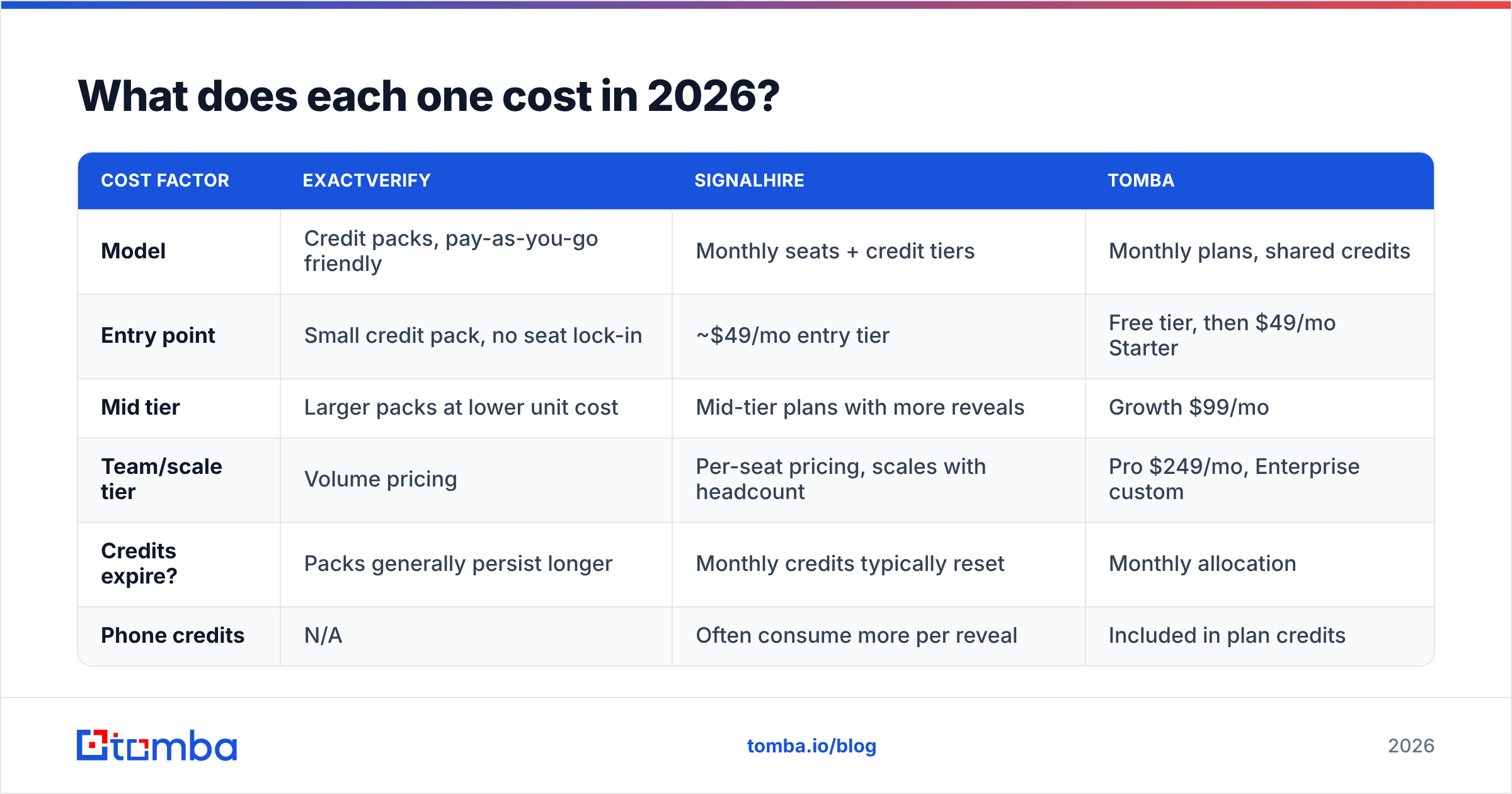
What does each one cost in 2026?#
Pricing is where the two diverge hardest. It is also the difference that bites teams six weeks in.
| Cost factor | ExactVerify | SignalHire | Tomba |
|---|---|---|---|
| Model | Credit packs, pay-as-you-go friendly | Monthly seats + credit tiers | Monthly plans, shared credits |
| Entry point | Small credit pack, no seat lock-in | ~$49/mo entry tier | Free tier, then $49/mo Starter |
| Mid tier | Larger packs at lower unit cost | Mid-tier plans with more reveals | Growth $99/mo |
| Team/scale tier | Volume pricing | Per-seat pricing, scales with headcount | Pro $249/mo, Enterprise custom |
| Credits expire? | Packs generally persist longer | Monthly credits typically reset | Monthly allocation |
| Phone credits | N/A | Often consume more per reveal | Included in plan credits |
Two traps to watch:
Trap one — per-seat multiplication. SignalHire charges per seat plus credits. A five-person SDR team does not pay one entry price. It pays five. If each rep only sources part-time, you are buying idle capacity. Compare that against a plan where the whole team shares one credit pool.
Trap two — paying twice for verification. Buy SignalHire to source and ExactVerify to clean, and you pay twice on the same contact. Once to reveal it. Again to check it. That is defensible at scale when both tools are genuinely best-in-class for your segment. It is waste when one platform's verification already clears your bounce threshold.
Look at Tomba pricing for what one combined bill looks like: Free (25 searches/mo), Starter $49/mo, Growth $99/mo, Pro $249/mo, Enterprise custom. Find, verify, and enrich all draw from the same pool.


Who should choose ExactVerify?#
Choose ExactVerify when your problem sits downstream of sourcing:
- You inherited a list. Trade-show scans, a partner's CSV, a five-year-old CRM export. You have addresses. You do not know which ones still resolve. A bulk verifier is built for exactly this.
- You are protecting a sending domain. After a deliverability scare, the fastest lever is cutting invalid addresses before they bounce. Mailbox providers read bounce rate as a spam signal. Cleaning a list costs far less than rebuilding reputation. Run a sender reputation check before you resume volume.
- You want pay-as-you-go, not a subscription. Agencies with lumpy workloads prefer credit packs that do not reset each month.
- You need verification inside a pipeline. Calling an API from a form handler or an ETL job? A focused verification endpoint is simpler to reason about than a broad sourcing platform's API surface.
Where it falls short: it will never fill an empty pipeline. If you open the dashboard with nothing to upload, ExactVerify has nothing to sell you.
Who should choose SignalHire?#
Choose SignalHire when sourcing is the bottleneck and LinkedIn is your hunting ground:
- You are a recruiter. SignalHire's DNA is recruiting. The candidate pipeline features, profile-first workflow, and heavy phone coverage match how technical and executive recruiters actually work.
- You need direct dials, not just email. Plenty of B2B tools treat phone numbers as an afterthought. SignalHire does not. If you call first and email second, that beats a small verification edge.
- You work profile by profile. Open a profile, reveal, save. The extension model suits low-volume, high-intent sourcing better than bulk domain sweeps.
Where it falls short: cost grows with headcount, credits usually reset monthly, and verification is a feature rather than a specialty. Push tens of thousands of addresses a month through cold sequences, and you will want a dedicated verifier alongside it. That drops you right back into the two-subscription problem.
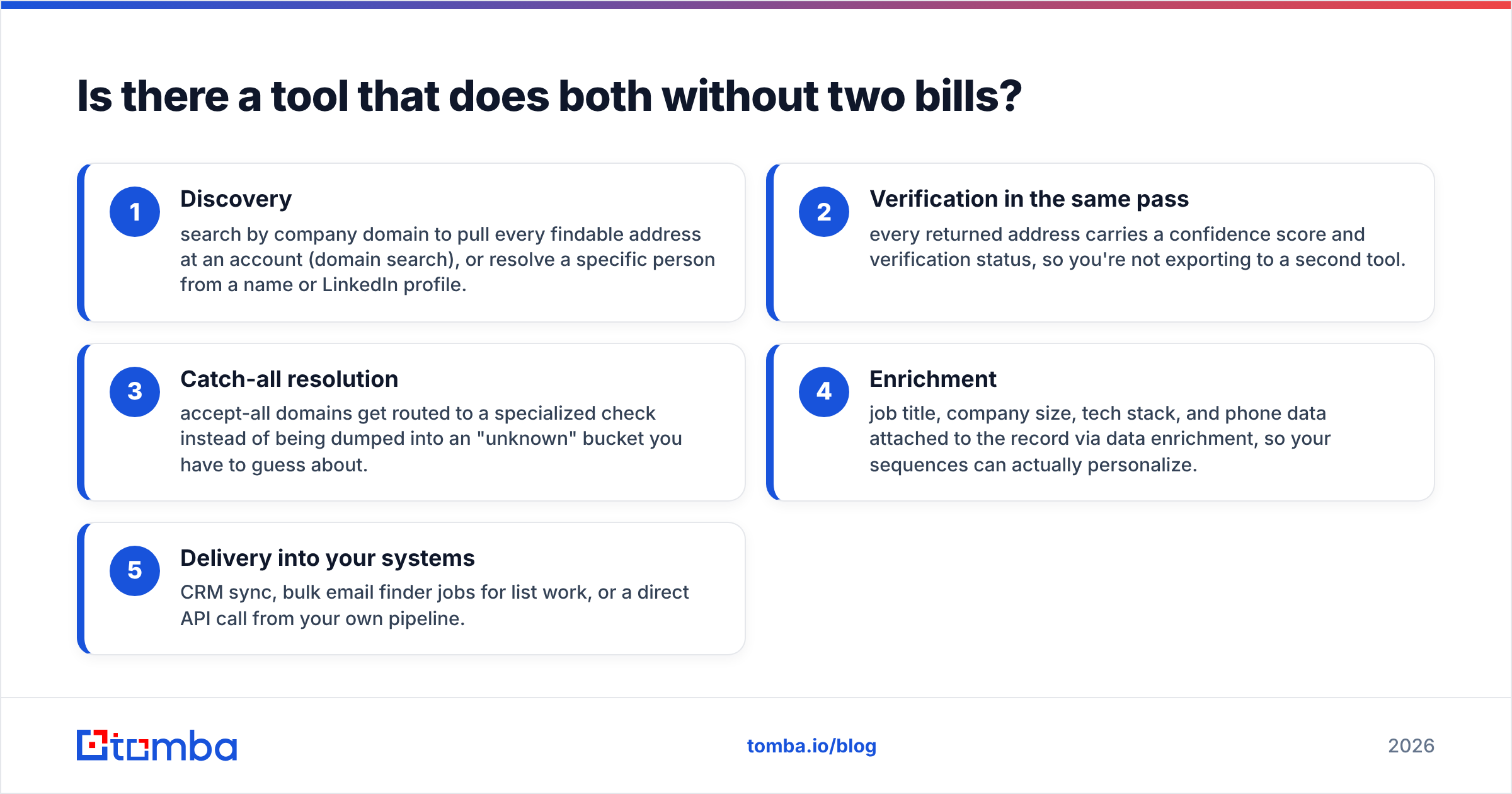
Is there a tool that does both without two bills?#
Yes. That is the honest reason this ExactVerify vs SignalHire comparison exists. The find-then-verify split is a quirk of how the tooling market grew up, not a law of nature.
A consolidated stack looks like this:
- Discovery — search by company domain to pull every findable address at an account (domain search). Or resolve one person from a name or LinkedIn profile.
- Verification in the same pass — every returned address carries a confidence score and a status. No export to a second tool.
- Catch-all resolution — accept-all domains route to a specialized check instead of an "unknown" bucket you have to guess about.
- Enrichment — job title, company size, tech stack, and phone data attach to the record via data enrichment, so your sequences can personalize.
- Delivery into your systems — CRM sync, bulk email finder jobs for list work, or a direct API call from your own pipeline.
The practical benefit is not feature count. It is that one credit pool, one accuracy standard, and one support contact beat reconciling two vendors' definitions of "valid" every month.
That said, be honest about the trade. If SignalHire's phone coverage in your vertical is clearly better than anything else you have tested, keep it. Coverage you can verify beats consolidation you cannot. Consolidate when the combined tool clears your accuracy bar, not because the invoice looks prettier.
How should you run the test before you buy?#
Do not take anyone's word for it, including ours. Run this in an afternoon:
- Build a 200-row control list. Use 100 addresses you know work: colleagues, customers who have replied, your own aliases. Add 100 you know are dead: former employees, made-up addresses on real domains, known disposables.
- Run it through every free tier. ExactVerify's trial, SignalHire's monthly free credits, and Tomba's free 25 searches. Record verdicts, not vibes.
- Score four numbers. True positives, false positives, false negatives, and the size of the "unknown" bucket. A tool with a 40% unknown rate is not accurate. It is evasive.
- Test sourcing separately. Take 50 target profiles in your real ICP. Count how many each tool resolves to a deliverable address, not how many it returns something for.
- Check the bill at your real volume. Multiply by seats, by monthly credits, by phone-reveal multipliers. Entry price is rarely the price you pay in month three.
Half an hour of testing beats a quarter of guessing. And if a vendor's free tier is too thin to run this test, that is information too.
The bottom line on ExactVerify vs SignalHire#
They solve different halves of the same pipeline. ExactVerify is the better pure verifier. SignalHire is the better LinkedIn-first sourcing tool, with strong phone coverage. If you only have one problem, buy the tool built for that problem.
Most outbound teams have both problems. In that case, the two-tool stack costs more than the pricing pages suggest. It also leaves you reconciling two different definitions of a valid contact.
Start with the free tier of Tomba's Email Finder — 25 searches a month, no card required. Run it against the same 200-row control list you use on everyone else. Find, verify, and enrich in one pass. Then decide whether you still need two subscriptions. Paid plans start at $49/mo when you are ready to scale.
Related guides#
Ready to find emails that actually work?
Join 150,000+ professionals who stopped guessing and started sending. Free credits on signup — no credit card required.
Get the Tomba newsletter
Practical outbound tactics and product updates — once every two weeks.
About the author