Example of Buyer Persona: 5 Real B2B Templates for 2026
Most buyer personas are fiction with a stock photo attached. Here are five real B2B persona examples built from CRM data, call recordings, and firmographics you can actually filter a list on.
TL;DR
- A useful example of buyer persona is not a biography. It is a filter: job titles, company size, tech stack, trigger events, and objections you can actually query in a data tool.
- Most persona documents fail because they include "Marketing Mary, 34, drinks oat milk" and omit the three fields that change your targeting: seniority, buying committee position, and the pain that has a budget line.
- Build personas from three sources — closed-won CRM records, 10 recorded discovery calls, and firmographic data — not from a workshop whiteboard.
- Five complete B2B examples below: SaaS VP of Sales, mid-market IT Director, agency founder, e-commerce Head of Growth, and healthcare compliance manager.
- The last mile is contact data. A persona is only worth writing if you can turn it into a list of named people with verified emails.
What Is a Buyer Persona, and What Is It Not?#
A buyer persona is a documented profile of a specific decision-maker archetype in your market, built from evidence, used to decide who you contact and what you say.
Think of it like a wanted poster versus a horoscope. A wanted poster gives you a height, a last known location, and a distinguishing scar — you can act on it. A horoscope tells you the subject "values authenticity and struggles with work-life balance," which describes roughly everyone. Most persona decks are horoscopes.
The practical test: can you hand your persona to a junior SDR and have them build a target list from it in 20 minutes? If your persona says "Director of IT at 200–1,000 employee US manufacturing companies running on-prem ERP," they can. If it says "Tech Tom is pragmatic and time-poor," they cannot.
Here is what separates the two:
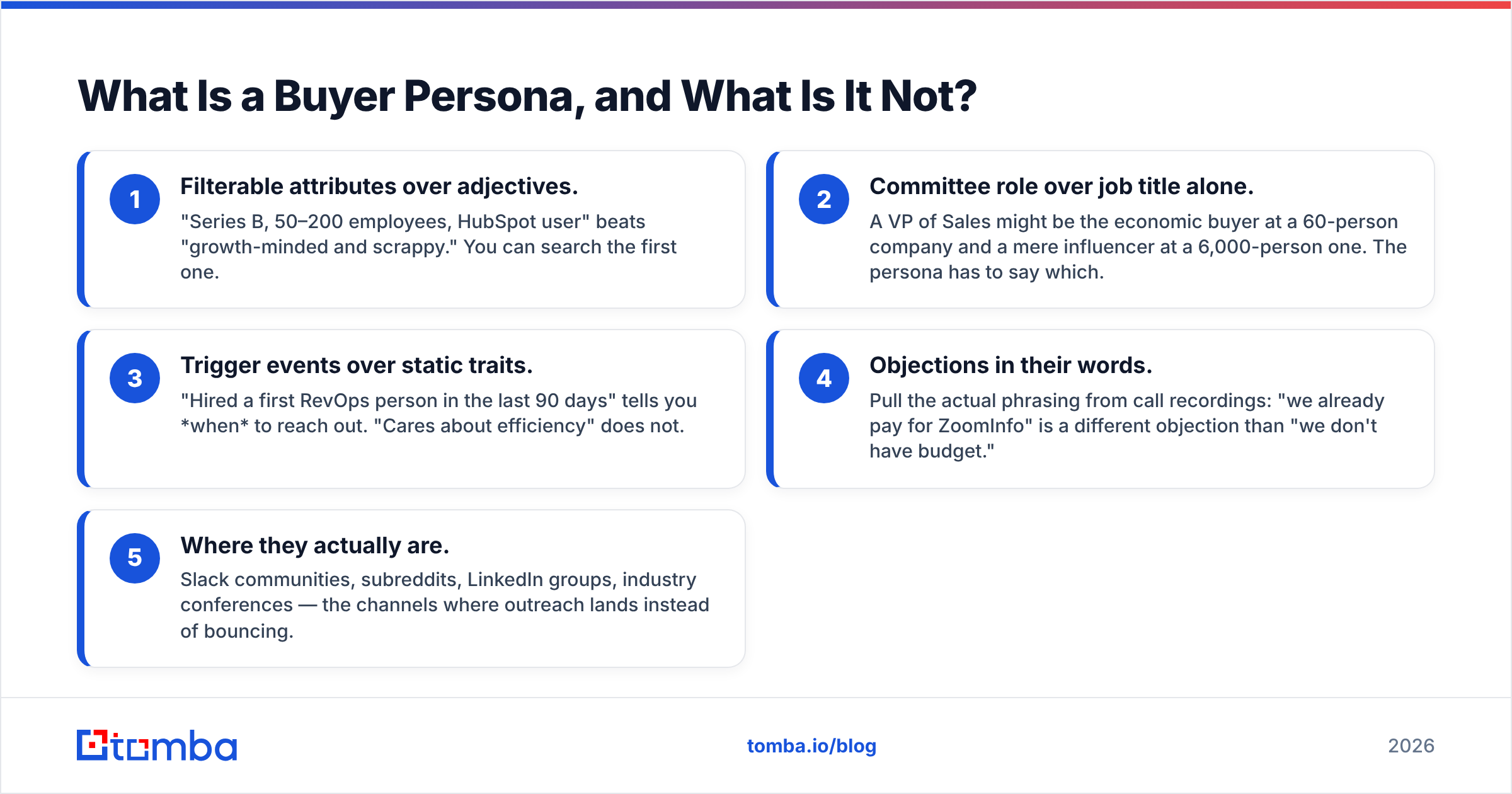
- Filterable attributes over adjectives. "Series B, 50–200 employees, HubSpot user" beats "growth-minded and scrappy." You can search the first one.
- Committee role over job title alone. A VP of Sales might be the economic buyer at a 60-person company and a mere influencer at a 6,000-person one. The persona has to say which.
- Trigger events over static traits. "Hired a first RevOps person in the last 90 days" tells you when to reach out. "Cares about efficiency" does not.
- Objections in their words. Pull the actual phrasing from call recordings: "we already pay for ZoomInfo" is a different objection than "we don't have budget."
- Where they actually are. Slack communities, subreddits, LinkedIn groups, industry conferences — the channels where outreach lands instead of bouncing.
Why Do Most Buyer Persona Examples Fail?#
They fail because they were written by marketing, for marketing, and never survived contact with a sales conversation.
The classic failure mode is the demographic template inherited from B2C. Age, gender, favorite coffee order, and a stock photo of a woman laughing at a salad. None of those fields change a single decision in a B2B sales motion. Nobody has ever won a deal because they knew the buyer was 41.
The second failure mode is the workshop persona. Eight people in a room, sticky notes, two hours, and a document that reflects the seniormost opinion instead of the data. HubSpot's research on buyer personas makes the same point: personas built without customer interviews reliably describe the company's self-image rather than the market.
The third is persona sprawl. A team ends up with 11 personas, nine of which are barely distinguishable, and the SDRs quietly ignore all of them. Three to five is the practical ceiling for most B2B companies. If two personas would receive the same email, they are one persona.
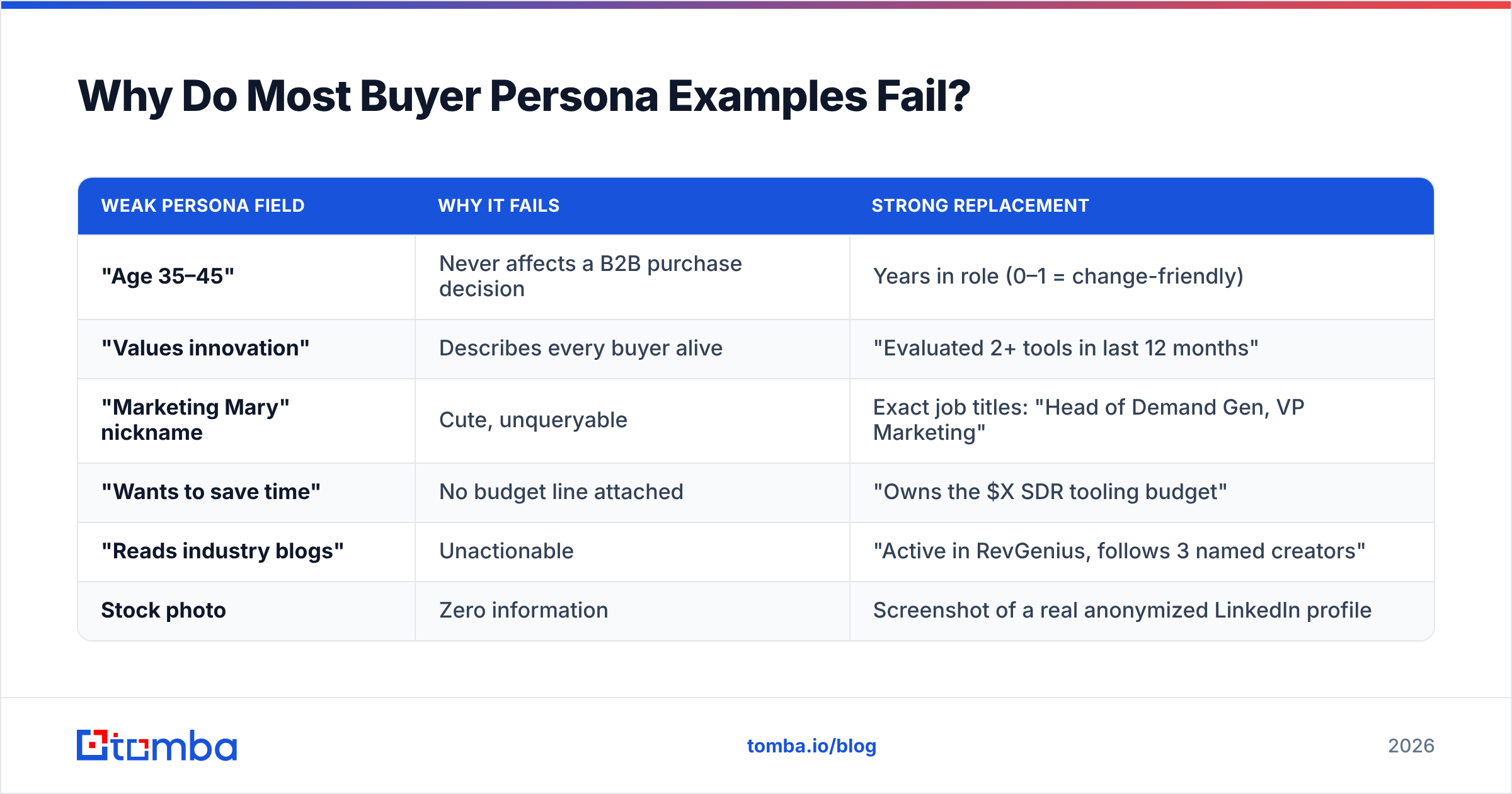
| Weak Persona Field | Why It Fails | Strong Replacement |
|---|---|---|
| "Age 35–45" | Never affects a B2B purchase decision | Years in role (0–1 = change-friendly) |
| "Values innovation" | Describes every buyer alive | "Evaluated 2+ tools in last 12 months" |
| "Marketing Mary" nickname | Cute, unqueryable | Exact job titles: "Head of Demand Gen, VP Marketing" |
| "Wants to save time" | No budget line attached | "Owns the $X SDR tooling budget" |
| "Reads industry blogs" | Unactionable | "Active in RevGenius, follows 3 named creators" |
| Stock photo | Zero information | Screenshot of a real anonymized LinkedIn profile |
What Does a Real Example of Buyer Persona Look Like?#
Here is a complete example of buyer persona for a sales-tooling company, written the way it should be written. Notice that every line is either something you can filter on or something you can say on a call.
Persona 1 — "Scaling VP of Sales" (SaaS, Series A–B)
- Titles: VP of Sales, VP Revenue, Head of Sales, Director of Sales (at companies under 150 people)
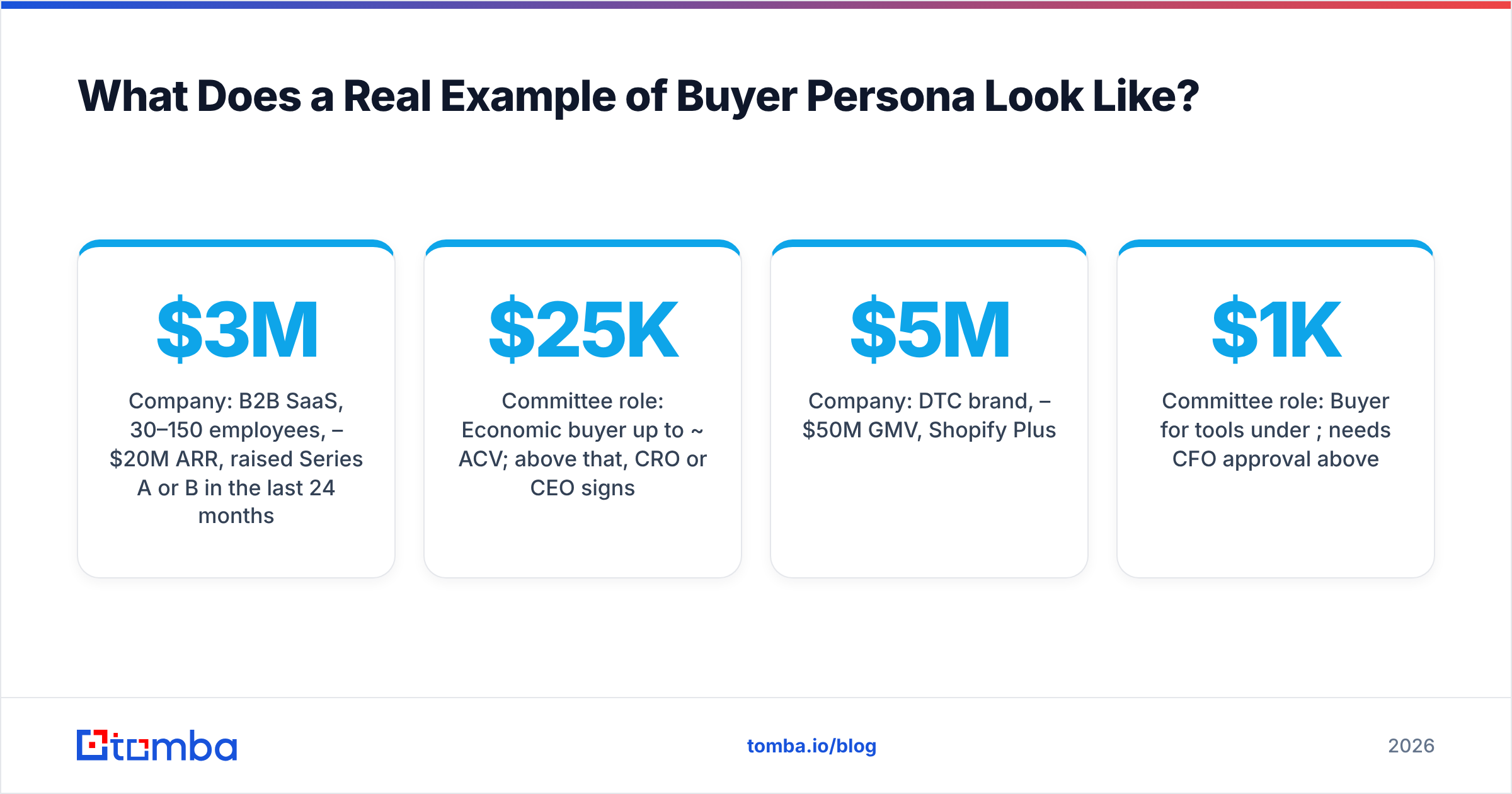
- Company: B2B SaaS, 30–150 employees, $3M–$20M ARR, raised Series A or B in the last 24 months
- Stack: Salesforce or HubSpot, Outreach or Instantly, some combination of ZoomInfo/Apollo/Clay
- Committee role: Economic buyer up to ~$25K ACV; above that, CRO or CEO signs
- Primary pain: Rep-sourced pipeline is flat while the board expects 3x. Data quality blamed in two consecutive QBRs.
- Trigger events: Hired 2+ AEs in 60 days, posted an SDR req, new CRO announcement, funding round
- Objection verbatim: "We already pay for a data provider and reps still say the emails bounce."
- What moves them: A bounce-rate comparison on their own domain list. Not a feature list.
- Where they are: LinkedIn (posts weekly), Pavilion, RevGenius, Sales Hacker newsletter
Persona 2 — "Mid-Market IT Director"
- Titles: IT Director, Director of Infrastructure, Head of IT Operations
- Company: 200–1,000 employees, manufacturing/logistics/distribution, US or DACH
- Committee role: Technical gatekeeper and champion; CFO is the economic buyer
- Primary pain: Security review burden. Every new vendor is a two-week questionnaire.
- Trigger events: SOC 2 renewal cycle, a publicized breach in their vertical, ERP migration announcement
- Objection verbatim: "Where does the data come from and can you prove GDPR compliance?"
- What moves them: A documented data sources page and a DPA they can forward to legal, before the demo.
Persona 3 — "Agency Founder"
- Titles: Founder, Managing Director, Owner (5–40 person marketing/recruiting agency)
- Committee role: Sole decision-maker. Buys on Tuesday, churns in month four if unused.
- Primary pain: Feast-or-famine pipeline. Client work eats the prospecting time.
- Trigger events: Lost a retainer client, hired a first BDR, launched a new service line
- Objection verbatim: "I don't have time to learn another platform."
- What moves them: Time-to-first-value under 10 minutes. A Chrome extension or a Google Sheets add-on beats a full platform onboarding.
Persona 4 — "E-commerce Head of Growth"
- Titles: Head of Growth, Growth Lead, Director of Ecommerce
- Company: DTC brand, $5M–$50M GMV, Shopify Plus
- Committee role: Buyer for tools under $1K/mo; needs CFO approval above
- Primary pain: Paid CAC rose 40% year over year; needs an owned outbound channel for wholesale/B2B accounts
- Trigger events: Launched a wholesale portal, hired a B2B sales lead, expanded to a new region
- Objection verbatim: "Our list is B2C — does any of this even apply?"
Persona 5 — "Healthcare Compliance Manager"
- Titles: Compliance Manager, Director of Regulatory Affairs, Privacy Officer
- Company: 500+ employee provider networks, payers, health-tech
- Committee role: Veto power. Cannot say yes alone, can absolutely say no alone.
- Primary pain: Shadow IT. Sales teams buying tools that touch PHI without review.
- Objection verbatim: "Is this a BAA-eligible vendor?"
- What moves them: Being told "no, we're not the right fit for PHI workflows" honestly, early. Credibility here wins the non-PHI use case later.
How Do You Build a Buyer Persona from Real Data?#
Start with your CRM, not a whiteboard. The people who already bought are the most reliable description of the people who will buy next.
Step 1: Export closed-won from the last 12 months. Pull company size, industry, the champion's title, the signer's title, deal size, and sales cycle length. Twenty accounts is enough to see clusters. If your top three title clusters cover 60%+ of revenue, those are your personas.
Step 2: Listen to 10 discovery calls. Not summaries — actual recordings. Write down the exact sentence the buyer used to describe their problem. That sentence goes into your subject lines verbatim. Gong's research on sales call analysis has repeatedly found that mirroring buyer language outperforms internal product language, and you can verify this on your own recordings in an afternoon.
Step 3: Layer firmographics. Take your title clusters and check how many companies in your addressable market actually have that role. A persona targeting "Chief Revenue Officer at 20-person startups" is a persona targeting a title that mostly doesn't exist. Use a B2B database to sanity-check volume before you commit a quarter to a segment.
Step 4: Document the anti-persona. Write down who you should not sell to — the segment with the highest churn or the longest cycle. This is the single highest-ROI page in the document, because it stops reps from wasting Q3 on a whale that will never close.
Step 5: Validate with 50 emails. Run a small campaign against each persona. Reply rate, not open rate, tells you whether the persona is real. A persona that produces sub-1% replies across 50 well-written sends is a hypothesis that failed.
How Do the Common Persona Frameworks Compare?#
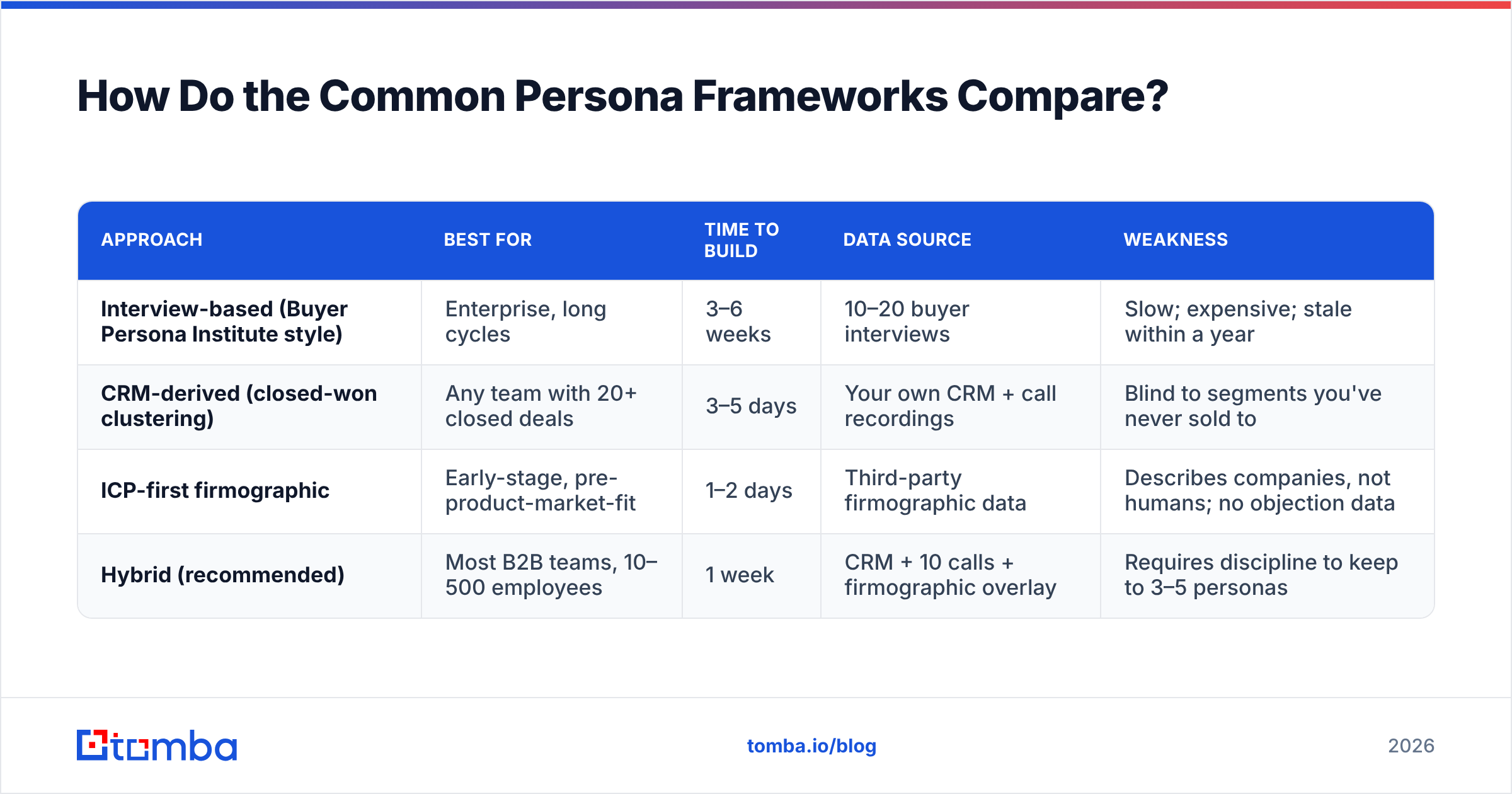
There are three dominant approaches, and they suit different team sizes and budgets.
| Approach | Best For | Time to Build | Data Source | Weakness |
|---|---|---|---|---|
| Interview-based (Buyer Persona Institute style) | Enterprise, long cycles | 3–6 weeks | 10–20 buyer interviews | Slow; expensive; stale within a year |
| CRM-derived (closed-won clustering) | Any team with 20+ closed deals | 3–5 days | Your own CRM + call recordings | Blind to segments you've never sold to |
| ICP-first firmographic | Early-stage, pre-product-market-fit | 1–2 days | Third-party firmographic data | Describes companies, not humans; no objection data |
| Hybrid (recommended) | Most B2B teams, 10–500 employees | 1 week | CRM + 10 calls + firmographic overlay | Requires discipline to keep to 3–5 personas |
The hybrid path is what most teams should run. Cluster your closed-won data to find the shape, use call recordings to fill in language and objections, and use firmographic data to size the segment before you build the list. G2's buyer behavior reports are a reasonable free sanity-check on whether your assumed evaluation criteria match what buyers in your category actually rank first.
How Do You Turn a Buyer Persona into an Actual Contact List?#
A persona becomes revenue only when it becomes a list of named people with working email addresses. This is where most persona projects quietly die.
The workflow is mechanical once the persona is written:
- Translate persona attributes into search filters. Industry, headcount band, geography, and technology become your company filter. Titles become your contact filter.
- Build the company list first. Pull the domains that match the firmographic profile. This is usually a few hundred to a few thousand accounts.
- Find the people at those companies. Run a domain search against each domain to surface the people holding your persona's titles, along with the company's email pattern.
- Verify before sending. Every list decays roughly 2–3% per month as people change jobs. Run the list through an email verifier so your bounce rate stays under 2% and your sender reputation survives the campaign.
- Enrich for personalization tokens. Funding stage, tech stack, and recent hires are what make the first line of your email non-generic. Contact enrichment fills those fields at scale rather than one browser tab at a time.
One warning about persona-to-list translation: do not let the tool's available filters redefine your persona. If your persona says "companies that just hired a first RevOps person" and your data tool has no such filter, the honest answer is to find that signal elsewhere — not to silently downgrade the persona to "companies with 50–200 employees" because that filter happens to exist.
What Should You Track to Know a Persona Is Working?#
Four numbers, checked monthly:
- Reply rate by persona. The clearest signal. Below 2% on a well-written sequence means the persona or the list is wrong.
- Meeting-to-opportunity rate. High meetings, low opportunities usually means you're reaching an influencer, not a buyer. Fix the seniority band in the persona.
- Sales cycle length by persona. If one persona takes 2.5x longer to close, it may belong in the anti-persona document.
- Churn by persona at 6 months. The most expensive persona error is the one that closes fast and churns faster.
Re-run the closed-won clustering every two quarters. Markets move, titles get renamed, and the persona that described your 2025 buyer will not describe your 2027 buyer.
Where Should You Start?#
Pick your single largest revenue cluster from closed-won, write the ten fields from the Persona 1 example above, and test it against 50 contacts this week. One validated persona beats five speculative ones.
When you're ready to turn that persona into a real list, the Tomba Email Finder takes your target domains and titles and returns verified professional email addresses, with a free tier of 25 searches per month to test the workflow before you commit. Paid plans start at $49/mo for Starter and $99/mo for Growth — see Tomba pricing for the full breakdown. Build the persona from data, then build the list from the persona. In that order.
Related guides#
Ready to find emails that actually work?
Join 150,000+ professionals who stopped guessing and started sending. Free credits on signup — no credit card required.
Get the Tomba newsletter
Practical outbound tactics and product updates — once every two weeks.
About the author