Example of GTM Strategy: 5 Real Playbooks Broken Down (2026)
Most GTM strategy advice stops at the framework. This breaks down five real go-to-market playbooks — PLG, outbound-led, ABM, channel, and community — with the numbers, motion, and data stack behind each.
TL;DR
- A go-to-market strategy is not a deck. It is a documented decision about who you sell to, how they find out about you, who does the selling, and what the economics have to look like for it to survive.
- The five motions that cover almost every B2B company: product-led (PLG), outbound-led (sales-led), account-based (ABM), channel/partner-led, and community-led. Most companies run two, badly.
- Motion choice is mostly a function of ACV. Under ~$2K ACV, human-led outbound rarely pays back. Over ~$50K ACV, self-serve alone rarely closes.
- Every motion breaks at the data layer first. Bad ICP definitions and stale contact data kill more GTM plans than bad messaging does.
- The concrete example of GTM strategy in this post includes target segments, channel mix, headcount, tooling budget, and the specific metric that tells you the motion is failing.
What is a GTM strategy, in plain terms?#
A go-to-market strategy is your route from "we built a thing" to "strangers pay us for it repeatedly." Think of it like planning a delivery route rather than just owning a truck. The product is the truck. GTM is which neighborhoods you drive to, in what order, with how many drivers, and what it costs per drop.
A real GTM strategy answers five questions in writing:
- Who exactly buys — not "mid-market SaaS" but "Series B–C SaaS companies, 80–400 employees, with an existing RevOps hire and at least 5 SDRs."
- What problem you're displacing — the status quo you replace, whether that's a competitor, a spreadsheet, or doing nothing.
- How they discover you — the specific channel, not a list of nine.
- Who closes — self-serve checkout, an AE, a partner, or a community champion.
- What the unit economics must be — CAC, payback period, and the gross margin that makes it defensible.
If your plan doesn't produce a number for question five, it's positioning, not a GTM strategy. Gartner's research on B2B buying has consistently shown buyers spend only a small fraction of their journey with any single vendor's sales team — which is exactly why the channel question matters as much as the pitch question.
Which GTM motion fits your ACV?#
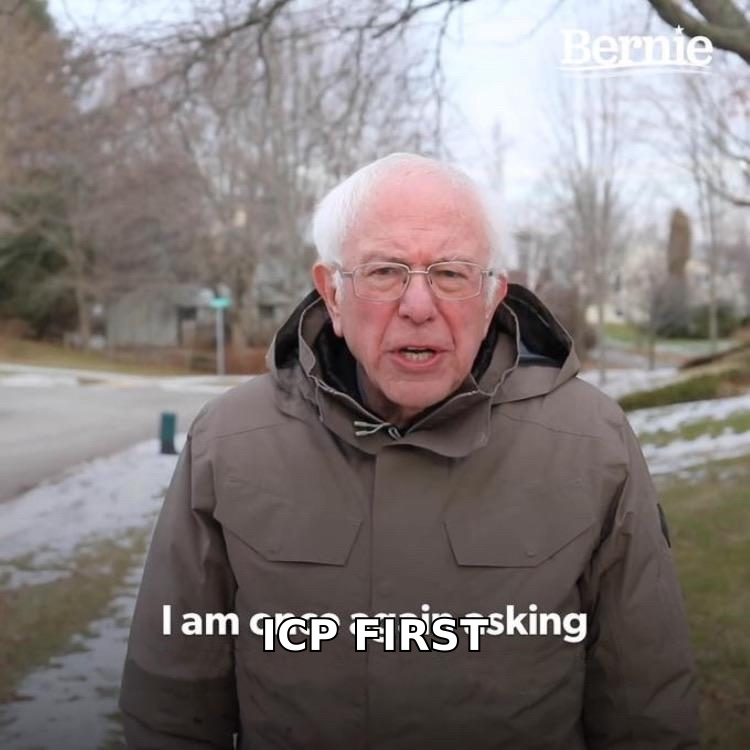
Here's the comparison most GTM posts skip. These are the five motions, sorted by what they actually cost to run.
| Motion | Best ACV range | Primary channel | Typical CAC payback | Headcount to start | Fails when |
|---|---|---|---|---|---|
| Product-led (PLG) | $0–$15K | Free tier, SEO, integrations | 5–12 months | 2 (growth eng + PMM) | Activation < 20%; no natural team expansion |
| Outbound-led | $5K–$60K | Cold email, cold call, LinkedIn | 12–18 months | 3 (1 AE + 2 SDRs) | Data accuracy < 90%; reply rate < 2% |
| Account-based (ABM) | $50K+ | Multi-thread email, events, ads | 15–24 months | 4 (AE, SDR, marketer, SE) | Fewer than 200 real target accounts |
| Channel/partner-led | $10K–$100K | Resellers, agencies, marketplaces | 9–18 months | 2 (partner manager + enablement) | Partner margin below 20% |
| Community-led | $0–$20K | Slack/Discord, creators, forums | 6–15 months | 2 (community lead + content) | You extract before you contribute |
Read the table as guardrails, not laws. But the ACV column is the one people ignore and then wonder why their $900/year product can't support a three-person sales pod.
What does a real example of GTM strategy look like?#
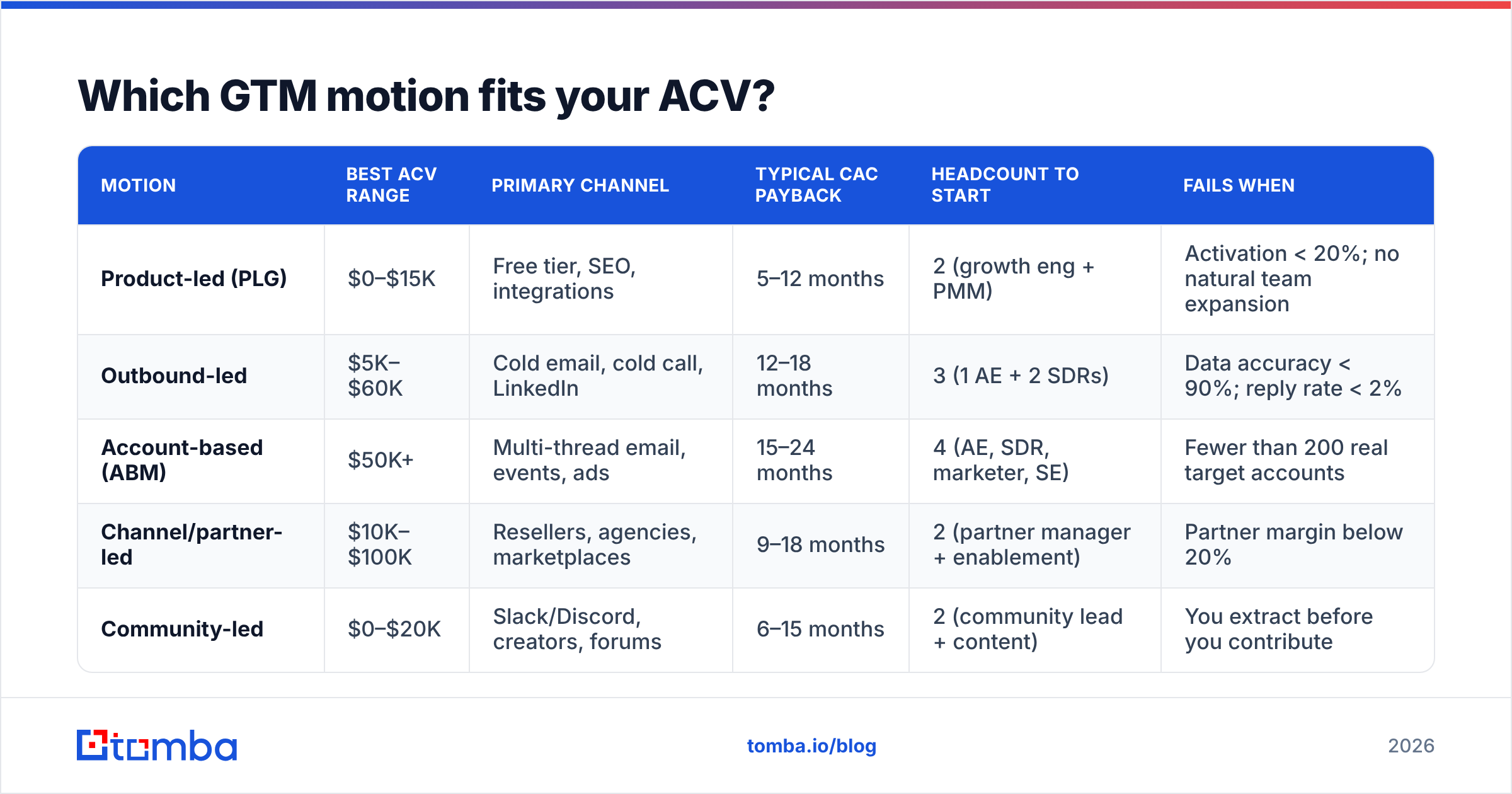
Let's make it concrete. Below is a full example of GTM strategy for a fictional but realistic company: Metrina, a $14K-ACV analytics tool for e-commerce operations teams, 18 months post-seed, $1.1M ARR, 6 people.
Segment definition. Shopify Plus and BigCommerce merchants doing $5M–$50M GMV, US and UK, with an in-house ops team of 3+. Roughly 11,000 companies globally. Excluded: agencies (they churn at 4x), sub-$5M GMV (can't afford it), enterprise retail (18-month cycles Metrina can't survive).
Displacement target. Not a competitor — it's a Google Sheet maintained by one ops analyst and a $0 Shopify report. That means the pitch is "kill the Monday morning spreadsheet," not "we're better than Looker."
Motion. Outbound-led primary, PLG secondary. Reasoning: 11,000 target accounts is too small for a pure PLG funnel to fill, and $14K ACV is too low for ABM's cost structure. A 14-day trial exists but doesn't drive pipeline on its own.
Channel mix and budget (monthly):
- Cold email — $2,400/mo in tooling and data, 2 SDRs, targeting 1,800 contacts/month across 900 accounts. Expected: 4.5% reply, 1.1% meeting rate → ~20 meetings.
- Founder-led LinkedIn — $0, 4 posts/week from the CEO, drives ~6 inbound conversations/month at 3x the close rate of outbound.
- Shopify App Store listing — $0 direct, ~9 trials/month, 2 convert. Highest-intent source, lowest volume.
- Partner referrals from 3 ops agencies — 20% first-year margin, ~3 deals/quarter, near-zero CAC.
- Two category-specific SEO clusters — 6-month payback horizon, budgeted at $3,000/mo in content.
The economics that have to hold. Blended CAC target: $6,800. Gross margin: 82%. Payback: under 14 months. If blended CAC crosses $9,000, the outbound pod gets cut before the SEO budget does — because SEO compounds and SDR seats don't.
The single failure metric. Meetings-held-to-opportunity conversion. If that drops below 40%, the problem is targeting, not messaging, and the ICP definition gets rewritten before a single email template changes.
That's a GTM strategy. Notice how much of it is subtraction — the excluded segments, the channels not run, the trigger for cutting spend.
Why does the data layer decide whether the motion works?#
Because every motion above except pure PLG depends on knowing who to contact and reaching them. Outbound with 70%-accurate contact data isn't outbound at a discount — it's outbound at a loss, since bounces damage your sending domain and drag down every future campaign, not just the current one.
The failure chain is predictable:
- Loose ICP → you build a list of 40,000 accounts instead of 900 real ones.
- Scraped or stale emails → 15–25% bounce rate on first send.
- Bounces above 3% → mailbox providers throttle you, and email deliverability collapses across every sequence you're running.
- Collapsed deliverability → your reply rate halves, your SDRs blame the copy, and you spend a quarter rewriting templates that were never the problem.
This is why the sequencing matters: define the ICP, build the list against it, verify the list, then write copy. Teams that reverse those steps spend months optimizing the last 10% of the funnel while the first 10% is broken.
Practically, that means running two checks before a campaign goes out. First, confirm you can actually reach the roles you named — use a domain search on 20 sample accounts and see whether the titles you need even appear. If they don't, your ICP is aspirational. Second, run the list through an email verifier and expect to discard 8–15% of a well-sourced list and 30%+ of a scraped one.

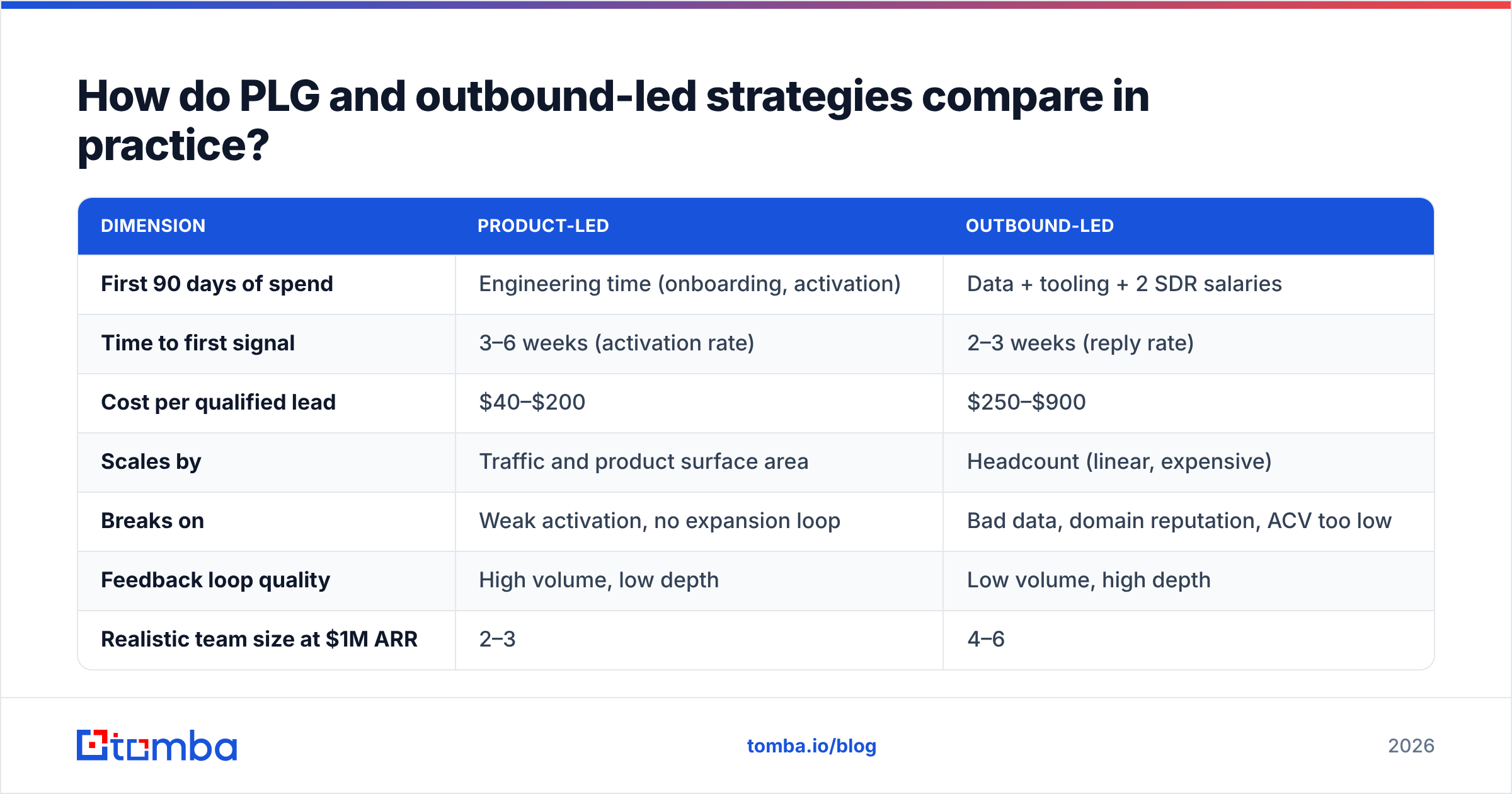
How do PLG and outbound-led strategies compare in practice?#
These two get conflated constantly because "we have a free tier and we also send emails" sounds like both. It usually means neither is resourced properly.
| Dimension | Product-led | Outbound-led |
|---|---|---|
| First 90 days of spend | Engineering time (onboarding, activation) | Data + tooling + 2 SDR salaries |
| Time to first signal | 3–6 weeks (activation rate) | 2–3 weeks (reply rate) |
| Cost per qualified lead | $40–$200 | $250–$900 |
| Scales by | Traffic and product surface area | Headcount (linear, expensive) |
| Breaks on | Weak activation, no expansion loop | Bad data, domain reputation, ACV too low |
| Feedback loop quality | High volume, low depth | Low volume, high depth |
| Realistic team size at $1M ARR | 2–3 | 4–6 |
The honest read: PLG has a far better cost curve but a much longer proof window, and it only works if your product delivers value before a human is involved. Outbound gives you learning in three weeks — you'll know within 400 emails whether your positioning lands — but it stops scaling the second you stop hiring.
Most companies at Metrina's stage should run outbound to learn and build PLG or SEO to compound. The mistake is treating outbound as the permanent engine.
What about ABM, channel, and community motions?#
ABM is outbound with the volume dial turned down and the effort dial turned up. It only makes sense when your total addressable account list is small (under ~2,000) and your ACV is high enough that spending $3,000 in effort on one account is rational. The tell that you're doing fake ABM: your "target account list" has 5,000 companies on it and everyone gets the same sequence. Real ABM means custom research per account, multi-threading across 4–6 stakeholders, and marketing running air cover on the same named list. If you can't name the six people you're trying to reach at an account, you're doing outbound with an ABM label.
Channel-led is the most underrated motion for products that sit inside someone else's workflow. Agencies, systems integrators, and marketplace listings can deliver deals at a fraction of direct CAC. The catch is margin: below roughly 20% first-year revenue share, partners deprioritize you, and you'll spend more on enablement than you earn. G2's category data is a useful sanity check here — if your category is dominated by tools that ship with implementation partners, channel isn't optional.
Community-led is the slowest and the most durable. It works when your buyer already congregates somewhere and treats peer recommendation as the primary trust signal — DevTools, security, RevOps. It fails when you show up to extract. The rough rule practitioners use: contribute for two quarters before you mention your product, and expect the first attributable pipeline in month 7 or later.
How do you actually build the target list for any of these?#
Every motion needs the same underlying asset: a clean, current list of accounts and the humans inside them. The build sequence:
- Write the ICP as filters, not adjectives. Employee range, funding stage, tech stack, geography, and one behavioral trigger (hiring for a role, new funding, tool adoption). If a filter can't be queried, it's not a filter.
- Size the list before you build it. If your ICP produces fewer than 300 accounts, you need ABM. Over 20,000, you need PLG or paid. Between those, outbound is viable.
- Find the accounts, then the people. Company-level sourcing first (marketplaces, funding databases, tech-stack lookups), then role-level contact discovery. A B2B database or an email finder handles the second step at volume.
- Verify before you send, every time. Lists decay 22–30% annually as people change jobs. A list you built in January is meaningfully wrong by June.
- Enrich for personalization inputs, not vanity fields. You need two or three facts you'd actually reference in an email. Forty enrichment columns nobody reads is a cost, not an asset.
- Instrument the handoff. Every contact should carry its source, its verification status, and its trigger into the CRM so you can kill underperforming sources with evidence rather than opinion.
Step 4 is where budgets get set. Data tooling for a two-SDR pod usually lands between $150 and $400 per month depending on volume; Tomba pricing starts free at 25 searches, with Starter at $49/mo and Growth at $99/mo for teams running steady weekly list builds. Compared to seat-based platforms that bundle sequencing you may not need, credit-based sourcing keeps the data line item separable from the sending line item — which matters when you need to cut one without killing the other.
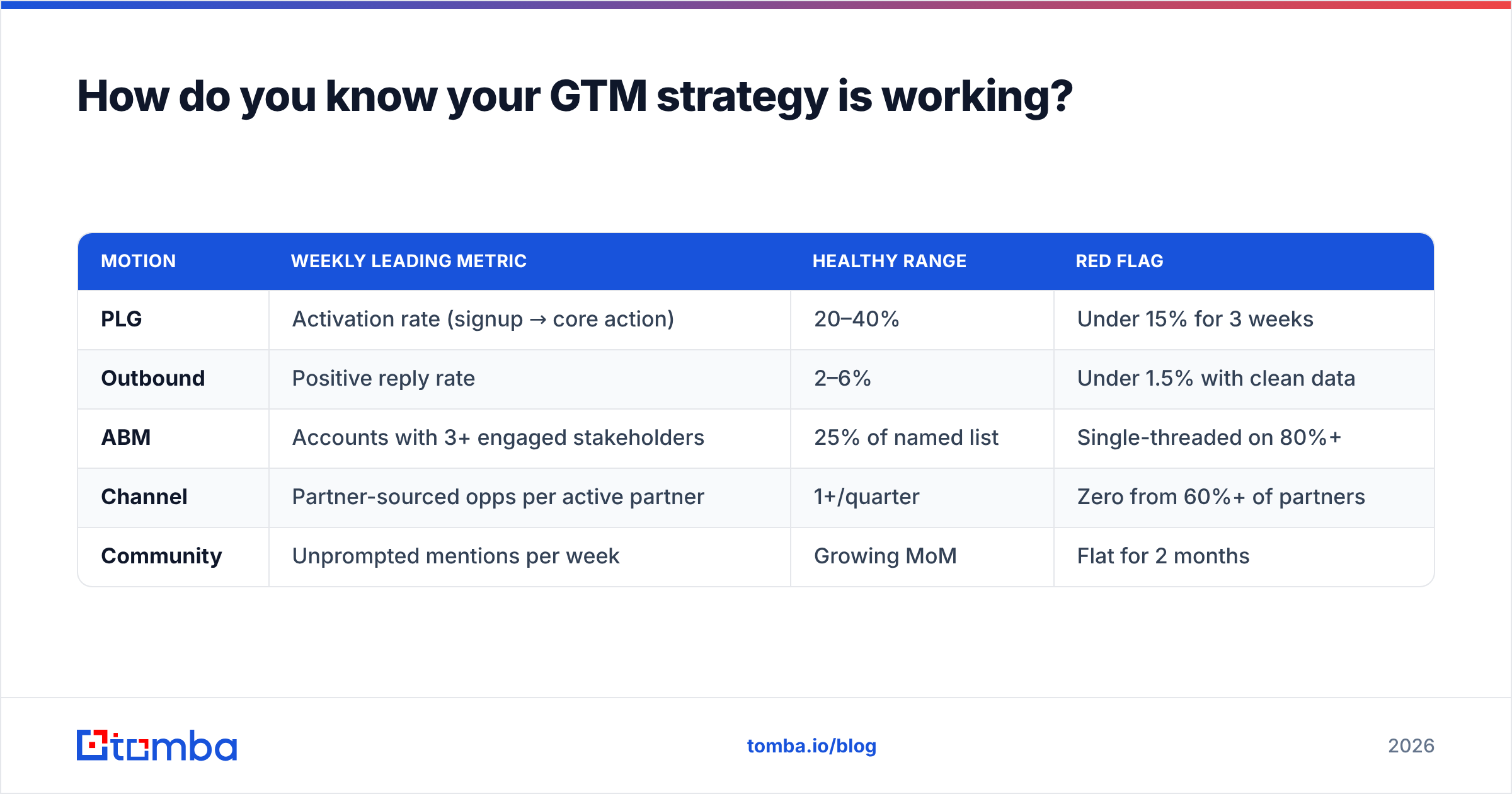
How do you know your GTM strategy is working?#
Pick one leading metric per motion and review it weekly. Lagging metrics like ARR tell you what happened last quarter; they can't steer.
| Motion | Weekly leading metric | Healthy range | Red flag |
|---|---|---|---|
| PLG | Activation rate (signup → core action) | 20–40% | Under 15% for 3 weeks |
| Outbound | Positive reply rate | 2–6% | Under 1.5% with clean data |
| ABM | Accounts with 3+ engaged stakeholders | 25% of named list | Single-threaded on 80%+ |
| Channel | Partner-sourced opps per active partner | 1+/quarter | Zero from 60%+ of partners |
| Community | Unprompted mentions per week | Growing MoM | Flat for 2 months |
One more discipline: separate motion failure from execution failure. If your outbound reply rate is 0.8% but your data is verified and your list matches your ICP, the motion may be wrong for your ACV. If your data is a scraped list of 12,000 contacts, the motion is fine and the execution is broken. Teams routinely abandon a viable motion because they never ran it with a clean list. HubSpot's sales benchmarks are a reasonable external reference point when you want to sanity-check whether your numbers are actually below par or just below your optimism.
What should you do in the next 30 days?#
If you're writing a GTM plan from scratch, compress it to one page:
- Week 1 — Write the ICP as queryable filters. Size the list. Pick the motion the size and ACV imply, not the one you find interesting.
- Week 2 — Build a 300-account pilot list against those exact filters. Verify it. Note the bounce and discard rate; that number is your data quality baseline.
- Week 3 — Run the motion with a single message and no variations. You're testing the segment, not the copy.
- Week 4 — Review the leading metric from the table above. Change one variable. Kill the segment or double the list.
The whole point of a written GTM strategy is that it makes killing things cheap. When the trigger for cutting the outbound pod is documented in advance at $9,000 CAC, cutting it is a decision, not an argument.
If step 2 of that plan is where you usually stall, start there. The Tomba Email Finder turns a company list into verified, role-matched contacts — by domain, name, or company — so your pilot list reflects your ICP instead of whatever a scraper happened to catch. The free tier covers 25 searches, which is enough to sanity-check whether your target roles are reachable at all before you commit a quarter's budget to a motion.
Related guides#
Ready to find emails that actually work?
Join 150,000+ professionals who stopped guessing and started sending. Free credits on signup — no credit card required.
Get the Tomba newsletter
Practical outbound tactics and product updates — once every two weeks.
About the author