Example of Objection Handling: 12 Real Scripts for 2026
Every objection you will hear in B2B sales, mapped to what the buyer actually means and the exact words that keep the deal moving instead of stalling it.
TL;DR
- An objection is a stated reason not to move forward. A brush-off is a polite exit. Treating them the same is why most reps lose winnable deals.
- Almost every example of objection in B2B sales collapses into six buckets: price, timing, authority, need, trust, and competitor incumbency.
- The response that works is almost never a counter-argument. It is a clarifying question that makes the buyer explain their own reasoning out loud.
- Frameworks (LAER, Feel-Felt-Found, Sandler negative reverse) are scaffolding, not scripts. Pick one, run it consistently, and log the results.
- A large share of "objections" are not objections at all — they are the wrong person, reached at the wrong company, because the contact data was stale.
What is an objection in sales?#
An objection is any stated reason a buyer gives for not advancing the deal right now. That is the whole definition. It is not rejection, it is not a no, and it is not a personal verdict on your pitch.
Think of it like a customer at a car dealership saying "the trunk looks small." They are not leaving. They are telling you the exact thing standing between them and a signature. A rep who argues about trunk dimensions loses. A rep who asks "what do you usually haul?" learns the buyer has a golden retriever and two kids, and sells them the wagon.
The mechanical version: an objection is information about the buyer's decision criteria, delivered in the least useful possible format. Your job is to convert it back into criteria.
What is the difference between an objection and a brush-off?#
This distinction decides how you spend the next ten minutes.
An objection is specific, references your product or their situation, and usually contains a detail you did not supply. "We already run this through Apollo and the credits roll over" is an objection — they thought about it.
A brush-off is generic, contains no detail, and would apply to literally any vendor. "Send me some info," "not right now," "we're all set" — these are exits dressed as feedback.
The tell is specificity. If the response could be copy-pasted to your three closest competitors without editing a word, you got a brush-off. Objections get handled. Brush-offs get one polite re-engagement attempt and then a calendar reminder for 90 days out.
What are the six types of objection?#
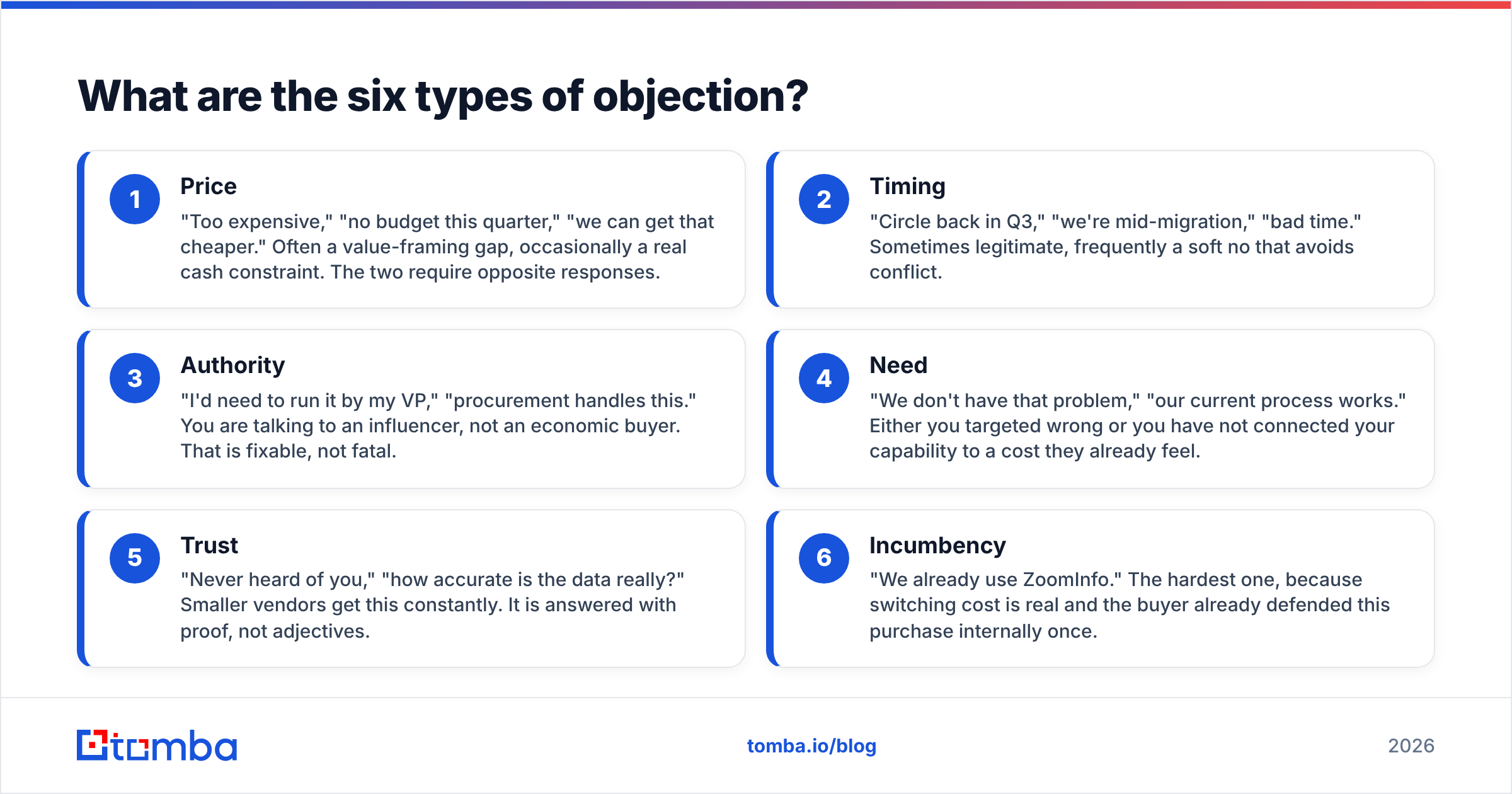
Nearly every example of objection you will encounter maps to one of these six. Learn the buckets and you stop improvising.
- Price — "Too expensive," "no budget this quarter," "we can get that cheaper." Often a value-framing gap, occasionally a real cash constraint. The two require opposite responses.
- Timing — "Circle back in Q3," "we're mid-migration," "bad time." Sometimes legitimate, frequently a soft no that avoids conflict.
- Authority — "I'd need to run it by my VP," "procurement handles this." You are talking to an influencer, not an economic buyer. That is fixable, not fatal.
- Need — "We don't have that problem," "our current process works." Either you targeted wrong or you have not connected your capability to a cost they already feel.
- Trust — "Never heard of you," "how accurate is the data really?" Smaller vendors get this constantly. It is answered with proof, not adjectives.
- Incumbency — "We already use ZoomInfo." The hardest one, because switching cost is real and the buyer already defended this purchase internally once.
Misdiagnosis is the expensive error. A timing objection answered with a discount teaches the buyer that your price was fake. A price objection answered with "when should I follow up?" hands them a free exit.
What does each example of objection actually mean?#
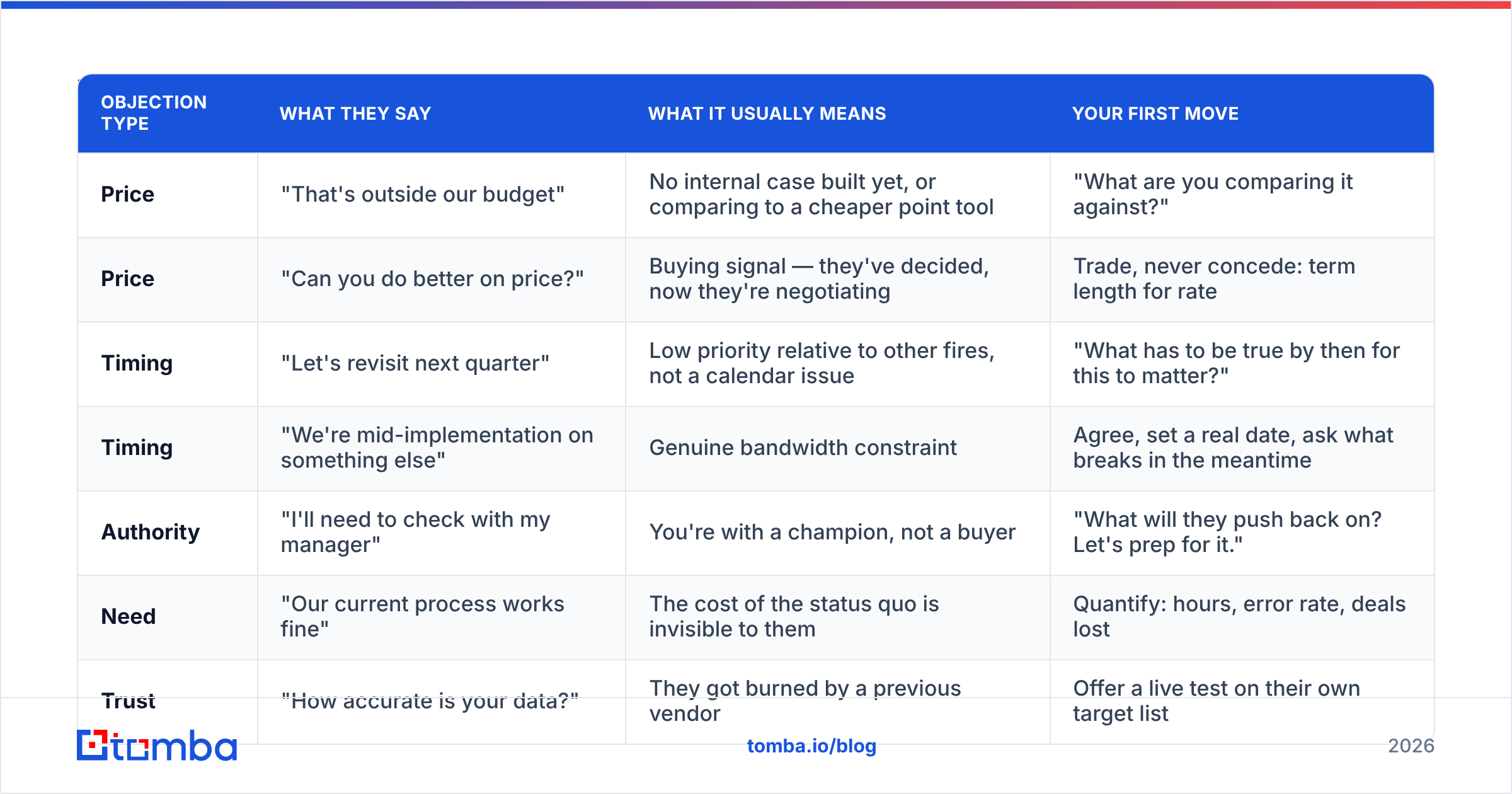
Here is the translation layer. The left column is what you hear; the middle is what is usually true underneath; the right is the first thing out of your mouth.
| Objection type | What they say | What it usually means | Your first move |
|---|---|---|---|
| Price | "That's outside our budget" | No internal case built yet, or comparing to a cheaper point tool | "What are you comparing it against?" |
| Price | "Can you do better on price?" | Buying signal — they've decided, now they're negotiating | Trade, never concede: term length for rate |
| Timing | "Let's revisit next quarter" | Low priority relative to other fires, not a calendar issue | "What has to be true by then for this to matter?" |
| Timing | "We're mid-implementation on something else" | Genuine bandwidth constraint | Agree, set a real date, ask what breaks in the meantime |
| Authority | "I'll need to check with my manager" | You're with a champion, not a buyer | "What will they push back on? Let's prep for it." |
| Need | "Our current process works fine" | The cost of the status quo is invisible to them | Quantify: hours, error rate, deals lost |
| Trust | "How accurate is your data?" | They got burned by a previous vendor | Offer a live test on their own target list |
| Incumbency | "We're already with a competitor" | Contract lock-in plus reluctance to admit a bad call | "What would they have to stop doing for you to look around?" |
Notice a pattern: seven of the eight first moves are questions. That is not a stylistic preference. Research on sales conversations — including Gong's analysis of recorded calls — consistently finds that reps who ask more questions after an objection close at a higher rate than reps who deliver more information.
How do you respond to a price objection?#
Split it first. "Too expensive" and "no budget" are different problems wearing the same shirt.
"Too expensive" is a value problem. They understand the price and do not yet believe the return. Do not discount. Reframe against the cost of the alternative:
"Fair. Right now your SDRs spend roughly six hours a week hand-building lists. At a loaded rate that's about $1,100 a month in salary going into a spreadsheet. The tool is $99. What I want to know is whether those six hours come back — want to test it on one territory before we talk contracts?"
"No budget" is a timing and authority problem. Money exists somewhere in the company; it is allocated elsewhere. Your move is to find whose budget this actually is:
"Understood — is it that the line item is spent, or that it was never budgeted? Because if it was never budgeted, I'd rather talk to whoever owns the number this affects than push you to find money you don't have."
"Competitor X is cheaper" is a scoping problem. Almost always the two quotes are not measuring the same thing. Credits that expire versus credits that roll over, verified emails versus raw guesses, seats included versus per-seat pricing. Ask exactly what is in their comparison quote before you defend yours. Transparent Tomba pricing helps here for a reason — when both sides can see the tiers, the conversation moves from "cheaper" to "what am I actually getting per credit."
One rule that survives every deal: never concede price without taking something back. Longer term, annual prepay, a case study, a reference call. A discount given for free teaches the buyer that everything else you said was also negotiable.
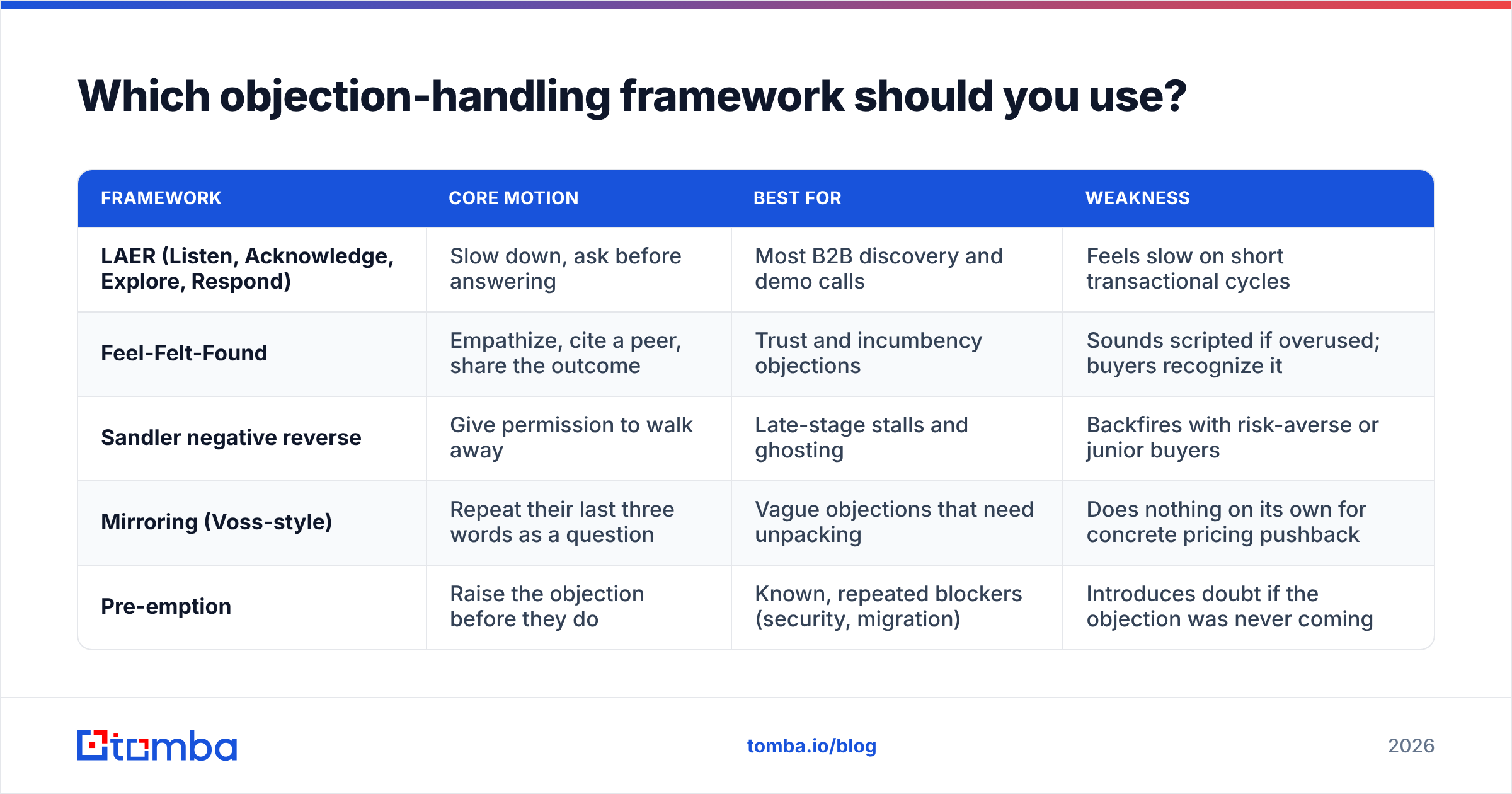
Which objection-handling framework should you use?#
There is no single winner. There is a fit between framework, deal size, and how combative the objection is.
| Framework | Core motion | Best for | Weakness |
|---|---|---|---|
| LAER (Listen, Acknowledge, Explore, Respond) | Slow down, ask before answering | Most B2B discovery and demo calls | Feels slow on short transactional cycles |
| Feel-Felt-Found | Empathize, cite a peer, share the outcome | Trust and incumbency objections | Sounds scripted if overused; buyers recognize it |
| Sandler negative reverse | Give permission to walk away | Late-stage stalls and ghosting | Backfires with risk-averse or junior buyers |
| Mirroring (Voss-style) | Repeat their last three words as a question | Vague objections that need unpacking | Does nothing on its own for concrete pricing pushback |
| Pre-emption | Raise the objection before they do | Known, repeated blockers (security, migration) | Introduces doubt if the objection was never coming |
If you run one team on one framework, pick LAER. It is the least likely to sound like a technique, and the "Explore" step is where the actual information lives. Both HubSpot's sales team and most enterprise enablement programs build on some variant of it.
What is a repeatable objection-handling sequence?#
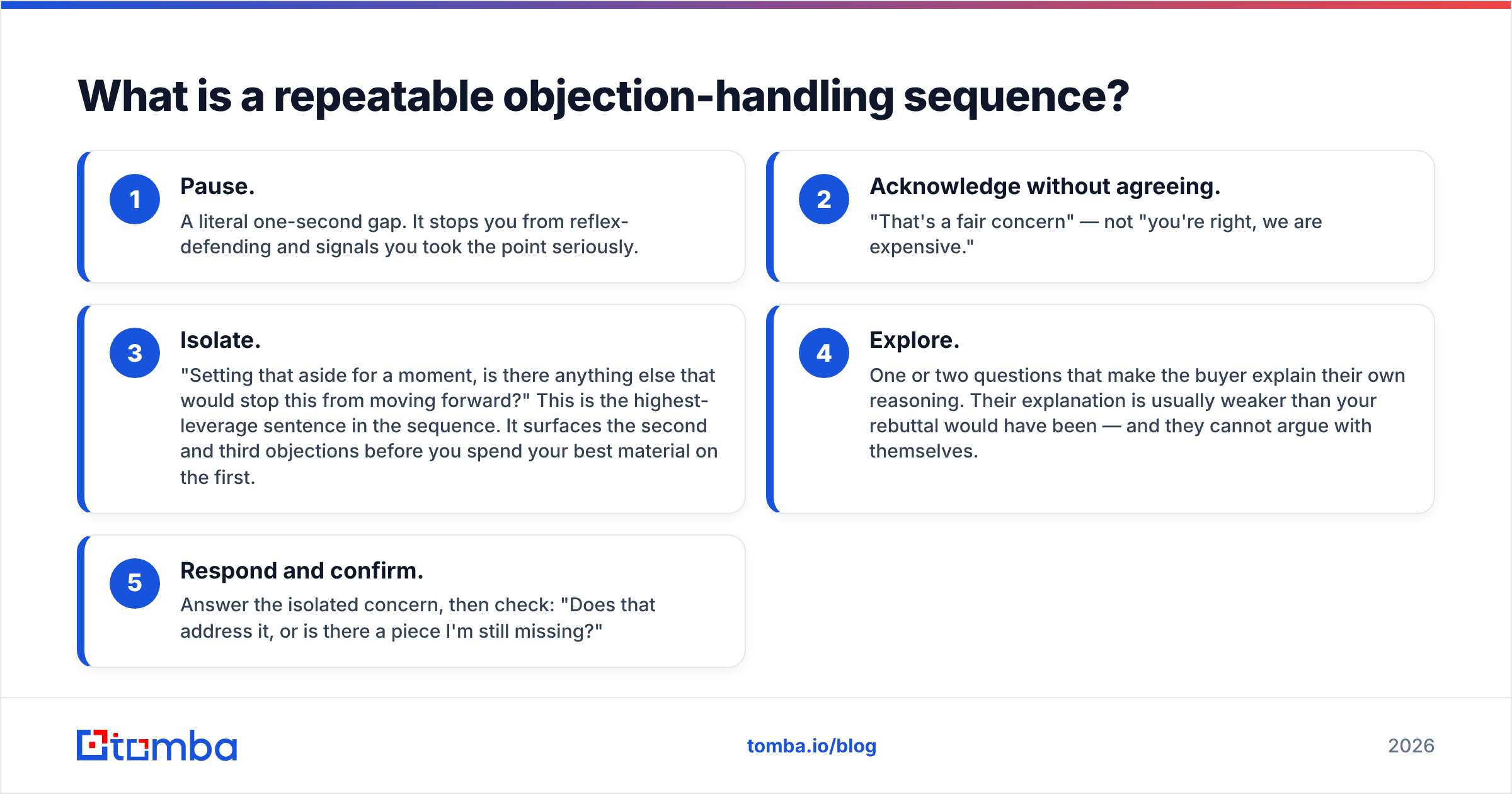
Five steps. Same order every time, whether the objection is price, timing, or a competitor.
- Pause. A literal one-second gap. It stops you from reflex-defending and signals you took the point seriously.
- Acknowledge without agreeing. "That's a fair concern" — not "you're right, we are expensive."
- Isolate. "Setting that aside for a moment, is there anything else that would stop this from moving forward?" This is the highest-leverage sentence in the sequence. It surfaces the second and third objections before you spend your best material on the first.
- Explore. One or two questions that make the buyer explain their own reasoning. Their explanation is usually weaker than your rebuttal would have been — and they cannot argue with themselves.
- Respond and confirm. Answer the isolated concern, then check: "Does that address it, or is there a piece I'm still missing?"
Step 3 is where most reps skip ahead. If you handle the price objection brilliantly and then discover there was also a security review and a competing contract, you burned your leverage on the smallest of three problems.
Why do so many objections come from bad data?#
Because a meaningful share of what reps log as objections are not objections at all. They are evidence that the outreach landed on the wrong human.
"We don't do that here" from a marketing manager at a company where procurement owns the tool is not a need objection. "I'm not the right person" is not an authority objection — it is a targeting failure. "Who is this?" after three emails to a role that changed nine months ago is a data problem wearing an objection costume.
Contact databases decay fast. Industry estimates for B2B contact data decay hover around 25-30% per year as people change jobs, companies rebrand, and email formats shift after acquisitions. Run a stale list and your objection log fills with noise that no script can fix.
The practical fix has three parts:
- Verify before you send. An email verifier pass removes bounces and role accounts before they hit your sequence and drag down your domain reputation.
- Confirm the role, not just the address. Finding a valid mailbox at the right company is half the job. Finding the person who owns the budget line is the other half — that is what turns "I'll ask my manager" into a first-call conversation with the manager.
- Re-enrich quarterly. Treat your list like inventory with an expiry date, not an asset you bought once.
When your targeting is clean, your objection log becomes useful. When it is dirty, you are coaching reps on scripts for problems that better data would have removed entirely. A steady response rate is the leading indicator that this is working; a rising volume of "wrong person" replies is the leading indicator that it is not.
How do you track objections so they stop surprising you?#
Log every objection as a structured field in your CRM, not as free text in call notes. Three properties are enough: type (the six buckets), stage (where in the pipeline it appeared), and outcome (handled, stalled, lost).
Within a quarter you will see the shape of your funnel. Common patterns and what they mean:
- Price objections clustering at first call — you are leading with cost or targeting companies below your price floor.
- Timing objections clustering at proposal — your discovery never established urgency; you sold a nice-to-have.
- Authority objections above 30% of all objections — your ICP definition names the wrong title.
- Incumbency objections rising quarter over quarter — a competitor is out-executing you at the top of the funnel, and you are arriving second.
That last pattern is the one worth acting on fastest. Arriving second means you spend the entire cycle arguing against someone else's framing. Reaching accounts earlier — before an incumbent sets the criteria — removes more objections than any script ever will. Salesforce's own pipeline research and most CRM-based analyses land on the same conclusion: deal outcome correlates strongly with who defines the evaluation criteria first.
What should you never do when handling an objection?#
Five reliable ways to lose a deal you had:
- Interrupt. The objection is rarely finished when the first sentence ends. The second sentence is where the real reason lives.
- Say "but." It deletes everything before it. Use "and" or a full stop.
- Discount on the first mention of price. You just told them the number was never real.
- Answer an objection you were not given. Volunteering "I know we're not the cheapest" plants a concern the buyer did not have.
- Send collateral instead of asking a question. A PDF has never once changed a buyer's mind mid-objection. It is a stalling tactic that lets both sides avoid the conversation.
And the meta-mistake: treating a brush-off as an objection and spending four follow-ups handling it. Specificity is the test. No detail, no deal.
Where should you start?#
Pick the single objection your team hears most this quarter. Write one response using the five-step sequence above. Run it for two weeks, log the outcomes, and rewrite it. One well-tested response beats a fifty-page battlecard nobody opens.
Then fix the input. If your reps are burning calls on "wrong person" and "never heard of you," the script is not the bottleneck — the list is. Tomba's email finder locates verified addresses for the specific titles that own your budget line, so your reps spend their objection-handling energy on real objections from real buyers. Start on the free tier at 25 searches a month, or move to Starter at $49/mo when the pipeline justifies it. The best objection is the one you never had to handle.
Related guides#
Ready to find emails that actually work?
Join 150,000+ professionals who stopped guessing and started sending. Free credits on signup — no credit card required.
Get the Tomba newsletter
Practical outbound tactics and product updates — once every two weeks.
About the author