Example of Personal Selling: 7 Real B2B Scenarios in 2026
Personal selling is the highest-cost, highest-conversion channel you own. Here are seven concrete examples — with scripts, stage mapping, and the data behind each — plus when to use automation instead.
TL;DR
- Personal selling is one-to-one, two-way persuasion where a human rep adapts the pitch in real time — a demo call, a trade-show conversation, a retail consultation, a QBR upsell.
- The clearest example of personal selling in B2B is the discovery call: a rep asks diagnostic questions, reshapes the pitch mid-conversation, and handles objections that no email sequence can.
- It converts 3-10x better than mass channels but costs 20-50x more per touch, so the entire game is deciding which accounts deserve a human.
- Seven concrete scenarios below cover field, inside, retail, technical, relationship, channel, and consultative selling — each with a script fragment and the stage it fits.
- Personal selling only pays off when the contact data is right. Bad emails and dead phone numbers burn rep hours before the selling even starts.
What is personal selling, exactly?#
Personal selling is direct, person-to-person persuasion where the seller tailors the message to one specific buyer in real time. That last clause is the whole definition. A billboard cannot change its mind. A drip sequence cannot notice that the prospect flinched when you mentioned migration timelines. A rep can.
Think of it like a tailor versus a rack of shirts. Mass marketing is the rack — cheap per unit, fits some people. Personal selling is the tailor taking measurements, noticing the customer favors one shoulder, and adjusting. Expensive, slow, and dramatically better fit.
Formally, personal selling has four traits that separate it from every other promotional channel:
- Two-way communication — the buyer talks back, and what they say changes the next sentence out of your mouth.
- Real-time adaptation — you can abandon a prepared deck at minute three because the actual problem is different from the one in the intake form.
- Relationship accumulation — trust compounds across calls, so touch #7 is worth more than touch #1. Mass channels have no memory.
- Direct close capability — the rep can ask for the signature, negotiate terms, and remove friction inside the same conversation.
Everything below is an application of those four traits to a different context.
What is a classic example of personal selling in B2B?#
The discovery call. A rep books 30 minutes with a VP of Operations at a 400-person logistics firm. They open with a hypothesis, not a pitch:
"Most ops leaders at your headcount tell me route planning is fine but driver onboarding takes eleven days. Is that your bottleneck, or is it something else?"
The VP corrects them — onboarding is fine, it's the compliance audit trail that's killing them. The rep drops the onboarding slides entirely, pulls up the audit module, and spends 20 minutes on a use case they had not planned to demo. Deal advances.
No sequence does that. The email that got the meeting booked was automation; everything after the "hello" was personal selling. That handoff point — automation gets attention, humans convert it — is the practical model for 2026.
What are 7 real examples of personal selling?#
Each of these is personal selling, but they sit at different pipeline stages, cost wildly different amounts, and demand different skills.
1. Field sales — the on-site enterprise visit#
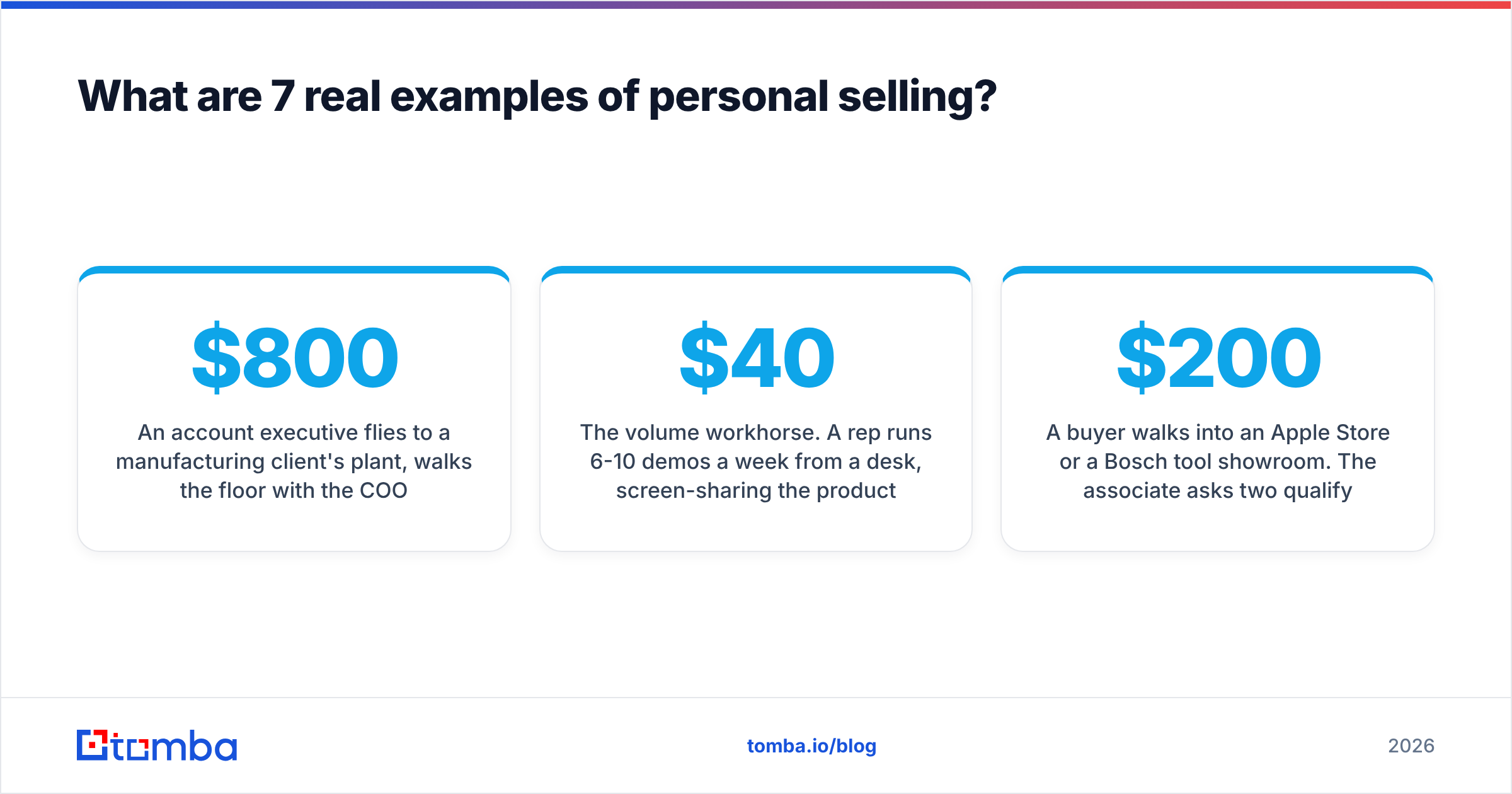
An account executive flies to a manufacturing client's plant, walks the floor with the COO, and sees the actual bottleneck. Cost per meeting: $800-$2,500 with travel. Justified only above roughly $75k ACV. What you get: physical context no Zoom call reveals, plus multi-threading with people who wander into the room.
2. Inside sales — the scheduled video demo#
The volume workhorse. A rep runs 6-10 demos a week from a desk, screen-sharing the product against the prospect's stated use case. Cost per meeting: $40-$120 in fully loaded rep time. This is where most B2B SaaS revenue is actually created.
3. Retail and showroom selling — the walk-in consultation#
A buyer walks into an Apple Store or a Bosch tool showroom. The associate asks two qualifying questions and routes them to a $200 product instead of the $600 one — building trust that produces a bigger second purchase. Same principle applies to B2B trade-show booths.
4. Technical selling — the solutions engineer session#
A sales engineer joins a call with the prospect's DevOps lead and walks through API rate limits, SSO options, and data residency. Nobody is "selling" in the traditional sense — they are removing technical objections one at a time. Deals with an SE on the call close measurably faster in most enterprise motions.
5. Relationship selling — the QBR expansion#
An account manager runs a quarterly business review with an existing customer, presents usage data, and notices three departments are unlicensed. The expansion ask happens in the last five minutes, framed as an observation rather than a pitch. Cheapest revenue in the entire company.
6. Channel and partner selling — the co-sell call#
Your rep and a reseller's rep run a joint call. Your rep handles product depth; the partner handles the existing trust and the procurement relationship. Half the credibility work is already done.
7. Consultative selling — the diagnostic engagement#
The rep spends two calls doing nothing but diagnosis — mapping the buyer's current process, quantifying the cost of the status quo, and only then proposing. Longest cycle, highest average deal size, lowest discount rate. This is what most people mean when they say "modern B2B sales."
How does personal selling compare to other channels?#
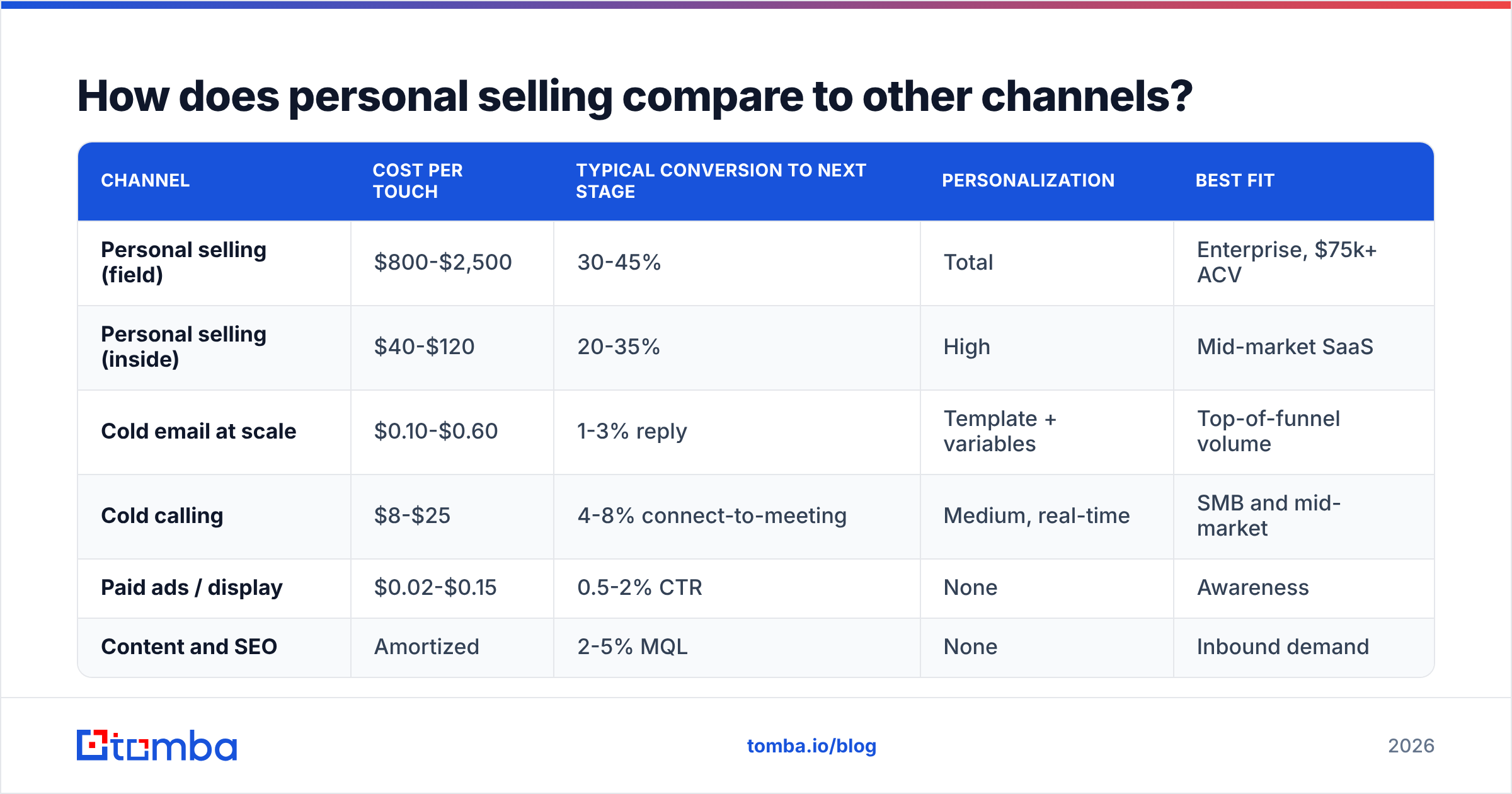
The honest comparison is cost-per-touch against conversion rate. Personal selling wins on conversion and loses badly on scale, which is why the answer is almost always "both, sequenced correctly."
| Channel | Cost per touch | Typical conversion to next stage | Personalization | Best fit |
|---|---|---|---|---|
| Personal selling (field) | $800-$2,500 | 30-45% | Total | Enterprise, $75k+ ACV |
| Personal selling (inside) | $40-$120 | 20-35% | High | Mid-market SaaS |
| Cold email at scale | $0.10-$0.60 | 1-3% reply | Template + variables | Top-of-funnel volume |
| Cold calling | $8-$25 | 4-8% connect-to-meeting | Medium, real-time | SMB and mid-market |
| Paid ads / display | $0.02-$0.15 | 0.5-2% CTR | None | Awareness |
| Content and SEO | Amortized | 2-5% MQL | None | Inbound demand |
Two things fall out of that table. First, a single field visit costs as much as roughly 4,000 cold emails — so you had better know the account is worth it. Second, cold email's job is not to close; it is to buy a rep a conversation at the cheapest possible price. Treat your cold email templates as meeting-generation infrastructure, not as a sales channel in themselves.
When should you use personal selling instead of automation?#
Use a human when at least three of these are true:
- Deal size above $10k ACV. Below that, rep hours cost more than the margin.
- More than three stakeholders. Multi-threading is a human skill; sequences cannot read a room.
- Non-obvious product fit. If the buyer needs to be taught a new category, automation fails.
- Sales cycle longer than 45 days. Long cycles need relationship memory.
- High switching cost for the buyer. Fear needs a person to absorb it.
- Custom pricing or procurement review. Legal and security reviews require live negotiation.
If fewer than three apply, run product-led growth or self-serve and keep your reps on the accounts that actually need them. Attaching an SDR to a $600 annual contract is the most common pipeline-economics mistake in B2B.
What does a personal selling process look like stage by stage?#
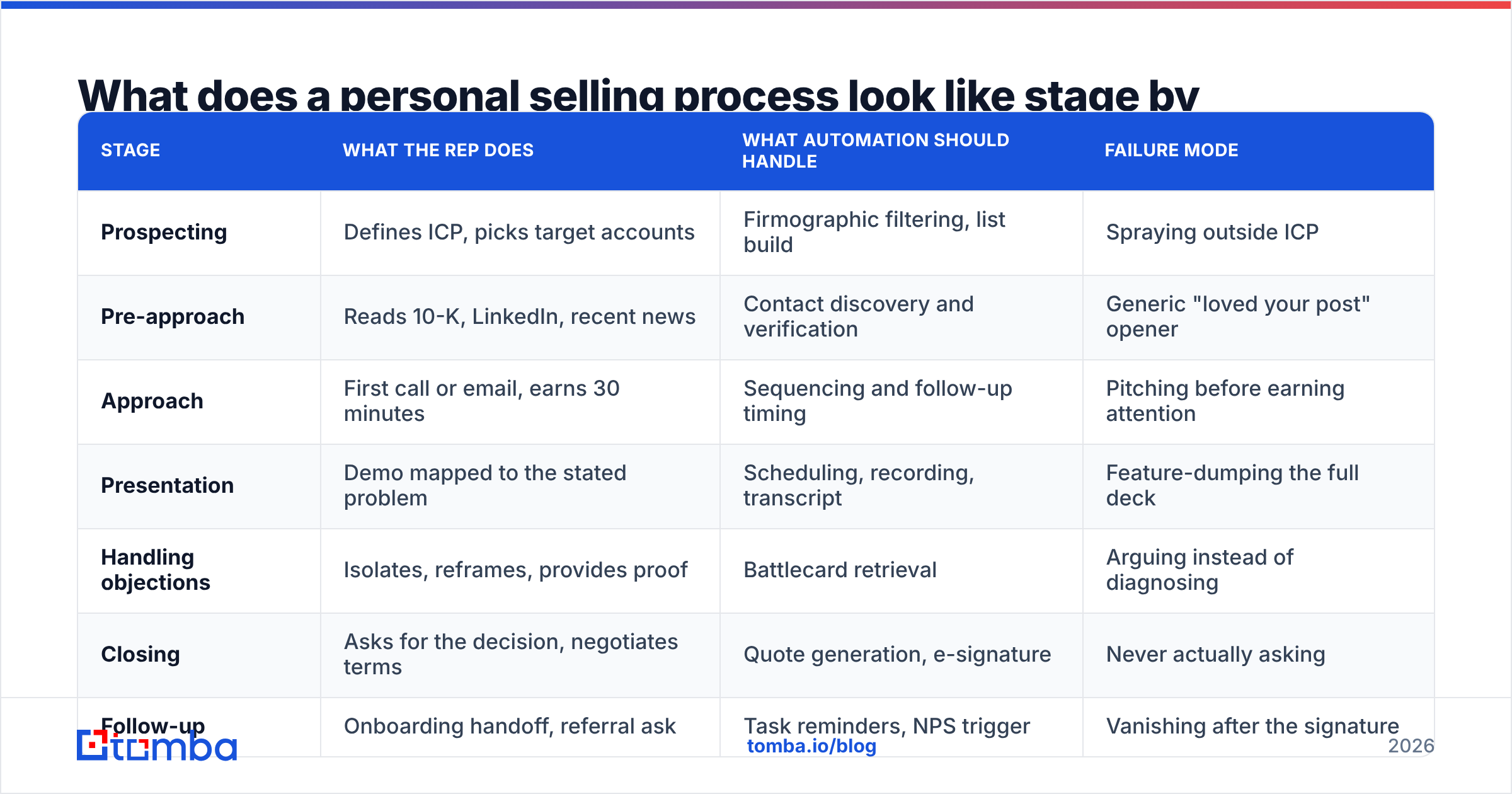
The classic seven-step framework still holds up in 2026, but the tooling under each step has changed:
| Stage | What the rep does | What automation should handle | Failure mode |
|---|---|---|---|
| Prospecting | Defines ICP, picks target accounts | Firmographic filtering, list build | Spraying outside ICP |
| Pre-approach | Reads 10-K, LinkedIn, recent news | Contact discovery and verification | Generic "loved your post" opener |
| Approach | First call or email, earns 30 minutes | Sequencing and follow-up timing | Pitching before earning attention |
| Presentation | Demo mapped to the stated problem | Scheduling, recording, transcript | Feature-dumping the full deck |
| Handling objections | Isolates, reframes, provides proof | Battlecard retrieval | Arguing instead of diagnosing |
| Closing | Asks for the decision, negotiates terms | Quote generation, e-signature | Never actually asking |
| Follow-up | Onboarding handoff, referral ask | Task reminders, NPS trigger | Vanishing after the signature |
The pattern: automation owns the data and the logistics, the human owns the judgment. Anywhere you have a rep doing data entry or list building, you are paying $85/hour for a $0.02 task.
What data does personal selling actually require?#
More than most teams admit. A rep running eight discovery calls a week needs, for each account: a correct decision-maker name, a deliverable email, a working direct dial, a recent trigger event, and the current tech stack. Miss any one of those and the call quality drops.
The failure is usually unglamorous. A rep books a "meeting" with someone who left the company nine months ago. Or the calendar invite bounces because the email was a guess. Research from Gartner has consistently flagged data quality as a primary drag on seller productivity — reps spend a large share of their week on non-selling activity, and bad records are a big slice of that.
Concretely, before a rep touches an account you want:
- Verified email — run every address through an email verifier so calendar invites and follow-ups actually land. A bounce on the first touch poisons your domain reputation too.
- Direct phone, not the switchboard — a phone finder matters more than most teams think, because voicemail on a direct line still gets heard.
- Full buying committee mapped — use domain search to pull every relevant contact at the account, not just the one name you found on LinkedIn.
- Enrichment for context — title, seniority, department, and company size, so the opener is about them and not about you.
That prep is what separates a personal selling motion from an expensive cold-calling motion. Peers in the space — including BookYourData, which sells pay-as-you-go verified B2B lists — solve the same problem from a database angle; the right choice depends on whether you want a static list or live lookups at the moment of prospecting.
How do you measure whether personal selling is working?#
Track four numbers and ignore the vanity metrics:
- Meetings per rep per week. Below four, your prospecting data or your targeting is broken, not your reps.
- Meeting-to-opportunity rate. Under 30% usually means you are booking unqualified meetings to hit an activity quota.
- Cost per closed-won. Fully loaded rep cost divided by wins. Compare it against ACV — if it exceeds 30% of first-year revenue, the motion is too expensive for the segment.
- Cycle length by stage. Find the stage where deals sit longest; that is where a rep skill gap or a data gap lives.
HubSpot's annual sales research is a reasonable public benchmark set if you have no internal history to compare against, though segment averages vary enormously by ACV.
What are the biggest personal selling mistakes?#
Talking more than 45% of the call. Recorded-call analysis across vendors consistently finds that top performers listen more than they talk on discovery. If your rep is presenting for 20 straight minutes, it is not personal selling — it is a webinar with an audience of one.
Personalizing the wrong layer. Mentioning a prospect's marathon photo is noise. Mentioning that their job posting for three compliance analysts suggests an audit burden is signal. Personalize the business context, not the biography.
Skipping the pre-approach. Every minute of prep saves five minutes of on-call fumbling. Ten minutes of research per account is the floor.
Treating every account the same. A $200k enterprise pursuit and a $9k SMB deal should not get the same number of touches. Segment your effort or you will lose money on the small deals and lose the big ones to competitors who showed up in person.
Running personal selling on unverified data. You cannot adapt in real time to a person who never receives your message. Start with a clean list, or the entire investment in rep skill is wasted.
Where does automation genuinely help a personal selling motion?#
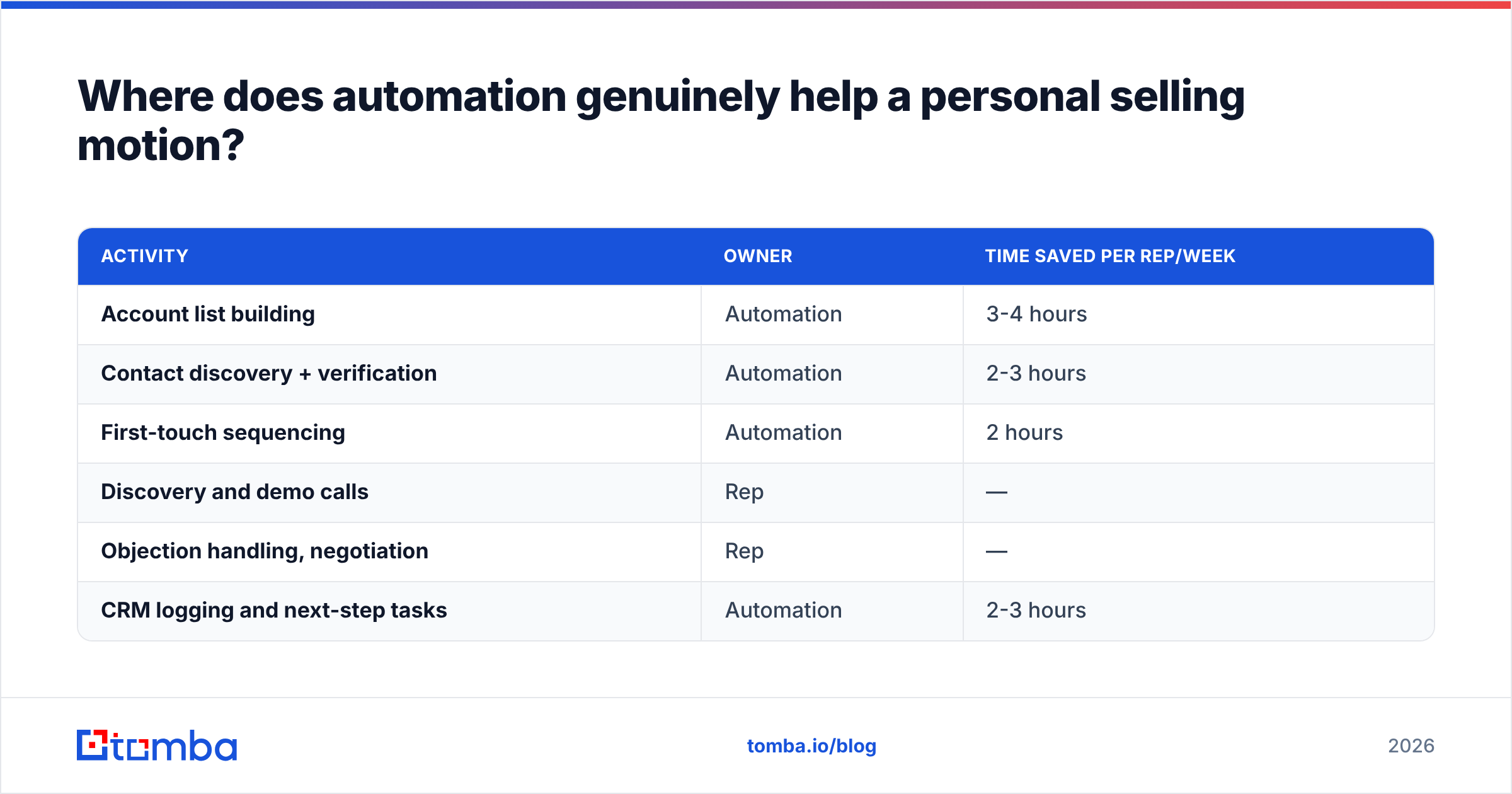
Automation should own everything before "hello" and everything after "thanks for your time." That means list building, verification, enrichment, sequencing, scheduling, CRM hygiene, and follow-up reminders. The moment a human voice enters, automation steps back.
A workable split for a mid-market team:
| Activity | Owner | Time saved per rep/week |
|---|---|---|
| Account list building | Automation | 3-4 hours |
| Contact discovery + verification | Automation | 2-3 hours |
| First-touch sequencing | Automation | 2 hours |
| Discovery and demo calls | Rep | — |
| Objection handling, negotiation | Rep | — |
| CRM logging and next-step tasks | Automation | 2-3 hours |
Ten hours back per rep per week is roughly two extra discovery calls per day. That is the real ROI of tooling in a personal selling org — not replacing the rep, but deleting the work that keeps the rep off the phone.
Get the contact data your reps deserve#
Personal selling is the most expensive channel you run, which makes it the one least tolerant of bad data. Every bounced invite, every wrong number, and every missing stakeholder is a direct multiple of rep salary burned.
Start by fixing the input. Use the Tomba Email Finder to pull verified, deliverable addresses for every decision-maker at your target accounts, then push them straight into your CRM before a rep spends a minute on outreach. The free tier gives you 25 searches a month to test the match rate against your own ICP, and paid plans start at $49/mo — see Tomba pricing for the full breakdown. Get the data right, then let your reps do the part machines still cannot.
Related guides#
Ready to find emails that actually work?
Join 150,000+ professionals who stopped guessing and started sending. Free credits on signup — no credit card required.
Get the Tomba newsletter
Practical outbound tactics and product updates — once every two weeks.
About the author