Examples of Consultative Selling That Win B2B Deals in 2026
Seven annotated examples of consultative selling — discovery scripts, cold email openers, pricing conversations, and the exact questions that move a buyer from polite interest to a signed contract.
TL;DR
- Consultative selling means you diagnose before you prescribe. The rep who asks four good questions beats the rep who sends four follow-ups.
- The seven examples below are annotated with the exact language: discovery openers, reframes, pricing conversations, and a cold email that earns a reply without pitching.
- The single biggest tell of a consultative rep is that they will disqualify a deal out loud, on the call, in front of the buyer.
- Consultative selling does not replace research — it depends on it. Bad contact data and zero pre-call context turn "consultative" into "interrogation."
- It works in outbound too, but only when your opener references something specific about the account. Generic curiosity reads as a script.
What is consultative selling, actually?#
Consultative selling is a sales approach where the rep acts as a diagnostician first and a vendor second. Instead of leading with product capabilities, you lead with questions designed to surface the buyer's actual problem, its cost, and who inside the organization feels that cost most.
Think of a good mechanic. You say "there's a noise when I brake." A bad mechanic quotes you new rotors immediately. A good one asks when the noise happens, whether it changes at speed, how long it's been going on — and sometimes tells you it's a loose heat shield and costs nothing. You trust that mechanic with the $1,400 job next year.
That's the whole mechanic. The commercial payoff is trust compounding into larger, faster, stickier deals.
The approach is not new — it grew out of solution selling and Neil Rackham's SPIN research in the 1980s — but the buying environment has made it non-optional. Gartner's research on the B2B buying journey found buyers spend only about 17% of their total purchase time meeting with potential suppliers, split across all vendors. You get a sliver. Spending it on a feature tour is malpractice.
What do real examples of consultative selling look like?#
Here are seven, each with the specific move that makes it consultative rather than a pitch wearing a question mark.
1. The cost-of-inaction question. A rep selling a data platform to a 40-person sales team doesn't ask "would better data help?" They ask: "Walk me through what happens today when an SDR gets a bounced email. Who fixes it, and how long does it take?" The buyer says twenty minutes per lead, maybe five a day. The rep does the arithmetic out loud — roughly 8 hours a week of SDR time — and lets the number sit there. The buyer just built the business case themselves.
2. The disqualification. Mid-demo, a rep hears the prospect describe a workflow that the product genuinely doesn't support. Instead of "we have that on the roadmap," they say: "Honestly, for that specific use case we're the wrong fit — you'd want something purpose-built. But the second half of what you described is exactly what we do. Do you want to keep going on that piece, or should we stop here?" Roughly one in three buyers stays, and the ones who stay close faster because the rep just spent credibility they didn't have to.
3. The reframe. A prospect asks for a feature comparison spreadsheet. The consultative rep replies: "I'll send it, but it won't tell you what you need. Every vendor on that list checks the same boxes. The real difference is what happens when your data is 30% catch-all domains. Can I show you how each approach handles that instead?" The rep controls the evaluation criteria without refusing the request.
4. The internal-champion coaching. After a good call, the rep doesn't send a recap and hope. They send: "You mentioned Priya owns the budget. Here's a three-bullet version of what we discussed, written for her — cost, timeline, and the risk of doing nothing. Feel free to paste it into Slack as your own." You're not selling to the buyer anymore; you're arming them.
5. The pricing conversation done backwards. Prospect asks for pricing on the first call. Weak rep dodges. Consultative rep says: "It's between $X and $Y depending on volume — I'll be precise once I know two things. How many contacts a month, and does anyone besides you need seat access?" You answer the question, give a real range, and turn the pricing ask into a scoping question.
6. The silence after the objection. Buyer says "this feels expensive." The rep says "compared to what?" — and then stops talking. Nine times out of ten the buyer fills the silence with the real objection, which is usually budget timing or a competing internal priority, not price.
7. The no-pitch cold email. Instead of a feature list, the opener references something observable: "Saw you're hiring three SDRs in EMEA. Most teams that scale outbound headcount that fast hit a data problem around month two — bounce rates climb and reps blame the list. Is that already happening, or did you get ahead of it?" One observation, one hypothesis, one question. No calendar link in the first email.
How is consultative selling different from transactional and solution selling?#
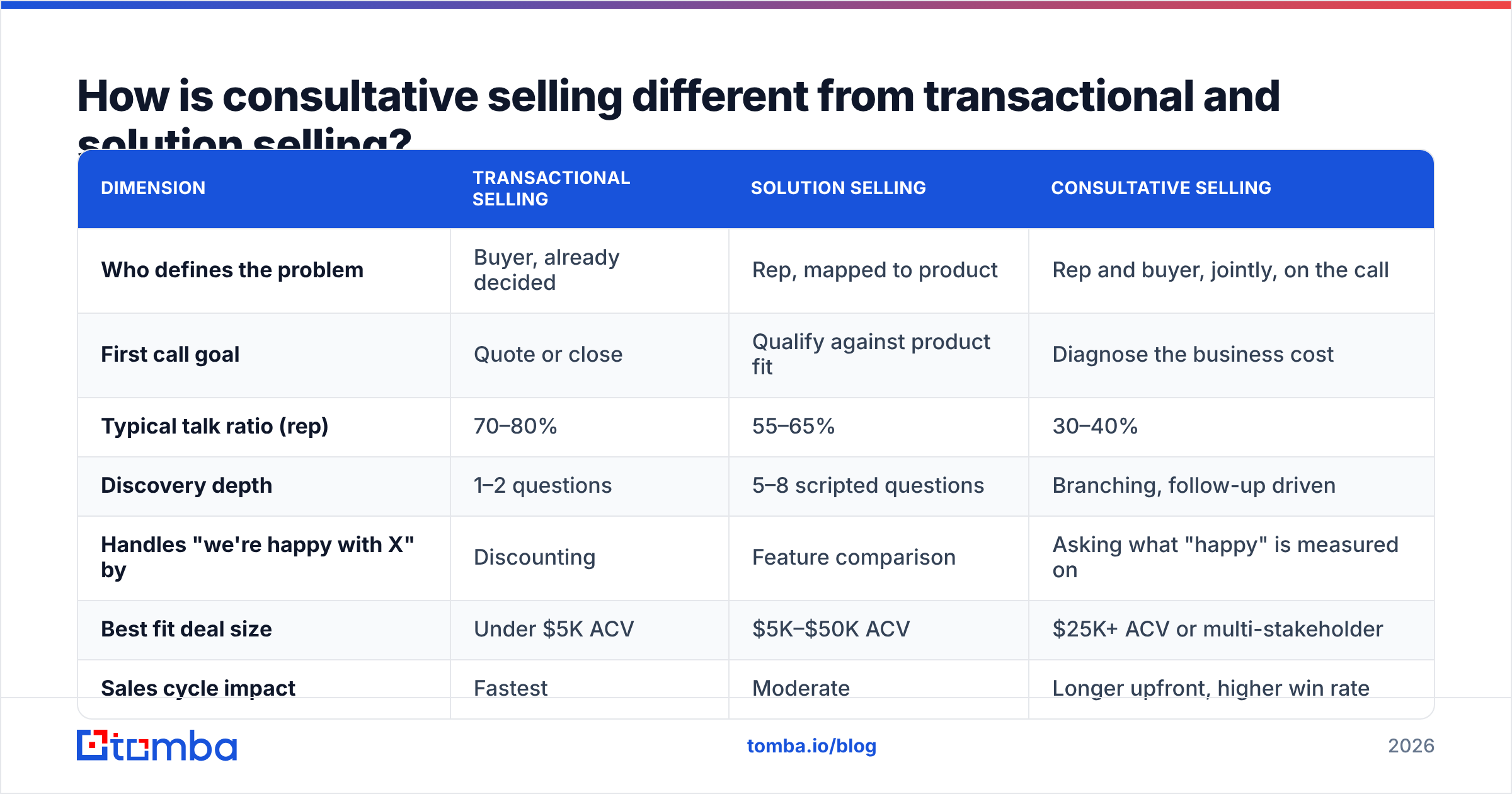
The three get blurred constantly. They differ in where the rep spends time and who defines the problem.
| Dimension | Transactional selling | Solution selling | Consultative selling |
|---|---|---|---|
| Who defines the problem | Buyer, already decided | Rep, mapped to product | Rep and buyer, jointly, on the call |
| First call goal | Quote or close | Qualify against product fit | Diagnose the business cost |
| Typical talk ratio (rep) | 70–80% | 55–65% | 30–40% |
| Discovery depth | 1–2 questions | 5–8 scripted questions | Branching, follow-up driven |
| Handles "we're happy with X" by | Discounting | Feature comparison | Asking what "happy" is measured on |
| Best fit deal size | Under $5K ACV | $5K–$50K ACV | $25K+ ACV or multi-stakeholder |
| Sales cycle impact | Fastest | Moderate | Longer upfront, higher win rate |
| Failure mode | Race to the bottom on price | Product-shaped questions | Endless discovery, no ask |
The row that matters most is the last one. Consultative selling's failure mode is a rep who becomes a free consultant and never asks for the business. Diagnosis is a means, not the product.
Which questions turn a pitch into a consultation?#
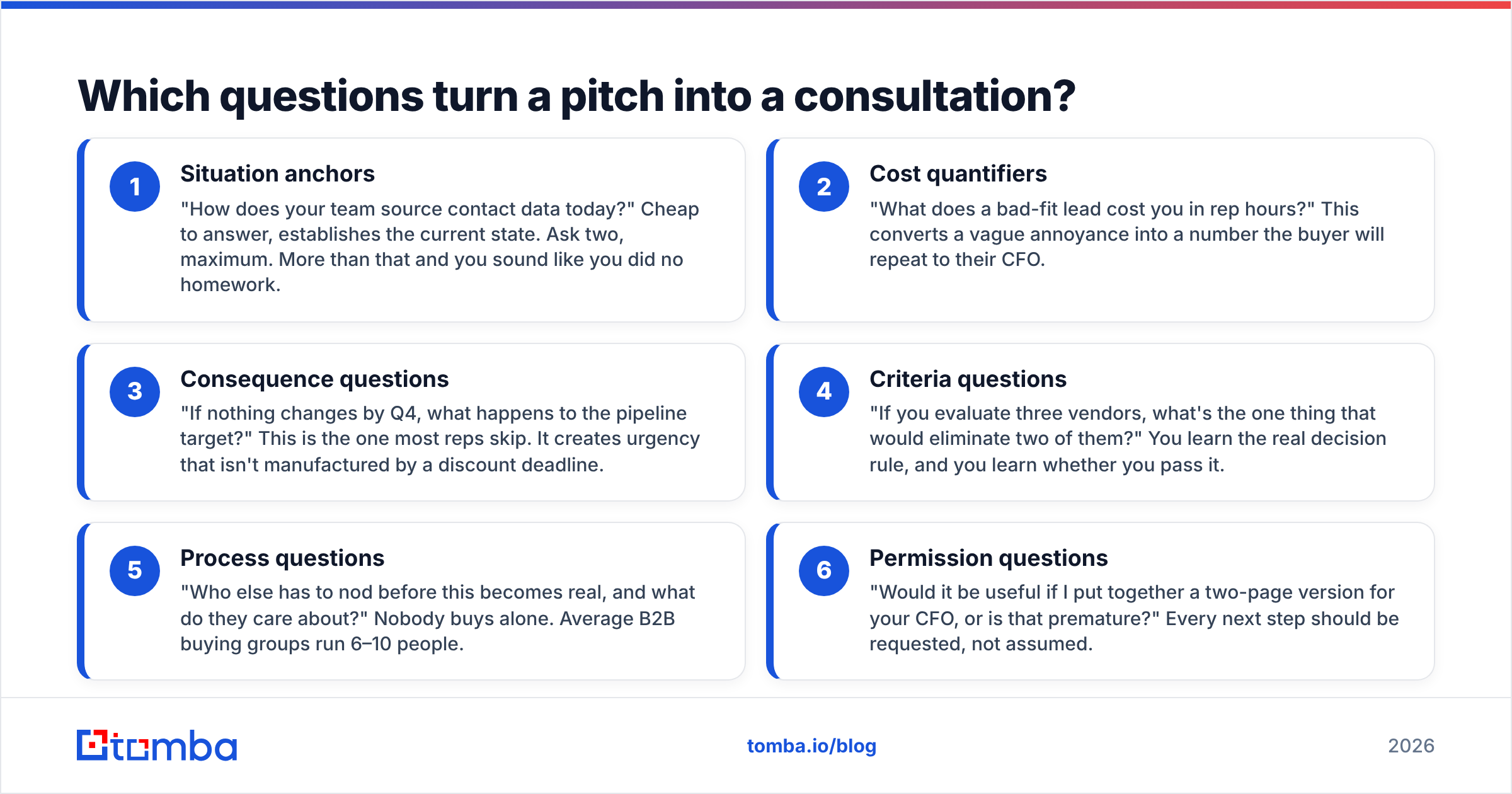
Six question types, ordered by when to deploy them:
- Situation anchors — "How does your team source contact data today?" Cheap to answer, establishes the current state. Ask two, maximum. More than that and you sound like you did no homework.
- Cost quantifiers — "What does a bad-fit lead cost you in rep hours?" This converts a vague annoyance into a number the buyer will repeat to their CFO.
- Consequence questions — "If nothing changes by Q4, what happens to the pipeline target?" This is the one most reps skip. It creates urgency that isn't manufactured by a discount deadline.
- Criteria questions — "If you evaluate three vendors, what's the one thing that would eliminate two of them?" You learn the real decision rule, and you learn whether you pass it.
- Process questions — "Who else has to nod before this becomes real, and what do they care about?" Nobody buys alone. Average B2B buying groups run 6–10 people.
- Permission questions — "Would it be useful if I put together a two-page version for your CFO, or is that premature?" Every next step should be requested, not assumed.
HubSpot's sales research puts numbers on why this ordering works: buyers overwhelmingly report that reps who understand their business context are the ones they engage with, and the understanding has to be demonstrated in the first few minutes.
What does a consultative discovery call actually sound like?#
Here's a compressed 30-minute call from a rep selling contact data to a Series B SaaS company.
Minute 0–2. "I did some homework — you launched a partner motion in March and you're hiring two AEs for it. I have a guess about why this call is on the calendar, but I'd rather hear it from you. What made you take the meeting?"
Minute 2–10. Buyer describes it. The rep asks follow-ups only. No product mentioned. When the buyer says "our list quality is inconsistent," the rep asks: "Inconsistent how — wrong people, or right people with wrong emails?" That single clarifying question splits a targeting problem from a data problem, and they turn out to be different tools.
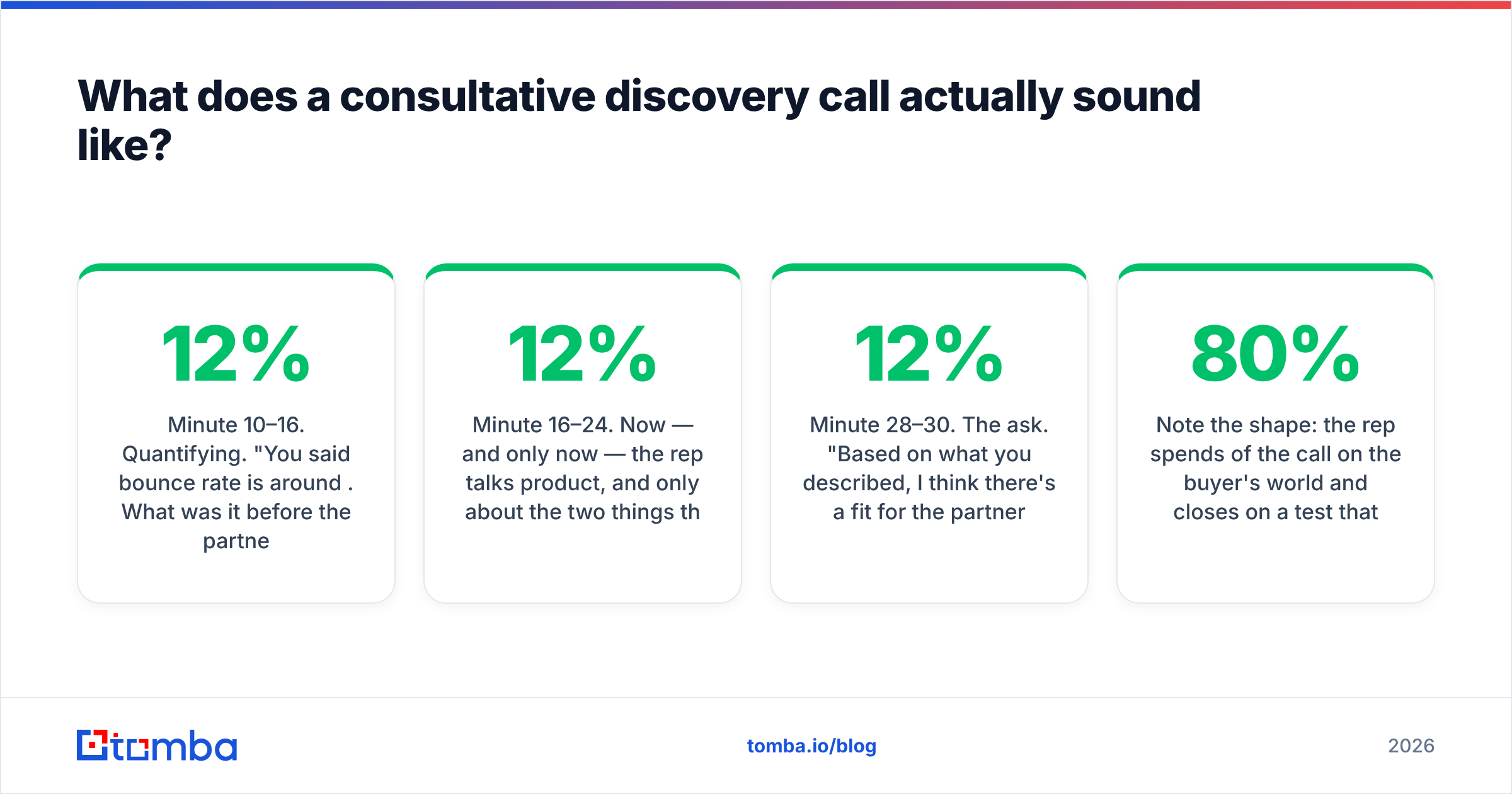
Minute 10–16. Quantifying. "You said bounce rate is around 12%. What was it before the partner launch?" Buyer: "About 4%." Rep: "So the new segment is three times worse. Is that segment also where your quota growth is coming from?" Silence. Yes it is.
Minute 16–24. Now — and only now — the rep talks product, and only about the two things that map to what was said. Not a tour. Two capabilities, tied to the 12% number.
Minute 24–28. Process. "Who owns the tooling budget? What did the last tool purchase look like — how long, who signed?"
Minute 28–30. The ask. "Based on what you described, I think there's a fit for the partner segment specifically, not for your core outbound. Want to run a 200-contact test on the partner list this week and compare bounce rates? If it doesn't beat 12%, we stop."
Note the shape: the rep spends 80% of the call on the buyer's world and closes on a test that can fail publicly. That's confidence a discount can't buy.
Does consultative selling work in cold outbound?#
Yes, but it collapses if your research layer is thin. Consultative outbound requires a real observation about the account, and observations require data.

That means the workflow behind the email matters more than the email. Before you write a single consultative opener, you need the right person, a verified address, and one non-obvious fact. Practically:
- Pull the buying committee from the target domain with a domain search, not a scraped list somebody sold you.
- Run every address through an email verifier so your consultative masterpiece doesn't bounce.
- Layer in firmographic context with data enrichment — headcount changes, tech stack, funding — because that's where the observation in your opener comes from.
A consultative cold email has four parts and stays under 90 words: the observation, the hypothesis, the question, and no calendar link. Example:
Noticed you moved from Marketo to HubSpot in April. Teams that migrate mid-year usually discover their contact records didn't survive the mapping — about 20–30% end up with stale or missing emails. Is that showing up in your open rates yet, or did the migration go clean? Happy to send what we've seen from three similar migrations either way.
The last sentence gives value regardless of whether they buy. That's the consultative tell.
What metrics prove consultative selling is working?#
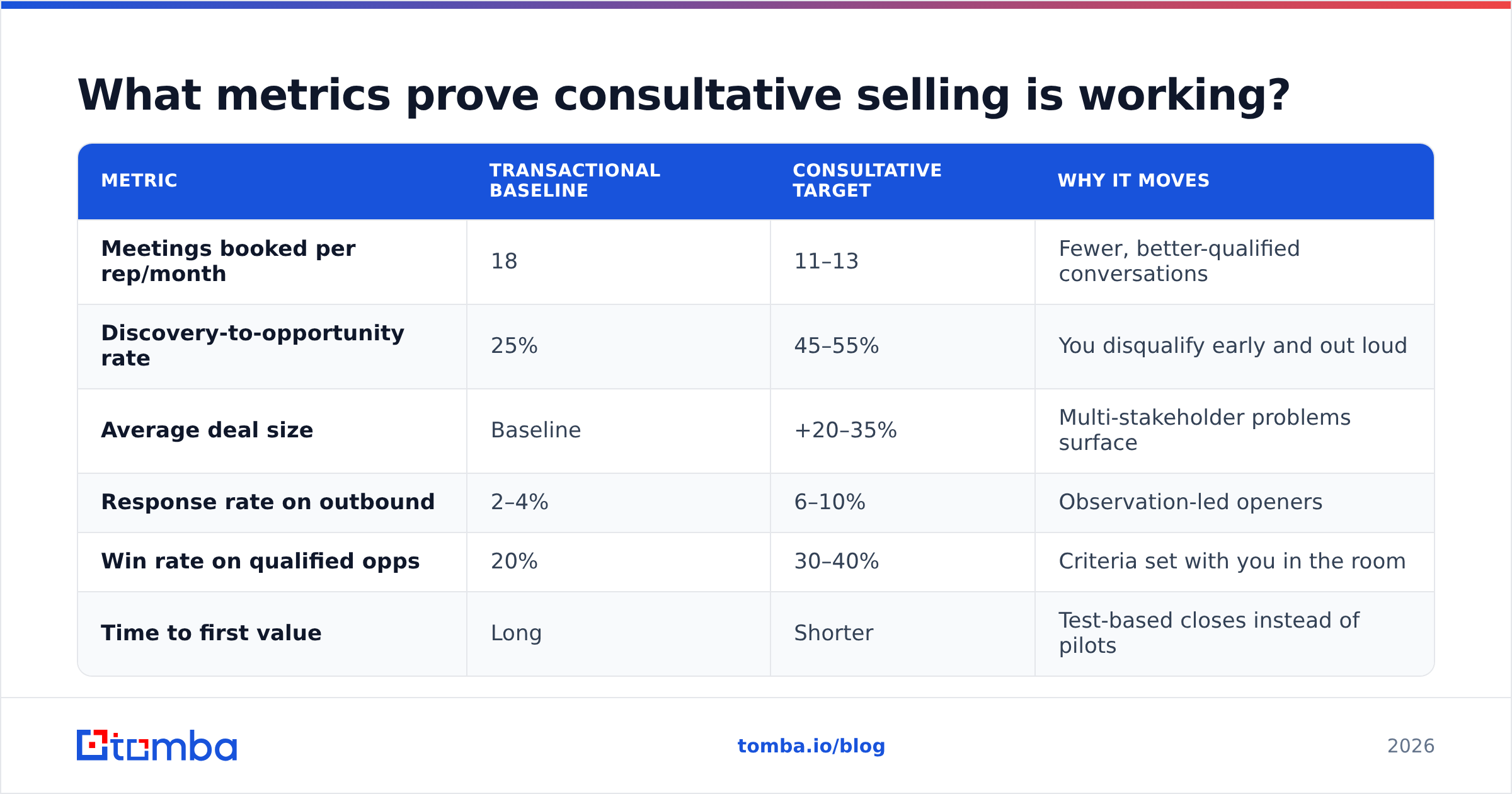
Activity metrics lie here. A consultative motion looks worse on volume and better on everything downstream.
| Metric | Transactional baseline | Consultative target | Why it moves |
|---|---|---|---|
| Meetings booked per rep/month | 18 | 11–13 | Fewer, better-qualified conversations |
| Discovery-to-opportunity rate | 25% | 45–55% | You disqualify early and out loud |
| Average deal size | Baseline | +20–35% | Multi-stakeholder problems surface |
| Response rate on outbound | 2–4% | 6–10% | Observation-led openers |
| Win rate on qualified opps | 20% | 30–40% | Criteria set with you in the room |
| Time to first value | Long | Shorter | Test-based closes instead of pilots |
If your discovery-to-opportunity rate goes up while meetings booked goes down, the motion is working. If both go down, you've become a consultant who forgot to ask for money.
Where does consultative selling break down?#
Four honest failure modes:
Deal size too small. Under roughly $5K ACV, a 30-minute diagnostic call is uneconomic. Sell transactionally, invest the saved time in volume.
The buyer already knows. Some prospects arrive with a spec and a shortlist. Running discovery theater on them is insulting. Ask one question — "how firm is the spec?" — and if it's firm, answer the spec.
Reps without domain fluency. Consultative questions only land if you can react to the answer. A rep who can't distinguish a routing problem from an attribution problem will ask three good questions and then default to the pitch anyway. This is a training gap, not a script gap.
No pre-call data. Walking into a call with nothing means your first ten minutes get spent on questions the buyer expects you to already know. Research is the price of admission. Pull the account's contacts, verify them, and know the org chart before you dial.
Where should you start?#
Pick your next five discovery calls. On each one, cap yourself at two situation questions and force yourself to ask one consequence question — "what happens if this doesn't change by [their deadline]?" — before you say a single product word. Then compare the outcomes to your last five calls. That's a one-week experiment with a clear read.
The upstream half is data. Consultative selling starts before the call, with knowing who's actually in the buying group and being able to reach them. The Tomba Email Finder gets you verified, deliverable addresses for the specific people you've decided to talk to — decision-maker, champion, and blocker — so your first touch lands on the right desk instead of a shared inbox. The free tier includes 25 searches a month, and paid plans start at $49/mo; see Tomba pricing for volume tiers. Do the research, then ask the better question.
Related guides#
Ready to find emails that actually work?
Join 150,000+ professionals who stopped guessing and started sending. Free credits on signup — no credit card required.
Get the Tomba newsletter
Practical outbound tactics and product updates — once every two weeks.
About the author