Examples of Objections in Sales: 27 Real Ones and How to Answer Them
Price, timing, trust, competitor, and "just send me info" pushback — 27 real sales objections with word-for-word replies, plus how to tell a real objection from a brush-off.
TL;DR
- Most sales objections fall into six buckets: price, timing, authority, need, trust, and competitor. Once you can name the bucket in real time, the reply almost writes itself.
- "It's too expensive" is rarely about money. It's about a value case the buyer can't defend to someone else in the building.
- The strongest response pattern is acknowledge → clarify → reframe → confirm. Skipping the clarify step is why most reps sound scripted.
- A large share of "objections" on cold outreach aren't objections at all — they're targeting errors caused by stale or unverified contact data.
- Log every objection by type in your CRM. Patterns across 50 calls tell you more about your pricing, ICP, and messaging than any single lost deal.
Every rep collects the same lines. "Send me some info." "We already use someone." "Call me next quarter." The difference between a rep at 12% win rate and one at 30% isn't that the second rep hears fewer objections — it's that they recognize which one they're hearing inside three seconds and respond to the real concern instead of the words.
This guide catalogs real examples of objections in sales, sorts them by what's actually driving them, and gives you responses you can say out loud without cringing. No manipulation scripts, no "feel, felt, found" theater.
What actually counts as a sales objection?#
An objection is a stated reason not to move forward that the buyer believes is true. That's it.
It is not the same as a brush-off, and confusing the two burns pipeline. A brush-off ("just email me something") is a low-effort exit from a conversation the buyer never opted into. An objection ("your onboarding takes six weeks and our fiscal year closes in four") is a real constraint they'd be happy to solve.
Three tells that separate them:
- Specificity. Real objections carry detail — a number, a name, a date. Brush-offs are vague by design.
- Engagement after the pushback. If they ask a follow-up question, you have an objection. If they go quiet, you had a brush-off.
- Consistency. A real constraint stays the same across two conversations. A brush-off mutates: budget one week, timing the next.
Treat a brush-off like an objection and you'll over-handle it, sound desperate, and lose the meeting. Treat an objection like a brush-off and you'll walk away from a deal that was two answers from closing.

What are the six categories of objections in sales?#
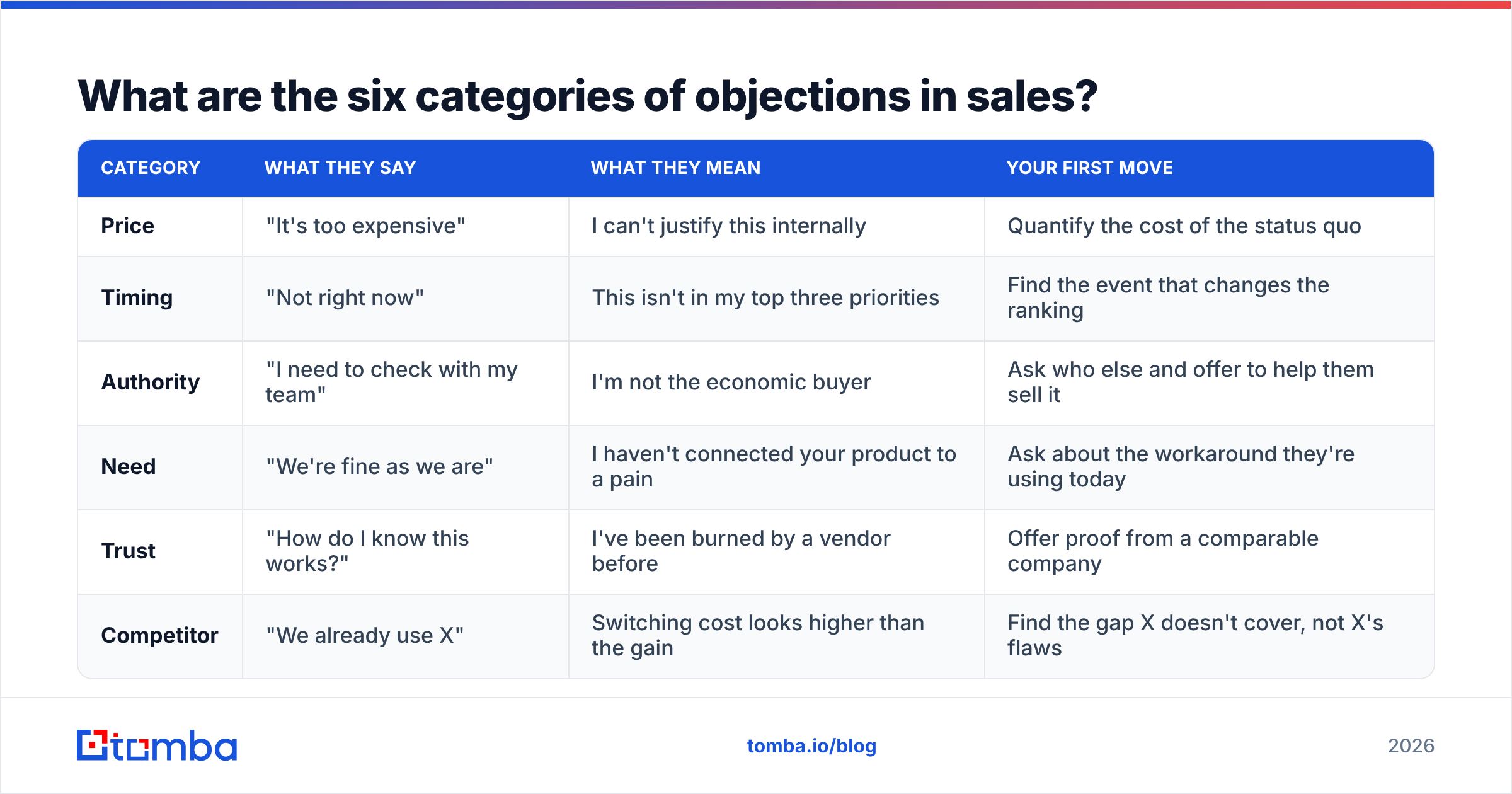
Every objection you'll hear this year fits one of six categories. Memorize these, not 27 individual scripts.
| Category | What they say | What they mean | Your first move |
|---|---|---|---|
| Price | "It's too expensive" | I can't justify this internally | Quantify the cost of the status quo |
| Timing | "Not right now" | This isn't in my top three priorities | Find the event that changes the ranking |
| Authority | "I need to check with my team" | I'm not the economic buyer | Ask who else and offer to help them sell it |
| Need | "We're fine as we are" | I haven't connected your product to a pain | Ask about the workaround they're using today |
| Trust | "How do I know this works?" | I've been burned by a vendor before | Offer proof from a comparable company |
| Competitor | "We already use X" | Switching cost looks higher than the gain | Find the gap X doesn't cover, not X's flaws |
The mistake most reps make is answering the category instead of the person. "It's too expensive" from a seed-stage founder and "it's too expensive" from a procurement lead at a 4,000-person company are the same words describing completely different problems. One has no cash. The other has plenty of cash and no approved line item.
What are the most useful examples of objections in sales, by category?#
Here are the specific lines, with responses that work because they open a conversation rather than close an argument.
Price and budget objections#
- "It's too expensive." → "Compared to what — another vendor, or doing nothing? I want to make sure I'm answering the right question."
- "We don't have budget this year." → "That's fair. Who owns the budget line this would come out of, and when does it get set for next cycle?"
- "Your competitor is half the price." → "They are. Here's where the gap shows up — [specific capability]. If you don't need that, they're genuinely the better buy."
- "Can you do a discount?" → "I can move on price if we move on something else — a longer term or a case study. What matters more to you?"
- "I need to see ROI before I commit." → "Let's build it together. What number does this need to move, and by how much, for it to be an easy yes?"
Never discount on the first ask. Gong's call research has consistently shown that reps who hold price and pivot to value close at a higher rate than those who concede early — and a fast discount teaches the buyer your list price was fiction.
Timing and priority objections#
- "Call me in Q3." → "Happy to. What's happening in Q3 that makes it a better moment than now?"
- "We're in the middle of a migration." → "Makes sense. Does this land before or after the migration in your planning?"
- "We just signed with someone else." → "Understood. What's the term length? I'd rather be useful at renewal than annoying now."
- "I'm slammed this month." → "Then I won't take 30 minutes. Give me 10 and I'll tell you whether this is worth a real meeting."
- "We're waiting on headcount." → "Is the headcount for the problem this solves, or something else?"
Timing objections are the easiest to fake and the hardest to disqualify. The test: ask what specifically changes at the future date. A real timing constraint has an event attached. A polite no does not.
Authority and process objections#
- "I need to run this by my boss." → "Of course. What will they push back on hardest? Let's get you the answer now."
- "We have a procurement process." → "Good — those are usually well documented. Can you send me the requirements so I'm not slowing you down?"
- "Security has to review it." → "We can start that in parallel. Want our SOC 2 report and DPA today?"
- "The team needs to be involved." → "Who else touches this daily? I'd rather demo to all of them once than to you three times."
An authority objection is not a rejection — it's an invitation to co-sell. Ask what your champion needs in writing and give it to them in a format they can forward without editing.
Need and status-quo objections#
- "We're happy with our current process." → "What does the current process cost you in hours per week? I'm not assuming it's broken."
- "We handle this in a spreadsheet." → "That works up to a point. Where does the spreadsheet start hurting — volume, accuracy, or handoffs?"
- "This isn't a priority for us." → "What is? If it's not adjacent to what we do, I'll stop taking your time."
- "We tried something like this and it didn't stick." → "What broke — the tool, the rollout, or the ownership?"
The status quo is your real competitor in most B2B deals, not the other logo on the shortlist. According to HubSpot's sales research, "no decision" outcomes routinely account for a larger share of lost pipeline than competitive losses.
Trust and credibility objections#
- "I've never heard of you." → "Fair. Here are two companies your size using us and what changed for them — happy to connect you directly."
- "How accurate is your data really?" → "Here's our published methodology and a free test. Run 25 of your own records before you believe me."
- "We got burned by a vendor like you." → "What did they promise that they didn't deliver? I'd rather tell you now if we do the same thing."
- "Your reviews are mixed." → "Which review? Let's look at it together — some are real and some are about a feature we deprecated."
Send them to a third-party source rather than your own marketing site. Pointing a skeptical buyer at G2 and letting them read unfiltered reviews builds more credibility than any deck.
Competitor objections#
- "We already use Apollo/ZoomInfo/Clearbit." → "Then you've solved discovery. Where does the data break down — verification, coverage outside the US, or credits running out?"
- "Switching would be a nightmare." → "What's actually attached to it — CRM fields, sequences, API calls? Let's scope it before we assume."
- "They give us a bundled price." → "Bundles are good when you use every part. Which parts do you not use?"
- "Our team is trained on it." → "How long did training take? If the switch costs a week, does the accuracy gain pay for it in a quarter?"
- "Their integration list is longer." → "Which integration do you actually need? Length of the list matters less than the one you use daily."
Never disparage the incumbent. The buyer chose it, and attacking the choice attacks the person. Find the gap, name it neutrally, and let them decide.
How do you handle objections without sounding scripted?#
Four steps, in this order. The order matters more than the wording.
- Acknowledge without agreeing. "That's a real constraint" beats "I totally understand!" Buyers can hear enthusiasm-as-deflection from a mile away.
- Clarify before you respond. One question. Always. This is the step reps skip, and it's the one that turns a canned answer into a relevant one.
- Reframe around their metric. Tie your response to the number they own — pipeline coverage, cost per lead, ramp time — not to your feature list.
- Confirm you landed it. "Does that address the concern, or is there another piece?" If you don't ask, you'll spend the next 10 minutes answering a question they stopped caring about.
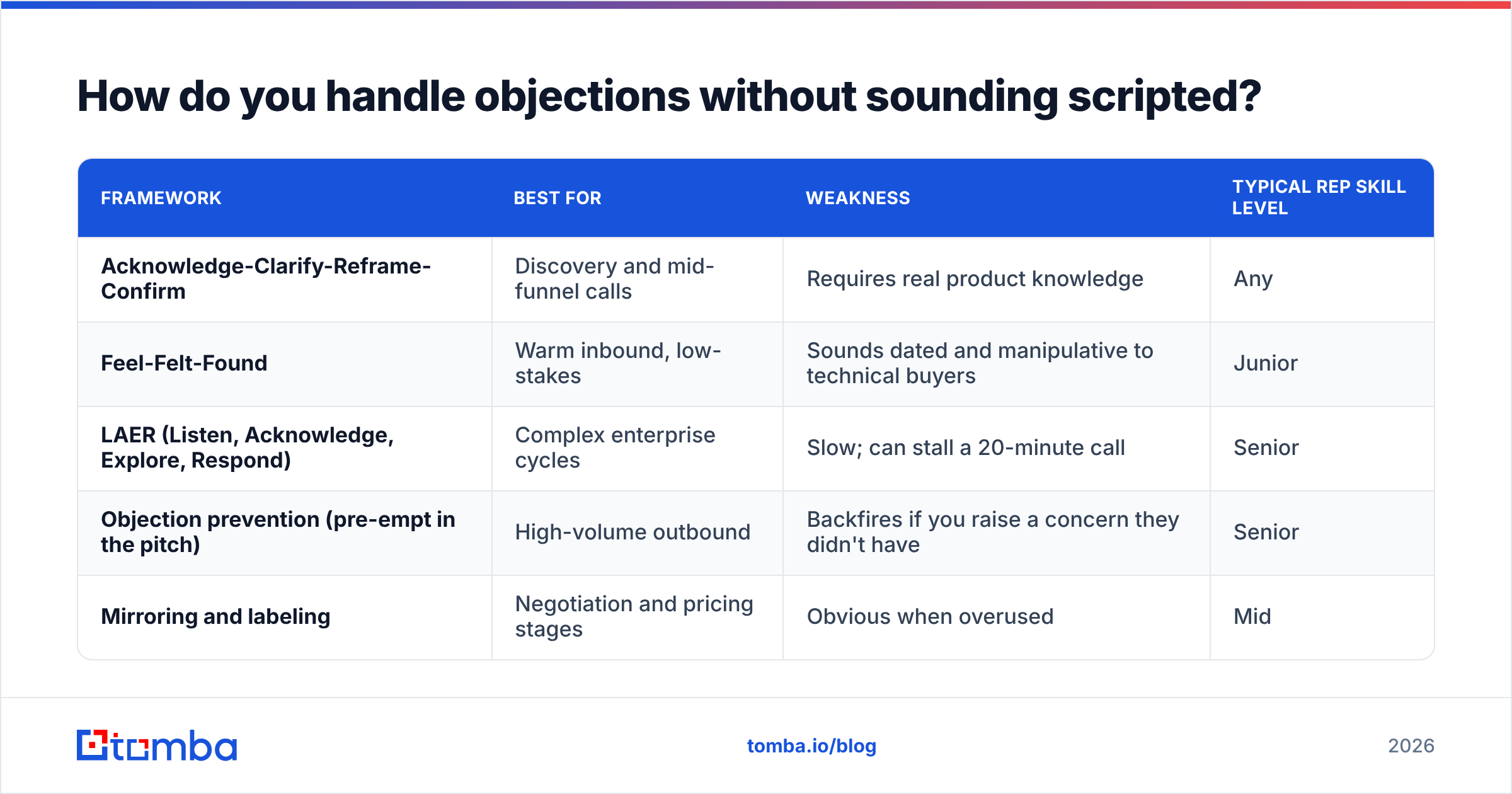
Compare that to the frameworks people usually reach for:
| Framework | Best for | Weakness | Typical rep skill level |
|---|---|---|---|
| Acknowledge-Clarify-Reframe-Confirm | Discovery and mid-funnel calls | Requires real product knowledge | Any |
| Feel-Felt-Found | Warm inbound, low-stakes | Sounds dated and manipulative to technical buyers | Junior |
| LAER (Listen, Acknowledge, Explore, Respond) | Complex enterprise cycles | Slow; can stall a 20-minute call | Senior |
| Objection prevention (pre-empt in the pitch) | High-volume outbound | Backfires if you raise a concern they didn't have | Senior |
| Mirroring and labeling | Negotiation and pricing stages | Obvious when overused | Mid |
Which sales objections are actually data problems in disguise?#
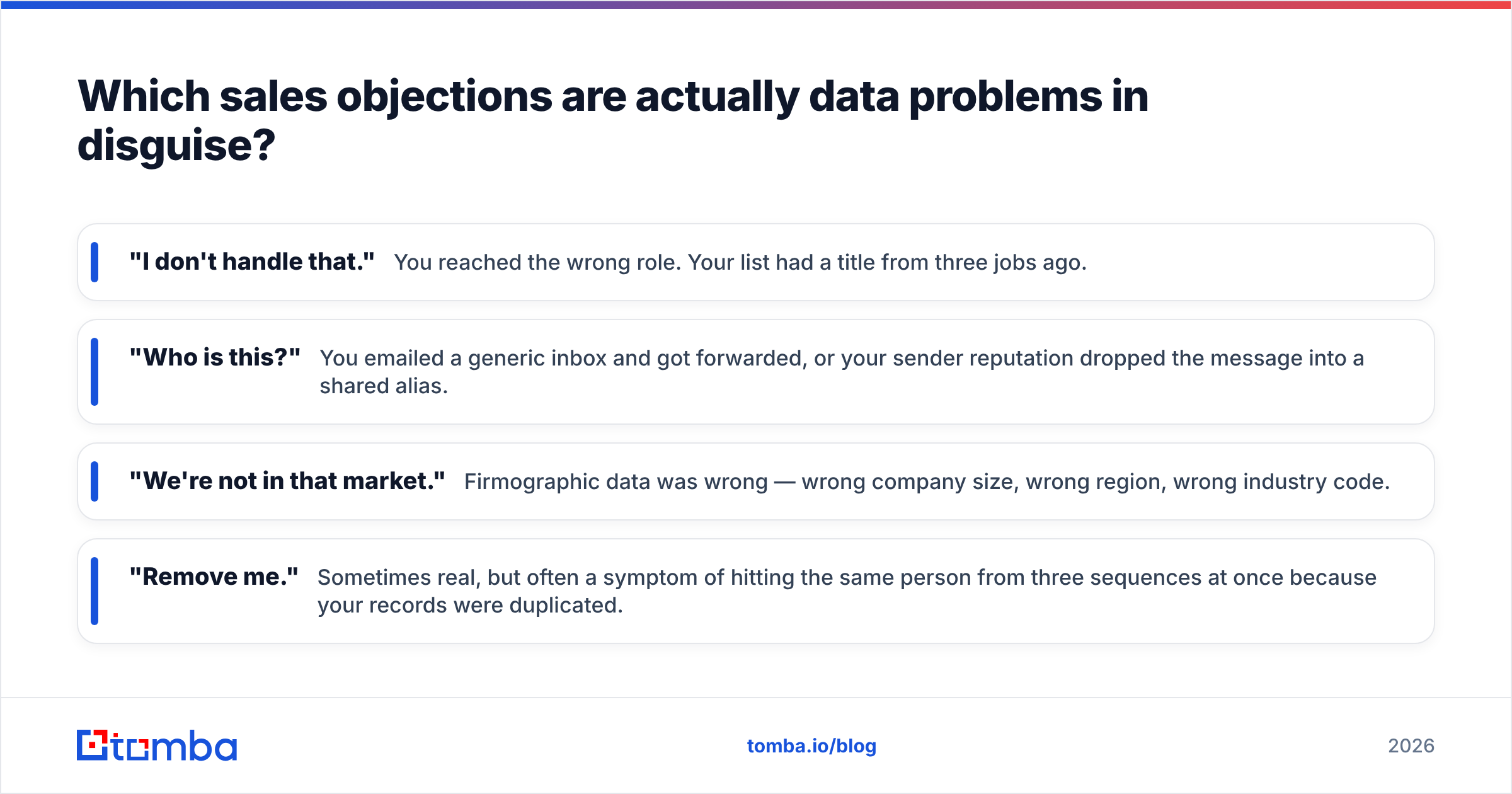
A meaningful share of the pushback on cold outreach isn't objection handling at all — it's a targeting failure that showed up at the worst possible moment.
Watch for these four:
- "I don't handle that." You reached the wrong role. Your list had a title from three jobs ago.
- "Who is this?" You emailed a generic inbox and got forwarded, or your sender reputation dropped the message into a shared alias.
- "We're not in that market." Firmographic data was wrong — wrong company size, wrong region, wrong industry code.
- "Remove me." Sometimes real, but often a symptom of hitting the same person from three sequences at once because your records were duplicated.
None of those improve with a better rebuttal. They improve with better inputs. Cleaning contact records before the sequence starts — verifying deliverability, confirming the current role, deduplicating across sources — removes objections rather than answering them. A quick pass through an email verifier plus contact enrichment to refresh job titles will strip out a chunk of "wrong person" replies before they ever reach a rep's inbox.
This matters for the numbers too. If 30% of your list is stale, your response rate looks like a messaging problem when it's a data problem, and you'll rewrite good copy for months chasing the wrong fix.
How should you track objections so they stop surprising you?#
Log every objection as structured data, not as a note. Three fields is enough: category (the six above), verbatim quote, and outcome (advanced / stalled / lost).
After 50 logged calls you get answers no amount of coaching produces:
- If price objections cluster at one company size, your packaging is wrong for that segment — not your reps.
- If timing objections spike in one quarter, you're prospecting against a predictable budget cycle. Move the outreach.
- If trust objections dominate, your top-of-funnel proof is thin. Fix the case studies before the scripts.
- If competitor objections all name the same vendor, build a one-page comparison and hand it to every rep.
Run this review monthly with the whole team, and make one person responsible for turning the top objection into a fix — a pricing tier, a security page, a new proof point. Objection handling that stays in the rep's head never compounds. Objection handling that turns into an asset does.
Where does better data fit into all of this?#
You cannot script your way out of talking to the wrong person. The cheapest objection to handle is the one you never trigger.
If a chunk of your pushback is "wrong role," "wrong company," or "this address bounced," start upstream. Tomba's Email Finder verifies professional addresses against live sources so your sequences land on the person who actually owns the problem — with a free tier at 25 searches a month to test it against your own list, and paid plans starting at $49/mo. Check Tomba pricing if you want to compare tiers before you commit. Fix the inputs, and the objections you're left with are the good kind: real constraints from real buyers you can actually solve.
Related guides#
Ready to find emails that actually work?
Join 150,000+ professionals who stopped guessing and started sending. Free credits on signup — no credit card required.
Get the Tomba newsletter
Practical outbound tactics and product updates — once every two weeks.
About the author