Examples of Open Ended Questions That Win B2B Sales Calls
Closed questions get you a yes. Open ended questions get you a deal. Here are 60+ examples of open ended questions built for discovery calls, cold outreach, and renewal conversations — plus when each one backfires.
TL;DR
- Open ended questions start with what, how, why, tell me, walk me through, or describe — they cannot be answered with yes, no, or a number.
- The best B2B reps run roughly a 70/30 split: mostly open questions in discovery, closed questions only to confirm facts and lock next steps.
- Copy the 60+ examples of open ended questions below, sorted by call stage: opener, pain discovery, budget, decision process, objection handling, and renewal.
- Open questions fail in three predictable spots — cold email, gatekeeper calls, and late-stage close — where a closed question converts better.
- Great questions are worthless against a bad list. Get the contact data right first, then let the questions do the work.
What Are Open Ended Questions, Exactly?#
An open ended question is one that cannot be answered with "yes," "no," or a single data point. It forces the other person to construct an answer in their own words.
Think of it like the difference between a turnstile and a doorway. A closed question is a turnstile: one person, one direction, click, done. An open ended question is a doorway — the other person decides how much walks through it. Sometimes you get a sentence. Sometimes you get the entire org chart, the failed vendor from last year, and the reason the budget got frozen in Q3.
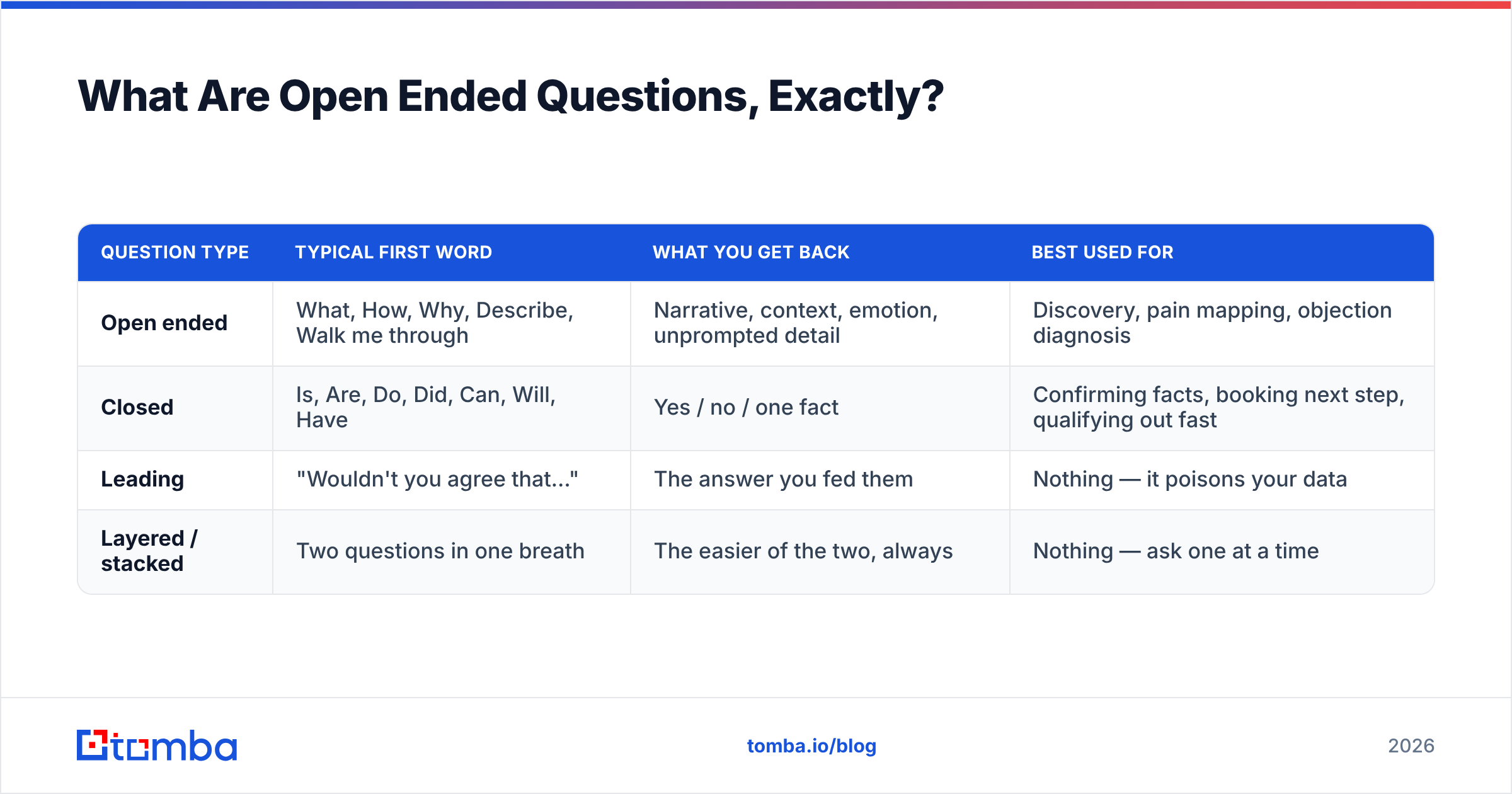
The mechanical test is the first word:
| Question type | Typical first word | What you get back | Best used for |
|---|---|---|---|
| Open ended | What, How, Why, Describe, Walk me through | Narrative, context, emotion, unprompted detail | Discovery, pain mapping, objection diagnosis |
| Closed | Is, Are, Do, Did, Can, Will, Have | Yes / no / one fact | Confirming facts, booking next step, qualifying out fast |
| Leading | "Wouldn't you agree that…" | The answer you fed them | Nothing — it poisons your data |
| Layered / stacked | Two questions in one breath | The easier of the two, always | Nothing — ask one at a time |
Two nuances most "open vs closed" articles skip:
- "Why" is open but risky. "Why did you choose that vendor?" can read as an accusation. Soften it: "What made that vendor the right call at the time?"
- Some closed questions are secretly open. "Do you have a formal procurement process?" gets a yes — and then people keep talking. The real distinction is whether the question invites elaboration, not just grammar.
- Question length matters. Gong's call analysis has repeatedly shown that top reps ask fewer, longer, better-spaced questions rather than rapid-fire interrogation. Eleven to fourteen questions across a discovery call outperforms thirty.
- Silence is part of the question. Ask, then stop. The three seconds after an open ended question are where the actual answer lives.
What Are the Best Examples of Open Ended Questions for Discovery Calls?#
Discovery is where open questions earn their keep. Your goal is not to demo — it's to get the prospect to describe their current state in enough detail that the gap between now and better becomes obvious to them, not just to you.
Openers that aren't small talk
- "What made you take this call?"
- "Walk me through how your team handles [process] today."
- "What does a good quarter look like for your team right now?"
- "How did this land on your plate?"
- "What were you hoping to get out of the next 25 minutes?"
Current-state and pain mapping
- "Describe the last time [process] broke down. What happened?"
- "What's the workaround your team has built to deal with that?"
- "How much of your week goes into that manually?"
- "What happens downstream when the data is wrong?"
- "Who feels that pain first — you, your reps, or your customers?"
- "What have you already tried to fix it?"
- "What made those attempts fall short?"
- "If nothing changes for the next two quarters, what does that cost you?"
Impact and quantification
- "How are you measuring success on this today?"
- "What number does your VP look at first on Monday morning?"
- "How would you know, six months from now, that this worked?"
- "What's the gap between where that metric is and where it needs to be?"
- "What else gets easier if this problem goes away?"
Budget — without saying 'budget'
- "How does spending typically get approved for tools in this category?"
- "What was the last purchase like this your team made, and how did it go?"
- "What range would make this an easy yes versus a hard conversation?"
- "Who else has to be comfortable with the number?"
- "What would have to be true for this to get funded this quarter?"
Decision process and stakeholders
- "Walk me through what happens after you and I agree this is a fit."
- "Who else lives with the consequences of this decision?"
- "How did the last vendor evaluation go inside your org?"
- "What tends to slow these things down for you?"
- "What's your role in the final call — recommender, approver, or something else?"
Competitive and status-quo probing
- "What do you like about your current setup?"
- "If you could change one thing about it tomorrow, what would it be?"
- "How does your team compare options like this?"
- "What would make you stay exactly where you are?"
That last one is the most underused question in B2B sales. It surfaces the real competitor — inertia — instead of the logo you assumed you were up against.
When Do Open Ended Questions Actually Hurt You?#
Here's the part most sales-training content leaves out: open ended questions have three failure modes, and each one costs real pipeline.
1. In cold email, open questions kill reply rates.
A cold email asking "What are your biggest challenges with lead data right now?" demands a paragraph from a stranger. That is a big ask from someone who owes you nothing. Cold email CTAs should be closed and low-friction — "Worth a look?" or "Is data accuracy on your list this quarter?" — because a one-word reply is still a reply. Save the open questions for the call you just booked. If you're building those sequences, our cold email templates show the closed-CTA pattern in context.
2. On gatekeeper and cold calls, open questions read as evasive.
"How does your team handle vendor evaluations?" to an office manager gets you transferred to voicemail. Cold-call openers should be direct and closed: "Is Sarah the right person for demand gen?" Earn the right to ask open questions with the person who owns the problem.
3. Late in the cycle, open questions reopen closed doors.
At the contract stage, "How are you feeling about the agreement?" invites new objections you'd already handled. Switch to closed confirmations: "Are we still on track for signature by the 30th?" Open early, close late.
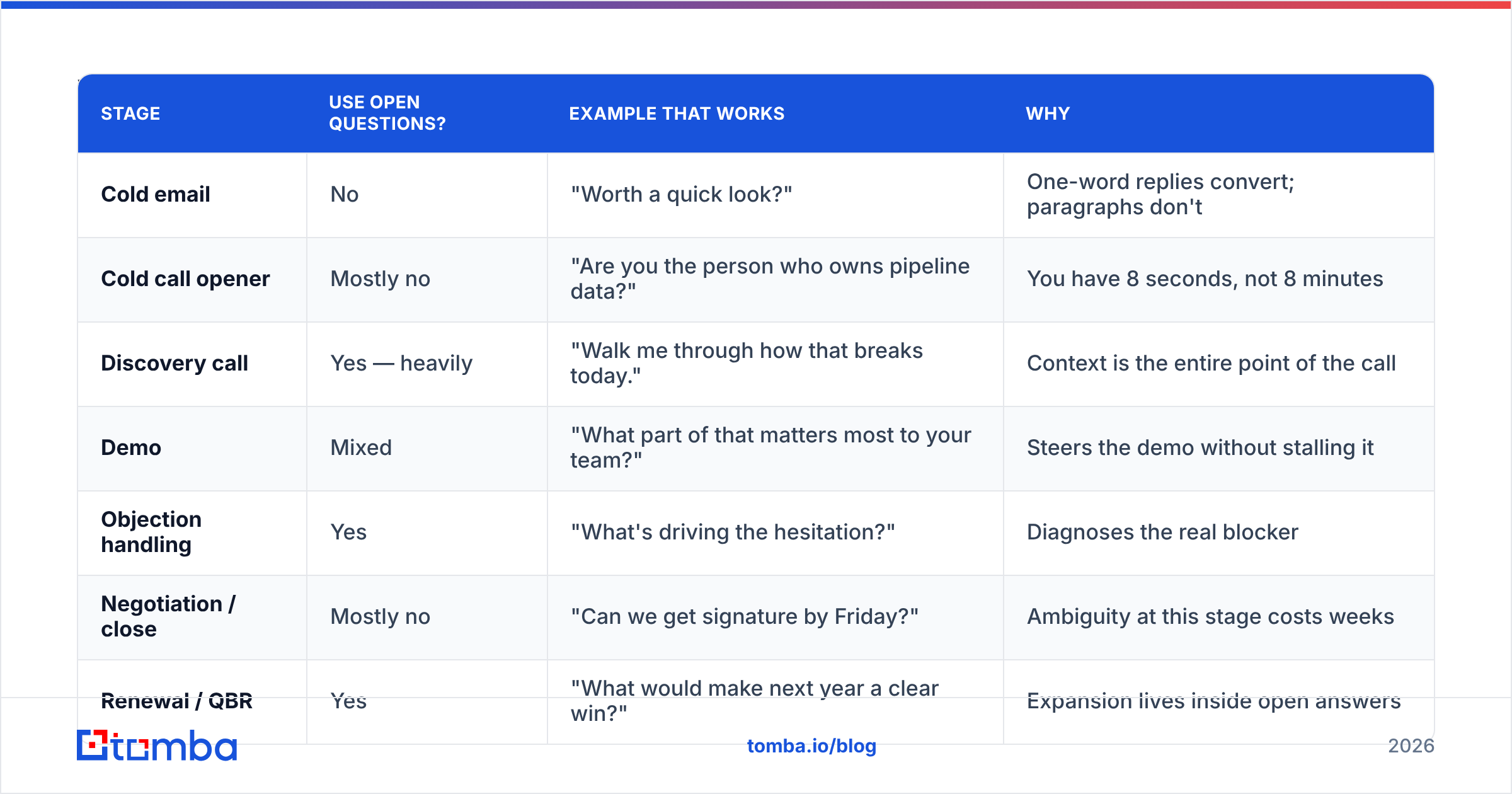
| Stage | Use open questions? | Example that works | Why |
|---|---|---|---|
| Cold email | No | "Worth a quick look?" | One-word replies convert; paragraphs don't |
| Cold call opener | Mostly no | "Are you the person who owns pipeline data?" | You have 8 seconds, not 8 minutes |
| Discovery call | Yes — heavily | "Walk me through how that breaks today." | Context is the entire point of the call |
| Demo | Mixed | "What part of that matters most to your team?" | Steers the demo without stalling it |
| Objection handling | Yes | "What's driving the hesitation?" | Diagnoses the real blocker |
| Negotiation / close | Mostly no | "Can we get signature by Friday?" | Ambiguity at this stage costs weeks |
| Renewal / QBR | Yes | "What would make next year a clear win?" | Expansion lives inside open answers |
How Do You Turn Objections Into Open Ended Questions?#
Objections are the highest-leverage place to switch from pitching to asking. The instinct is to rebut. The better move is to make the prospect explain their own objection until it either dissolves or becomes a real, solvable constraint.
"It's too expensive."
- "What are you comparing it against?"
- "How does your team usually think about cost versus the cost of leaving it broken?"
- "What would the right number look like, and what changes at that number?"
"We're happy with our current provider."
- "What's working best about them?"
- "Where do they fall short, even a little?"
- "What would have to happen for you to reconsider?"
"Send me some information."
- "Happy to — what specifically would you want that information to answer?"
- "Who else will read it, and what will they be looking for?"
"Now isn't a good time."
- "What's taking priority right now?"
- "What would need to shift for this to move up the list?"
"We tried something like this before and it didn't work."
- "Walk me through what happened."
- "What would you do differently if you ran it again?"
Notice the pattern: every one of these hands the prospect the pen. HubSpot's sales research and Salesforce's own enablement material both converge on the same principle — reps who diagnose objections outperform reps who counter them. See HubSpot's sales objection guidance for a longer treatment of the diagnostic approach.
What Do Great Open Ended Questions Look Like in Cold Outreach?#
You can't lead a cold email with an open question — but you can earn one by the second or third touch, once you've given something first.
The sequence that works:
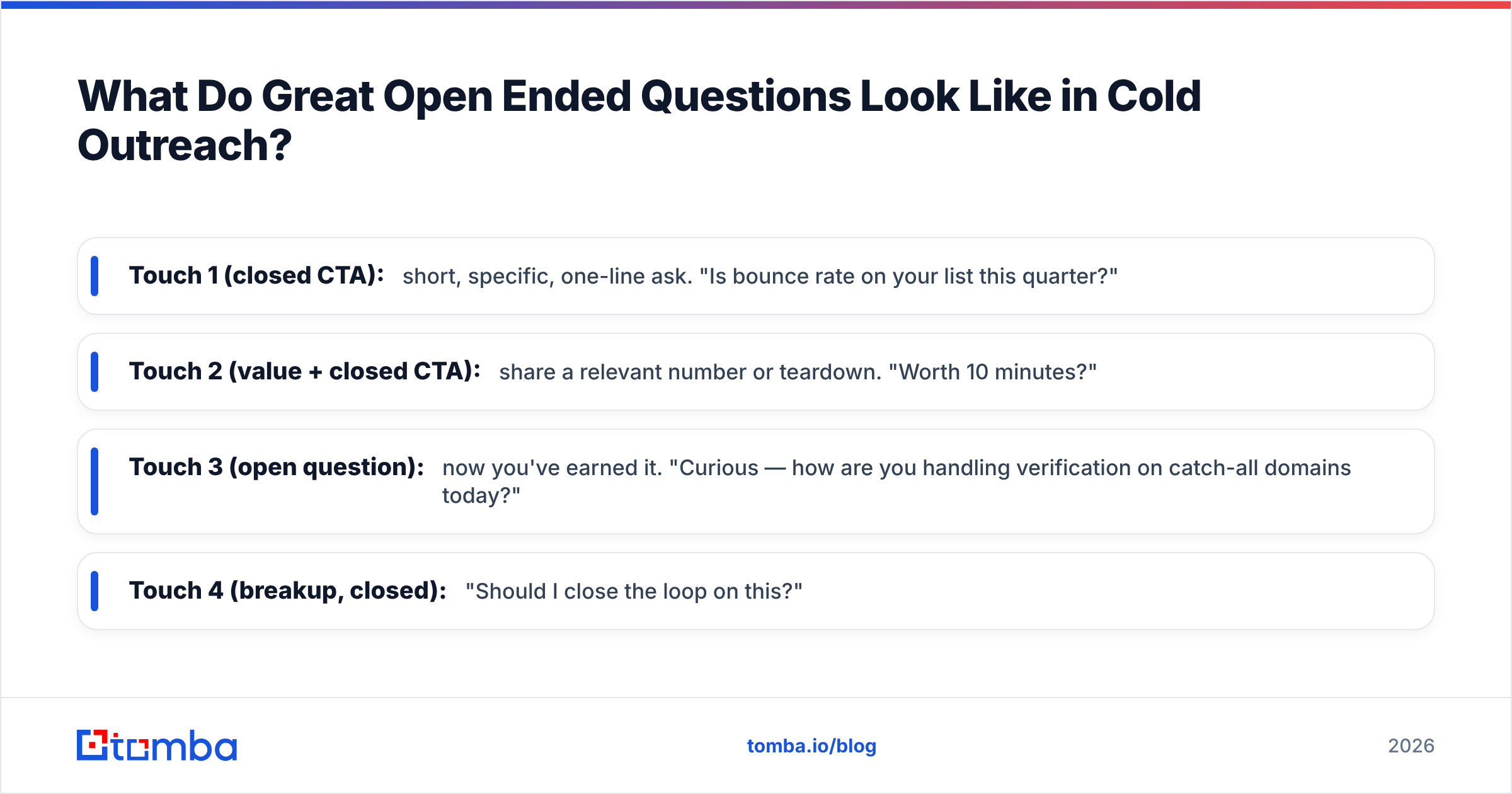
- Touch 1 (closed CTA): short, specific, one-line ask. "Is bounce rate on your list this quarter?"
- Touch 2 (value + closed CTA): share a relevant number or teardown. "Worth 10 minutes?"
- Touch 3 (open question): now you've earned it. "Curious — how are you handling verification on catch-all domains today?"
- Touch 4 (breakup, closed): "Should I close the loop on this?"
The open question in touch three works because you've already demonstrated you know their world. It reads as professional curiosity, not a survey.
One caveat that has nothing to do with phrasing: the world's best question sent to a stale or guessed address is a bounce. Your reply rate is a product of question quality times list quality, and list quality is the term most teams neglect. If more than 3-5% of your sends bounce, mailbox providers start throttling you and your carefully written open questions never get read. Run the list through an email verifier before the sequence goes out, and use domain search to pull verified contacts at target accounts rather than guessing patterns.
How Should You Practice and Score Your Questions?#
Treat questions as a repeatable asset, not improvisation.
Build a question bank by stage. Ten to fifteen per stage, stored where reps actually work — the CRM opportunity record, not a Google Doc nobody opens.
Score calls on talk-time ratio. If you're above 55% talk time in discovery, your questions are too closed or you're not leaving silence. Conversation-intelligence tools measure this automatically, but a stopwatch works too.
Count the follow-ups. The second question on a topic ("What do you mean by that?" / "Say more about that") produces more usable intel than the first. A rep who asks fourteen questions but never follows up is running a survey, not a discovery call.
Log the answers verbatim. Paraphrasing loses the language the prospect used, and their language is what you put in the proposal. Copy the exact phrase into your CRM notes.
Run a monthly question retro. Which questions produced multi-sentence answers? Which produced "um, I guess so"? Kill the dead ones. G2's buyer-behavior research consistently shows that buyers rate reps highest when the rep understood their specific situation — and understanding is downstream of asking well. G2's B2B buyer behavior data is worth a read on how buyers actually evaluate reps.
A Question Bank Is Only as Good as the List Behind It#
You can write the best examples of open ended questions on the internet, rehearse them, and still miss quota — because you asked them to the wrong 400 people, or to email addresses that bounced.
The order of operations is: right accounts → right people → verified contact details → great questions. Most teams invest heavily in the last step and almost nothing in the third.
That's the gap Tomba's Email Finder closes. Point it at a domain or a name-plus-company and it returns verified professional emails with a confidence score, so the discovery call you prepared those questions for actually happens. The free tier gives you 25 searches a month to test the accuracy on your own target list, and paid plans start at $49/mo on the Starter tier — full Tomba pricing is public, with Growth at $99/mo and Pro at $249/mo when volume ramps.
Write the questions. Verify the list. Then go have the conversation.
Related guides#
Ready to find emails that actually work?
Join 150,000+ professionals who stopped guessing and started sending. Free credits on signup — no credit card required.
Get the Tomba newsletter
Practical outbound tactics and product updates — once every two weeks.
About the author