9 Examples of Personal Selling That Close Real B2B Deals
Personal selling is the oldest revenue motion in B2B and still the most expensive. Here are nine concrete examples, what each one costs per touch, and the deal sizes where it stops paying for itself.
TL;DR
- Personal selling is any sales motion where a human being adapts the pitch in real time to one specific buyer. Everything else — ads, drip sequences, self-serve checkout — is not personal selling, no matter how much merge-tag personalization you bolt on.
- The nine examples below range from a $4 LinkedIn touch to a $1,200 trade-show conversation. Cost per touch is the number that decides which one you should run.
- Personal selling wins when the deal is complex, expensive, or politically messy. It loses badly on sub-$5k ACV products where the math never closes.
- Every example depends on the same input: accurate contact data. A perfect discovery script sent to a bounced address converts at zero.
- Measure personal selling on meetings-to-opportunity and cycle length, not on activity counts. Activity metrics reward the reps who talk to the wrong people fastest.
What is personal selling, and why does it still exist in 2026?#
Personal selling is direct, two-way communication between a seller and a specific buyer, where the seller adjusts the message based on what the buyer says back. That last clause is the whole definition. If the message can't change mid-conversation, you're doing marketing.
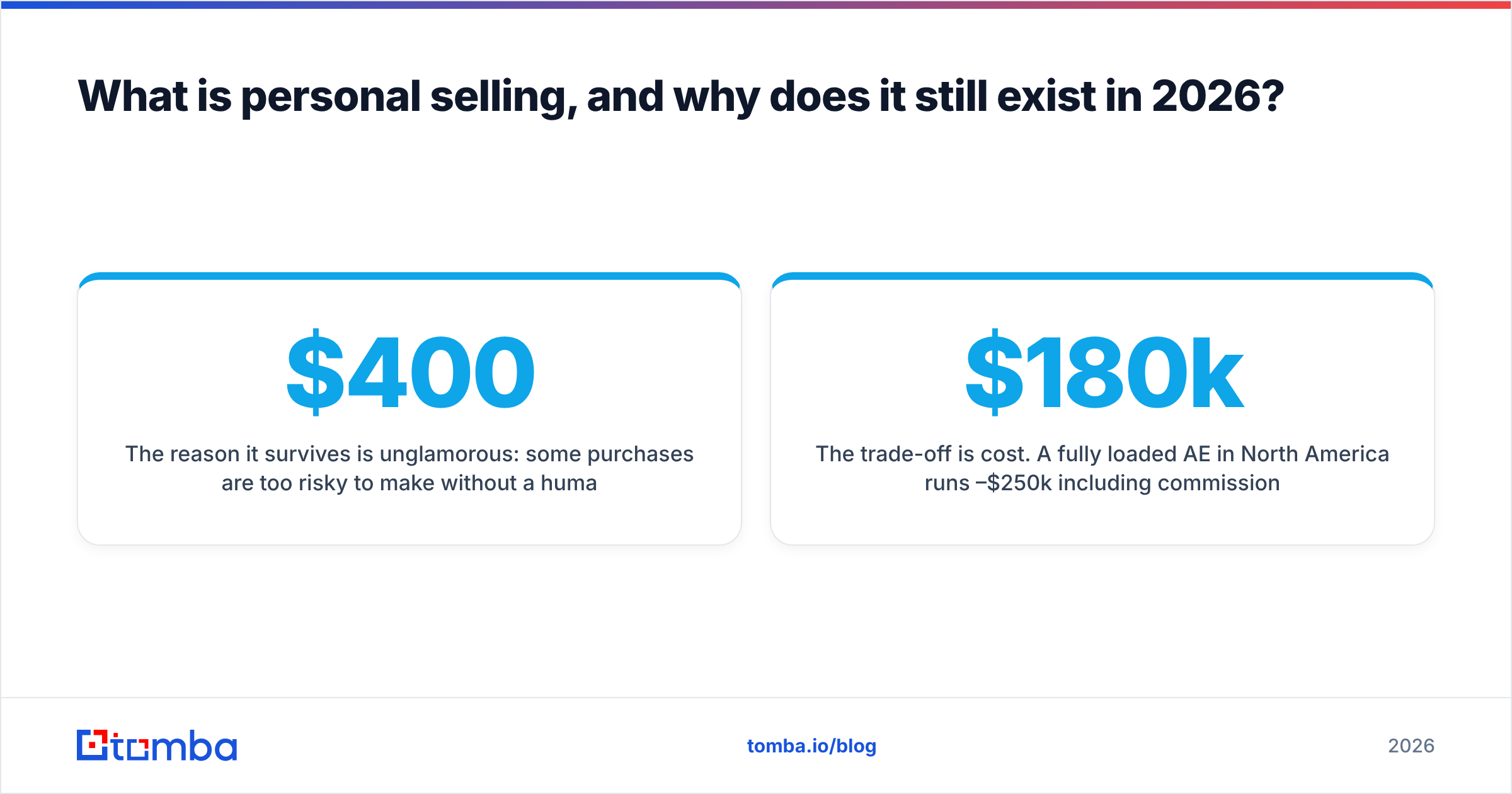
The reason it survives is unglamorous: some purchases are too risky to make without a human on the other end. A $400/year tool gets bought from a pricing page. A $180,000 platform migration involving four departments, a security review, and a procurement team gets bought from a person who can answer "what happens if we churn in month seven?" without escalating.
Gartner's sales research has documented the same pattern for a decade — buyers want self-service for the easy parts and a human for the parts that carry career risk. Personal selling is how you cover the second half.
The trade-off is cost. A fully loaded AE in North America runs $180k–$250k including commission, benefits, and tooling. That's roughly $120 per productive selling hour. Any example of personal selling you run has to generate more than that per hour, or it's a hobby.
What are the main types of personal selling?#
Before the specific examples, the five structural forms. Most teams run two or three of these simultaneously without ever naming them, which is why their playbooks contradict each other.
- Order takers — The buyer has already decided. The rep processes, upsells slightly, and removes friction. Inside sales at a distributor, renewals desks, retail counters. Lowest skill ceiling, highest volume.
- Order getters — The rep creates demand that didn't exist that morning. Outbound AEs, field reps opening new territory. This is what most people mean when they say "sales."
- Consultative / solution selling — The rep diagnoses before prescribing. Long discovery, multi-stakeholder, often a scoping document before pricing appears. Standard for enterprise SaaS and professional services.
- Technical selling — A sales engineer or specialist carries the deal because the buying decision is an engineering decision. Common in infrastructure, security, and API-first products.
- Relationship / account management — The sale is ongoing rather than transactional. QBRs, expansion conversations, executive sponsorship. Revenue comes from retention and land-and-expand rather than new logos.
Nearly every real-world example below is a blend. A field demo is order-getting plus technical selling. A trade-show booth is order-getting plus relationship building. Don't over-index on the taxonomy — use it to figure out which skill you're actually hiring for.
What do real examples of personal selling look like?#
Nine concrete motions, with the mechanics that make each one work.
1. The field demo at the prospect's office#
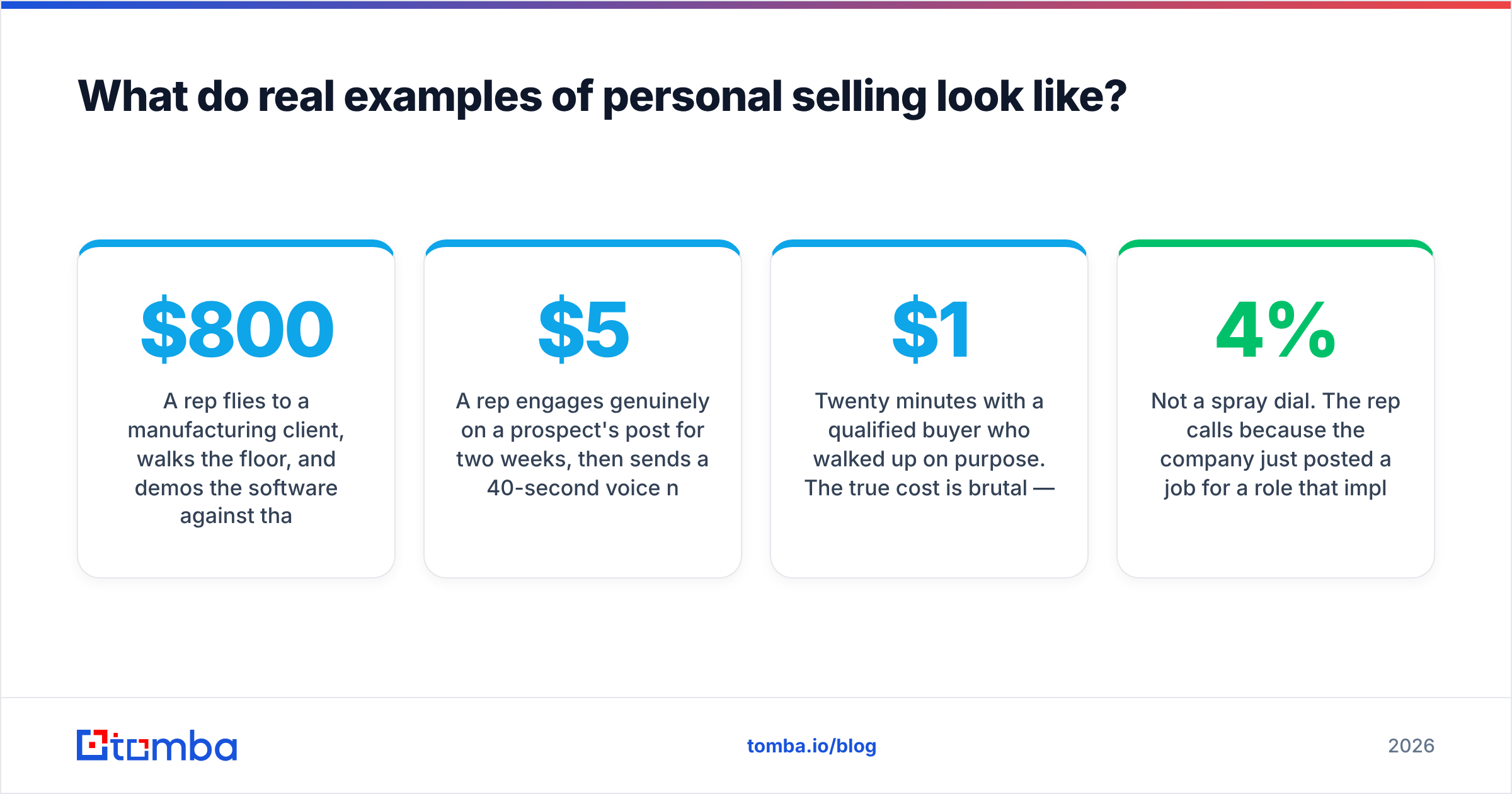
A rep flies to a manufacturing client, walks the floor, and demos the software against that client's actual production line rather than a sandbox. Cost: $800–$2,000 all-in with travel. Justified only above roughly $50k ACV, but the close rate on a well-run onsite demo routinely doubles a remote one because the rep sees objections the buyer would never type into a chat window.
2. The multi-threaded enterprise discovery call#
Not one call — a sequence of four to six, each with a different stakeholder. The VP of Ops call is about throughput. The IT call is about SOC 2 and SSO. The CFO call is about payback period. The rep maintains one narrative across all of them and lets each stakeholder hear their own version of it. This is the highest-leverage example of personal selling in B2B and the hardest to train.
3. The LinkedIn voice note after a comment thread#
A rep engages genuinely on a prospect's post for two weeks, then sends a 40-second voice note referencing the specific thing they disagreed about. Cost per touch: under $5. Reply rates on this run 3–5x cold connection requests because the prospect already recognizes the name. If you're building this motion, the practical constraints of LinkedIn outreach — connection limits, view caps, the risk of restriction — determine your ceiling more than your copy does.
4. The trade-show booth conversation#
Twenty minutes with a qualified buyer who walked up on purpose. The true cost is brutal — booth, travel, staff, swag — often $1,000–$1,500 per real conversation once you divide total spend by qualified conversations rather than badge scans. It works because intent is pre-qualified and objections surface faster in person. It fails when teams measure badge scans.
5. The technical proof-of-concept#
A sales engineer spends three weeks building a working integration inside the prospect's environment. Extremely expensive, and it's the only thing that closes deals where the buyer's real objection is "I don't believe this works at our scale." Gate it hard — POCs given away to unqualified prospects are the single largest hidden cost in enterprise sales.
6. The referral introduction call#
An existing customer emails a peer at another company and CCs the rep. Close rates on referred deals commonly run 2–3x cold-sourced ones, and cycle length drops because trust is pre-loaded. The mistake is treating referrals as luck. Teams that build a referral motion ask for them at a specific milestone — usually 60 days after a successful onboarding, never at renewal.
7. The cold call with a specific trigger#
Not a spray dial. The rep calls because the company just posted a job for a role that implies the pain the product solves, or announced a funding round, or changed a compliance vendor. Connect rates on trigger-based calls beat generic lists by a wide margin, but this only works if you have direct dials — switchboards eat the motion alive. Pulling verified B2B phone numbers is the difference between a 4% and a 15% connect rate.
8. The executive-to-executive dinner#
Your CEO takes their CRO to dinner. No deck. This closes stalled seven-figure deals that no AE can move, and it's a rounding error at that deal size. It's also the fastest way to burn credibility if the exec hasn't been briefed properly.
9. The in-app expansion conversation#
A CSM notices an account hitting 90% of seat limits, opens a conversation about the team that's about to get blocked, and expands the contract. Technically personal selling — a human adapting to one buyer's situation in real time — and the cheapest revenue in the entire list, because acquisition cost is already sunk.
Which examples of personal selling fit your deal size?#
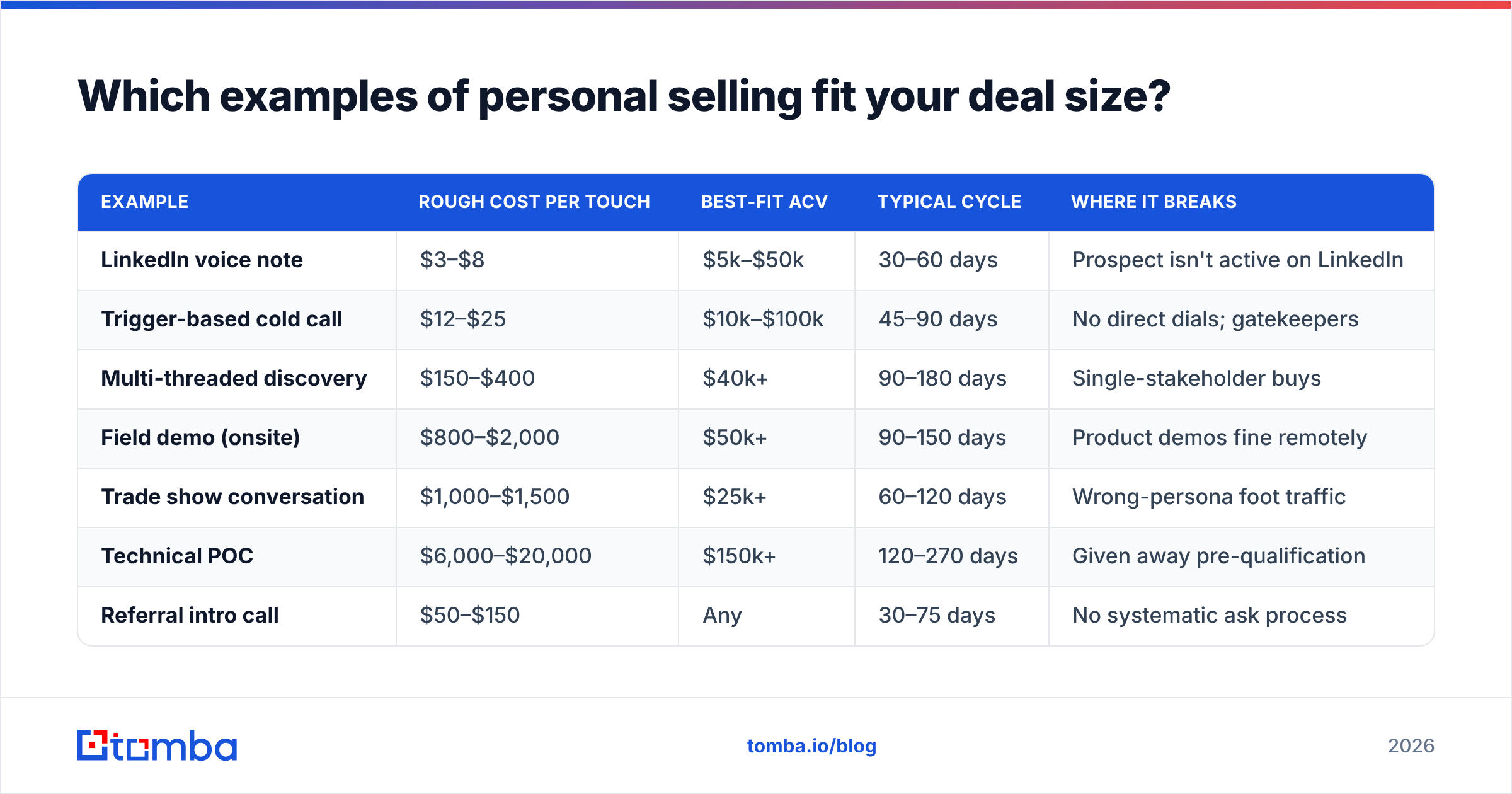
The honest answer is a cost table. Run the motion whose cost per touch is under about 8% of your expected gross profit per deal, and skip the rest.
| Example | Rough cost per touch | Best-fit ACV | Typical cycle | Where it breaks |
|---|---|---|---|---|
| LinkedIn voice note | $3–$8 | $5k–$50k | 30–60 days | Prospect isn't active on LinkedIn |
| Trigger-based cold call | $12–$25 | $10k–$100k | 45–90 days | No direct dials; gatekeepers |
| Multi-threaded discovery | $150–$400 | $40k+ | 90–180 days | Single-stakeholder buys |
| Field demo (onsite) | $800–$2,000 | $50k+ | 90–150 days | Product demos fine remotely |
| Trade show conversation | $1,000–$1,500 | $25k+ | 60–120 days | Wrong-persona foot traffic |
| Technical POC | $6,000–$20,000 | $150k+ | 120–270 days | Given away pre-qualification |
| Referral intro call | $50–$150 | Any | 30–75 days | No systematic ask process |
| Exec-to-exec dinner | $400–$1,200 | $250k+ | Unblocks stalls | Exec not briefed |
| In-app expansion | $20–$60 | Existing accounts | 7–30 days | No usage telemetry |
Two things fall out of this table. First, almost nobody should be flying to a prospect for a $20k deal, and plenty of teams still do. Second, the two cheapest motions — referrals and in-app expansion — are the two that most orgs run informally and never staff.
How do you build a prospect list good enough for personal selling?#
Personal selling amplifies list quality in both directions. A rep spending $400 of company time on a discovery call with a person who left the company in March hasn't just wasted $400 — they've burned the one slot that week they had for that account tier.
Three things separate a list worth a rep's time from one that isn't:
- The contact is real and reachable. Verified work email plus, ideally, a direct dial. If you're generating leads at volume, an email verifier run before the list ever reaches a rep is non-negotiable — bounces don't just cost a touch, they degrade the sending domain that your follow-up sequence depends on.
- The contact is the right seniority for the motion. An exec dinner needs a VP+. A trigger call can work at manager level. Mismatched seniority is the most common reason a good script fails.
- There's a reason to reach out this week. Funding, hiring, a leadership change, a tech-stack shift. Without a trigger, personal selling degrades into interruption, and your reply rate converges on your worst automated sequence.
Most teams solve the first point with a data enrichment pass that fills in title, company size, and direct contact details before assignment, then let the rep spend their research time on the third point — the trigger — which is the only part software can't do for them.
What does a personal selling conversation actually sound like?#
The structural difference between personal selling and a scripted pitch is that the seller spends the first third of the call not selling.
A workable shape for a first discovery call:
- Frame (60 seconds). "I've got 25 minutes on the calendar. I want to understand how your team handles X today, and if it's not a fit I'll tell you and give the time back."
- Diagnose (12 minutes). Open questions about current process, volume, and what breaks. No product mentions. The rep is looking for a quantified pain — hours, dollars, headcount.
- Reflect (3 minutes). Play back what you heard in the buyer's own words. If you get this wrong, the buyer corrects you, which is more valuable than getting it right.
- Position (5 minutes). Now — and only now — connect one or two capabilities to the specific pain named in step two. Not the full feature tour.
- Advance (4 minutes). Agree on a concrete next step with a name, a date, and a stakeholder attached. "I'll send some info" is not an advance.
HubSpot's sales resources have a deep library on discovery frameworks if you want to go further, and the general history of personal selling is a reminder that this structure predates software by about a century.
How do you measure whether personal selling is working?#
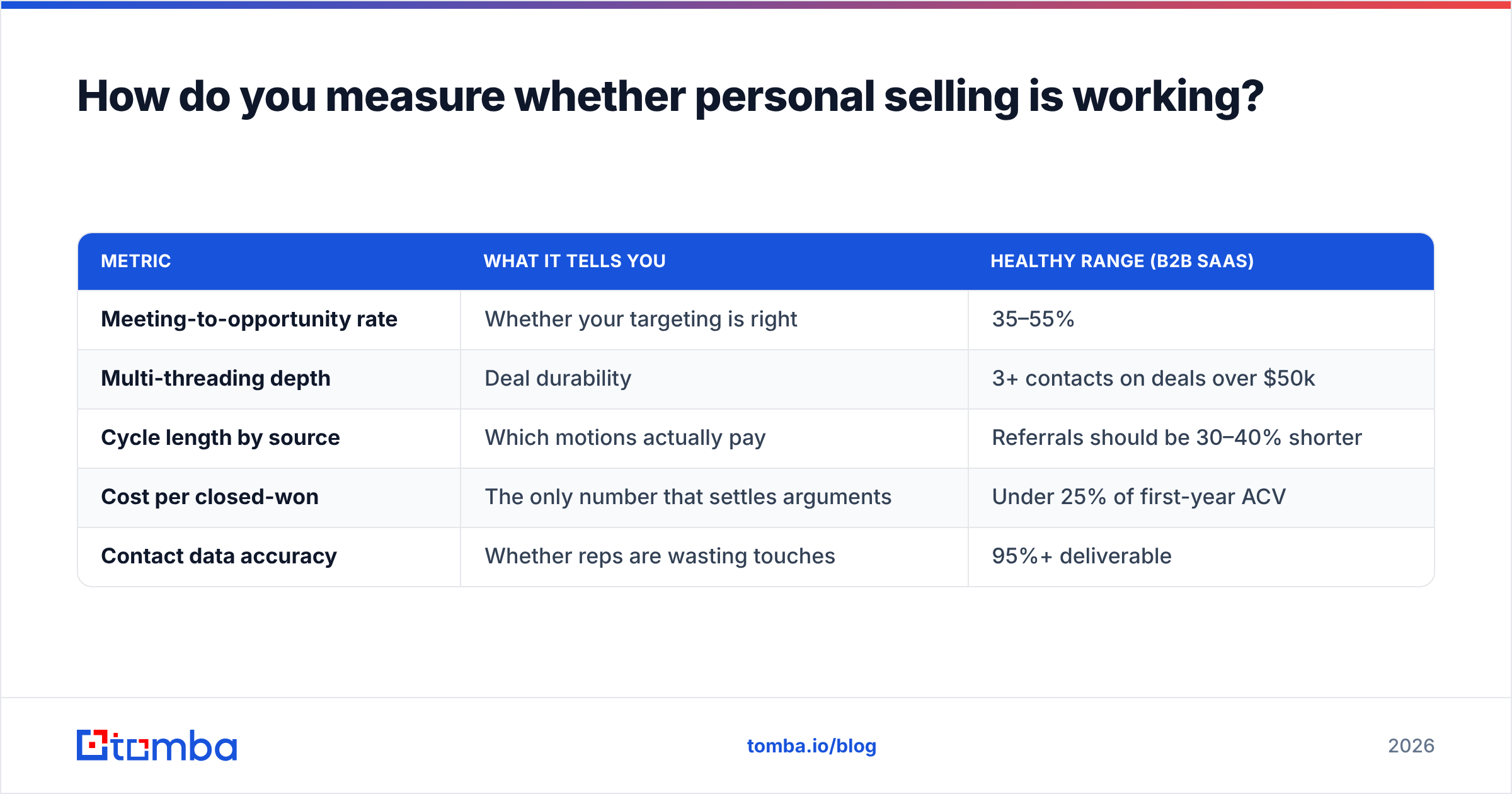
Activity metrics — calls dialed, emails sent, meetings booked — measure motion, not progress. They're useful for coaching new reps and dangerous for evaluating a mature team, because they reward speed toward the wrong accounts.
| Metric | What it tells you | Healthy range (B2B SaaS) |
|---|---|---|
| Meeting-to-opportunity rate | Whether your targeting is right | 35–55% |
| Multi-threading depth | Deal durability | 3+ contacts on deals over $50k |
| Cycle length by source | Which motions actually pay | Referrals should be 30–40% shorter |
| Cost per closed-won | The only number that settles arguments | Under 25% of first-year ACV |
| Contact data accuracy | Whether reps are wasting touches | 95%+ deliverable |
Track cost per closed-won by motion, not in aggregate. That's how you discover that your trade-show program produced four logos at $38,000 each while your referral motion produced eleven at $2,100 each — a conversation that only happens when the numbers are split.
Where does personal selling break down?#
Four failure modes, in order of how often they show up:
Wrong deal size. Running consultative discovery on a $3,000 ACV product. The math cannot work no matter how good the rep is. Move to product-led or a low-touch inside motion.
Bad data underneath. Reps burning 30–40% of their week on research and dead contacts. This is the most fixable and the most ignored. If your team isn't at 95%+ deliverability on their lists, that's the first thing to fix — before any script or methodology training.
No trigger discipline. Personal selling without a reason to reach out becomes cold interruption with extra steps, and it burns territory. A rep who has called the same 200 accounts with no new angle for six months has effectively poisoned that list.
Single-threading. One champion, no economic buyer, no technical validator. The champion changes jobs and the deal dies. Enforce a minimum contact count in your pipeline reviews for anything over $50k.
Where should you start?#
Pick one motion from the table that matches your ACV, staff it properly for a quarter, and measure cost per closed-won against your current blended number. Adding a second motion before the first one has a clean cost figure just makes attribution impossible.
Whichever motion you pick, it runs on contact data. Trigger calls need direct dials. Multi-threading needs four verified addresses per account, not one. Referral intros need the peer's real work email, not a guess at the pattern.
Tomba's Email Finder gives you verified work emails by name and domain, with a free tier of 25 searches a month to test list quality before you commit — paid plans start at $49/mo on Starter and $99/mo on Growth, and full Tomba pricing scales to Pro at $249/mo for teams running high-volume enrichment. Build the list first. The conversation is the easy part.
Related guides#
Ready to find emails that actually work?
Join 150,000+ professionals who stopped guessing and started sending. Free credits on signup — no credit card required.
Get the Tomba newsletter
Practical outbound tactics and product updates — once every two weeks.
About the author