Examples of Sales Pitch Presentation: 7 Decks That Close
Seven real sales pitch presentation structures, slide by slide, with the timing, table stakes, and research work that separates a deck that closes from one that gets forwarded and forgotten.
TL;DR
- The best sales pitch presentations run 8–14 slides and spend the first third on the buyer's problem, not your product.
- Seven formats dominate B2B: problem-first, before/after, insight-led, ROI-first, land-and-expand, competitive-displacement, and renewal/expansion.
- Format choice should follow deal size and buying stage — a $5k self-serve pitch and a $250k committee pitch cannot share a deck.
- Personalization is the multiplier. A pitch that names the prospect's actual stack, headcount, and hiring signals outperforms a generic deck at every stage.
- The research work — verified contacts, org mapping, tech signals — is what makes personalization possible at more than five accounts a week.
What Counts as a Sales Pitch Presentation?#
A sales pitch presentation is a structured argument delivered against visuals, aimed at moving a specific buying group from "interesting" to "let's scope it." That definition rules out two things people confuse it with: the elevator pitch, which is 30 seconds of positioning with no visuals, and the product demo, which shows mechanics rather than making a case.
The distinction matters because the failure mode is always the same. Reps build a deck that is really a product tour, present it to a room that has not yet agreed a problem exists, and get "send me the deck" as the close. A pitch presentation earns the demo. It does not replace it.
Three constraints shape every good example:
- A named buying group. You are not pitching "companies like this." You are pitching a VP of RevOps who owns the number, a Head of Data who owns the risk, and a CFO who owns the signature.
- A single decision you want at the end. Not "thoughts?" — a technical validation slot, a pilot scope, or a security review kickoff.
- Evidence they cannot get from your website. If every slide is on your marketing site, the meeting was a waste of their calendar.
What Structure Do the Best Pitch Decks Follow?#
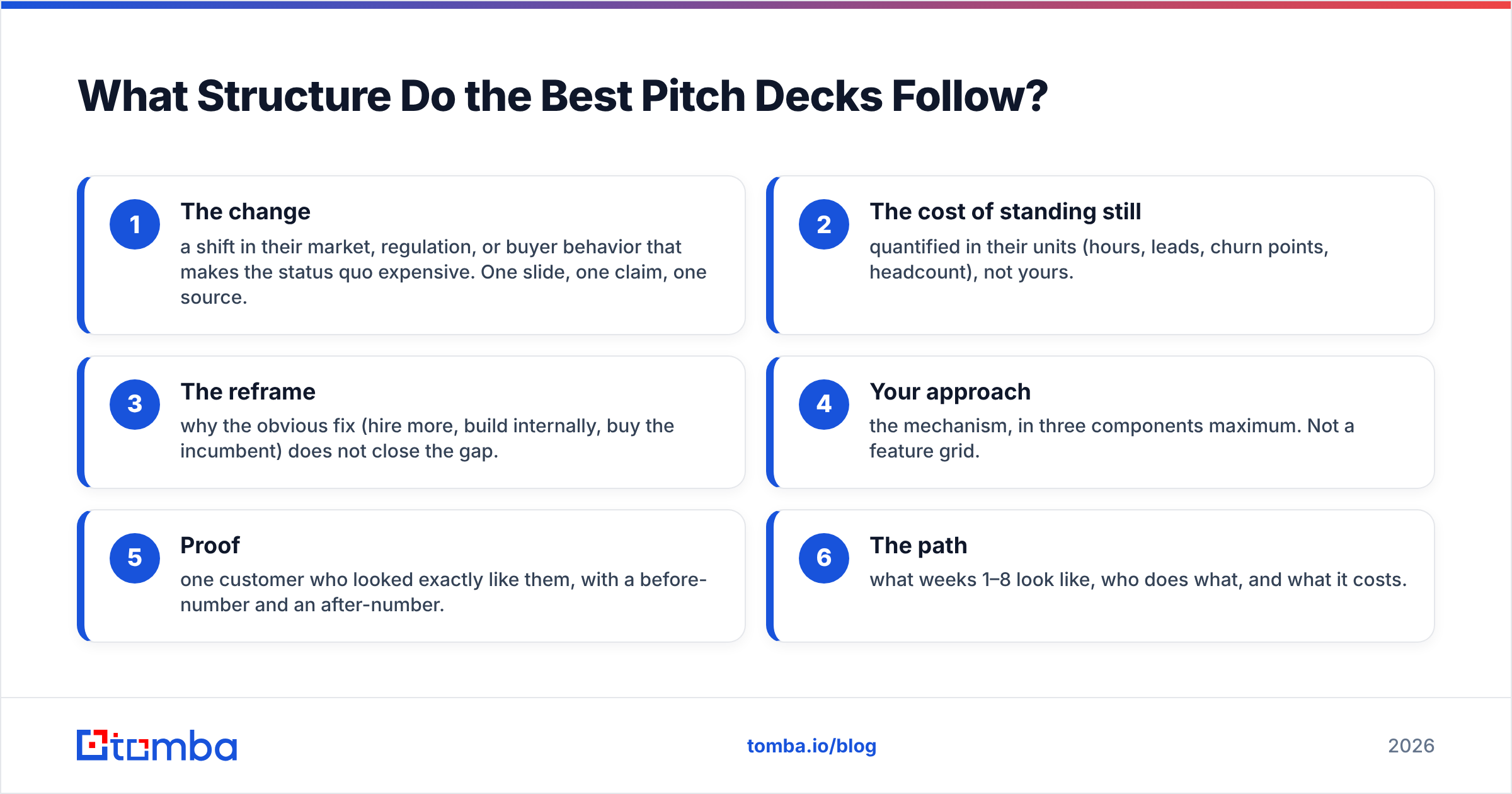
Nearly every high-performing B2B deck maps to the same skeleton, regardless of industry. The order is what changes.
- The change — a shift in their market, regulation, or buyer behavior that makes the status quo expensive. One slide, one claim, one source.
- The cost of standing still — quantified in their units (hours, leads, churn points, headcount), not yours.
- The reframe — why the obvious fix (hire more, build internally, buy the incumbent) does not close the gap.
- Your approach — the mechanism, in three components maximum. Not a feature grid.
- Proof — one customer who looked exactly like them, with a before-number and an after-number.
- The path — what weeks 1–8 look like, who does what, and what it costs.
That is six slides of argument. Everything else — title, agenda, team, security, pricing detail, appendix — supports it. HubSpot's sales resource library documents the same pattern from a different angle: the decks that convert front-load the buyer's world and back-load the vendor's.
Sorry — the image again, correctly:

What Do Real Examples of Sales Pitch Presentation Formats Look Like?#
Here are seven structures that show up repeatedly in B2B deals, with the slide order that makes each one work.
1. The problem-first pitch (mid-market SaaS, 30–45 min)#
Slides: Cost of the current process → three symptoms they will recognize → why point fixes fail → your mechanism → one lookalike customer → 60-day path.
Use it when the buyer knows something is broken but has not put a number on it. The whole pitch hinges on slide one landing a number they have never calculated. Example: "Your SDR team spends 11 hours a week on manual list building — that's 1.4 FTEs of research, not selling."
2. The before/after pitch (workflow and automation tools)#
Slides: Their workflow today, drawn as a diagram with the friction points circled → the same workflow with your product → what disappears → time and error math → proof → pricing.
This one is brutally effective because you build the "before" slide from their own words in discovery. If they correct your diagram in the meeting, you have won — they are now editing your deck instead of evaluating it.
3. The insight-led pitch (challenger style, enterprise)#
Slides: A data point about their industry they did not know → what it implies for their 12-month plan → the capability gap it exposes → your approach as the closer of that gap → peer proof → executive summary.
The bar here is high: the insight must be genuinely new. Research from Gartner's sales practice has consistently found that buyers reward suppliers who help them make sense of information, not suppliers who simply present more of it. A recycled industry stat does not qualify.
4. The ROI-first pitch (CFO in the room)#
Slides: The model assumptions → cost today → cost with you → payback period → sensitivity (what if adoption is only 60%?) → implementation risk and how you de-risk it.
Put the sensitivity slide in. Finance buyers trust a model that shows its downside far more than one that only shows the happy path. Every input on the model slide should be editable live.
5. The competitive-displacement pitch (they already own something)#
Slides: What they bought and why it was right then → what changed → the three specific gaps → migration plan and data continuity → cost of switching vs. cost of staying → proof from a customer who made the same switch.
Never open by attacking the incumbent. You are telling the champion they made a bad decision, and they will defend it. Open by validating the original choice, then age it.
6. The land-and-expand pitch (PLG to enterprise)#
Slides: Usage data from their own account → who is already using it and for what → what breaks at the next tier (security, admin, seats) → the enterprise wrapper → rollout by team → commercial terms.
The strongest slide is the one you did not write: their own usage chart. This pitch is mostly reading their behavior back to them.
7. The renewal-and-expansion pitch (existing customer, QBR-adjacent)#
Slides: Committed outcomes vs. delivered → adoption by team → what is underused and why → next-year goals → the module or seat expansion that maps to those goals → renewal terms.
Treat it as a pitch, not a status update. The competitor in the room is "flat renewal," and flat renewals are how accounts quietly decay.
Which Pitch Format Fits Which Deal?#
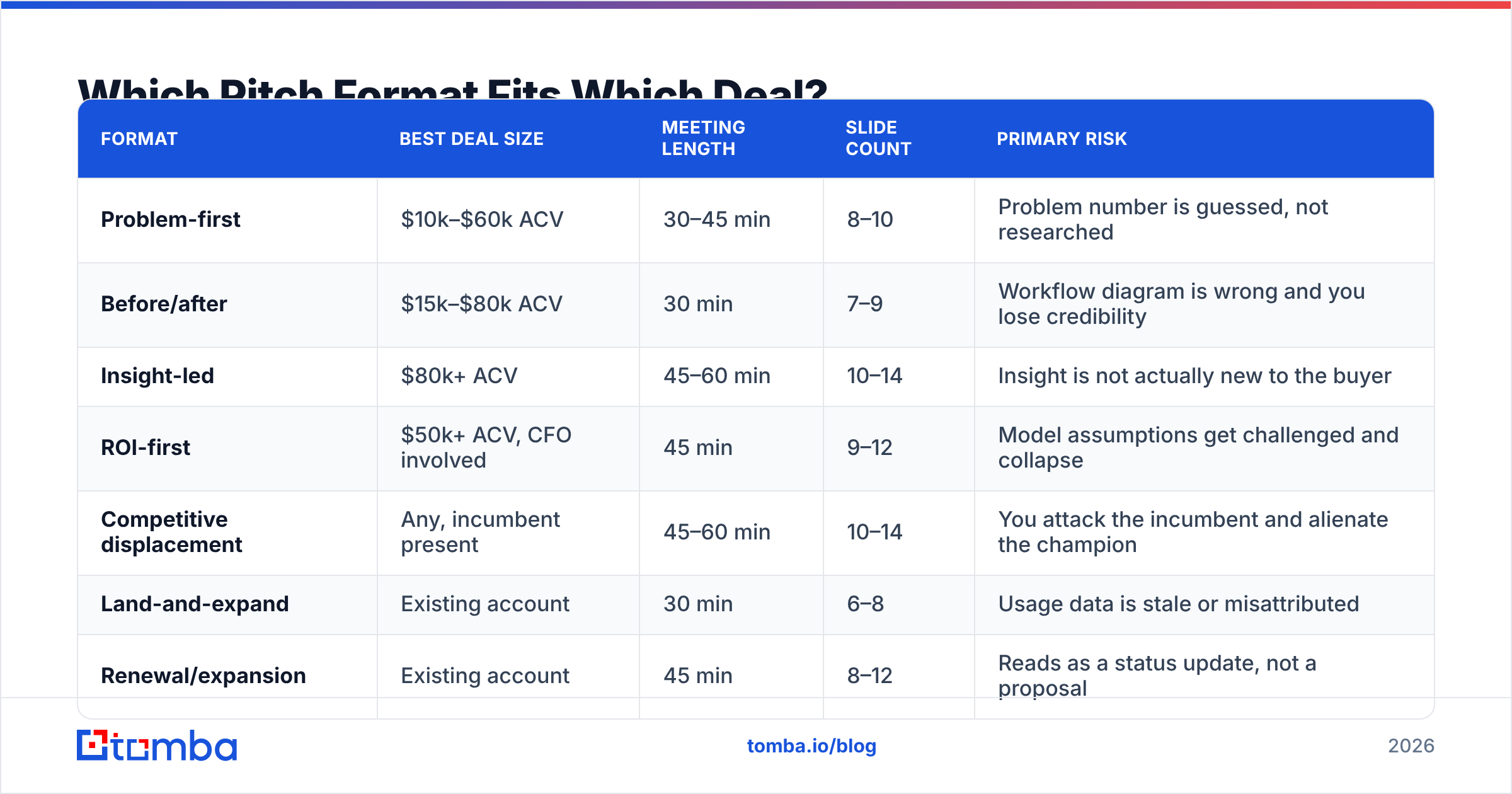
| Format | Best deal size | Meeting length | Slide count | Primary risk |
|---|---|---|---|---|
| Problem-first | $10k–$60k ACV | 30–45 min | 8–10 | Problem number is guessed, not researched |
| Before/after | $15k–$80k ACV | 30 min | 7–9 | Workflow diagram is wrong and you lose credibility |
| Insight-led | $80k+ ACV | 45–60 min | 10–14 | Insight is not actually new to the buyer |
| ROI-first | $50k+ ACV, CFO involved | 45 min | 9–12 | Model assumptions get challenged and collapse |
| Competitive displacement | Any, incumbent present | 45–60 min | 10–14 | You attack the incumbent and alienate the champion |
| Land-and-expand | Existing account | 30 min | 6–8 | Usage data is stale or misattributed |
| Renewal/expansion | Existing account | 45 min | 8–12 | Reads as a status update, not a proposal |
The pattern in that table: as deal size rises, slide count rises modestly and meeting length rises sharply. You are not adding content — you are adding discussion. Decks that scale by adding slides instead of adding room for objections are the ones that get "send it over."
How Long Should a Sales Pitch Presentation Be?#
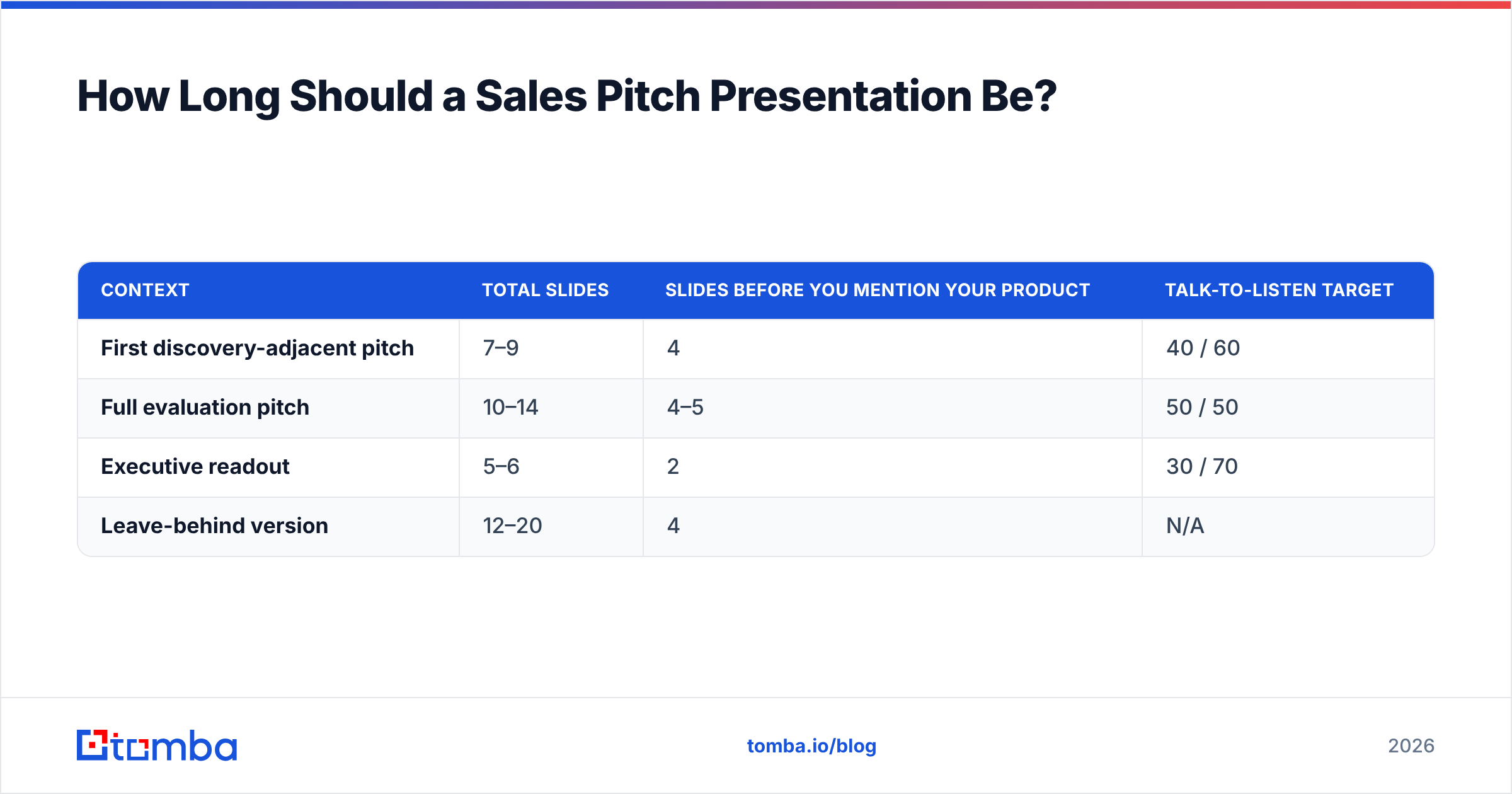
Shorter than you want, longer than a one-pager. Practical benchmarks:
| Context | Total slides | Slides before you mention your product | Talk-to-listen target |
|---|---|---|---|
| First discovery-adjacent pitch | 7–9 | 4 | 40 / 60 |
| Full evaluation pitch | 10–14 | 4–5 | 50 / 50 |
| Executive readout | 5–6 | 2 | 30 / 70 |
| Leave-behind version | 12–20 | 4 | N/A |
Two rules survive every context. First, build a separate leave-behind. The deck you present and the deck you email are different artifacts — the presented one is sparse because you are the narration, and the emailed one is dense because you are not in the room. Second, never open with your company timeline and logo wall. Move it to slide 6 as proof, or to the appendix.
What Makes a Sales Pitch Presentation Fail?#
The failures are boringly consistent across the sales tools reviewed on G2 and across every pipeline review I have sat in:
- Generic problem framing. "Companies struggle with data quality" is not a problem statement. "Your 340-person sales org runs on a CRM where 22% of contact emails bounce" is.
- Feature grids as slide 3. Features before an agreed problem read as noise.
- No named next step. A pitch that ends in "any questions?" ends in nothing.
- Wrong room. Pitching an ROI deck to an end user, or a workflow deck to a CFO, wastes both formats.
- Unverifiable claims. "3x productivity" with no denominator gets discounted to zero by anyone senior.
- Contact chaos. The pitch never reaches the economic buyer because nobody found their address, so the champion forwards a PDF into a vacuum.
That last one is unglamorous and enormously common. A perfect deck stalls when the only person who can sign it never sees it.
How Do You Personalize a Pitch at Scale?#
Personalization is what makes every format above work, and it is the first thing that breaks when a rep has 40 accounts. The fix is to standardize the research inputs so that building a tailored slide takes ten minutes instead of ninety.
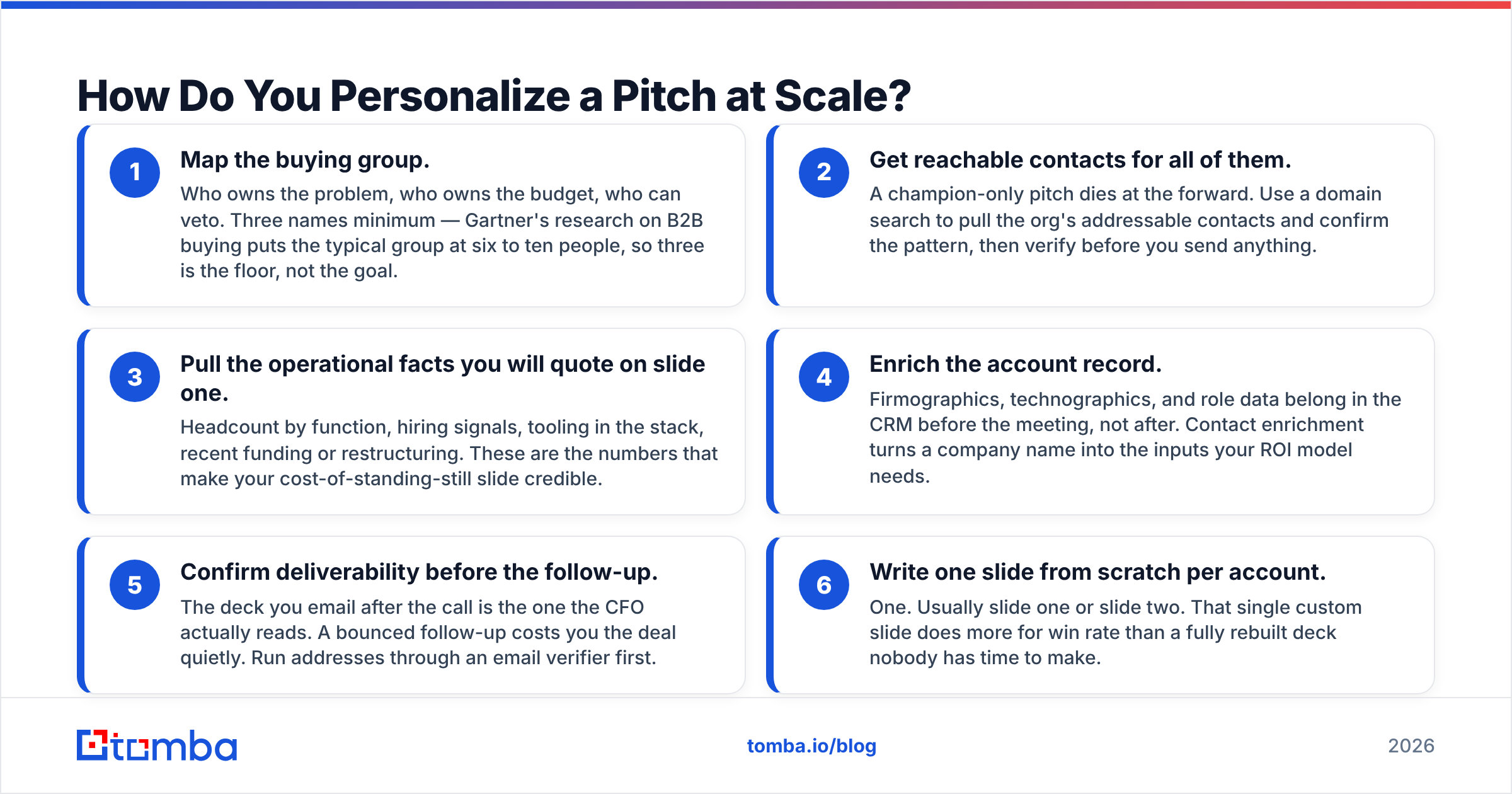
A workable per-account research checklist before you open the deck template:
- Map the buying group. Who owns the problem, who owns the budget, who can veto. Three names minimum — Gartner's research on B2B buying puts the typical group at six to ten people, so three is the floor, not the goal.
- Get reachable contacts for all of them. A champion-only pitch dies at the forward. Use a domain search to pull the org's addressable contacts and confirm the pattern, then verify before you send anything.
- Pull the operational facts you will quote on slide one. Headcount by function, hiring signals, tooling in the stack, recent funding or restructuring. These are the numbers that make your cost-of-standing-still slide credible.
- Enrich the account record. Firmographics, technographics, and role data belong in the CRM before the meeting, not after. Contact enrichment turns a company name into the inputs your ROI model needs.
- Confirm deliverability before the follow-up. The deck you email after the call is the one the CFO actually reads. A bounced follow-up costs you the deal quietly. Run addresses through an email verifier first.
- Write one slide from scratch per account. One. Usually slide one or slide two. That single custom slide does more for win rate than a fully rebuilt deck nobody has time to make.
Reps who do steps 1–5 in a repeatable way can personalize twenty pitches a week. Reps who do them manually personalize three and send seventeen generic decks.
What Should You Steal From These Examples?#
Three things, in order of impact.
Open on their number. Whatever format you pick, slide one should contain a figure about the prospect's business, sourced and specific. It changes the meeting from a presentation to a conversation about their operation.
Cut the deck by a third. Take the deck you have now, delete the slides that exist because someone in marketing asked for them, and move anything defensive to the appendix. If you cannot delete a third, the deck was written for internal approval rather than for a buyer.
Design for the forward. Every deck gets sent to someone who was not in the room. Give each slide a headline that states the conclusion — "Manual list building costs your team 1.4 FTEs" rather than "Current State" — so the argument survives without you.
What Data Do You Need Before You Build the Deck?#
The gap between a generic deck and a pitch that closes is almost always a research gap, not a design gap. You need the right names, verified addresses, and enough firmographic context to say something true and specific on slide one.
That is exactly the job the Tomba Email Finder is built for: turn a target company into a mapped, reachable buying group so your pitch reaches the person who signs, not just the person who took the meeting. The free tier covers 25 searches a month if you want to test it against one account list first, and paid plans start at $49/mo — see Tomba pricing for the full breakdown. Build the research habit first; the deck gets easier every time after that.
Related guides#
Ready to find emails that actually work?
Join 150,000+ professionals who stopped guessing and started sending. Free credits on signup — no credit card required.
Get the Tomba newsletter
Practical outbound tactics and product updates — once every two weeks.
About the author