Executive Selling in 2026: How to Win C-Suite Deals
Executive selling is not enterprise selling with better slides. It is a different buyer, a different clock, and a different unit of proof. Here is the 2026 playbook, with the numbers.
TL;DR
- Executive selling is not "enterprise selling with a nicer deck." The C-suite buys a business outcome on a board calendar; the practitioner buys a feature on a sprint calendar. Different pitch, different proof, different cadence.
- Deals with an executive sponsor engaged before the demo close roughly 2x more often than deals where the exec appears only at signature time — because late-stage exec entry usually means a re-sell, not an approval.
- The hard part is not the meeting, it's the 90 seconds that earn it. That means a verified direct email, a specific trigger event, and a message about their P&L — not your product.
- Most "exec outreach" fails on data before it fails on messaging. If your CRO email bounces, your positioning never gets graded.
- The 2026 shift: executives now delegate discovery to AI summaries and internal champions. You are increasingly selling to a briefing document you never see. Write for that document.
What is executive selling, exactly?#
Executive selling is the practice of running a deal where the primary buyer is a C-level or SVP-level decision maker who owns a P&L, not a workflow.
Here's the everyday version: selling to a practitioner is like selling running shoes to a runner — they care about the cushioning, the drop, the weight. Selling to an executive is like selling running shoes to the person who has to fund the entire marathon team. They don't care about the drop. They care about injury rates, budget per athlete, and whether the team finishes the season.
That distinction drives everything else. A VP of Engineering asks "does it integrate with our stack?" A CTO asks "does this reduce the number of vendors I have to defend at the board meeting?" Same product, different question. If you answer the first question to the person asking the second, you lose — politely, with a "let's circle back next quarter."
Executive selling has four defining traits:
- The buyer owns outcomes, not tasks. Their success metric is on a board slide. Yours needs to map to it in one hop, not three.
- The clock is compressed. You get 20 minutes, and 6 of them are small talk and a late start. Practitioner discovery gets an hour.
- The proof standard is peer evidence. Executives trust other executives at comparable companies far more than they trust your case study PDF.
- The risk calculus is asymmetric. A failed purchase costs them credibility. A missed opportunity costs them nothing visible. Your job is to make inaction the riskier position.
Wait — that renders wrong. Here it is properly:
How is executive selling different from enterprise selling?#
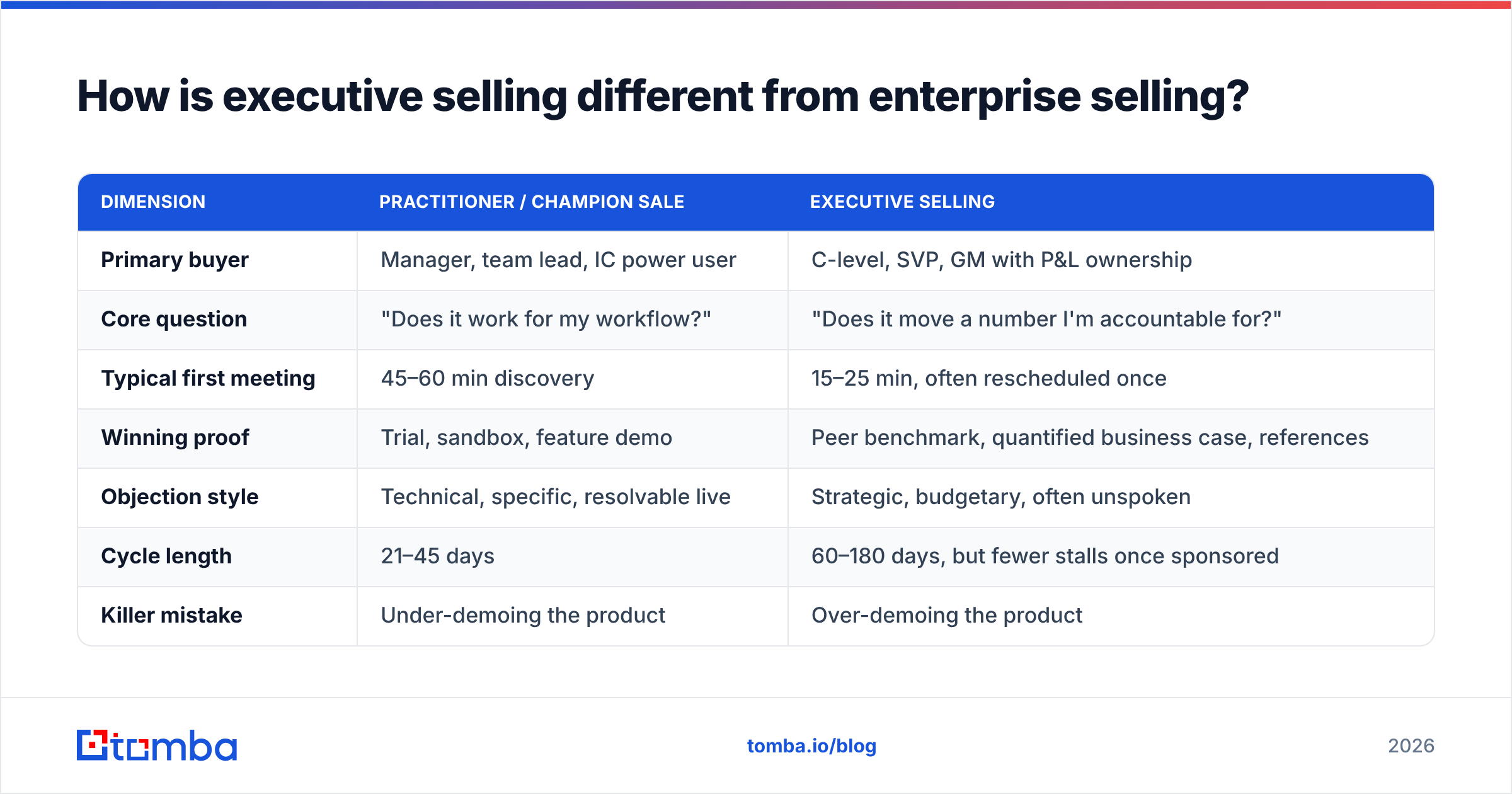
They overlap, but they are not synonyms. Enterprise selling describes deal size and complexity. Executive selling describes who you're persuading. You can run an enterprise deal that never reaches an executive (and it will stall in procurement), and you can run a $30k deal that is pure executive selling (a founder-to-founder purchase decided in one call).
| Dimension | Practitioner / champion sale | Executive selling |
|---|---|---|
| Primary buyer | Manager, team lead, IC power user | C-level, SVP, GM with P&L ownership |
| Core question | "Does it work for my workflow?" | "Does it move a number I'm accountable for?" |
| Typical first meeting | 45–60 min discovery | 15–25 min, often rescheduled once |
| Winning proof | Trial, sandbox, feature demo | Peer benchmark, quantified business case, references |
| Objection style | Technical, specific, resolvable live | Strategic, budgetary, often unspoken |
| Cycle length | 21–45 days | 60–180 days, but fewer stalls once sponsored |
| Killer mistake | Under-demoing the product | Over-demoing the product |
| Deal velocity effect | Steady but stallable | Slow to start, fast to close once bought in |
The practical read on that table: the two motions require opposite instincts. Practitioner selling rewards depth. Executive selling rewards compression. Reps who are excellent at one are frequently mediocre at the other, and most sales orgs never make that explicit — they just wonder why their best demo-er can't close upmarket.
Why do most executive outreach attempts never get a reply?#
Because they fail in a fixed order, and almost nobody diagnoses which failure they actually have.
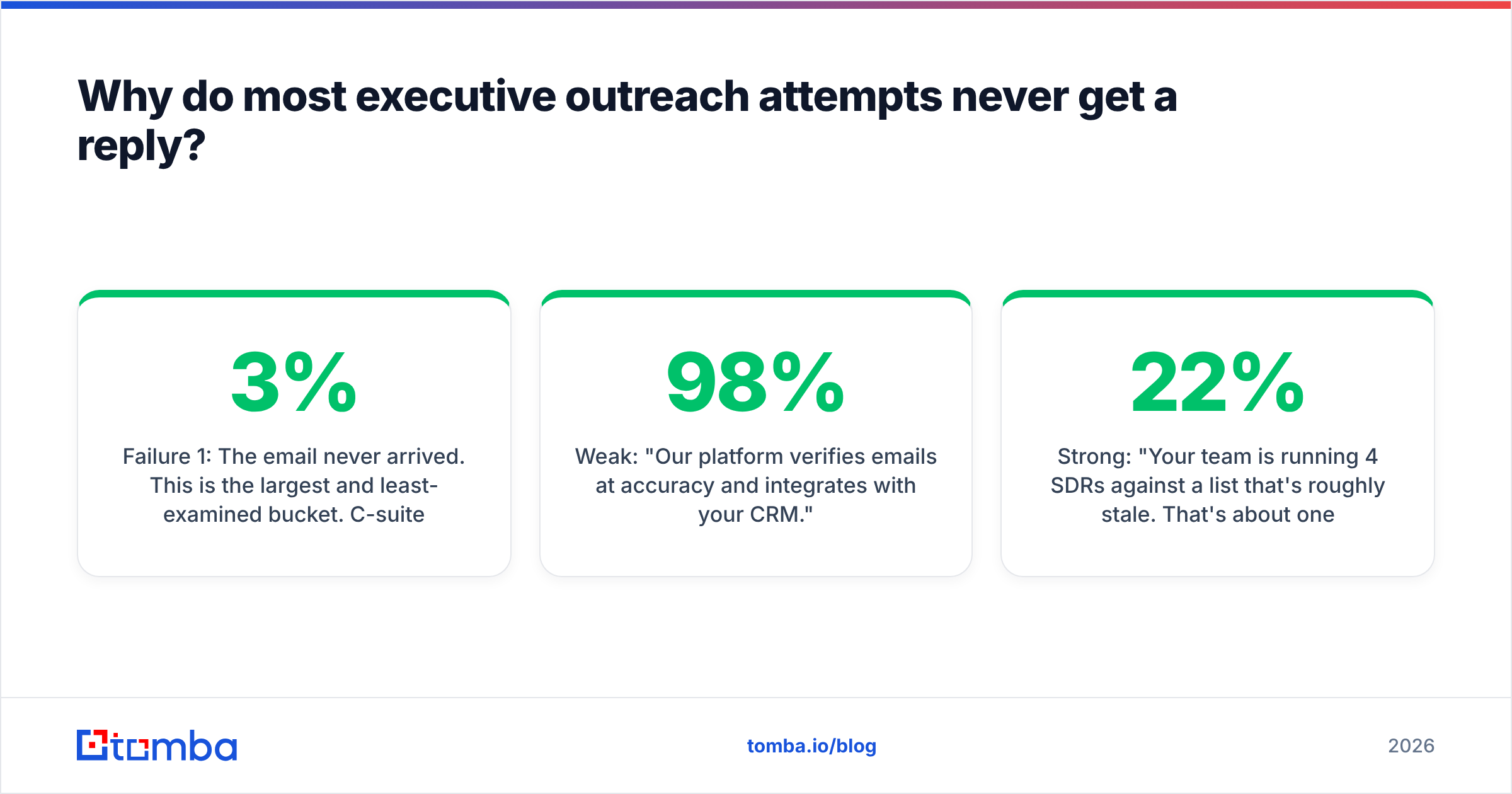
Failure 1: The email never arrived. This is the largest and least-examined bucket. C-suite email patterns are frequently non-standard (initials, legal first names, holdover domains from acquisitions), and executive inboxes sit behind aggressive filtering. A bounced send to a CRO doesn't just cost that lead — it degrades your sender reputation and drags down the rest of your sequence. Before you blame your copy, check your bounce rate on exec-level contacts specifically. If it's above 3%, your data is the problem, not your writing.
Failure 2: The subject line signaled "vendor." Executives triage by pattern-match in under two seconds. "Quick question about [Company]" is a pattern they've filtered a thousand times. Specificity is the only defense: reference an earnings call remark, a named hire, a stated 2026 priority.
Failure 3: The body sold your product. The single most common executive-outreach error is describing what the product does. Executives do not buy capability, they buy consequence. Compare:
- Weak: "Our platform verifies emails at 98% accuracy and integrates with your CRM."
- Strong: "Your team is running 4 SDRs against a list that's roughly 22% stale. That's about one full SDR's salary spent emailing people who left."
Same fact base. Only the second one is denominated in a currency an executive tracks.
Failure 4: There was no reason to act this quarter. Without a trigger — funding, a leadership change, a compliance deadline, a competitor move — you're asking a busy person to create urgency on your behalf. They won't.
Failure 5: You asked for the wrong thing. "30 minutes to explore synergies" is a cost with no defined return. "10 minutes — I'll show you the three benchmarks and you tell me if the third one is wrong" is a bounded, low-risk ask with an implicit ego hook.
How do you actually get access to the C-suite?#
Four routes, ranked by realistic yield in 2026:
1. Sponsored referral from inside the account (highest yield). A champion who forwards your email converts several times better than any cold path, because the executive is now evaluating their own employee's judgment, not yours. To earn it, give the champion an internal-ready artifact: a one-pager written in their boss's language that they can forward without editing. Most reps hand champions marketing collateral. Hand them ammunition instead.
2. Direct, verified, trigger-timed email. Still the workhorse. It requires three things stacked: a real deliverable address, a real trigger, and a message about their number. Miss any one and the other two don't matter. This is where a email finder and a disciplined verification step earn their keep — you want the CFO's actual address, not a permutated guess that lands in a catch-all void.
3. Peer-network and warm-intro paths. Investors, board members, shared advisors, and former colleagues. Slow to build, extremely high conversion when they land. Worth maintaining a permanent map of who in your company knows whom.
4. Executive-adjacent entry. Target the Chief of Staff, the EA, or the exec's direct report. This is not "going around" the executive — done right, it's routing through the person whose job is to filter for relevance. Treat the Chief of Staff as a legitimate first buyer, not an obstacle.

What doesn't work in 2026: LinkedIn connection requests with a pitch attached (executives ignore them at near-total rates), voicemail without a preceding email, and "I noticed you viewed my profile" openers. These were marginal in 2020 and are dead now.
What does an executive-grade business case look like?#
It has four parts and fits on one page. If it needs a second page, you haven't finished thinking.
- The number that's off. One metric, currently underperforming, that the executive already tracks. Not a metric you invented. "Pipeline coverage is 2.4x against a 3.5x target" beats "your outbound could be more efficient."
- The mechanism. Two sentences on why it's off, in causal terms. This is where you demonstrate you understand their business rather than your product.
- The delta. What the number becomes, with a range and an assumption you're willing to defend. Ranges read as honest; single-point estimates read as sales math. Say "we'd expect 3.1x–3.6x within two quarters, assuming rep headcount holds."
- The cost of waiting. Quantified. "Each quarter of delay is roughly $180k of unworked pipeline" is a sentence that gets forwarded.
Notice what's absent: features, screenshots, your funding announcement, your logo wall. Those belong in the follow-up pack, not the case.
One warning on the numbers. Executives sanity-check the arithmetic, and they check it fast. If your claimed lift assumes a 40% reply rate on cold email, you have just disqualified yourself in front of someone who has seen real numbers. Conservative and defensible beats impressive and fragile — every time.
What data do you need before you can sell to executives at scale?#
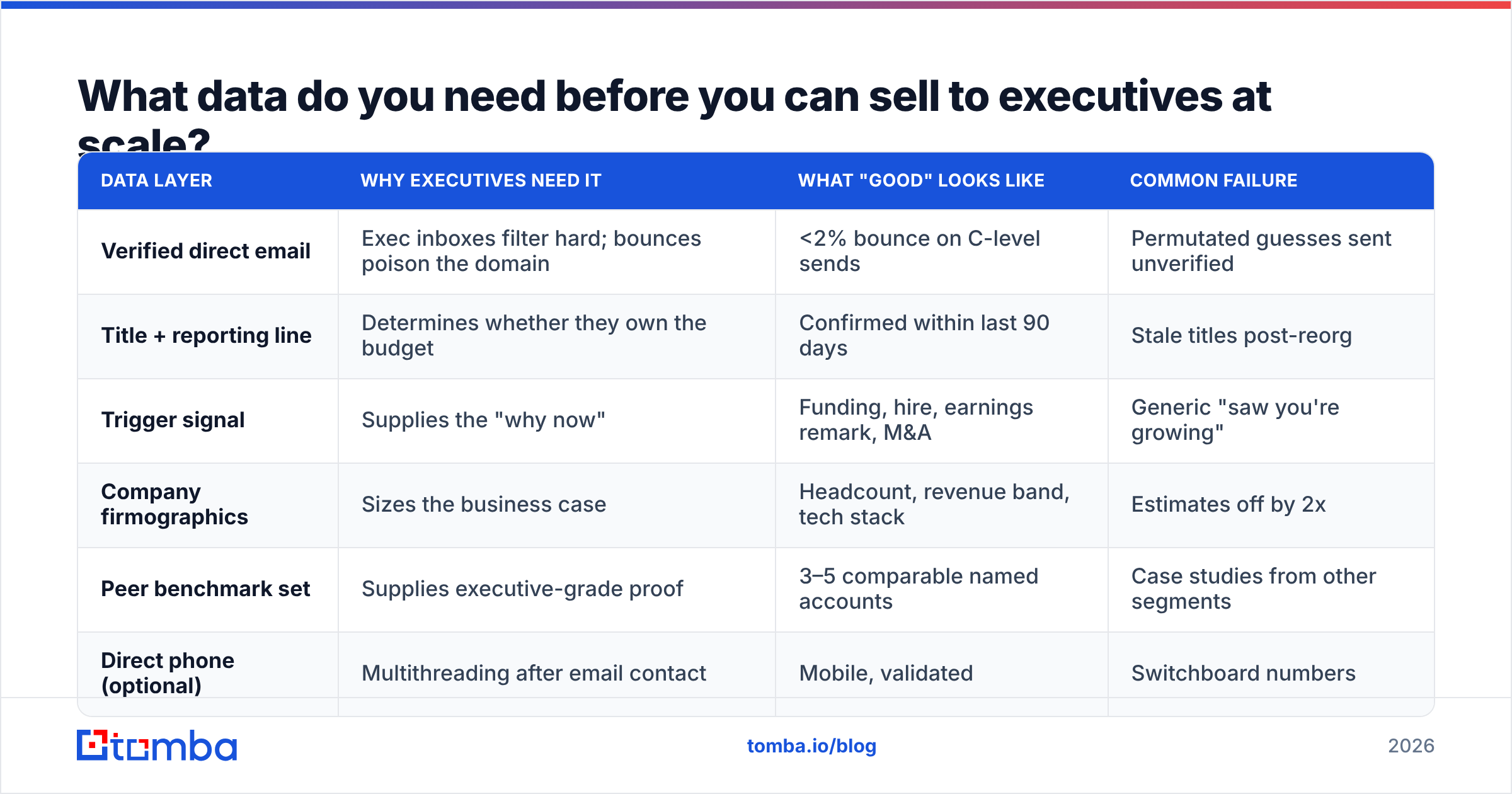
Executive selling has a data floor that practitioner selling doesn't. You can prospect managers off a scraped list and survive the noise. You cannot do that to a CRO — the deliverability penalty and the reputational cost of a mis-addressed exec email are both real.
Here's the minimum stack:
| Data layer | Why executives need it | What "good" looks like | Common failure |
|---|---|---|---|
| Verified direct email | Exec inboxes filter hard; bounces poison the domain | <2% bounce on C-level sends | Permutated guesses sent unverified |
| Title + reporting line | Determines whether they own the budget | Confirmed within last 90 days | Stale titles post-reorg |
| Trigger signal | Supplies the "why now" | Funding, hire, earnings remark, M&A | Generic "saw you're growing" |
| Company firmographics | Sizes the business case | Headcount, revenue band, tech stack | Estimates off by 2x |
| Peer benchmark set | Supplies executive-grade proof | 3–5 comparable named accounts | Case studies from other segments |
| Direct phone (optional) | Multithreading after email contact | Mobile, validated | Switchboard numbers |
For the first row, the workflow that actually holds up at volume is: find by domain, verify before send, re-verify quarterly. Tools in this space price it differently — Tomba runs a free tier at 25 searches/month, then Starter at $49/mo, Growth at $99/mo, and Pro at $249/mo, with the email verifier and domain search bundled rather than metered separately. If your list is heavy on catch-all domains — common at large enterprises where exec addresses hide behind accept-all MX records — a dedicated catch-all verifier is the difference between a usable list and a coin flip. Peers like BookYourData take a different approach with pre-built verified datasets, which suits teams that would rather buy a finished list than build one; both models work, and the right choice depends on whether your ICP is stable enough to buy off the shelf.
The re-verification cadence matters more at exec level than anywhere else. C-suite turnover runs high — Gartner and other analyst houses have tracked steadily shortening CxO tenure for years — which means an executive contact list decays faster than a mid-market one. A quarterly refresh is not paranoia; it's the baseline.
How do you run the executive meeting itself?#
Assume 20 minutes, starting 4 minutes late. That gives you 16. Structure it:
Minutes 1–2: Frame and permission. "I've got one hypothesis about your pipeline and three benchmarks. If the hypothesis is wrong, tell me in the first five minutes and I'll give you the rest of the time back." This does two things: it signals respect for their clock, and it gives them a legitimate exit — which paradoxically makes them stay.
Minutes 3–7: The hypothesis and the number. Lead with your read on their business. Be specific enough to be wrong. Vague statements can't be corrected, and correction is how executives engage.
Minutes 8–12: Their reaction, which is the real discovery. When a CFO says "that's not our constraint, our constraint is retention," you have just received better qualification data than any discovery script produces. Follow it.
Minutes 13–15: The bounded next step. Not "a longer demo." Something like: "Let me run your actual domain through this and send you the three-line result. If it's not interesting, we stop." Small, concrete, reversible.
Minute 16: Confirm the internal path. "Who else has to be comfortable with this?" Ask it explicitly. Executives will answer honestly, and the answer is your multithreading map.
Do not demo unless asked. If they ask, demo for four minutes on one workflow. The instinct to show more is the instinct that loses exec deals.
What metrics tell you executive selling is working?#
Track these separately from your general pipeline metrics, because blending them hides the signal:
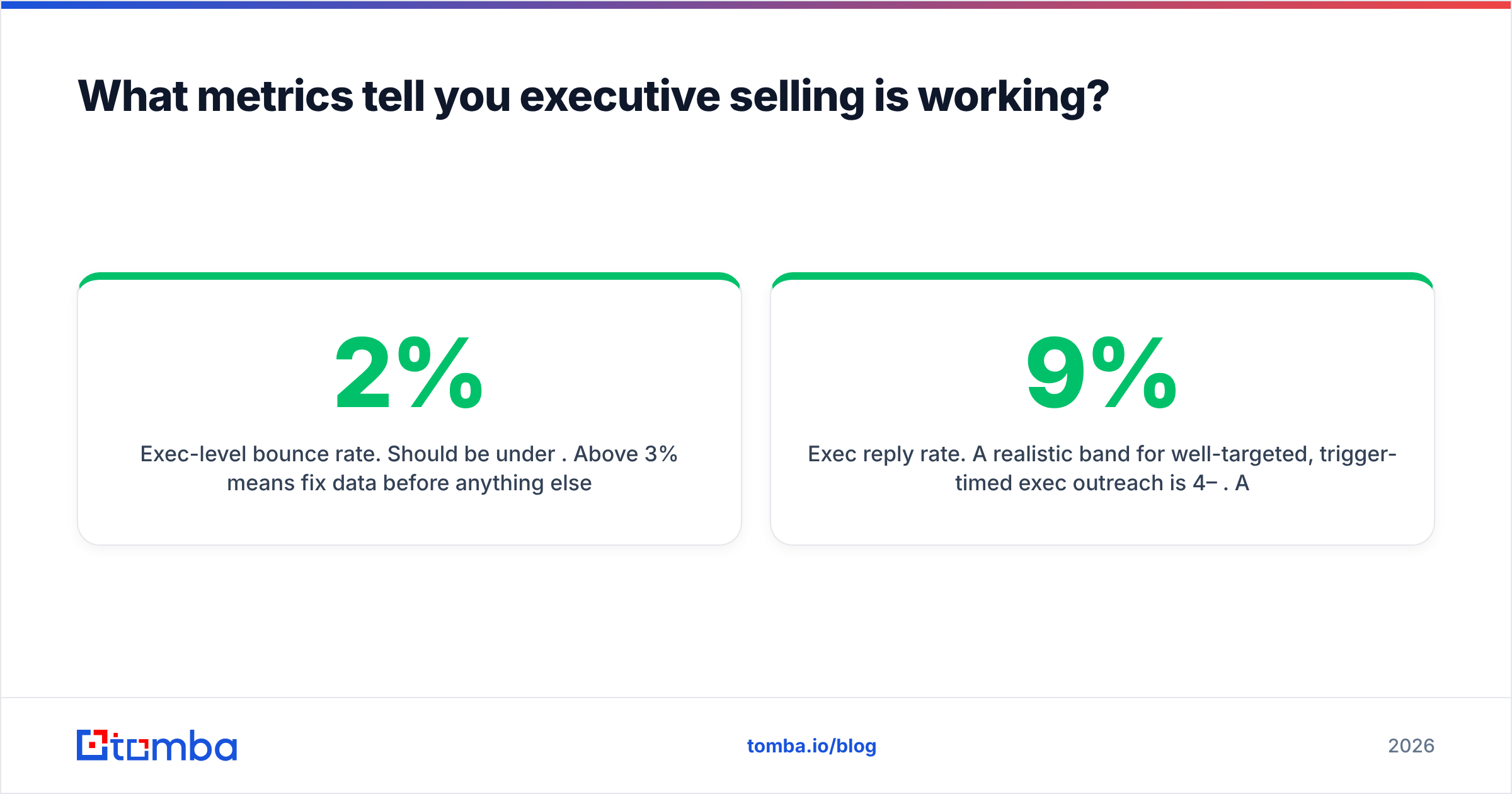
- Exec-level bounce rate. Should be under 2%. Above 3% means fix data before anything else.
- Exec reply rate. A realistic band for well-targeted, trigger-timed exec outreach is 4–9%. Anyone quoting 25% is either counting auto-replies or selling you something.
- Sponsor-engaged rate. Percentage of open opportunities with a verified exec sponsor who has attended at least one call. This is the single best leading indicator of close rate in upmarket deals.
- Time-to-exec. Days from first contact to first executive conversation. Shorter is better; deals where this exceeds 45 days tend to become champion-only deals that die in procurement.
- Win rate split by sponsor presence. Run this once and it will change how your team prioritizes. The gap is usually stark enough to end the debate internally.
- Forward rate. How often your email gets forwarded internally. Hard to measure directly, but a proxy is inbound replies from people you never emailed. If that number is zero, your artifacts aren't forwardable.
For benchmarking your own numbers against the market, G2's category reports and HubSpot's annual sales research are reasonable public reference points — both publish enough methodology to judge whether their numbers apply to your segment.
What's changing about executive selling in 2026?#
Three shifts worth planning around.
Executives increasingly read a summary, not your email. AI inbox triage, chief-of-staff filtering, and internal briefing docs mean your message is often compressed before it reaches the decision maker. Write so the compression survives: put the number in the first sentence, keep it under 120 words, and avoid the clever framing that only works when read in full.
Committee size keeps growing, but sponsor authority is re-concentrating. More people are involved in evaluation, while final approval concentrates in fewer hands under budget pressure. Practically: multithread wide for information, but single-thread narrow for the decision.
Peer proof is displacing vendor proof. Executives verify with their own network before they verify with your references. Assume every claim you make will be checked against someone who actually uses your product. That's an argument for accuracy, not enthusiasm.
Data decay is accelerating. Reorgs, title inflation, and domain consolidation after M&A mean exec records go stale faster than the annual refresh cycle most teams run. Building data enrichment into your CRM hygiene, rather than treating it as a quarterly project, is now table stakes for anyone selling upmarket.
Where should you start if you're building this motion now?#
Pick 25 accounts. Not 250. For each one, identify the single executive who owns the number you affect, verify their direct email, find one trigger from the last 90 days, and write one 90-word message built around their metric. Send them over two weeks and measure bounce, reply, and meeting-set separately.
That sample is large enough to diagnose which of the five failure modes you actually have, and small enough that you'll do the research properly. Scale only after the 25 works — scaling a broken exec motion just burns your domain and your ICP simultaneously.
The data layer is where this either holds up or falls over. If you want the contact side handled before you invest in the messaging side, start with the Tomba Email Finder — find the exec by domain and name, verify the address before it enters a sequence, and re-check quarterly so your C-suite list doesn't quietly rot between reorgs. The free tier covers 25 searches a month, which is exactly the size of the pilot described above. Check Tomba pricing when you're ready to move past the pilot.
Related guides#
Ready to find emails that actually work?
Join 150,000+ professionals who stopped guessing and started sending. Free credits on signup — no credit card required.
Get the Tomba newsletter
Practical outbound tactics and product updates — once every two weeks.
About the author