How to Write an Executive Summary for a Sales Proposal
The executive summary is often the only page a buying committee actually reads. Here is the structure, length, and language that turns a one-page summary into a signed deal.
TL;DR
- The executive summary is the only section of your proposal that every stakeholder reads. Write it last, put it first, and keep it to one page.
- It is not a summary of your company. It is a summary of the buyer's problem, the cost of that problem, your proposed outcome, and the commercial terms.
- Target 250–400 words for deals under $50K, and 500–800 words for enterprise deals with a formal buying committee.
- Lead with the buyer's numbers, not your feature list. If the first sentence contains your company name, rewrite it.
- Personalization at volume breaks without clean contact and company data. That is a data problem before it is a writing problem.
What is an executive summary in a sales proposal?#
An executive summary is a self-contained, one-page argument for why the buyer should sign. It sits at the front of the proposal and has to survive being read alone, forwarded without context, and skimmed in 90 seconds by someone who never sat in your discovery call.
Think of it like the back cover of a book. Nobody reads chapter four to decide whether to buy. They read the back cover, decide, and only then open the book to confirm what they already suspect. Your scope, timelines, and case studies are chapter four. The executive summary is the back cover.
Technically, it belongs to the same family as the executive summary used in business plans and consulting reports: a condensed document that restates the problem, the recommendation, and the expected result without requiring the reader to consult the source material. The difference in sales is that yours ends in a commercial ask.
The failure mode is predictable. Most reps write a company introduction, paste it into every proposal, and call it a summary. That paragraph — founded in 2014, trusted by 400 customers, committed to excellence — tells the buyer nothing they can act on. It is a summary of you, not of the decision in front of them.
Why do buyers read the executive summary and skip the rest?#
Because B2B purchases are made by groups, and most of that group was not in the room with you.
Gartner's research on B2B buying behavior puts the typical enterprise buying group at six to ten decision-makers, each arriving with their own priorities and their own independently gathered information. Your champion attended the demo. The CFO, the security lead, and the VP whose team will actually use the product did not. What reaches them is a PDF and a Slack message that says "thoughts?"
That forwarding chain is where deals die quietly. If the summary does not make sense to someone with zero context, your champion has to defend the proposal on your behalf using their own words — and their words are worse than yours, because they do not sell this for a living.
So write the summary for the person who was not there. Three practical consequences:
- No unexplained jargon or internal shorthand. If your discovery call produced a nickname for the project, spell it out once.
- Restate the problem before proposing the fix. The CFO needs to see that you understood the business issue before they will evaluate the price.
- Put the number in the first third. Executives scan for magnitude — cost, savings, timeline — before they read prose.

What should an executive summary for a sales proposal include?#
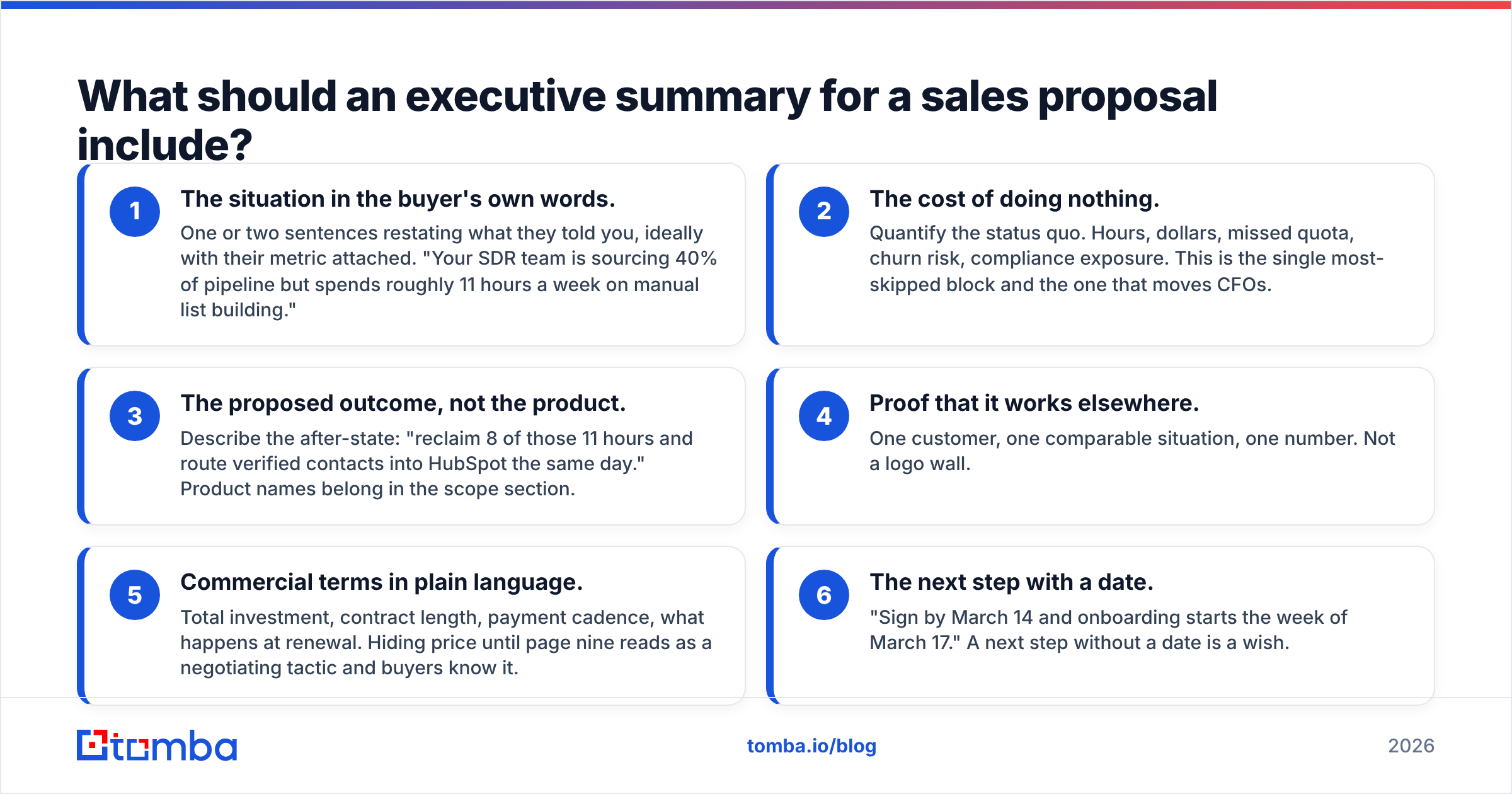
Six blocks, in this order. Each one earns its place; drop any of them and the summary reads as incomplete.
- The situation in the buyer's own words. One or two sentences restating what they told you, ideally with their metric attached. "Your SDR team is sourcing 40% of pipeline but spends roughly 11 hours a week on manual list building."
- The cost of doing nothing. Quantify the status quo. Hours, dollars, missed quota, churn risk, compliance exposure. This is the single most-skipped block and the one that moves CFOs.
- The proposed outcome, not the product. Describe the after-state: "reclaim 8 of those 11 hours and route verified contacts into HubSpot the same day." Product names belong in the scope section.
- Proof that it works elsewhere. One customer, one comparable situation, one number. Not a logo wall.
- Commercial terms in plain language. Total investment, contract length, payment cadence, what happens at renewal. Hiding price until page nine reads as a negotiating tactic and buyers know it.
- The next step with a date. "Sign by March 14 and onboarding starts the week of March 17." A next step without a date is a wish.
If you want a scaffold to start from, the free email templates library covers the outreach that precedes the proposal, and the same problem-cost-outcome logic carries over directly.
How long should an executive summary be?#
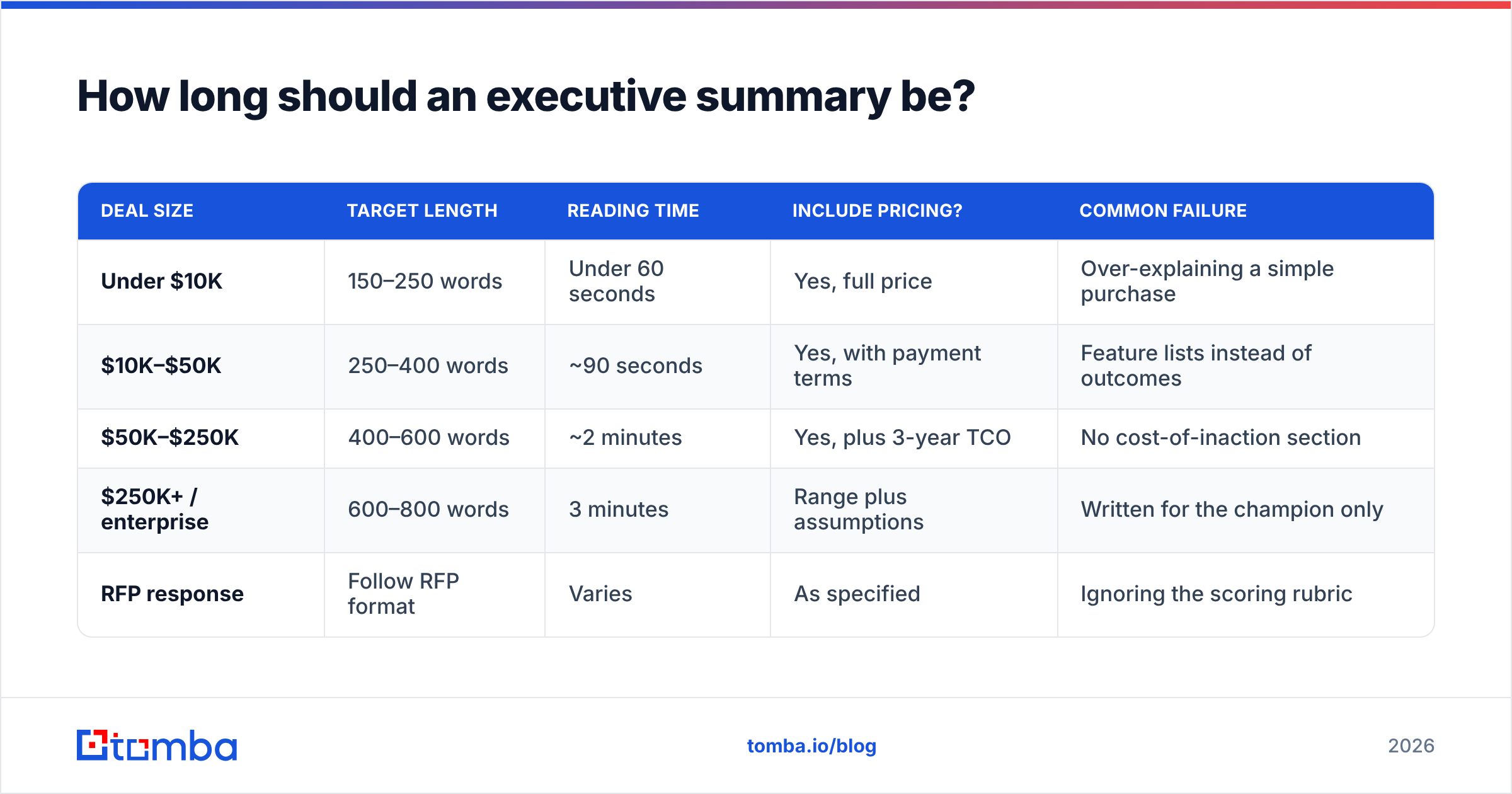
Length scales with deal complexity, not with how much you have to say. The rule of thumb below reflects what most enterprise procurement teams tolerate before they start skimming.
| Deal size | Target length | Reading time | Include pricing? | Common failure |
|---|---|---|---|---|
| Under $10K | 150–250 words | Under 60 seconds | Yes, full price | Over-explaining a simple purchase |
| $10K–$50K | 250–400 words | ~90 seconds | Yes, with payment terms | Feature lists instead of outcomes |
| $50K–$250K | 400–600 words | ~2 minutes | Yes, plus 3-year TCO | No cost-of-inaction section |
| $250K+ / enterprise | 600–800 words | 3 minutes | Range plus assumptions | Written for the champion only |
| RFP response | Follow RFP format | Varies | As specified | Ignoring the scoring rubric |
Two caveats. If the buyer issued an RFP, their format wins — every time, without exception, even when their format is worse. And if you cannot get under 800 words on an enterprise deal, the problem is usually that you have two proposals fused into one; split them.
Is an executive summary the same as a cover letter or an abstract?#
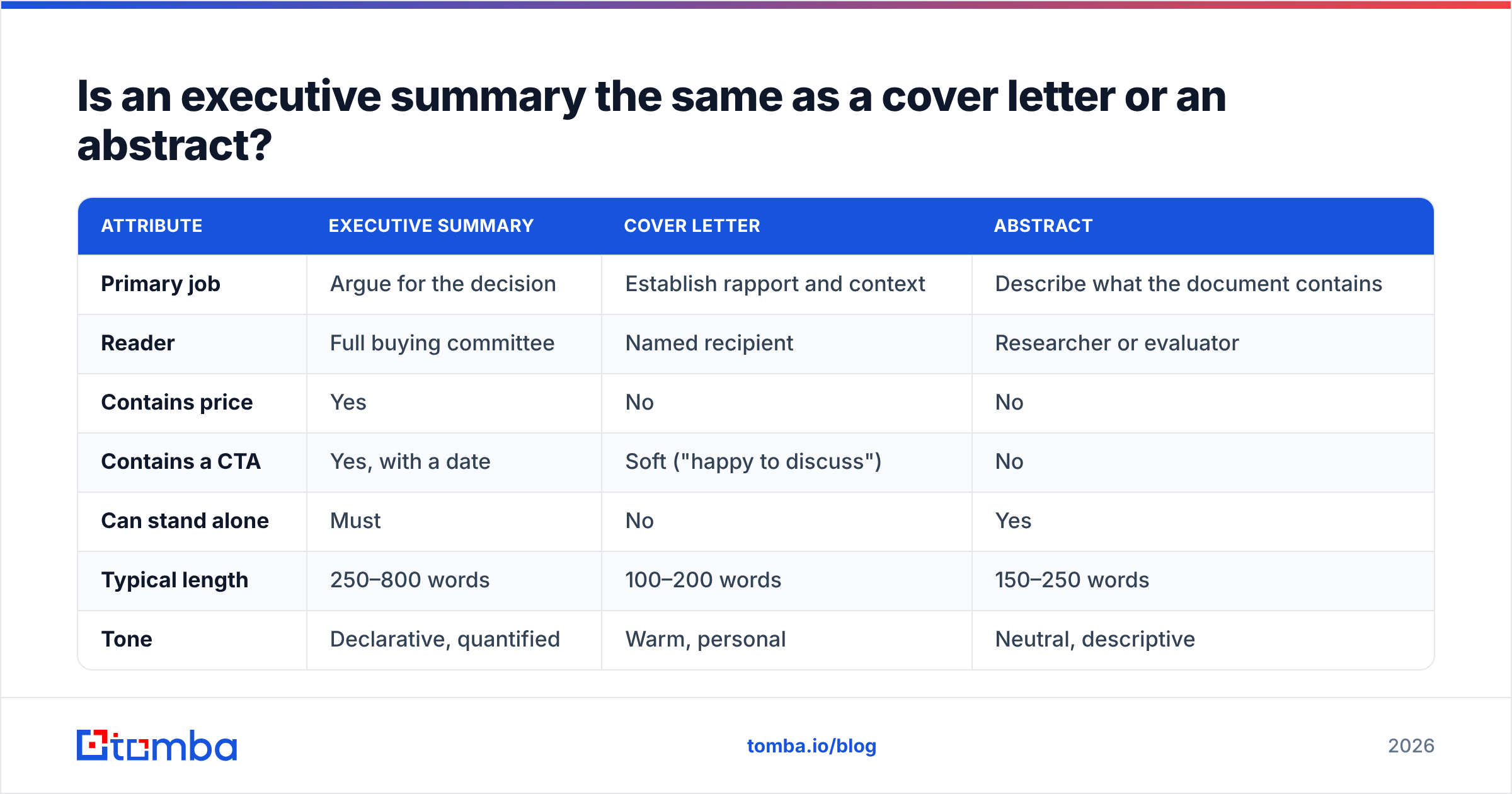
No, and mixing them up is why so many proposals open with three paragraphs of nothing. Here is the practical difference:
| Attribute | Executive summary | Cover letter | Abstract |
|---|---|---|---|
| Primary job | Argue for the decision | Establish rapport and context | Describe what the document contains |
| Reader | Full buying committee | Named recipient | Researcher or evaluator |
| Contains price | Yes | No | No |
| Contains a CTA | Yes, with a date | Soft ("happy to discuss") | No |
| Can stand alone | Must | No | Yes |
| Typical length | 250–800 words | 100–200 words | 150–250 words |
| Tone | Declarative, quantified | Warm, personal | Neutral, descriptive |
You can include a short cover note and an executive summary. What you cannot do is let the cover note pretend to be the summary. If your opening page has no numbers and no ask, you have written a cover letter and labeled it wrong.
What does a good executive summary actually look like?#
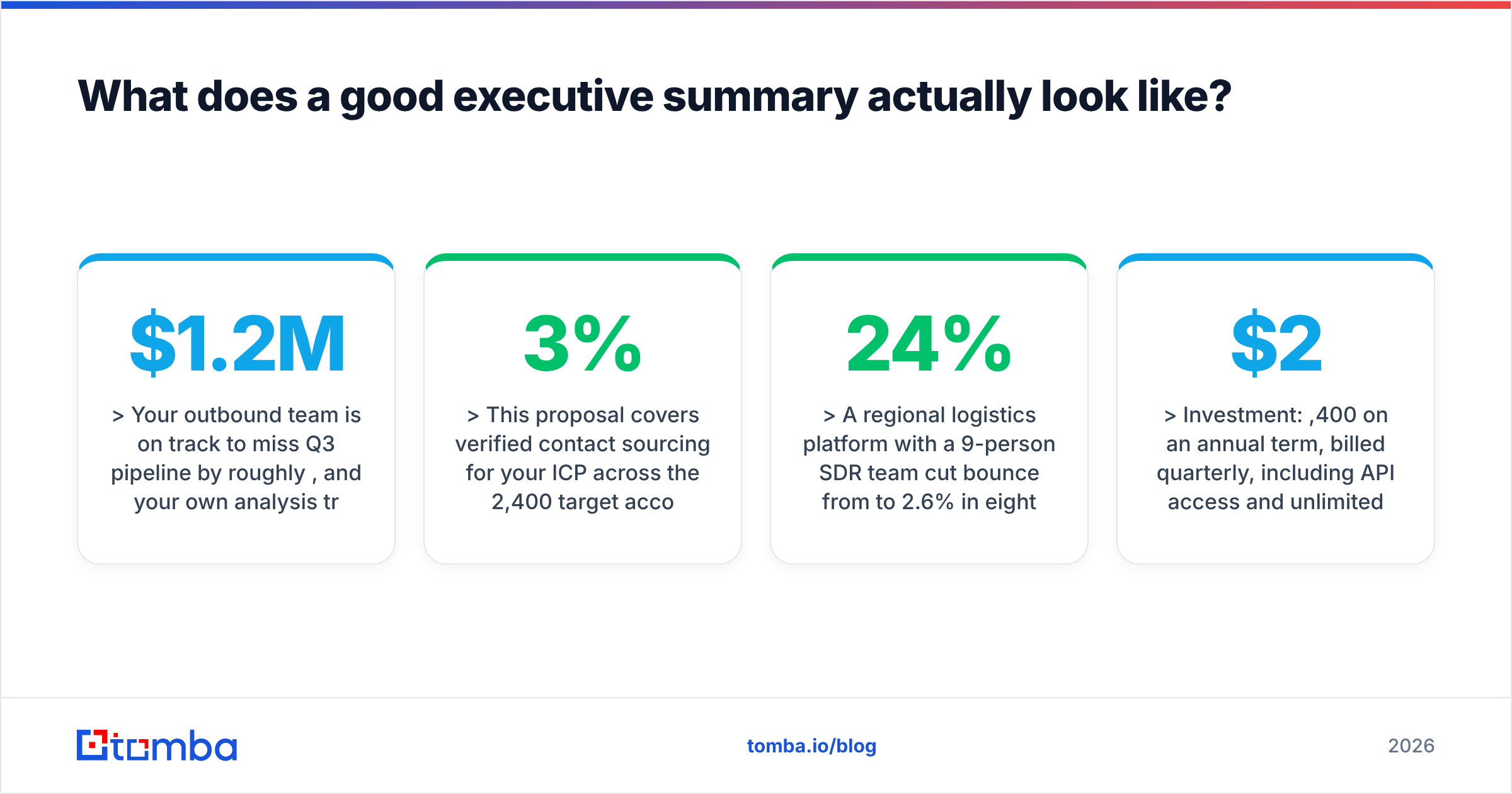
Here is a compressed example for a mid-market deal. Note that the vendor's name does not appear until the fourth sentence.
Your outbound team is on track to miss Q3 pipeline by roughly $1.2M, and your own analysis traces most of the gap to list quality: 31% of contacts sourced last quarter bounced or reached the wrong role. At current SDR cost, that is approximately $14K per quarter in wasted send volume plus an estimated 240 hours of rework.
This proposal covers verified contact sourcing for your ICP across the 2,400 target accounts in your Salesforce instance, with verification running before records reach a sequence. Comparable teams we work with hold bounce rates under 3% after the first 60 days.
A regional logistics platform with a 9-person SDR team cut bounce from 24% to 2.6% in eight weeks and recovered 6 hours per rep per week.
Investment: $2,400 per month on an annual term, billed quarterly, including API access and unlimited seats. Implementation is included; there is no separate onboarding fee.
If we countersign by March 14, your team is running verified sequences the week of March 17. I have held implementation capacity until March 21.
Five short paragraphs. A number in the first line. Price stated plainly. A dated next step. That is the whole job.
Notice what is absent: no mission statement, no "we are excited to partner," no adjective stack. Buyers discount enthusiasm and read numbers.
What mistakes kill an executive summary?#
- Opening with your company. "Founded in 2014, we are a leading provider of…" The buyer's problem opens the document. Always.
- No cost of inaction. Without it, the proposal competes against your competitors. With it, the proposal competes against doing nothing — which is the actual competitor in most lost deals.
- Unhedged claims you cannot source. "Increase revenue by 300%." One unverifiable number contaminates every other number on the page.
- Burying price. Procurement will find it. Making them hunt costs you goodwill and signals that you expect resistance.
- Recycled summaries. If you could swap the buyer's logo and the text still works, it is a brochure. Kill it.
- Passive next steps. "Let us know your thoughts" is not a close. Name the date and what happens on it.
How do you personalize proposals at scale without lying?#
The bottleneck is rarely the writing. It is knowing enough about the account, and reaching the right people, to say something specific.
Three things make a summary specific rather than generic:
- Firmographic and technographic context — headcount, funding stage, current tooling. This is what lets you write "your 9-person SDR team" instead of "your team."
- The right stakeholders on the distribution list. If the CFO never receives the PDF, the CFO paragraph is wasted effort. Reaching them means having a verified work email, not a guess.
- A metric the buyer already agreed to. Pull it from discovery notes into your CRM and quote it back verbatim. Numbers the buyer supplied cannot be argued with.
For point two, the practical workflow is to identify the additional decision-makers by role, find their addresses with an email finder, and run them through an email verifier before the proposal goes out. Sending a $250K proposal to a bounced address is an avoidable way to lose a quarter. Layering data enrichment on top gives you the headcount, tech stack, and seniority signals that make the first paragraph land.
HubSpot's proposal and quote guidance is a reasonable second reference for the surrounding document structure, and buyer reviews on G2 are useful if you are evaluating dedicated proposal software rather than writing in Docs.
What is the fastest way to improve your next proposal?#
Take your last three proposals and run one test: delete every sentence that does not contain a number, a date, or a verb the buyer would use. If more than half the summary disappears, you have found your problem.
Then fix the order. Problem, cost, outcome, proof, price, date. Six blocks, one page, written last. Track the effect on your win rate over the next 20 deals rather than the next two — proposal changes take a full cycle to show up in closed-won.
The writing is the easy half. The harder half is having accurate, current data on the accounts and people you are writing to, so the first paragraph is specific enough to be worth reading. Tomba's Email Finder gets verified work addresses for every stakeholder in the buying committee, so your proposal reaches the CFO and the security lead, not just your champion's inbox. Start on the free tier with 25 searches a month, or check Tomba pricing — Starter runs $49/mo and Growth $99/mo when you are ready to work full account lists.
Related guides#
Ready to find emails that actually work?
Join 150,000+ professionals who stopped guessing and started sending. Free credits on signup — no credit card required.
Get the Tomba newsletter
Practical outbound tactics and product updates — once every two weeks.
About the author