ExecVision Alternatives: 7 Conversation Intelligence Tools
ExecVision now lives inside Mediafly, and a lot of revenue teams are re-evaluating. Here are seven ExecVision alternatives compared on coaching depth, pricing model, and what they actually do with your call data.
TL;DR
- ExecVision was acquired by Mediafly in 2021 and its conversation intelligence is now sold as part of the Mediafly Intelligence360 suite — it is no longer a standalone product you can buy on its own terms.
- The best ExecVision alternatives split into three camps: enterprise revenue intelligence (Gong, Chorus by ZoomInfo, Clari Copilot), coaching-first mid-market tools (Jiminny, Avoma), and cheap meeting recorders (Fireflies, Fathom).
- Price ranges from free to roughly $1,200–$1,600 per user per year once you add platform fees. The coaching workflow, not the transcript quality, is what actually differs.
- Conversation intelligence only pays back if reps are having enough conversations. If your calendar is thin, fix top-of-funnel data before you buy a $40k coaching platform.
- Pick on three things: how coaching scorecards work, whether the vendor locks your call history behind an export request, and whether the CRM sync writes fields you can report on.
What actually happened to ExecVision?#
ExecVision was bought by Mediafly in 2021 and folded into its revenue enablement suite. The technology did not disappear — the call recording, transcription, and coaching library still exist — but the buying motion changed. You now evaluate a broader enablement platform, with content management and value selling attached, rather than a focused conversation intelligence point solution.
That is fine if you wanted the whole suite. It is annoying if you bought ExecVision specifically because it was the cheaper, coaching-obsessed option next to Gong. Most of the teams searching for ExecVision alternatives fall into that second group: they liked the call library and the scorecards, they did not want an enterprise enablement contract, and their renewal is coming up.
The other reason people shop around: ExecVision's original pitch was that recording calls is worthless without a behavior-change loop. That pitch is now table stakes. Every serious vendor in 2026 ships AI scorecards, objection tracking, and coaching queues. The differentiation moved to pricing model, data ownership, and how well the tool sits inside the rest of your stack.
Why do teams leave conversation intelligence platforms at all?#
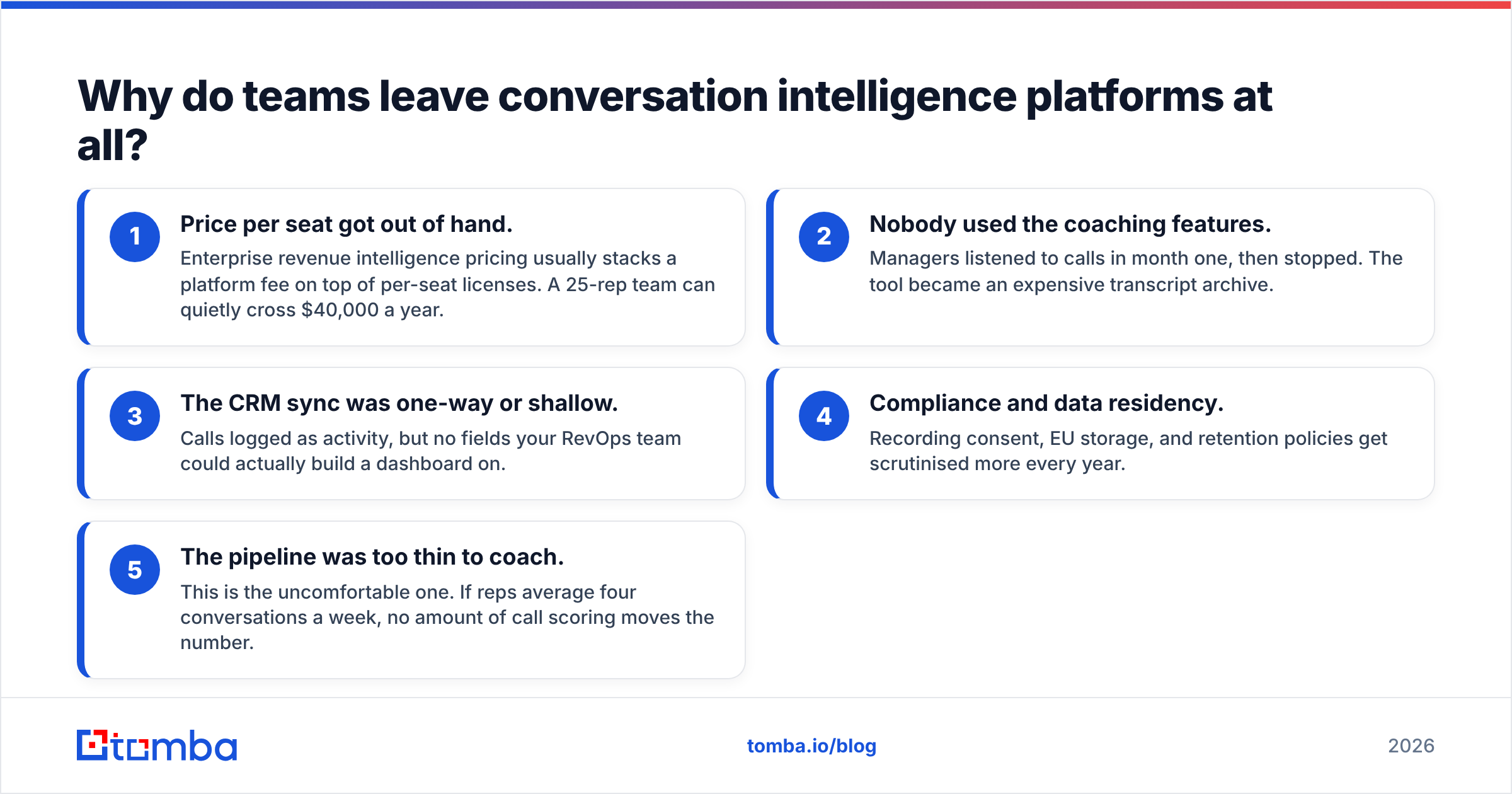
Before you shortlist replacements, be honest about which problem you are solving. In my experience reviewing these migrations, the reasons cluster into five buckets.
- Price per seat got out of hand. Enterprise revenue intelligence pricing usually stacks a platform fee on top of per-seat licenses. A 25-rep team can quietly cross $40,000 a year.
- Nobody used the coaching features. Managers listened to calls in month one, then stopped. The tool became an expensive transcript archive.
- The CRM sync was one-way or shallow. Calls logged as activity, but no fields your RevOps team could actually build a dashboard on.
- Compliance and data residency. Recording consent, EU storage, and retention policies get scrutinised more every year.
- The pipeline was too thin to coach. This is the uncomfortable one. If reps average four conversations a week, no amount of call scoring moves the number.
What should a conversation intelligence tool actually do in 2026?#
Transcription accuracy is a solved problem. Every vendor on this list will get 90%+ word accuracy on clean audio in English. Judge on the workflow instead:
- Scorecards that a manager will finish. Ten criteria maximum, scored on the call page, not in a separate module. If it takes 15 minutes per call, it will not happen.
- Automatic topic and objection tracking. You want "pricing objection mentioned in 34% of lost deals" without a human tagging anything.
- Deal-level rollups, not just call-level. Conversation data is most useful when it attaches to an opportunity and warns you that the economic buyer has been silent for three weeks.
- Two-way CRM writeback. Call outcomes, next steps, and risk flags should land in Salesforce or HubSpot as structured fields.
- Clean export. Ask, in writing, how you get every recording and transcript out if you leave. Answers vary wildly.
- Coaching library. Snippets, playlists, and onboarding tracks built from your own best calls. This was ExecVision's strongest feature and the one most replacements underinvest in.
Which ExecVision alternatives are worth evaluating?#
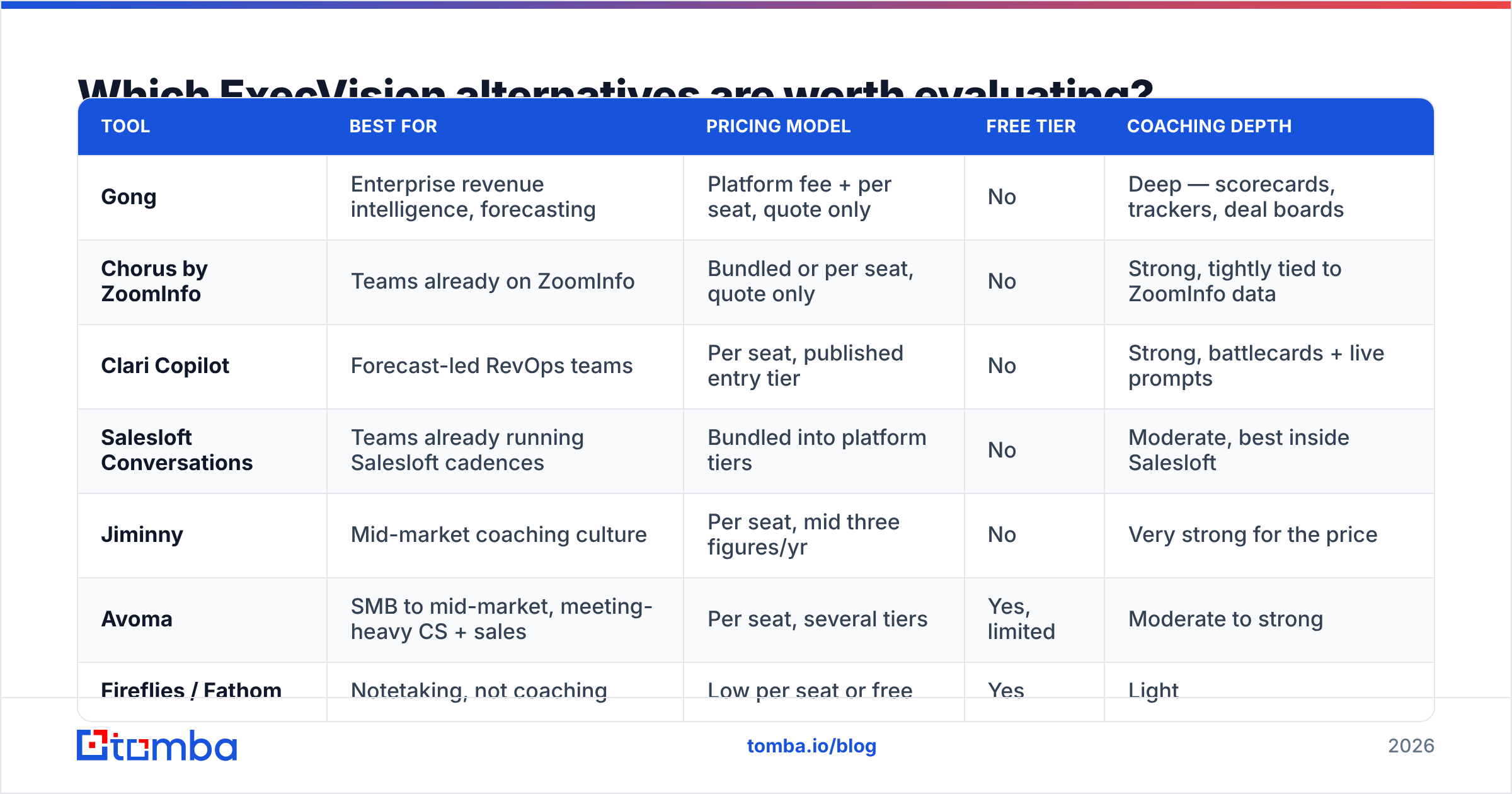
| Tool | Best for | Pricing model | Free tier | Coaching depth |
|---|---|---|---|---|
| Gong | Enterprise revenue intelligence, forecasting | Platform fee + per seat, quote only | No | Deep — scorecards, trackers, deal boards |
| Chorus by ZoomInfo | Teams already on ZoomInfo | Bundled or per seat, quote only | No | Strong, tightly tied to ZoomInfo data |
| Clari Copilot | Forecast-led RevOps teams | Per seat, published entry tier | No | Strong, battlecards + live prompts |
| Salesloft Conversations | Teams already running Salesloft cadences | Bundled into platform tiers | No | Moderate, best inside Salesloft |
| Jiminny | Mid-market coaching culture | Per seat, mid three figures/yr | No | Very strong for the price |
| Avoma | SMB to mid-market, meeting-heavy CS + sales | Per seat, several tiers | Yes, limited | Moderate to strong |
| Fireflies / Fathom | Notetaking, not coaching | Low per seat or free | Yes | Light |
Gong — the default enterprise answer#
Gong is where most ExecVision refugees with budget end up. The trackers, deal warnings, and forecast module are genuinely strong, and the data model is the most mature in the category. The trade-off is cost and contract shape: expect a platform fee plus per-seat licensing, annual commitment, and a real implementation. If you have fewer than 20 reps, the per-rep economics are hard to justify against Jiminny or Avoma.
Chorus by ZoomInfo — good if you already pay ZoomInfo#
Chorus is the closest thing to a like-for-like ExecVision replacement in feature terms, and it is materially cheaper when bundled with an existing ZoomInfo contract. Standalone, it is less compelling. The gotcha is that the value case assumes you are buying into the wider ZoomInfo data platform; if you are not, you are paying for integration you will not use.
Clari Copilot — conversation data pointed at the forecast#
Formerly Wingman, Clari Copilot is built for teams whose real question is "will we hit the number," not "was that a good discovery call." Live battlecards during calls are the standout feature for SDR and BDR teams. If your ExecVision use case was pure coaching, this is a slight angle change; if you wanted call data feeding pipeline inspection, it is the tightest fit.
Jiminny — the mid-market coaching pick#
Jiminny is the tool I would shortlist first for a 10–50 rep team that liked ExecVision's philosophy. Coaching scorecards, playlists, and manager workflows are the core product rather than an add-on, and pricing lands well below enterprise revenue intelligence. Reporting is less sophisticated than Gong's, and the deal intelligence layer is thinner.
Avoma — meetings across the whole customer lifecycle#
Avoma covers sales calls, customer success reviews, and internal meetings in one licence, with a free tier for basic recording and notes. That breadth is the selling point: you are not buying a sales-only tool. Coaching is competent rather than best in class, and heavy Salesforce shops sometimes find the CRM mapping less flexible than they want.
Fireflies and Fathom — cheap, but be clear about what you are buying#
Fireflies and Fathom are excellent AI notetakers at a fraction of the price, and both have usable free plans. They are not coaching platforms. There is no serious scorecard workflow, no deal-level risk analysis, and limited manager tooling. If your honest requirement is "stop making reps write call notes," buy one of these and save $35,000. If your requirement is behavior change, they will disappoint you in month two.
How do the pricing models really compare?#
Published pricing in this category is scarce, and vendors change it often — verify every number against a current quote and cross-check user reports on G2 before you build a business case.
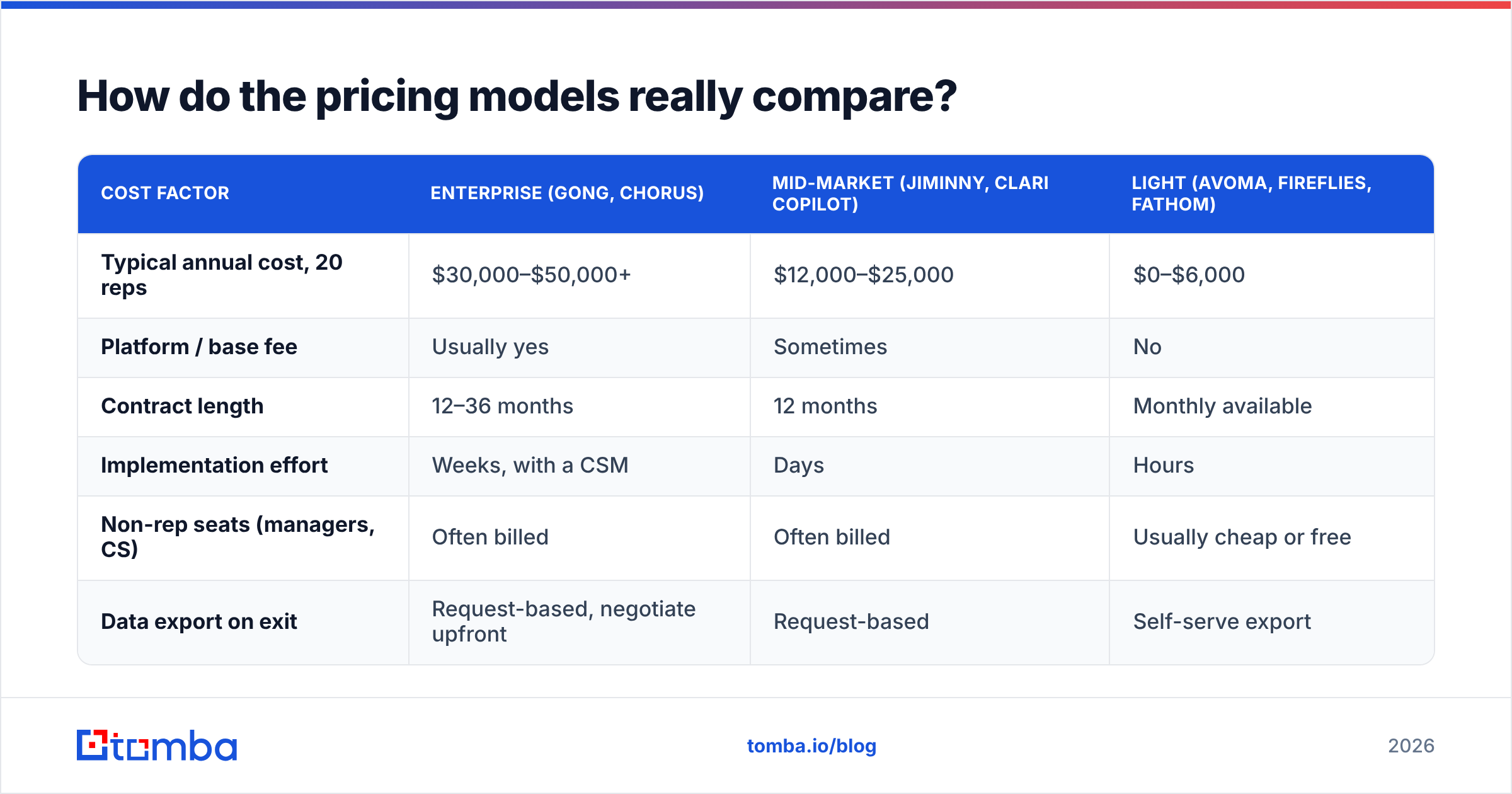
| Cost factor | Enterprise (Gong, Chorus) | Mid-market (Jiminny, Clari Copilot) | Light (Avoma, Fireflies, Fathom) |
|---|---|---|---|
| Typical annual cost, 20 reps | $30,000–$50,000+ | $12,000–$25,000 | $0–$6,000 |
| Platform / base fee | Usually yes | Sometimes | No |
| Contract length | 12–36 months | 12 months | Monthly available |
| Implementation effort | Weeks, with a CSM | Days | Hours |
| Non-rep seats (managers, CS) | Often billed | Often billed | Usually cheap or free |
| Data export on exit | Request-based, negotiate upfront | Request-based | Self-serve export |
Two line items get missed in every one of these evaluations. First, listener seats: if you want RevOps, marketing, and product to browse calls, some vendors charge for them and some do not. Second, storage and retention limits — a two-year retention cap looks harmless until a compliance review asks for a call from 30 months ago.
Is conversation intelligence the right purchase at all?#
Here is the check I would run before signing anything. Take your total conversations last quarter and divide by rep count. If a rep is averaging fewer than eight to ten real discovery conversations a month, conversation intelligence is not your constraint. Coaching multiplies whatever volume already exists; it does not create volume.
When the constraint is volume, the fix sits upstream in list quality. Bounced sends and wrong-person outreach are the two cheapest problems to solve, and they compound: a cleaner list lifts connect rate, which lifts recorded conversations, which finally gives your coaching platform something to work with. Use an email finder to build accurate target lists from company domains, run them through an email verifier before they hit a sequence, and use data enrichment to fill in job titles and seniority so reps prioritise the right names. Teams that do this consistently see a measurable lift in response rate, which is the input every coaching metric depends on.
The order matters. Data quality, then volume, then conversation quality. Buying a $40,000 coaching platform to fix a $500 data problem is the most common sequencing error in revenue tooling.
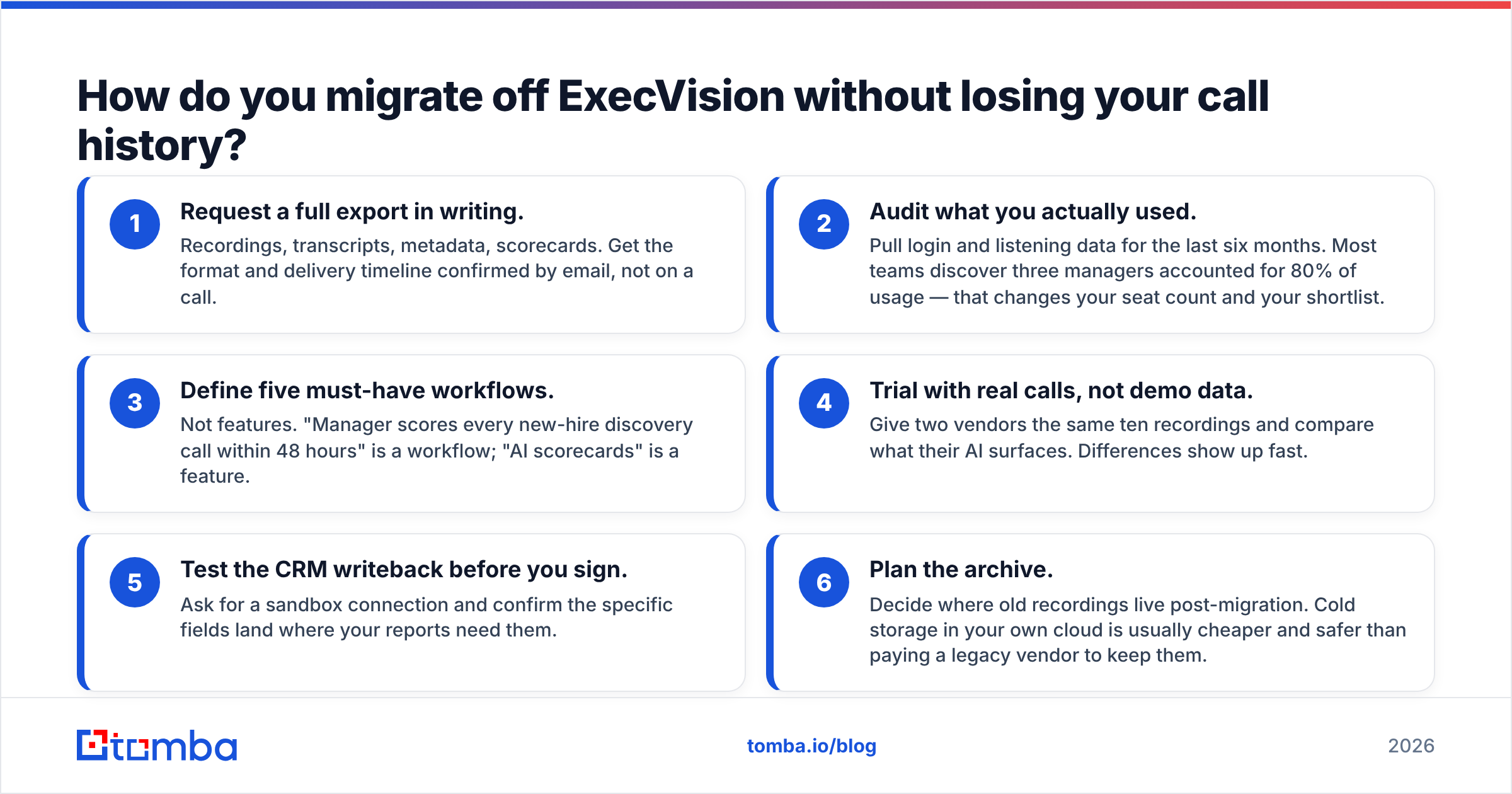
How do you migrate off ExecVision without losing your call history?#
Run this sequence, in this order, and start at least 90 days before renewal.
- Request a full export in writing. Recordings, transcripts, metadata, scorecards. Get the format and delivery timeline confirmed by email, not on a call.
- Audit what you actually used. Pull login and listening data for the last six months. Most teams discover three managers accounted for 80% of usage — that changes your seat count and your shortlist.
- Define five must-have workflows. Not features. "Manager scores every new-hire discovery call within 48 hours" is a workflow; "AI scorecards" is a feature.
- Trial with real calls, not demo data. Give two vendors the same ten recordings and compare what their AI surfaces. Differences show up fast.
- Test the CRM writeback before you sign. Ask for a sandbox connection and confirm the specific fields land where your reports need them.
- Plan the archive. Decide where old recordings live post-migration. Cold storage in your own cloud is usually cheaper and safer than paying a legacy vendor to keep them.
The teams that handle this badly are the ones that treat it as a procurement exercise. The teams that handle it well pick one coaching workflow, prove it with a five-seat pilot, then expand.
What is the honest recommendation?#
If you have budget and 50+ reps, Gong remains the strongest all-round platform and the safest default. If you are a 10–50 rep team that bought ExecVision because you cared about coaching rather than forecasting, Jiminny gives you most of the value at a fraction of the cost. If you already pay ZoomInfo, price Chorus before anything else — the bundled economics are hard to beat. If the truth is that you just want meeting notes to stop eating rep time, buy Fathom or Fireflies and put the savings into pipeline.
And if your call volume is the actual problem, start there. Feed your sequences with verified, enriched contact data and you will have far more conversations worth coaching. Tomba's Email Finder finds professional email addresses by domain, name, or company, with verification built into the same workflow — free tier at 25 searches a month, Starter at $49/mo, Growth at $99/mo. Build the list first, then buy the coaching platform that fits the volume you actually have.
Related guides#
Ready to find emails that actually work?
Join 150,000+ professionals who stopped guessing and started sending. Free credits on signup — no credit card required.
Get the Tomba newsletter
Practical outbound tactics and product updates — once every two weeks.
About the author