ExecVision Pricing Reviews Pros and Cons: 2026 Buyer's Guide
ExecVision is no longer sold as a standalone product — it lives inside Mediafly Coach360. Here is what buyers actually pay, what reviewers praise, where it falls short, and what to run alongside it.
TL;DR — the short version of ExecVision pricing reviews pros and cons in 2026:
- ExecVision is not sold on its own anymore. Mediafly bought it in late 2021. It now ships as Mediafly Coach360.
- Pricing is quote-only. Buyers report about $80–$130 per user per month on annual deals, plus platform and setup fees. Seat minimums start near 10–25 reps.
- Reviews praise the coaching workflow — scorecards, playlists, keyword tracking — more than the raw AI. That is the honest strength here.
- The usual gripes: weak transcripts on noisy calls, a dated look next to Gong and Chorus, and docs now folded into Mediafly.
- Call software improves the calls you booked. It does not fill the top of the funnel. Budget for contact data too. It costs far less.
What is ExecVision, and does it still exist in 2026?#
ExecVision was a call-recording and coaching tool built near Washington, DC around 2015. Its pitch was narrow. It did not try to forecast deals or run a revenue dashboard. It taped sales calls, wrote out the text, tagged key moments, and fed them into a coaching workflow for managers.
In November 2021, Mediafly bought ExecVision and folded it into its suite. Today the product ships as Mediafly Coach360. It sits next to Content360 and Intelligence360. If a rep says they "use ExecVision," they are almost surely on Coach360.
That matters for three reasons:
- You cannot buy ExecVision on its own. Any quote you get is a Mediafly quote, and Mediafly likes to sell the full suite.
- Old pricing pages and review threads are stale. A 2020 G2 review covers a product with a different owner and a different support team.
- Renewal leverage changed. You now deal with a bigger vendor that has more to upsell. That cuts both ways, since bundles can lower the price per module.
How does ExecVision pricing actually work?#
There is no public price list. Mediafly gates pricing behind a demo, like most vendors in this space. That is the top complaint in buyer forums, and it is a fair one. You cannot budget against a number you cannot see.
Here is what buyers report paying, in the order the quote usually arrives:
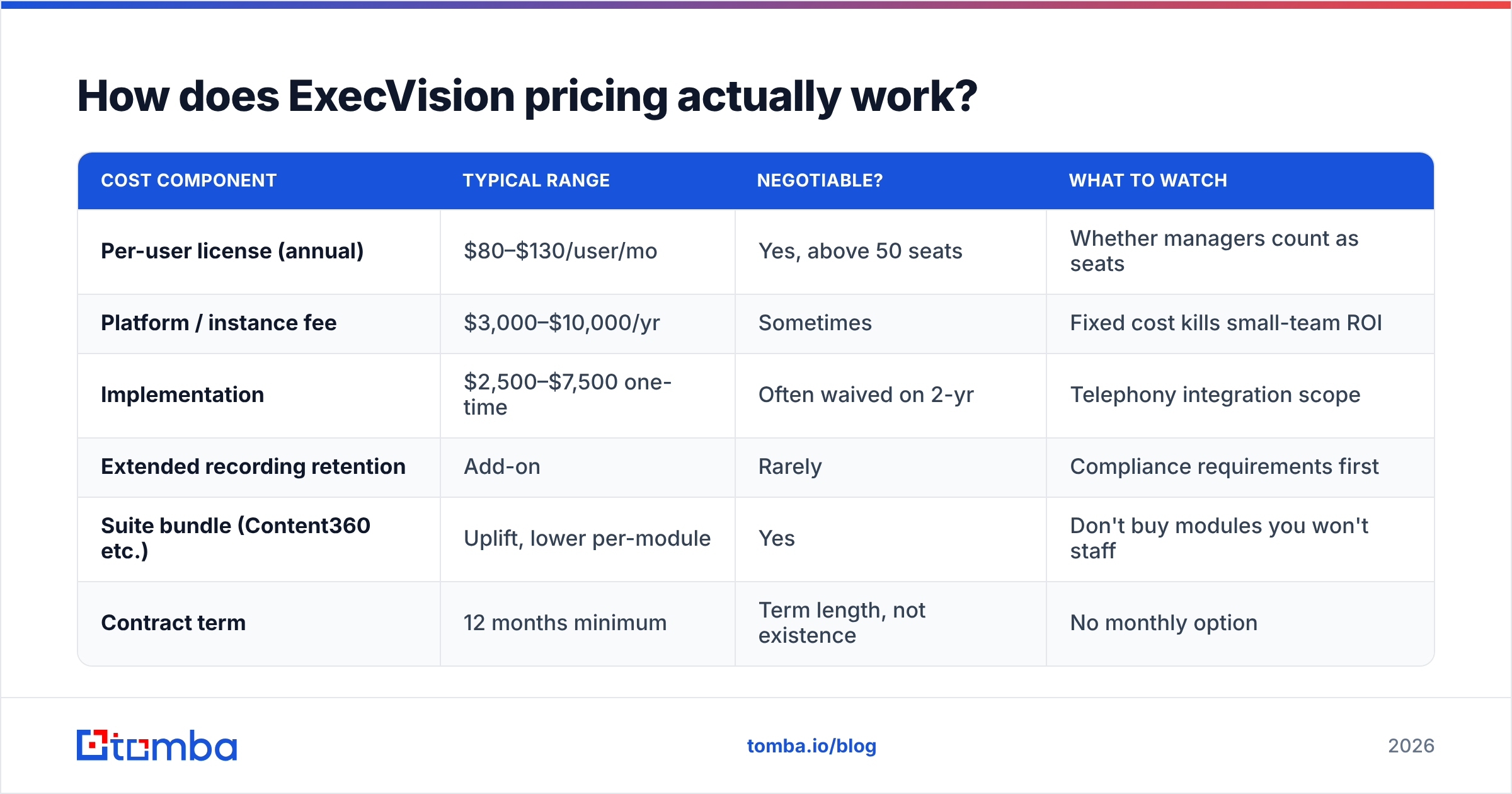
- Per-seat license. The main cost. Reports cluster at $80–$130 per user per month, billed yearly. Volume discounts start above roughly 50 seats. In most setups, only recorded users need a seat. Listen-only managers sometimes ride free. Ask before you sign.
- Platform fee. A flat yearly charge for the tenant itself, often $3,000–$10,000. You pay it with 12 seats or with 120. This is what makes small-team math ugly.
- Setup and onboarding. A one-time fee, often $2,500–$7,500. It covers phone system hookups, CRM field mapping, and scorecard setup. Some multi-year deals waive it.
Three more line items show up on most quotes:
- Storage and retention. Call recordings are heavy. Standard retention runs 12–24 months. Longer archives cost extra.
- Bundle uplift. Adding Content360 or Intelligence360 raises the total but lowers the price per module. If you only want coaching, say so early.
- Annual term and seat minimums. There is no month-to-month plan. Minimums usually start at 10–25 seats.
A 25-rep team should plan for roughly $30,000–$45,000 in year one. Year two costs less, once the setup fee drops off. Treat that as a planning range, not a quote.
| Cost component | Typical range | Negotiable? | What to watch |
|---|---|---|---|
| Per-user license (annual) | $80–$130/user/mo | Yes, above 50 seats | Whether managers count as seats |
| Platform / instance fee | $3,000–$10,000/yr | Sometimes | Fixed cost kills small-team ROI |
| Implementation | $2,500–$7,500 one-time | Often waived on 2-yr | Telephony integration scope |
| Extended recording retention | Add-on | Rarely | Compliance requirements first |
| Suite bundle (Content360 etc.) | Uplift, lower per-module | Yes | Don't buy modules you won't staff |
| Contract term | 12 months minimum | Term length, not existence | No monthly option |
What do ExecVision reviews say — the pros?#
Skip the vendor quotes and a clear picture shows up on sites like G2's conversation intelligence category. The praise is specific, and it repeats.
Coaching is the product, not a feature. Most rivals bolt coaching onto an analytics core. ExecVision did the reverse. Scorecards, coaching tasks, manager-to-rep comment threads, and "did the rep improve?" tracking all come first here. Leaders who track rep growth rate this above the AI-first tools.
Call playlists for onboarding. You can build a library of great discovery calls and assign it to new hires. It works well. Faster ramp is the payback story most customers tell.
Keyword and phrase tracking. Flag every call where a rival name, a price objection, or a legal phrase comes up. Setup is easy. Sales, marketing, and legal teams all use the same feed.
Broad phone system support. ExecVision wired up dialers early — Five9, Genesys, RingCentral, Dialpad — not just Zoom and Google Meet. If your team lives in a dialer, that is a real edge over video-first tools.
Human support. Reviewers often praise the success and setup staff. That helps a lot when you map call notes to Salesforce fields.
What are the cons buyers keep raising?#
Transcripts slip on hard audio. This is the top gripe. Strong accents, cross-talk, cheap headsets, and dialer compression all hurt accuracy. Keyword tracking runs on those transcripts, so bad audio quietly breaks the rest. Test your worst calls in the trial, not your best ones.
The interface looks dated. Next to Gong or ZoomInfo's Chorus, it feels plain. Daily users adapt. Casual users bounce off it. Low adoption is the top reason these deals fail to renew.
Opaque pricing and bundle pressure. You sit through discovery before you see a number. That number often includes modules you did not ask for.
Docs drifted after the deal. Search for "ExecVision" and you land on Mediafly pages, redirects, and mixed branding. Guides from the standalone era are not reliable.
No top-of-funnel value. This is by design, not a bug. Coach360 makes your current calls better. It does not find you one new person to call. Teams that buy call software to fix a thin pipeline are treating the wrong problem.
How does ExecVision compare to the alternatives?#
| Attribute | Mediafly Coach360 (ExecVision) | Gong | Chorus (ZoomInfo) |
|---|---|---|---|
| Core strength | Structured rep coaching | Revenue intelligence + deal risk | Native ZoomInfo data tie-in |
| Reported entry price | ~$80–$130/user/mo | ~$100–$160/user/mo + platform fee | Bundled with ZoomInfo tiers |
| Platform fee | Common ($3k–$10k) | Yes, often $5k+ | Folded into suite pricing |
| Public pricing page | No | No | No |
| Dialer/contact-center support | Strong | Good | Good |
| Seat minimum | ~10–25 | Often 25–50 | Suite-dependent |
| Best fit | Enablement-led SMB/mid-market | Enterprise revenue teams | Existing ZoomInfo customers |
| Contract | Annual | Annual | Annual, suite-linked |
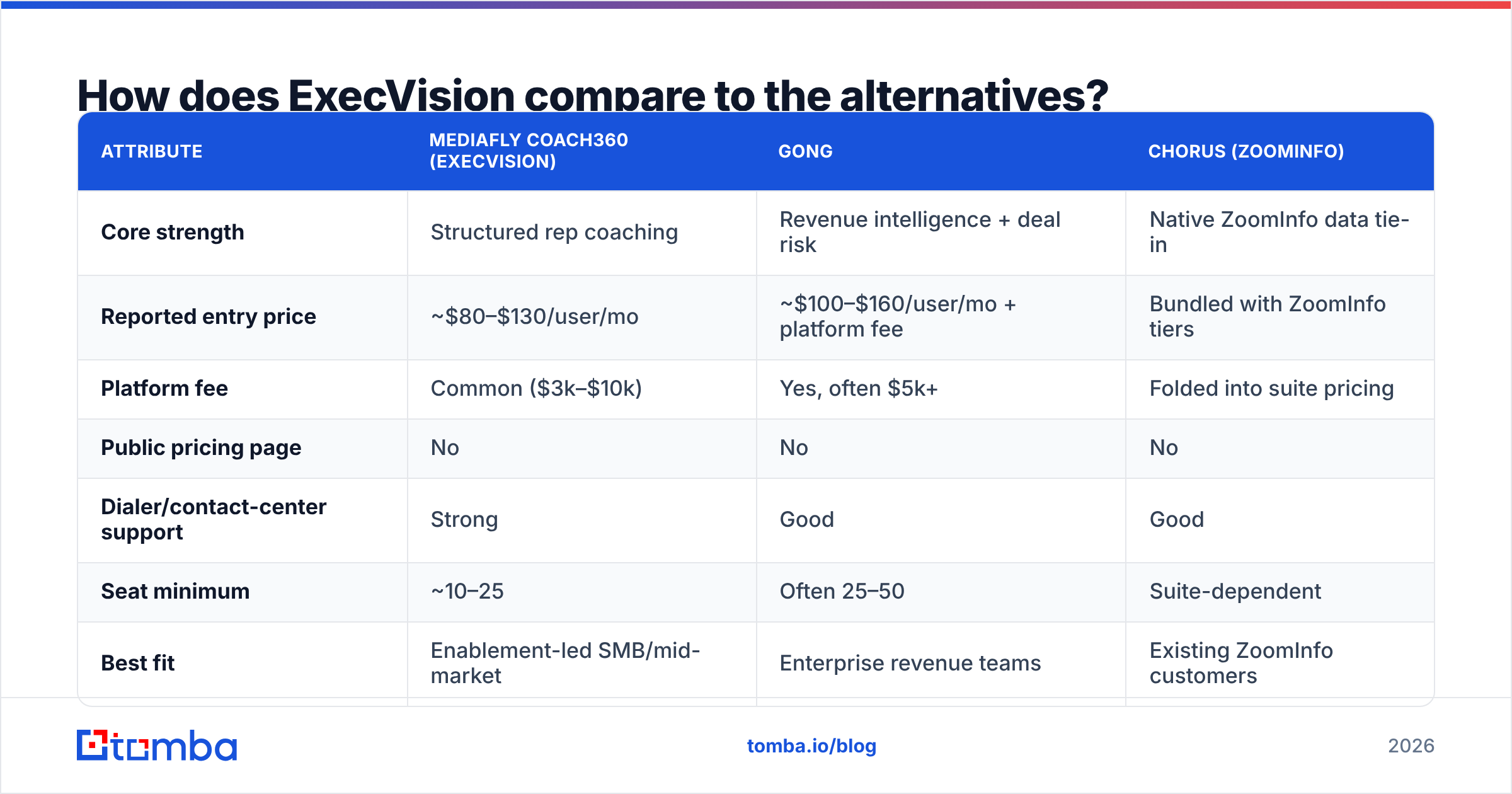
The honest read: if your problem is "my managers do not coach," Coach360 is a fair pick, and it usually costs less than Gong. If your problem is "we cannot see deal risk," Gong is built for that. If you already pay ZoomInfo, Chorus is the easiest path through procurement.
Who should buy it — and who should not?#
Good fit:
- Teams of 15–150 reps with a real enablement owner and a manager cadence to enforce.
- Dialer-heavy teams, where video-first tools miss most calls.
- Companies with set onboarding, where call libraries shorten ramp.
- Current Mediafly content customers who get bundle pricing.
Poor fit:
- Teams under 10 reps. The platform fee dominates, and the per-seat math never recovers.
- Founder-led sales with no coach. The tool records. It does not coach for you.
- Teams whose real bottleneck is call volume, not call quality.
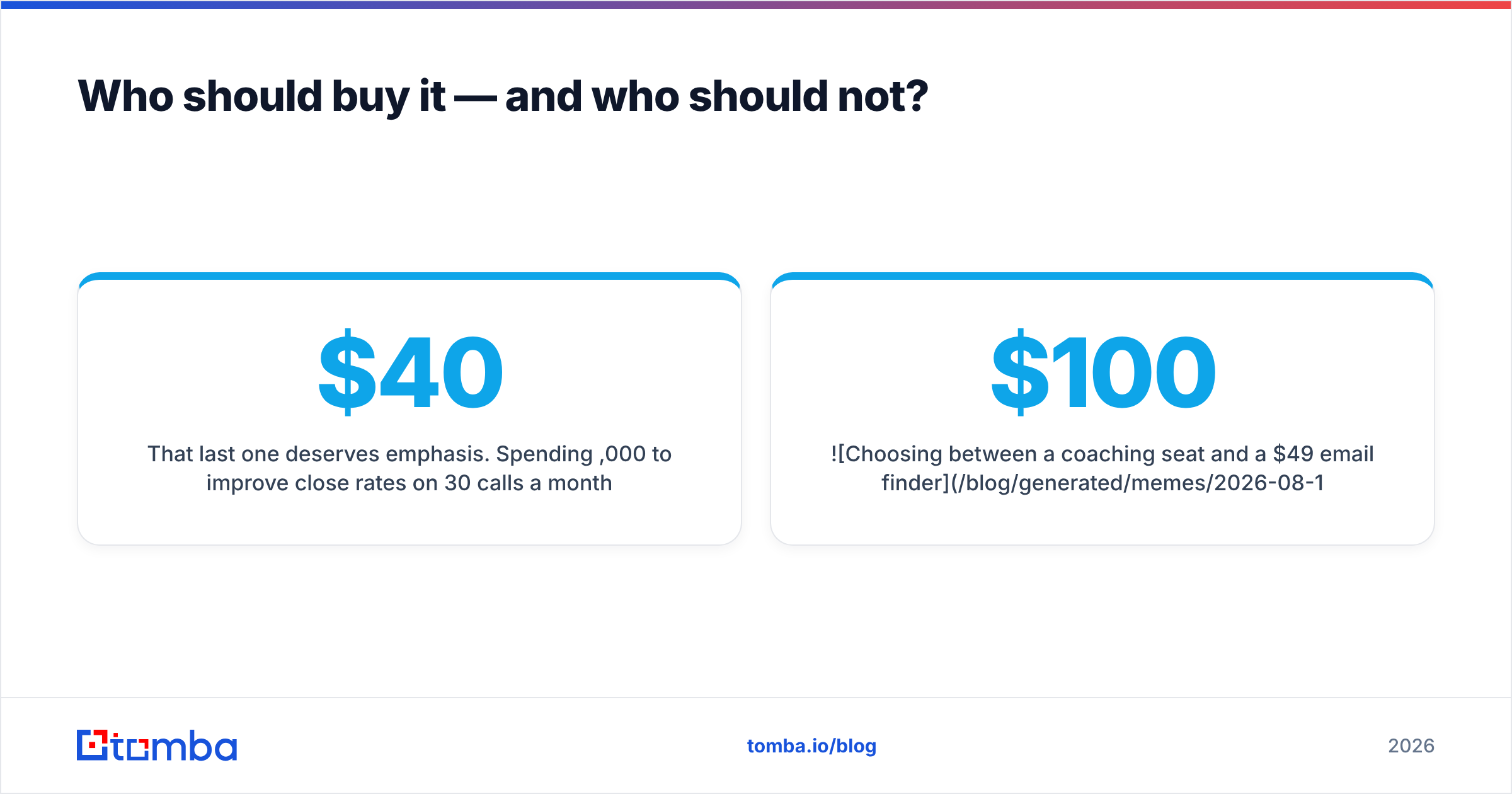
That last one deserves emphasis. Spending $40,000 to lift close rates on 30 calls a month is bad math. Spending a fraction of that to book 90 calls a month at the same close rate is better math. Fix volume first. Then fix quality.

What should you run alongside it?#
Call software sits at the bottom of the funnel. It needs a full funnel to earn its price. For most B2B teams, the cheapest lever is not better coaching. It is more verified contacts in the right inboxes.
A practical companion stack:
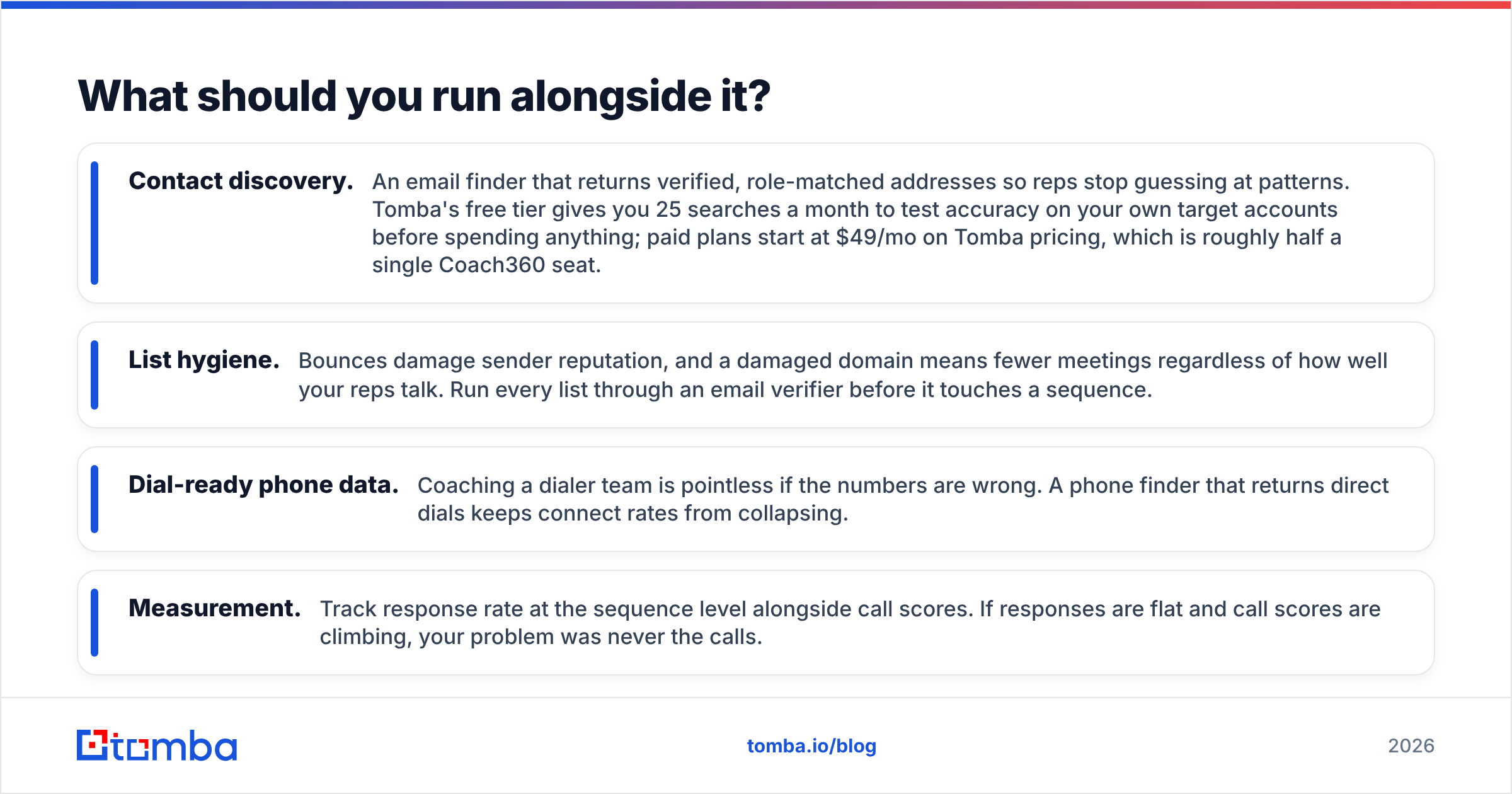
- Contact discovery. An email finder returns verified, role-matched addresses, so reps stop guessing at patterns. Tomba's free tier gives you 25 searches a month. Test it on your own target accounts first. Paid plans start at $49/mo on Tomba pricing, or about half a single Coach360 seat.
- List hygiene. Bounces hurt your sender reputation. A damaged domain means fewer meetings, no matter how well your reps talk. Run every list through an email verifier before it hits a sequence.
- Dial-ready phone data. Coaching a dialer team is pointless if the numbers are wrong. A phone finder returns direct dials and keeps connect rates up.
- Measurement. Track response rate per sequence next to your call scores. If replies stay flat while call scores climb, the calls were never the problem.
Note the cost gap. A 25-seat Coach360 deal runs tens of thousands per year. The data layer that feeds it costs a few hundred to a few thousand. Teams often get this backwards. They buy the pricey analysis layer for a funnel with nothing in it.
ExecVision pricing reviews pros and cons: is it worth it in 2026?#
Here is the short verdict on ExecVision pricing reviews pros and cons.
Yes, with conditions. You need 15 or more reps, an owner who runs scorecards every week, and dialer-heavy calls that video tools cannot capture. In that case, Mediafly Coach360 gives you real coaching infrastructure for less than Gong. The pros — coaching depth, playlists, dialer breadth, support — are earned, not marketing.
No, if any of these are true. You have fewer than ten reps. No one owns coaching. Your pipeline is thin. In those cases the platform fee alone sinks the ROI math, and the money buys more meetings elsewhere.
Do three things before you sign. Ask for the platform fee as its own line item. Test transcripts on your worst-audio calls. Push the setup fee to zero on a two-year term. All three are winnable.
Fill the funnel before you optimize it. Coaching improves the calls you have. It cannot create them. Start with Tomba Email Finder — 25 free searches a month, plus verified work addresses by domain, name, or company. Plans start at $49/mo. Test it on your next target-account list, then decide how much call software you actually need.
Related guides#
Ready to find emails that actually work?
Join 150,000+ professionals who stopped guessing and started sending. Free credits on signup — no credit card required.
Get the Tomba newsletter
Practical outbound tactics and product updates — once every two weeks.
About the author