Exellius Pricing in 2026: Real Costs, Limits and Alternatives
Exellius doesn't publish a price list, so buyers walk into the demo blind. Here's how quote-based B2B data pricing actually works, what drives the number up, and when a self-serve tool costs a fraction of it.
TL;DR
- Exellius does not publish a public price list. Every number you get comes out of a discovery call, which means your quote depends on your list size, your seniority filters, and how much the rep thinks your budget is.
- Custom-quote B2B data contracts in this category typically land between roughly $3,000 and $25,000+ per year, usually annual and usually prepaid. Treat any figure you see online — including the estimate ranges in this post — as a directional benchmark, not a rate card.
- The real cost drivers are record volume, refresh frequency, exclusivity of the data pull, and whether you're buying a static list or an ongoing enrichment feed.
- If you need contact data for a defined, repeatable motion — find email by domain, verify, push to CRM — a self-serve credit tool like Tomba at $49–$249/mo does that job without a procurement cycle.
- Buy custom-quote data services when you need bespoke research, niche verticals, or human-curated lists. Buy self-serve when you need volume, an API, and predictable monthly spend.
What is Exellius and who is it actually for?#
Exellius sits in the B2B data and demand-gen services category: custom contact lists, account research, appended firmographics, and in some engagements outsourced lead-generation support. That's a different product shape from an email-finder SaaS, and the pricing model follows the shape.
Tools that sell software price by credits and seats. Services that sell research price by scope. When a vendor builds a list to your ICP spec — job titles, geography, tech stack, headcount bands, intent signals — you're paying for labour and data licensing, not for API calls. That's why there's no pricing page.
The practical consequence for a buyer: you cannot compare Exellius to a tool with a published price without first getting a quote, and the quote is the negotiation. Vendors in this segment routinely anchor high, then discount 20–40% against a competing bid. If you walk in without a comparison quote, you pay the anchor.
How does Exellius pricing actually work?#
Quote-based data pricing almost always resolves into one of four commercial structures. Knowing which one you're being sold makes the number legible:
- Per-record (CPL) pricing. You pay a unit price per verified contact — commonly $0.30–$2.00+ depending on seniority and difficulty. C-level contacts in narrow verticals sit at the top of that band; generic SMB records sit at the bottom. Cheap per-record pricing is the tell that you're getting recycled database exports rather than fresh research.
- Project pricing. A fixed fee for a defined deliverable: "5,000 verified marketing decision-makers in DACH manufacturing, delivered in three tranches." Best structure when your need is one-off. Worst structure when your ICP will change in a quarter.
- Annual subscription / data licence. Flat annual fee for a seat plus a credit allotment or an unlimited-view-limited-export arrangement. This is where the $10k–$25k+ contracts live, and where auto-renewal clauses bite.
- Managed service retainer. Data plus SDR-style execution — sequences, appointment setting, or campaign management — billed monthly. The data is bundled, so you can't see its unit cost, which makes the retainer very hard to benchmark.
Ask, on the first call, which of those four you're being quoted. If the rep won't decompose the number, that's information too.

What should you expect Exellius to cost in 2026?#
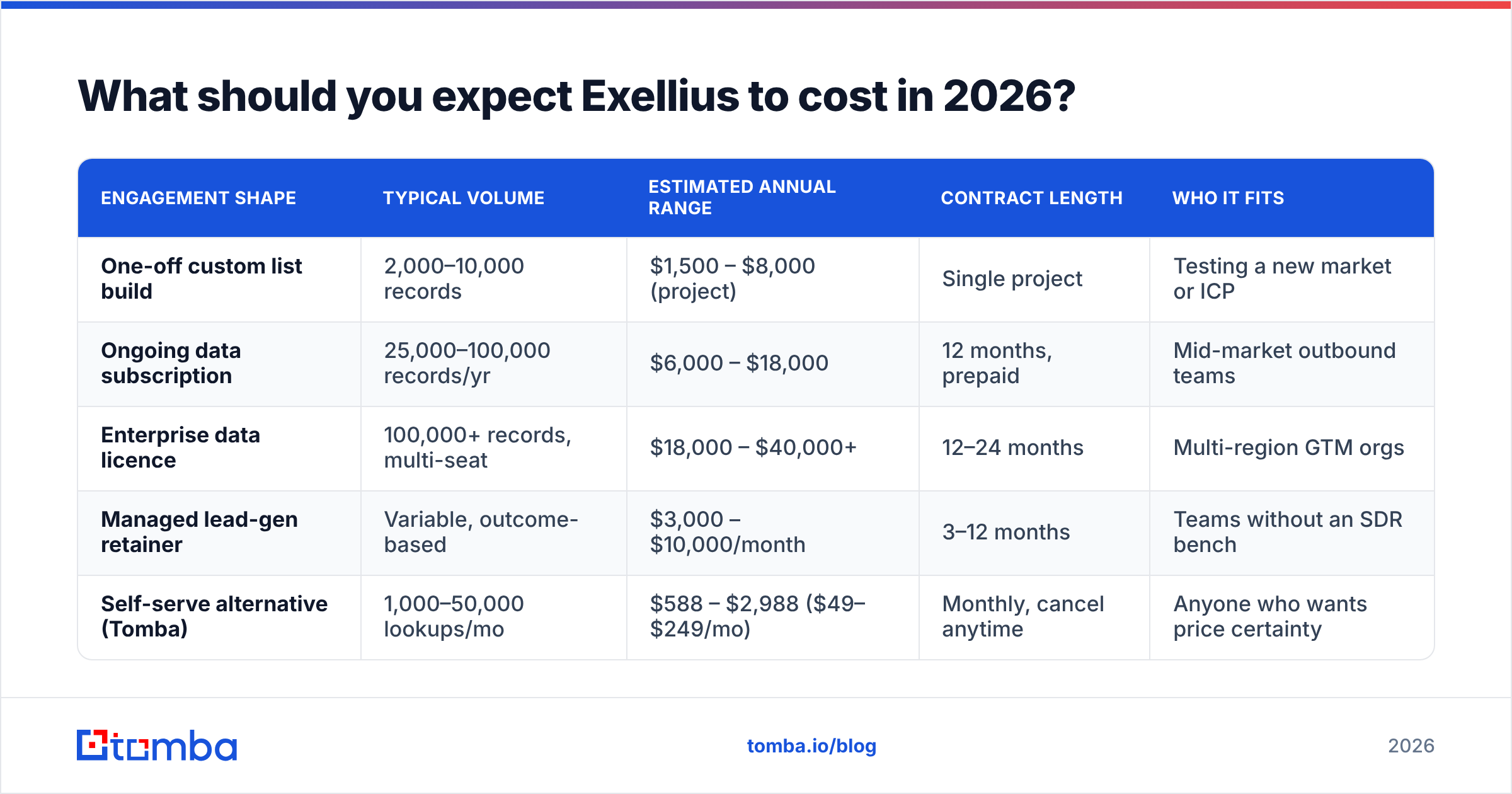
The table below is a buyer-side estimate model, not published vendor pricing. Use it to sanity-check the quote you receive, not to quote it back as fact.
| Engagement shape | Typical volume | Estimated annual range | Contract length | Who it fits |
|---|---|---|---|---|
| One-off custom list build | 2,000–10,000 records | $1,500 – $8,000 (project) | Single project | Testing a new market or ICP |
| Ongoing data subscription | 25,000–100,000 records/yr | $6,000 – $18,000 | 12 months, prepaid | Mid-market outbound teams |
| Enterprise data licence | 100,000+ records, multi-seat | $18,000 – $40,000+ | 12–24 months | Multi-region GTM orgs |
| Managed lead-gen retainer | Variable, outcome-based | $3,000 – $10,000/month | 3–12 months | Teams without an SDR bench |
| Self-serve alternative (Tomba) | 1,000–50,000 lookups/mo | $588 – $2,988 ($49–$249/mo) | Monthly, cancel anytime | Anyone who wants price certainty |
Two things jump out. First, the spread between the cheapest and most expensive shape is more than 20×, so "what does Exellius cost" has no single answer — it depends entirely on what you ask for. Second, the self-serve row is not a like-for-like substitute for a managed retainer, but it is a like-for-like substitute for the first two rows if your team can run its own searches.
Which variables move your quote the most?#
- Record volume and tiering. Unit price drops as volume climbs, but the break points are negotiable. Ask for the price at 2× your intended volume — it often reveals how much margin sits in the first tier.
- Seniority and geography. VP+ contacts in EMEA or APAC cost multiples of director-level US records. Narrowing "nice to have" titles is the fastest way to cut a quote without cutting reach.
- Refresh cadence. A static list decays roughly 2–3% per month as people change jobs. Quarterly re-verification is usually an add-on line item; annual-only refresh is how a cheap quote becomes expensive by month nine.
- Exclusivity. Non-exclusive lists — the same records sold to your competitors — are far cheaper. If the quote is unusually low, ask directly whether the data is exclusive to you.
- Onboarding and integration fees. CRM mapping, dedupe against your existing database, and custom field schemas frequently appear as one-time setup charges of $500–$2,500.
- Auto-renewal and overage terms. Read the overage rate before you sign. Per-record overage on an exhausted allotment is often 2–3× the contracted unit price.
What's included, and what quietly costs extra?#
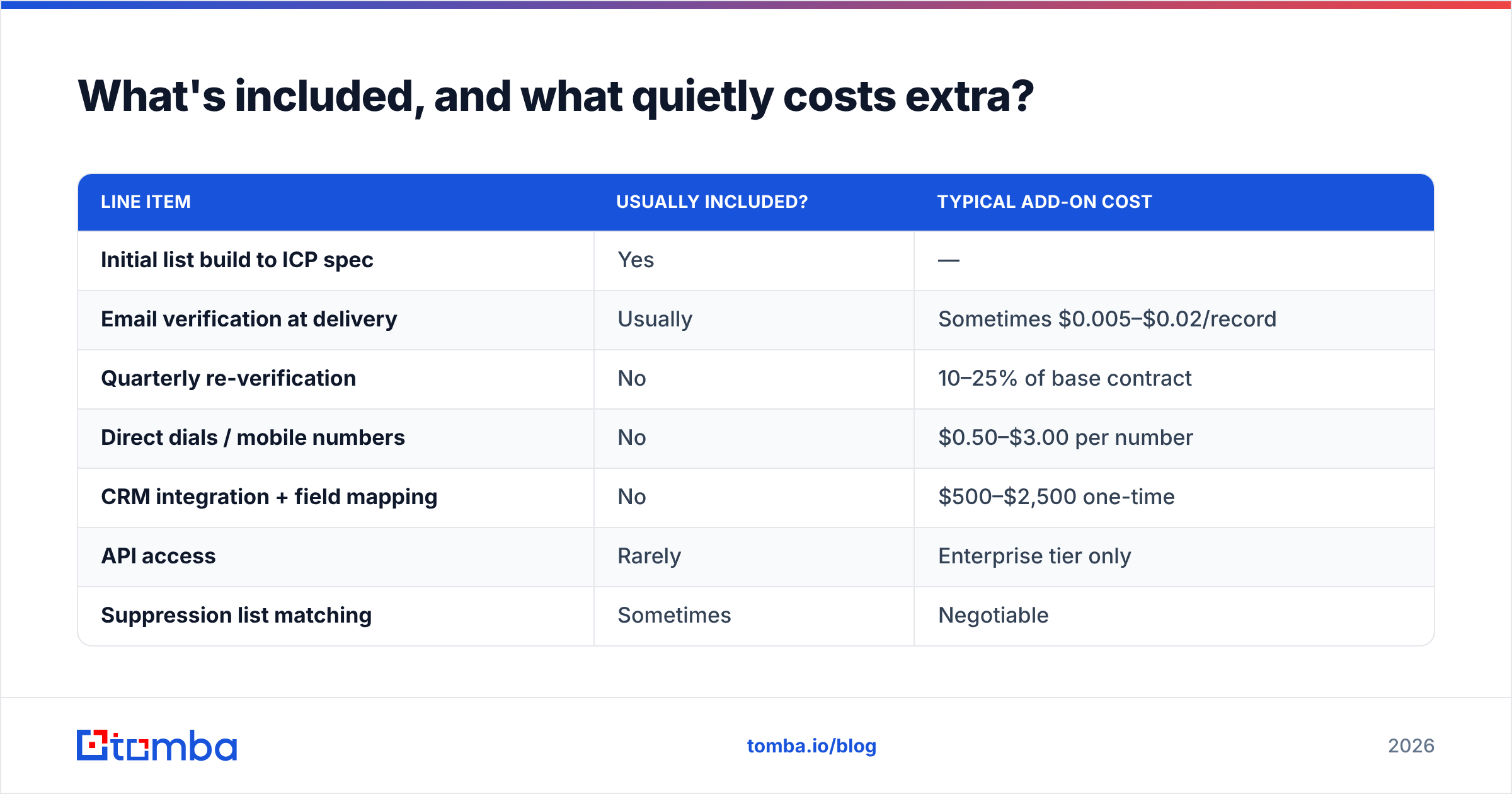
The pattern across quote-based data vendors — Exellius included — is that the headline number covers acquisition, and everything downstream is a line item. Budget for these separately:
| Line item | Usually included? | Typical add-on cost |
|---|---|---|
| Initial list build to ICP spec | Yes | — |
| Email verification at delivery | Usually | Sometimes $0.005–$0.02/record |
| Quarterly re-verification | No | 10–25% of base contract |
| Direct dials / mobile numbers | No | $0.50–$3.00 per number |
| CRM integration + field mapping | No | $500–$2,500 one-time |
| API access | Rarely | Enterprise tier only |
| Suppression list matching | Sometimes | Negotiable |
| Replacement credits for bounces | Negotiable | Ask for a written bounce guarantee |
That bounce-replacement clause is the single most valuable thing to negotiate. A written guarantee — typically "under 5% hard bounce or we replace the records" — converts a vague accuracy claim into an enforceable term. If a vendor won't put it in writing, run your own email verification pass on the delivered file before you load anything into your sending domain.
Is the data accurate enough to justify a custom quote?#
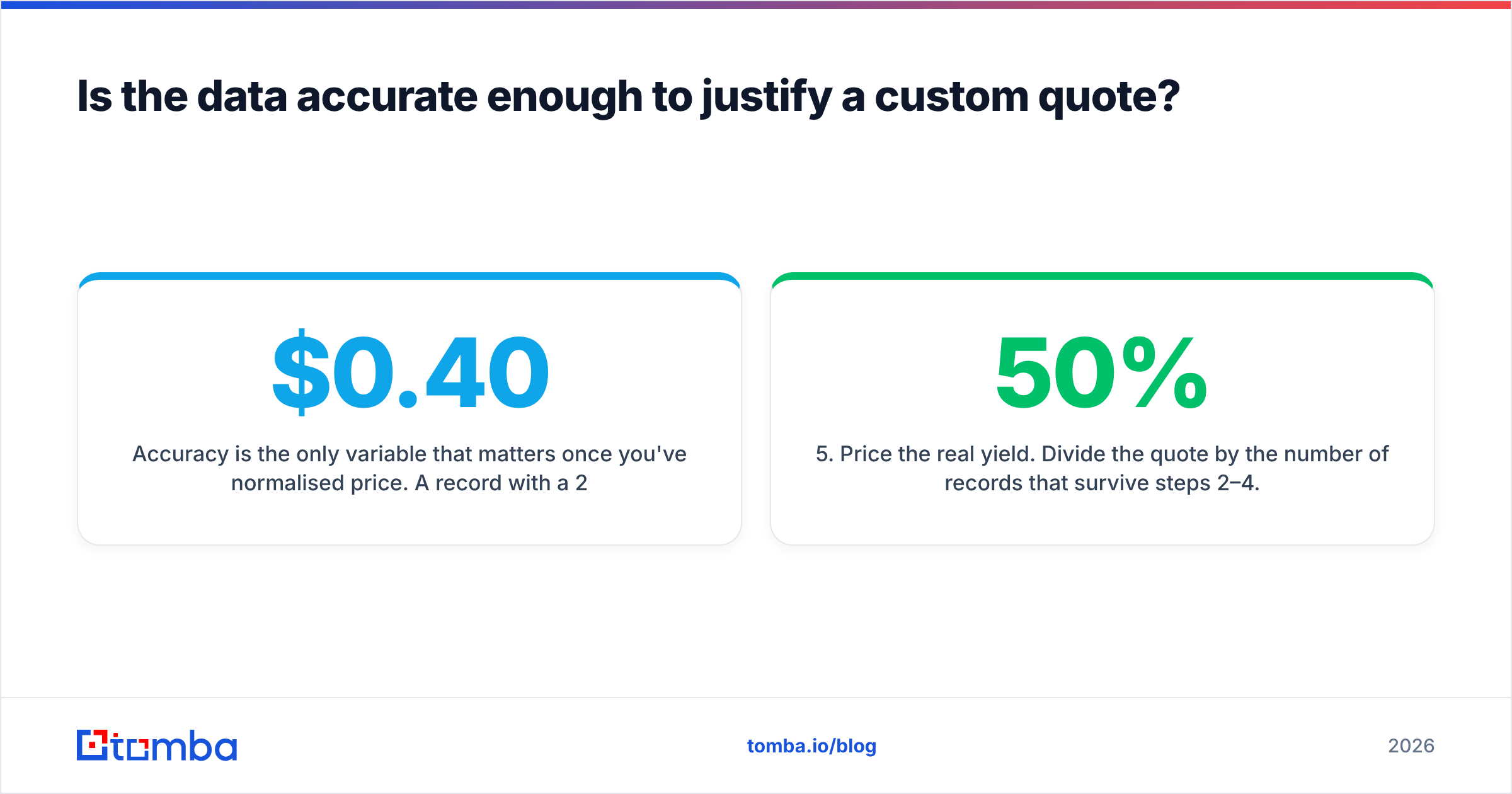
Accuracy is the only variable that matters once you've normalised price. A $0.40 record with a 20% bounce rate is more expensive than a $1.20 record with a 2% bounce rate, because the bad file also costs you sender reputation.

Independent accuracy figures for quote-based vendors are hard to come by precisely because there's no free tier to test. That asymmetry is the point of the sales process. Counter it with a structured pilot:
- Request a 100-record sample against your real ICP before signing anything. Not a canned demo list — your spec.
- Verify the sample independently. Run it through a third-party verifier and record valid / catch-all / invalid ratios.
- Check freshness, not just validity. Spot-check 20 contacts on LinkedIn. If more than three have changed roles, the underlying database is stale regardless of what SMTP validation says.
- Measure catch-all share. Catch-all domains inflate "valid" rates because they accept everything. A catch-all verifier tells you how much of the file is genuinely confirmed versus merely un-rejected.
- Price the real yield. Divide the quote by the number of records that survive steps 2–4. That's your true cost per usable contact — and it's usually 30–50% above the headline unit price.
Third-party review sites like G2 and Capterra are useful for spotting recurring complaints about data freshness and contract terms, though volume of reviews in this category is thin enough that you should weight your own pilot more heavily than the star rating.
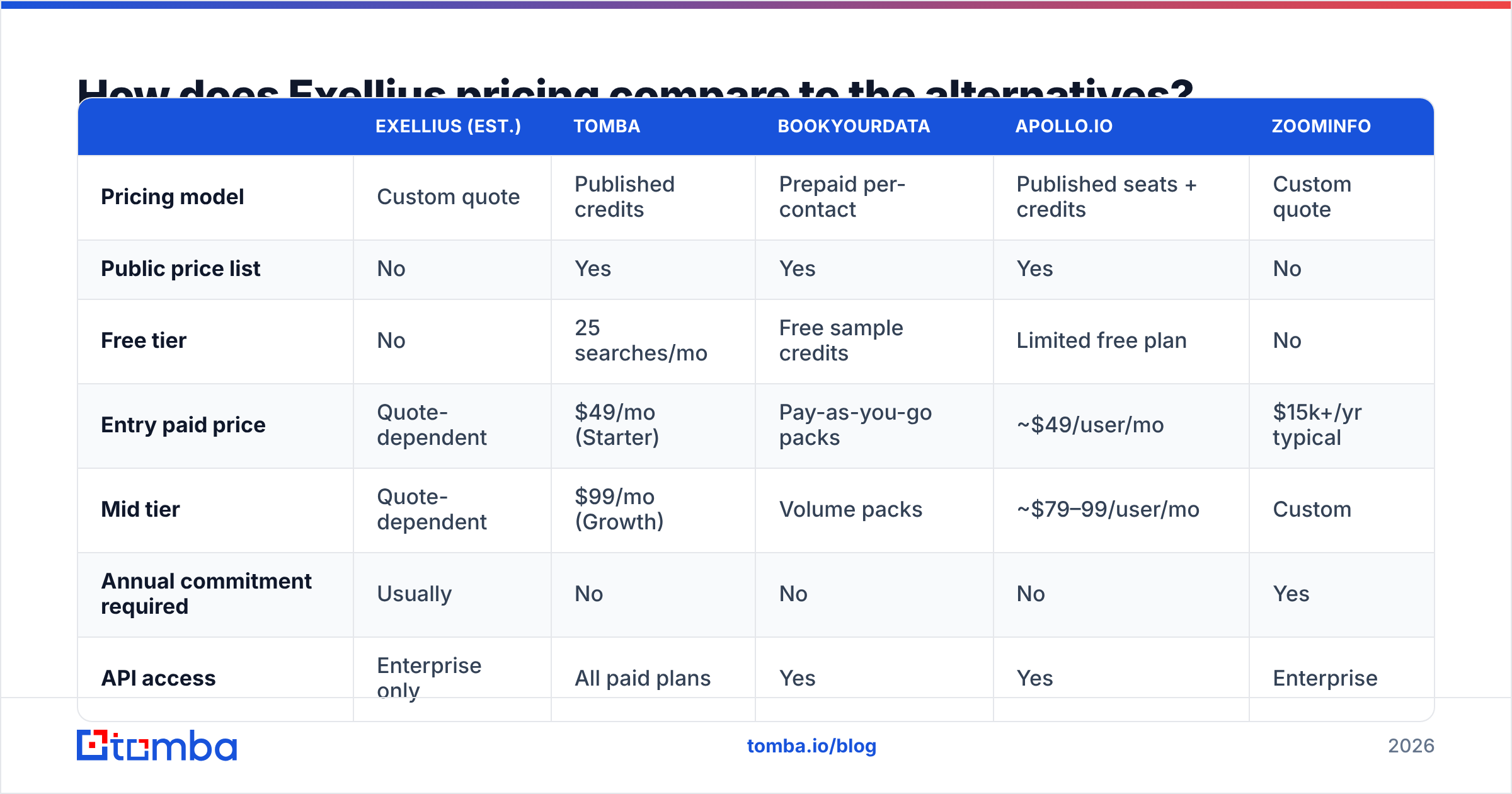
How does Exellius pricing compare to the alternatives?#

Here's the honest landscape, sorted by how you'd actually buy:
| Exellius (est.) | Tomba | BookYourData | Apollo.io | ZoomInfo | |
|---|---|---|---|---|---|
| Pricing model | Custom quote | Published credits | Prepaid per-contact | Published seats + credits | Custom quote |
| Public price list | No | Yes | Yes | Yes | No |
| Free tier | No | 25 searches/mo | Free sample credits | Limited free plan | No |
| Entry paid price | Quote-dependent | $49/mo (Starter) | Pay-as-you-go packs | ~$49/user/mo | $15k+/yr typical |
| Mid tier | Quote-dependent | $99/mo (Growth) | Volume packs | ~$79–99/user/mo | Custom |
| Annual commitment required | Usually | No | No | No | Yes |
| API access | Enterprise only | All paid plans | Yes | Yes | Enterprise |
| Bulk enrichment | Yes, managed | Yes, self-serve | Yes | Yes | Yes |
| Best for | Bespoke research, niche verticals | Predictable self-serve volume | Verified prepaid lists, no subscription | All-in-one prospecting + sequencing | Enterprise account intelligence |
| Time to first record | Days to weeks | Minutes | Minutes | Minutes | Days |
BookYourData deserves a specific note: if your objection to Exellius is the annual commitment rather than the data model, a prepaid credit vendor solves that cleanly. You buy exactly what you need, the price per contact is visible up front, and there's nothing to renew. That's a genuinely different buying posture from either a quote-based service or a monthly SaaS seat, and for some teams it's the right one.
Who should buy Exellius, and who should not?#
Buy a custom-quote data service when:
- Your ICP is genuinely obscure — regional manufacturers, regulated niches, non-English markets — and no database covers it well.
- You need human research layered on top of records: org charts, buying-committee mapping, event attendee lists.
- You have budget authority for annual contracts and a procurement process that can absorb a 4–6 week cycle.
- You want the vendor to own execution, not just delivery.
Skip it and go self-serve when:
- Your motion is repeatable: identify a target company, find the right contact, verify, sequence. That's a tool problem, not a research problem.
- You need data this week. A domain search returns a company's email patterns and contacts in seconds; a quote cycle returns a PDF in a fortnight.
- Your volume is spiky. Monthly plans flex; annual licences don't.
- You need programmatic access. An email finder API that your ops team can wire into a workflow beats a quarterly CSV drop for any team running automated enrichment.
The mistake teams make is treating this as a quality question. It isn't. Custom-quote services and self-serve tools are good at different things. Analysts at firms like Gartner have made this point about the broader GTM data stack for years: buyers over-index on database size and under-index on whether the delivery model matches their operating cadence.
What's the smartest way to run the Exellius negotiation?#
Four moves, in order:
- Get a competing self-serve baseline first. Sign up for a free tier, run 25 real lookups, and calculate your cost per usable contact. Now you have a floor.
- Ask for the quote decomposed into unit price, setup, refresh, and overage. A bundled number is a number you can't negotiate.
- Push for month-to-month or a 3-month pilot before the annual. If the vendor's data is as good as the pitch, a pilot is low risk for them.
- Negotiate the bounce guarantee in writing, with a replacement mechanism and a defined threshold.
If the quote survives all four, it's probably a fair price for what you're getting. If it collapses on the second question, you've learned something cheaper than a year-long contract would have taught you.
Where does Tomba fit?#
If what you actually need is contact data — not managed research — start with the cheap end and only escalate if it fails. The Tomba Email Finder does the core job of every list-build engagement: give it a name and a domain, or just a domain, and it returns verified professional email addresses with confidence scores and sources. Pricing is published — free tier at 25 searches/month, Starter $49/mo, Growth $99/mo, Pro $249/mo — so you can model your cost per contact before you spend anything, and the API, bulk tools, and CRM integrations are included on paid plans rather than gated behind an enterprise tier.
Run 25 free searches against your real ICP this week. Compare the yield to whatever quote you're holding. Then decide whether you're buying data, or buying a sales process.
Related guides#
Ready to find emails that actually work?
Join 150,000+ professionals who stopped guessing and started sending. Free credits on signup — no credit card required.
Get the Tomba newsletter
Practical outbound tactics and product updates — once every two weeks.
About the author