Exellius vs Finderio: Which B2B Email Data Tool Wins in 2026?
One sells you a custom-built B2B contact list. The other sells you a self-serve email finder inside a 50-app bundle. Here is how Exellius and Finderio actually compare on data, pricing, and workflow fit in 2026.
TL;DR
- Exellius and Finderio are not the same category of product. Exellius is a done-for-you B2B data and lead-generation provider — you brief them, they deliver a custom contact list. Finderio is a self-serve email finder that ships as part of the 500apps bundle.
- Choose Exellius if you need a niche, hand-built list (obscure verticals, APAC/EMEA mid-market, ABM target accounts) and you have budget plus lead time.
- Choose Finderio if you want cheap, always-on lookups and you are already paying for the 500apps suite.
- Neither is a great fit if your real requirement is high-volume API enrichment with per-record verification — that is a different tool class entirely.
- Verify everything. Both models — outsourced lists and bundled finders — hand you records that were true at some point in the past. The bounce rate is on you, not them.
What exactly are Exellius and Finderio?#
They solve the same business problem — "get me email addresses for people I want to sell to" — through opposite delivery models, and that difference matters more than any feature checklist.
Exellius operates as a B2B data and demand-generation partner. You submit an ideal customer profile (industry, headcount, geography, job titles, tech stack), and their team assembles, appends, and verifies a list against that brief. Deliverables typically arrive as CSV or a CRM push. Pricing is quote-based and scoped per project or per record. There is no free tier to poke at, no dashboard to self-serve from at 11pm — you talk to a human first. Check the current scope directly at exellius.com, because managed-service offerings change faster than SaaS pricing pages do.
Finderio is the email-finder app inside the 500apps ecosystem. It does the things you would expect from that category: single email lookup by name and domain, domain search to pull the contacts a company has published, bulk upload, a Chrome extension, and an API. Its pricing hook is that it is bundled — 500apps has historically sold the entire app catalogue for one flat per-user monthly fee rather than pricing each tool independently. Confirm the current tier on finder.io before you plan around it.
So the honest framing of Exellius vs Finderio is: outsourced data operations versus in-house self-serve tooling. Comparing them purely on "credits per dollar" will mislead you.

How do the two models differ in practice?#
Six practical differences decide which model fits your team:
- Time to first contact. Finderio: minutes. You log in, paste a domain, get results. Exellius: days to weeks, because a human is building your list. If your SDR is idle today, a managed list does not help today.
- Control over the ICP. Exellius wins here. A brief can encode "Series B fintechs in Benelux with an in-house compliance lead" in a way that no filter UI reliably reproduces. Finderio can only find what it can find from a domain and a name.
- Cost predictability. Finderio's bundled model is flat and boring — a good thing. Exellius quotes per project, so a second campaign means a second quote and a second negotiation.
- Repeatability. Self-serve tools compound. Every workflow you build on an API or extension is reusable at 2am forever. A delivered CSV is a one-time asset that starts decaying the moment it lands in your inbox.
- Data provenance. Ask both providers where records come from and how recently they were validated. A managed provider should be able to answer specifically; a bundled tool usually points at a general methodology page. Neither answer is automatically better — the specificity of the answer is the signal.
- Verification depth. This is the one buyers skip and then regret. Finding an address and proving it will accept mail are separate jobs. Ask explicitly whether verification is SMTP-level, whether catch-all domains are flagged, and whether you are charged for unverifiable records.
Is one more accurate than the other?#
Accuracy claims in this market are close to meaningless without a test file, and the fair answer is: run your own bake-off before you sign anything.
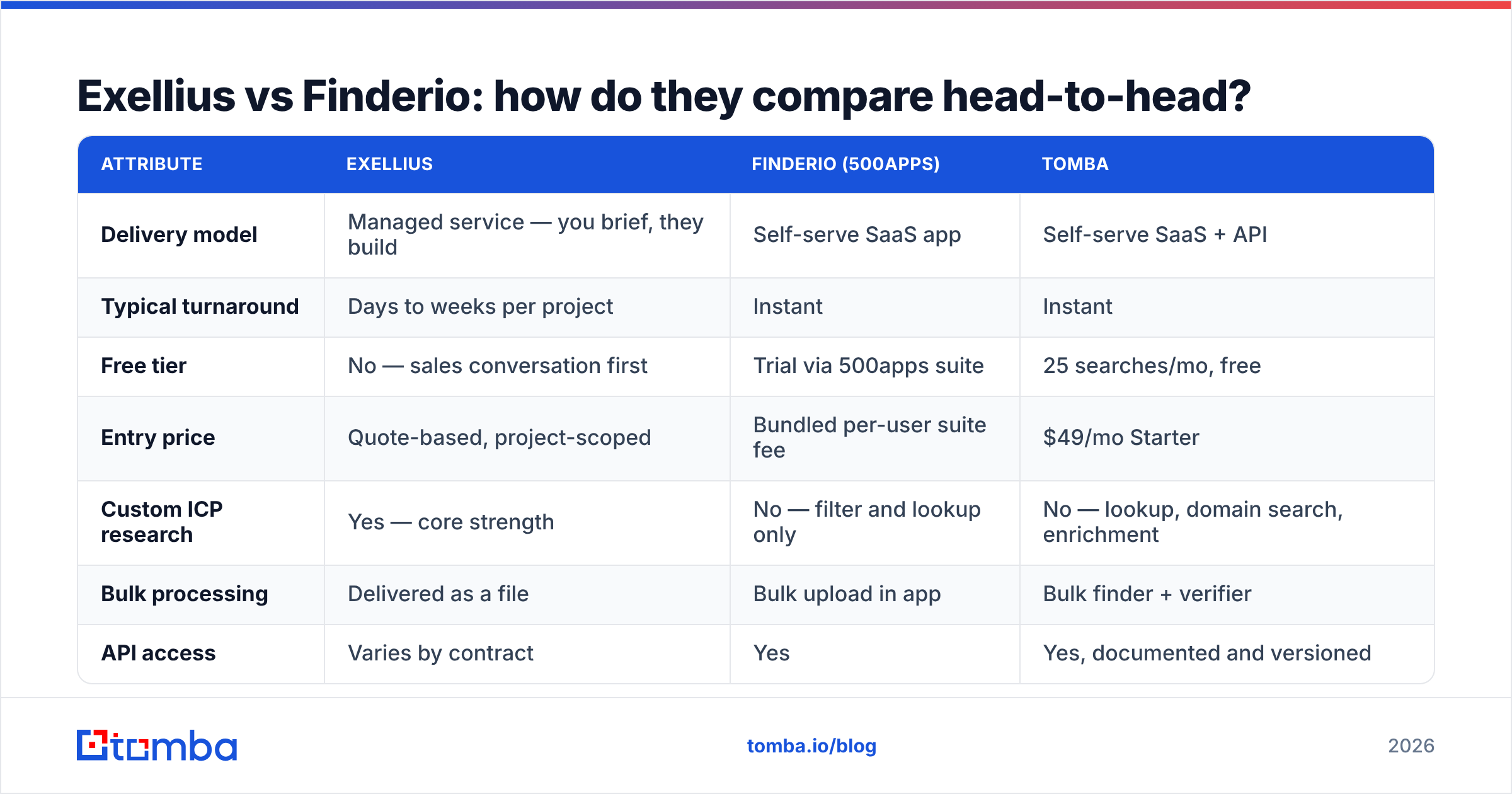
The reason is structural. Vendors quote accuracy against their validation set, which is naturally biased toward the segments where their coverage is strongest. A provider that is 96% accurate on North American SaaS may be 60% accurate on German manufacturing SMBs. Your ICP is the only benchmark that counts.

Here is a bake-off protocol that takes an afternoon and has settled more vendor arguments than any G2 grid:
- Build a 100-row truth set. Pull 100 contacts you already have confirmed working emails for — past customers, webinar attendees, replied-to prospects. Strip the email column.
- Run the same 100 rows through every candidate. For Exellius, this means asking for a paid pilot or sample against your file. If a provider refuses any sample, that is your answer.
- Score three numbers, not one. Coverage (rows returned), precision (returned rows that match your known-good address), and silent failure rate (rows returned confidently that are wrong). The third number is the expensive one — a wrong address that looks confident costs you a bounce and a chunk of sender reputation.
- Re-verify the winner's output independently. Push the delivered list through a separate email verifier before a single send. If 12% of a "verified" list comes back risky, you have learned the real accuracy number, not the marketing one.
- Check the catch-all handling. Roughly a fifth of B2B domains are catch-all, meaning the server accepts everything and verifies nothing. A tool that marks catch-alls as "valid" is inflating its own score.
Independent review aggregators like G2 are useful for spotting support and billing complaints — the things a trial will not surface — but treat their star ratings as sentiment, not measurement.
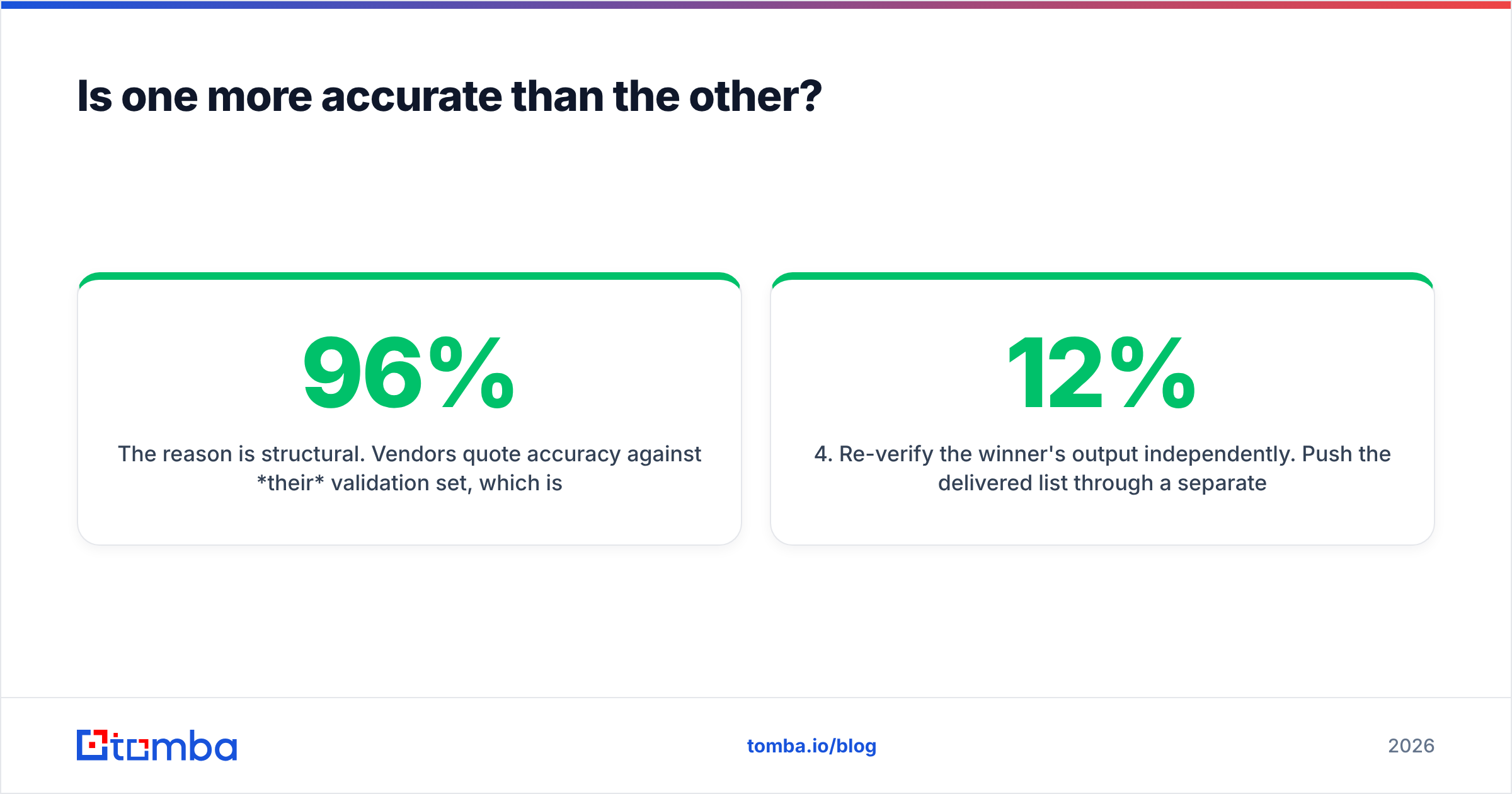
Exellius vs Finderio: how do they compare head-to-head?#
| Attribute | Exellius | Finderio (500apps) | Tomba |
|---|---|---|---|
| Delivery model | Managed service — you brief, they build | Self-serve SaaS app | Self-serve SaaS + API |
| Typical turnaround | Days to weeks per project | Instant | Instant |
| Free tier | No — sales conversation first | Trial via 500apps suite | 25 searches/mo, free |
| Entry price | Quote-based, project-scoped | Bundled per-user suite fee | $49/mo Starter |
| Custom ICP research | Yes — core strength | No — filter and lookup only | No — lookup, domain search, enrichment |
| Bulk processing | Delivered as a file | Bulk upload in app | Bulk finder + verifier |
| API access | Varies by contract | Yes | Yes, documented and versioned |
| Built-in verification | Provider-side, ask for method | Basic validation | Verifier, catch-all verifier included |
| Best for | Niche verticals, ABM target lists | Cheap always-on lookups | Repeatable outbound + enrichment ops |
| Main risk | Cost per campaign, no self-serve | Depth outside common segments | Not a done-for-you list service |

Two honest caveats on that table. First, Exellius pricing genuinely varies — a 500-record niche list and a 50,000-record append are not the same negotiation, and anyone publishing a single number for a managed provider is guessing. Second, 500apps' bundling means Finderio's effective cost depends entirely on whether you use the other apps. If you use two of fifty, you are paying suite prices for a point solution.
When does a managed list beat a self-serve tool?#
Managed data services earn their premium in four specific situations:
- The segment is not on the open web. Family-owned distributors, regional healthcare groups, and government-adjacent buyers often have no LinkedIn footprint and no published team page. Algorithms fail; researchers do not.
- The title is fuzzy. "Whoever owns fleet maintenance decisions" is not a job title. A human can read an org chart and infer it. A filter cannot.
- You need firmographic depth, not just contacts. Revenue bands, ownership structure, equipment installed, contract renewal timing — that is research output, not database output.
- Compliance requires documented sourcing. In regulated industries or strict-consent jurisdictions, a contractual provenance guarantee has real value. Read the terms; do not assume.
Outside those four cases, self-serve almost always wins on total cost. The reason is decay. B2B contact data goes stale at roughly 2–3% per month as people change roles — a purchased list is worth measurably less in month six than on delivery day. A self-serve tool lets you re-find and re-verify continuously; a delivered CSV does not.
This is also why prebuilt-list vendors have carved out a legitimate middle ground. Providers like BookYourData let you filter and buy verified contacts instantly without a sales cycle, which splits the difference between a full research engagement and raw lookup tooling. If your objection to Exellius is turnaround and your objection to Finderio is depth, that middle lane deserves a look.

What does the total cost actually look like?#
Compare the cost per meeting booked, not the cost per record. The record price is the smallest line item in the equation.
Model it like this. Say you need 2,000 usable contacts per quarter.
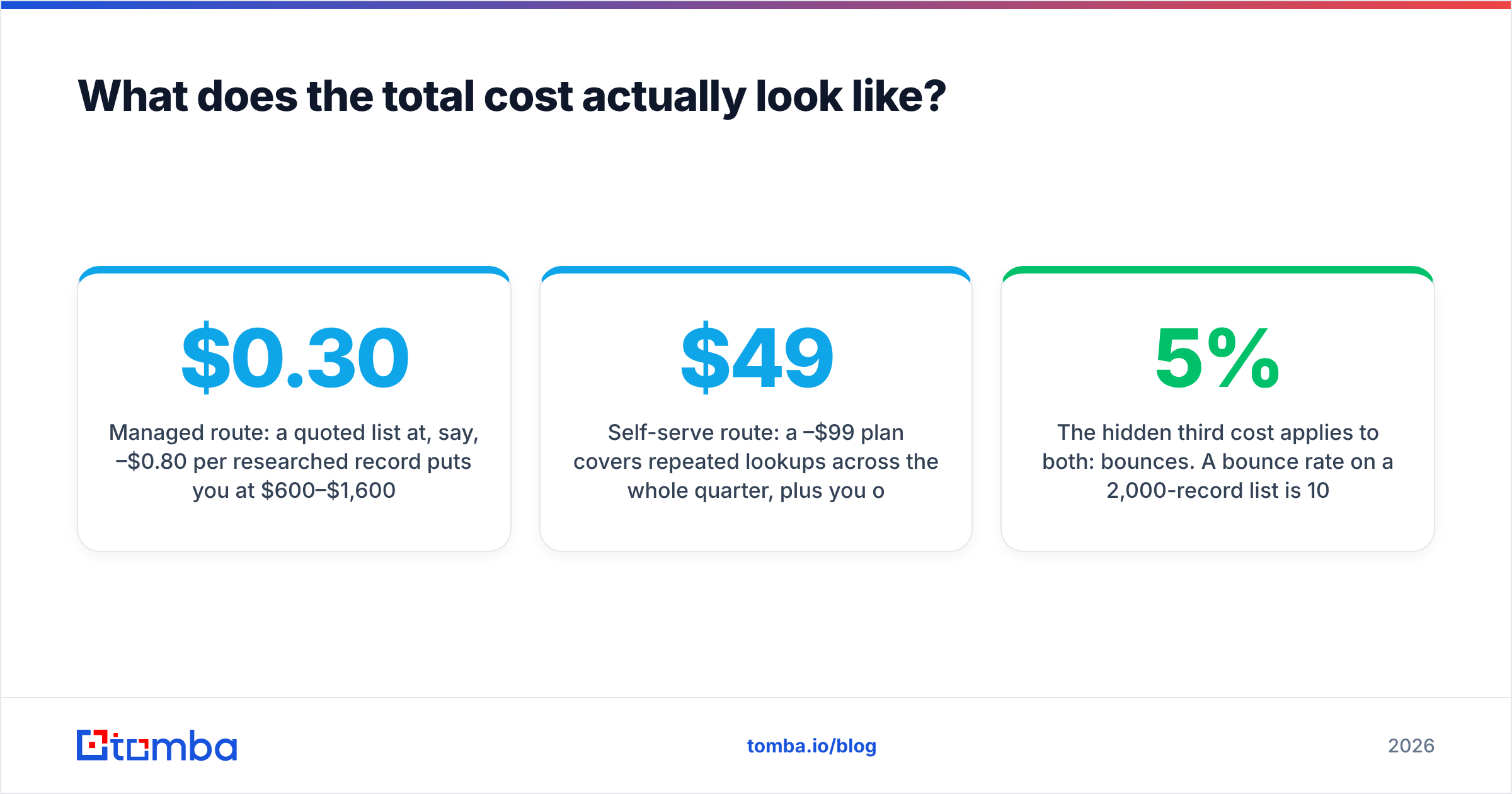
Managed route: a quoted list at, say, $0.30–$0.80 per researched record puts you at $600–$1,600 per delivery, plus 1–3 weeks of lead time, plus internal review hours. Accuracy should be high, but you re-buy next quarter because the list decays.
Self-serve route: a $49–$99/mo plan covers repeated lookups across the whole quarter, plus you own the workflow. You pay in SDR time spent building and cleaning lists — call it 4–6 hours a week — and you absorb whatever accuracy gap exists in your segment.
The hidden third cost applies to both: bounces. A 5% bounce rate on a 2,000-record list is 100 bad sends. At scale, that is not just wasted volume — mailbox providers read it as a spam signal, and your email deliverability on the good 1,900 addresses degrades with it. Verification is cheaper than reputation repair by roughly an order of magnitude.
Run those three numbers against your own close rate before you pick a lane. Teams that only compare sticker prices consistently pick the option that costs them more.
Which should you pick in 2026?#
Pick Exellius if your ICP is genuinely hard to reach, your ACV is high enough to absorb research pricing, and you can wait. Ask for a paid pilot on 200 records, insist on their verification methodology in writing, and confirm what happens to your money when a record turns out to be wrong.
Pick Finderio if you are already inside the 500apps ecosystem and your prospecting is opportunistic — a few dozen lookups a week across mainstream tech and services companies. The economics only work if the bundle is already justified.
Pick a dedicated self-serve platform if your outbound is systematic. Once you are enriching CRM records nightly, running bulk verify before every campaign, and pulling contacts programmatically, you need documented API behavior, transparent per-record status codes, and predictable pricing more than you need either a bundle or a services contract.
The one non-negotiable, whichever way you go: verify before you send. Every model in this comparison hands you data that was accurate on some date in the past. The only question is whether you find the dead records or your mailbox provider does.
Ready to test the self-serve path?#
If your conclusion is that you want the speed of self-serve without giving up verification depth, start with Tomba Email Finder. You get 25 free searches a month to run the 100-row bake-off described above — no sales call, no bundle commitment. Paid plans start at $49/mo Starter and scale to $99/mo Growth and $249/mo Pro, with the email verifier, catch-all verification, domain search, and enrichment included rather than sold as separate add-ons. See full Tomba pricing, or go straight to the Tomba API if you would rather wire lookups into your own stack today.
Run your own truth-set test. Whatever the numbers say, that is your answer — not this article's.
Related guides#
Ready to find emails that actually work?
Join 150,000+ professionals who stopped guessing and started sending. Free credits on signup — no credit card required.
Get the Tomba newsletter
Practical outbound tactics and product updates — once every two weeks.
About the author