Exellius vs FindThatLead: Which Email Finder Wins in 2026?
One is a quote-based B2B data service, the other a self-serve email finder with a cold-email layer bolted on. Here is how Exellius and FindThatLead actually differ on data, pricing transparency, and cost per usable contact.
TL;DR
- Exellius sells outcomes: sourced, quote-based B2B contact lists and done-for-you prospecting support. Pricing is not publicly self-serve, so you cannot benchmark it before a sales call.
- FindThatLead sells software: a self-serve email finder with domain search, a Chrome extension, and a built-in cold-email sender, starting around $49/month at the entry tier.
- If you want to test data quality before you commit budget, FindThatLead wins on access. If you want someone else to build the list, Exellius is the closer fit.
- Neither is the cheapest route to verified emails at volume. Cost per usable contact — not cost per credit — is the number that decides this.
- Our pick for most outbound teams in 2026: a self-serve finder with a real verification layer and an API. Run all three through the 30-minute test at the end of this post before you sign anything.
What are Exellius and FindThatLead?#
They are not the same category of product, which is the single most important thing to understand before comparing prices.
- Exellius positions itself as a B2B lead-generation and data-sourcing provider — closer to a service than a SaaS dashboard. You describe an ideal customer profile, and contact data (and often outreach support) is delivered to you. Pricing is quote-based rather than published, so evaluation starts with a conversation, not a free trial.
- FindThatLead is a self-serve prospecting tool from Spain, live since 2015. It bundles four things: an email finder by name and domain, a domain-wide "Prospector" search, a Chrome extension for LinkedIn, and a built-in cold-email sender (Scrab.in / Sender). You can see the pricing page and start on a limited free tier without talking to anyone.
- The buying motion differs. Exellius is a procurement decision with a contract. FindThatLead is a credit-card decision an SDR can make on a Tuesday afternoon.
- The failure modes differ too. Service providers fail by delivering a stale list you cannot audit. Self-serve tools fail by burning credits on catch-all domains and returning "guessed" patterns as if they were verified.
- Verification is the shared weak point. Finding a plausible address is easy — SMTP-level validation, catch-all handling, and role-account filtering are where tools separate. Read the email deliverability primer if bounce rate is what actually keeps you up at night.

How do Exellius and FindThatLead compare feature by feature?#
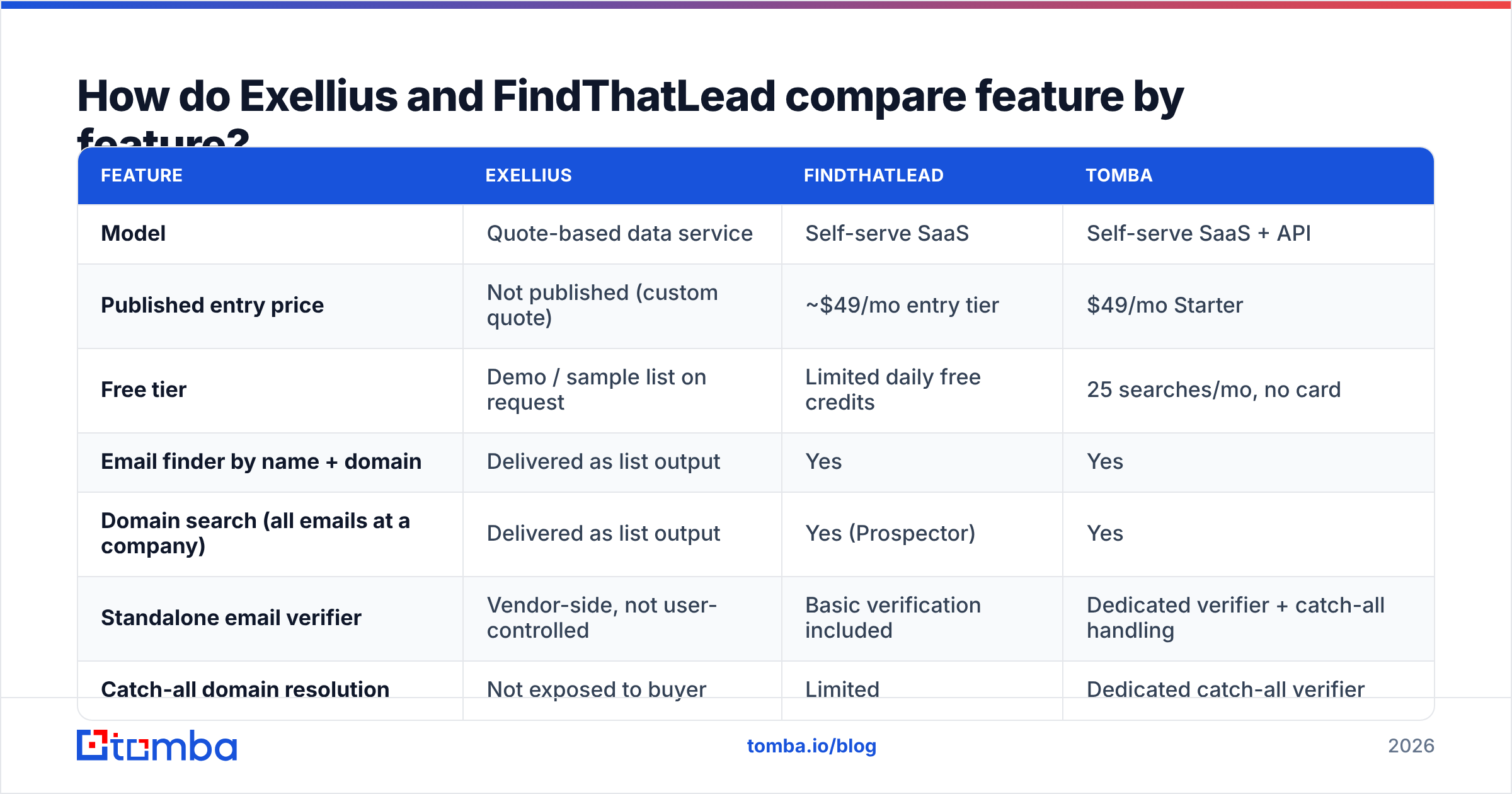
Here is the honest side-by-side. Where a vendor does not publish a number, we say so rather than inventing one — treat any blog that quotes exact Exellius seat pricing with suspicion.
| Feature | Exellius | FindThatLead | Tomba |
|---|---|---|---|
| Model | Quote-based data service | Self-serve SaaS | Self-serve SaaS + API |
| Published entry price | Not published (custom quote) | ~$49/mo entry tier | $49/mo Starter |
| Free tier | Demo / sample list on request | Limited daily free credits | 25 searches/mo, no card |
| Email finder by name + domain | Delivered as list output | Yes | Yes |
| Domain search (all emails at a company) | Delivered as list output | Yes (Prospector) | Yes |
| Standalone email verifier | Vendor-side, not user-controlled | Basic verification included | Dedicated verifier + catch-all handling |
| Catch-all domain resolution | Not exposed to buyer | Limited | Dedicated catch-all verifier |
| Chrome extension | No | Yes | Yes |
| Built-in cold email sender | Service-side outreach option | Yes | No (integrations instead) |
| Public API | Limited / contract-dependent | Yes | Yes, documented REST API |
| Phone numbers | Available on request | Limited | Phone finder + validator |
| Best for | Teams outsourcing list building | Solo founders and small SDR teams | Teams that want data + verification in one stack |

The pattern in that table repeats across the whole category: bundled senders look generous until you realise the sending layer is the part you will replace first, while the data layer is the part you are actually stuck with.
Which one returns more valid emails?#
Neither vendor publishes an independently audited accuracy figure, and you should not trust the ones they do publish about themselves — including ours. What you can trust is a controlled test on your own list.
Accuracy in this category is really three separate numbers, and vendors love to blur them:
- Hit rate — what percentage of your input rows returned any address. Easy to inflate by returning pattern guesses.
- Deliverable rate — what percentage of returned addresses survive an independent email verifier. This is the number that maps to your bounce rate.
- Usable rate — deliverable addresses that are also the right person, not
info@or a departed employee. Role accounts inflate hit rate and destroy reply rate.

FindThatLead's public positioning leans on volume and speed; user reviews on G2's lead intelligence category consistently praise the Chrome extension and flag credit burn on unverified results. Exellius, being service-delivered, hands you a finished list — which means the quality question moves entirely into the sample you negotiate before signing. Always demand a 100-row sample from your actual ICP, not a curated demo file.
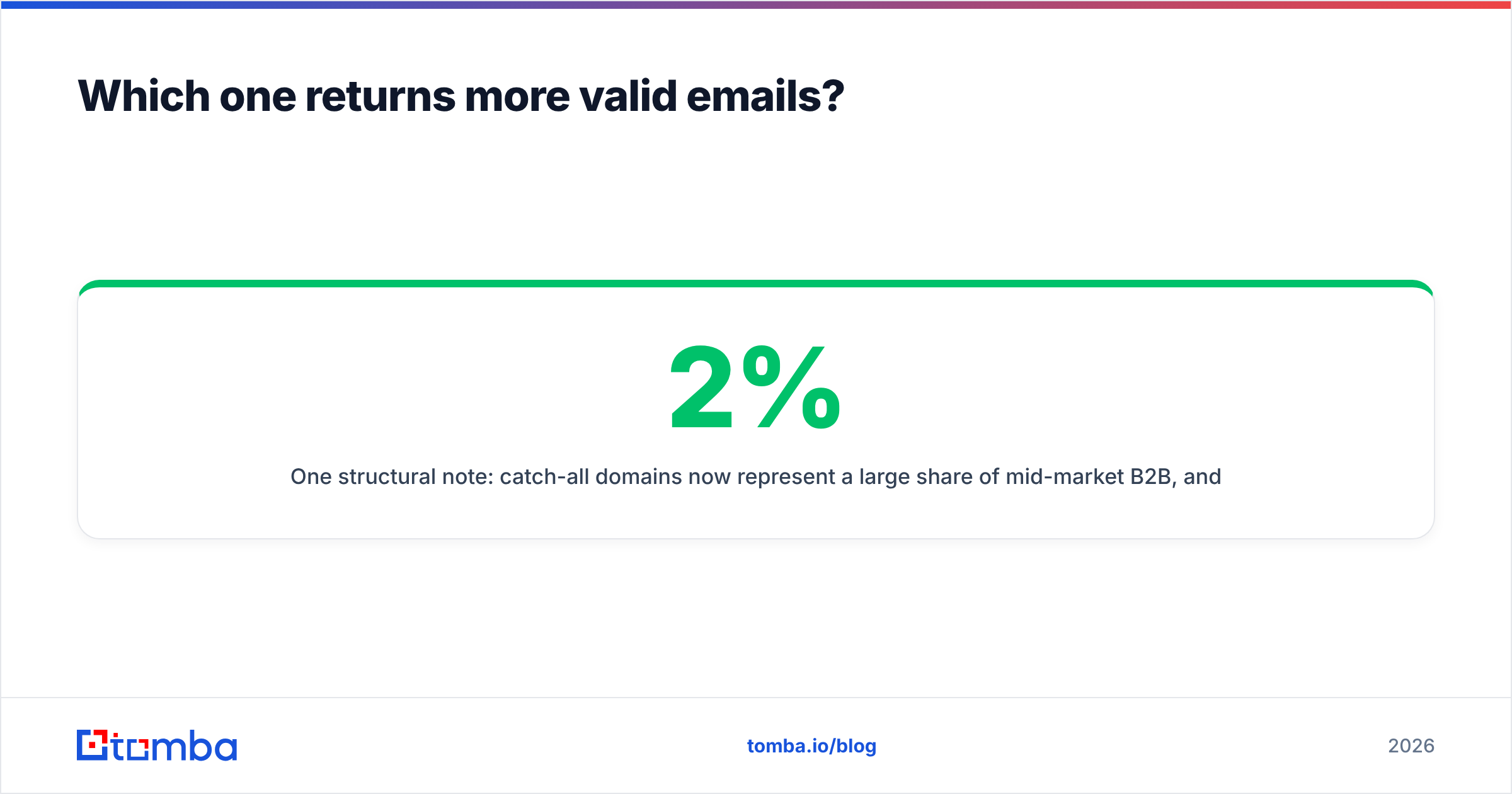
One structural note: catch-all domains now represent a large share of mid-market B2B, and a tool that marks every catch-all as "valid" is quietly selling you bounces. A dedicated catch-all verifier is the difference between a 2% bounce rate and a 9% one — and at 9% your domain reputation starts absorbing real damage.
What does each actually cost per usable contact?#
Cost per credit is marketing. Cost per usable contact is procurement. Run the math like this:
Cost per usable contact = (monthly price ÷ credits) ÷ (hit rate × deliverable rate × right-person rate)
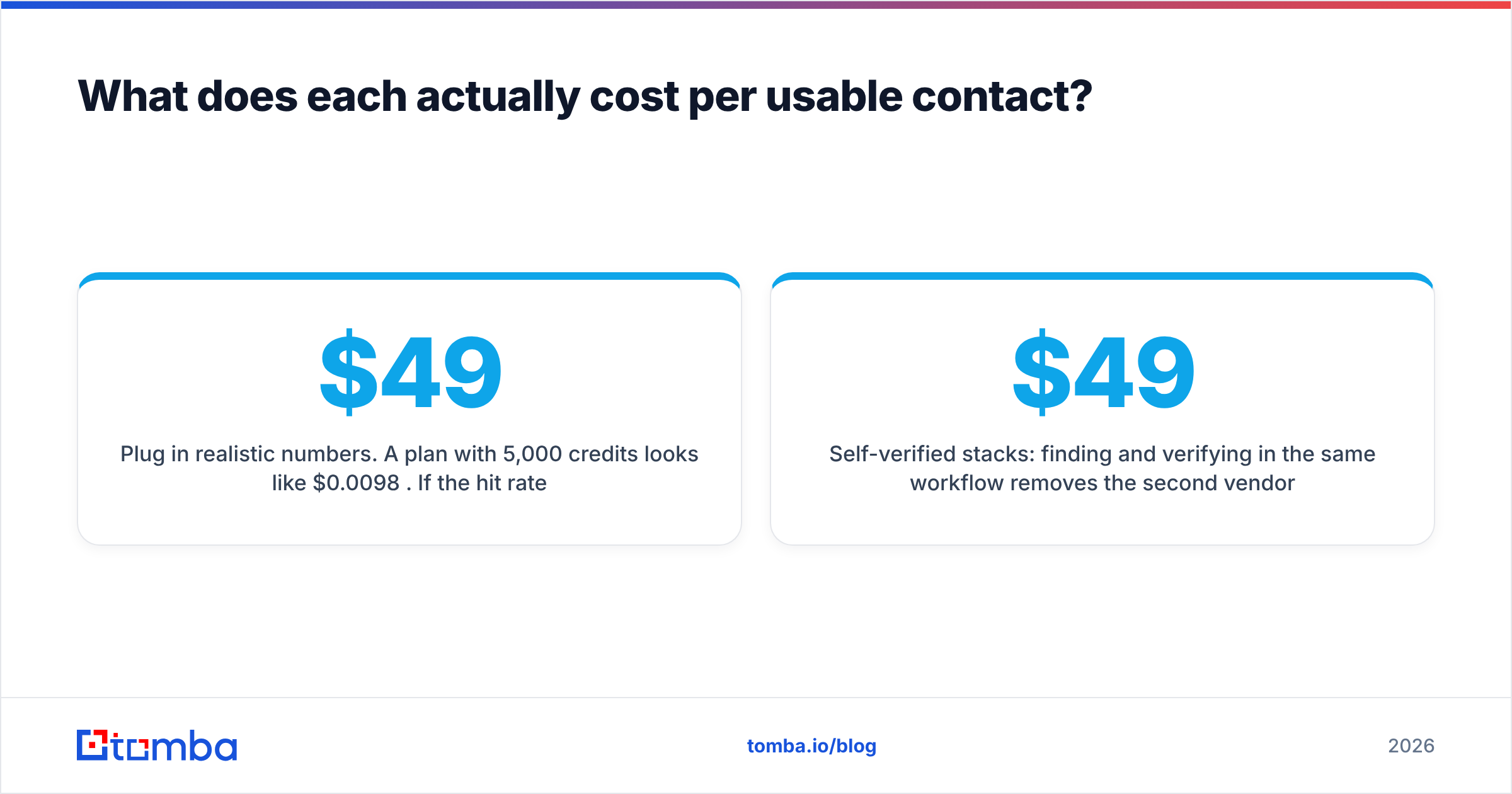
Plug in realistic numbers. A $49/month plan with 5,000 credits looks like $0.0098 per credit. If the hit rate is 65%, the deliverable rate on those hits is 80%, and 85% are the right person rather than a role inbox, your real cost is $0.0098 ÷ 0.44 = $0.022 per usable contact — more than double the sticker figure.
Now apply that to each option:
- Exellius: you are quoted per contact or per project, so the arithmetic is done for you — but you cannot verify the deliverable rate until after delivery. Negotiate a replacement clause for bounced records. Any reputable data service will agree to one.
- FindThatLead: credits are consumed on searches, not just successes on every plan tier, so a low hit rate on niche domains inflates your true cost quietly. Watch the counter during your first week.
- Self-verified stacks: finding and verifying in the same workflow removes the second vendor and the second invoice. Compare Tomba pricing — Free (25 searches/mo), Starter $49/mo, Growth $99/mo, Pro $249/mo — against your computed cost per usable contact, not per credit.
If you need pre-built lists rather than lookups, a list marketplace like BookYourData is a legitimate third path and often cheaper than a custom sourcing engagement for common ICPs. Different tool, different job — worth pricing alongside both.

Is FindThatLead better for cold email campaigns?#
For a solo founder sending 200 emails a week, yes — the bundled sender means one login, one bill, one place to look when something breaks. That convenience is real and worth paying for at small volume.
It stops being an advantage fast. Three reasons:
- Sending infrastructure is specialised. Dedicated platforms handle inbox rotation, warmup ramps, and per-domain throttling far better than a finder with a sending module attached. Once you run more than a couple of mailboxes, you will migrate.
- Deliverability is a domain problem, not a tool problem. No sender saves you from a missing SPF record or a cold domain. Check yours with an SPF checker and run copy through a spam checker before blaming the vendor.
- Bundling hides the data cost. When finding, verifying, and sending share one subscription, you cannot see which layer is underperforming. Splitting them makes each one accountable.
Exellius does not compete here at all — outreach is either handled service-side or handed back to you as a file. If campaign execution is your bottleneck rather than list building, that is a meaningful gap.
When should you choose Exellius over FindThatLead?#
Pick Exellius when these are true:
- You have budget but no SDR bandwidth. Paying for a finished list beats paying an SDR to build one badly.
- Your ICP is genuinely hard. Non-English markets, offline industries, or roles that barely exist on LinkedIn are where automated finders collapse and human sourcing earns its premium.
- You need contractual accountability. A signed replacement clause for invalid records is worth more than any self-reported accuracy claim.
- Volume is lumpy. One large quarterly list beats a monthly subscription you use twice.
Pick FindThatLead when:
- You want to test before you buy — the free tier and low entry price make evaluation cheap.
- Your team lives on LinkedIn and the Chrome extension fits the existing workflow.
- You are under 500 prospects/month and a bundled sender genuinely saves you a second subscription.
- You want the tool in-house, not a dependency on someone else's delivery timeline.
Where does Tomba fit in this comparison?#
Honestly: Tomba overlaps FindThatLead more than Exellius. Both are self-serve finders at a similar entry price, and if you only ever look up one email at a time, the difference will feel marginal.
The gap opens at scale and at the verification layer. Tomba ships a dedicated email verifier, a catch-all verifier, bulk email finder processing, and a documented Tomba API so the whole loop — find, verify, enrich, push to CRM — runs without a human in the middle. FindThatLead's strength is the opposite: everything in one interface, including sending, for people who do not want an API at all.
What Tomba does not do is send campaigns. If you want one vendor for finding and sending, FindThatLead has the more complete single-login story and you should weigh that seriously. If you have already picked a sending platform, adding a bundled sender you will never use is dead weight in the price.
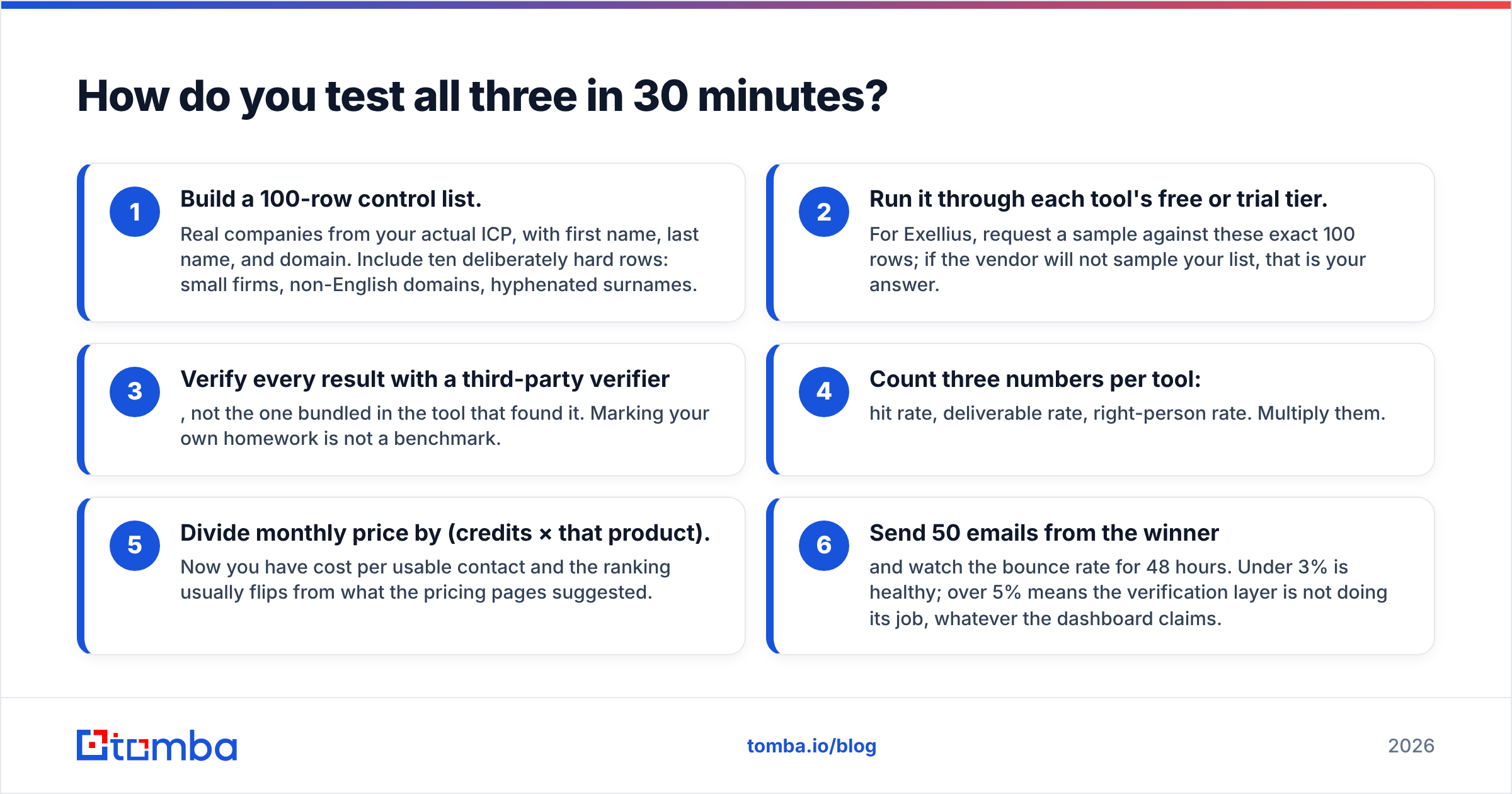
How do you test all three in 30 minutes?#
Do not buy on a comparison table — including this one. Run the test:
- Build a 100-row control list. Real companies from your actual ICP, with first name, last name, and domain. Include ten deliberately hard rows: small firms, non-English domains, hyphenated surnames.
- Run it through each tool's free or trial tier. For Exellius, request a sample against these exact 100 rows; if the vendor will not sample your list, that is your answer.
- Verify every result with a third-party verifier, not the one bundled in the tool that found it. Marking your own homework is not a benchmark.
- Count three numbers per tool: hit rate, deliverable rate, right-person rate. Multiply them.
- Divide monthly price by (credits × that product). Now you have cost per usable contact and the ranking usually flips from what the pricing pages suggested.
- Send 50 emails from the winner and watch the bounce rate for 48 hours. Under 3% is healthy; over 5% means the verification layer is not doing its job, whatever the dashboard claims.
That process takes half an hour and has settled more vendor arguments than any feature matrix. For a broader view of the category conventions behind these results — SMTP handshakes, catch-all behaviour, role accounts — the email address fundamentals are worth ten minutes of reading before you interpret your own numbers.
The verdict#
FindThatLead is the better default for small teams that want to start today, test cheaply, and keep everything in one login. Exellius is the better fit when list building is a problem you would rather outsource than operate, and you have the budget and contract leverage to hold a vendor accountable for quality.
But if your real requirement is high-volume, verified data that flows into your existing stack — with catch-all handling that does not quietly hand you bounces — start with the Tomba Email Finder. The free tier gives you 25 searches a month with no card, Starter is $49/month, and every result runs through the same verification layer rather than a pattern guess dressed up as a match. Run your 100-row control list through it alongside the other two and let the cost-per-usable-contact number decide.
Related guides#
Ready to find emails that actually work?
Join 150,000+ professionals who stopped guessing and started sending. Free credits on signup — no credit card required.
Get the Tomba newsletter
Practical outbound tactics and product updates — once every two weeks.
About the author