Exellius vs FullCircl: Which B2B Data Tool Wins in 2026?
Exellius sells outsourced list-building; FullCircl sells regulated-market company intelligence. They barely overlap — and picking wrong costs you a quarter. Here is the honest breakdown.
TL;DR
- These two tools are not real competitors. Exellius is a done-for-you lead generation and list-building service. FullCircl is a customer lifecycle intelligence platform built mostly for UK/EU regulated industries — banking, insurance, lending — with KYB and onboarding checks baked in.
- Pick Exellius if you have no SDR bandwidth and want someone to hand you a targeted contact list plus outreach execution.
- Pick FullCircl if you sell into regulated markets and need Companies House-grade firmographics, credit signals, and compliance screening in one place.
- Pick neither if what you actually need is verifiable contact data at API speed. That is a third category, and it is where a self-serve email finder costs a fraction of either.
- Neither vendor publishes transparent self-serve pricing. Budget for a sales call, a scoping doc, and a 6–12 month commitment on FullCircl.
What are Exellius and FullCircl, actually?#
Short answer: one is an agency, one is a database platform. Most "Exellius vs FullCircl" searches come from someone who has been pitched both in the same month and is trying to work out why the demos looked nothing alike.
Exellius operates as a B2B lead generation partner. You brief them on your ideal customer profile, and they build lists, enrich them, and in many engagements run the outbound campaigns too. The deliverable is a pipeline outcome — meetings booked, or a validated contact list handed over — not a login you use daily. Pricing is quoted per engagement.
FullCircl (formerly Artesian Solutions, merged with DueDil) is a data and decisioning platform. It aggregates company registry data, financials, credit risk, news signals, and ownership structures, then exposes that through a web app, a CRM sidebar, and APIs. Its heaviest adoption is in UK financial services, where the same record has to serve both a salesperson prospecting and a compliance officer running KYB. FullCircl was acquired into the Perfect Portal / IRIS orbit in recent years, and its roadmap has leaned further into onboarding and regulatory workflow.
So the honest framing is not "which is better." It is "which problem do you have."
How do their data models differ?#
This is the part that decides everything downstream.
FullCircl is company-first. Its atomic unit is a legal entity: registration number, filings, directors, shareholders, credit score, industry codes. Contacts hang off that entity, and contact-level email coverage has historically been the platform's weakest dimension — it was never built to be a B2B database of individual inboxes. If you ask FullCircl "who is the VP of Engineering at this 200-person SaaS firm and what is her email," you will often get a partial answer.
Exellius is outcome-first. There is no persistent data model you own. Researchers and tooling assemble a list per campaign, so quality varies with the brief and the analyst. Good briefs produce genuinely good lists. Vague briefs produce padded ones.
A pure contact-data provider is person-first: name, role, verified email, phone, company mapping — refreshed continuously and queryable by API. That is a third architecture entirely, and it explains why teams frequently end up buying two things instead of one.

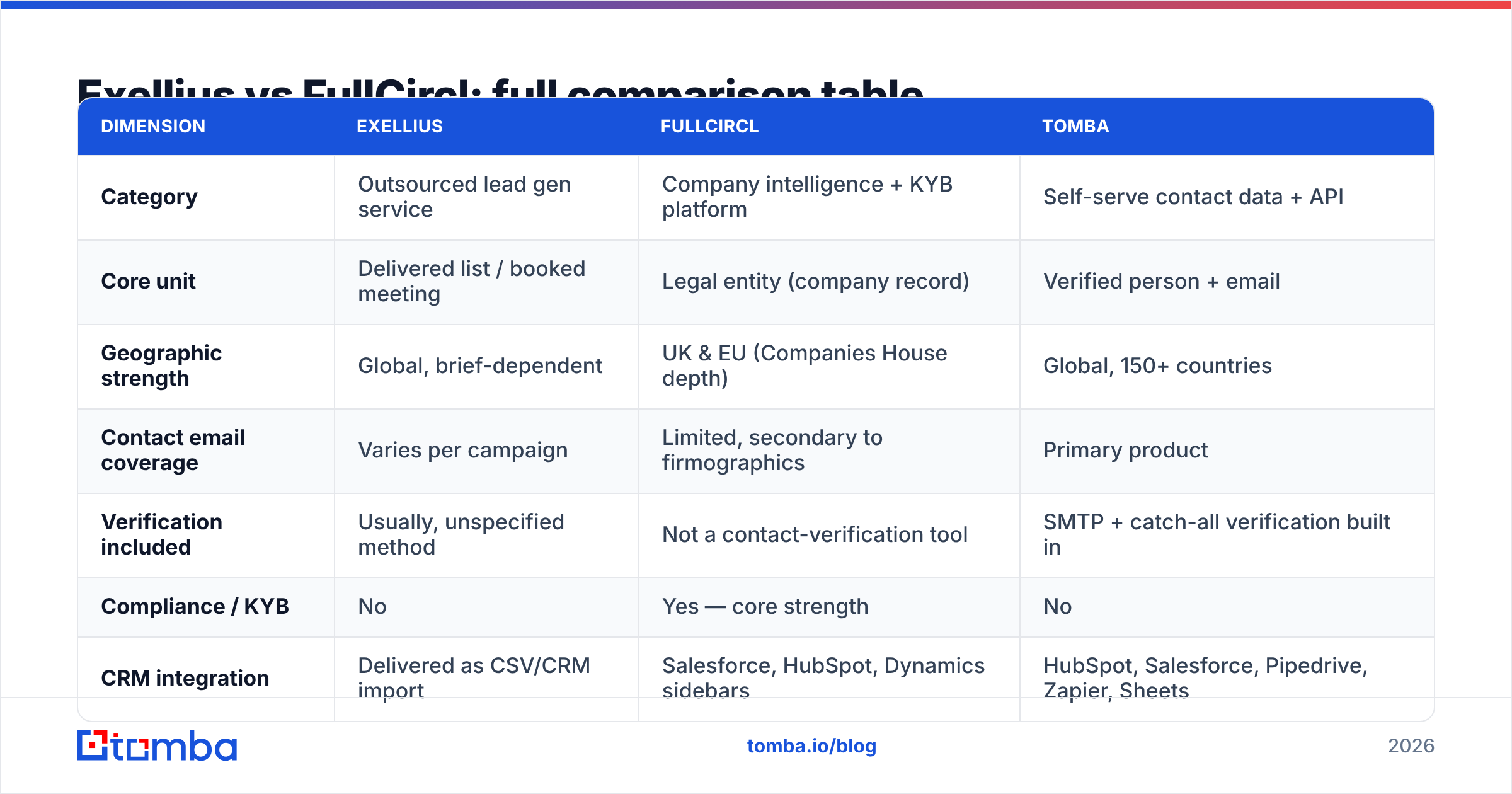
Exellius vs FullCircl: full comparison table#
| Dimension | Exellius | FullCircl | Tomba |
|---|---|---|---|
| Category | Outsourced lead gen service | Company intelligence + KYB platform | Self-serve contact data + API |
| Core unit | Delivered list / booked meeting | Legal entity (company record) | Verified person + email |
| Geographic strength | Global, brief-dependent | UK & EU (Companies House depth) | Global, 150+ countries |
| Contact email coverage | Varies per campaign | Limited, secondary to firmographics | Primary product |
| Verification included | Usually, unspecified method | Not a contact-verification tool | SMTP + catch-all verification built in |
| Compliance / KYB | No | Yes — core strength | No |
| CRM integration | Delivered as CSV/CRM import | Salesforce, HubSpot, Dynamics sidebars | HubSpot, Salesforce, Pipedrive, Zapier, Sheets |
| API access | Not a product | Yes, enterprise-tier | Yes, on every paid plan |
| Pricing model | Quote per engagement | Annual contract, sales-led | Free tier, then $49–$249/mo |
| Published pricing | No | No | Yes |
| Time to first record | Days to weeks | Days (onboarding + training) | Under 60 seconds |
| Best for | Teams with no SDR capacity | Regulated-industry revenue teams | Anyone building outbound lists in-house |
Two things jump out. First, only one of the three publishes a price you can read without a call — see Tomba pricing for the exact tiers. Second, the "best for" row barely overlaps. That is the real finding.
Which one is better for regulated industries?#
FullCircl, decisively, and it is not close.
If you are a commercial lender, an insurance broker, or a fintech onboarding SMB accounts, you have a legal obligation that a generic prospecting tool cannot touch. You need to know the entity is real, solvent, correctly registered, and not sitting behind a sanctioned owner — before your rep spends an hour on the call, and again before you onboard. FullCircl collapses that into one record: the same view the AE uses to research is the view the risk team uses to approve.
Exellius has no answer here. Neither does any contact-data vendor, including Tomba. If regulated onboarding is your bottleneck, evaluate FullCircl against Creditsafe and Dun & Bradstreet, not against lead-gen agencies. Check current buyer sentiment on G2 before you shortlist — the reviews split sharply between "indispensable for compliance" and "overkill for pure sales."
Which one is better for outbound sales?#
Neither, if you are running high-volume outbound. Here is the reasoning.
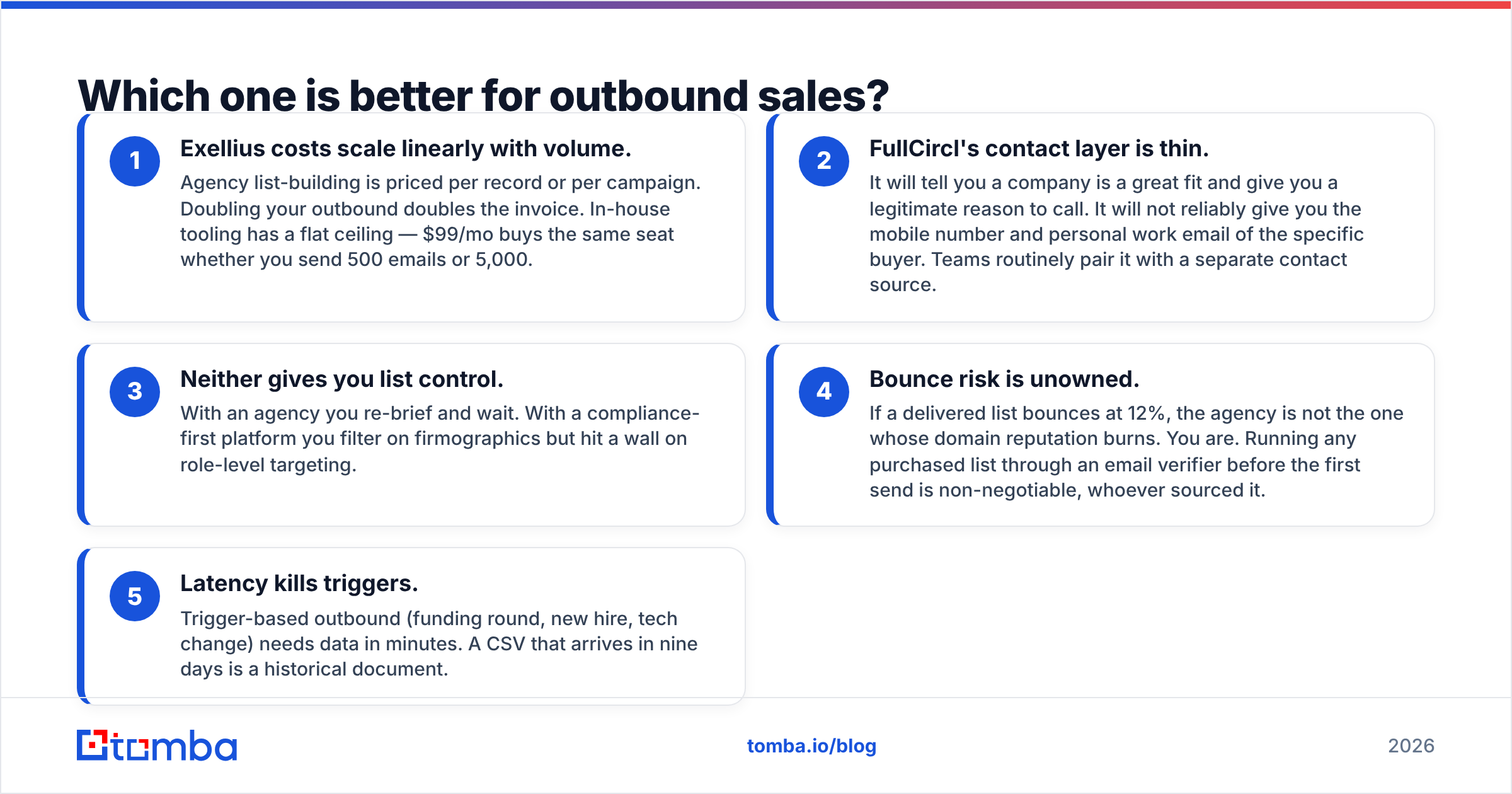
- Exellius costs scale linearly with volume. Agency list-building is priced per record or per campaign. Doubling your outbound doubles the invoice. In-house tooling has a flat ceiling — $99/mo buys the same seat whether you send 500 emails or 5,000.
- FullCircl's contact layer is thin. It will tell you a company is a great fit and give you a legitimate reason to call. It will not reliably give you the mobile number and personal work email of the specific buyer. Teams routinely pair it with a separate contact source.
- Neither gives you list control. With an agency you re-brief and wait. With a compliance-first platform you filter on firmographics but hit a wall on role-level targeting.
- Bounce risk is unowned. If a delivered list bounces at 12%, the agency is not the one whose domain reputation burns. You are. Running any purchased list through an email verifier before the first send is non-negotiable, whoever sourced it.
- Latency kills triggers. Trigger-based outbound (funding round, new hire, tech change) needs data in minutes. A CSV that arrives in nine days is a historical document.
The practical pattern that works: use a company-intelligence layer for account selection, then resolve contacts yourself via domain search and verify before sending. You keep control of the two variables that actually move reply rate — targeting precision and deliverability.
What does each one really cost?#
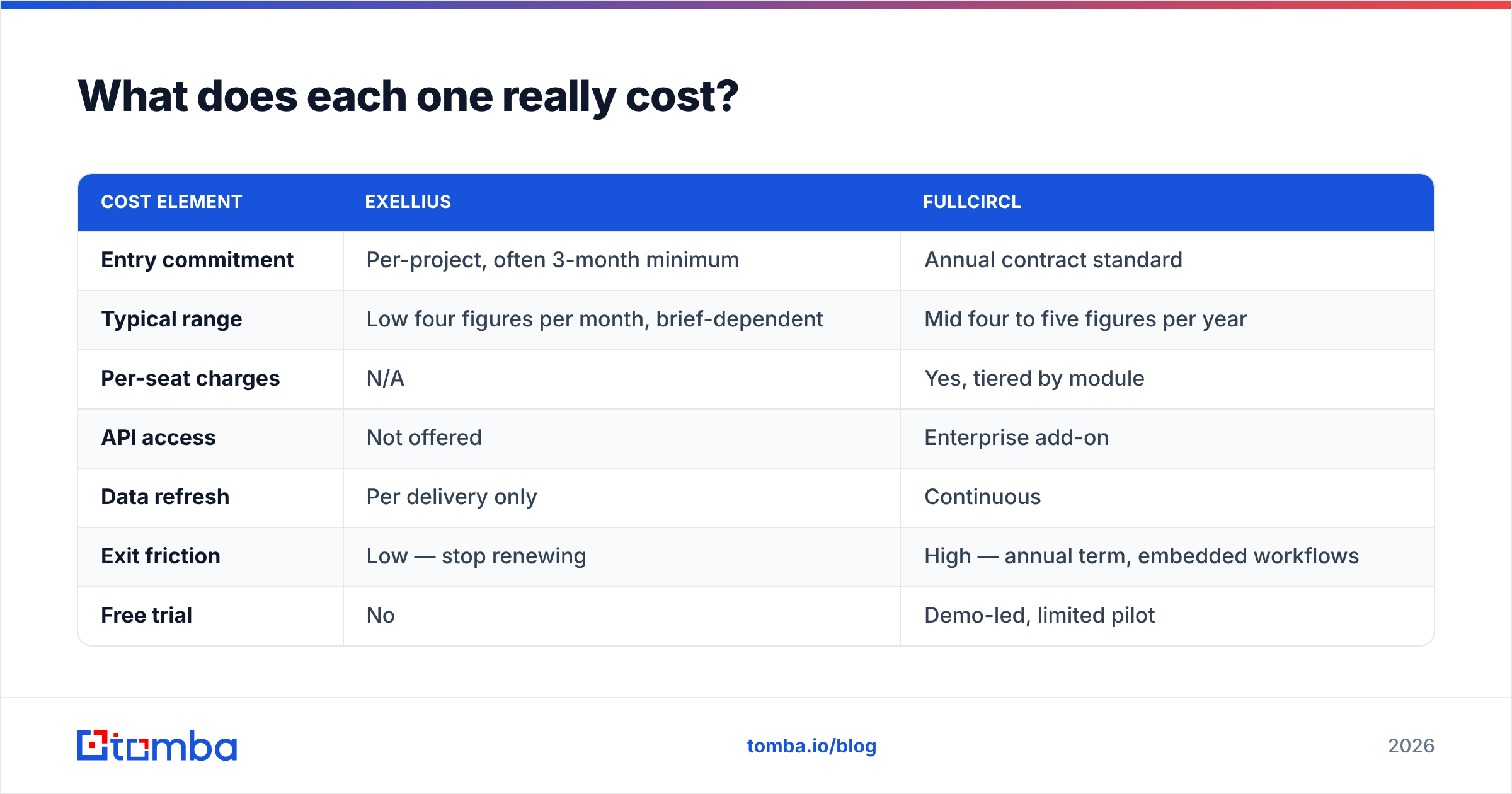
Neither publishes rates, so treat the following as directional ranges gathered from buyer reports rather than rate cards. Always get a written quote.
| Cost element | Exellius | FullCircl |
|---|---|---|
| Entry commitment | Per-project, often 3-month minimum | Annual contract standard |
| Typical range | Low four figures per month, brief-dependent | Mid four to five figures per year |
| Per-seat charges | N/A | Yes, tiered by module |
| API access | Not offered | Enterprise add-on |
| Data refresh | Per delivery only | Continuous |
| Exit friction | Low — stop renewing | High — annual term, embedded workflows |
| Free trial | No | Demo-led, limited pilot |
Compare that to a published ladder: free tier at 25 searches/month, Starter $49/mo, Growth $99/mo, Pro $249/mo, Enterprise custom. Not because cheaper is automatically better — FullCircl's compliance data genuinely justifies enterprise pricing for the right buyer — but because you can test the entire hypothesis for zero dollars before anyone signs anything. That optionality has real value when you are three weeks from a board meeting.

What are the strongest alternatives to both?#
Depending on which half of the problem you are solving:
- For company intelligence and risk (the FullCircl job): Creditsafe, Dun & Bradstreet, Bureau van Dijk. Evaluate on registry depth in your specific markets — coverage outside UK/EU varies wildly.
- For outsourced pipeline (the Exellius job): any reputable SDR-as-a-service firm, plus BookYourData if you want a pay-as-you-go verified list without an ongoing retainer. BookYourData is a solid option when you want the list-buying model but without agency lock-in.
- For self-serve contact data (the job neither does well): Tomba, Hunter, Apollo, or Findymail. Compare on verification rigor and API quality rather than raw database size — a claimed 700M contacts means nothing if a third bounce. If you are already evaluating the big platforms, our Apollo alternative and Findymail alternative breakdowns cover the trade-offs in detail.
One underrated combination: FullCircl (or a cheaper registry source) for account selection, a contact-data API for person resolution, and your own sequencer for delivery. Three specialists usually beat one generalist, and the total cost is often lower than a single all-in-one contract.
How should you run the evaluation?#
Do not compare feature lists. Run the same test against both.
Step 1 — Build a 50-account control set. Real accounts from your last two closed-won cohorts, plus 25 you wish you had. This is your ground truth.
Step 2 — Ask each vendor for those exact 50. Not their sample data. Yours. If a vendor refuses to run your list in a pilot, that tells you something about coverage.
Step 3 — Score three things. Match rate (did they find the company), contact depth (did they find the right person, by title), and accuracy (does the email actually deliver). Run every returned address through a free email checker yourself — never accept a vendor's own validity claim as evidence.
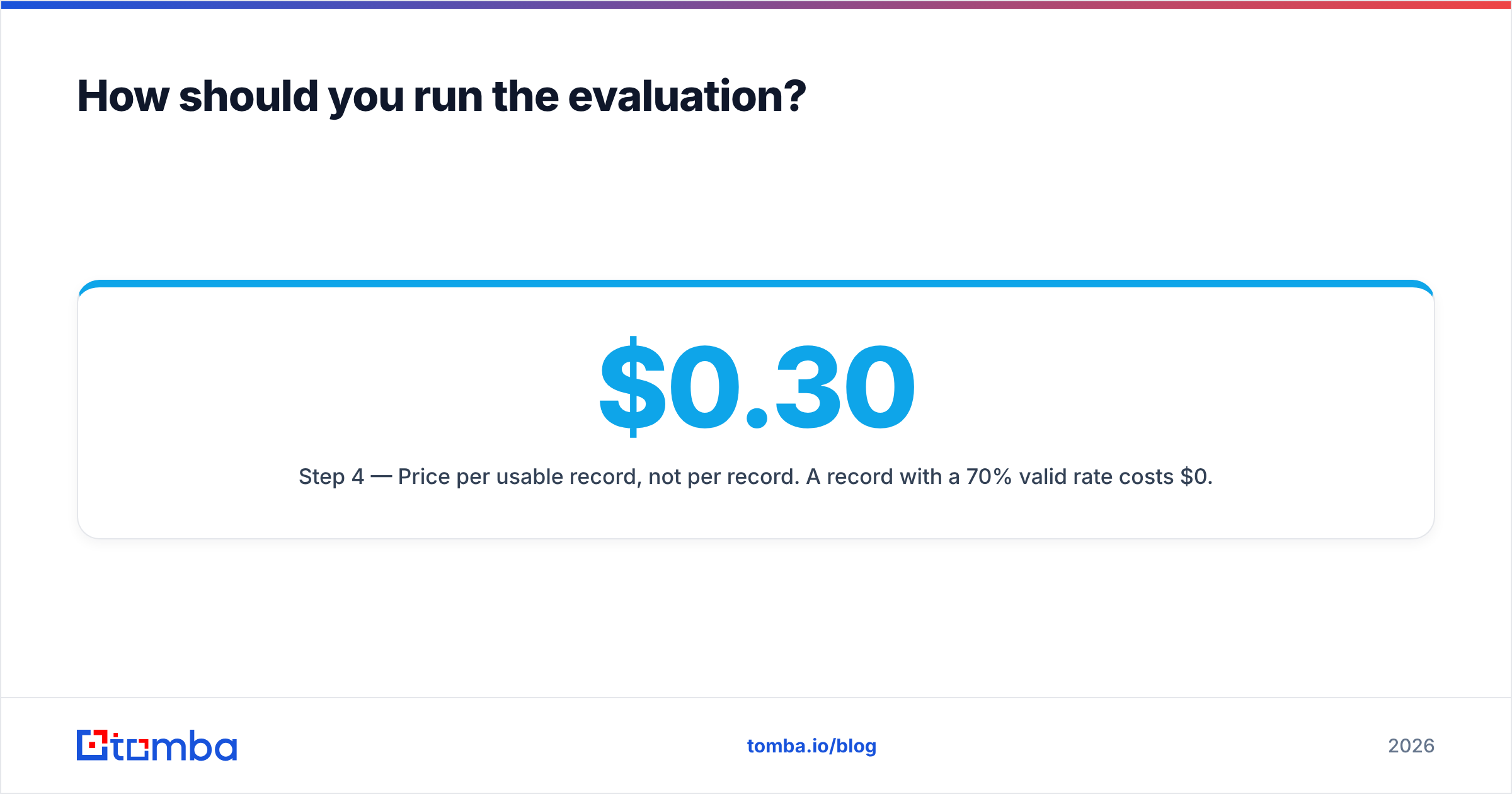
Step 4 — Price per usable record, not per record. A $0.30 record with a 70% valid rate costs $0.43 usable. A $0.50 record at 96% costs $0.52. Now compare against your quotes properly.
Step 5 — Check the exit. Can you export? Do you keep the data after cancelling? On agency engagements, who owns the list? Get the answer in writing before the annual term starts.
This takes about a week and routinely saves five figures. Most teams skip it, buy on demo polish, and rebuy in eleven months.
The verdict#
Choose FullCircl if you are a UK or EU regulated-market revenue team and your bottleneck is knowing whether an account is real, solvent, and approvable. It is a strong product in a narrow lane, and the compliance angle is a genuine moat.
Choose Exellius if you have budget but no SDR headcount and want a partner to carry the list-building and outreach load for a defined campaign.
Choose neither if your bottleneck is simply "I know who to target, I just need their verified email addresses, fast, at a predictable price." That is the most common situation of the three, and it is the one both of these vendors are structurally poor at solving.
If that last line describes you, start with the Tomba Email Finder. The free tier gives you 25 searches a month with no card, Starter is $49/mo, and every plan includes API access plus built-in verification — so you can test coverage on your own 50-account control set this afternoon rather than waiting three weeks for a scoping call. Run the test, price it per usable record, and let the numbers pick your vendor.
Related guides#
Ready to find emails that actually work?
Join 150,000+ professionals who stopped guessing and started sending. Free credits on signup — no credit card required.
Get the Tomba newsletter
Practical outbound tactics and product updates — once every two weeks.
About the author