Exellius vs Labnify (2026): Which Tool Fits Your Outbound?
Exellius and Labnify get compared constantly, but they solve opposite halves of the same problem. Here's what each actually does, what it costs, and which one belongs in your outbound stack.
TL;DR
- Exellius and Labnify are not direct competitors. Exellius sits on the data and lead-sourcing side of outbound; Labnify sits on the sending and delivery side. Comparing them head-to-head is like comparing a supplier to a delivery truck.
- If your problem is "I don't have enough qualified contacts," a sourcing tool wins. If your problem is "my emails aren't landing," a sending platform wins. Most teams misdiagnose this and buy the wrong one.
- Neither category fixes the other's failure mode. Perfect deliverability infrastructure sending to a 30% invalid list still burns your domain.
- Both vendors publish limited public pricing detail, so treat any number you see in a comparison post (including this one) as a starting point and confirm on their own sites.
- The practical 2026 setup for most SMB and mid-market teams: a dedicated finder/verifier for data, a sending platform for delivery, and a CRM in the middle — not one tool pretending to do all three.
What is Exellius and what does it actually do?#
Exellius positions itself around B2B lead generation and prospect data — the front of the funnel. The category it plays in is the one occupied by contact databases, list-building services, and enrichment providers: you describe an ideal customer profile, and the platform hands back companies and people that match, with contact details attached.
The value proposition of anything in this bucket comes down to three questions:
- Coverage — for the industries, geographies, and seniority levels you sell into, what percentage of your target accounts return a usable contact?
- Accuracy — of the emails returned, what percentage actually deliver? Anything under ~95% verified starts hurting your sender reputation.
- Freshness — B2B contact data decays roughly 25–30% per year as people change jobs. A database built in 2023 and not re-verified is not a 2026 database.
Those three numbers matter more than any feature list. A tool that returns 10,000 contacts at 70% validity is worse than one that returns 3,000 at 97%, because the bad 30% costs you domain reputation, not just credits.
What is Labnify and where does it fit?#
Labnify operates on the other end of the pipeline: email sending and delivery infrastructure. Think SMTP relay, bulk sending, campaign dispatch, and the mechanics of getting a message from your server into an inbox rather than a spam folder.
Tools in this category are judged on a completely different set of criteria:
- Throughput and cost per email — how many messages can you push per month, and what do you pay per thousand?
- IP and domain management — dedicated IPs, warmup ramps, subdomain separation between transactional and marketing traffic.
- Authentication support — SPF, DKIM, and DMARC alignment, which Google and Yahoo both made non-negotiable for bulk senders in 2024.
- Bounce and complaint handling — automatic suppression, feedback loop processing, and reporting granular enough to catch a problem before it becomes a blocklisting.
If you are evaluating Labnify against Exellius, you are almost certainly comparing a solution to one problem against a solution to a different problem. That's the single most useful thing to know before you spend money.
Are Exellius and Labnify even competitors?#
No — and the confusion is worth unpacking, because it costs teams real money.
Outbound has four distinct layers, and vendors blur the language across all of them:
- Sourcing — finding companies and people who match your ICP.
- Contact data — getting a verified email address or phone number for those people. This is where an email finder and an email verifier live.
- Sequencing — writing, scheduling, and personalizing the messages.
- Delivery — the infrastructure that physically sends them and keeps them out of spam.
Exellius targets layers 1 and 2. Labnify targets layer 4. Neither meaningfully covers the other's territory. A team that buys Labnify because "our outbound isn't working" and then discovers the real problem was a list scraped from a 2022 conference attendee PDF has bought a faster truck for spoiled cargo.
The honest diagnostic question is: when your last campaign underperformed, what actually happened?
- High bounce rate (>3%) → data problem. Buy sourcing/verification.
- Low open rate with clean bounces → deliverability or subject-line problem. Buy sending infrastructure, then fix copy.
- Good opens, no replies → targeting or messaging problem. Neither tool fixes this.
- Emails never arriving at all, even to your own test inbox → authentication problem. Check your SPF record before buying anything.
How do Exellius and Labnify compare side by side?#
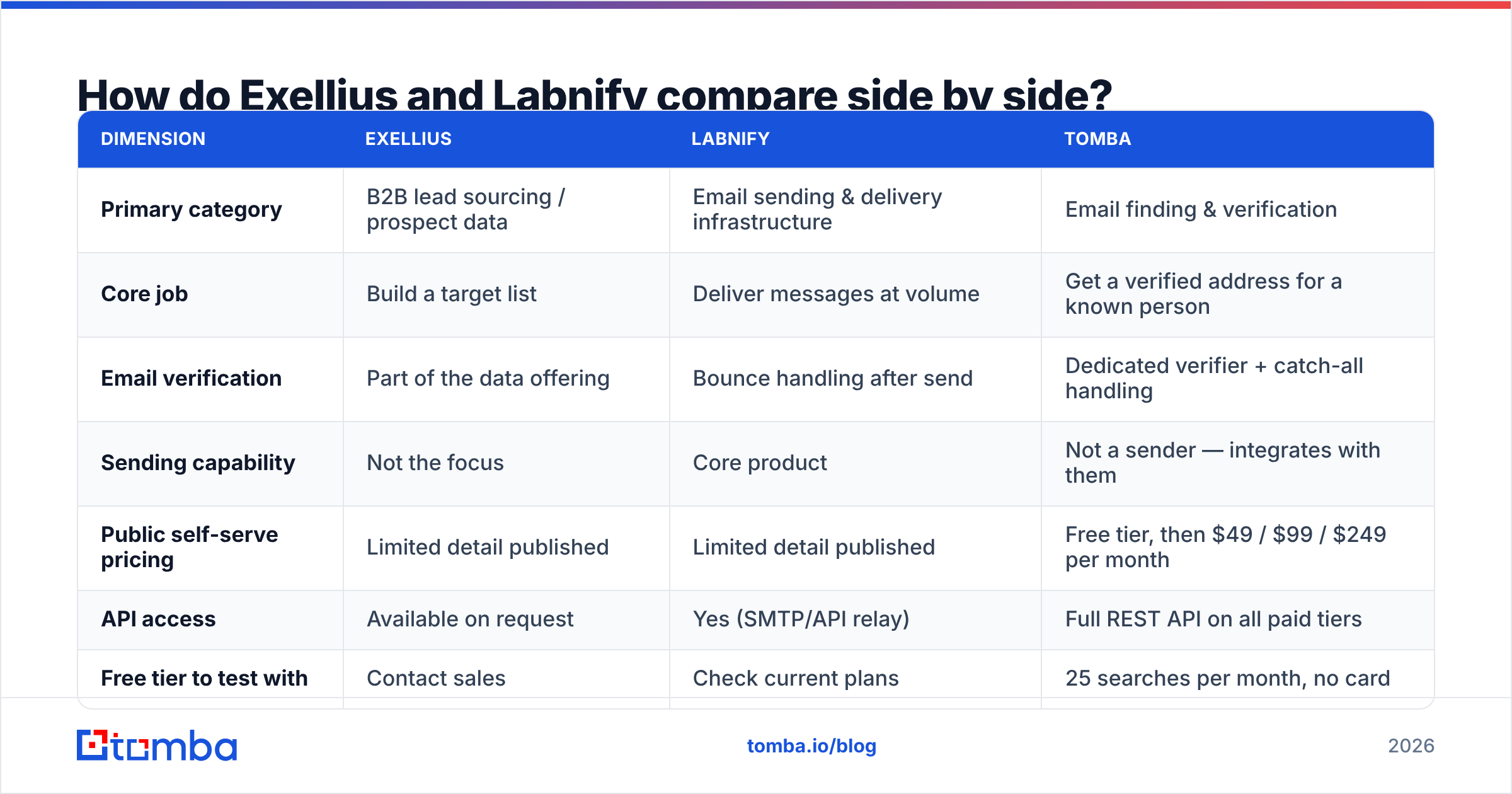
Here's the layer-by-layer breakdown. Where a vendor doesn't publish a figure openly, the cell says so rather than inventing one.
| Dimension | Exellius | Labnify | Tomba |
|---|---|---|---|
| Primary category | B2B lead sourcing / prospect data | Email sending & delivery infrastructure | Email finding & verification |
| Core job | Build a target list | Deliver messages at volume | Get a verified address for a known person |
| Email verification | Part of the data offering | Bounce handling after send | Dedicated verifier + catch-all handling |
| Sending capability | Not the focus | Core product | Not a sender — integrates with them |
| Public self-serve pricing | Limited detail published | Limited detail published | Free tier, then $49 / $99 / $249 per month |
| API access | Available on request | Yes (SMTP/API relay) | Full REST API on all paid tiers |
| Free tier to test with | Contact sales | Check current plans | 25 searches per month, no card |
| Best for | Teams with no list at all | Teams with a clean list and volume needs | Teams who know who to reach but not how |
The row that decides most purchases is the last one. If you already know your 500 target accounts and just need the right person's address at each, you don't need a database subscription or a sending platform — you need a finder. If you have a clean 50,000-record list and are sending newsletters, you don't need a finder — you need a relay.
What should you actually pay for each layer?#
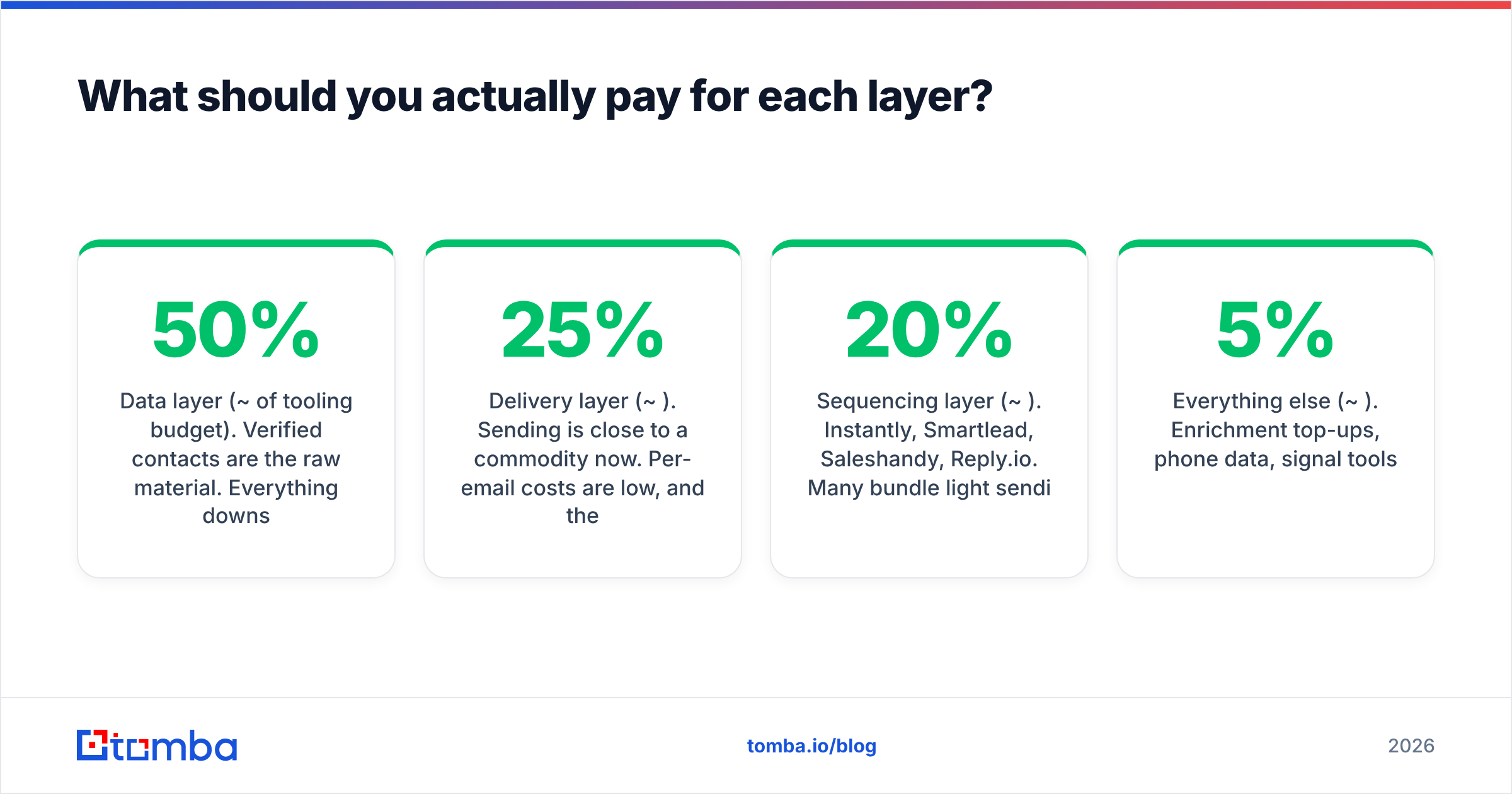
Budget allocation is where teams go wrong more often than tool selection. A useful rule from years of outbound post-mortems: spend on data first, sending second, sequencing third.
- Data layer (~50% of tooling budget). Verified contacts are the raw material. Everything downstream multiplies whatever quality you start with — including the bad quality. Tools here run $30–$300/month for SMB volumes. Tomba pricing starts free at 25 searches, then $49/mo for Starter, $99/mo for Growth, and $249/mo for Pro.
- Delivery layer (~25%). Sending is close to a commodity now. Per-email costs are low, and the differentiator is IP management and reporting, not raw throughput. Labnify, Amazon SES, Postmark, and a dozen others compete here.
- Sequencing layer (~20%). Instantly, Smartlead, Saleshandy, Reply.io. Many bundle light sending, which is why the categories blur.
- Everything else (~5%). Enrichment top-ups, phone data, signal tools.
The failure pattern is inverted: teams spend 70% on a sequencer with slick dashboards, feed it a scraped list, and blame the copy when nothing lands.
Where does data quality actually break?#
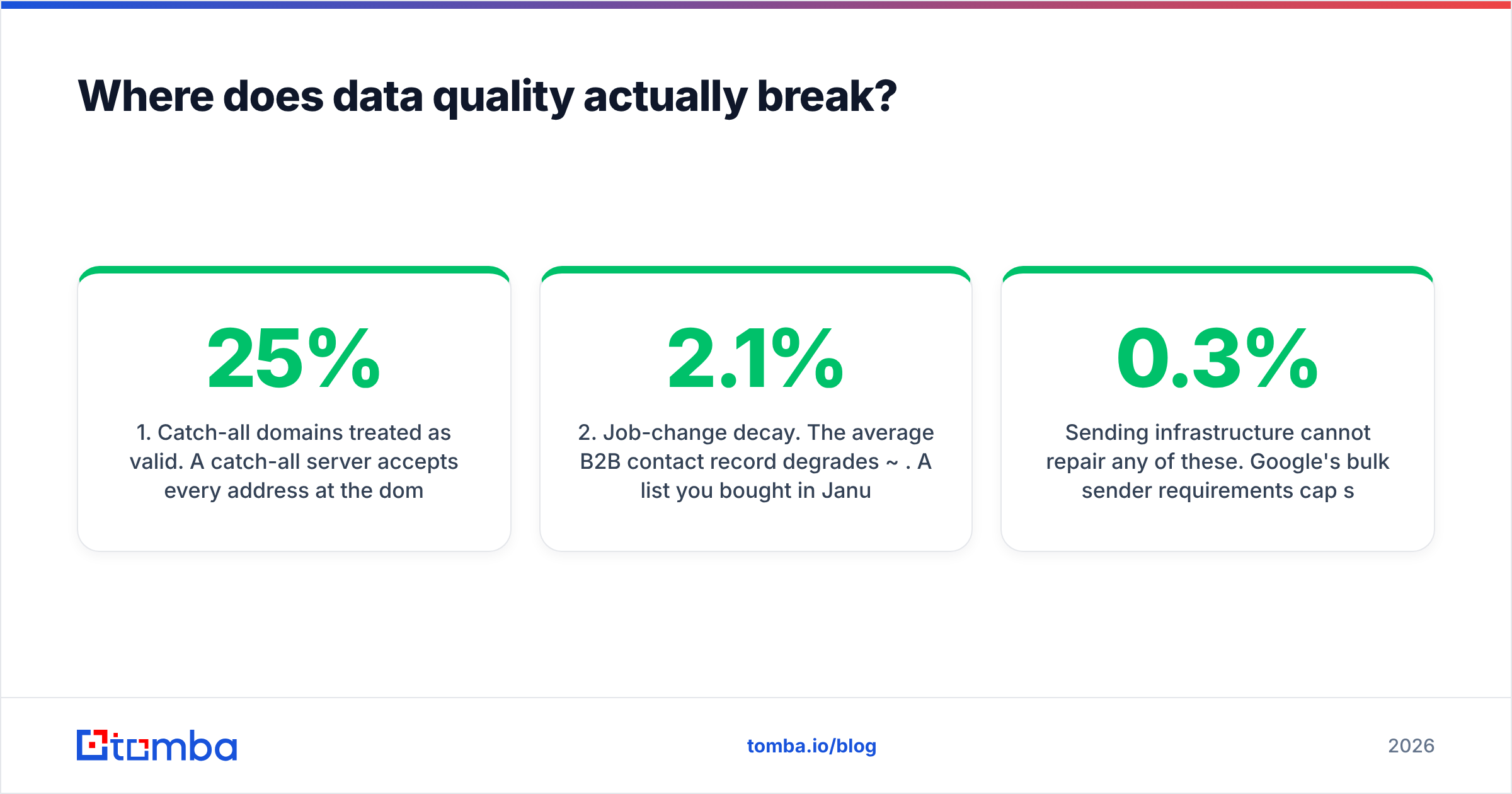
Four specific failure points cause the overwhelming majority of bounced B2B campaigns. Fix these before comparing any two vendors.
- Catch-all domains treated as valid. A catch-all server accepts every address at the domain, so a naive SMTP check returns "valid" for
asdfgh@company.com. Roughly 20–25% of corporate domains are catch-all. You need a catch-all verifier that uses pattern confidence and additional signals, not just an SMTP handshake. - Job-change decay. The average B2B contact record degrades ~2.1% per month. A list you bought in January is meaningfully worse by June. Re-verify before every major send, not once at purchase.
- Role accounts.
info@,sales@,support@deliver fine and reply almost never — while quietly dragging your engagement metrics down. Filter them out explicitly. - Pattern-guessed addresses passed off as verified. Guessing
first.last@domain.comis trivial. The question is whether the vendor confirmed it exists or just generated it. Ask directly — and check how the vendor documents its data sources.

Sending infrastructure cannot repair any of these. Google's bulk sender requirements cap spam complaints at 0.3%, and there is no relay configuration that keeps you under that threshold while you mail a list full of dead and role addresses. Deliverability is downstream of data quality — email deliverability is a symptom, not a control surface.
Which should you choose for your situation?#
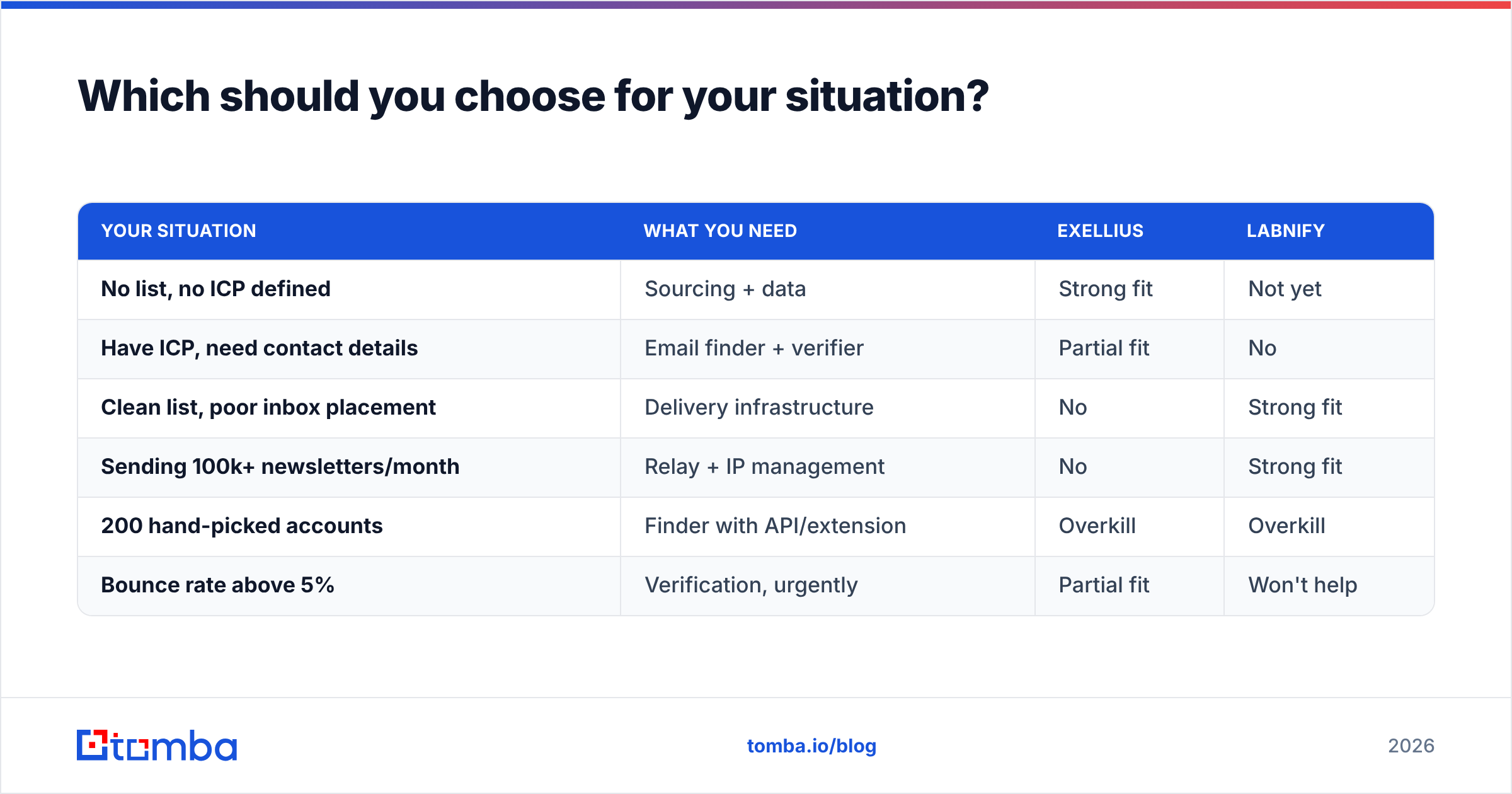
Match the tool to the bottleneck, not to the marketing site:
| Your situation | What you need | Exellius | Labnify |
|---|---|---|---|
| No list, no ICP defined | Sourcing + data | Strong fit | Not yet |
| Have ICP, need contact details | Email finder + verifier | Partial fit | No |
| Clean list, poor inbox placement | Delivery infrastructure | No | Strong fit |
| Sending 100k+ newsletters/month | Relay + IP management | No | Strong fit |
| 200 hand-picked accounts | Finder with API/extension | Overkill | Overkill |
| Bounce rate above 5% | Verification, urgently | Partial fit | Won't help |
Two extra considerations before you sign anything:
- Contract structure. Database vendors often price annually with credit commitments. Sending platforms usually price monthly per volume. If you're testing a motion that might not work, monthly beats annual even at a higher effective rate.
- Export and portability. Ask whether contacts you pull are yours to keep in your CRM after the contract ends. Some data licences say no. Check independent reviews on G2 before assuming, and read the vendor's own terms at exellius.com and labnify.com.
What does a working 2026 outbound stack look like?#
The stack that consistently outperforms a single all-in-one platform is boring and modular:
- Signal layer — job-change alerts, funding news, hiring posts, or website visitor reveal to tell you who to contact now rather than someday.
- Data layer — an email finder and verifier with API access so enrichment runs automatically rather than as a manual CSV chore. Bulk jobs go through a bulk email finder rather than one lookup at a time.
- CRM — the single source of truth. HubSpot's own sales tooling documentation is a reasonable reference for how the handoffs should be structured.
- Sequencer — writes and schedules. Personalization tokens pull from the CRM record, not from a spreadsheet column.
- Delivery — the relay or sending platform, with SPF/DKIM/DMARC aligned on a dedicated sending subdomain, warmed properly before volume.
Exellius plugs into slot 2. Labnify plugs into slot 5. They coexist. The teams asking "Exellius vs Labnify" are usually asking the wrong question — the right one is "which slot in my stack is currently empty, and what's the cheapest way to fill it well?"
One caveat worth naming: all-in-one platforms that bundle slots 2 through 5 look cheaper on a spreadsheet, and sometimes they are. The trade-off is that bundled data is usually the weakest component — the vendor competes on the sequencer UI, so the database gets the leftover engineering budget. Test the data quality of any bundle with 50 known-good contacts before you migrate your motion onto it.
The verdict#
Neither Exellius nor Labnify is the "winner," because they're not in the same race. Exellius is the right conversation if your pipeline is starving for qualified contacts. Labnify is the right conversation if you have volume to move and inbox placement problems to solve. Buying either to fix the other's problem is the most common and most expensive mistake in this comparison.
If your actual bottleneck is the middle — you know exactly who you want to reach and just need a verified, deliverable address for each of them — that's a narrower problem than either platform is built for, and it's worth solving with a dedicated tool. Tomba Email Finder does that one job: domain search, name-based lookup, and verification with catch-all handling, backed by a full API and a free tier of 25 searches a month so you can benchmark accuracy against your own known-good list before paying anyone. Start there, measure the bounce rate, and let the number decide which layer you fund next.
Related guides#
Ready to find emails that actually work?
Join 150,000+ professionals who stopped guessing and started sending. Free credits on signup — no credit card required.
Get the Tomba newsletter
Practical outbound tactics and product updates — once every two weeks.
About the author