Exellius vs Leadmine (2026): Which Lead Data Tool Wins?
Exellius and Leadmine both promise verified B2B contacts, but they solve different problems. Here is an honest breakdown of coverage, verification depth, pricing models, and which one actually belongs in your outbound stack in 2026.
TL;DR
- Exellius leans toward done-for-you B2B lead lists and outbound support — you describe an ICP, you get contacts. Leadmine is a self-serve email finder and verifier you drive yourself, credit by credit.
- If you want control, an API, and predictable per-credit economics, a self-serve finder wins. If you want someone else to build the list, a service-led vendor wins.
- Neither vendor publishes a bounce-rate guarantee that survives contact with a catch-all-heavy domain list. Verify before you send, no matter which you buy.
- Cost per usable contact matters more than sticker price. A $29 plan with 40% unverifiable rows is more expensive than a $49 plan at 95% deliverable.
- Tomba is the third option worth pricing against both: free tier at 25 searches/month, Starter at $49/mo, and a verifier plus catch-all checker bundled into the same credit pool.
What are Exellius and Leadmine?#
They get lumped together in the same search results, but they are not the same category of product.
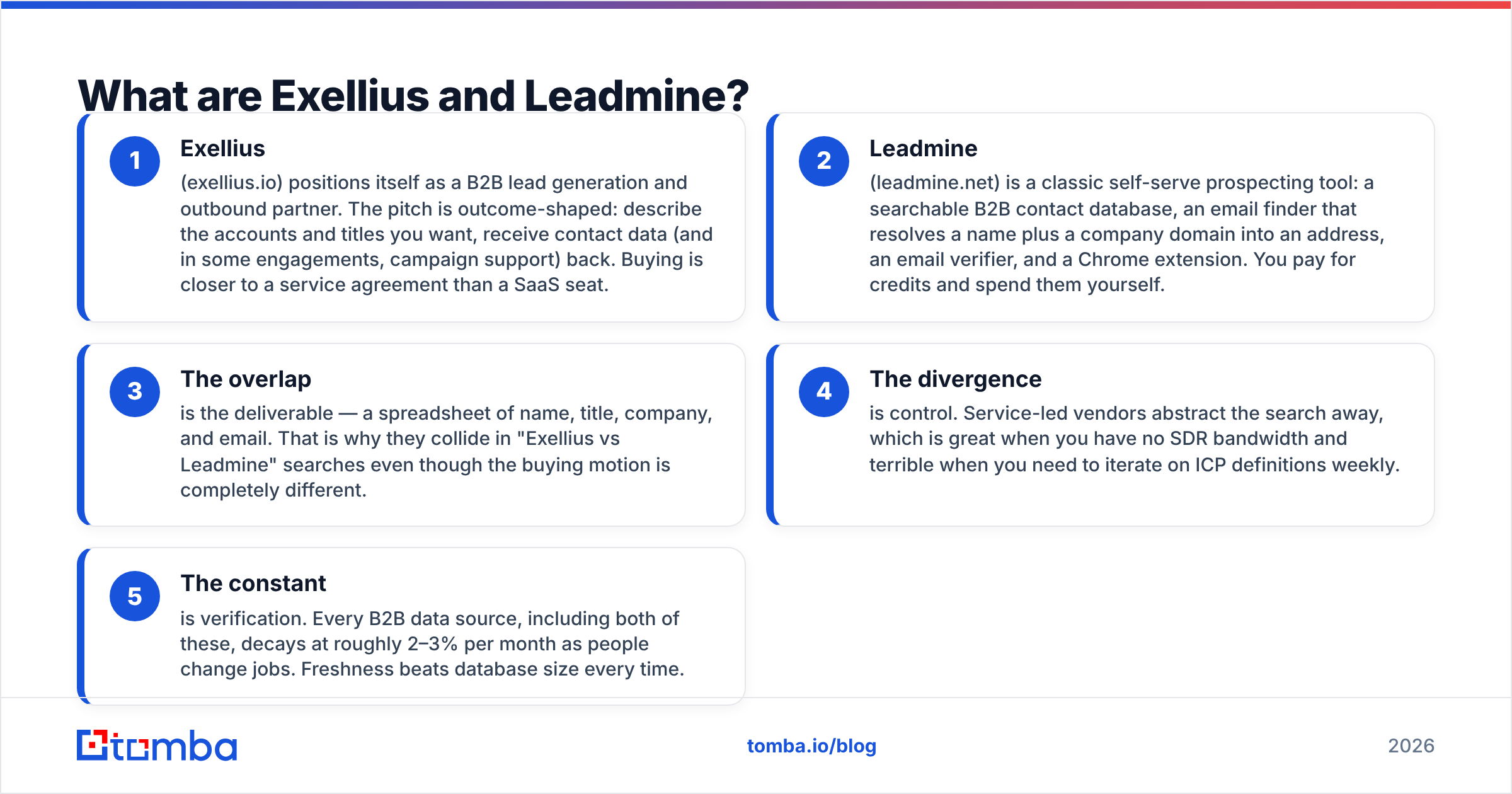
- Exellius (exellius.io) positions itself as a B2B lead generation and outbound partner. The pitch is outcome-shaped: describe the accounts and titles you want, receive contact data (and in some engagements, campaign support) back. Buying is closer to a service agreement than a SaaS seat.
- Leadmine (leadmine.net) is a classic self-serve prospecting tool: a searchable B2B contact database, an email finder that resolves a name plus a company domain into an address, an email verifier, and a Chrome extension. You pay for credits and spend them yourself.
- The overlap is the deliverable — a spreadsheet of name, title, company, and email. That is why they collide in "Exellius vs Leadmine" searches even though the buying motion is completely different.
- The divergence is control. Service-led vendors abstract the search away, which is great when you have no SDR bandwidth and terrible when you need to iterate on ICP definitions weekly.
- The constant is verification. Every B2B data source, including both of these, decays at roughly 2–3% per month as people change jobs. Freshness beats database size every time.
Before you compare feature grids, decide which motion you are actually buying. A team running 12 ICP experiments a quarter should not be filing list requests with a vendor. A two-person founder-led sales motion probably should not be learning a credit UI at 11pm.
How do Exellius and Leadmine compare head-to-head?#
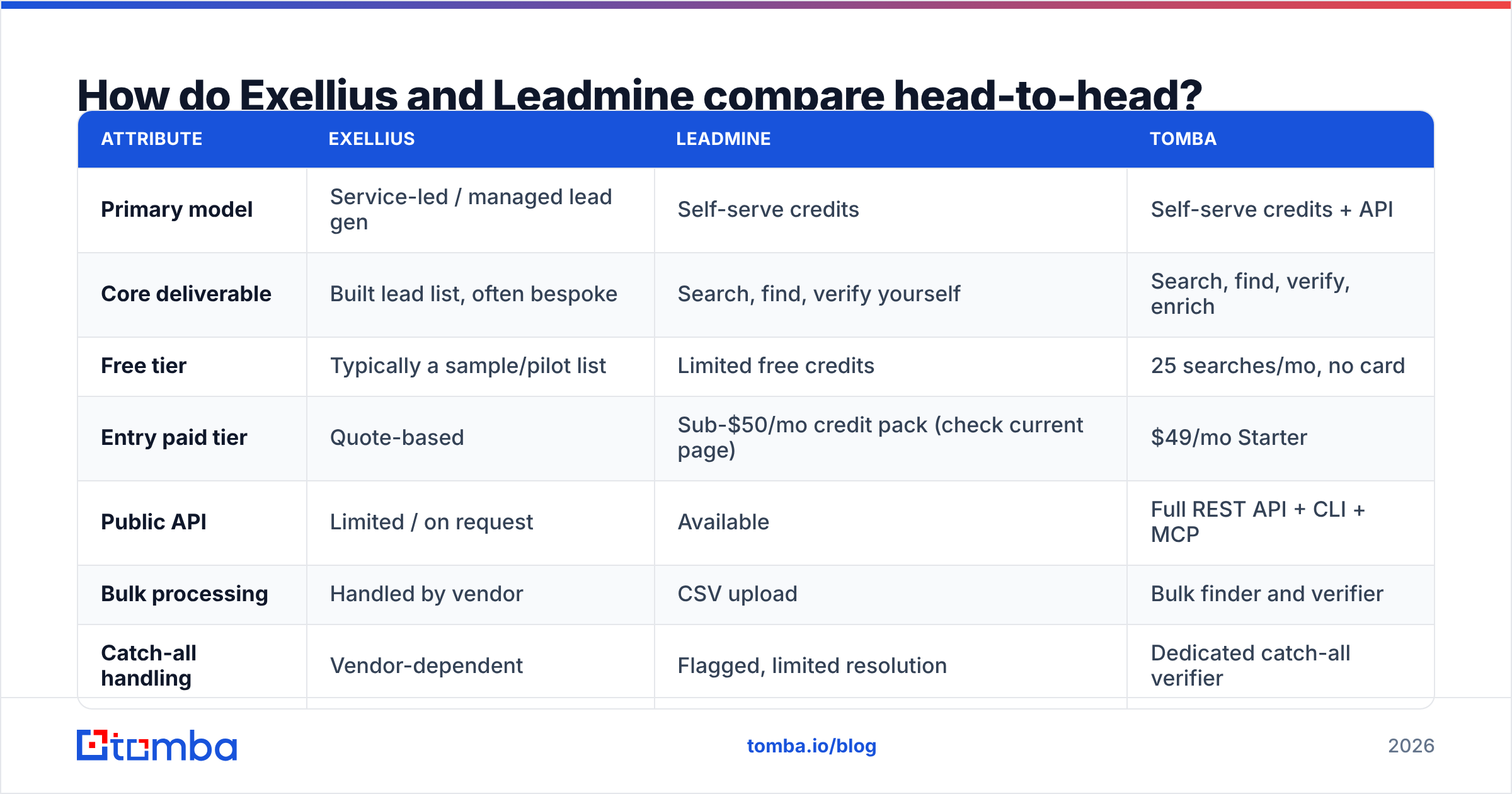
Here is the practical comparison, with Tomba included as the neutral third reference point since most buyers evaluating these two also shortlist a general-purpose email finder.
| Attribute | Exellius | Leadmine | Tomba |
|---|---|---|---|
| Primary model | Service-led / managed lead gen | Self-serve credits | Self-serve credits + API |
| Core deliverable | Built lead list, often bespoke | Search, find, verify yourself | Search, find, verify, enrich |
| Free tier | Typically a sample/pilot list | Limited free credits | 25 searches/mo, no card |
| Entry paid tier | Quote-based | Sub-$50/mo credit pack (check current page) | $49/mo Starter |
| Public API | Limited / on request | Available | Full REST API + CLI + MCP |
| Bulk processing | Handled by vendor | CSV upload | Bulk finder and verifier |
| Catch-all handling | Vendor-dependent | Flagged, limited resolution | Dedicated catch-all verifier |
| Chrome extension | No | Yes | Yes |
| Turnaround | Days (list build) | Seconds per lookup | Seconds per lookup |
| Best for | No-bandwidth teams buying outcomes | Small teams wanting cheap self-serve | Teams wanting API + verification in one stack |
Two caveats on that table. First, quote-based pricing means Exellius costs are genuinely situational — a 500-contact niche list and a 25,000-contact sweep are not the same conversation. Second, self-serve credit prices move; check the live pricing pages before you budget. Only the Tomba numbers here are fixed and public (Tomba pricing).

Which one finds more valid emails?#
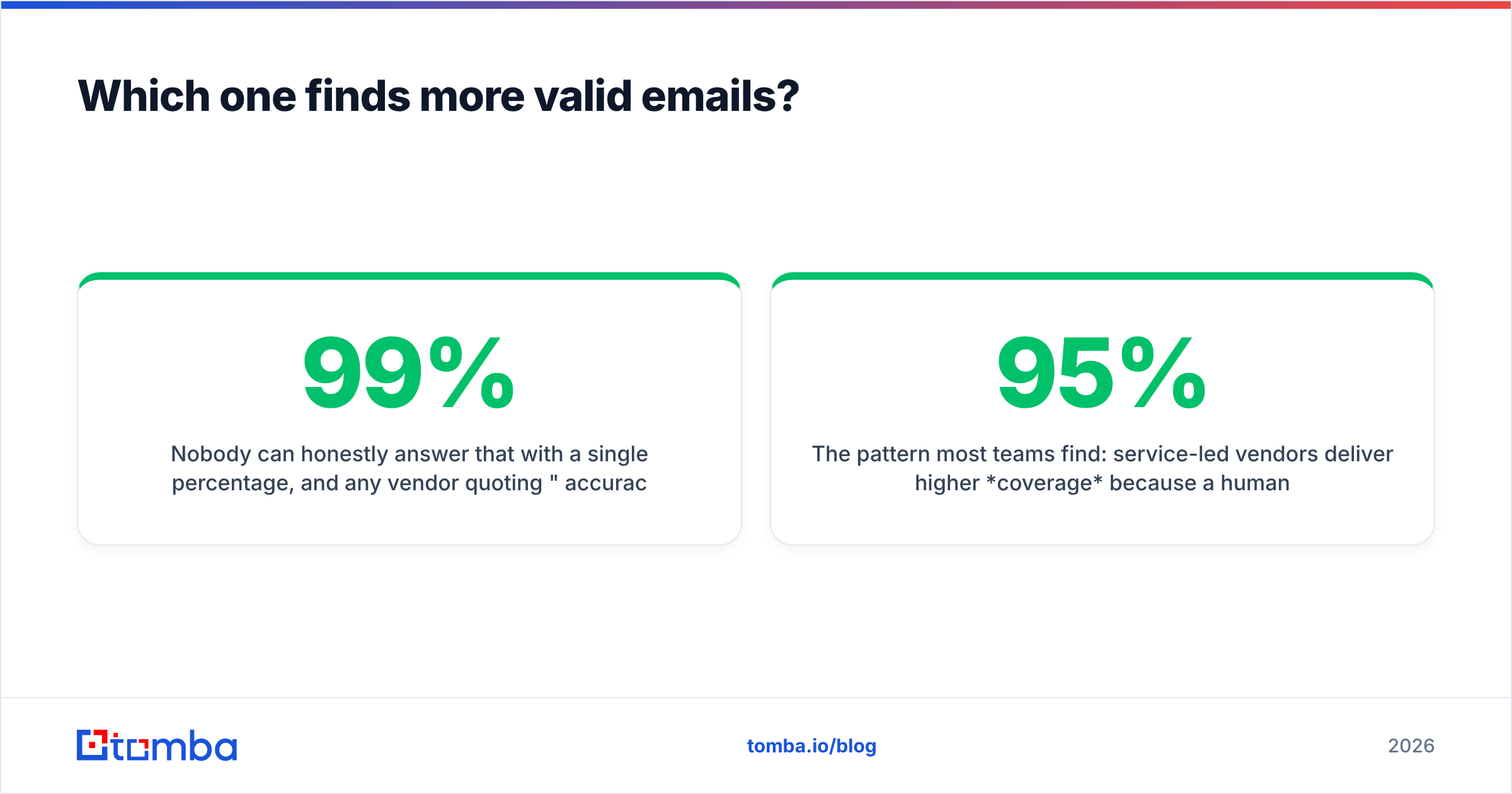
Nobody can honestly answer that with a single percentage, and any vendor quoting "99% accuracy" without defining the test set is quoting marketing, not measurement.
What you can measure is your own hit rate. Run the same 100-row control list through both:
- Coverage rate — of 100 known-good prospects, how many returned any email at all?
- Verified rate — of those, how many came back as valid rather than "accepted-all" or "unknown"?
- Bounce rate — send to a 50-address sample from each and count hard bounces after 48 hours.
- Freshness — spot-check 10 contacts against their current LinkedIn employer. Job changes are the single largest source of silent decay.
The pattern most teams find: service-led vendors deliver higher coverage because a human researcher will chase a contact your tool gave up on, while self-serve finders deliver faster iteration. Coverage without verification is a trap — a 95% coverage list at 12% bounce will torch your domain reputation faster than a 70% coverage list at 1%.

That is why the verification layer is not an optional add-on. Whichever source you pick, run the output through an email verifier before the first send. Treat the finder as a candidate generator and the verifier as the gate.
How does pricing actually compare?#
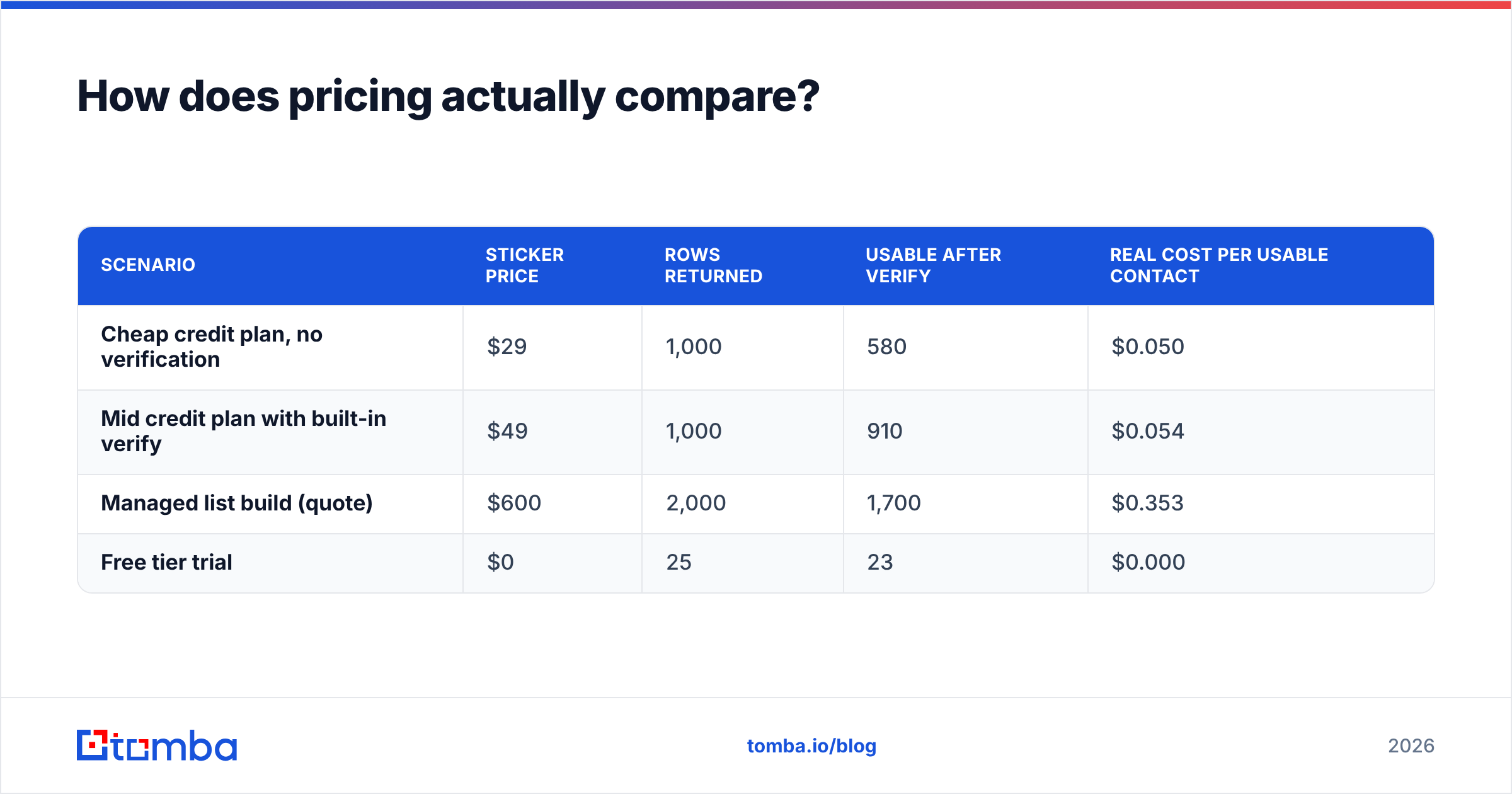
Compare cost per usable contact, not cost per credit. Here is the arithmetic that matters, using illustrative rates:
| Scenario | Sticker price | Rows returned | Usable after verify | Real cost per usable contact |
|---|---|---|---|---|
| Cheap credit plan, no verification | $29 | 1,000 | 580 | $0.050 |
| Mid credit plan with built-in verify | $49 | 1,000 | 910 | $0.054 |
| Managed list build (quote) | $600 | 2,000 | 1,700 | $0.353 |
| Free tier trial | $0 | 25 | 23 | $0.000 |
The cheap plan and the mid plan land within a rounding error of each other per usable contact — but the mid plan hands you 330 more contacts you can actually email this month, and it does not leave you paying a separate verification vendor. The managed build is 6–7x the unit cost, which is defensible only if the research is genuinely bespoke (obscure verticals, non-standard titles, hard-to-source regions) or if your team has zero hours to spend.
One line item people forget: bounced sends have a cost too. A 12% bounce rate on a 5,000-send campaign is not just 600 wasted emails, it is a measurable hit to sender reputation that suppresses inbox placement for the other 4,400.
What about catch-all domains?#
This is where most Exellius vs Leadmine comparisons quietly fall apart, and it is worth understanding before you sign anything.
A catch-all (accept-all) mail server accepts every address at the domain, valid or not. SMTP verification returns "OK" for nonsense@company.com just as happily as for the real CEO. Roughly a quarter to a third of B2B domains are configured this way, and the share skews higher in enterprise and among companies behind certain security gateways.
Three ways vendors handle it:
- Flag and pass through — the row is marked "accept-all" and handed to you as-is. Cheapest for the vendor, riskiest for you.
- Drop silently — the row never appears in your export. Your coverage looks worse than it is, and you never learn the contact existed.
- Resolve with secondary signals — pattern confidence, historical send data, and cross-source corroboration produce an actual verdict instead of a shrug.
Only the third approach lets you email catch-all domains with a straight face. If you deal with enterprise accounts, ask both vendors directly what percentage of your list came back accept-all and what they did about it. A catch-all verifier exists precisely because "accept-all" is not an answer you can build a campaign on.

Which fits your workflow?#
Pick by constraint, not by feature count.
- You have no research bandwidth and a real budget. A managed vendor like Exellius makes sense. You are buying hours back, and $0.35/contact is cheap against an SDR's fully loaded hourly rate.
- You run frequent ICP experiments. Self-serve wins outright. Waiting two days for a list build kills the feedback loop that makes outbound work.
- You need data inside a product or workflow. You need an API, full stop. Check whether the vendor exposes one before anything else — the Tomba API tier of capability (REST, CLI, spreadsheet add-ins) is the benchmark to hold others against.
- You are enriching an existing CRM list. You do not need a database at all, you need a bulk enrichment run. Upload the accounts and names you already have and resolve the missing fields with a bulk email finder.
- You are budget-constrained and testing. Start with free tiers on both, run the same 25-row control list, and let the bounce rates decide. This costs nothing and beats any blog comparison, including this one.
- Compliance matters in your market. If you sell into the EU, ask both vendors where the data came from and what the lawful basis is. "We scrape publicly available sources" is a starting point, not a compliance answer.
What do reviewers say about each?#
Public review volume is thin for both compared to the Apollo/ZoomInfo tier, so weight the reviews you do find carefully. Check G2 and comparable directories for recency — a 2023 review of a data vendor tells you very little about 2026 database freshness, because coverage is rebuilt continuously.
Signals worth more than star ratings:
- Refund and credit rollover policy. Vendors confident in their hit rate refund unverifiable rows. Vendors that are not, do not.
- How support answers a hard question. Email both and ask what percentage of a sample domain list came back catch-all. The quality of that answer is the product review.
- Whether the trial is representative. A hand-curated pilot list is not the same as what a self-serve query returns at scale.
For background on why SMTP-level checks are inherently probabilistic rather than definitive, the SMTP protocol overview is a useful primer — servers are under no obligation to tell the truth about which mailboxes exist, and many deliberately do not.
So which should you choose?#
Choose Exellius if your bottleneck is people, not tools. Bespoke research in a niche vertical, a one-off ABM list for 200 named accounts, or a team with no one to run a prospecting tool — that is where a service-led vendor earns its premium. Treat it as outsourced research, price it against headcount, and still verify the delivered file before you send.
Choose Leadmine if your bottleneck is budget and your volume is modest. A small self-serve credit plan, a Chrome extension, and a CSV export cover a founder-led motion doing a few hundred touches a month perfectly well. Just budget separately for verification, because a finder's own "valid" flag on a catch-all domain is not a verdict.
Choose neither and run a combined stack if you need finding, verification, catch-all resolution, and enrichment in one credit pool with an API behind it. That is the practical middle ground, and it is where the real cost-per-usable-contact math tends to land best.
Whichever way you go, the sequencing is the same: find candidates, verify them, resolve the catch-alls, then send. Skipping step two to save a few dollars is the most expensive decision in outbound.
Ready to benchmark the alternative yourself? Run your control list through the Tomba Email Finder — the free tier gives you 25 searches a month with no card, Starter is $49/mo, and verification plus catch-all checking come from the same credit pool rather than a second invoice. Compare the bounce rate against whatever Exellius or Leadmine returns on the identical list, and let the numbers pick your vendor.
Related guides#
Ready to find emails that actually work?
Join 150,000+ professionals who stopped guessing and started sending. Free credits on signup — no credit card required.
Get the Tomba newsletter
Practical outbound tactics and product updates — once every two weeks.
About the author